- Base Value(2025): 413.2 Bn
- Estimated Value(2026): 437.6 Bn
- Forecast Value (2036): 776.3 Bn
- CAGR (2026 - 2036): 5.9%
Fish Processing Market Forecast By Fact.MR
In 2025, the fish processing market was valued at USD 413.2 billion. Based on Fact MR analysis, demand for fish processing is estimated to grow to USD 437.6 billion in 2026 and USD 776.3 billion by 2036. FMR projects a CAGR of 5.9% during the forecast period.
The absolute dollar growth from 2026 to 2036 is USD 338.7 billion. This expansion reflects steady development in seafood processing and distribution rather than a structural shift in the global food industry. Fish processing includes freezing, canning, curing, and value added product preparation for retail and food service channels. Demand continues to rise with increasing seafood consumption, expansion of cold chain logistics, and growth in ready to cook and processed seafood products. Growth remains influenced by fluctuations in raw fish supply, regulatory controls on fishing practices, and cost pressures in processing and cold storage infrastructure.
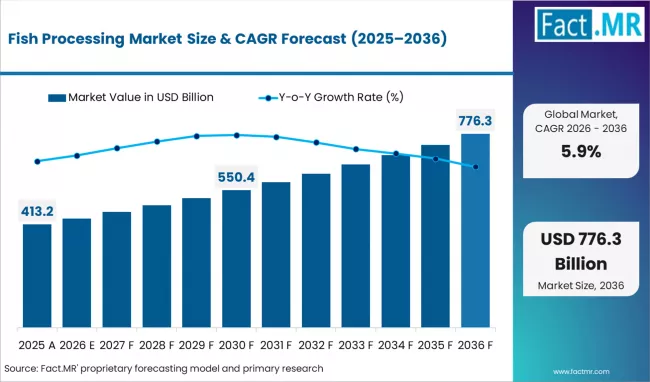
Fish Processing Market Market Value Analysis | Source: Fact.MR
Fish Processing Market
| Metric | Details |
|---|---|
| Industry Size (2026E) | USD 437.6 billion |
| Industry Value (2036F) | USD 776.3 billion |
| CAGR (2026 to 2036) | 5.9% |
Source: Fact.MR analysis. Updated Mar 25, 2026
China leads with a projected CAGR of 6.0%, supported by large scale seafood processing capacity and strong domestic consumption. India follows with a CAGR of 5.8%, reflecting growth in seafood exports and expansion of processing facilities. Indonesia records a CAGR of 5.5%, driven by abundant marine resources and increasing export oriented processing activities. The United States shows a CAGR of 4.5%, supported by steady demand across retail and food service sectors. Japan records the slowest growth at 3.9%, reflecting a mature seafood market where demand is increasingly linked to replacement consumption patterns. Mature markets generate a significant share of replacement demand as consumption stabilizes and supply constraints influence production levels.
Summary of the Fish Processing Market
- Market Definition
- The market includes industrial activities involved in cleaning, cutting, preserving, and packaging fish for human consumption and related applications. Processing methods include freezing, canning, drying, and smoking to extend shelf life and maintain product quality. These processes support distribution across retail, food service, and export markets.
- Demand Drivers
- Increasing global consumption of seafood as a primary protein source across diverse diets
- Expansion of cold chain logistics supporting storage and distribution of processed fish products
- Rising demand for ready to cook and value added seafood products in retail and food service channels
- Growth in seafood exports driven by international trade and processing capacity expansion
- Key Segments Analyzed
- Application: Food segment leads with around 75% share in 2026 supported by widespread consumption
- Source: Marine sources dominate with about 60% share due to high volume availability and supply chains
- Processing Type: Frozen and preserved products account for significant share driven by shelf life requirements
- Geography: Asia Pacific leads in production and processing, while North America and Japan maintain stable consumption demand
- Analyst Opinion at Fact MR
- Shambhu Nath Jha, Principal Consultant, Fact MR, opines, "In this updated edition of the Fish Processing Market report, industry participants will observe that demand remains closely linked to seafood consumption patterns and global trade dynamics. Processing activities are evolving toward value added products that improve convenience and shelf life. Companies that strengthen supply chain integration, processing efficiency, and compliance with food safety standards will maintain competitive positioning as demand expands through 2036."
- Strategic Implications/Executive Takeaways
- Invest in advanced processing technologies to improve efficiency and product quality
- Expand cold chain infrastructure to support distribution and export of processed seafood
- Develop value added seafood products aligned with changing consumer preferences
- Strengthen compliance with food safety and regulatory standards across global markets
- Methodology
- Primary interviews conducted with seafood processors, distributors, and food manufacturers
- Desk research based on seafood industry publications, company reports, government fisheries data, and trade statistics
- Market sizing derived using a hybrid approach combining bottom up production analysis with top down consumption assessment
- Data validation performed through cross verification with industry datasets and internal peer review aligned with Fact MR standards
Segmental Analysis
Fish Processing Market Analysis by Application
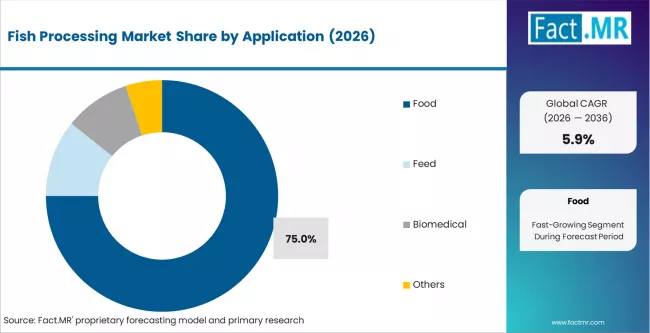
Fish Processing Market Analysis By Application | Source: Fact.MR
- Market Overview: Food applications are projected to account for around 75% share of the fish processing market by 2026. Processed fish products are widely consumed as part of daily diets across global markets, including frozen fish, canned fish, smoked products, and ready to cook seafood items. Fish processing enables preservation, extended shelf life, and convenient consumption formats for end users. Manufacturers utilize processing techniques such as freezing, drying, smoking, and canning to maintain product quality and safety. The consistent demand for protein rich food products continues to support the dominance of fish processing within food applications.
- Demand Drivers:
- Global Seafood Consumption: Fish is widely consumed as a dietary protein source, supporting demand for processed seafood products.
- Preservation Techniques: Processing methods such as freezing and canning extend shelf life and maintain product quality.
- Convenience Food Demand: Ready to cook and ready to eat fish products support consumer demand for convenient meal options.
Fish Processing Market Analysis by Source
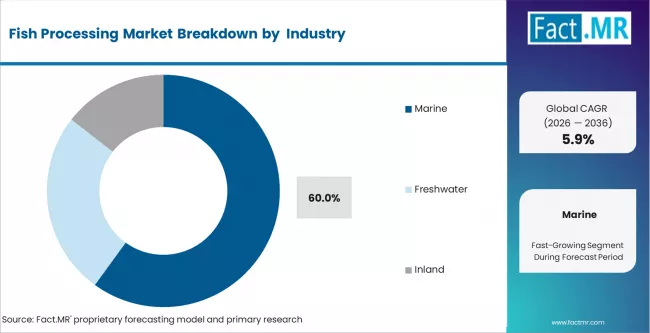
Fish Processing Market Analysis By Source | Source: Fact.MR
- Market Overview: Marine sources are expected to represent approximately 60% share of the fish processing market in 2026. Marine fish species are widely harvested from oceans and seas and processed for commercial distribution. These sources provide a diverse range of fish types used in food production, including tuna, salmon, cod, and mackerel. Marine fisheries support large scale processing operations due to the availability of high volume catch and established supply chains. Processed marine fish products are distributed through retail, food service, and export channels across global markets.
- Demand Drivers:
- Abundant Marine Supply: Oceans and seas provide large volumes of fish species that support industrial processing operations.
- Diverse Product Range: Marine sources offer a variety of fish types used in processed seafood products.
- Established Supply Chains: Marine fisheries and processing facilities support large scale distribution of processed fish products across domestic and international markets.
Fish Processing Market Drivers, Restraints, and Opportunities
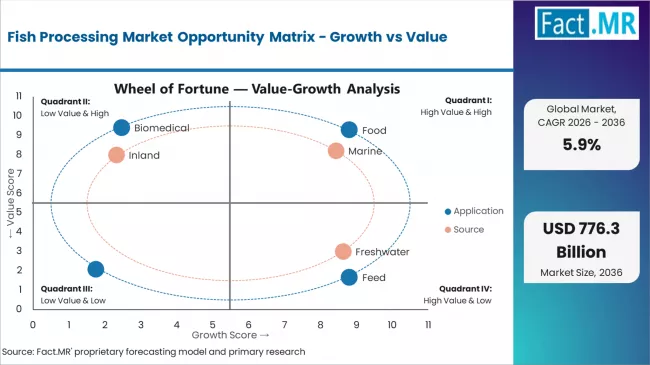
Fish Processing Market Opportunity Matrix Growth Vs Value | Source: Fact.MR
Fact MR analysis indicates that the fish processing market developed from traditional preservation and handling methods used to extend shelf life of seafood products. Early processing relied on salting, drying, and smoking techniques that enabled storage and transport across regions. The current market valuation reflects large-scale industrial processing operations that include freezing, canning, filleting, and value-added seafood production. Demand persists because processed fish products support global seafood trade, reduce spoilage, and enable distribution across long supply chains.
A structural shift is occurring as conventional bulk fish processing transitions toward value-added and convenience-oriented seafood products. Traditional frozen and canned fish remain widely consumed where affordability and long shelf life remain primary factors. Processors increasingly produce ready-to-cook, marinated, and portion-controlled seafood products that cater to changing consumption patterns. These products require additional processing, packaging, and cold chain management, which increases production costs. Even with stable raw fish supply volumes, higher pricing associated with value-added seafood products supports steady market value expansion.
- Value Added Processing: Seafood processors expand into ready-to-cook and portioned products that improve convenience and reduce preparation time for consumers.
- Food Safety Regulation: Standards such as Hazard Analysis and Critical Control Points (HACCP) and European Union seafood hygiene regulations govern processing, storage, and quality control.
- Asia Seafood Production: China, Vietnam, and Thailand maintain large fish processing industries that supply global markets with frozen, canned, and processed seafood products.
Regional Analysis
The fish processing market is assessed across North America, Europe, Asia Pacific, Latin America, and Middle East & Africa, segmented by country-level seafood production, processing capacity, and export dynamics. Regional demand reflects aquaculture output, cold chain infrastructure, and consumption patterns. The full report offers market attractiveness analysis.
.webp "Top Country Growth Comparison Fish Processing Market Cagr (2026 2036)")
Top Country Growth Comparison Fish Processing Market Cagr (2026 2036) | Source: Fact.MR
| Country | CAGR (2026-2036) |
|---|---|
| China | 6% |
| India | 5.8% |
| USA | 4.5% |
| Indonesia | 5.5% |
| Japan | 3.9% |
Source: Fact.MR analysis. Updated Mar 25, 2026
Source: Fact MR analysis, based on proprietary forecasting model and primary research
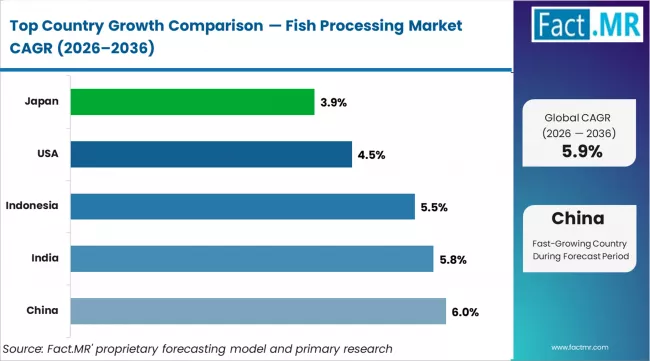
Fish Processing Market Cagr Analysis By Country | Source: Fact.MR
North America
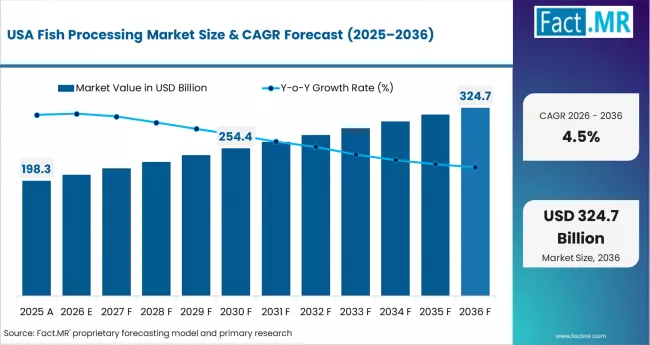
Fish Processing Market Country Value Analysis | Source: Fact.MR
North America functions as the regulated seafood processing and high-value consumption hub, supported by strict food safety standards and advanced cold chain systems. Trident Seafoods Corporation maintains a strong position in fish processing. Maruha Nichiro Corporation expands global seafood operations. Thai Union Group PCL supports international supply chains.
- USA: Demand for fish processing in USA is projected to rise at 4.5% CAGR through 2036. Growth is supported by the Seafood HACCP Regulation (U.S. FDA, ongoing), ensuring processing compliance. Trident Seafoods Corporation expanded processing capacity in Alaska (March 2023), supporting domestic production.
Asia Pacific
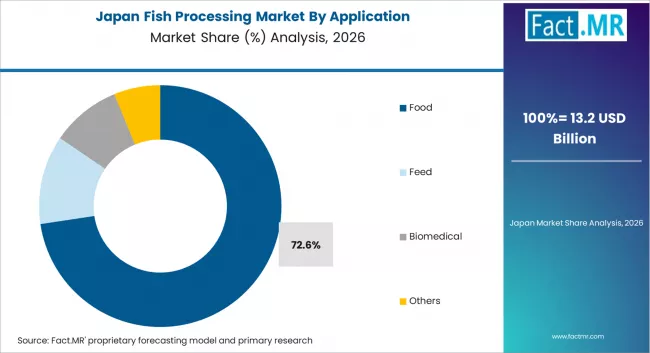
Fish Processing Market Japan Market Share Analysis By Application | Source: Fact.MR
Asia Pacific serves as the high-volume seafood production and processing market, supported by large aquaculture output and export-oriented supply chains. Chareon Pokphand Foods PCL strengthens aquaculture and processing operations. Nippon Suisan Kaisha, Ltd. advances processing technologies. PT Central Proteina Prima Tbk supports regional production.
- China: Demand for fish processing in China is projected to rise at 6% CAGR through 2036. The National Fisheries Development Plan (Ministry of Agriculture and Rural Affairs, updated 2021) supports aquaculture expansion. Chareon Pokphand Foods PCL expanded seafood processing operations in China (April 2023), supporting growth.
- India: Demand for fish processing in India is projected to rise at 5.8% CAGR through 2036. The Pradhan Mantri Matsya Sampada Yojana (Department of Fisheries, ongoing since 2020) supports fisheries infrastructure. Avanti Feeds Limited expanded processing and export capabilities (May 2023), supporting domestic growth.
- Indonesia: Demand for fish processing in Indonesia is projected to rise at 5.5% CAGR through 2036. The National Medium-Term Development Plan (BAPPENAS, updated 2020) supports fisheries sector development. PT Central Proteina Prima Tbk expanded aquaculture and processing operations (March 2023), supporting supply.
- Japan: Demand for fish processing in Japan is projected to rise at 3.9% CAGR through 2036. The Fisheries Basic Plan (Ministry of Agriculture, Forestry and Fisheries, updated 2022) supports industry modernization. Nippon Suisan Kaisha, Ltd. expanded processing technologies and facilities (January 2023), supporting market stability.
Fact MR's analysis of fish processing market in global regions consists of country-wise assessment that includes China, India, USA, Indonesia, and Japan. Readers can find aquaculture trends, processing capacity developments, regulatory frameworks, and competitive positioning across key markets.
Competitive Structure and Buyer Dynamics in the Fish Processing Market
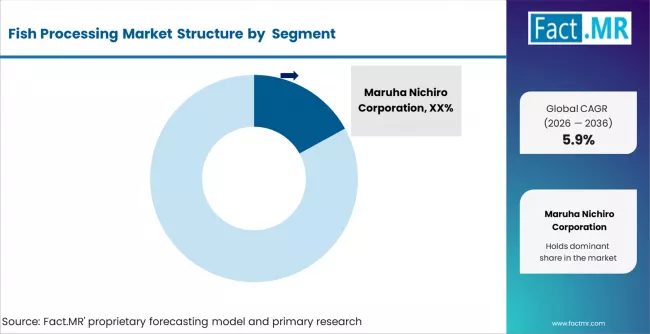
Fish Processing Market Analysis By Company | Source: Fact.MR
The competitive structure of the Fish Processing Market is moderately fragmented, with large seafood companies and regional processors operating across capture, farming, and processing activities. Companies such as Maruha Nichiro Corporation, Mowi ASA, Thai Union Group Public Company Limited, Nippon Suisan Kaisha, Ltd., and Charoen Pokphand Foods Public Company Limited maintain strong positions through integrated seafood supply chains and global distribution networks. These firms process a wide range of fish products for retail, foodservice, and export markets. Additional participants including Austevoll Seafood ASA, Lerøy Seafood Group ASA, High Liner Foods Incorporated, Trident Seafoods Corporation, and Pacific Seafood Group contribute through regional processing operations and value added seafood products. Competition is primarily influenced by product quality, processing efficiency, supply consistency, and compliance with food safety standards.
Several companies maintain structural advantages through vertically integrated operations that combine aquaculture, fishing, and processing capabilities. Firms such as Mowi ASA, Lerøy Seafood Group ASA, and Charoen Pokphand Foods Public Company Limited benefit from direct control over raw material sourcing and production processes. Large processors such as Thai Union Group Public Company Limited and Maruha Nichiro Corporation maintain advantages through global procurement networks and established distribution channels. Buyers including retailers and foodservice operators often diversify suppliers to reduce dependence on a single processor and ensure supply continuity. Procurement decisions evaluate vendors based on product quality, certification standards, and delivery reliability. This purchasing behavior moderates supplier pricing leverage, while companies with integrated supply chains and consistent raw material access retain stronger negotiating influence.
Key Players of the Fish Processing Market
- Maruha Nichiro Corporation
- Mowi ASA
- Thai Union Group Public Company Limited
- Nippon Suisan Kaisha, Ltd. (Nissui Co., Ltd.)
- Charoen Pokphand Foods Public Company Limited
- Austevoll Seafood ASA
- High Liner Foods Incorporated
- Lerøy Seafood Group ASA
- Trident Seafoods Corporation
- Pacific Seafood Group
Report Scope
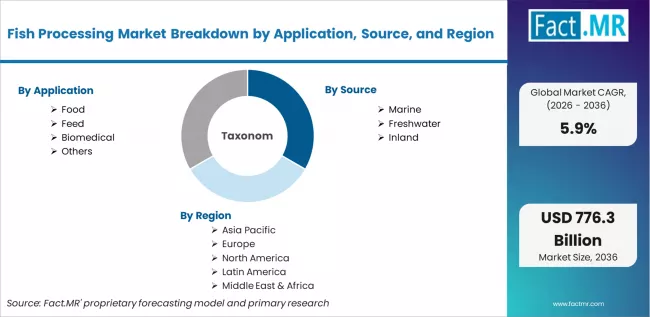
Fish Processing Market Breakdown By Application, Source, And Region | Source: Fact.MR
| Metric | Value |
|---|---|
| Quantitative Units | USD 437.6 billion (2026) to USD 776.3 billion (2036), at a CAGR of 5.9% |
| Market Definition | The fish processing market includes industrial activities involved in cleaning, cutting, preserving, packaging, and converting raw fish into consumable and value added products for food, feed, and biomedical applications across global supply chains. |
| Source Segmentation | Freshwater, Marine, Inland |
| Application Segmentation | Food, Feed, Biomedical, Others |
| Processing Type Segmentation | Frozen, Preserved, Dried, Others |
| Equipment Segmentation | Slaughtering, Deheading and Gutting, Skinning, Scaling, Filleting, Desliming and Rinsing, Others |
| Regions Covered | North America, Latin America, Europe, East Asia, South Asia, Oceania, Middle East and Africa |
| Countries Covered | United States, Canada, Mexico, Brazil, Germany, United Kingdom, France, Italy, Spain, China, India, Japan, South Korea, Australia, and 40+ countries |
| Key Companies Profiled | Maruha Nichiro Corporation, Mowi ASA, Thai Union Group Public Company Limited, Nippon Suisan Kaisha, Ltd., Charoen Pokphand Foods Public Company Limited, Austevoll Seafood ASA, High Liner Foods Incorporated, Lerøy Seafood Group ASA, Trident Seafoods Corporation, Pacific Seafood Group |
| Forecast Period | 2026 to 2036 |
| Approach | Hybrid top-down and bottom-up market modeling supported by seafood production data, processing capacity analysis, trade flow assessment, and validation through interviews with seafood processors, distributors, and industry stakeholders. |
Source: Fact.MR analysis. Updated Mar 25, 2026
Bibliographies
- [1] Mowi ASA. (2023, November). Mowi quarterly report Q3 2023.
- [2] Press Information Bureau, Government of India. (2024, September). Blue Revolution: 4 years of Pradhan Mantri Matsya Sampada Yojana.
- [3] Avanti Feeds Ltd. (2023, July). 30th Annual Report FY 2022-23.
- [4] Trident Seafoods. (2023, December). Trident Seafoods seeks buyers for select plants and assets in Alaska.
- [5] State Council Information Office of China. (2023, October). Development of China's distant-water fisheries.
- [6] Avanti Feeds Ltd. (2024, July). 31st Annual Report 2023-24.
- [7] Mowi ASA. (2023). Mowi integrated annual report 2023.
This Report Addresses
- Market size estimation and revenue forecasts for the Fish Processing Market from 2026 to 2036, supported by seafood production data and processed food consumption trends.
- Growth opportunity mapping across frozen, preserved, dried, and value added fish products, reflecting demand for extended shelf life and convenience food formats.
- Segment and regional revenue forecasts covering sources, applications, processing types, equipment, and key markets including China, India, United States, Indonesia, and Japan.
- Competition strategy assessment of leading companies such as Mowi ASA, Maruha Nichiro Corporation, Thai Union Group Public Company Limited, Nippon Suisan Kaisha, Ltd., and Charoen Pokphand Foods Public Company Limited, including supply chain integration and processing capacity benchmarking.
- Regulatory impact analysis covering HACCP standards, seafood hygiene regulations, and food safety compliance frameworks influencing processing and distribution.
- Market report delivery in PDF, Excel, PPT, and interactive dashboard formats designed for production planning, supply chain management, and operational evaluation.
- Supply chain vulnerability assessments examining raw fish supply fluctuations, cold chain infrastructure costs, and regulatory controls on fishing practices impacting processing operations.
Fish Processing Market Definition
The Fish Processing Market includes activities and systems used to clean, cut, preserve, and package fish for human consumption. Processing converts raw fish into forms such as fillets, frozen products, canned fish, smoked fish, and ready to cook items. Methods include chilling, freezing, drying, smoking, and canning to extend shelf life and maintain quality. These processes are carried out by seafood processors and food companies before distribution to retail and food service channels. The primary function of fish processing is to ensure safe, stable, and convenient seafood products for consumption.
Fish Processing Market Inclusions
This report covers global and regional market sizes for fish processing with forecast analysis for the study period. The market is segmented by processing type including frozen, canned, smoked, dried, and fresh processed fish. Application segments include retail consumption, food service supply, and industrial food processing. End users include seafood processing companies, distributors, and food manufacturers. The report also evaluates pricing trends, production patterns, and selected trade flow analysis across major seafood producing and consuming regions.
Fish Processing Market Exclusions
The report excludes aquaculture and fish farming activities focused on fish cultivation. Fishing operations and raw fish harvesting are not included. The scope also excludes seafood species such as shellfish and crustaceans unless processed under fish product categories. Ready to eat meals containing fish as a minor ingredient are outside the defined market scope, as the analysis focuses strictly on primary fish processing activities and products.
Fish Processing Market Research Methodology
- Primary Research: Interviews were conducted with seafood processors, distributors, food manufacturers, and supply chain stakeholders.
- Desk Research: Public information was collected from seafood industry publications, company reports, government fisheries data, and trade statistics.
- Market-Sizing and Forecasting: A hybrid model combining bottom up production analysis with top down consumption assessment across seafood markets was applied.
- Data Validation and Update Cycle: Findings were cross verified using multiple industry data sources and expert inputs, with periodic updates conducted as new production and trade data becomes available.
Segmentation
Fish Processing Market Key Segments
-
Source :
- Freshwater
- Marine
- Inland
-
Application :
- Food
- Feed
- Biomedical
- Others
-
Processing Type :
- Frozen
- Preserved
- Dried
- Others
-
Equipment :
- Slaughtering
- Deheading and Gutting
- Skinning
- Scaling
- Filleting
- Desliming and Rinsing
- Others
-
Region :
- North America
- USA
- Canada
- Mexico
- Europe
- Germany
- UK
- France
- Italy
- Spain
- Nordic Countries
- BENELUX
- Rest of Europe
- Asia Pacific
- China
- Japan
- South Korea
- India
- Australia
- Rest of Asia Pacific
- Latin America
- Brazil
- Argentina
- Rest of Latin America
- Middle East and Africa
- Kingdom of Saudi Arabia
- United Arab Emirates
- South Africa
- Rest of Middle East and Africa
- Other Regions
- Oceania
- Central Asia
- Other Markets
- North America
Frequently Asked Questions
How large is the demand for Fish Processing in the global market in 2026?
What will be the market size of Fish Processing in the global market by 2036?
What is the expected demand growth for Fish Processing in the global market between 2026 and 2036?
Which Application Segment is poised to lead global demand by 2026?
Which Company is Identified as a Leading Participant in the Fish Processing Market?
What is Driving Fish Processing Demand in the United States?
What is the United States Growth Outlook in this Report?
Why is China an Important Market for Fish Processing?
What is the China Growth Outlook in this Report?
What Factors Support Fish Processing Demand in India?
What is the India Growth Outlook in this Report?
Why is Indonesia Included in the Fish Processing Market Outlook?
What is the Indonesia Growth Outlook in this Report?
Why is Japan an Important Market for Fish Processing?
What is the Japan Growth Outlook in this Report?
What is Fish Processing and What is It Mainly Used For?
What does Fish Processing Market Mean in this Report?
What is Included in the Scope of this Fish Processing Market Report?
What is Excluded from the Scope of this Report?
What does Market Forecast Mean on this Page?
How is the Fish Processing Market Forecast Developed in this Report?
Who worked on this report


Preview the report firsthand - request a free sample
Free SampleGet the brochure for pricing and purchase details
Download PDF