- Market Value (2025): USD 1.51 Bn
- Estimated Value (2026): USD 1.59 Bn
- Forecast Value (2036): USD 2.68 Bn
- CAGR (2026-2036): 5.4%
What is the Fixed-Gear Bicycle Market forecast to be worth by 2036?
USD 1.6 billion in 2026 to USD 2.7 billion by 2036, at a CAGR of 5.4%.
- As per Fact.MR analysis, the fixed-gear bicycle market crossed a valuation of USD 1.51 billion in 2025.
- Demand will grow from USD 1.59 billion in 2026 to USD 2.68 billion by 2036.
- The market is expected to record a 5.4% CAGR between 2026 and 2036, supported by interest in simple bicycle designs and urban cycling.
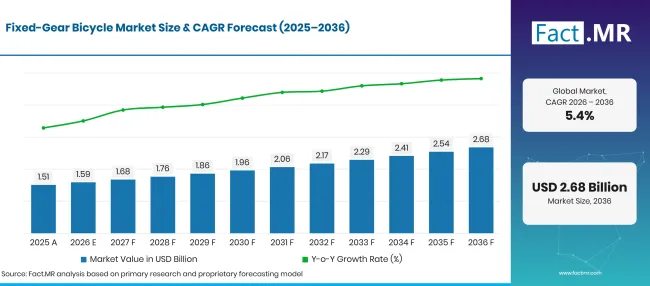
Fixed Gear Bicycle Market Forecast Global | Source: Fact.MR
| Year | Basis | Market Value (USD billion) |
|---|---|---|
| 2025 | Actual | 1.51 |
| 2026 | Estimate | 1.59 |
| 2036 | Forecast | 2.68 |
| CAGR 2026 to 2036 | Forecast period | 5.4% |
Source: Fact.MR analysis. Updated Nov 5, 2026
What are the defining numbers behind Fixed-Gear Bicycle Market growth?
USD 1.1 billion in absolute opportunity between 2026 and 2036.
- Demand Drivers in the Market
- Urban commuting interest supports demand for practical bicycle formats. Fixed-gear bicycles appeal to riders who prefer a simple drivetrain and direct pedal control. Germany's Federal Ministry of Transport reported in April 2026 that 41% of survey respondents aged 14–69 regularly used a bicycle or pedelec, while 80% identified as bicycle users in the 2025 Cycling Monitor. These statistics describe cycling generally, not fixed-gear market penetration [1].[1]
- Growing support for active mobility creates opportunities in Brazil. The Brazilian Ministry of Cities’ Bicicleta Brasil programme encourages bicycle use as an urban transport option in cities with more than 20,000 inhabitants. Such initiatives can improve the environment for urban bicycle sales, including fixed-gear models [2].
- Track cycling and cycling subcultures sustain specialist demand. Fixed-gear bicycles serve both velodrome-oriented riders and urban cycling communities. Brands such as Cinelli continue to position their Vigorelli range around track performance and fixed-gear cycling [3].
- Online retail expands access to specialist models. Digital channels allow buyers to compare frame materials, geometry, components and sizes. Online retailers can also reach customers in locations where specialist bicycle stores have limited fixed-gear inventory.
- Key Segments Analyzed
- By Product Type: Urban Bikes will account for 38.5% of the market in 2026, reflecting demand for fixed-gear bicycles designed for everyday city riding.
- By Application: Personal use will lead with a 72.4% share in 2026, supported by individual commuting and recreational purchases.
- By Distribution Channel: Online Retail is projected to hold 46.2% of the market in 2026, as digital platforms provide access to specialist models and customization options.
- By End User: Men are expected to account for 63.8% of the market in 2026 under the segmentation.
- Analyst Opinion at Fact.MR
- Shambhu Nath Jha, Principal Consultant at Fact.MR, states, “Fixed-gear bicycles occupy a distinct position between everyday urban mobility and specialist cycling. Brands that combine durable frames with practical component choices and clear product positioning can appeal to riders seeking a simple bicycle for city use or track-inspired riding.”
- Strategic Implications
- Manufacturers should offer clear distinctions between urban fixed-gear models and track-focused bicycles. Frame geometry, braking configuration and component compatibility should be explained in product specifications.
- Online retailers need to provide accurate sizing guidance and detailed component information to reduce uncertainty during online purchases.
- Specialist bicycle stores must strengthen sales by offering fitting support and explaining the differences between fixed-gear and single-speed freewheel systems.
- Brands can consider durable frames and practical braking options when positioning fixed-gear bicycles for daily commuting.
- Distributors need to maintain access to replacement components and service support, particularly for customers who use fixed-gear bicycles frequently.
Germany is projected to record a 6.0% CAGR through 2036. Brazil is set to post 5.5%, followed by the USA at 4.9%. The UK is estimated to advance at 4.4%, while Japan is forecast to grow at 3.9%.
How does the Fixed-Gear Bicycle Market break down by segment?
Fact.MR estimates that Urban Bikes will lead Product Type with a 38.5% share in 2026. Personal use will dominate Application at 72.4%, while Online Retail will account for 46.2% of Distribution Channel demand. Men are projected to represent 63.8% of the End-User segment.
Which Product Type dominates?
Urban Bikes are set to hold a 38.5% share in 2026.
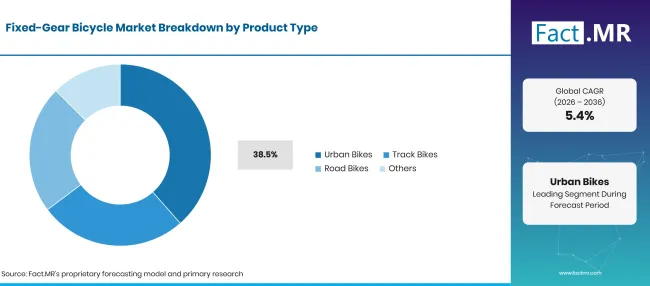
Fixed Gear Bicycle Market Breakdown Product Type | Source: Fact.MR
| Product Type | Share (2026) |
|---|---|
| Urban Bikes (Leading segment) | 38.5% |
| Other segments combined | 61.5%* |
| Total | 100.0% |
Source: Fact.MR analysis. Updated Nov 5, 2026
Urban fixed-gear bicycles are suited to riders who want a straightforward bicycle for city streets and everyday travel. Their appeal can include simple drivetrain design and a distinctive riding style. Track bikes serve riders seeking equipment designed around velodrome use or track-inspired performance. Road bikes and other models address narrower riding preferences within the market. The product categories should be defined by primary design and intended use to avoid overlap.
Which Application leads the market?
Personal use is projected to represent 72.4% of the market in 2026.
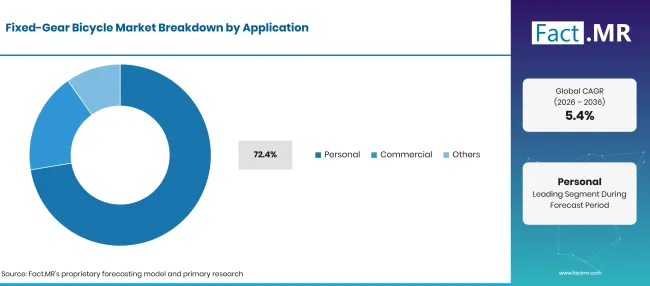
Fixed Gear Bicycle Market Breakdown Application | Source: Fact.MR
| Application | Share (2026) |
|---|---|
| Personal (Leading segment) | 72.4% |
| Other segments combined | 27.6%* |
| Total | 100.0% |
Source: Fact.MR analysis. Updated Nov 5, 2026
Personal use accounts for purchases made by individuals for commuting, leisure and recreational cycling. Fixed-gear bicycles can appeal to riders who prefer a simple drivetrain and a direct connection between pedal movement and wheel rotation. Commercial use covers bicycles purchased for business-related activities, subject to the market's classification rules. Other applications may include institutional or specialised uses.
Which Distribution Channel is gaining share?
Online Retail is set to account for 46.2% of the market in 2026.
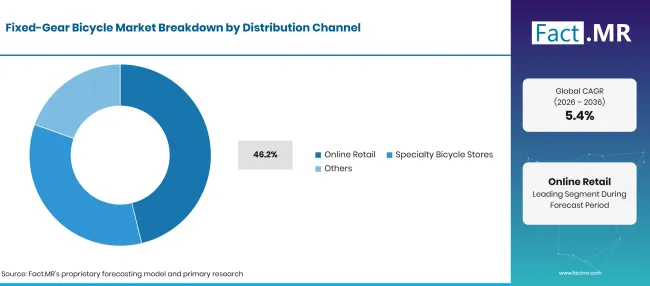
Fixed Gear Bicycle Market Breakdown Distribution Channel | Source: Fact.MR
| Distribution Channel | Share (2026) |
|---|---|
| Online Retail (Leading segment) | 46.2% |
| Other segments combined | 53.8%* |
| Total | 100.0% |
Source: Fact.MR analysis. Updated Nov 5, 2026
Online retail gives buyers access to brands and models that may not be stocked by local bicycle shops. Product pages can help customers compare frame materials, sizes and component specifications before purchasing. However, fixed-gear bicycles require careful attention to fit and setup. Specialist bicycle stores continue to provide value through test rides, assembly and maintenance support.
Which End User accounts for the largest share?
Men are projected to account for 63.8% of the market in 2026.
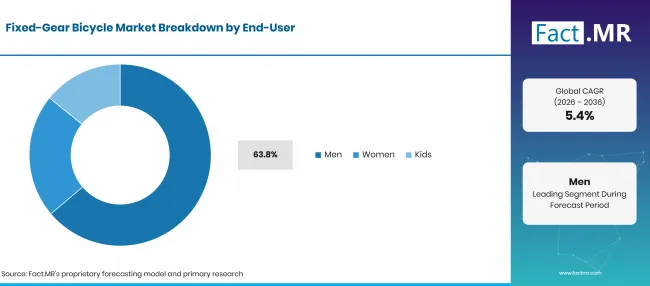
Fixed Gear Bicycle Market Breakdown End User | Source: Fact.MR
| End User | Share (2026) |
|---|---|
| Men (Leading segment) | 63.8% |
| Other segments combined | 36.2%* |
| Total | 100.0% |
Source: Fact.MR analysis. Updated Nov 5, 2026
The end-user segmentation identifies men as the largest customer group. Women and kids represent the remaining demand. Manufacturers can broaden their addressable customer base by providing a wider size range and product geometry suited to different rider requirements. The reported gender split should be interpreted as a market estimate rather than an indication that fixed-gear bicycles are inherently designed for one gender.
What is accelerating Fixed-Gear Bicycle Market growth, and what is holding it back?
Interest in urban cycling and track-inspired bicycle designs can support demand, while safety concerns and competition from geared and electric bicycles may limit wider adoption.
Drivers Impact Analysis
| DRIVER | (~) % IMPACT ON CAGR | GEOGRAPHIC RELEVANCE | IMPACT TIMELINE |
|---|---|---|---|
| Demand for simple urban commuting bicycles | +1.0% | Europe, Asia | Medium term (2–4 years) |
| Interest in fixed-gear and track-inspired cycling | +0.8% | Global | Medium term (2–4 years) |
| Growth of online bicycle retail | +0.7% | Global | Short term (≤ 2 years) |
| Cycling infrastructure and active mobility programmes | +0.6% | Europe, Latin America | Long term (≥ 4 years) |
| Customisation and specialist bicycle communities | +0.4% | North America, Europe | Medium term (2–4 years) |
Source: Fact.MR analysis. Updated Nov 5, 2026
Opportunity Impact Analysis
| OPPORTUNITY | (~) % IMPACT ON CAGR | GEOGRAPHIC RELEVANCE | IMPACT TIMELINE |
|---|---|---|---|
| Affordable urban fixed-gear models | +0.8% | Asia, Latin America | Medium term (2–4 years) |
| Wider online access to specialist brands | +0.7% | Global | Short term (≤ 2 years) |
| Durable frames and practical component packages | +0.6% | Global | Medium term (2–4 years) |
| Customisation and limited-edition models | +0.5% | North America, Europe | Short term (≤ 2 years) |
| Expansion of specialist bicycle retail | +0.4% | Asia, Latin America | Long term (≥ 4 years) |
Source: Fact.MR analysis. Updated Nov 5, 2026
Restraints Impact Analysis
| RESTRAINT | (~) % IMPACT ON CAGR | GEOGRAPHIC RELEVANCE | IMPACT TIMELINE |
|---|---|---|---|
| Safety concerns and braking requirements | -0.8% | Global | Short term (≤ 2 years) |
| Competition from geared and electric bicycles | -0.7% | Europe, Asia | Medium term (2–4 years) |
| Limited suitability for varied terrain and riding conditions | -0.5% | Global | Medium term (2–4 years) |
| Specialist maintenance and component availability | -0.4% | Emerging markets | Short term (≤ 2 years) |
Source: Fact.MR analysis. Updated Nov 5, 2026
Which countries are scaling the Fixed-Gear Bicycle Market through 2036?
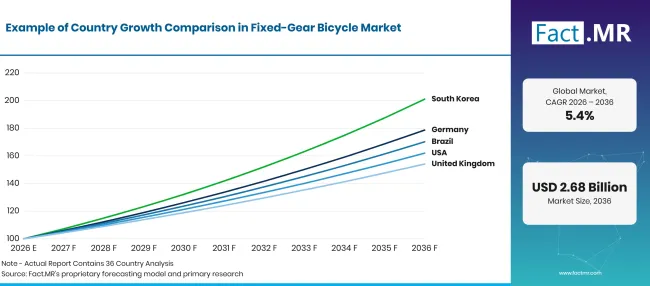
Fixed Gear Bicycle Market Growth Index | Source: Fact.MR
| Country | CAGR (2026–2036) |
|---|---|
| Germany | 6.0% |
| Brazil | 5.5% |
| USA | 4.9% |
| UK | 4.4% |
| Japan | 3.9% |
Source: Fact.MR analysis. Updated Nov 5, 2026
What supports Germany's market growth?
6.0% CAGR, supported by established cycling participation and a sizeable bicycle market.
Germany's cycling ecosystem continues to expand through investments in cycling infrastructure and the growth of bicycle tourism. According to a study published by the Federal Ministry of Transport in November 2026, the country's nationally marketed cycling route network has expanded to 320 routes covering more than 100,000 kilometres. Cycling tourism generated approximately €18.1 billion in gross revenue in 2025, with 319.3 million cycling-related visitor days recorded during the year [10]. The Federal Ministry of Transport also reports that around 80% of German households own at least one bicycle [11]. These developments support demand across different bicycle categories and create opportunities for specialist formats such as fixed-gear bicycles.
How is Brazil developing its fixed-gear bicycle market?
5.5% CAGR, shaped by active mobility programmes and interest in bicycle-based urban transport.
Brazil's urban mobility investment programmes are creating opportunities for the development of cycling infrastructure and bicycle-sharing services. In 2026, the Ministry of Cities included public bicycle-sharing systems and cycleways integrated with public transport under its New Growth Acceleration Programme (Novo PAC) selection for large and medium-sized cities. The initiative allows eligible municipalities and state governments to seek federal support for projects that improve urban transport connectivity [12]. These investments can strengthen the cycling ecosystem and encourage wider bicycle adoption in urban areas. Fixed-gear bicycle manufacturers can target commuters and recreational riders seeking lightweight and mechanically simple bicycles. Market development will depend on infrastructure expansion and affordability as well as the availability of maintenance services.
What supports the United States market?
4.9% CAGR, driven by specialist cycling communities and demand for urban bicycle formats.
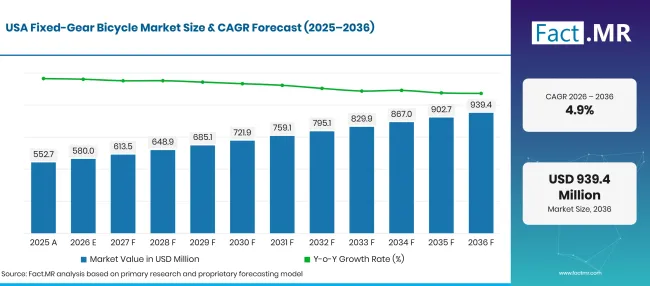
Fixed Gear Bicycle Market Forecast Usa | Source: Fact.MR
The United States has an established market for recreational and specialist bicycles. Fixed-gear models attract customers interested in urban cycling, custom builds and track-inspired designs. The 2024 American Community Survey recorded bicycle commuting as the usual travel mode for 0.4% of U.S. workers aged 16 and over [4].
How is the United Kingdom developing market demand?
4.4% CAGR, led by urban cycling and continued participation in recreational riding.
Cycling remains an established form of travel and leisure in the UK. The Department for Transport reported 3.7 billion vehicle miles travelled by cycling in 2025, an increase of 4% from 2024. Commuting accounted for 32% of cycling trips in England in 2025, while leisure represented 35% [5]. These patterns provide opportunities for urban bicycle brands, although fixed-gear adoption will depend on rider preferences and local road conditions.
What supports Japan's market development?
3.9% CAGR, backed by everyday bicycle use and government promotion of cycling.
Japan has an established bicycle culture, with bicycles used for local journeys, commuting and leisure. The Ministry of Land, Infrastructure, Transport and Tourism promotes bicycle use through measures covering cycling infrastructure, bicycle commuting and cycle tourism [6]. This policy environment can support interest in different bicycle formats. Fixed-gear models are more likely to appeal to specialist and urban cycling customers than to the broader utility-bicycle market.
Who leads the Fixed-Gear Bicycle Market?
Fact.MR profiles State Bicycle Co., Surly Bikes, Cinelli, Wabi Cycles and Fuji Bikes across the bicycle market. However, their current product-level involvement in fixed-gear bicycles differs. The strongest direct evidence among the listed names is available for State Bicycle Co., Surly and Cinelli.
State Bicycle Co. offers fixed-gear and single-speed models through its 4130 and 6061 bicycle ranges. Its official specifications page identifies the 4130 Fixed Gear / Single Speed as a current model and lists the 6061 Black Label as a fixed-gear / single-speed model [7]. Surly Bikes has a long-standing association with fixed-gear cycling through its Steamroller platform. The company describes the Steamroller as a fixed-gear commuter design. Its 2026 limited-edition offering is a frameset rather than a complete bicycle, so its current commercial availability should be distinguished from a full-bike offering [8].
Cinelli has a strong connection with track and fixed-gear cycling through its Vigorelli range. The company describes the model as a track bike associated with fixed-gear urban cycling communities. Its current official product range includes the Vigorelli frameset [9].
Competition in this market depends on product positioning, frame design and brand recognition among specialist riders. Manufacturers can differentiate through track-inspired geometry, durable frame materials and component configurations suited to urban riding. Retailers also influence purchasing decisions through sizing support, assembly and maintenance services.
How is the market segmented?
-
By Product Type
- Urban Bikes
- Track Bikes
- Road Bikes
- Others
-
By Application
- Personal
- Commercial
- Others
-
By Distribution Channel
- Online Retail
- Specialty Bicycle Stores
-
By End User
- Men
- Women
- Kids
-
By Region
- North America
- Latin America
- Western Europe
- Eastern Europe
- East Asia
- South Asia & Pacific
- Middle East & Africa
Which companies are the key providers?
Key Companies Included in the market are:
- State Bicycle Co.
- Surly Bikes
- Cinelli
- Wabi Cycles
- Fuji Bikes
Bibliography
- German Federal Ministry of Transport. (2026, April 23). Fahrrad-Monitor 2025: Wie Kinder, Jugendliche und Erwachsene Radfahren erleben.
- Ministério das Cidades. (n.d.). Programa Bicicleta Brasil.
- Cinelli. (n.d.). Vigorelli.
- U.S. Census Bureau. (2024). Means of transportation to work: 2024 American Community Survey 1-year estimates, Table B08301.
- Department for Transport. (2026, September 11). NTS 2025: Active travel. GOV.UK.
- Ministry of Land, Infrastructure, Transport and Tourism. (n.d.). 自転車活用推進本部 [Bicycle Use Promotion Headquarters]. Government of Japan.
- State Bicycle Co. (n.d.). Size charts & full specs & manuals.
- Surly Bikes. (2026, June 23). Full Metal Circle: A Steamroller story.
- Cinelli. (n.d.). Vigorelli – Frameset.
- Federal Ministry of Transport. (2026, November 2). Grundlagenuntersuchung Fahrradtourismus in Deutschland [Basic study of bicycle tourism in Germany].
- Federal Ministry of Transport. (n.d.). Radverkehr [Cycling in Germany].
- Ministério das Cidades. (2026, February 19). Mobilidade Urbana – Grandes e Médias Cidades. Government of Brazil.
This Report Answers
- The report examines demand for fixed-gear bicycles across urban, track and road-oriented product categories.
- Segment analysis compares personal and commercial applications.
- Distribution channel analysis evaluates online retail and specialist bicycle stores.
- Country analysis discusses Germany, Brazil, the USA, the UK and Japan.
- The competitive overview assesses the fixed-gear product relevance of State Bicycle Co., Surly Bikes, Cinelli, Wabi Cycles and Fuji Bikes.
What does the Fixed-Gear Bicycle Market cover?
The market covers complete fixed-gear bicycles and relevant bicycle models sold for urban riding, track cycling and related road-oriented uses. These bicycles use a drivetrain in which the rear cog remains engaged with the rear wheel, requiring the pedals to rotate whenever the wheel moves. The market analysis considers personal and commercial applications and sales through online retail and specialist bicycle stores.
What is included in the scope?
The scope includes fixed-gear bicycles sold for personal commuting, recreational cycling and track-related use.
It covers the specified product types and distribution channels. Where a bicycle is sold as a frameset rather than a complete bicycle, its treatment in market revenue estimates should follow the report's defined product boundary.
What is excluded from the scope?
The analysis excludes conventional multi-speed bicycles and single-speed bicycles that use a freewheel mechanism rather than a fixed drivetrain.
Electric bicycles, bicycle-sharing services, standalone accessories, replacement components and maintenance services are excluded unless specifically included in the market's revenue definition.
How Was the Analysis Built?
The analysis draws on 120+ sources, 35+ company portfolios, 25+ countries, and more than 20 industry interviews.
- Primary Research: Primary research includes discussions with manufacturers, service providers, technology developers, distributors, end users, and subject-matter experts. These conversations examine purchasing priorities, product adoption, operational challenges, approval requirements, competitive positioning, and the factors that influence wider market acceptance.
- Desk Research: Desk research covers government statistics, regulatory publications, company filings, trade data, technical studies, industry associations, standards, public policy, and other authoritative sources. Every source used in the analysis is documented in the bibliography.
- Market Sizing and Forecasting: Market estimates combine historical performance, demand indicators, pricing and volume trends, segment shares, company participation, country-level growth, adoption patterns, investment activity, and barriers to market expansion.
- Data Validation and Update Cycle: Findings are validated by comparing primary interviews with public data, company activity, regulatory changes, trade patterns, and industry developments. Regular updates review new product launches, capacity changes, partnerships, approvals, and shifts in commercial adoption.
Segmentation
What is the report's scope and coverage?
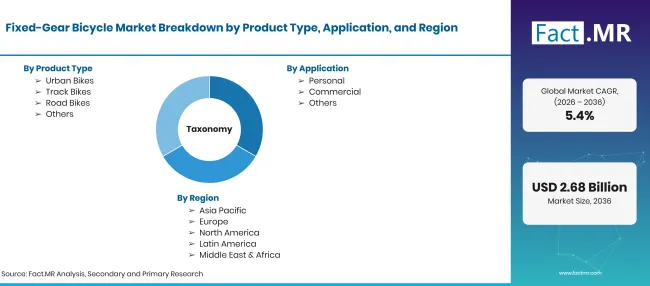
Fixed Gear Bicycle Market Taxonomy | Source: Fact.MR
| Attribute | Details |
|---|---|
| Quantitative Units | USD billion |
| Market Definition | The fixed-gear bicycle market comprises bicycles featuring a single-speed drivetrain in which the rear cog is directly connected to the rear wheel, requiring the pedals to move whenever the bicycle is in motion. These bicycles typically feature a simplified mechanical design without a freewheel mechanism and are used for urban commuting, recreational riding and track cycling. |
| Product Type | Urban Bikes; Track Bikes; Road Bikes; Others |
| Application | Personal; Commercial; Others |
| Distribution Channel | Online Retail; Specialty Bicycle Stores |
| End User | Men; Women; Kids |
| Regions Covered | North America; Latin America; Western Europe; Eastern Europe; East Asia; South Asia & Pacific; Middle East & Africa |
| Countries Covered | Germany; Brazil; USA; UK; Japan |
| Companies Profiled | State Bicycle Co.; Surly Bikes; Cinelli; Wabi Cycles; Fuji Bikes |
| Forecast Period | 2026 to 2036 |
| Approach | Market segmentation and scenario-based analysis supported by company product information and national cycling indicators |
Source: Fact.MR analysis. Updated Nov 5, 2026
Frequently Asked Questions
How big is the Fixed-Gear Bicycle Market in 2026?
What is the CAGR from 2026 to 2036?
Which product type has the largest share?
Which application leads the market?
Which distribution channel has the largest share?
Which end-user segment dominates?
Which companies are covered?
Who worked on this report


Preview the report firsthand - request a free sample
Free SampleGet the brochure for pricing and purchase details
Download PDF