- Market Value (2025): USD 2.1 Bn
- Estimated Value (2026): USD 2.2 Bn
- Forecast Value (2036): USD 3.44 Bn
- CAGR (2026-2036): 4.6%
What is the Fixed Roof Above Ground Storage Tank Market forecast to be worth by 2036?
USD 2.2 billion in 2026 to USD 3.44 billion by 2036 at a 4.6% CAGR.
- Worth USD 2.1 billion in 2025, the fixed roof above ground storage tank market drew most of its revenue from refinery, terminal and plant operators that favour established cone roof designs for atmospheric storage.
- Revenue will grow from USD 2.2 billion in 2026 to USD 3.44 billion by 2036 as petroleum infrastructure, chemical output and industrial water storage add new tank orders and replacement work.
- A 4.6% CAGR reflects a mature installed base in which renewal of ageing shells and terminal expansions, not entirely new demand, set the pace of purchases.
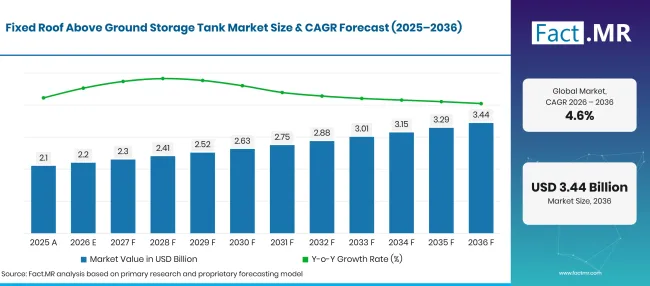
Fixed Roof Above Ground Storage Tank Market Forecast Global | Source: Fact.MR
| Year | Basis | Market Value (USD billion) |
|---|---|---|
| 2025 | Actual | 2.1 |
| 2026 | Estimate | 2.2 |
| 2036 | Forecast | 3.44 |
| CAGR 2026 to 2036 | Forecast period | 4.6% |
Source: Fact.MR analysis. Updated Nov 4, 2026
What are the defining numbers behind Fixed Roof Above Ground Storage Tank Market growth?
New value of USD 1.2 billion will be created between 2026 and 2036, led by steel cone roof tanks for oil and gas, chemical and water duties.
- Demand Drivers in the Market
- Refining capacity keeps tank fields busy. India had 267.116 million tonnes per annum of installed refining capacity as of 1 April 2026 [1]. Each refinery needs crude, intermediate and product tankage, and a large share of the atmospheric duties suit fixed roof designs.
- Water infrastructure funding is opening work for treated water and process water storage. In November 2025, the US EPA made USD 6.5 billion in WIFIA funding available to water systems and approved five new loans [2]. Utilities that use this credit often add or replace welded and bolted steel reservoirs.
- Chemical production is widening demand for dedicated tanks that hold feedstocks, intermediates and finished liquids. Plants usually keep each product in its own vessel, so a new process line brings several tanks with it.
- Emission rules are shaping tank design and lifecycle spending. The EPA’s June 2026 update of AP-42 Section 7.1 explains that fixed roof tank breathing losses come from vapour space temperature changes, while filling the tank pushes vapour out through the vents [3]. Owners respond with vent controls, reflective coatings and closer inspection schedules.
- Key Segments Analyzed
- By Product Type: Cone Roof Tanks will hold 45.2% share in 2026, since a simple roof structure keeps fabrication and erection costs down on atmospheric duties.
- By Material: Steel will account for 64.3% of 2026 value, given its load-bearing strength, weldability and wide supply of plate and fabrication skills.
- By Application: Oil & Gas will capture 38.5% of 2026 revenue, as crude handling, refining and fuel distribution each need dedicated storage.
- By Capacity: Small (Under 50,000 gallons) will command 50.7% of 2026 sales, because plants and local depots need on-site reserves without the cost of a field-erected tank.
- Analyst Opinion at Fact.MR
- Shambhu Nath Jha, Principal Consultant at Fact.MR, states, “Fixed roof tanks will stay the workhorse of atmospheric liquid storage at refineries, terminals and chemical plants through 2036. Much of the coming business will come from replacing and upgrading shells that have reached the end of their inspection life. Fabricators that combine sound weld quality, durable coatings and fast field erection will win most of these orders.”
- Strategic Implications
- Manufacturers should invest in fabrication accuracy and weld inspection, since shell defects found at hydrotest delay handover and raise project cost.
- Engineering contractors should offer erection, repair and refurbishment as one package, as many owners now tender replacement and life extension work together.
- Terminal and plant operators should match steel grade, internal lining and external coating to the stored liquid, because corrosion drives most early tank retirements.
- Investors should favour suppliers with both shop-built and field-erected ranges, which lets them serve small plant tanks and large terminal projects alike.
Germany will grow at 5.9%, helped by tank renewal at refineries that run on imported crude. The United Kingdom comes 0.4 points behind at 5.5%, as lower domestic refining pushes more product through import terminals. Japan follows at 4.8%, a 0.7-point step down, with strategic stockpiles and seismic upgrades keeping tank owners spending. Brazil reaches 4.3%, where rising offshore output feeds terminals but much new storage is still in planning. The United States closes the range at 3.7%, 0.6 points lower, because its large refinery tank base grows mainly through replacement.
How does the Fixed Roof Above Ground Storage Tank Market break down by segment?
Cone Roof Tanks will lead Product Type at 45.2%; Steel will head Material at 64.3%; Oil & Gas will lead Application at 38.5%; Small (Under 50,000 gallons) will hold Capacity at 50.7% in 2026.
Which Product Type leads?
Cone Roof Tanks take 45.2% of 2026 sales.
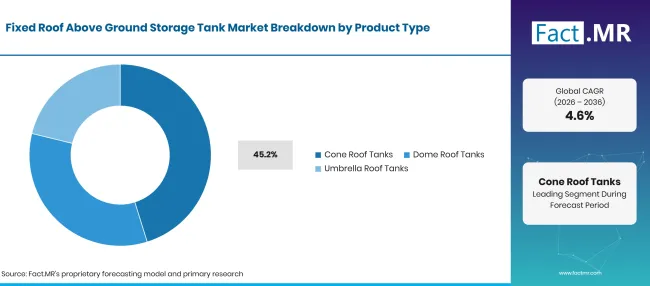
Fixed Roof Above Ground Storage Tank Market Breakdown Product Type | Source: Fact.MR
| Product Type | Share (2026) |
|---|---|
| Cone Roof Tanks (Leading segment) | 45.2% |
| Other segments combined | 54.8%* |
| Total | 100.0% |
Source: Fact.MR analysis. Updated Nov 4, 2026
Tank owners pick the cone roof when they want a proven design that most fabricators can build from standard drawings. The sloped roof sheds rain, supports itself on rafters or a centre column, and suits a wide range of diameters. Refineries, terminals and water utilities use it for crude, diesel, fuel oil and treated water. Dome roof tanks spread load more evenly and suit larger diameters or sites with heavy snow. Aluminium geodesic domes are often fitted to new or existing shells to cut corrosion and vapour losses. Umbrella roofs serve smaller tanks where a self-supporting roof simplifies the build. Products stored very cold, such as LNG, move into cryogenic storage tanks built to a different code.
What supports Steel within Material?
Steel represents 64.3% of 2026 revenue.
| Material | Share (2026) |
|---|---|
| Steel (Leading segment) | 64.3% |
| Other segments combined | 35.7%* |
| Total | 100.0% |
Source: Fact.MR analysis. Updated Nov 4, 2026
Shell and bottom plates carry heavy hydrostatic loads, and carbon steel handles them at a cost that other materials cannot match. Plate thickness, stiffening rings and coating systems can be set to fit each site. Fabricators across all five assessed countries work to common steel tank codes, which keeps sourcing simple for owners. Aluminium serves roofs and specialist tanks where low weight or particular corrosion behaviour carry more weight than price. Other materials, including stainless and lined designs, cover chemical and food duties. Most steel tanks still rely on an internal anti-corrosion coating or external paint system to reach a long service life.
How does Application shape demand?
Oil & Gas accounts for 38.5% of 2026 value.
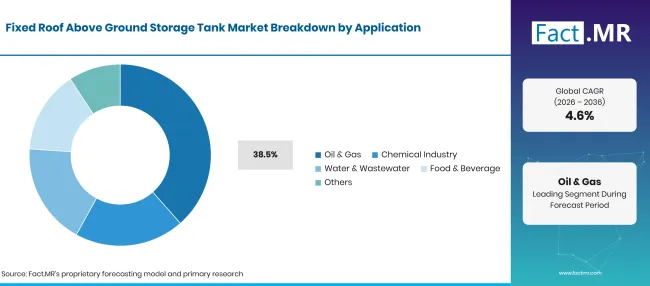
Fixed Roof Above Ground Storage Tank Market Breakdown Application | Source: Fact.MR
| Application | Share (2026) |
|---|---|
| Oil & Gas (Leading segment) | 38.5% |
| Other segments combined | 61.5%* |
| Total | 100.0% |
Source: Fact.MR analysis. Updated Nov 4, 2026
Refineries, pipeline stations and fuel depots hold crude, diesel and other petroleum liquids in dedicated tanks sized around their throughput. Fixed roof designs fit the lower vapour pressure products in this chain. Tank integrity, vapour control, corrosion resistance and inspection access shape every specification. Smaller sites often pair these tanks with portable fuel storage container units for field supply. Chemical plants use fixed roof tanks for feedstocks, intermediates and finished products. Water utilities and industrial sites rely on them for treated water and process reserves, often alongside a containment tank fleet built in bolted steel. Food and beverage producers store edible oils, syrups and process water.
Which Capacity band leads?
Small (Under 50,000 gallons) holds 48.3% of 2026 sales.
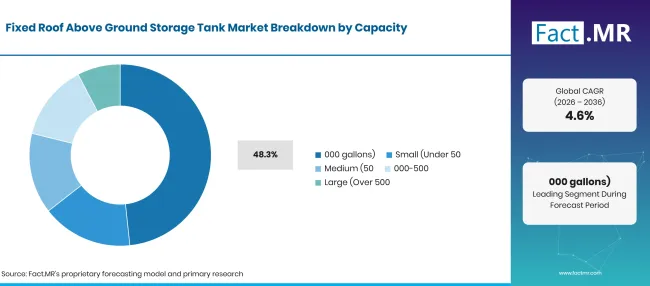
Fixed Roof Above Ground Storage Tank Market Breakdown Capacity | Source: Fact.MR
| Capacity | Share (2026) |
|---|---|
| Small (Under 50,000 gallons) (Leading segment) | 50.7% |
| Other segments combined | 49.3%* |
| Total | 100.0% |
Source: Fact.MR analysis. Updated Nov 4, 2026
Manufacturing units, farms, water facilities and local fuel distributors want liquid reserves on site without the cost of a large field-erected tank. Shop-built tanks under 50,000 gallons arrive ready to set on a foundation, which shortens installation. Medium tanks of 50,000 to 500,000 gallons serve regional depots and larger plants. Units above 500,000 gallons appear at refineries, major fuel terminals and bulk chemical complexes. At these sizes, foundation design and erection logistics need closer engineering coordination, and connected pipework often carries an FBE coating system.
What is accelerating Fixed Roof Above Ground Storage Tank Market adoption, and what is holding it back?
Refinery capacity, chemical output and water system funding keep new tank orders coming, while ageing shells feed steady replacement work. Steel construction gives owners a flexible design that scales across capacities. On the other side, high capital outlay, corrosion upkeep and stricter vapour loss controls slow some projects.
Drivers Impact Analysis
| DRIVER | (~) % IMPACT ON CAGR | GEOGRAPHIC RELEVANCE | IMPACT TIMELINE |
|---|---|---|---|
| DRIVER | (~) % IMPACT ON CAGR | GEOGRAPHIC RELEVANCE | IMPACT TIMELINE |
| Expansion and modernisation of petroleum storage infrastructure | +1.4% | Global | Short term (<=2 years) |
| Rising requirements for chemical and industrial liquid storage | +0.9% | East Asia, Western Europe, North America | Medium term (2-4 years) |
| Investment in water and wastewater storage | +0.7% | Global | Medium term (2-4 years) |
| Replacement of ageing tanks and integrity upgrades | +0.6% | Western Europe, North America, East Asia | Long term (>=4 years) |
Source: Fact.MR analysis. Updated Nov 4, 2026
Opportunity Impact Analysis
| OPPORTUNITY | (~) % IMPACT ON CAGR | GEOGRAPHIC RELEVANCE | IMPACT TIMELINE |
|---|---|---|---|
| OPPORTUNITY | (~) % IMPACT ON CAGR | GEOGRAPHIC RELEVANCE | IMPACT TIMELINE |
| Expansion of petroleum terminals and bulk liquid storage | +0.8% | Middle East & Africa, South Asia & Pacific, Latin America | Short term (<=2 years) |
| Corrosion-resistant steel tanks and protective systems | +0.6% | Global | Medium term (2-4 years) |
| Refurbishment of ageing industrial storage assets | +0.5% | Western Europe, North America, East Asia | Medium term (2-4 years) |
| Specialised chemical, food and water storage installations | +0.4% | South Asia & Pacific, Western Europe, North America | Long term (>=4 years) |
Source: Fact.MR analysis. Updated Nov 4, 2026
Restraints Impact Analysis
| RESTRAINT | (~) % IMPACT ON CAGR | GEOGRAPHIC RELEVANCE | IMPACT TIMELINE |
|---|---|---|---|
| RESTRAINT | (~) % IMPACT ON CAGR | GEOGRAPHIC RELEVANCE | IMPACT TIMELINE |
| High capital outlay and civil works requirements | -0.6% | Global | Short term (<=2 years) |
| Corrosion, maintenance and periodic inspection costs | -0.4% | Global | Short term (<=2 years) |
| Leakage and vapour emission controls | -0.3% | Western Europe, North America, East Asia | Medium term (2-4 years) |
| Competition from alternative tank designs and storage systems | -0.2% | Global | Long term (>=4 years) |
Source: Fact.MR analysis. Updated Nov 4, 2026
Which countries are scaling the Fixed Roof Above Ground Storage Tank Market through 2036?
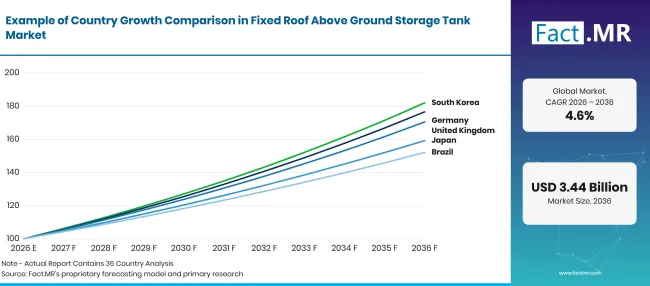
Fixed Roof Above Ground Storage Tank Market Growth Index | Source: Fact.MR
| Country | CAGR (2026 to 2036) |
|---|---|
| Germany | 5.9% |
| United Kingdom | 5.5% |
| Japan | 4.8% |
| Brazil | 4.3% |
| United States | 3.7% |
Source: Fact.MR analysis. Updated Nov 4, 2026
What supports fixed roof tank adoption in Germany?
5.9% CAGR, driven by refinery and terminal storage that handles a heavy flow of imported crude.
Germany imported 75.7 million tonnes of crude oil in 2025, with Norway, the United States and Libya as the main suppliers [4]. Every tonne passes through port and refinery tank farms before processing. Many of these tanks date from earlier decades, so replacement, recoating and roof upgrades create work for fabricators.
How is the United Kingdom scaling demand?
5.5% CAGR, backed by import terminals and stockholding duties that keep tankage in use.
UK refinery production fell to 48 million tonnes in 2025, and the country held 11.2 million tonnes of oil stocks at year end [5]. Total stocks stood at about 120 days of net imports in July 2025, above the 90-day IEA duty [6]. More product now arrives by sea, so terminal operators need sound tankage for imported fuels. Integrity upgrades at older sites add to new build work.
What supports Japan’s adoption?
4.8% CAGR, reflecting a long national focus on petroleum security and strategic stockholding.
In March 2026, METI announced the release of about 8.5 million kilolitres of national crude oil stockpiles, equal to roughly one month of supply [7]. Refilling and maintaining these reserves keeps large storage sites active. Seismic rules also push owners to upgrade older tanks.
How is Brazil developing demand?
4.3% CAGR, helped by rising crude output that needs terminal and refinery storage.
ANP data show national oil production of 4,498 thousand barrels per day in July 2026, while diesel sales averaged about 205 thousand cubic metres per day [8]. The agency’s 2026 yearbook also reports storage capacity for oil, oil products and ethanol by terminal as of 31 December 2025 [9]. Fuel distributors and terminal owners need added tankage to keep pace with these flows.
What is supporting United States adoption?
3.7% CAGR, as a mature refinery tank base grows mainly through replacement and repair.
The EIA counted 130 operable refineries with 19.16 million barrels per calendar day of atmospheric crude distillation capacity on 1 January 2026 [10]. These sites hold crude, intermediates and finished products in thousands of tanks. Federal emission rules and routine integrity checks drive recoating, roof changes and shell replacement.
Who leads the Fixed Roof Above Ground Storage Tank Market?
Three kinds of supplier meet the buyer in this market. Field-erected tank builders form the first group: CB&I, Tarsco and Toyo Kanetsu. They design and build large welded tanks on site for refineries and terminals, and win on engineering depth, safety record and the ability to field large crews. CB&I’s May 2026 contract for five LNG storage tanks in Louisiana shows the scale of its project teams, even though that cryogenic work falls outside this market [11].
Toyo Kanetsu brings decades of oil tank building and maintenance in Japan. The second group, led by CST Industries and Superior Tank Co., Inc., sells factory-welded and bolted steel tanks with aluminium dome covers for water and industrial liquids. CST released its 2025 Sustainability Report in August 2026, stressing the long service life of its products [12]. Pittsburg Tank & Tower Group and Novus Process Systems cover design, fabrication, repair and smaller above ground units. Owners will keep awarding repeat work to the fabricators whose welds pass inspection first time, whose coatings last and whose crews finish on schedule.
Which companies are the key providers?
Key companies in the Fixed Roof Above Ground Storage Tank Market include CB&I, CST Industries, Tarsco, Toyo Kanetsu, Superior Tank Co., Inc., Pittsburg Tank & Tower Group and Novus Process Systems.
- CB&I
- CST Industries
- Tarsco
- Toyo Kanetsu
- Superior Tank Co., Inc.
- Pittsburg Tank & Tower Group
- Novus Process Systems
Bibliography
- [1] Petroleum Planning & Analysis Cell. (2026, November 3). Installed Refinery Capacity.
- [2] U.S. Environmental Protection Agency. (2025, November 20). EPA Announces $7 Billion in Newly Available WIFIA Funding and Five New WIFIA Loan Approvals.
- [3] U.S. Environmental Protection Agency. (2026, June). AP-42 Section 7.1: Organic Liquid Storage Tanks.
- [4] Statistisches Bundesamt. (2026, March 9). 6,1 % der deutschen Rohöl-Importe 2025 aus dem Nahen Osten.
- [5] Department for Energy Security and Net Zero. (2026, July 30). Digest of UK Energy Statistics 2026: Chapter 3, Oil and Oil Products.
- [6] Department for Energy Security and Net Zero. (2025, December 17). Statutory Security of Supply Report 2025.
- [7] Ministry of Economy, Trade and Industry. (2026, March 24). Release of National Crude Oil Stockpiles.
- [8] Agência Nacional do Petróleo, Gás Natural e Biocombustíveis. (2026, September). Relatório Executivo ANP: Setembro 2026.
- [9] Agência Nacional do Petróleo, Gás Natural e Biocombustíveis. (2026, July 17). Oil, Natural Gas and Biofuels Statistical Yearbook 2026.
- [10] U.S. Energy Information Administration. (2026, June 26). Refinery Capacity Report: Data as of January 1, 2026.
- [11] CB&I. (2026, May 27). CB&I Awarded Contract for Five LNG Storage Tanks at Caturus’ Commonwealth LNG Facility.
- [12] CST Industries. (2026, August 27). CST is excited to share our 2025 Sustainability Report!.
This Report Answers
- How is fixed roof tank revenue divided by product type, material, application and capacity?
- Why do cone roof tanks lead, and where do dome and umbrella roofs win orders?
- What keeps steel ahead of aluminium and other shell materials?
- Which refinery, terminal and stockholding trends shape demand in Germany, the United Kingdom, Japan, Brazil and the United States?
- How do emission rules, corrosion upkeep and capital cost affect new builds and replacements?
- Which fabricators compete in field-erected, shop-built and bolted tank lines?
What does the Fixed Roof Above Ground Storage Tank Market cover?
This study tracks revenue from stationary tanks with permanently attached roofs that hold petroleum products, industrial chemicals, water, food ingredients and other compatible liquids. It counts cone, dome and umbrella roof designs built in steel, aluminium and other materials, across all applications and capacity bands.
Values are stated in USD billion at manufacturer and contractor selling price for 2026 to 2036. Roofs, vents, linings and coatings count when sold with the tank, since owners usually buy them as one package.
What is included in the scope?
Shop-fabricated and field-erected welded steel tanks with cone, dome or umbrella roofs.
Bolted steel tanks and aluminium dome covers sold with new fixed roof tanks. Tanks for crude oil, refined products, chemicals, water, wastewater and food liquids. Factory-applied linings, coatings, vents and access fittings sold with the tank.
What is excluded from the scope?
Floating roof tanks, underground tanks, pressure vessels and cryogenic storage systems.
The value of stored products such as fuels, chemicals, water and food liquids.
Foundations, independent piping networks, pumps and unrelated process equipment.
Terminal operating services and general construction work, along with inspection services outside a new tank contract and steel pipe coating work on connected lines.
How Was the Analysis Built?
The analysis draws on 120+ sources, 35+ company portfolios, 25+ countries, and more than 20 industry interviews.
- Primary Research: Primary research includes discussions with manufacturers, service providers, technology developers, distributors, end users, and subject-matter experts. These conversations examine purchasing priorities, product adoption, operational challenges, approval requirements, competitive positioning, and the factors that influence wider market acceptance.
- Desk Research: Desk research covers government statistics, regulatory publications, company filings, trade data, technical studies, industry associations, standards, public policy, and other authoritative sources. Every source used in the analysis is documented in the bibliography.
- Market Sizing and Forecasting: Market estimates combine historical performance, demand indicators, pricing and volume trends, segment shares, company participation, country-level growth, adoption patterns, investment activity, and barriers to market expansion.
- Data Validation and Update Cycle: Findings are validated by comparing primary interviews with public data, company activity, regulatory changes, trade patterns, and industry developments. Regular updates review new product launches, capacity changes, partnerships, approvals, and shifts in commercial adoption.
Segmentation
What is the report’s scope and coverage?
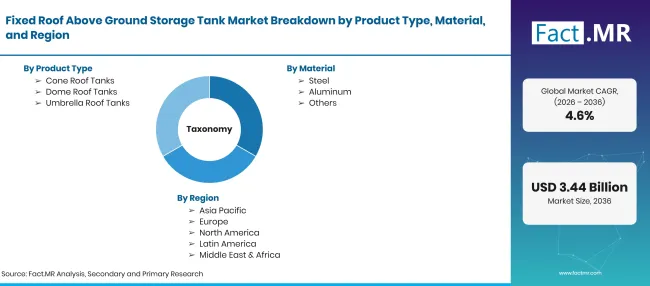
Fixed Roof Above Ground Storage Tank Market Taxonomy | Source: Fact.MR
| Attribute | Details |
|---|---|
| Quantitative Units | USD billion |
| Market Definition | Stationary above ground tanks with a permanently attached roof that store petroleum products, chemicals, water, food liquids and other industrial liquids at or near atmospheric pressure. |
| Product Type | Cone Roof Tanks; Dome Roof Tanks; Umbrella Roof Tanks |
| Material | Steel; Aluminum; Others |
| Application | Oil & Gas; Chemical Industry; Water & Wastewater; Food & Beverage; Others |
| Capacity | Small (Under 50,000 gallons); Medium (50,000 to 500,000 gallons); Large (Over 500,000 gallons) |
| Regions Covered | North America; Latin America; Western Europe; Eastern Europe; East Asia; South Asia & Pacific; Middle East & Africa |
| Countries Covered | Germany; United Kingdom; Japan; Brazil; United States |
| Companies Profiled | CB&I; CST Industries; Tarsco; Toyo Kanetsu; Superior Tank Co., Inc.; Pittsburg Tank & Tower Group; Novus Process Systems |
| Forecast Period | 2026 to 2036 |
| Approach | Installed tank bases and replacement cycles at refineries, terminals, chemical plants and water systems, checked against fabricator product ranges and country capacity data. |
Source: Fact.MR analysis. Updated Nov 4, 2026
How is the market segmented?
-
By Product Type
- Cone Roof Tanks
- Dome Roof Tanks
- Umbrella Roof Tanks
-
By Material
- Steel
- Aluminum
- Others
-
By Application
- Oil & Gas
- Chemical Industry
- Water & Wastewater
- Food & Beverage
- Others
-
By Capacity
- Small (Under 50,000 gallons)
- Medium (50,000 to 500,000 gallons)
- Large (Over 500,000 gallons)
-
By Region
- North America
- Latin America
- Western Europe
- Eastern Europe
- East Asia
- South Asia & Pacific
- Middle East & Africa
Frequently Asked Questions
How large is the fixed roof above ground storage tank market in 2026?
What growth rate will the fixed roof above ground storage tank market record?
Which product type leads?
Which material leads?
Which application leads?
Which capacity band leads?
Which country will grow quickest?
Who are the main companies?
What holds the market back?
Who worked on this report


Preview the report firsthand - request a free sample
Free SampleGet the brochure for pricing and purchase details
Download PDF