- Market Value (2025): USD 3.7 Bn
- Estimated Value (2026): USD 3.91 Bn
- Forecast Value (2036): USD 6.86 Bn
- CAGR (2026-2036): 5.8%
Flat Flame Burners Market Forecast and Outlook 2026 to 2036
The flat flame burners market is projected to grow from USD 3.91 billion in 2026 to USD 6.86 billion by 2036. Demand for flat flame burners is likely to grow at a CAGR of 5.8% over the forecast period.
Furnaces used for steel, glass and ceramics require controlled heat distribution. Flat flame burners spread combustion over a wider surface than conventional narrow-jet designs. Engineers match the burner to furnace geometry, fuel availability and permitted emissions. During replacement projects, plants may consider low-NOx performance or alternative-fuel operation. Each proposed fuel change still requires burner-specific engineering checks.
Market Highlights for the Flat Flame Burners Market
- Sales of flat flame burners stood at USD 3.7 billion in 2025
- Flat Flame Burners Market Value (2026): USD 3.91 billion
- Flat Flame Burners Market Forecast Value (2036): USD 6.86 billion
- Flat Flame Burners Market Forecast CAGR (2026-2036): 5.8%
- Leading Product Type: Gas Flat Flame Burners (42.3%)
- Companies Profiled: Honeywell Thermal Solutions, Fives Group.
- Countries Analyzed: Germany, Brazil, United States, United Kingdom, Japan
On March 25, 2024, the US Department of Energy selected 33 industrial decarbonization projects for award negotiations, representing up to USD 6 billion in potential federal funding through its Industrial Demonstrations Program. The wider investment program provides context for modernization in energy-intensive industries, including steel, cement and other process operations. Burner orders will depend on whether a facility retains fuel-fired heating and what combustion requirements its new furnace design specifies. Suppliers are responding with emission-control and fuel-flexibility options.
Flat Flame Burners Market
| Metric | Value |
|---|---|
| Estimated Value in (2026) | USD 3.91 billion |
| Forecast Value in (2036) | USD 6.86 billion |
| Forecast CAGR (2026 to 2036) | 5.8% |
Source: Fact.MR analysis. Updated Nov 19, 2026
Source: Fact.MR analysis.
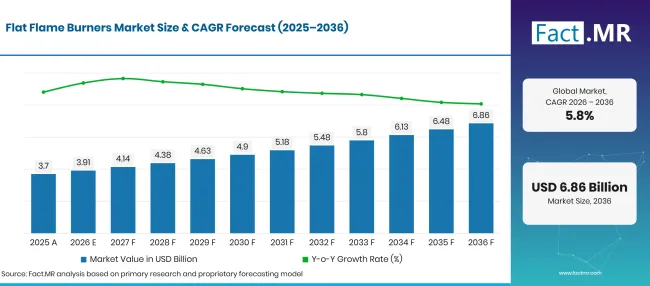
Flat Flame Burners Market Forecast Global | Source: Fact.MR
Category
| Category | Segments |
|---|---|
| Product Type | Gas Flat Flame Burners, Oil Flat Flame Burners, Dual Fuel Flat Flame Burners |
| Application | Industrial Furnaces, Boilers, Kilns, Others |
| End-User Industry | Metallurgy, Chemical, Glass, Ceramics, Others |
| Region | Germany; Brazil; United States; United Kingdom; Japan |
Source: Fact.MR analysis. Updated Nov 19, 2026
Source: Fact.MR analysis.
Segmental Analysis
Why do gas flat flame burners lead product demand in the Flat Flame Burners Market?
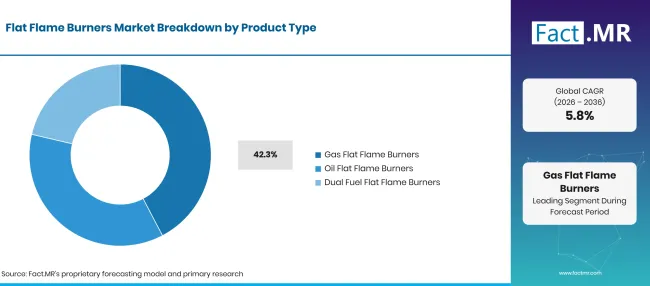
Flat Flame Burners Market Breakdown Product Type | Source: Fact.MR
Gas flat flame burners represent 42.3% of product revenue in 2026, or about USD 1.7 billion. Natural-gas-fired furnace systems provide an established market for surface heating. Oil and dual-fuel designs serve installations with different fuel availability or backup requirements. Manufacturers are developing options that can accommodate selected hydrogen blends, but compatibility depends on burner design and the intended operating conditions.
Why do industrial furnaces lead application demand in the Flat Flame Burners Market?
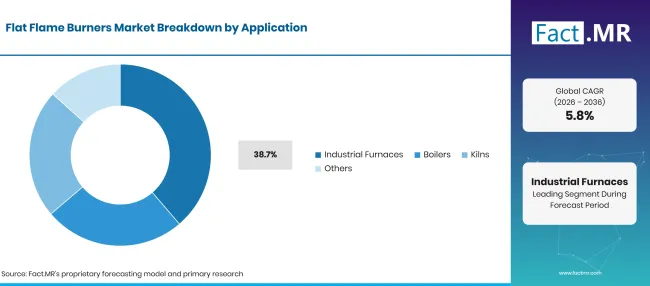
Flat Flame Burners Market Breakdown Application | Source: Fact.MR
Industrial furnaces account for 38.7% of application revenue in 2026, approximately USD 1.5 billion. Heat-treatment and reheating equipment uses carefully distributed heat to improve temperature consistency across a load. Engineers select burners according to furnace size, temperature control and emissions requirements. Boilers and kilns have different combustion arrangements, so a design suited to a furnace roof may need modification before it can be used elsewhere.
Why does metallurgy lead end-user demand in the Flat Flame Burners Market?
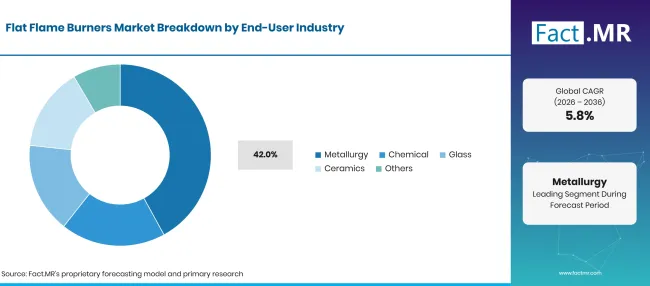
Flat Flame Burners Market Breakdown End User Industry | Source: Fact.MR
Metallurgy contributes 42.0% of end-user revenue in 2026, close to USD 1.6 billion. Steel and aluminum plants operate thermal equipment for reheating and treatment, creating demand for controlled flame patterns. Glass and ceramics manufacturers also buy burners but evaluate them against their own product and furnace requirements. Metal producers compare energy consumption, maintenance needs and heating consistency before approving a replacement project.
Flat Flame Burners Market-Drivers, Restraints & Trends
Drivers:
Emission limits and the need for steady furnace temperatures encourage operators to evaluate modern combustion systems. Flat flame burners can distribute heat across a wider surface, reducing concentrated heating in suitable furnace layouts. Low-NOx techniques and automated air-fuel controls can form part of these upgrades. Demand is linked to specific furnace renewal projects and their approved performance targets.
Restraints:
Electric heating technologies offer alternatives to combustion in some industrial processes. Induction systems and electric furnaces can reduce the need for fuel-fired burners where their operating range suits the product. Furnace investment may also be deferred when industrial activity weakens. Suppliers therefore need to assess whether their combustion equipment remains relevant to each customer’s planned heating route.
Trend:
Hydrogen-Capable Combustion. Industrial plants evaluating lower-carbon fuels are testing burners that can operate with specified hydrogen mixtures. Fives product families are active in industrial combustion solutions. Flame behavior, safety controls and heat transfer must be validated for the intended fuel. Technical testing will determine how quickly such designs enter regular furnace operation.
Trend:
Digital Combustion Control. Sensors and automated burner management systems allow plants to adjust fuel and air flows more precisely. Operators use performance information to investigate heating inconsistencies and reduce avoidable interruptions. The value of remote diagnostics depends on how easily the controls integrate with existing furnace equipment. Engineering support remains important during installation and tuning.
Flat Flame Burners Market by Analysis by Key Country
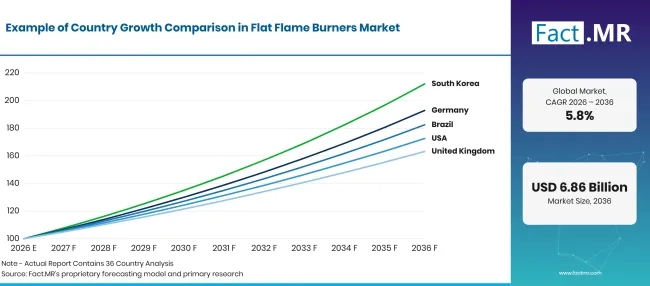
Flat Flame Burners Market Growth Index | Source: Fact.MR
| Country | CAGR (2026-2036) |
|---|---|
| Germany | 6.8% |
| Brazil | 6.2% |
| United States | 5.6% |
| United Kingdom | 5.0% |
| Japan | 4.4% |
Source: Fact.MR analysis. Updated Nov 19, 2026
Source: Fact.MR analysis.
Why is Germany the fastest-growing market for flat flame burners?
Germany is forecast to lead the five-country growth comparison with a 6.8% CAGR through 2036.
Steel producers are evaluating new heating and fuel arrangements as they modernize production. Projects linked to thyssenkrupp Steel and Salzgitter illustrate the scale of industrial changes, although hydrogen-based direct reduction does not automatically require flat flame burners. Burner suppliers serving German plants must show that each design fits the furnace duty, emission requirements and available fuels.
What is supporting flat flame burner demand in Brazil?
In Brazil, the flat flame burners market is projected to expand at a 6.2% CAGR.
Steel producers such as Gerdau and Usiminas operate thermal processing equipment, while the ceramics industry provides another source of furnace demand. Retrofitting decisions depend on the condition of existing burners and the economics of fuel supply. Vendors that can adapt equipment to local operating conditions and provide plant-level service are positioned to compete for modernization orders.
What is shaping flat flame burner sales in the United States?
US sales are forecast to rise at a 5.6% CAGR from 2026 to 2036.
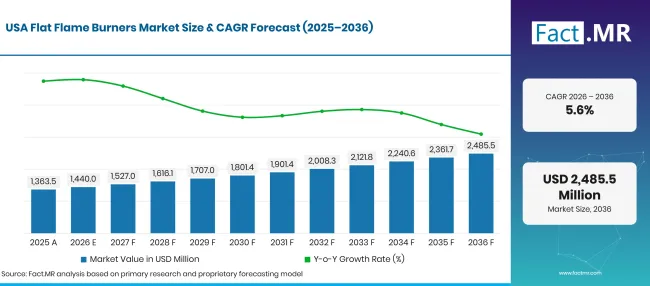
Flat Flame Burners Market Forecast Usa | Source: Fact.MR
Steel minimills and glass manufacturers review furnace efficiency, emissions and maintenance costs when updating combustion equipment. Public investment programs supporting industrial decarbonization provide a wider context for these projects but do not directly measure burner purchases. Bloom Engineering offer established industrial combustion solutions. Orders will follow the technical needs of individual facilities.
What is shaping flat flame burner demand in the United Kingdom?
The United Kingdom is expected to post a 5.0% CAGR over the forecast period.
Changes in steel production, including the shift planned for Port Talbot, are altering industrial heating requirements. Electric arc steelmaking replaces some fuel-intensive process stages, while other plants may continue to use combustion for specific duties. Glass-sector trials with alternative fuels create another area of engineering work. Burner opportunities depend on the heating process that remains in place.
Why is flat flame burner growth slower in Japan?
Japan’s flat flame burner market is projected to increase at a 4.4% CAGR, below the other four countries in this comparison.
Established industrial furnaces provide a base for replacement and maintenance orders. Japanese manufacturers may prefer improvements to existing lines when major capacity additions are limited. Suppliers will need to demonstrate useful changes in temperature uniformity, operating cost or emissions performance to justify plant upgrades.
Competitive Assessment of Flat Flame Burners Market
Competition includes industrial combustion suppliers, furnace engineering companies and specialized burner manufacturers. Fives, IBS, Selas Heat Technology, Bloom Engineering, cover different industrial heating applications. Their participation in flat flame burners depends on specific qualifying product lines. Furnace engineers compare flame geometry, emission performance, fuel compatibility and controls. Installation experience and the availability of technical service can weigh heavily in complex retrofit projects.
Low-emission combustion and fuel flexibility are important points of comparison between suppliers. A burner must undergo testing for the intended hydrogen mixture before a plant can rely on that capability. Furnace operators will assess flame stability, safety controls and heat distribution when choosing equipment for modernization projects.
Recent Developments
- In 2026, DUNGS acquired IBS Industrie-Brenner-Systeme GmbH, expanding its industrial combustion portfolio with complete burner systems for high- and low-temperature applications while extending IBS products through DUNGS' international sales network from the third quarter.
- In December 2024, Wabtec Corporation acquired Bloom Engineering, adding industrial burner technologies and combustion systems to its heat transfer and energy solutions portfolio for manufacturing and industrial heating applications.
Key Players in Flat Flame Burners Market
Key companies operating in the market include Honeywell Thermal Solutions, Fives Group, IBS Industrie-Brenner-Systeme GmbH, Selas Heat Technology Company, and Bloom Engineering.
- Honeywell Thermal Solutions
- Fives Group
- IBS Industrie-Brenner-Systeme GmbH
- Selas Heat Technology Company
- Bloom Engineering
Bibliography
- ABB Ltd. (2026). Annual reporting suite 2025.
- DUNGS. (2026). DUNGS acquires IBS Industrie-Brenner-Systeme GmbH. Official acquisition announcement
- European Commission. (2025, February 26). A Clean Industrial Deal for competitiveness and decarbonisation in the EU.
- National Institute of Standards and Technology. (2025, May 30). The rise of artificial intelligence in U.S. manufacturing.
- Rockwell Automation, Inc. (2025). 2025 annual report.
- Schneider Electric. (2026). 2025 full-year results.
- Siemens AG. (2025, May 12). Siemens introduces AI agents for industrial automation.
- thyssenkrupp Steel Europe AG. (2025, December 1). thyssenkrupp Steel concludes collective restructuring agreement with the IG Metall union.
- Thomas, D. (2026, February 20). Annual report on the U.S. manufacturing economy: 2025 (NIST Advanced Manufacturing Series 100-76). National Institute of Standards and Technology.
- Wabtec Corporation. (2024, December 30). Wabtec acquires Bloom Engineering to strengthen its heat transfer and energy solution portfolio. Official acquisition announcement
- World Economic Forum. (2026, April 16). Intelligent industrial operations outlook 2026.
Segmentation
Scope of Report
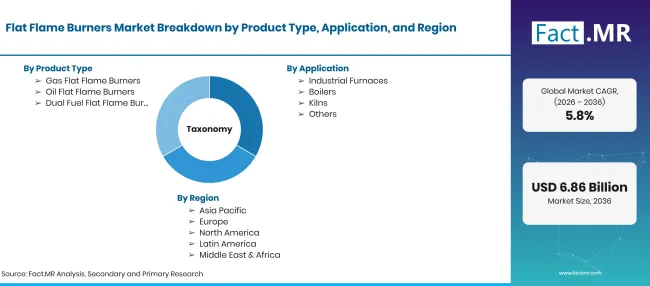
Flat Flame Burners Market Taxonomy | Source: Fact.MR
| Items | Values |
|---|---|
| Quantitative Units (2026) | USD 3.91 Billion |
| Product Type | Gas Flat Flame Burners, Oil Flat Flame Burners, Dual Fuel Flat Flame Burners |
| Application | Industrial Furnaces, Boilers, Kilns, Others |
| End-User Industry | Metallurgy, Chemical, Glass, Ceramics, Others |
| Regions Covered | North America, Latin America, Europe, East Asia, South Asia and Pacific, Middle East & Africa |
| Countries Covered | United States, Germany, Japan, United Kingdom, Brazil, and other countries |
| Key Companies Profiled | Honeywell Thermal Solutions, Fives Group, IBS Industrie-Brenner-Systeme GmbH, Selas Heat Technology Company, Bloom Engineering |
| Additional Attributes | Dollar revenue in the Flat Flame Burners Market is segmented by product type (gas flat flame burners, oil flat flame burners, dual fuel flat flame burners); application (industrial furnaces, boilers, kilns); end-user industry (metallurgy, chemical, glass, ceramics) and region. |
Source: Fact.MR analysis. Updated Nov 19, 2026
Source: Fact.MR analysis.
Flat Flame Burners Market by Segments
-
Product Type
- Gas Flat Flame Burners
- Oil Flat Flame Burners
- Dual Fuel Flat Flame Burners
-
Application
- Industrial Furnaces
- Boilers
- Kilns
- Others
-
End-User Industry
- Metallurgy
- Chemical
- Glass
- Ceramics
- Others
-
Region:
- North America
- United States
- Canada
- Mexico
- Europe
- Germany
- United Kingdom
- France
- Italy
- Spain
- Rest of Europe
- Asia Pacific
- China
- India
- Japan
- South Korea
- Australia
- Rest of Asia Pacific
- Latin America
- Brazil
- Mexico
- Argentina
- Rest of Latin America
- Middle East & Africa
- GCC Countries
- South Africa
- Rest of Middle East & Africa
- North America
Frequently Asked Questions
How big is the global Flat Flame Burners Market in 2026?
What will be the size of the Flat Flame Burners Market by 2036?
How fast will the Flat Flame Burners Market grow during the forecast period?
Which product type segment holds the largest share of the Flat Flame Burners Market?
Who worked on this report


Preview the report firsthand - request a free sample
Free SampleGet the brochure for pricing and purchase details
Download PDF