- Market Value (2025): USD 2.94 Bn
- Estimated Value (2026): USD 3.07 Bn
- Forecast Value (2036): USD 4.77 Bn
- CAGR (2026-2036): 4.5%
Rack Ends Market Forecast and Outlook 2026 to 2036
Sales of rack ends are projected to grow from USD 3.07 billion in 2026 to USD 4.77 billion by 2036, a 4.5% CAGR, as vehicle production and replacement activity keep steering component volumes rising. This adds about USD 1.7 billion in absolute opportunity.
Adoption of rack ends is anchored in passenger vehicle output. For example, Germany produced approximately 4.07 million passenger cars in 2024 and Japan 7.14 million, according to national and industry statistics. Suppliers are serving both OEM programs and replacement channels, and production volumes of this size should sustain sales through 2036.
Key Takeaways from the Rack Ends Market
- The rack ends market was valued at USD 2.94 billion in 2025
- Rack Ends Market Value (2026): USD 3.07 billion
- Rack Ends Market Forecast Value (2036): USD 4.77 billion
- Rack Ends Market Forecast CAGR (2026-2036): 4.5%
- Leading Product Type: Inner Rack Ends (62.1%)
- Key Market Participants: ZF Friedrichshafen AG, Tenneco Inc. (MOOG / DRiV), HL Mando, JTEKT Corporation, Rane Group
- Key Growth Regions: Germany, Brazil, United Kingdom, United States, Japan
OEM sales account for 51.4% of rack ends revenue in 2026 as automakers buy in volume under supply agreements, while steel holds 63.9% of material demand. Demand from the aftermarket is growing as independent workshops and parts distributors widen coverage, and suppliers with accurate fitment data are cutting incorrect orders and returns. Distribution expansion of this kind is projected to drive sales in replacement channels.
Rack Ends Market
| Metric | Value |
|---|---|
| Estimated Value in (2026) | USD 3.07 billion |
| Forecast Value in (2036) | USD 4.77 billion |
| Forecast CAGR (2026 to 2036) | 4.5% |
Source: Fact.MR analysis. Updated Nov 19, 2026
Source: Fact.MR analysis
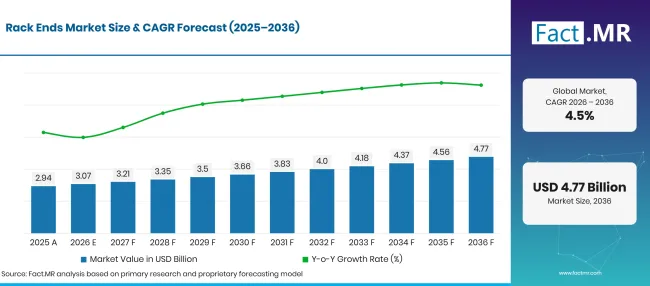
Rack Ends Market Forecast Global | Source: Fact.MR
Category
| Category | Segments |
|---|---|
| Product Type | Inner Rack Ends, Outer Rack Ends |
| Vehicle Type | Passenger Cars, Commercial Vehicles |
| Sales Channel | OEM, Aftermarket |
| Material | Steel, Aluminum, Others |
| Region | Germany; Brazil; United Kingdom; United States; Japan |
Source: Fact.MR analysis. Updated Nov 19, 2026
Segmental Analysis
Why does the inner type lead demand in the Rack Ends Market?
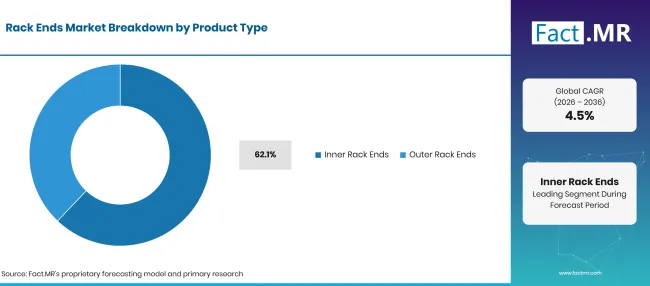
Rack Ends Market Breakdown Product Type | Source: Fact.MR
Demand for inner rack ends accounts for 62.1% of rack ends revenue in 2026 as they are specified across steering configurations and replaced as vehicles age. Suppliers are maintaining both inner and outer ranges to meet vehicle-specific requirements, and replacement demand depends on vehicle usage and road conditions. Continued replacement activity should keep inner rack ends the leading type through 2036. Aftermarket suppliers add to this by holding inventories of both inner and outer ranges so that repair workshops can complete jobs without delay. Wear in connected steering components is often found during replacement, which gives workshops further opportunities to sell related parts alongside the rack end.
Why do passenger cars lead vehicle-type demand in the Rack Ends Market?
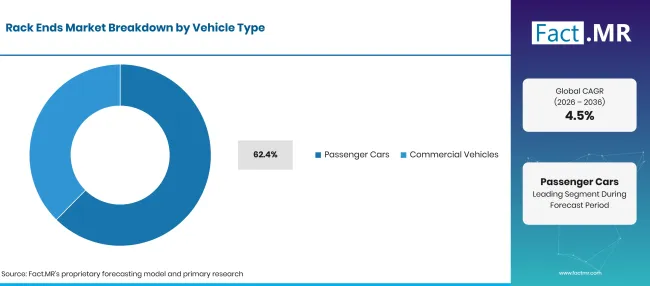
Rack Ends Market Breakdown Vehicle Type | Source: Fact.MR
Sales of rack ends for passenger cars account for 62.4% of 2026 revenue because the passenger vehicle base is large and generates demand through both new production and replacement. Commercial vehicles add demand where heavier loads and intensive operating schedules raise component wear. Suppliers are building vehicle-specific catalogs, and fleet scale is projected to keep passenger cars the leading segment. Fitment accuracy is the main purchasing criterion for replacement buyers, so distributors with detailed vehicle catalogs gain share. OEM programs for passenger cars also run in large volumes, which keeps supply agreements concentrated among qualified suppliers. This combination of production and aftermarket demand is expected to keep the segment above commercial vehicles through 2036.
Why does OEM lead sales-channel demand?
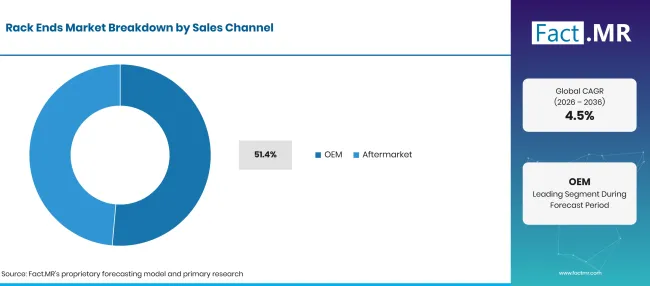
Rack Ends Market Breakdown Sales Channel | Source: Fact.MR
Demand through OEM channels accounts for 51.4% of 2026 revenue as automakers purchase rack ends in large volumes under established supply agreements and qualify suppliers during vehicle development. Aftermarket purchases are more fragmented. Long-term supplier relationships are expected to keep OEM sales steady through 2036. For suppliers, winning an OEM program means volumes that are stable across the life of a vehicle platform, while aftermarket sales depend on repeat purchases by workshops and individual owners. Early collaboration with automakers on dimensions, load capacity and joint specifications supports smoother qualification, and this closeness explains why OEM suppliers invest heavily in application engineering.
Why does steel lead material demand in the Rack Ends Market?
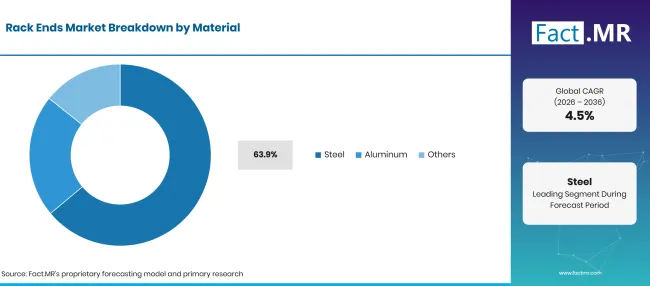
Rack Ends Market Breakdown Material | Source: Fact.MR
Demand for steel rack ends accounts for 63.9% of material revenue in 2026 as buyers rely on its strength and durability. Aluminum and other materials are being explored for corrosion resistance and weight, and manufacturers must balance durability with production cost. These priorities should keep steel the leading material through 2036. Material choice is also tied to cost: raw material price fluctuations rank among the largest restraints on market growth, so suppliers watch steel input prices closely. Component developers exploring improved steel grades and aluminum look for lower weight and better corrosion resistance without sacrificing fatigue performance, which keeps the segment evolving even as steel remains dominant.
Rack Ends Market-Drivers, Restraints & Trends
Drivers
Demand for rack ends is rising as passenger vehicle production and replacement needs grow. Fact.MR rates passenger vehicle production at about +1.0% on the CAGR, steering component replacement at +0.9%, OEM steering system integration at +0.7%, aftermarket distribution expansion at +0.5% and demand for durable linkages at +0.4%. Suppliers are widening vehicle coverage for independent workshops and distributors, which is projected to drive sales through the forecast period.
Restraints
Sales of rack ends are exposed to raw material price swings (about -0.8% on the CAGR), price competition in aftermarket channels (-0.6%), steering system design changes (-0.5%), counterfeit and low-quality replacement parts in emerging markets (-0.4%) and OEM qualification requirements (-0.3%). Suppliers must hold quality and pricing discipline to protect sales.
Trend
Vehicle-Specific Aftermarket Catalogs Opportunities are strongest in detailed compatibility catalogs, worth about +0.8% on the CAGR over the short term. Distributors that map products to model, production year and configuration are reducing incorrect orders and returns, and further catalog investment is projected to increase sales of rack ends in replacement channels.
Trend
Lightweight and Corrosion-Resistant Components Demand for lighter and corrosion-resistant components is rising, with lightweight development at +0.6% on the CAGR in Europe and Japan and improved corrosion-resistant materials at +0.4%. Expanded OEM supplier partnerships add +0.5% and commercial vehicle replacement +0.3%, supporting adoption across OEM programs
Rack Ends Market by Analysis by Key Country
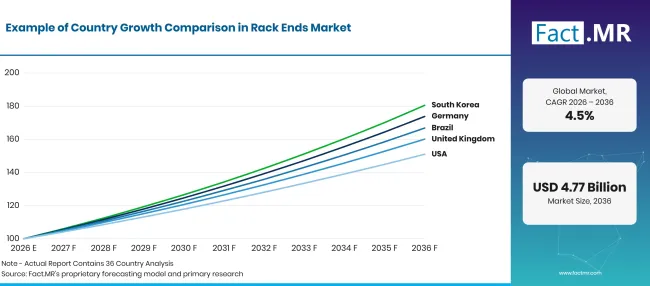
Rack Ends Market Growth Index | Source: Fact.MR
| Country | CAGR (2026-2036) |
|---|---|
| Germany | 5.7% |
| Brazil | 5.3% |
| United Kingdom | 4.8% |
| United States | 4.2% |
| Japan | 3.7% |
Source: Fact.MR analysis. Updated Nov 19, 2026
Source: Fact.MR analysis
What is driving rack ends demand in Germany?
The market in Germany is projected to grow at 5.7%, the highest of the five countries, as the automotive manufacturing base requires steering components.
For example, Destatis, citing OICA data, reported about 4.07 million passenger cars produced in Germany in 2024. Suppliers meeting OEM quality requirements are positioned to gain, and production strength should sustain sales through 2036. Aftermarket distributors in Germany add to OEM demand through replacement sales, and suppliers able to cover both channels with consistent quality benefit most. The country's engineering reputation also raises buyer expectations for dimensional accuracy, which favors established producers in qualification-heavy programs and keeps the market attractive for precision suppliers.
How is vehicle manufacturing supporting rack ends sales in Brazil?
The market in Brazil is projected to grow at 5.3% a year as domestic vehicle manufacturing and replacement needs expand.
For example, OICA recorded about 1.90 million passenger cars and 654,575 commercial vehicles produced in Brazil in 2024. Suppliers are expanding through regional distribution and vehicle-specific catalogs. Brazil's mix of passenger and commercial vehicle output creates demand for a wide range of linkage types, and a large vehicle population supports steady replacement. Suppliers with regional distribution networks can reach independent workshops across a large territory, while vehicle-specific catalogs reduce mistakes in ordering. These factors place Brazil second among the five countries and signal continued opportunities through 2036.
What is shaping rack ends adoption in the United Kingdom?
The market in the United Kingdom is projected to grow at 4.8% a year as assembly activity and a network of independent repairers support demand.
For example, OICA recorded about 780,000 passenger cars produced in the UK in 2024. Suppliers maintain application-specific ranges and dependable distribution to serve both channels. Independent repair businesses are a key route to market, so distributors that keep reliable stock across vehicle ages gain share. Assembly activity supports OEM demand, though volumes are smaller than in Germany. The combination of production and replacement keeps the market growing at a steady pace, with suppliers focusing on application-specific ranges to serve both channels.
How does the vehicle mix affect rack ends demand in the United States?
The market in the United States is projected to grow at 4.2% a year across OEM and aftermarket channels.
For example, OICA reported roughly 9.13 million commercial vehicles produced in 2024 against about 1.43 million passenger cars. Suppliers are matching products to several vehicle categories, and this production mix is expected to sustain sales. Light trucks and commercial vehicles require durable steering linkages, which supports demand for heavier-duty ranges, while passenger car production adds standard fitments. A large vehicle population keeps replacement channels active across independent workshops and parts distributors. Suppliers able to cover several vehicle categories with accurate catalogs are positioned to serve the market, which is expected to sustain steady growth.
Why is rack ends growth slowest in Japan?
The market in Japan is projected to grow at 3.7%, the lowest of the five countries, as a mature market expands gradually.
For example, Japan recorded about 4.42 million new vehicle registrations in 2024, including 3.73 million passenger cars, and its fleet reached roughly 83.09 million units by December 2024. A fleet of this scale should keep replacement demand steady. Because most of the fleet is already in service, sales depend on maintenance and replacement more than on new vehicle output, and suppliers prioritize quality and compatibility. Opportunities for additional suppliers therefore lie mainly in the aftermarket. Growth is slower than in other countries, but the large installed base provides dependable volumes.
Competitive Landscape for Rack Ends Market
Competition in the rack ends market is divided between global steering and chassis suppliers and aftermarket brands. ZF Friedrichshafen, Tenneco (MOOG / DRiV), HL Mando and JTEKT compete across OEM and replacement channels, while Rane Group competes through its steering and linkage portfolio. Buyers select suppliers on quality, vehicle compatibility, OEM relationships and distribution reach.
Suppliers with accurate dimensional specifications, long-standing automotive customers and broad replacement catalogs are best placed to serve demand across vehicle platforms.
Recent Developments
- In November 2025, the International Trade Administration published its Japan automotive country guide, citing about 4.42 million new vehicle registrations in 2024.
- In November 2025, Germany's Federal Statistical Office updated its international statistics on passenger car production, which show about 4.07 million cars built in Germany in 2024.
- In October 2025, Rane Group issued a corporate brochure describing its steering and suspension systems portfolio.
- In 2025, the Japan Automobile Manufacturers Association reported a fleet of about 83.09 million vehicles in Japan as of December 2024 in its annual motor industry review.
Key Players in Rack Ends Market
Key companies profiled include ZF Friedrichshafen AG; Tenneco Inc. (MOOG / DRiV); HL Mando; JTEKT Corporation; and Rane Group.
- ZF Friedrichshafen AG
- Tenneco Inc. (MOOG / DRiV)
- HL Mando
- JTEKT Corporation
- Rane Group
Bibliography
- Japan Automobile Manufacturers Association, Inc. 2025. The motor industry of Japan 2025. Tokyo: JAMA.
- International Organization of Motor Vehicle Manufacturers. n.d. Production statistics: World motor vehicle production 2024. Paris: OICA.
- International Trade Administration. 2025. Japan: Automotive. Washington, DC: U.S. Department of Commerce.
- MOOG Advance Systems. n.d. Products and precision engineering. MOOG.
- Rane Group. 2025. Corporate brochure: Steering and suspension systems. Chennai: Rane Group.
- Statistisches Bundesamt (Destatis). 2025. International statistics: Production of passenger cars. Wiesbaden: Destatis.
- ZF Friedrichshafen AG. n.d. Steering and chassis parts. ZF Aftermarket.
Segmentation
Scope of Report
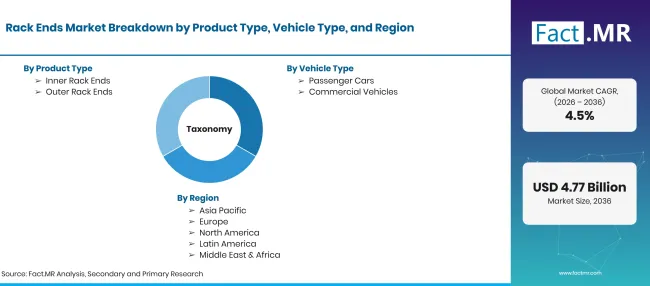
Rack Ends Market Taxonomy | Source: Fact.MR
| Items | Values |
|---|---|
| Quantitative Units (2026) | USD 3.1 Billion |
| Market Definition | Automotive steering linkage components that connect the steering rack to the tie rod assembly and transmit steering movement to the wheels, supporting directional control and stable steering. |
| Product Type | Inner Rack Ends, Outer Rack Ends |
| Vehicle Type | Passenger Cars, Commercial Vehicles |
| Sales Channel | OEM, Aftermarket |
| Material | Steel, Aluminum, Others |
| Regions Covered | North America, Latin America, Western Europe, Eastern Europe, East Asia, South Asia & Pacific, Middle East & Africa |
| Countries Covered | Germany, Brazil, USA, UK, Japan |
| Key Companies Profiled | ZF Friedrichshafen AG, Tenneco Inc., HL Mando, JTEKT Corporation, Rane Group |
| Additional Attributes | Revenue is built from automotive production statistics and company portfolio research. Complete steering racks, columns, power steering pumps, ball joints and repair services are outside the market boundary. |
Source: Fact.MR analysis. Updated Nov 19, 2026
Rack Ends Market by Segments
-
Product Type
- Inner Rack Ends
- Outer Rack Ends
-
Vehicle Type
- Passenger Cars
- Commercial Vehicles
-
Sales Channel
- OEM
- Aftermarket
-
Material
- Steel
- Aluminum
- Others
-
Region:
- North America
- United States
- Canada
- Mexico
- Europe
- Germany
- United Kingdom
- France
- Italy
- Spain
- Rest of Europe
- Asia Pacific
- China
- India
- Japan
- South Korea
- Australia
- Rest of Asia Pacific
- Latin America
- Brazil
- Mexico
- Argentina
- Rest of Latin America
- Middle East & Africa
- GCC Countries
- South Africa
- Rest of Middle East & Africa
- North America
Frequently Asked Questions
How large will the Rack Ends Market be by 2036?
What CAGR is forecast for rack ends from 2026 to 2036?
Which sales channel leads the market?
Which companies are profiled in the study?
Who worked on this report


Preview the report firsthand - request a free sample
Free SampleGet the brochure for pricing and purchase details
Download PDF