- Market Value (2025): USD 3.37 Bn
- Estimated Value (2026): USD 3.53 Bn
- Forecast Value (2036): USD 5.67 Bn
- CAGR (2026-2036): 4.9%
Noise Barrier System Market Forecast and Outlook 2026 to 2036
The global noise barrier systems market is valued at USD 3.53 billion in 2026 and is projected to reach USD 5.67 billion by 2036, advancing at a CAGR of 4.9% over the assessment period.
Expansion of road and rail networks near residential neighbourhoods has made environmental noise control a more prominent part of infrastructure planning. Barrier developers are responding with absorptive, transparent and modular systems suited to busy transport corridors, where installation work must be coordinated around live traffic. The European Environment Agency reported in 2025 that more than 20% of Europeans are exposed to harmful transport-noise levels, with road traffic the most widespread source (European Environment Agency, 2025).
Key Takeaways from the Noise Barrier System Market
- Noise barrier system sales reached USD 3.37 billion in 2025.
- Noise Barrier System Market Value (2026): USD 3.53 billion.
- Noise Barrier System Market Forecast Value (2036): USD 5.67 billion.
- Noise Barrier System Market Forecast CAGR (2026–2036): 4.9%.
- Leading Material Type: Concrete (38.5%).
- Key Market Participants: Noise Barriers LLC, Trelleborg AB, Armtec Infrastructure Inc.; R. Kohlhauer GmbH, Evonik Industries AG and Industrial Acoustics Company Inc.
- Key Growth Markets: Germany, the United States, Brazil; Japan and the United Kingdom.
The Bipartisan Infrastructure Law authorizes USD 365 billion for highways and bridges as part of a broader five-year transportation funding package. This investment is supporting road reconstruction, bridge renewal and corridor upgrades across the United States. Where highway works bring traffic closer to residential areas, noise analysis and mitigation can become part of project design under Federal Highway Administration requirements (Federal Highway Administration, n.d.; U.S. Department of Transportation, 2022).
Noise Barrier System Market
| Metric | Value |
|---|---|
| Estimated Value (2025) | USD 3.37 billion |
| Estimated Value (2026) | USD 3.53 billion |
| Forecast Value (2036) | USD 5.67 billion |
| Forecast CAGR (2026–2036) | 4.9% |
Source: Fact.MR analysis. Updated Nov 19, 2026
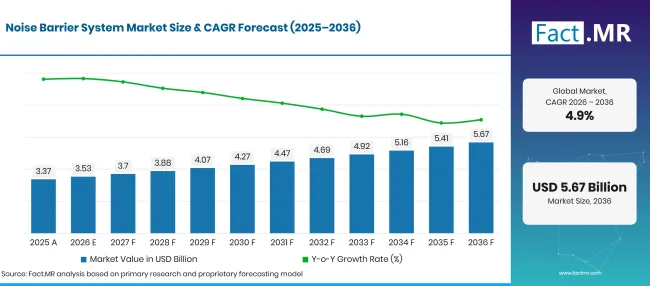
Noise Barrier System Market Forecast Global | Source: Fact.MR
Category
| Category | Segments |
|---|---|
| Material Type | Concrete, Metal, Wood; Others |
| Application | Highways, Railways, Industrial; Residential; Others |
| Installation | Ground-Mounted, Structure-Mounted |
| End-User | Transportation, Industrial, Commercial; Residential |
| Key Countries | Germany, United States, Brazil; Japan; United Kingdom |
Source: Fact.MR analysis. Updated Nov 19, 2026
Segmental Analysis
Why does concrete lead the Noise Barrier System Market by material type?
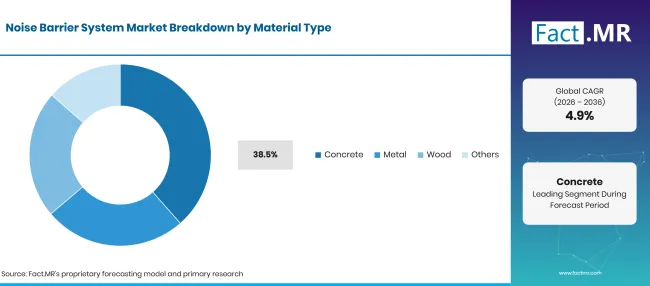
Noise Barrier System Market Breakdown Material Type | Source: Fact.MR
Concrete holds a 38.5% market share in 2026, equivalent to nearly USD 1.4 billion in revenue. Its high surface mass, structural strength and resistance to weathering make it suitable for long-life installations along highways and railways. In February 2026, Smith-Midland secured a USD 1.9 million contract to manufacture SoftSound® absorptive noise-wall panels for the Elbow Road improvement project in Virginia Beach. The project combines highway upgrades with noise mitigation for nearby neighbourhoods, illustrating the use of precast concrete systems with improved acoustic performance (Smith-Midland Corporation, 2026).
Why do highways lead application revenue in the Noise Barrier System Market?
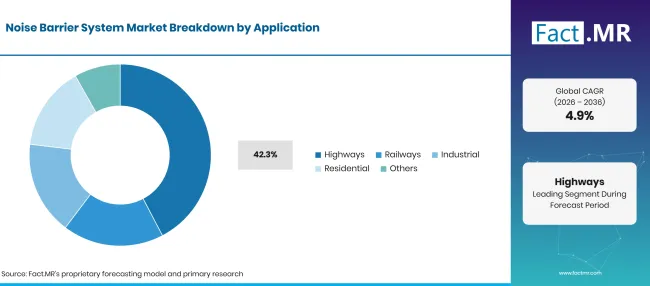
Noise Barrier System Market Breakdown Application | Source: Fact.MR
Noise barriers began appearing along Kerala’s 12.75-km Aroor–Thuravoor elevated highway in January 2026. Translucent polycarbonate panels were selected to reduce traffic noise near homes, schools and hospitals (Onmanorama, 2026). Highways account for 42.3% of market revenue in 2026, or nearly USD 1.5 billion, because heavy vehicle traffic and road widening create sustained noise exposure along populated corridors. Elevated roads are more suited to transparent panels where daylight and views matter, while conventional roadside stretches continue to use concrete and absorptive metal barriers for durability and sound reduction.
Why are ground-mounted barriers the leading installation type?
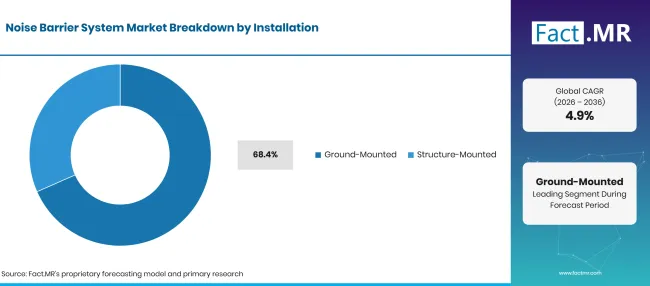
Noise Barrier System Market Breakdown Installation | Source: Fact.MR
The Illinois Department of Transportation revised its ground-mounted noise-abatement wall specification on October 17, 2025. The specification describes precast concrete panels spanning between vertical posts supported by drilled-shaft foundations (Illinois Department of Transportation, 2025). Ground-mounted systems hold a 68.4% market share in 2026, valued at nearly USD 2.4 billion, because they can form continuous walls along highways; rail boundaries and residential corridors without relying on existing bridges or viaducts. Post-and-panel systems are favoured over cast-in-place walls where factory production can simplify installation and quality control. Earth berms remain an alternative, but their larger land footprint limits use in congested corridors.
Why does transportation lead end-user revenue in the Noise Barrier System Market?
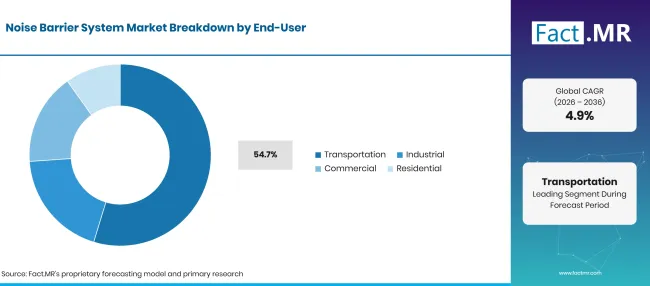
Noise Barrier System Market Breakdown End User | Source: Fact.MR
In September 2025, the Maharashtra State Road Development Corporation invited tenders for bi-absorbent noise-barrier panels on the Nitin-Cadbury Flyover along Thane’s Eastern Express Highway (Maharashtra State Road Development Corporation, 2025). Transportation accounts for 54.7% of market revenue in 2026, or nearly USD 1.9 billion. Highway expansion and railway upgrades bring busy traffic corridors closer to residential areas, making acoustic mitigation a recurring infrastructure consideration. Highway authorities tend to install extended roadside walls, while railway operators use specialised barriers near elevated tracks, stations and densely populated stretches. Industrial and commercial users generally focus on more localised site-boundary installations.
Noise Barrier System Market: Drivers, Restraints and Trends
Driver: Transport infrastructure investment and noise-control regulation
Government transport investment is strengthening noise-control measures, while the EU Environmental Noise Directive requires noise maps and action plans every five years for major transport routes and urban areas.. These assessments help authorities identify residential hotspots and decide where mitigation is needed. Barrier developers are responding with absorptive panels and designs suited to different traffic conditions, giving acoustic protection a more defined role in infrastructure improvement programmes (European Commission, n.d.).
Restraint: Installation costs, land constraints and approval requirements
High installation costs, limited right-of-way space and structural approval requirements can restrict barrier projects, particularly on smaller roads. Authorities must assess foundation capacity, drainage, wind loading; sightlines and nearby utilities before approving a wall. Objections to bulky concrete structures can also delay planning near residential areas. Some agencies choose low-noise asphalt, traffic management or speed restrictions when budgets and site conditions make permanent barriers difficult to justify. These alternatives can reduce the number of locations where a full barrier installation is selected.
Trend: Transparent and greener noise barriers
Urban transport planners are paying closer attention to barriers that control traffic noise without blocking daylight, views or roadside greenery. Acrylic panels and vegetated structures are relevant options in built-up corridors. In February 2026, Rijkswaterstaat reported that its test barrier made from retired wind-turbine blades along the A58 motorway achieved noise reduction comparable to a conventional concrete barrier. The project adds circular-material use to the design considerations for future acoustic infrastructure (Rijkswaterstaat, 2026).
Trend and opportunity: Solar-integrated noise protection
A solar-integrated noise barrier was completed along Italy’s E80 highway near Rome in November 2025. The 100-metre installation combines 45 bifacial photovoltaic modules with sound-absorbing aluminium panels and has an installed capacity of 19.575 kW (SoliTek, 2025). Such projects create an opportunity to pair noise mitigation with renewable electricity generation along transport corridors. Future investment may favour dual-purpose infrastructure where road authorities can use existing barrier surfaces for energy production without compromising acoustic performance.
Noise Barrier System Market Analysis by Key Country
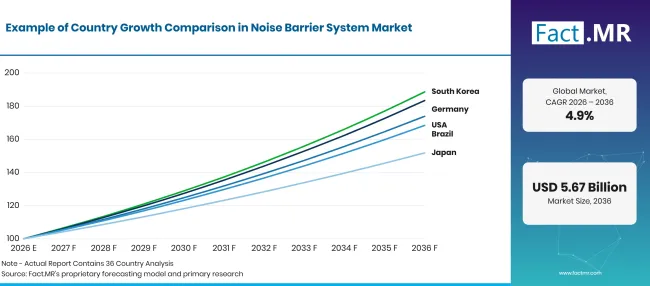
Noise Barrier System Market Growth Index | Source: Fact.MR
| Country | CAGR (2026–2036) |
|---|---|
| Germany | 6.3% |
| United States | 5.7% |
| Brazil | 5.4% |
| Japan | 4.3% |
| United Kingdom | 3.9% |
Source: Fact.MR analysis. Updated Nov 19, 2026
What is driving noise barrier system growth in Germany?
Germany records the highest CAGR among the selected countries at 6.3% through 2036. Deutsche Bahn reported that 39.6 km of noise barriers were completed along its existing network in 2025, with another 61.5 km completed on new and upgraded lines
The company also recorded EUR 201 million in federal budget utilisation for noise remediation on the existing network (Deutsche Bahn AG, 2026). Dense rail coverage, freight movements near residential areas and continuing federal remediation work are sustaining investment in permanent noise walls.
How are highway investments shaping the United States market?
The United States market is advancing at a 5.7% CAGR through 2036.
Michigan’s November 2025 US-23 noise analysis identified 16 barriers for assessment; six met feasibility and reasonableness criteria and were approved following votes by affected residents (Michigan Department of Transportation, 2025). Highway reconstruction, additional lanes and suburban expansion are bringing noise mitigation into project planning. Federal rules require traffic-noise impacts and abatement options to be assessed for qualifying federally aided highway projects, supporting state-level contracts for new and replacement barriers (Federal Highway Administration, n.d.).
Why is Brazil becoming an attractive market for noise barrier systems?
Brazil’s market is forecast to expand at a 5.4% CAGR through 2036. In October 2026, the Rodoanel Oeste concessionaire began work on 8 km of acoustic barriers along the SP-021 motorway as part of an R$115 million investment.
The planned structures combine concrete, acrylic, rubber-coated and mixed-material solutions (Rodoanel Oeste; 2026). Highway concessions, urban expansion and environmental commitments around major transport routes are creating project opportunities, particularly where residential neighbourhoods border heavily used roads.
What is sustaining noise barrier system sales in Japan?
Japan’s market is set to grow at a 4.3% CAGR through 2036. On October 23, 2025, NEXCO Central Japan issued a tender for noise-barrier installation on the Tomei Expressway between the Tomei Kawasaki and Yokohama-Aoba interchanges; with work scheduled to run from January 2026 to January 2027 (NEXCO Central Japan Expressway Company; 2025). Expressway maintenance, ageing roadside structures and noise-control needs near dense urban areas are sustaining replacement and upgrade work.
Highway rehabilitation and barriers suited to restricted roadside space are important sources of project activity.
Why does the United Kingdom record slower market growth?
The United Kingdom has the lowest CAGR among the selected countries at 3.9% through 2036.
The Office of Rail and Road reported that National Highways had mitigated noise for 7,776 households by the end of its second road period, using quieter road surfaces; noise barriers and insulation upgrades (Office of Rail and Road; 2026). The use of several mitigation methods, rather than barriers alone, can limit wall installations to locations where they offer clear value. Replacement projects and targeted work near noise-sensitive communities will continue to support market activity.
Competitive Landscape for the Noise Barrier System Market
Competition spans material specialists and companies that design and install complete acoustic structures. Trelleborg, Evonik and Armtec compete through material technologies and precast capabilities, while R. Kohlhauer, Industrial Acoustics Company, Sound Fighter Systems; Noise Barriers LLC and Gramm Barriers focus on engineered barrier systems. Project buyers assess sound absorption, weather resistance, service life; installation time and total cost. Transparent panels, modular construction and systems that reduce traffic disruption have become more visible areas of competition. Companies with tested acoustic performance, regional production capacity and experience in public infrastructure projects are well placed to compete for government contracts.
Recent Developments
- On February 9, 2026, EKHO Infrastructure Solutions introduced an integrated MASH TL-5 noise-barrier system designed to combine roadway crash protection with noise reduction.
- On August 5, 2025, R. Kohlhauer GmbH partnered with US-based Ko-Solar to develop solar-integrated noise barriers for highways, railways and airport corridors.
- On August 13, 2026, Gramm Barriers Systems Limited joined the Global Centre of Rail Excellence Benefits Scheme and showcased acoustic panels developed with Turkish manufacturer HATKO using recycled rubber from end-of-life tyres.
- On October 22, 2025, Saferoad Noise Protection GmbH installed its SonIQ Mobile Eco noise-barrier system at the Lidl central warehouse construction site in Kirchheim; Germany. The temporary barrier measured about 315 metres long and five metres high.
- On August 11, 2025, Noise Barriers LLC deployed its QuietLine 5-inch V-Stack acoustic panel system at a Tier-One data-centre project to control facility noise.
Key Players in the Noise Barrier System Market
Key companies profiled include Noise Barriers LLC; Armtec Infrastructure Inc. (EKHO Infrastructure Solutions); R. Kohlhauer GmbH; Industrial Acoustics Company (IAC Acoustics); Sound Fighter Systems LLC; Gramm Barriers Systems Limited; DELTABLOC International GmbH; and Saferoad Noise Protection GmbH.
- Noise Barriers LLC
- Armtec Infrastructure Inc. (EKHO Infrastructure Solutions)
- R. Kohlhauer GmbH
- Industrial Acoustics Company (IAC Acoustics)
- Sound Fighter Systems LLC
- Gramm Barriers Systems Limited
- DELTABLOC International GmbH
- Saferoad Noise Protection GmbH
Bibliography
- Deutsche Bahn AG. (2026). Metrics: Annual report 2025
- European Commission. (n.d.). Environmental Noise Directive.
- European Environment Agency. (2025). Environmental noise in Europe 2025 (EEA Report 05/2025).
- Illinois Department of Transportation. (2025, October 17). Noise abatement wall, ground mounted (GBSP101).
- Maharashtra State Road Development Corporation. (2025, September 4). Providing and fixing bi-absorbent noise barrier panel on Nitin-Cadbury Flyover at Thane on Eastern Express Highway Corridor [Tender notice].
- Michigan Department of Transportation. (2025, November). US-23 corridor noise analysis report.
- NEXCO Central Japan Expressway Company. (2025, October 23). Tomei Expressway Yokohama area noise barrier installation work (FY2025) [Tender notice].
- Office of Rail and Road. (2026). Annual report and accounts 2025–2026: Performance report.
- Onmanorama. (2026, January 10). This road in Kochi gets noise barriers to keep sound pollution in check.
- Rijkswaterstaat. (2026, February 12). Blade Barrier shows promising results.
- Rodoanel Oeste. (2026, October 27). Concessionária Rodoanel Oeste inicia implantação de 8 km de barreiras acústicas na SP-021.
- Smith-Midland Corporation. (2026, February 3). Smith-Midland producing $1.9M in wall systems for Virginia Beach project. Newswire.
- SoliTek. (2025, November 17). SoliTek photovoltaic noise barrier installed in Italy.
- U.S. Department of Transportation. (2022). Bipartisan Infrastructure Law: Overview [PowerPoint presentation].
Segmentation
Scope of Report
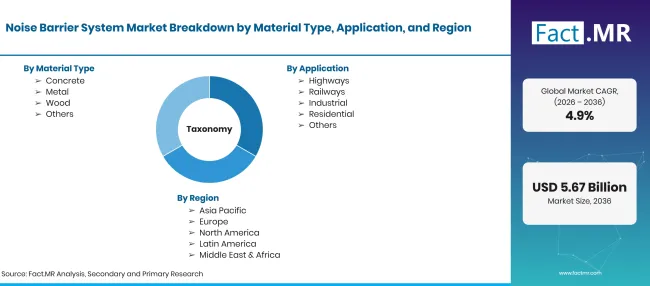
Factmr Noise Barrier System Market Taxonomy | Source: Fact.MR
| Items | Values |
|---|---|
| Quantitative Units (2026) | USD 3.53 billion |
| Material Type | Concrete, Metal, Wood; Others |
| Application | Highways, Railways, Industrial; Residential; Others |
| Installation | Ground-Mounted, Structure-Mounted |
| End-User | Transportation, Industrial, Commercial; Residential |
| Regions Covered | North America, Latin America, Europe; East Asia; South Asia and Pacific; Middle East & Africa |
| Countries Covered | United States, Germany, Japan; United Kingdom; Brazil and other countries |
| Key Companies Profiled | Noise Barriers LLC, Trelleborg AB, Armtec Infrastructure Inc.; R. Kohlhauer GmbH, Evonik Industries AG, Industrial Acoustics Company Inc.; Sound Fighter Systems LLC; ZAK Acoustic Panels; Akripol d.o.o. and Gramm Barriers Systems Limited |
| Additional Attributes | Revenue is segmented by material type, application, installation; end-user and region. |
Source: Fact.MR analysis. Updated Nov 19, 2026
Noise Barrier System Market by Segments
-
Material Type
- Concrete
- Metal
- Wood
- Others
-
Application
- Highways
- Railways
- Industrial
- Residential
- Others
-
Installation
- Ground-Mounted
- Structure-Mounted
-
End-User
- Transportation
- Industrial
- Commercial
- Residential
-
Region
- North America
- United States
- Canada
- Mexico
- Europe
- Germany
- United Kingdom
- France
- Italy
- Spain
- Rest of Europe
- Asia Pacific
- China
- India
- Japan
- South Korea
- Australia
- Rest of Asia Pacific
- Latin America
- Brazil
- Argentina
- Rest of Latin America
- Middle East & Africa
- GCC Countries
- South Africa
- Rest of Middle East & Africa
- North America
Frequently Asked Questions
How big is the global Noise Barrier System Market in 2026?
What will be the size of the Noise Barrier System Market by 2036?
How fast will the Noise Barrier System Market grow during the forecast period?
Which material type holds the largest share of the Noise Barrier System Market?
Who worked on this report


Preview the report firsthand - request a free sample
Free SampleGet the brochure for pricing and purchase details
Download PDF