- Market Value (2025): USD 3.06 Bn
- Estimated Value (2026): USD 3.23 Bn
- Forecast Value (2036): USD 5.6 Bn
- CAGR (2026-2036): 5.7%
Precision Resistors Market Forecast and Outlook 2026 to 2036
The precision resistors market was valued at approximately USD 3.06 billion in 2025 and USD 3.23 billion in 2026. It is projected to reach USD 5.6 billion by 2036, registering a 5.7% CAGR during the 2026–2036 assessment period.
Electric vehicle production, industrial automation and advanced testing equipment are creating new applications for precision resistors in current sensing and voltage control. In March 2025, Vishay Intertechnology introduced its WSBE Power Metal Strip shunt resistor series, featuring a temperature coefficient of resistance as low as ±10 ppm/°C and power ratings up to 50 W. The AEC-Q200-qualified components target automotive, energy and industrial applications, highlighting manufacturers' focus on improving measurement accuracy and thermal stability.
Key Takeaways from the Precision Resistors Market
- Sales of precision resistors stood at USD 3.06 billion in 2025
- Precision Resistors Market Value (2026): USD 3.23 billion
- Precision Resistors Market Forecast Value (2036): USD 5.6 billion
- Precision Resistors Market Forecast CAGR (2026-2036): 5.7%
- Leading Type: Thin Film (32.4%)
- Key Market Participants: Vishay Intertechnology, Yageo Corporation, Panasonic Corporation; Rohm Semiconductor; KOA Speer Electronics; Bourns Inc.
- Key Growth Regions: Brazil, United Kingdom, Japan; United States; Germany
Yageo’s 2025 acquisition of Shibaura Electronics expanded its presence in temperature-sensing components alongside its existing passive electronics portfolio. This move highlights how component manufacturers are broadening their product ranges to serve automotive and industrial customers through a wider mix of resistors, thermistors and sensors. Such portfolio expansion is changing competitive strategies and creating stronger links between precision resistor manufacturing and temperature-sensing technologies.
Precision Resistors Market
| Metric | Value |
|---|---|
| Estimated Value in (2025) | USD 3.06 billion |
| Estimated Value in (2026) | USD 3.23 billion |
| Forecast Value in (2036) | USD 5.6 billion |
| Forecast CAGR (2026 to 2036) | 5.7% |
Source: Fact.MR analysis. Updated Nov 19, 2026
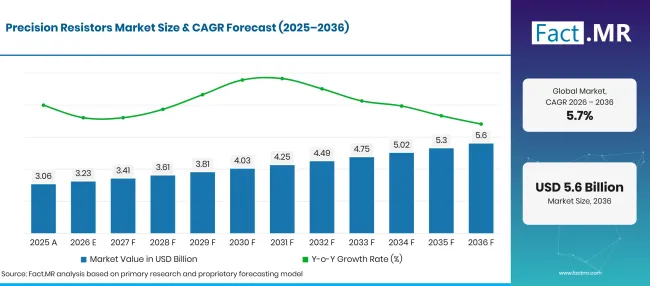
Precision Resistors Market Forecast Global | Source: Fact.MR
Category
| Category | Segments |
|---|---|
| Type | Thin Film, Thick Film, Wirewound; Metal Foil; Others |
| Application | Automotive, Consumer Electronics, Industrial; Telecommunications; Medical; Others |
| Tolerance | ±1%, ±0.01%, ±0.1%; Others |
| End-User | OEMs, Aftermarket |
| Region | Brazil; United Kingdom; Japan; United States; Germany |
Source: Fact.MR analysis. Updated Nov 19, 2026
Segmental Analysis
Why does thin film lead the type segment in the Precision Resistors Market?
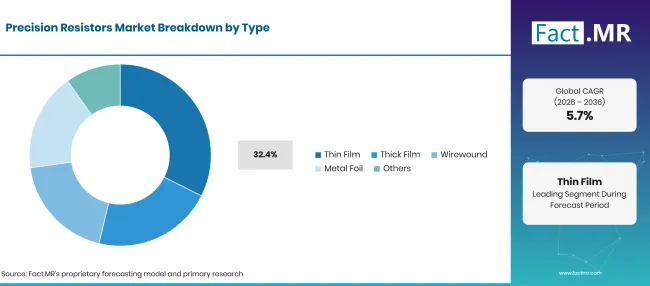
Precision Resistors Market Breakdown Type | Source: Fact.MR
Sputtered nichrome and tantalum nitride layers let thin film chips hold tight tolerance and a low temperature coefficient in very small footprints. That is why the type takes 32.4% of 2026 precision resistor revenue, close to USD 1.0 billion. Vishay, Susumu and KOA all list thin film chip ranges down to ±0.05% tolerance, aimed at instrumentation and medical boards.
Makers are now stretching the technology into automotive-grade and high-power case sizes, and continued miniaturization should hold its lead through 2036. The sensor market that feeds many of these boards is forecast by WSTS to grow from USD 20.9 billion in 2025 to USD 21.5 billion in 2026, a 3.0% rise.
How is the automotive sector shaping application sales in the Precision Resistors Market?
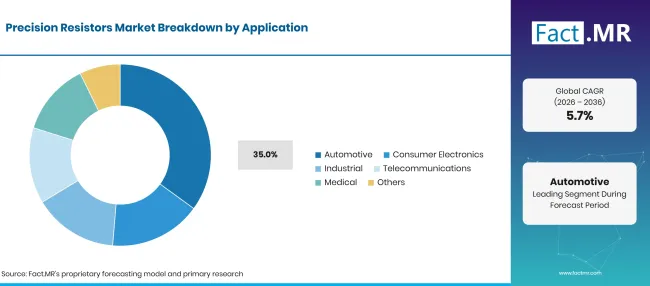
Precision Resistors Market Breakdown Application | Source: Fact.MR
Isabellenhütte and Bourns supply metal-element shunts sized for battery current measurement in electric vehicles, and that is where much of the segment’s buying sits. Automotive electronics hold 35.0% of 2026 application revenue, about USD 1.1 billion. Battery-management systems, onboard chargers and traction inverters all rely on shunt and divider resistors that keep readings stable as temperature and load swing.
Producers are qualifying parts to AEC-Q200 and raising pulse-load ratings, and more electronics content per vehicle should keep automakers the biggest buyers. The vehicle base itself is growing. The IEA reports that global electric car sales topped 20 million in 2025, up 20% from 2024, and it projects 23 million in 2026; even though first-quarter sales fell 8% after policy changes in China and the United States.
Why does ±1% tolerance lead the Precision Resistors Market?
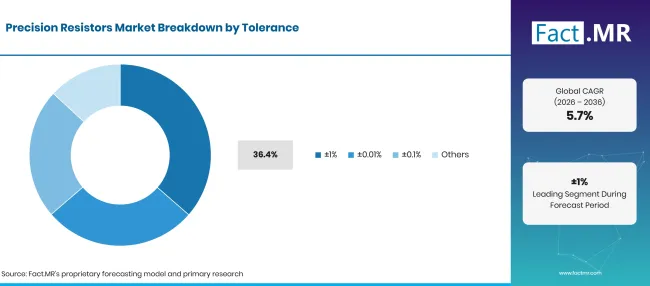
Precision Resistors Market Breakdown Tolerance | Source: Fact.MR
Most circuit designers do not need better than ±1%, so that band is where the money goes. It holds 36.4% of 2026 precision resistor revenue, about USD 1.2 billion, across automotive; industrial and consumer boards at moderate cost. Tolerances of ±0.1% and ±0.01% are kept for metrology, medical and reference circuits where error budgets are tight. Thick and thin film lines both turn out ±1% parts in high volume, and that cost-to-performance balance should keep the band in front. Volumes follow wider electronics activity. WSTS reported global semiconductor sales of USD 702 billion in the first half of 2026, a 102% increase year over year.
Why do OEMs dominate end-user sales in the Precision Resistors Market?
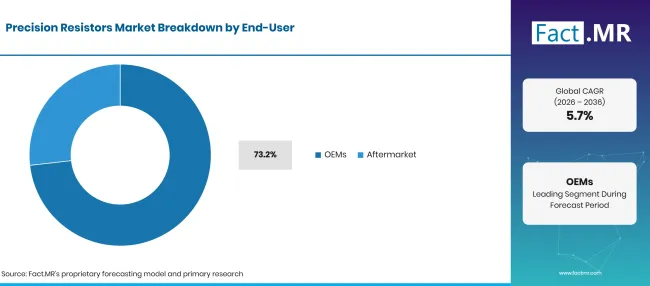
Precision Resistors Market Breakdown End User 1 | Source: Fact.MR
Precision resistors are chosen at the design stage. An OEM fixes values and tolerances at the start of a program and secures supply through long-term agreements. That puts OEMs at 73.2% of 2026 end-user revenue, about USD 2.4 billion. Aftermarket buying is mostly repair, calibration and module replacement. Suppliers back OEMs with design-in engineering, sample kits and dual-site manufacturing, and that purchasing pattern should keep OEMs ahead. WSTS’s Spring 2026 forecast has discrete semiconductor sales rising from USD 30.7 billion in 2025 to USD 33.2 billion in 2026, an 8.0% increase.
Precision Resistors Market-Drivers, Restraints & Trends
Driver
Electrification and factory automation are bringing precision resistors into more sensing, control and measurement circuits. In September 2025, the International Federation of Robotics reported that 542,000 industrial robots were installed worldwide in 2024; highlighting the scale of electronics used in automated production. These systems depend on stable resistance values for motor control and feedback, making low-TCR and current-sensing resistors important components in industrial equipment.
Restraints
Precision resistor sales can suffer when electronics manufacturers cut inventory or postpone production, leaving suppliers with excess stock and weaker order volumes. High manufacturing costs, lengthy qualification processes and price competition from Asian chip resistor producers further squeeze margins. These pressures make it difficult for smaller manufacturers to compete on price while maintaining tight tolerance and quality standards.
Trend
Rising Battery Monitoring Requirements: Precision resistors are becoming more relevant to battery monitoring as electric vehicles and stationary storage installations place greater emphasis on accurate current measurement and thermal stability. The International Energy Agency reported in April 2026 that global battery storage additions reached 108 GW in 2025, marking a 40% annual increase. This expansion creates opportunities for precision resistor manufacturers across battery management, grid storage and charging infrastructure. Future market gains will also depend on wider adoption of energy storage in renewable power networks.
Trend
Consolidation Across Passive Components: The passive component industry is seeing portfolio expansion as manufacturers look to serve more electronic applications through established customer relationships. In October 2025, Yageo completed its tender offer for Shibaura Electronics, securing an approximately 87.3% ownership stake. Such transactions point to a broader shift towards consolidated component portfolios. For the precision resistors market, this creates opportunities to reach new automotive, industrial and electronics customers through wider distribution networks and integrated manufacturing capabilities.
Precision Resistors Market by Analysis by Key Country
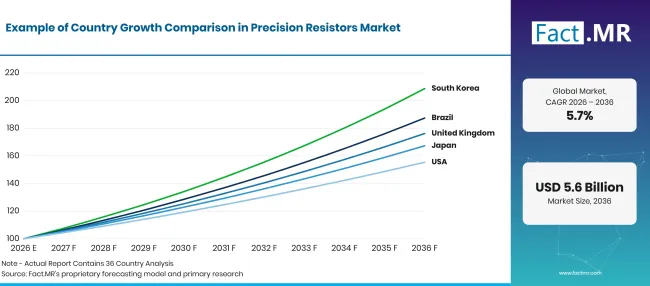
Precision Resistors Market Growth Index | Source: Fact.MR
| Country | CAGR (2026-2036) |
|---|---|
| Brazil | 6.5% |
| United Kingdom | 5.8% |
| Japan | 5.3% |
| United States | 4.5% |
| Germany | 4.0% |
Source: Fact.MR analysis. Updated Nov 19, 2026
Why is Brazil the fastest-growing market for precision resistors?
Brazil's precision resistors market is set to expand at a 6.5% CAGR through 2036, supported by automotive manufacturing and investment in domestic industrial production.
The country's Mover programme is encouraging automakers to invest in technological innovation, energy efficiency and lower-emission vehicles. This creates a favourable environment for precision components used in battery monitoring, vehicle electronics and industrial controls. Local manufacturing partnerships and access to automotive supply chains will influence how quickly resistor manufacturers capture these opportunities.
How is the electronics base supporting precision resistors in the United Kingdom?
The United Kingdom market is advancing at a 5.8% CAGR, with semiconductor research, aerospace electronics; defence systems and industrial instrumentation creating opportunities for precision component manufacturers.
The UK government announced a £10 million semiconductor innovation fund in September 2025 to help domestic businesses move chip technologies from research into commercial production. This activity strengthens the wider electronics ecosystem, where accurate resistance control is important in testing, power management and electronic equipment.
What is driving precision resistor demand in Japan?
Japan's precision resistors market is set to record a 5.3% CAGR through 2036.
Semiconductor manufacturing, automotive electronics and factory automation provide a strong industrial base for components used in measurement and circuit control. In November 2025, Japan's Ministry of Economy, Trade and Industry selected Rapidus for financial support; including an initial investment of JPY 100 billion from the FY2025 budget. Semiconductor capacity expansion could create additional opportunities for precision resistor manufacturers serving advanced electronics production.
How are investment programs supporting precision resistor sales in the United States?
At a 4.5% CAGR, the United States market is advancing at a slower pace than Brazil, the UK and Japan.
domestic semiconductor manufacturing, aerospace electronics, medical equipment and industrial controls continue to create opportunities for precision components. In June 2025, the US Department of Commerce announced Micron's planned USD 200 billion investment in semiconductor manufacturing and research across the country. Expansion of domestic chip production can widen the customer base for precision resistors used in power regulation, testing and electronic control systems.
What is shaping precision resistor demand in Germany?
Germany's market is projected to grow at a 4.0% CAGR through 2036, reflecting the slower pace of its automotive and industrial manufacturing sectors. Destatis reported in January 2026 that German manufacturing output declined 1.3% in 2025, with automotive and machinery production among the weaker areas.
This industrial slowdown can limit near-term component orders. demand from factory automation, industrial testing, power electronics and automotive control systems continues to offer opportunities for precision resistor manufacturers.
Competitive Landscape for Precision Resistors Market
The precision resistors market includes large passive-component manufacturers such as Vishay, Yageo, Panasonic; Rohm and KOA; alongside specialists such as Susumu and Isabellenhütte that focus on metal-foil; shunt and low-TCR technologies. Buyers pay close attention to resistance accuracy, long-term stability, pulse handling and reliable product availability when selecting component partners.
In 2025, Yageo completed its acquisition of Shibaura Electronics, broadening its presence in temperature-sensing technologies. Wider product portfolios, automotive qualifications and manufacturing reach across regions are becoming important considerations in securing long-term OEM contracts.
Recent Developments
- On September 3, 2026, Vishay Intertechnology introduced its CHEP series of thin-film high-frequency chip resistors; offering power ratings of up to 2.8 W and operation at frequencies up to 50 GHz.
- On October 3, 2025, Yageo Corporation completed its tender offer for Japan-based Shibaura Electronics; securing approximately 87% of its shares to expand its temperature-sensing and electronic component business.
- On March 26, 2026, Panasonic Industry introduced its ERJPC series of high-precision thick-film resistors; offering tolerances as low as ±0.1% and a temperature coefficient of resistance of 25 ppm/K.
- On September 10, 2026, ROHM introduced its SDR01 series of high anti-surge chip resistors; delivering a rated power of 0.33 W in the compact 0402 size for automotive; industrial and consumer electronics applications.
- On July 31, 2026, KOA expanded its RN73H precision resistor series by adding a 0201-inch size option; increasing the range of compact; high-power metal-film chip resistors available to customers.
Key Players in Precision Resistors Market
Key companies profiled include Vishay Intertechnology; Yageo Corporation; Panasonic Corporation; Rohm Semiconductor; KOA Speer Electronics; Bourns Inc.; TT Electronics plc; Susumu Co., Ltd.; and Isabellenhütte Heusler GmbH.
- Vishay Intertechnology
- Yageo Corporation
- Panasonic Corporation
- Rohm Semiconductor
- KOA Speer Electronics
- Bourns Inc.
- TT Electronics plc
- Susumu Co., Ltd.
- Isabellenhütte Heusler GmbH
Bibliography
- Department for Science, Innovation and Technology. (2025, September 24). New £10 million fund to support UK businesses to deliver next generation of semiconductors. GOV.UK.
- Destatis. (2026, January). Gross domestic product up 0.2% in 2025. Federal Statistical Office of Germany
- International Energy Agency. (2026). Global Energy Review 2026: Technology: Battery storage
- International Energy Agency. (2026). Global EV Outlook 2026: Executive summary
- International Federation of Robotics. (2025, September 25). Global robot demand in factories doubles over 10 years
- Ministério do Desenvolvimento, Indústria, Comércio e Serviços. (2026). Programa MOVER. Governo Federal do Brasil
- Ministry of Economy, Trade and Industry. (2025, November 21). Press conference by Minister Akazawa (excerpt). Government of Japan.
- Senado Federal. (2024, June 27). Lei nº 14.902, de 27 de junho de 2024. Governo Federal do Brasil
- U.S. Department of Commerce, National Institute of Standards and Technology. (2024). FY 2025 budget in brief
- World Semiconductor Trade Statistics. (2026). Global semiconductor market records exceptional growth in Q2 2026
Segmentation
Scope of Report
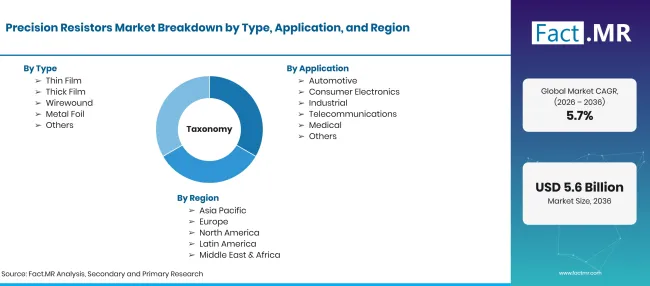
Precision Resistors Market Taxonomy | Source: Fact.MR
| Items | Values |
|---|---|
| Quantitative Units (2026) | USD 3.23 Billion |
| Type | Thin Film, Thick Film, Wirewound; Metal Foil; Others |
| Application | Automotive, Consumer Electronics, Industrial; Telecommunications; Medical; Others |
| Tolerance | ±1%, ±0.01%, ±0.1%; Others |
| End-User | OEMs, Aftermarket |
| Regions Covered | North America, Latin America, Europe; East Asia; South Asia and Pacific; Middle East & Africa |
| Countries Covered | United States, Germany, Japan; United Kingdom; Brazil; and other countries |
| Key Companies Profiled | Vishay Intertechnology, Yageo Corporation, Panasonic Corporation; Rohm Semiconductor; KOA Speer Electronics; Bourns Inc.; TT Electronics plc; Susumu Co.; Ltd.; Isabellenhütte Heusler GmbH |
| Additional Attributes | Dollar revenue in the Precision Resistors Market is segmented by type (thin film, thick film, wirewound; metal foil); application (automotive; consumer electronics; industrial; telecommunications; medical); tolerance (±1%; ±0.01%; ±0.1%); end-user (OEMs; aftermarket) and region. |
Source: Fact.MR analysis. Updated Nov 19, 2026
Precision Resistors Market by Segments
-
Type
- Thin Film
- Thick Film
- Wirewound
- Metal Foil
- Others
-
Application
- Automotive
- Consumer Electronics
- Industrial
- Telecommunications
- Medical
- Others
-
Tolerance
- ±1%
- ±0.01%
- ±0.1%
- Others
-
End-User
- OEMs
- Aftermarket
-
Region:
- North America
- United States
- Canada
- Mexico
- Europe
- Germany
- United Kingdom
- France
- Italy
- Spain
- Rest of Europe
- Asia Pacific
- China
- India
- Japan
- South Korea
- Australia
- Rest of Asia Pacific
- Latin America
- Brazil
- Mexico
- Argentina
- Rest of Latin America
- Middle East & Africa
- GCC Countries
- South Africa
- Rest of Middle East & Africa
- North America
Frequently Asked Questions
How big is the global Precision Resistors Market in 2026?
What will be the size of the Precision Resistors Market by 2036?
How fast will the Precision Resistors Market grow during the forecast period?
Which type segment holds the largest share of the Precision Resistors Market?
Who worked on this report


Preview the report firsthand - request a free sample
Free SampleGet the brochure for pricing and purchase details
Download PDF