
Flexible Thermal Insulation Market Forecast and Outlook 2026 to 2036
As per the Fact.MR analysis, the flexible thermal insulation market crossed a valuation of USD 7.13 billion in 2025 and is projected to grow from USD 7.56 billion in 2026 to USD 13.54 billion by 2036. Demand for flexible thermal insulation is likely to grow at a CAGR of 6.0% over the forecast period.
Demand for flexible thermal insulation is rising as building owners, process plants and equipment makers look to cut heat loss, control condensation and meet tighter energy-efficiency requirements without the cost of rigid cladding. The key players are offering elastomeric foam, mineral wool blankets, polyolefin foam and reflective multilayer products that install quickly around pipes, ducts and irregular shapes.
Key Takeaways from the Flexible Thermal Insulation Market
- Flexible Thermal Insulation Market Value (2025): USD 7.13 billion
- Flexible Thermal Insulation Market Value (2026): USD 7.56 billion
- Flexible Thermal Insulation Market Forecast Value (2036): USD 13.54 billion
- Flexible Thermal Insulation Market Forecast CAGR (2026-2036): 6.0%
- Leading Material: Elastomeric foam (34.8%)
- Key Market Participants: Owens Corning, Saint-Gobain, Armacell, Johns Manville, Rockwool
- Key Growth Countries: India, China, United Kingdom, United States, South Korea
Retrofit work on existing pipework and HVAC systems, alongside new commercial construction, is expected to keep volumes growing steadily through 2036, with fire-rated and low-smoke grades taking a larger share of purchases.
Flexible Thermal Insulation Market
| Metric | Value |
|---|---|
| Estimated Value in (2026) | USD 7.56 billion |
| Forecast Value in (2036) | USD 13.54 billion |
| Forecast CAGR (2026 to 2036) | 6.0% |
Source: Fact.MR analysis
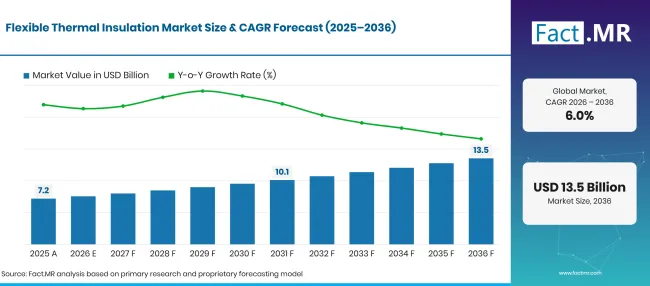
Flexible Thermal Insulation Market Forecast Global | Source: Fact.MR
Category
| Category | Segments |
|---|---|
| Material | Elastomeric foam, Fibreglass and mineral wool blankets, Polyolefin and polyethylene foam, Flexible reflective multilayer, Ceramic fibre blankets |
| Application | Pipe and tank insulation, HVAC ducts and refrigeration, Industrial furnaces and process equipment, Building envelope and roofing, Transport and vehicles |
| Form | Rolls and blankets, Pre-formed tubes and sleeves, Sheets, Tapes and wraps |
| End Use | Commercial buildings, Oil, gas and petrochemicals, Residential buildings, Industrial manufacturing, Power generation |
| Region | India; China; United Kingdom; United States; South Korea |
Source: Fact.MR analysis
Segmental Analysis
What makes elastomeric foam the leading material segment in the Flexible Thermal Insulation Market?
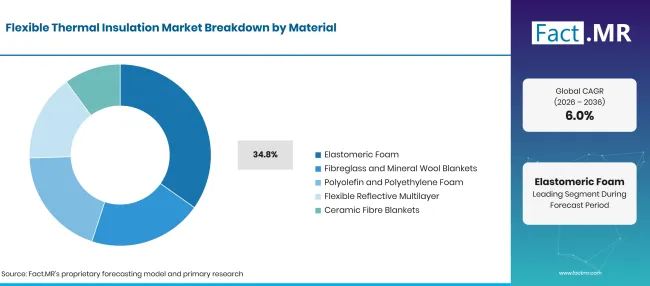
Flexible Thermal Insulation Market Breakdown Material | Source: Fact.MR
Demand for the elastomeric foam segment accounts for 34.8% of revenue in 2026, about USD 2.63 billion, as closed-cell foam resists moisture ingress and keeps its insulating value on chilled-water and refrigeration lines, where vapor barriers are hard to maintain. Installers favor the material for its flexibility and fast fitting around bends and fittings. India's Bureau of Energy Efficiency (BEE), in its April 2026 building-sector update, reported that buildings account for more than 30% of national electricity consumption. It also estimates that 300,000 square feet of commercial floor space is being constructed daily. Expanding cooling infrastructure supports demand for closed-cell elastomeric insulation, particularly around pipes, fittings and complex installations where vapor protection is essential.
Which factors support pipe and tank insulation as the largest application segment in the Flexible Thermal Insulation Market?
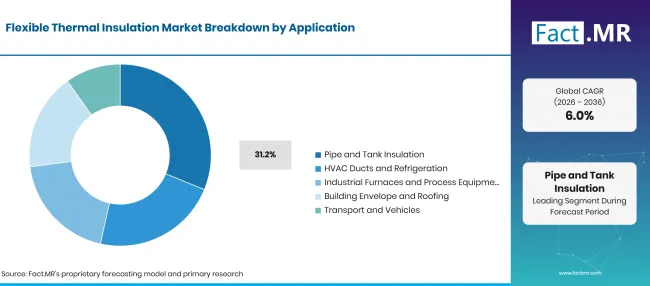
Flexible Thermal Insulation Market Breakdown Application | Source: Fact.MR
Pipe and tank insulation accounts for 31.2% of revenue in 2026, about USD 2.36 billion, as process plants, district systems and commercial buildings insulate hot and cold lines to cut energy loss and prevent condensation. Specifiers look for products that stay in place under vibration and temperature cycling. India's Ministry of Statistics and Programme Implementation released Energy Statistics India 2026 on March 30, highlighting the country's expanding energy infrastructure and the importance of improving energy efficiency. Additionally, BEE identifies industrial and building energy conservation as important priorities. These developments support demand for flexible insulation materials that reduce thermal losses, control surface condensation and maintain performance under temperature fluctuations and mechanical vibration.
What makes rolls and blankets the leading form segment in the Flexible Thermal Insulation Market?
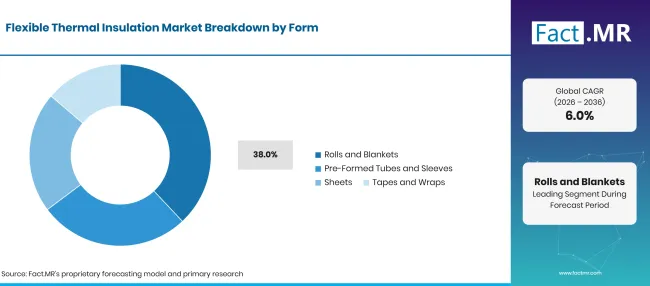
Flexible Thermal Insulation Market Breakdown Form | Source: Fact.MR
Demand for the rolls and blankets segment accounts for 38.0% of revenue in 2026, about USD 2.87 billion, because rolls can be cut and wrapped on site around ducts, tanks and irregular surfaces with limited tooling. Contractors value the low waste and quick coverage on large surfaces. India's building-sector expansion provides a supportive demand environment. BEE reported in April 2026 that approximately 40% of the building stock expected over the next 20 years has yet to be constructed. This creates opportunities for insulation materials used in new HVAC installations and building retrofits. Flexible rolls and blankets offer convenient cutting, wrapping and installation, helping contractors cover larger surfaces while accommodating different equipment dimensions and site requirements.
Which factors support commercial buildings as the largest end use segment in the Flexible Thermal Insulation Market?
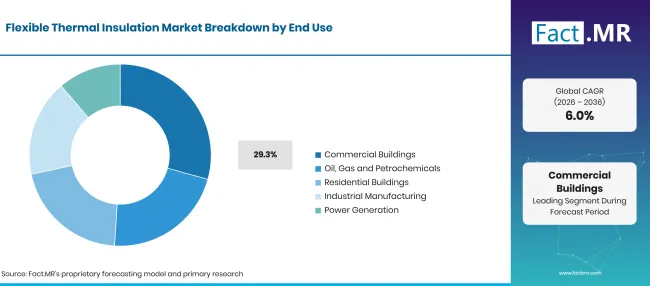
Flexible Thermal Insulation Market Breakdown End Use | Source: Fact.MR
The commercial buildings segment accounts for 29.3% of revenue in 2026, about USD 2.22 billion, as offices, hospitals, retail and hospitality sites run extensive chilled-water, heating and ventilation networks that need insulating and are refitted often to meet energy targets. Building owners weigh thermal performance, fire rating and smoke emission when choosing materials. NITI Aayog's February 2026 building-sector assessment estimated commercial building electricity demand at approximately 137 TWh in 2025. The assessment also identifies improved insulation, efficient HVAC systems and building energy management as important measures for controlling future consumption. With commercial floor space expanding and cooling requirements increasing, building owners are prioritising flexible insulation for chilled-water pipes, ventilation ducts and mechanical equipment to improve energy performance and reduce operating expenses.
Flexible Thermal Insulation Market-Drivers, Restraints & Trends
Drivers:
Energy Efficiency Requirements and Rising Building Energy Consumption -: Demand for flexible thermal insulation is rising as energy-efficiency requirements and higher energy costs push building and plant operators to insulate pipes, ducts and equipment that were previously left bare or poorly covered. The Bureau of Energy Efficiency (BEE), Ministry of Power, Government of India, updated its Buildings Background report on April 30, 2026. According to BEE, buildings account for more than 30% of India's total electricity consumption, while approximately 300,000 square feet of commercial floor space is being constructed daily. The agency also estimates that 40% of the building stock expected over the next 20 years has yet to be constructed. These figures demonstrate the scale of India's building expansion and the importance of improving building-envelope efficiency. Growing construction activity and energy-efficiency requirements support demand for flexible thermal insulation in HVAC ducts, pipes and building equipment.
Restraints: Installation Costs and Performance-Related Investment Barriers -:
Sales is constrained by price competition from rigid and spray-applied alternatives and by installation quality, because gaps and poor sealing reduce the thermal performance that buyers are paying for. The UK Ministry of Housing, Communities and Local Government published its English Housing Survey 2024–25 findings on January 29, 2026. The report estimated that improving a dwelling to at least Energy Performance Certificate (EPC) band C would cost an average of £7,480 in 2024. It also found that 56% of English homes had achieved energy-efficiency bands A to C, compared with 26% in 2014. These figures illustrate the financial commitment involved in improving building energy performance. For flexible thermal insulation suppliers, installation expenditure and the need for correct fitting, sealing and maintenance can influence purchasing decisions, particularly when buyers compare flexible products with alternative insulation systems.
Opportunity: Fire-Rated and Low-Smoke Grades
Specifiers are asking for lower smoke and flame-spread ratings, and suppliers are adding halogen-free and fire-tested grades for enclosed buildings and transport. The UK Ministry of Housing, Communities and Local Government published its 2026 fire prevention and protection statistics on September 2, 2026, covering the year ending March 2026. The government reported 26,180 dwelling fires during the reporting period. Fire safety requirements also place emphasis on maintaining appropriate precautions in non-domestic premises and multi-occupied residential buildings. Separately, India's Ministry of Health and Family Welfare specifies that hospital construction materials should provide adequate fire resistance and should not emit toxic gases or smoke during fires. These safety considerations create opportunities for insulation manufacturers offering tested fire-resistant, low-smoke and halogen-free materials.
Trend: Pre-Formed and Pre-Cut Systems
Pre-formed tubes, sleeves and pre-cut kits are taking share from site-cut insulation as contractors seek faster installation and consistent fit. India's Ministry of Statistics and Programme Implementation released its first-ever detailed pilot study of the unincorporated construction sector on April 10, 2026. The study estimated 10.27 lakh construction establishments and found that approximately 77% regularly engaged at least one hired worker. Household construction activities employed around four labourers on average. These figures highlight the labour-intensive nature of construction activity and the importance of improving installation efficiency. Pre-formed pipe sections, factory-prepared sleeves and pre-cut insulation kits can help reduce on-site measuring, cutting and fitting requirements. India's Bureau of Indian Standards also maintains IS 9842:2024 for preformed fibrous pipe insulation, demonstrating the established technical standardization of this product category.
Flexible Thermal Insulation Market Analysis by Key Country
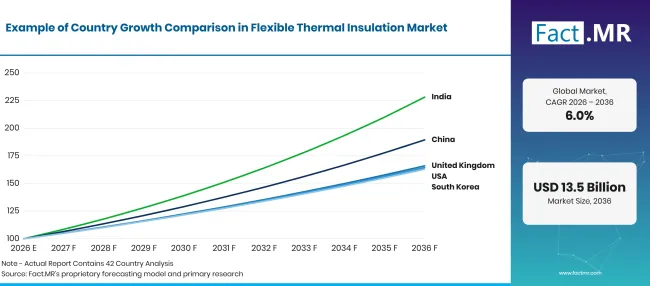
Flexible Thermal Insulation Market Growth Index | Source: Fact.MR
| Country | CAGR (2026-2036) |
|---|---|
| India | 8.6% |
| China | 6.6% |
| United Kingdom | 5.2% |
| United States | 5.1% |
| South Korea | 5.0% |
Source: Fact.MR analysis.
Why is India the fastest-growing market for flexible thermal insulation?
Demand for flexible thermal insulation in India is likely to increase at an 8.6% CAGR through 2036, the fastest among the five countries.
Rapid construction of commercial space, data centers and process plants, together with growing cooling demand, is enlarging the base of piping and ductwork that needs insulating. India's flexible thermal insulation market is projected to expand at an 8.6% CAGR through 2036, the fastest among the five profiled countries. Rising data-centre construction, commercial infrastructure and industrial cooling requirements are expanding opportunities for insulated pipes, ducts and HVAC systems. According to India's Ministry of Electronics and Information Technology, installed data-centre capacity increased from 375 MW in 2020 to approximately 1,575 MW by August 2026. The government also highlighted the Energy Conservation and Sustainable Building Code 2024, which establishes energy-efficiency requirements for buildings. These developments support demand for thermal insulation across cooling-intensive infrastructure.
How is demand for flexible thermal insulation developing in China?
Demand for flexible thermal insulation in China is estimated to advance at a 6.6% CAGR through 2036, above the global rate of 6.0%.
Large-scale building and industrial investment, along with efficiency standards for new construction, supports steady demand for elastomeric and mineral wool products from local and international suppliers. Demand opportunities remain connected to industrial facilities, commercial building upgrades and energy-efficiency improvements, although the construction market faces significant headwinds. China's National Bureau of Statistics reported that real-estate development investment declined 21.6% year-on-year to RMB 5,721.5 billion during January to October 2026. Building floor space under construction also decreased 13.0%. Consequently, insulation suppliers increasingly need to target industrial applications, replacement projects and energy-efficiency retrofits rather than rely exclusively on new-building construction.
Which building-efficiency developments are supporting insulation demand in the United Kingdom?
Demand for flexible thermal insulation in United Kingdom is set to expand at a 5.2% CAGR through 2036, below the global rate of 6.0%.
Retrofit activity in older commercial and public buildings, driven by decarbonization targets, is raising demand for pipe and duct insulation in heating and cooling systems. Demand is supported by energy-efficiency improvements in existing buildings and requirements for better-performing heating and cooling infrastructure. The UK Ministry of Housing, Communities and Local Government reported that 468,000 Energy Performance Certificates were lodged for domestic and non-domestic properties across England and Wales during July to September 2026, representing a 9% annual increase. Additionally, the Department for Energy Security and Net Zero published 2026 household energy-efficiency statistics covering insulation measures installed under government-supported schemes.
What is shaping flexible thermal insulation demand in United States?
Demand for flexible thermal insulation in United States is projected to grow at a 5.1% CAGR through 2036, below the global rate of 6.0%.
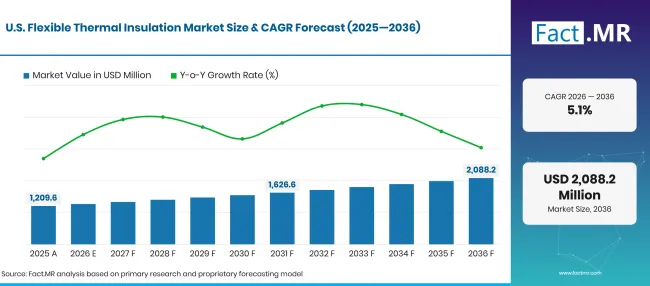
Flexible Thermal Insulation Market Forecast Usa | Source: Fact.MR
Commercial building development, industrial maintenance and HVAC modernisation continue to create opportunities for flexible insulation products. According to the US Census Bureau, non-residential construction spending reached an annualised USD 790.6 billion in September 2026, increasing 1.1% from August. This spending supports demand across commercial facilities and industrial infrastructure, where insulated piping and ductwork help control thermal losses. Energy-efficiency requirements and building upgrades further encourage insulation replacement across existing facilities.
Which industrial and building trends explain South Korea's comparatively slower growth?
Demand for flexible thermal insulation in South Korea is forecast to rise at a 5.0% CAGR through 2036, the slowest among the five countries.
Demand remains associated with electronics manufacturing, shipbuilding, petrochemical facilities and energy-efficient building construction. Statistics Korea's January 2026 construction orders data recorded Seoul construction orders of KRW 1.65 trillion, an increase of 23.0% year-on-year. Private-sector orders increased 76.4%, supported by reconstruction housing, offices and redevelopment projects. These investments create opportunities for pipe and duct insulation, although the established industrial base and relatively mature building market moderate the pace of additional equipment and insulation demand.
Competitive Landscape for Flexible Thermal Insulation Market
The flexible thermal insulation market is moderately concentrated, with Owens Corning, Saint-Gobain, Armacell, Johns Manville and Rockwool together hold about 48% of 2026 revenue, based on Fact.MR estimates. Competition centers on thermal performance, fire ratings, availability through insulation distributors and technical support for contractors. Global insulation groups compete with specialist elastomeric foam makers, while regional producers compete mainly on price and local supply.
Recent Developments
- In February 2026, Owens Corning announced construction of a new fiberglass insulation production line at its Kansas City, Kansas facility. The investment will expand residential and non-residential insulation manufacturing capacity, with production expected to begin in 2027. The facility will incorporate improved manufacturing technology, energy efficiency and environmental controls.
- On August 13, 2025, Saint-Gobain announced construction of its fifth mineral wool insulation line at Oragadam, Chennai. The facility is designed for annual production capacity of 50,000 tonnes and represents a major expansion of the company's insulation manufacturing operations in India. The investment incorporates digital manufacturing technologies and near-net-zero-carbon production objectives.
- On January 6, 2026, Saint-Gobain announced the divestment of HKO, a business specialising in high-temperature industrial insulation textiles. This represents a portfolio restructuring development in the industrial insulation segment rather than an expansion of its insulation business.
- On April 1, 2025, Armacell introduced ArmaGel XGC, an advanced aerogel insulation blanket for cryogenic and dual-temperature industrial applications. The product is designed for operating temperatures down to -196°C and incorporates proprietary low-dust technology to improve worker safety during installation.
- On June 23, 2025, Armacell inaugurated its new Pune manufacturing facility to produce ArmaGel XGH and XGC aerogel insulation blankets. The facility doubles the company's available aerogel blanket manufacturing capacity, supporting industrial insulation requirements across high-temperature and cryogenic applications.
- On February 25, 2025, Johns Manville announced plans to build a new Climate Pro blowing-wool production line in Winder, Georgia. The expansion is intended to increase fiberglass insulation manufacturing capacity and address growing demand across eastern and central US markets. Commercial operations are expected to begin in mid-2027. Strengthens fiberglass insulation manufacturing capacity, particularly for building thermal insulation.
- On April 2, 2025, ROCKWOOL introduced Smartrock, an insulation solution combining a stone wool board with an integrated smart vapor retarder. The product provides thermal, vapor and air-control functionality for interior insulation of concrete and masonry walls, supporting both renovation and new construction.
- On May 6, 2026, ROCKWOOL signed an agreement to acquire Ravago's stone wool manufacturing facility in Hungary. The plant has annual production capacity of 40,000 tonnes and employs more than 100 people. The transaction is intended to strengthen manufacturing coverage in Central and Eastern Europe.
Key Players in Flexible Thermal Insulation Market
Key companies operating in the market include Owens Corning, Saint-Gobain, Armacell, Johns Manville, and Rockwool.
- Owens Corning
- Saint-Gobain
- Armacell
- Johns Manville
- Rockwool
Bibliography
- Armacell. (2026, September 9). ArmaFlex ECO550 adhesives awarded UL ECOLOGO certification under UL 2762.
- Bureau of Energy Efficiency. (2026, April 30). Energy efficiency in buildings.
- Ministry of Statistics and Programme Implementation. (2026, March 30). Release of publication “Energy Statistics India 2026”. Press Information Bureau.
- NITI Aayog. (2026, February 10). Scenarios towards Viksit Bharat and Net Zero: Sectoral insights—Buildings (Vol. 5).
- NITI Aayog. (2026, February 11). NITI Aayog releases study reports on scenarios towards Viksit Bharat and Net Zero. Press Information Bureau.
- Armacell. (2025, June 23). Armacell opens new aerogel insulation plant in India to manufacture breakthrough ArmaGel XG product line.
- Saint-Gobain. (2025, August 13). Saint-Gobain begins construction of new float glass and insulation lines in Chennai.
Segmentation
Scope of Report
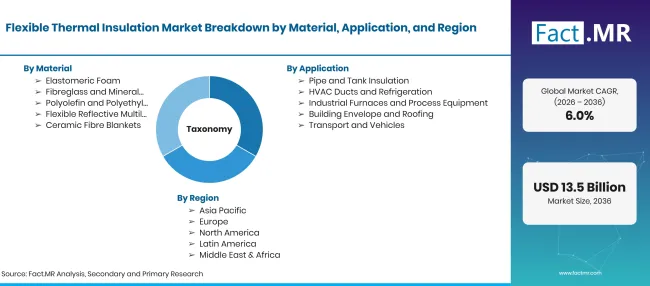
Flexible Thermal Insulation Market Taxonomy | Source: Fact.MR
| Items | Values |
|---|---|
| Quantitative Units (2026) | USD 7.56 Billion |
| Material | Elastomeric foam, Fibreglass and mineral wool blankets, Polyolefin and polyethylene foam, Flexible reflective multilayer, Ceramic fibre blankets |
| Application | Pipe and tank insulation, HVAC ducts and refrigeration, Industrial furnaces and process equipment, Building envelope and roofing, Transport and vehicles |
| Form | Rolls and blankets, Pre-formed tubes and sleeves, Sheets, Tapes and wraps |
| End Use | Commercial buildings, Oil, gas and petrochemicals, Residential buildings, Industrial manufacturing, Power generation |
| Regions Covered | North America, Latin America, Europe, Asia Pacific, Middle East & Africa |
| Countries Covered | India, China, United Kingdom, United States, South Korea, and other countries |
| Key Companies Profiled | Owens Corning, Saint-Gobain, Armacell, Johns Manville, Rockwool |
| Additional Attributes | Dollar revenue in the Flexible Thermal Insulation Market is segmented by material, application, form and end use and region. |
Source: Fact.MR analysis.
Flexible Thermal Insulation Market by Segments
-
Material
- Elastomeric foam
- Fibreglass and mineral wool blankets
- Polyolefin and polyethylene foam
- Flexible reflective multilayer
- Ceramic fibre blankets
-
Application
- Pipe and tank insulation
- HVAC ducts and refrigeration
- Industrial furnaces and process equipment
- Building envelope and roofing
- Transport and vehicles
-
Form
- Rolls and blankets
- Pre-formed tubes and sleeves
- Sheets
- Tapes and wraps
-
End Use
- Commercial buildings
- Oil, gas and petrochemicals
- Residential buildings
- Industrial manufacturing
- Power generation
-
Region:
- North America
- United States
- Canada
- Mexico
- Europe
- Germany
- United Kingdom
- France
- Italy
- Spain
- Rest of Europe
- Asia Pacific
- China
- India
- Japan
- South Korea
- Australia and New Zealand
- Rest of Asia Pacific
- Latin America
- Brazil
- Argentina
- Rest of Latin America
- Middle East & Africa
- GCC Countries
- South Africa
- Rest of Middle East & Africa
- North America
Table of Contents
Key Takeaways
- Market Size and CAGR
- Top Growth Driver
- Fastest Growing Segment
- Leading Region
- Key Companies
- Emerging Opportunities

