
- Market Value (2025): USD 197.2 Mn
- Estimated Value (2026): USD 211.0 Mn
- Forecast Value (2036): USD 415.1 Mn
- CAGR (2026-2036): 7.0%
On-Demand Flavour Systems Market Forecast and Outlook 2026 to 2036
The on-demand flavour systems market reached a derived estimate of USD 197.2 million in 2025. The market is expected to increase from USD 211.0 million in 2026 to USD 415.1 million by 2036, expanding at a CAGR of 7.0% during the forecast period.
Food manufacturers are exploring flexible flavour dosing to manage frequent recipe changes and growing product variety. On-demand systems allow liquid and powdered concentrates to be added in controlled quantities during production, reducing the need to hold large pre-blended batches. Givaudan reported CHF 7,472 million in group sales in 2025, while its Taste & Wellbeing division generated CHF 3,642 million. Its flavour business recorded growth across snacks, dairy, healthcare and sweet goods, highlighting the breadth of applications where precise flavour handling matters.
Key Takeaways from the On-Demand Flavour Systems Market
- Sales of on-demand flavour systems stood at USD 197.2 million in 2025
- On-Demand Flavour Systems Market Value (2026): USD 211.0 million
- On-Demand Flavour Systems Market Forecast Value (2036): USD 415.1 million
- On-Demand Flavour Systems Market Forecast CAGR (2026-2036): 7.0%
- Leading Flavour dosing architecture: Dry powder dosing (29.0%)
- Key Market Participants: Givaudan, IFF, Symrise, Kerry Group, DSM-Firmenich, Sensient Technologies
- Key Growth Regions: China, United States, United Kingdom, Germany, Japan
In 2025, food manufacturers faced growing pressure to adjust recipes as the UK government confirmed that HFSS advertising restrictions would take effect on 5 January 2026, covering paid online advertising and television promotions before 9 pm. Kerry introduced its Smart Taste™ portfolio in September 2025, combining flavour expertise and food science to help manufacturers address sugar reduction, nutritional targets and changing regulations without compromising taste. Such reformulation activity is creating opportunities for flexible flavour dosing systems across European food and beverage production.
On-Demand Flavour Systems Market
| Metric | Value |
|---|---|
| Market Value (2025) | USD 197.2 million (Derived estimate) |
| Market Value (2026) | USD 211.0 million |
| Forecast Value (2036) | USD 415.1 million |
| Forecast CAGR (2026 to 2036) | 7.0% |
Source: Fact.MR analysis. Updated Nov 25, 2026
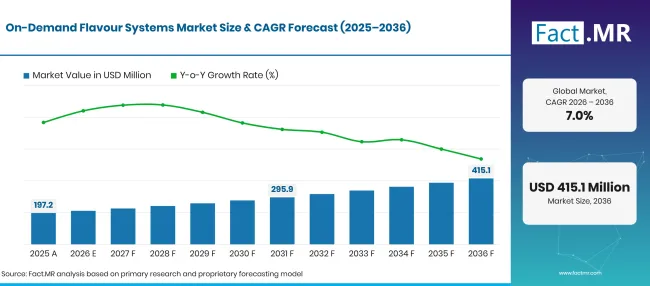
On Demand Flavour Systems Forecast Global | Source: Fact.MR
Category
| Category | Segments |
|---|---|
| Flavour dosing architecture | Inline liquid injection, Dry powder dosing, Microbatch blending, Cartridge dispensing, Recipe-controlled hybrid |
| Processing scale | Pilot / lab, Small commercial, Mid-scale, High-throughput, Ultra-high-throughput |
| Operating configuration | Batch, Semi-continuous, Continuous, Modular skid, Integrated line |
| Food / process application | Bakery / wafers, Confectionery / cocoa, Snacks / seasoning, Brewing / grains, Other food / industrial |
| Region | China; United States; United Kingdom; Germany; Japan |
Source: Fact.MR analysis. Updated Nov 25, 2026
Segmental Analysis
Why does Dry powder dosing lead dosing-architecture demand in the On-Demand Flavour Systems Market?
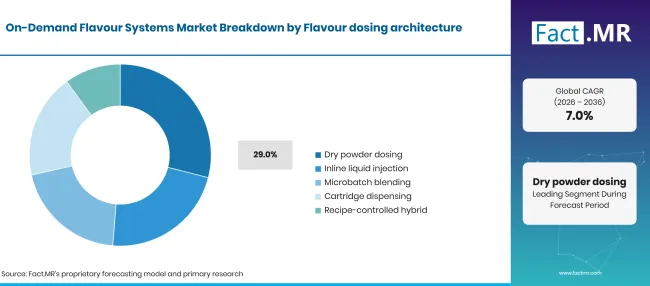
On Demand Flavour Systems Breakdown Flavour Dosing Architecture | Source: Fact.MR
Dry powder dosing captures 29.0% of market revenue in 2026, equivalent to USD 61.2 million. Snack seasonings, powdered dairy ingredients and beverage premixes require controlled addition to maintain uniform flavour distribution. Liquid dosing is gaining traction in beverage applications, while hybrid arrangements appeal to plants handling multiple ingredient formats. India's Ministry of Food Processing Industries reported that 66 food processing units completed during 2025 added 18.75 lakh MT of annual processing capacity, creating opportunities for more precise ingredient handling.
Why does the Small commercial segment lead scale demand in the On-Demand Flavour Systems Market?
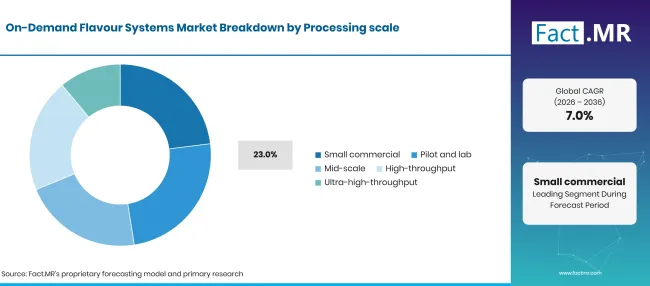
On Demand Flavour Systems Breakdown Processing Scale | Source: Fact.MR
Smaller production facilities favour compact flavour dosing equipment because frequent recipe changes and limited storage space make large dispensing installations less practical. The small commercial segment captures 23.0% of 2026 revenue, reaching USD 48.5 million. Mid-scale processors are expanding their use of automated dosing, while high-throughput facilities favour larger integrated systems. India's ASUSE 2025 results, released by the Ministry of Statistics in March 2026, recorded 6.48% growth in unincorporated manufacturing establishments, highlighting the expanding base of smaller production businesses.
Why does Continuous operation lead configuration demand in the On-Demand Flavour Systems Market?
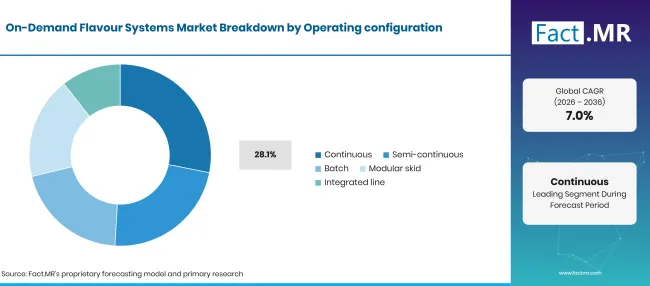
On Demand Flavour Systems Breakdown Operating Configuration | Source: Fact.MR
Continuous operation generates USD 59.3 million in 2026, equivalent to 28.1% of market revenue. Inline flavour addition helps beverage and food processors maintain consistent recipes while production moves between batches or product variants. Modular skids are also gaining attention among plants seeking adaptable processing arrangements, particularly where production layouts require flexibility. India's Ministry of Food Processing Industries reported that 170 applications had been approved under its food processing PLI scheme by September 2025, with the programme associated with 35 lakh MT of additional annual processing capacity.
Why does Brewing / grains lead application demand in the On-Demand Flavour Systems Market?
On Demand Flavour Systems Breakdown Food And Process Application | Source: Fact.MR
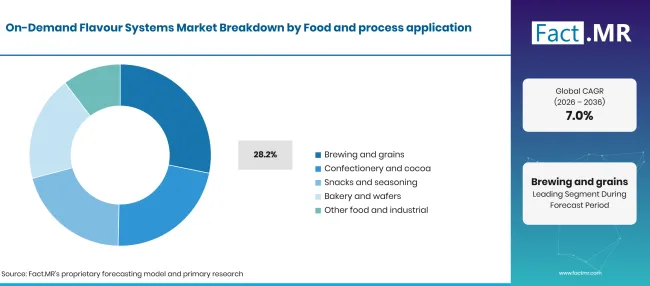
Brewing and grains capture 28.2% of 2026 revenue, equivalent to USD 59.5 million. Brewers use controlled flavour addition to introduce fruit, botanical and hop profiles into beer, malt beverages and related products. Snacks and confectionery manufacturers are also adopting flexible seasoning and coating processes, while dairy applications are gaining ground through flavoured product development. The Brewers Association reported that US craft breweries produced 22.034 million barrels in 2025, with independent brewers increasing their market share to 13.4%. This competitive environment encourages breweries to differentiate their product offerings.
On-Demand Flavour Systems Market-Drivers, Restraints & Trends
Drivers: Growing appetite for customised flavour profiles:
Food brands are introducing seasonal, regional and limited-edition variants more frequently, making large pre-blended batches less practical. On-demand flavour systems allow production teams to change recipes quickly without maintaining extensive flavour inventories. Tata Consumer Products reported 80 new product launches in FY2026 across health and wellness, convenience and premiumisation, illustrating the pace of portfolio expansion and the need for flexible flavour handling.
Restraints: High installation and operating costs:
The initial expense of hygienic dosing equipment, cleaning systems and recipe validation can discourage smaller food processors. Each formulation also requires testing for flavour stability, compatibility and consistency, adding time and operating costs. Smaller facilities may find pre-blended ingredients easier to manage, particularly when production volumes are low. These financial and technical barriers can delay equipment upgrades and make returns on investment harder to justify.
Trend: Sugar and salt reduction creating new opportunities:
Food reformulation is opening fresh opportunities for on-demand flavour systems as manufacturers work to retain taste while lowering sugar and sodium content. Australia's Healthy Food Partnership reviewed its reformulation programme during 2025–26 and updated targets across food categories, with revised goals extending to June 2030. This creates scope for greater use of controlled flavour addition and recipe flexibility as manufacturers adapt existing products to changing nutritional requirements.
Trend: Digital flavour recipes and production flexibility:
Digital recipe management is gaining relevance as food manufacturers handle more variants across production lines. Storing ingredient ratios and dosing instructions electronically helps reduce manual recipe changes, improve batch consistency and maintain production records. The opportunity lies in connecting flavour formulation data with factory control systems, allowing manufacturers to introduce new recipes faster and manage multiple product variants without extensive manual intervention.
On-Demand Flavour Systems Market by Analysis by Key Country
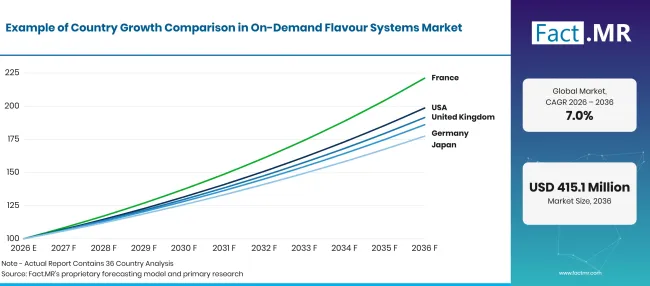
On Demand Flavour Systems Growth Index | Source: Fact.MR
| Country | CAGR (2026-2036) |
|---|---|
| China | 8.6% |
| United States | 7.1% |
| United Kingdom | 6.6% |
| Germany | 6.4% |
| Japan | 5.9% |
Source: Fact.MR analysis. Updated Nov 25, 2026
Why is China the fastest-growing market for on-demand flavour systems?
China's expanding food-processing base creates considerable scope for automated flavour addition.
In 2025, value added from food processing of agricultural and related products increased by 5.6%, according to the National Bureau of Statistics of China. Food and beverage manufacturers are investing in production efficiency while responding to changing consumer preferences for varied packaged foods. These developments are encouraging the use of flexible dosing arrangements that accommodate frequent recipe adjustments and different flavour formats.
What is shaping on-demand flavour system sales in the United States?
Britain's sizeable food and drink manufacturing base offers a favourable setting for flexible flavour processing.
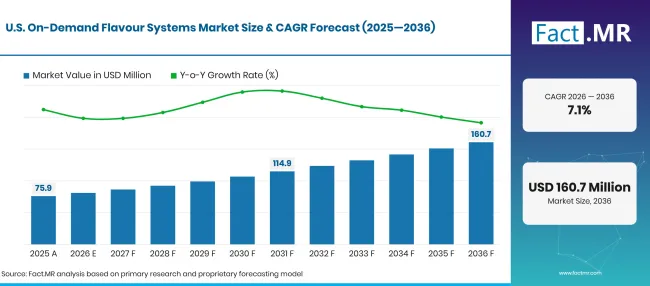
On Demand Flavour Systems Forecast Usa | Source: Fact.MR
Government figures show that food and drink exports reached GBP 25.7 billion in 2025, while consumer expenditure on food and alcoholic drinks stood at GBP 303.3 billion. Manufacturers are exploring new flavour combinations for domestic consumption and export markets. Shorter production runs and growing interest in regional product variants are creating opportunities for on-demand dispensing equipment
What is shaping on-demand flavour system demand in the United Kingdom?
Britain's sizeable food and drink manufacturing base offers a favourable setting for flexible flavour processing.
Government figures show that food and drink exports reached GBP 25.7 billion in 2025, while consumer expenditure on food and alcoholic drinks stood at GBP 303.3 billion. Manufacturers are exploring new flavour combinations for domestic consumption and export markets. Shorter production runs and growing interest in regional product variants are creating opportunities for on-demand dispensing equipment.
What is shaping on-demand flavour system demand in Germany?
Germany's food manufacturing landscape is creating opportunities for advanced ingredient-handling equipment.
Destatis recorded 2,911 new business registrations in food manufacturing and another 290 in beverage manufacturing during 2025. The addition of new businesses strengthens the potential customer base for compact and automated flavour dosing installations. Established processors are also exploring production flexibility to manage varied recipes, improve ingredient accuracy and accommodate changing product specifications.
Why is on-demand flavour system growth slower in Japan?
Japan's strong processed-food export business is encouraging manufacturers to develop distinctive flavour profiles for overseas consumers.
The Ministry of Agriculture, Forestry and Fisheries reported that agricultural, forestry, fishery and food exports reached JPY 1.7005 trillion in 2025, rising 12.8% year over year. Processed food exports alone reached JPY 572.5 billion. Greater export activity and interest in Japanese-inspired flavours are creating opportunities for precise flavour dosing and flexible production systems.
Competitive Landscape for On-Demand Flavour Systems Market
Competition in the on-demand flavour systems market is increasingly shaped by how effectively flavour houses combine formulation expertise with faster product development. Givaudan introduced Myromi™ in April 2025, a smartphone-controlled aroma delivery device that allows customers to explore and adjust flavour profiles through digital feedback.
Kerry launched Smart Taste™ in September 2025, combining flavour development and food science to address sugar reduction, cost and nutritional challenges. IFF is also expanding its digital flavour development through AI-assisted formulation and concept testing. Meanwhile, Symrise, dsm-firmenich and Sensient Technologies compete through specialised taste portfolios and application support. The competitive advantage lies in helping manufacturers move from recipe development to accurate, repeatable production with fewer formulation delays.
Recent Developments
- On October 8, 2025, Givaudan broke ground on a new USD 215 million liquid production facility in Reading, Ohio, to expand its Taste & Wellbeing manufacturing capacity and strengthen its North American operations.
- On November 24, 2025, IFF introduced the Colibri automated dosing robot at its Chin Bee facility in Singapore. The system can produce 200 fragrance sample batches in eight hours, compared with 24 hours previously.
- On February 27, 2025, Symrise relaunched its beverage incubator Califormulations under the name bWorks™. The facility offers flavour development, rapid prototyping and agile manufacturing services for beverage companies in North America.
- On September 30, 2025, Kerry launched Smart Taste™, a portfolio combining flavour expertise and food science to help food and beverage manufacturers address sugar reduction, cost pressures and changing nutritional requirements.
- On August 26, 2025, dsm-firmenich announced major plant investments in India to strengthen its flavour manufacturing capabilities and support future growth in the Indian food and beverage industry.
- On July 11, 2025, Sensient Technologies introduced its BioSymphony™ natural flavour portfolio. The range helps food and beverage manufacturers improve flavour profiles in products containing challenging ingredients such as plant proteins.
Key Players in On-Demand Flavour Systems Market
Key companies operating in the market include Givaudan, IFF, Symrise, Kerry Group, DSM-Firmenich, and Sensient Technologies.
- Givaudan
- IFF
- Symrise
- Kerry Group
- DSM-Firmenich
- Sensient Technologies
Bibliography
- Brewers Association. (2026, April 14). A year of correction for craft beer, with early signals of recovery.
- Destatis. (n.d.). Gewerbeanmeldungen: Deutschland, Jahre, Grund der Gewerbeanmeldung, Wirtschaftszweige. GENESIS-Online.
- Department for Environment, Food & Rural Affairs. (2026, July 29). Food statistics in your pocket. GOV.UK.
- Givaudan. (2026, January 29). 2025 full year results.
- Kerry Group. (2025, September 30). Kerry launches Smart Taste™ to help customers navigate market complexities without compromising on taste.
- Ministry of Agriculture, Forestry and Fisheries. (2026, February 3). 2025年の農林水産物・食品の輸出実績について [2025 export results for agricultural, forestry, fishery and food products]. Government of Japan.
- Ministry of Agriculture, Forestry and Fisheries. (2026). 加工食品の輸出の現状 [Current status of processed food exports]. Government of Japan.
- Ministry of Food Processing Industries. (2025). Assessment of the infrastructure and logistics requirements of India's food processing sector. Government of India.
- Ministry of Food Processing Industries. (2026). Annual report 2025-26. Government of India.
- Ministry of Statistics and Programme Implementation. (2026, March 24). Annual Survey of Unincorporated Sector Enterprises (ASUSE) results for 2025. Government of India.
- National Bureau of Statistics of China. (2026, February 28). Statistical communiqué of the People's Republic of China on the 2025 national economic and social development.
- Symrise. (2025, February 27). Symrise introduces beverage incubator bWorks™: Modular capabilities from flavor development to agile manufacturing.
- Tata Consumer Products. (2026). Managing director and CEO's message: Integrated annual report 2025-26.
- U.S. Census Bureau. (2026). Quarterly financial report: Manufacturing, mining, wholesale trade, and selected service industries, fourth quarter 2025.
- UK Government. (2025, June 4). Restricting advertising of less healthy food or drink on TV and online: Products in scope. GOV.UK.
Segmentation
Scope of Report
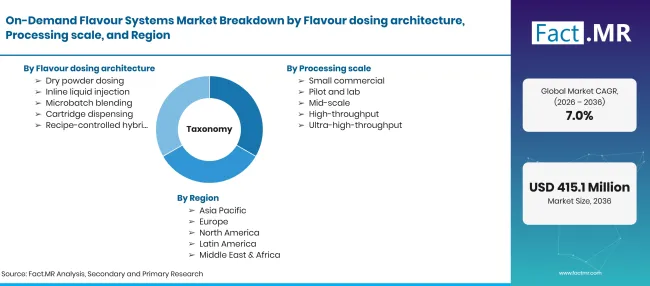
On Demand Flavour Systems Taxonomy | Source: Fact.MR
| Items | Values |
|---|---|
| Quantitative Units (2026) | USD 211.0 Million |
| Flavour dosing architecture | Inline liquid injection, Dry powder dosing, Microbatch blending, Cartridge dispensing, Recipe-controlled hybrid |
| Processing scale | Pilot / lab, Small commercial, Mid-scale, High-throughput, Ultra-high-throughput |
| Operating configuration | Batch, Semi-continuous, Continuous, Modular skid, Integrated line |
| Food / process application | Bakery / wafers, Confectionery / cocoa, Snacks / seasoning, Brewing / grains, Other food / industrial |
| Regions Covered | North America, Latin America, Europe, East Asia, South Asia and Pacific, Middle East & Africa |
| Countries Covered | China, United States, United Kingdom, Germany, Japan, and other countries |
| Key Companies Profiled | Givaudan, IFF, Symrise, Kerry Group, DSM-Firmenich, Sensient Technologies |
| Additional Attributes | Dollar revenue in the On-Demand Flavour Systems Market is segmented by flavour dosing architecture (inline liquid injection, dry powder dosing, microbatch blending, cartridge dispensing, recipe-controlled hybrid); processing scale (pilot / lab, small commercial, mid-scale, high-throughput, ultra-high-throughput); operating configuration (batch, semi-continuous, continuous, modular skid, integrated line); food / process application (bakery / wafers, confectionery / cocoa, snacks / seasoning, brewing / grains, other food / industrial) and region. |
Source: Fact.MR analysis. Updated Nov 25, 2026
On-Demand Flavour Systems Market by Segments
-
Flavour dosing architecture
- Inline liquid injection
- Dry powder dosing
- Microbatch blending
- Cartridge dispensing
- Recipe-controlled hybrid
-
Processing scale
- Pilot / lab
- Small commercial
- Mid-scale
- High-throughput
- Ultra-high-throughput
-
Operating configuration
- Batch
- Semi-continuous
- Continuous
- Modular skid
- Integrated line
-
Food / process application
- Bakery / wafers
- Confectionery / cocoa
- Snacks / seasoning
- Brewing / grains
- Other food / industrial
-
Region:
- North America
- United States
- Canada
- Mexico
- Europe
- Germany
- United Kingdom
- France
- Italy
- Spain
- Rest of Europe
- Asia Pacific
- China
- India
- Japan
- South Korea
- Australia
- Rest of Asia Pacific
- Latin America
- Brazil
- Mexico
- Argentina
- Rest of Latin America
- Middle East & Africa
- GCC Countries
- South Africa
- Rest of Middle East & Africa
- North America
Table of Contents
Key Takeaways
- Market Size and CAGR
- Top Growth Driver
- Fastest Growing Segment
- Leading Region
- Key Companies
- Emerging Opportunities

