Floating Floor Market (2026 - 2036)

Floating Floor Market is segmented by System Type (Resilient Underlayment Floating Floors, Raised Floating Floors (Acoustic), Spring/Isolator Floating Floors, and Others), End Use (Residential Multifamily, Commercial Offices, Hospitality, Studios & Specialty Rooms), Material (Rubber & Elastomer, Foam Underlay, Mineral Wool Systems, and Others), Sales Channel (Flooring Contractors, Building Distributors, Direct Manufacturer Sales, and Others), and Region. Forecast for 2026 to 2036.

Core Findings

    Floating Floor Market Forecast 2026 to 2036

    In 2025, the floating floor market was valued at USD 1.7 billion. Based on Fact MR's analysis, demand for floating floors is estimated to grow to USD 1.9 billion in 2026 and USD 3.5 billion by 2036. FMR projects a CAGR of 6.6% during the forecast period.

    The absolute dollar growth from 2026 to 2036 is USD 1.6 billion. This growth is driven by the increasing demand for easy-to-install and durable flooring solutions across residential, commercial, and industrial sectors. While the market is expanding steadily, challenges such as fluctuating raw material costs and regional regulatory differences may affect its growth rate in some regions.

    India leads with a CAGR of 7.9%, supported by rapid urbanization and a growing construction sector. Vietnam follows with a 7.4% CAGR, driven by rising infrastructure development and increasing demand for efficient flooring solutions. Indonesia grows at 7.1%, fueled by the expansion of residential and commercial buildings. Saudi Arabia and the UAE show CAGRs of 6.6% and 6.3%, respectively, due to growing construction activities and demand for cost-effective flooring solutions. Mexico experiences a 5.7% growth rate, supported by increasing demand for home renovation and commercial projects. The USA and Germany exhibit slower growth at 3.7% and 3.1%, respectively, due to their more mature markets and established demand for flooring solutions.
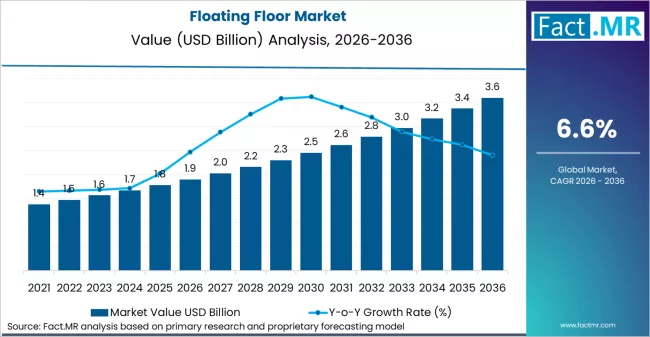
    Floating Floor Market Market Value Analysis

    Floating Floor Market Definition

    The floating floor market refers to the production and sale of floor systems that are installed without being fastened directly to the subfloor. These floors “float” over an underlayment and are held in place by locking mechanisms or weight. Their primary function is to provide durable, stable, and often easier‑to‑install flooring solutions for interior spaces. Key end uses include residential housing, commercial buildings, offices, retail spaces, and hospitality projects where quick installation and comfort underfoot are priorities.

    Market Inclusions

    This report covers global and regional market sizes for floating floors with a defined forecast period. It includes segment breakdowns by product type (laminate, engineered wood, luxury vinyl tile/plank, hybrid), application (residential, commercial, institutional), and end user. Pricing trends, raw material supply, and trade flow data are included to show comprehensive market dynamics.

    Market Exclusions

    The scope excludes traditional nailed or glued‑down floor systems and unrelated surface finishes such as tiles, carpet, or poured concrete overlays. Subfloor preparation materials, adhesives for non‑floating floors, and installation tools are not covered. Specialty industrial flooring systems, such as epoxy or chemical‑resistant coatings, are omitted.

    Research Methodology

    • Primary Research: Interviews were conducted with flooring manufacturers, distributors, and facility managers.
    • Desk Research: Public data was sourced from industry reports, construction statistics, and trade associations.
    • Market‑Sizing and Forecasting: A hybrid model was used, combining top‑down construction material demand with bottom‑up product shipment data.
    • Data Validation and Update Cycle: Findings were validated through expert review and aligned with recent sales and construction activity, with periodic updates.

    Floating Floor Market Summary

    • Floating Floor Market Definition
      • The floating floor market refers to the production and sale of floor systems that are installed without being directly affixed to the subfloor. These floors "float" over an underlayment and are held in place by locking mechanisms or weight. The primary function of floating floors is to provide durable, stable, and often easier-to-install flooring solutions for both residential and commercial spaces. They are particularly valued for their sound insulation and comfort underfoot. Key end uses include residential housing, commercial buildings, offices, retail spaces, and hospitality projects where quick installation and comfort are priorities.
    • Demand Drivers in the Market
      • Ease of Installation: Floating floors offer easy installation as they do not require glue or nails, reducing labor costs and installation time, making them an attractive option for both residential and commercial applications.
      • Durability and Cost-Effectiveness: These floors are known for their durability and are cost-effective, offering long-lasting performance across various sectors.
      • Sound Insulation: Floating floors are especially popular for their sound insulation properties, making them ideal for multi-story buildings and spaces that require noise reduction, such as offices and residential spaces.
      • Sustainability Trends: There is an increasing preference for eco-friendly and sustainable flooring solutions, which is driving demand for materials that support these trends.
    • Key Segments Analyzed in the FMR Report
      • System Type: Resilient Underlayment Floating Floors are expected to hold 51% of the market share by 2026, due to their flexibility, sound absorption capabilities, and ease of installation.
      • End Use: Residential Multifamily and Commercial Offices are projected to lead demand due to the growing construction sector and focus on soundproofing and ease of installation in both residential and commercial buildings.
      • Material: Rubber & Elastomer materials are projected to account for 43% of the market share by 2026 due to their durability and soundproofing properties.
    • Analyst Opinion at FMR
      • Fact MR analyst Shambhu Nath Jha, predicts that "Floating floors will continue to gain popularity, particularly in rapidly urbanizing regions. As demand grows for soundproofing and durable flooring solutions in commercial and residential applications, the floating floor market will expand steadily, driven by both regulatory standards and consumer preference for performance-based flooring systems."
    • Strategic Implications/Executive Takeaways
      • Focus on Performance and Acoustic Solutions: As more buildings prioritize noise control, focusing on advanced flooring solutions with integrated acoustic properties will enhance market position.
      • Target Emerging Markets: Fast-growing regions like India, Vietnam, and Indonesia represent significant opportunities for floating floor systems due to rapid urbanization and expanding construction activity.
      • Innovation in Sustainable Materials: Offering flooring solutions made from sustainable, eco-friendly materials will cater to the growing trend of green construction and sustainability.
    • Methodology
      • Primary Research: Interviews with flooring manufacturers, distributors, and contractors provided insights into current trends, demand drivers, and market needs.
      • Desk Research: Data was gathered from industry reports, construction statistics, and trade publications to analyze demand dynamics and market forecasts.
      • Market Sizing and Forecasting: A hybrid model combining top-down market data with bottom-up product shipment data was used to forecast market growth.

    Segmental Analysis

    Floating Floor Market Analysis by System Type
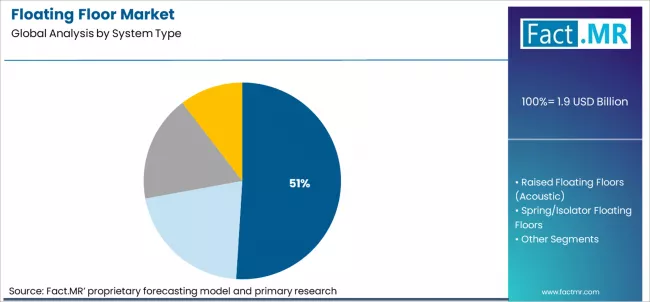
    Floating Floor Market Analysis By System Type

    • Market Overview: Resilient underlayment floating floors are expected to capture 51% of the market share by 2026. These floors, known for their flexibility and sound absorption qualities, are widely used in both residential and commercial applications to enhance comfort and noise reduction. The resilient underlayment system offers effective insulation, making it a popular choice for floating floor installations.
    • Demand Drivers:
      • Improved Sound Insulation: Resilient underlayment floating floors are highly effective in minimizing sound transmission, particularly in multi-story buildings, which drives their demand in both residential and commercial applications.
      • Comfort and Durability: The flexibility of resilient underlayment provides a cushioned feel underfoot, enhancing comfort, and helping to absorb shocks and impacts. This makes them a preferred option for flooring systems in areas where comfort is a priority, such as bedrooms, offices, and recreational spaces.
      • Ease of Installation: These systems are relatively easy to install, as they do not require glue or nails. This reduces labor costs and installation time, contributing to their increasing adoption.

    Floating Floor Market Analysis by Material
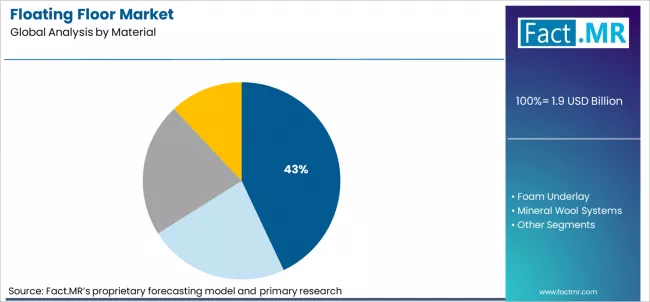
    Floating Floor Market Analysis By Material

    • Market Overview: Rubber and elastomer materials are projected to account for 43% of the floating floor market share by 2026. Rubber-based underlayments are highly valued for their durability, resilience, and soundproofing properties, making them an ideal choice for floating floor systems in areas with high foot traffic or noise concerns.
    • Demand Drivers:
      • Superior Soundproofing Capabilities: Rubber and elastomer-based materials are highly effective in providing acoustic insulation, making them popular in environments where noise reduction is critical, such as in apartments, offices, and commercial spaces.
      • Durability and Longevity: Rubber underlayments offer long-term durability and can withstand heavy use without losing their effectiveness, which is crucial in high-traffic areas or in floating floor systems that need to support heavy loads.
      • Environmental and Sustainability Focus: With an increasing demand for sustainable building materials, rubber and elastomer-based materials, which are often derived from recycled sources, align with growing eco-conscious trends in the construction and interior design industries.

    Floating Floor Market Drivers, Restraints, and Opportunities

    FMR analysts observe that the floating floor market is a mature, performance‑oriented segment within flooring systems, driven by demand for improved acoustic comfort, thermal separation, and ease of installation over traditional fixed substrates. Historically, floating floors gained traction in multi‑family and commercial construction because they reduced sound transfer and installation time versus nailed or glued systems. The 2026 valuation reflects stable baseline demand tied to ongoing construction, renovation, and performance standard adoption in residential and non‑residential projects.

    While demand for basic subflooring remains large, engineered floating floor systems with integrated acoustic underlays and resilience layers are gaining share. These higher‑value systems command elevated per‑unit prices, contributing to net market value growth even as unit volumes grow in line with construction activity. The market exists because designers and builders increasingly specify floating solutions to meet performance targets without extensive on‑site adaptation.

    • Performance Specification Demand: Architects and contractors are selecting floating floor systems for measurable improvements in sound transmission class (STC) and impact isolation class (IIC) over traditional fixed floors.
    • Regulatory Standards Influence: Building codes and acoustic requirements such as ASTM E492/IIC criteria push adoption of certified floating solutions that meet defined sound and vibration metrics.
    • Regional Construction Dynamics: In North America and Europe, stringent indoor comfort and acoustic expectations drive higher uptake of advanced floating systems, while cost‑led markets retain broader use of standard underlays.

    Regional Analysis

    The market analysis covers key global regions, including South Asia and Pacific, Middle East & Africa, North America, Latin America, and Western Europe. It is segmented geographically, with specific market dynamics for each region. The full report provides a detailed market attractiveness analysis.
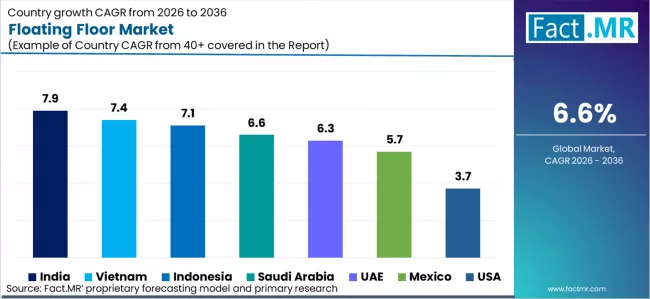
    Floating Floor Market Cagr Analysis By Country

    Country CAGR (2026-2036)
    India 7.9%
    Vietnam 7.4%
    Indonesia 7.1%
    Saudi Arabia 6.6%
    UAE 6.3%
    Mexico 5.7%
    USA 3.7%
    Germany 3.1%

    Source: Fact MR (FMR) analysis, based on proprietary forecasting model and primary research.

    South Asia and Pacific:

    South Asia and Pacific represent "emerging markets" for floating floors, with demand driven by rapid urbanization, increasing construction activity, and rising consumer preference for high-quality flooring solutions.

    • India: Demand for floating floors in India is projected to rise at 7.9% CAGR through 2036. Urbanization, infrastructure development, and increasing interest in premium flooring materials contribute significantly to market growth.
    • Vietnam: Demand for floating floors in Vietnam is projected to rise at 7.4% CAGR through 2036. Growing demand for residential and commercial construction and increasing awareness of flooring technologies fuel market expansion.
    • Indonesia: Demand for floating floors in Indonesia is projected to rise at 7.1% CAGR through 2036. Rising construction projects and urban growth continue to drive the demand for flooring solutions, including floating floors.

    Middle East & Africa:

    In the Middle East, countries like Saudi Arabia and UAE are witnessing steady growth in the floating floor market, driven by expanding construction projects, especially in residential and commercial sectors.

    • Saudi Arabia: Demand for floating floors in Saudi Arabia is projected to rise at 6.6% CAGR through 2036. Rapid urban development and growing construction activities are driving the adoption of floating floor solutions in residential and commercial buildings.
    • UAE: Demand for floating floors in the UAE is projected to rise at 6.3% CAGR through 2036. The UAE’s real estate boom, along with rising demand for premium flooring solutions, supports market growth in the region.

    Latin America:

    In Latin America, particularly in Mexico, the demand for floating floors is growing as construction projects increase and consumers seek durable, easy-to-install flooring options.

    • Mexico: Demand for floating floors in Mexico is projected to rise at 5.7% CAGR through 2036. The growing construction sector and demand for affordable yet high-quality flooring solutions continue to contribute to market growth.

    North America:

    The USA remains a stable market for floating floors, driven by the demand for cost-effective and easy-to-install flooring solutions for both residential and commercial spaces.

    • USA: Demand for floating floors in the U.S. is projected to rise at 3.7% CAGR through 2036. Increased demand for home renovations and commercial projects support steady growth in the floating floor market.

    Western Europe:

    Germany represents a "mature market" for floating floors, with demand supported by a focus on sustainable construction practices and high-performance flooring materials.

    • Germany: Demand for floating floors in Germany is projected to rise at 3.1% CAGR through 2036. Germany’s commitment to sustainable construction practices and high demand for durable, eco-friendly flooring continue to support steady market growth.

    Fact MR's analysis of the Floating Floor Market in South Asia and Pacific, Middle East & Africa, North America, Latin America, and Western Europe consists of country-wise assessments that include India, Vietnam, Indonesia, Saudi Arabia, UAE, Mexico, the United States, and Germany. Readers can find detailed trends, regulatory updates, and company-specific investments shaping the market’s growth in these countries.

    How Are Key Players Competing in the Floating Floor Market?
    Floating Floor Market Analysis By Company

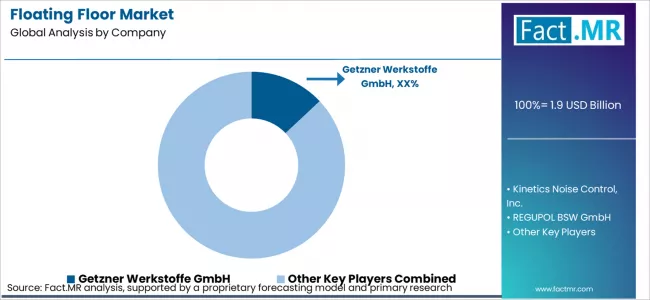
    In the floating floor market, companies like Getzner Werkstoffe GmbH and Kinetics Noise Control, Inc. lead with advanced soundproofing technologies that reduce vibrations and enhance acoustic performance. REGUPOL BSW GmbH and Mason Industries, Inc. focus on providing specialized materials designed to improve both noise control and structural integrity in various building applications. GERB Schwingungsisolierungen GmbH & Co. KG and Trelleborg AB offer innovative solutions that integrate vibration isolation with effective floor stabilization. Compagnie de Saint-Gobain S.A. and Knauf Gips KG leverage their expertise in construction materials, integrating floating floor solutions into broader acoustic and thermal insulation systems. MAPEI S.p.A. is also notable for offering versatile flooring products, including adhesives and systems that enhance both performance and ease of installation. These players differentiate themselves by delivering customized solutions that address both noise reduction and the growing demand for sustainable, high-performance flooring.

    Recent Industry Developments

    • Product introduction-AHF “Ingenious Plank” rigid core/laminate hybrid (Surfaces 2024): AHF introduced Ingenious Plank, a waterproof rigid-core/laminate hybrid positioned as lighter than typical SPC and aimed at floating-floor installations across its Bruce/Robbins/Armstrong brands.
    • Production scale-up-Engineered Floors PureGrain DLVT domestic production (2023): Engineered Floors began 100% production of its PureGrain DLVT rigid core offering at its Seretean Plant in Dalton in 2023, reflecting a domestic manufacturing push for floating rigid-core floors.
    • Technology award-Välinge PRO locking technology (Jan 22, 2025): Välinge announced its PRO locking technology (introduced in 2024 for resilient floating floors) won Floor Covering News’ FCNnovation Award, highlighting continued innovation in click-lock performance and durability.

    Key Players of the Floating Floor Market

    • Getzner Werkstoffe GmbH
    • Kinetics Noise Control, Inc.
    • REGUPOL BSW GmbH
    • Mason Industries, Inc.
    • GERB Schwingungsisolierungen GmbH & Co. KG
    • Trelleborg AB
    • Compagnie de Saint-Gobain S.A.
    • Knauf Gips KG
    • MAPEI S.p.A.

    Report Scope

    Metric Value
    Quantitative Units USD 1.9 billion (2026) to USD 3.5 billion (2036), at a CAGR of 6.6%
    Market Definition The Floating Floor Market includes flooring systems that provide sound insulation and vibration control, commonly used in residential, commercial, and specialty room applications.
    By System Type Resilient Underlayment Floating Floors, Raised Floating Floors (Acoustic), Spring/Isolator Floating Floors, Other
    By End Use Residential Multifamily, Commercial Offices, Hospitality, Studios & Specialty Rooms
    By Material Rubber & Elastomer, Foam Underlay, Mineral Wool Systems, Other
    By Sales Channel Flooring Contractors, Building Distributors, Direct Manufacturer Sales, Other
    Regions Covered North America, Latin America, Europe, East Asia, South Asia, Oceania, Middle East and Africa
    Countries Covered United States, Canada, Mexico, Brazil, Argentina, Germany, France, United Kingdom, Italy, Spain, China, India, Japan, South Korea, Indonesia, Australia, and 40+ countries
    Key Companies Profiled Getzner Werkstoffe GmbH, Kinetics Noise Control, Inc., REGUPOL BSW GmbH, Mason Industries, Inc., GERB Schwingungsisolierungen GmbH & Co. KG, Trelleborg AB, Compagnie de Saint-Gobain S.A., Knauf Gips KG, MAPEI S.p.A.
    Forecast Period 2026 to 2036
    Approach Hybrid top-down and bottom-up market modeling validated through primary interviews with manufacturers and supported by trade data benchmarking and market research.

    Floating Floor Market Key Segments

    • By System Type

      • Resilient Underlayment Floating Floors
      • Raised Floating Floors (Acoustic)
      • Spring/Isolator Floating Floors
      • Other
    • By End Use

      • Residential Multifamily
      • Commercial Offices
      • Hospitality
      • Studios & Specialty Rooms
    • By Material

      • Rubber & Elastomer
      • Foam Underlay
      • Mineral Wool Systems
      • Other
    • By Sales Channel

      • Flooring Contractors
      • Building Distributors
      • Direct Manufacturer Sales
      • Other
    • Region

      • North America
        • USA
        • Canada
        • Mexico
      • Europe
        • Germany
        • UK
        • France
        • Italy
        • Spain
        • Nordic Countries
        • BENELUX
        • Rest of Europe
      • Asia Pacific
        • China
        • Japan
        • South Korea
        • India
        • Australia
        • Rest of Asia Pacific
      • Latin America
        • Brazil
        • Argentina
        • Rest of Latin America
      • Middle East and Africa
        • Kingdom of Saudi Arabia
        • United Arab Emirates
        • South Africa
        • Rest of Middle East and Africa
      • Other Regions
        • Oceania
        • Central Asia
        • Other Markets

    Bibliographies

    • Product Introduction-AHF “Ingenious Plank” Rigid Core/Laminate Hybrid: AHF. (2024). AHF introduces Ingenious Plank rigid core/laminate hybrid. Floor Daily. [1]
    • Production Scale-Up-Engineered Floors PureGrain DLVT Domestic Production: Engineered Floors. (2023). Engineered Floors begins 100% production of PureGrain DLVT. Floor Covering News. [2]
    • Technology Award-Välinge PRO Locking Technology: Välinge. (2025, January 22). Välinge PRO locking technology wins FCNnovation Award. Välinge. [3]

    Table of Content

    1. Executive Summary
      • Global Market Outlook
      • Demand to side Trends
      • Supply to side Trends
      • Technology Roadmap Analysis
      • Analysis and Recommendations
    2. Market Overview
      • Market Coverage / Taxonomy
      • Market Definition / Scope / Limitations
    3. Research Methodology
      • Chapter Orientation
      • Analytical Lens and Working Hypotheses
        • Market Structure, Signals, and Trend Drivers
        • Benchmarking and Cross-market Comparability
        • Market Sizing, Forecasting, and Opportunity Mapping
      • Research Design and Evidence Framework
        • Desk Research Programme (Secondary Evidence)
          • Company Annual and Sustainability Reports
          • Peer-reviewed Journals and Academic Literature
          • Corporate Websites, Product Literature, and Technical Notes
          • Earnings Decks and Investor Briefings
          • Statutory Filings and Regulatory Disclosures
          • Technical White Papers and Standards Notes
          • Trade Journals, Industry Magazines, and Analyst Briefs
          • Conference Proceedings, Webinars, and Seminar Materials
          • Government Statistics Portals and Public Data Releases
          • Press Releases and Reputable Media Coverage
          • Specialist Newsletters and Curated Briefings
          • Sector Databases and Reference Repositories
          • FMR Internal Proprietary Databases and Historical Market Datasets
          • Subscription Datasets and Paid Sources
          • Social Channels, Communities, and Digital Listening Inputs
          • Additional Desk Sources
        • Expert Input and Fieldwork (Primary Evidence)
          • Primary Modes
            • Qualitative Interviews and Expert Elicitation
            • Quantitative Surveys and Structured Data Capture
            • Blended Approach
          • Why Primary Evidence is Used
          • Field Techniques
            • Interviews
            • Surveys
            • Focus Groups
            • Observational and In-context Research
            • Social and Community Interactions
          • Stakeholder Universe Engaged
            • C-suite Leaders
            • Board Members
            • Presidents and Vice Presidents
            • R&D and Innovation Heads
            • Technical Specialists
            • Domain Subject-matter Experts
            • Scientists
            • Physicians and Other Healthcare Professionals
          • Governance, Ethics, and Data Stewardship
            • Research Ethics
            • Data Integrity and Handling
        • Tooling, Models, and Reference Databases
      • Data Engineering and Model Build
        • Data Acquisition and Ingestion
        • Cleaning, Normalisation, and Verification
        • Synthesis, Triangulation, and Analysis
      • Quality Assurance and Audit Trail
    4. Market Background
      • Market Dynamics
        • Drivers
        • Restraints
        • Opportunity
        • Trends
      • Scenario Forecast
        • Demand in Optimistic Scenario
        • Demand in Likely Scenario
        • Demand in Conservative Scenario
      • Opportunity Map Analysis
      • Product Life Cycle Analysis
      • Supply Chain Analysis
      • Investment Feasibility Matrix
      • Value Chain Analysis
      • PESTLE and Porter’s Analysis
      • Regulatory Landscape
      • Regional Parent Market Outlook
      • Production and Consumption Statistics
      • Import and Export Statistics
    5. Global Market Analysis 2021 to 2025 and Forecast, 2026 to 2036
      • Historical Market Size Value (USD Million) Analysis, 2021 to 2025
      • Current and Future Market Size Value (USD Million) Projections, 2026 to 2036
        • Y to o to Y Growth Trend Analysis
        • Absolute $ Opportunity Analysis
    6. Global Market Pricing Analysis 2021 to 2025 and Forecast 2026 to 2036
    7. Global Market Analysis 2021 to 2025 and Forecast 2026 to 2036, By System Type
      • Introduction / Key Findings
      • Historical Market Size Value (USD Million) Analysis By System Type , 2021 to 2025
      • Current and Future Market Size Value (USD Million) Analysis and Forecast By System Type , 2026 to 2036
        • Resilient Underlayment Floating Floors
        • Raised Floating Floors (Acoustic)
        • Spring/Isolator Floating Floors
        • Other
      • Y to o to Y Growth Trend Analysis By System Type , 2021 to 2025
      • Absolute $ Opportunity Analysis By System Type , 2026 to 2036
    8. Global Market Analysis 2021 to 2025 and Forecast 2026 to 2036, By Material
      • Introduction / Key Findings
      • Historical Market Size Value (USD Million) Analysis By Material, 2021 to 2025
      • Current and Future Market Size Value (USD Million) Analysis and Forecast By Material, 2026 to 2036
        • Rubber & Elastomer
        • Foam Underlay
        • Mineral Wool Systems
        • Other
      • Y to o to Y Growth Trend Analysis By Material, 2021 to 2025
      • Absolute $ Opportunity Analysis By Material, 2026 to 2036
    9. Global Market Analysis 2021 to 2025 and Forecast 2026 to 2036, By Region
      • Introduction
      • Historical Market Size Value (USD Million) Analysis By Region, 2021 to 2025
      • Current Market Size Value (USD Million) Analysis and Forecast By Region, 2026 to 2036
        • North America
        • Latin America
        • Western Europe
        • Eastern Europe
        • East Asia
        • South Asia and Pacific
        • Middle East & Africa
      • Market Attractiveness Analysis By Region
    10. North America Market Analysis 2021 to 2025 and Forecast 2026 to 2036, By Country
      • Historical Market Size Value (USD Million) Trend Analysis By Market Taxonomy, 2021 to 2025
      • Market Size Value (USD Million) Forecast By Market Taxonomy, 2026 to 2036
        • By Country
          • USA
          • Canada
          • Mexico
        • By System Type
        • By Material
      • Market Attractiveness Analysis
        • By Country
        • By System Type
        • By Material
      • Key Takeaways
    11. Latin America Market Analysis 2021 to 2025 and Forecast 2026 to 2036, By Country
      • Historical Market Size Value (USD Million) Trend Analysis By Market Taxonomy, 2021 to 2025
      • Market Size Value (USD Million) Forecast By Market Taxonomy, 2026 to 2036
        • By Country
          • Brazil
          • Chile
          • Rest of Latin America
        • By System Type
        • By Material
      • Market Attractiveness Analysis
        • By Country
        • By System Type
        • By Material
      • Key Takeaways
    12. Western Europe Market Analysis 2021 to 2025 and Forecast 2026 to 2036, By Country
      • Historical Market Size Value (USD Million) Trend Analysis By Market Taxonomy, 2021 to 2025
      • Market Size Value (USD Million) Forecast By Market Taxonomy, 2026 to 2036
        • By Country
          • Germany
          • UK
          • Italy
          • Spain
          • France
          • Nordic
          • BENELUX
          • Rest of Western Europe
        • By System Type
        • By Material
      • Market Attractiveness Analysis
        • By Country
        • By System Type
        • By Material
      • Key Takeaways
    13. Eastern Europe Market Analysis 2021 to 2025 and Forecast 2026 to 2036, By Country
      • Historical Market Size Value (USD Million) Trend Analysis By Market Taxonomy, 2021 to 2025
      • Market Size Value (USD Million) Forecast By Market Taxonomy, 2026 to 2036
        • By Country
          • Russia
          • Poland
          • Hungary
          • Balkan & Baltic
          • Rest of Eastern Europe
        • By System Type
        • By Material
      • Market Attractiveness Analysis
        • By Country
        • By System Type
        • By Material
      • Key Takeaways
    14. East Asia Market Analysis 2021 to 2025 and Forecast 2026 to 2036, By Country
      • Historical Market Size Value (USD Million) Trend Analysis By Market Taxonomy, 2021 to 2025
      • Market Size Value (USD Million) Forecast By Market Taxonomy, 2026 to 2036
        • By Country
          • China
          • Japan
          • South Korea
        • By System Type
        • By Material
      • Market Attractiveness Analysis
        • By Country
        • By System Type
        • By Material
      • Key Takeaways
    15. South Asia and Pacific Market Analysis 2021 to 2025 and Forecast 2026 to 2036, By Country
      • Historical Market Size Value (USD Million) Trend Analysis By Market Taxonomy, 2021 to 2025
      • Market Size Value (USD Million) Forecast By Market Taxonomy, 2026 to 2036
        • By Country
          • India
          • ASEAN
          • Australia & New Zealand
          • Rest of South Asia and Pacific
        • By System Type
        • By Material
      • Market Attractiveness Analysis
        • By Country
        • By System Type
        • By Material
      • Key Takeaways
    16. Middle East & Africa Market Analysis 2021 to 2025 and Forecast 2026 to 2036, By Country
      • Historical Market Size Value (USD Million) Trend Analysis By Market Taxonomy, 2021 to 2025
      • Market Size Value (USD Million) Forecast By Market Taxonomy, 2026 to 2036
        • By Country
          • Kingdom of Saudi Arabia
          • Other GCC Countries
          • Turkiye
          • South Africa
          • Other African Union
          • Rest of Middle East & Africa
        • By System Type
        • By Material
      • Market Attractiveness Analysis
        • By Country
        • By System Type
        • By Material
      • Key Takeaways
    17. Key Countries Market Analysis
      • USA
        • Pricing Analysis
        • Market Share Analysis, 2025
          • By System Type
          • By Material
      • Canada
        • Pricing Analysis
        • Market Share Analysis, 2025
          • By System Type
          • By Material
      • Mexico
        • Pricing Analysis
        • Market Share Analysis, 2025
          • By System Type
          • By Material
      • Brazil
        • Pricing Analysis
        • Market Share Analysis, 2025
          • By System Type
          • By Material
      • Chile
        • Pricing Analysis
        • Market Share Analysis, 2025
          • By System Type
          • By Material
      • Germany
        • Pricing Analysis
        • Market Share Analysis, 2025
          • By System Type
          • By Material
      • UK
        • Pricing Analysis
        • Market Share Analysis, 2025
          • By System Type
          • By Material
      • Italy
        • Pricing Analysis
        • Market Share Analysis, 2025
          • By System Type
          • By Material
      • Spain
        • Pricing Analysis
        • Market Share Analysis, 2025
          • By System Type
          • By Material
      • France
        • Pricing Analysis
        • Market Share Analysis, 2025
          • By System Type
          • By Material
      • India
        • Pricing Analysis
        • Market Share Analysis, 2025
          • By System Type
          • By Material
      • ASEAN
        • Pricing Analysis
        • Market Share Analysis, 2025
          • By System Type
          • By Material
      • Australia & New Zealand
        • Pricing Analysis
        • Market Share Analysis, 2025
          • By System Type
          • By Material
      • China
        • Pricing Analysis
        • Market Share Analysis, 2025
          • By System Type
          • By Material
      • Japan
        • Pricing Analysis
        • Market Share Analysis, 2025
          • By System Type
          • By Material
      • South Korea
        • Pricing Analysis
        • Market Share Analysis, 2025
          • By System Type
          • By Material
      • Russia
        • Pricing Analysis
        • Market Share Analysis, 2025
          • By System Type
          • By Material
      • Poland
        • Pricing Analysis
        • Market Share Analysis, 2025
          • By System Type
          • By Material
      • Hungary
        • Pricing Analysis
        • Market Share Analysis, 2025
          • By System Type
          • By Material
      • Kingdom of Saudi Arabia
        • Pricing Analysis
        • Market Share Analysis, 2025
          • By System Type
          • By Material
      • Turkiye
        • Pricing Analysis
        • Market Share Analysis, 2025
          • By System Type
          • By Material
      • South Africa
        • Pricing Analysis
        • Market Share Analysis, 2025
          • By System Type
          • By Material
    18. Market Structure Analysis
      • Competition Dashboard
      • Competition Benchmarking
      • Market Share Analysis of Top Players
        • By Regional
        • By System Type
        • By Material
    19. Competition Analysis
      • Competition Deep Dive
        • Getzner Werkstoffe GmbH
          • Overview
          • Product Portfolio
          • Profitability by Market Segments (Product/Age /Sales Channel/Region)
          • Sales Footprint
          • Strategy Overview
            • Marketing Strategy
            • Product Strategy
            • Channel Strategy
        • Kinetics Noise Control, Inc.
        • REGUPOL BSW GmbH
        • Mason Industries, Inc.
        • GERB Schwingungsisolierungen GmbH & Co. KG
        • Trelleborg AB
        • Compagnie de Saint-Gobain S.A.
        • Knauf Gips KG
        • MAPEI S.p.A.
    20. Assumptions & Acronyms Used

    List Of Table

    • Table 1: Global Market Value (USD Million) Forecast by Region, 2021 to 2036
    • Table 2: Global Market Value (USD Million) Forecast by System Type, 2021 to 2036
    • Table 3: Global Market Value (USD Million) Forecast by Material, 2021 to 2036
    • Table 4: North America Market Value (USD Million) Forecast by Country, 2021 to 2036
    • Table 5: North America Market Value (USD Million) Forecast by System Type, 2021 to 2036
    • Table 6: North America Market Value (USD Million) Forecast by Material, 2021 to 2036
    • Table 7: Latin America Market Value (USD Million) Forecast by Country, 2021 to 2036
    • Table 8: Latin America Market Value (USD Million) Forecast by System Type, 2021 to 2036
    • Table 9: Latin America Market Value (USD Million) Forecast by Material, 2021 to 2036
    • Table 10: Western Europe Market Value (USD Million) Forecast by Country, 2021 to 2036
    • Table 11: Western Europe Market Value (USD Million) Forecast by System Type, 2021 to 2036
    • Table 12: Western Europe Market Value (USD Million) Forecast by Material, 2021 to 2036
    • Table 13: Eastern Europe Market Value (USD Million) Forecast by Country, 2021 to 2036
    • Table 14: Eastern Europe Market Value (USD Million) Forecast by System Type, 2021 to 2036
    • Table 15: Eastern Europe Market Value (USD Million) Forecast by Material, 2021 to 2036
    • Table 16: East Asia Market Value (USD Million) Forecast by Country, 2021 to 2036
    • Table 17: East Asia Market Value (USD Million) Forecast by System Type, 2021 to 2036
    • Table 18: East Asia Market Value (USD Million) Forecast by Material, 2021 to 2036
    • Table 19: South Asia and Pacific Market Value (USD Million) Forecast by Country, 2021 to 2036
    • Table 20: South Asia and Pacific Market Value (USD Million) Forecast by System Type, 2021 to 2036
    • Table 21: South Asia and Pacific Market Value (USD Million) Forecast by Material, 2021 to 2036
    • Table 22: Middle East & Africa Market Value (USD Million) Forecast by Country, 2021 to 2036
    • Table 23: Middle East & Africa Market Value (USD Million) Forecast by System Type, 2021 to 2036
    • Table 24: Middle East & Africa Market Value (USD Million) Forecast by Material, 2021 to 2036

    List Of Figures

    • Figure 1: Global Market Pricing Analysis
    • Figure 2: Global Market Value (USD Million) Forecast 2021-2036
    • Figure 3: Global Market Value Share and BPS Analysis by System Type, 2026 and 2036
    • Figure 4: Global Market Y to o to Y Growth Comparison by System Type, 2026 to 2036
    • Figure 5: Global Market Attractiveness Analysis by System Type
    • Figure 6: Global Market Value Share and BPS Analysis by Material, 2026 and 2036
    • Figure 7: Global Market Y to o to Y Growth Comparison by Material, 2026 to 2036
    • Figure 8: Global Market Attractiveness Analysis by Material
    • Figure 9: Global Market Value (USD Million) Share and BPS Analysis by Region, 2026 and 2036
    • Figure 10: Global Market Y to o to Y Growth Comparison by Region, 2026 to 2036
    • Figure 11: Global Market Attractiveness Analysis by Region
    • Figure 12: North America Market Incremental Dollar Opportunity, 2026 to 2036
    • Figure 13: Latin America Market Incremental Dollar Opportunity, 2026 to 2036
    • Figure 14: Western Europe Market Incremental Dollar Opportunity, 2026 to 2036
    • Figure 15: Eastern Europe Market Incremental Dollar Opportunity, 2026 to 2036
    • Figure 16: East Asia Market Incremental Dollar Opportunity, 2026 to 2036
    • Figure 17: South Asia and Pacific Market Incremental Dollar Opportunity, 2026 to 2036
    • Figure 18: Middle East & Africa Market Incremental Dollar Opportunity, 2026 to 2036
    • Figure 19: North America Market Value Share and BPS Analysis by Country, 2026 and 2036
    • Figure 20: North America Market Value Share and BPS Analysis by System Type, 2026 and 2036
    • Figure 21: North America Market Y to o to Y Growth Comparison by System Type, 2026 to 2036
    • Figure 22: North America Market Attractiveness Analysis by System Type
    • Figure 23: North America Market Value Share and BPS Analysis by Material, 2026 and 2036
    • Figure 24: North America Market Y to o to Y Growth Comparison by Material, 2026 to 2036
    • Figure 25: North America Market Attractiveness Analysis by Material
    • Figure 26: Latin America Market Value Share and BPS Analysis by Country, 2026 and 2036
    • Figure 27: Latin America Market Value Share and BPS Analysis by System Type, 2026 and 2036
    • Figure 28: Latin America Market Y to o to Y Growth Comparison by System Type, 2026 to 2036
    • Figure 29: Latin America Market Attractiveness Analysis by System Type
    • Figure 30: Latin America Market Value Share and BPS Analysis by Material, 2026 and 2036
    • Figure 31: Latin America Market Y to o to Y Growth Comparison by Material, 2026 to 2036
    • Figure 32: Latin America Market Attractiveness Analysis by Material
    • Figure 33: Western Europe Market Value Share and BPS Analysis by Country, 2026 and 2036
    • Figure 34: Western Europe Market Value Share and BPS Analysis by System Type, 2026 and 2036
    • Figure 35: Western Europe Market Y to o to Y Growth Comparison by System Type, 2026 to 2036
    • Figure 36: Western Europe Market Attractiveness Analysis by System Type
    • Figure 37: Western Europe Market Value Share and BPS Analysis by Material, 2026 and 2036
    • Figure 38: Western Europe Market Y to o to Y Growth Comparison by Material, 2026 to 2036
    • Figure 39: Western Europe Market Attractiveness Analysis by Material
    • Figure 40: Eastern Europe Market Value Share and BPS Analysis by Country, 2026 and 2036
    • Figure 41: Eastern Europe Market Value Share and BPS Analysis by System Type, 2026 and 2036
    • Figure 42: Eastern Europe Market Y to o to Y Growth Comparison by System Type, 2026 to 2036
    • Figure 43: Eastern Europe Market Attractiveness Analysis by System Type
    • Figure 44: Eastern Europe Market Value Share and BPS Analysis by Material, 2026 and 2036
    • Figure 45: Eastern Europe Market Y to o to Y Growth Comparison by Material, 2026 to 2036
    • Figure 46: Eastern Europe Market Attractiveness Analysis by Material
    • Figure 47: East Asia Market Value Share and BPS Analysis by Country, 2026 and 2036
    • Figure 48: East Asia Market Value Share and BPS Analysis by System Type, 2026 and 2036
    • Figure 49: East Asia Market Y to o to Y Growth Comparison by System Type, 2026 to 2036
    • Figure 50: East Asia Market Attractiveness Analysis by System Type
    • Figure 51: East Asia Market Value Share and BPS Analysis by Material, 2026 and 2036
    • Figure 52: East Asia Market Y to o to Y Growth Comparison by Material, 2026 to 2036
    • Figure 53: East Asia Market Attractiveness Analysis by Material
    • Figure 54: South Asia and Pacific Market Value Share and BPS Analysis by Country, 2026 and 2036
    • Figure 55: South Asia and Pacific Market Value Share and BPS Analysis by System Type, 2026 and 2036
    • Figure 56: South Asia and Pacific Market Y to o to Y Growth Comparison by System Type, 2026 to 2036
    • Figure 57: South Asia and Pacific Market Attractiveness Analysis by System Type
    • Figure 58: South Asia and Pacific Market Value Share and BPS Analysis by Material, 2026 and 2036
    • Figure 59: South Asia and Pacific Market Y to o to Y Growth Comparison by Material, 2026 to 2036
    • Figure 60: South Asia and Pacific Market Attractiveness Analysis by Material
    • Figure 61: Middle East & Africa Market Value Share and BPS Analysis by Country, 2026 and 2036
    • Figure 62: Middle East & Africa Market Value Share and BPS Analysis by System Type, 2026 and 2036
    • Figure 63: Middle East & Africa Market Y to o to Y Growth Comparison by System Type, 2026 to 2036
    • Figure 64: Middle East & Africa Market Attractiveness Analysis by System Type
    • Figure 65: Middle East & Africa Market Value Share and BPS Analysis by Material, 2026 and 2036
    • Figure 66: Middle East & Africa Market Y to o to Y Growth Comparison by Material, 2026 to 2036
    • Figure 67: Middle East & Africa Market Attractiveness Analysis by Material
    • Figure 68: Global Market - Tier Structure Analysis
    • Figure 69: Global Market - Company Share Analysis

    - FAQs -

    How large is the demand for Floating Floors in the global market in 2026?

    Demand for Floating Floors in the global market is estimated to be valued at USD 1.9 billion in 2026.

    What will be the market size of Floating Floors in the global market by 2036?

    The market size for Floating Floors is projected to reach USD 3.5 billion by 2036.

    What is the expected demand growth for Floating Floors in the global market between 2026 and 2036?

    Demand for Floating Floors in the global market is expected to grow at a CAGR of 6.6% - between 2026 and 2036.

    Which system type is expected to dominate the market?

    Resilient Underlayment Floating Floors are expected to dominate the market, accounting for 51% of the market share in 2026, due to their effectiveness in providing noise reduction and comfort in both residential and commercial applications.

    Which region is expected to show the highest growth rate for Floating Floors?

    India is projected to show the highest regional CAGR at 7.9% during the forecast period, driven by rapid urbanization, construction growth, and increasing demand for durable and cost-effective flooring solutions.

    How significant is the growth outlook for Vietnam in this market?

    Vietnam is expected to grow at a CAGR of 7.4%, reflecting expanding infrastructure projects and a rising demand for floating floor systems in residential and commercial buildings.

    What is the growth outlook for the United States in this report?

    The United States is anticipated to grow at a CAGR of 3.7% from 2026 to 2036, supported by steady demand for floating floors in commercial properties and residential buildings.

    What is the growth forecast for Saudi Arabia in the Floating Floor market?

    Saudi Arabia is expected to grow at a CAGR of 6.6%, driven by increasing construction activities and the growing focus on high-quality, efficient flooring systems in both residential and commercial sectors.

    Which European market is highlighted in this analysis?

    Germany is a key European market, with a projected CAGR of 3.1%, influenced by steady demand for floating floors in commercial buildings and residential projects in urban areas.

    Which company is identified as a leading player in the Floating Floor market?

    Getzner Werkstoffe GmbH is recognized as a leading player in this market, providing innovative resilient underlayment floating floor solutions for various applications.

    What are Floating Floors used for?

    Floating Floors are used in construction to provide durable, noise-reducing, and comfortable flooring solutions, often used in residential, commercial, and industrial buildings where ease of installation and performance are key factors.

    What does the Floating Floors market include in this report?

    The market scope includes floating floor systems, with a focus on resilient underlayment floating floors, which are commonly used for noise reduction and improved comfort in various building types.

    How is the market forecast developed in this report?

    The forecast is developed using historical data on construction growth, trends in flooring solutions, and insights from key industry players involved in the production and supply of floating floor systems.

    What is meant by the Floating Floors market in this report?

    The market refers to the global production, trade, and consumption of floating floor systems, which are used to provide effective flooring solutions that reduce noise and improve comfort in a variety of construction applications.

    Floating Floor Market