- Market Value (2025): USD 259.6 Mn
- Estimated Value (2026): USD 272.5 Mn
- Forecast Value (2036): USD 442.1 Mn
- CAGR (2026-2036): 5.0%
What is the Flotation Suits Market forecast to be worth by 2036?
USD 272.5 million in 2026 to USD 442.1 million by 2036, at a 5.0% CAGR.
- The report estimates 2025 market was valued at USD 259.6 million.
- According to Fact.MR analysis, sales are projected to increase from USD 272.5 million in 2026 to USD 442.1 million by 2036.
- The market is forecast to register a 5.0% CAGR from 2026 to 2036 as marine operators and recreational users replace protective clothing.
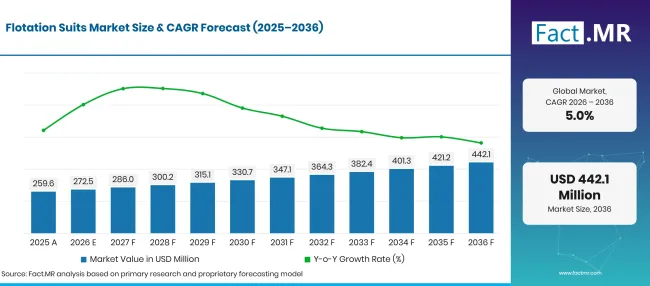
Flotation Suits Market Forecast Global | Source: Fact.MR
| Year | Basis | Market Value (USD million) |
|---|---|---|
| 2025 | Actual | 259.6 |
| 2026 | Estimate | 272.5 |
| 2036 | Forecast | 442.1 |
| CAGR 2026 to 2036 | Forecast period | 5.0% |
Source: Fact.MR analysis. Updated Oct 30, 2026
What are the defining numbers behind Flotation Suits Market growth?
The annual market value is forecast to increase by USD 169.6 million between 2026 and 2036.
- Demand Drivers in the Market
- Cold-water exposure changes clothing choices for fishing crews. An insulated flotation suit addresses buoyancy and weather protection in one garment while leaving operators to assess any separate lifejacket requirement.
- Commercial boat operators replace equipment when fit or fabric condition affects safe use. Routine inspections also make visible the limits of waterproof seals and worn closures, which can turn a clothing purchase into a planned replacement cycle.
- People fishing from small boats need room to move during casting and deck work. They also weigh warmth against bulk, especially when the suit is worn for several hours instead of kept in a locker.
- Marine safety training keeps wearable protection visible to private boaters. In January 2026, the U.S. Coast Guard and the National Association of State Boating Law Administrators renewed their agreement on recreational boating safety, including boater education and lifejacket-use initiatives [3].
- Key Segments Analyzed
- By Product Type: Two-Piece Flotation Suits account for 54.3% of 2026 value, as separate jackets and trousers give users more ways to adjust layers.
- By Application: Marine represents 38.5% of 2026 sales, reflecting exposed work on vessels and small craft.
- By Material: Neoprene captures 40.0% of 2026 sales, linked to water resistance and thermal insulation requirements.
- By End-User: Commercial users lead with 55.0% of 2026 value, as employers buy suits for crews and replace damaged equipment.
- By Distribution Channel: Specialty Stores hold 38.2% of 2026 sales, helped by fit advice and direct product comparison.
- Analyst Opinion at Fact.MR
- Shambhu Nath Jha, Principal Consultant at Fact.MR, states, “Buyers need to distinguish flotation suits used during routine marine activities from immersion suits intended for specific emergency survival conditions. Each garment serves a different purpose, so the choice depends on the work involved and the protective equipment required.”
- Strategic Implications
- Marine fleet operators should specify the clothing task and conditions before comparing thermal protection, buoyancy and fit. Related product comparisons cover life jacket equipment for a distinct equipment category.
- Manufacturers should publish clear care instructions and testing information so customers can assess service life and garment suitability. Related product comparisons cover immersion suits for a distinct equipment category.
- Specialist retailers can help buyers compare the fit of flotation suits over normal clothing and insulating layers. Customers should be able to bend, sit and move comfortably while wearing the complete outfit.
- Fishing businesses can include garment condition and fit in routine onboard inspections, while checking lifejackets and other rescue equipment against their separate requirements.
The USA records 6.3% CAGR through 2036, followed by the UK at 6.0%. Brazil is forecast at 5.3%, Japan at 4.7% and Germany at 3.7%. Each market combines different marine work patterns with separate recreational boating requirements.
How does the Flotation Suits Market break down by segment?
Two-Piece Suits lead Product Type at 54.3%; Marine leads Application at 38.5%; Neoprene leads Material at 40.0%.
Which Product Type dominates?
Two-Piece Flotation Suits account for 54.3% of 2026 value.
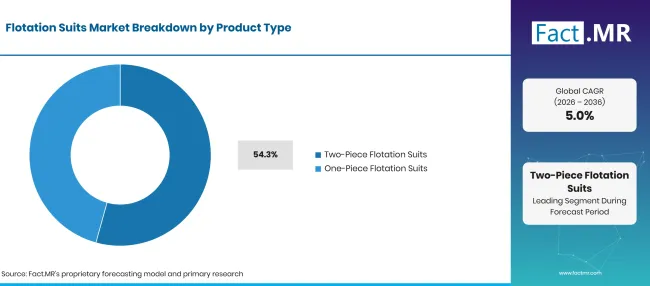
Flotation Suits Market Breakdown Product Type | Source: Fact.MR
| Product Type | Share (2026) |
|---|---|
| Two-Piece Flotation Suits (Leading segment) | 54.3% |
| Other segments combined | 45.7% |
| Total | 100.0% |
Source: Fact.MR analysis. Updated Oct 30, 2026
Two-piece flotation suits let boat crews wear a jacket on its own and add matching trousers when spray or colder weather calls for more coverage. Separate sizing also helps customers find a better fit when their jacket and trouser measurements differ.
What leads the Application segment?
Marine applications represent 38.5% of 2026 sales.
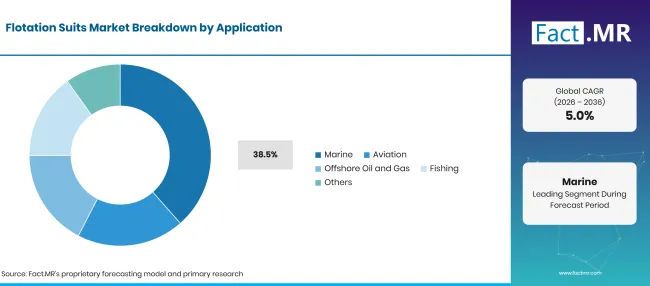
Flotation Suits Market Breakdown Application | Source: Fact.MR
| Application | Share (2026) |
|---|---|
| Marine (Leading segment) | 38.5% |
| Other segments combined | 61.5% |
| Total | 100.0% |
Source: Fact.MR analysis. Updated Oct 30, 2026
Marine lead application segment with 38.5% share in 2026. Aviation users and fishing operators similarly face different emergency arrangements. Manufacturers therefore need clear product boundaries instead of one claim covering every offshore task.
How does Material shape product selection?
Neoprene accounts for 40.0% of 2026 sales.
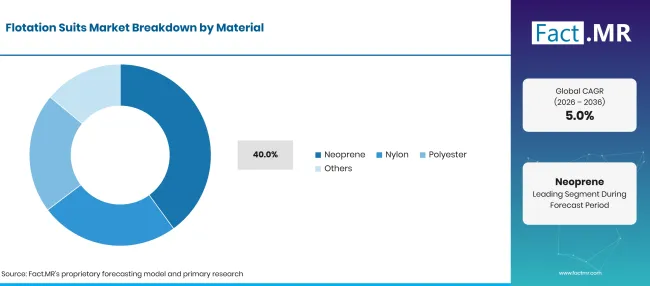
Flotation Suits Market Breakdown Material | Source: Fact.MR
| Material | Share (2026) |
|---|---|
| Neoprene (Leading segment) | 40.0% |
| Other segments combined | 60.0% |
| Total | 100.0% |
Source: Fact.MR analysis. Updated Oct 30, 2026
Neoprene offers insulation in garments designed for regular exposure to cold water, while nylon fabrics can provide a lighter outer shell. Polyester is also used in durable woven constructions, giving manufacturers different options for balancing warmth, weight and wear resistance.
Which End-User group accounts for more spending?
Commercial users represent 55.0% of 2026 value.
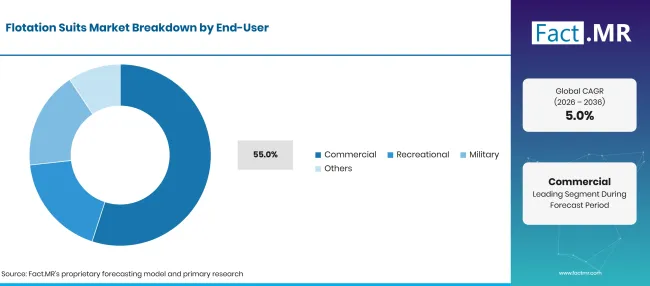
Flotation Suits Market Breakdown End User | Source: Fact.MR
| End-User | Share (2026) |
|---|---|
| Commercial (Leading segment) | 55.0% |
| Other segments combined | 45.0% |
| Total | 100.0% |
Source: Fact.MR analysis. Updated Oct 30, 2026
Commercial customers usually purchase protective clothing for several crew members under a common equipment policy. They may order additional suits when staffing changes or replace garments when inspection finds worn fabric, closures or seams.
Where are Flotation Suits purchased?
Specialty Stores account for 38.2% of 2026 sales.
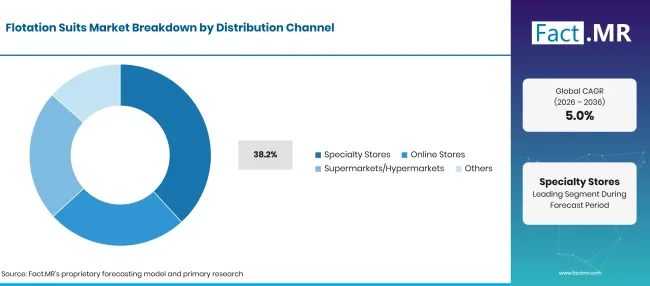
Flotation Suits Market Breakdown Distribution Channel | Source: Fact.MR
| Distribution Channel | Share (2026) |
|---|---|
| Specialty Stores (Leading segment) | 38.2% |
| Other segments combined | 61.8% |
| Total | 100.0% |
Source: Fact.MR analysis. Updated Oct 30, 2026
Specialty stores allow customers to try on flotation suits and check whether they can bend, sit and move comfortably. This is particularly important when the garment needs to fit over insulating clothing.
What is accelerating Flotation Suits Market adoption, and what is holding it back?
Demand is shaped by the time people spend on exposed vessels and their need for warmth without excessive bulk. Suit suitability, price and replacement intervals also influence purchasing decisions.
Drivers Impact Analysis
| DRIVER | (~) % IMPACT ON CAGR | GEOGRAPHIC RELEVANCE | IMPACT TIMELINE |
|---|---|---|---|
| Cold-water crew protection | +1.2% | North America, Europe | Short term |
| Commercial fleet replacement | +0.9% | Global | Medium term |
| Practical two-piece fit | +0.7% | Europe, Japan | Medium term |
| Recreational safety purchasing | +0.6% | North America, Japan | Short term |
| Clear technical product information | +0.4% | Global | Long term |
Source: Fact.MR analysis. Updated Oct 30, 2026
Opportunity Impact Analysis
| OPPORTUNITY | (~) % IMPACT ON CAGR | GEOGRAPHIC RELEVANCE | IMPACT TIMELINE |
|---|---|---|---|
| Adjustable layered suit designs | +0.7% | Europe, North America | Medium term |
| Crew-specific fit ranges | +0.5% | Global offshore | Medium term |
| Service and replacement programs | +0.4% | Commercial fleets | Long term |
| Direct-to-user fit guidance | +0.3% | North America, Japan | Short term |
Source: Fact.MR analysis. Updated Oct 30, 2026
Restraints Impact Analysis
| RESTRAINT | (~) % IMPACT ON CAGR | GEOGRAPHIC RELEVANCE | IMPACT TIMELINE |
|---|---|---|---|
| Cost of technical garments | -0.6% | Global | Short term |
| Wearer comfort and bulk | -0.5% | Recreational users | Medium term |
| Confusion with survival suits | -0.4% | Global | Short term |
| Limited specialist retail access | -0.3% | Remote coastal areas | Long term |
Source: Fact.MR analysis. Updated Oct 30, 2026
Which countries are scaling the Flotation Suits Market through 2036?
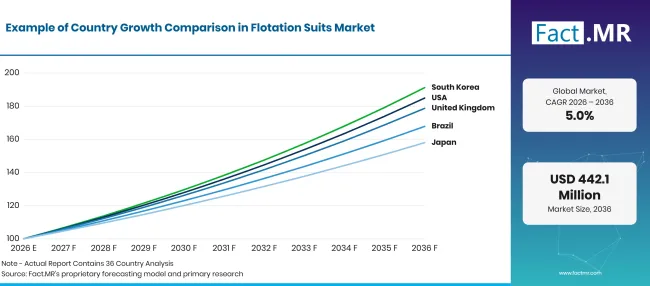
Flotation Suits Market Growth Index | Source: Fact.MR
| Country | CAGR (2026 to 2036) |
|---|---|
| USA | 6.3% |
| UK | 6.0% |
| Brazil | 5.3% |
| Japan | 4.7% |
| Germany | 3.7% |
Source: Fact.MR analysis. Updated Oct 30, 2026
What is supporting United States demand?
6.3% CAGR, supported by recreational boating activity and persistent cold-water safety needs.
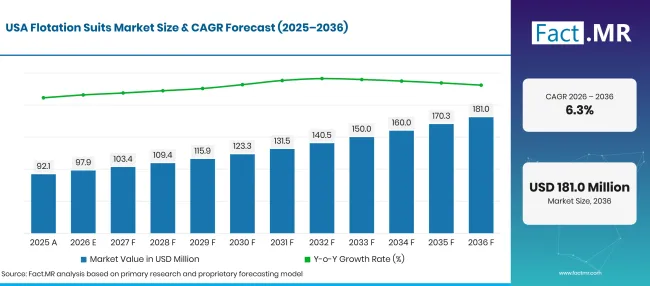
Flotation Suits Market Forecast Usa | Source: Fact.MR
Cold-water exposure and the size of the leisure boating fleet shape buying decisions in the United States. The U.S. Coast Guard reported in July 2025 that 556 people died in recreational boating incidents during 2024 [1]. The U.S. Coast Guard’s 2024 Recreational Boating Statistics, released in July 2025, recorded a fatality rate of 4.8 deaths per 100,000 registered recreational vessels, compared with 4.9 in 2023 [13].
How is the United Kingdom developing sales?
6.0% CAGR, linked to an established fishing fleet and active seafarer base.
The United Kingdom has an established commercial fishing fleet whose crews need clothing that permits regular deck movement. The Marine Management Organisation reported in December 2025 that 5,232 fishing vessels were registered in the UK during 2024 [4]. Its fleet statistics give marine clothing brands a clear picture of the professional customer base. The UK Department for Transport estimated that 24,550 UK seafarers were active at sea in 2025 [14].
What supports Brazil’s outlook?
5.3% CAGR, driven by busy ports, inland waterways, and commercial marine activity.
Brazil’s long coastline and inland waterways create different purchasing conditions for marine workwear. Brazil’s Ministry of Ports and Airports reported that the country’s ports handled approximately 1.4 billion tonnes of cargo in 2025, representing growth of 6.1% compared with 2024 [8]. Brazil’s National Waterway Transport Agency (ANTAQ) reported approximately 374.6 billion tonne-kilometres of waterborne transport activity in 2025, representing growth of 9.81% [9]. Marine outfitters serving busy terminals and inland routes may therefore focus on durable garments and readily available sizes.
How is Japan approaching water safety?
4.7% CAGR, tied to small-vessel fishing and marine recreation safety requirements.
Japan’s flotation-suit demand is tied closely to the conditions of small-vessel fishing and seasonal water recreation. The Japan Coast Guard reported in January 2026 that 1,708 vessels were involved in marine accidents during 2025 [10]. Marine safety retailers can explain how everyday buoyant clothing differs from emergency survival equipment. The same agency recorded 702 people involved in marine-leisure casualty incidents in 2025. Fishing users often evaluate how freely they can bend and work in a suit before choosing a warmer garment.
What is influencing Germany’s position?
3.7% CAGR, shaped by merchant shipping activity and replacement needs across marine workwear.
Germany’s marine buyers place particular attention on garment function and the distinction between routine protective wear and emergency equipment. Destatis recorded 258 sea-going merchant vessels in its 2024 fleet figures published in March 2025 [12]. Fleet operators evaluating workwear can combine fit checks with an assessment of actual water and weather exposure. Eurostat reported that the EU fishing fleet comprised 68,863 catching vessels in 2024 [11]. A changing fishing-fleet base may affect repeat garment purchases. Eurostat reported that the EU fishing fleet decreased by 13.6% between 2014 and 2024. That regional comparison provides background for equipment replacement planning without measuring German flotation-suit sales.
Who participates in the Flotation Suits Market?
Competition between brands selling flotation garments and marine safety companies known for neighboring protective categories.
Mustang Survival and Baltic Safety Products offer wearable flotation products; other named suppliers focus variously on sailing wear, foul-weather clothing or immersion equipment. VIKING Life-Saving Equipment’s April 2025 launch involved a purpose-built offshore wind immersion suit [2].
Which companies are the key providers?
Key companies include Mustang Survival; Baltic Safety Products; VIKING Life-Saving Equipment; Crewsaver; and Survitec Group.
- Mustang Survival
- Baltic Safety Products
- VIKING Life-Saving Equipment
- Crewsaver
- Survitec Group
Bibliography
- [1] U.S. Coast Guard. (2025, July 1). Coast Guard reports fewest boating fatalities in more than 50 years.
- [2] VIKING Life-Saving Equipment. (2025, April 23). VIKING collaborates with offshore wind safety leaders to launch world’s first immersion suit designed for women.
- [3] U.S. Coast Guard. (2026, January 21). Coast Guard, NASBLA renew commitment to recreational boating safety.
- [4] Marine Management Organisation. (2025, December 2). Fishing industry 2024 statistics published.
- [8] Ministry of Ports and Airports. (2026, February 10). Portos brasileiros movimentam 1,4 bilhão de toneladas em 2025 e batem recorde histórico.
- [9] Agência Nacional de Transportes Aquaviários. (2026, October 7). Transporte aquaviário registra crescimento de 9,81% e alcança 374,6 bilhões de TKU em 2025.
- [10] Japan Coast Guard. (2026, January 21). 令和7年における海難発生状況(速報値) [Marine accident occurrence status in 2025: Preliminary figures].
- [11] Eurostat. (2026, February 16). Key figures on food chain – EU’s fishing fleet.
- [12] Statistisches Bundesamt (Destatis). (2025, March 5). Bestand an Schiffen und Luftfahrzeugen für die Jahre 2019 bis 2024.
- [13] U.S. Coast Guard. (2025, June 24). Recreational boating statistics 2024.
- [14] Department for Transport. (2026, February 25). Seafarers in the UK shipping industry: 2025.
This Report Answers
- The report explains how one-piece and two-piece flotation clothing differs in routine marine use.
- The material review compares neoprene with nylon and polyester construction choices.
- The end-user analysis separates commercial replacement demand from recreational purchasing.
- Country coverage compares marine activity and fit requirements in the USA, UK, Brazil, Japan and Germany.
- Competitive coverage distinguishes flotation garment brands from neighboring immersion-suit suppliers.
What does the Flotation Suits Market cover?
The scope covers one-piece and two-piece outer garments sold as flotation suits for use on or near water. The study considers products designed for working crews and recreational users, including garments that combine buoyancy with an insulating or weather-resistant outer layer.
What is included in the scope?
Covered products include flotation suit jackets and trousers sold together and continuous one-piece flotation garments. Marine fishing and other use cases are included when the item is sold as a flotation suit.
What is excluded from the scope?
Standalone lifejackets and ordinary rainwear are outside the scope. Dedicated emergency immersion suits are excluded where their certification and primary function place them in a distinct life-saving equipment category.
How Was the Analysis Built?
The analysis draws on 120+ sources, 35+ company portfolios, 25+ countries, and more than 20 industry interviews.
- Primary Research: Primary research includes discussions with manufacturers, service providers, technology developers, distributors, end users, and subject-matter experts. These conversations examine purchasing priorities, product adoption, operational challenges, approval requirements, competitive positioning, and the factors that influence wider market acceptance.
- Desk Research: Desk research covers government statistics, regulatory publications, company filings, trade data, technical studies, industry associations, standards, public policy, and other authoritative sources. Every source used in the analysis is documented in the bibliography.
- Market Sizing and Forecasting: Market estimates combine historical performance, demand indicators, pricing and volume trends, segment shares, company participation, country-level growth, adoption patterns, investment activity, and barriers to market expansion.
- Data Validation and Update Cycle: Findings are validated by comparing primary interviews with public data, company activity, regulatory changes, trade patterns, and industry developments. Regular updates review new product launches, capacity changes, partnerships, approvals, and shifts in commercial adoption.
Segmentation
What is the report’s scope and coverage?
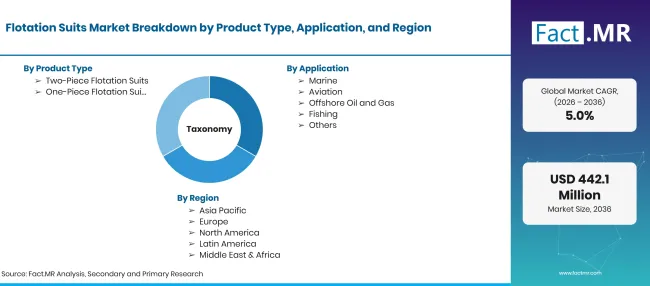
Flotation Suits Market Taxonomy | Source: Fact.MR
| Attribute | Details |
|---|---|
| Quantitative Units | USD million in 2026 to USD million by 2036, at CAGR |
| Market Definition | Buoyant protective outer suits marketed for use on water. Excludes ordinary lifejackets and dedicated emergency immersion suits unless marketed within the flotation-suit product boundary. |
| Product Type | Two-Piece Flotation Suits; One-Piece Flotation Suits |
| Application | Marine; Aviation; Offshore Oil and Gas; Fishing; Others |
| Material | Neoprene; Nylon; Polyester; Others |
| End-User | Commercial; Recreational; Military; Others |
| Distribution Channel | Specialty Stores; Online Stores; Supermarkets/Hypermarkets; Others |
| Regions Covered | North America; Latin America; Western Europe; Eastern Europe; East Asia; South Asia & Pacific; Middle East & Africa |
| Countries Covered | USA; UK; Brazil; Japan; Germany |
| Companies Profiled | Mustang Survival; Baltic Safety Products; VIKING Life-Saving Equipment; Crewsaver; and Survitec Group |
| Forecast Period | 2026 to 2036 |
| Approach | Product-category review, boating and fleet activity indicators, supplier positioning, and forecast scenario assessment |
Source: Fact.MR analysis. Updated Oct 30, 2026
How is the market segmented?
-
By Product Type
- Two-Piece Flotation Suits
- One-Piece Flotation Suits
-
By Application
- Marine
- Aviation
- Offshore Oil and Gas
- Fishing
- Others
-
By Material
- Neoprene
- Nylon
- Polyester
- Others
-
By End-User
- Commercial
- Recreational
- Military
- Others
-
By Distribution Channel
- Specialty Stores
- Online Stores
- Supermarkets/Hypermarkets
- Others
-
By Region
- North America
- Latin America
- Western Europe
- Eastern Europe
- East Asia
- South Asia & Pacific
- Middle East & Africa
Frequently Asked Questions
How big is the flotation suits market in 2026?
What CAGR applies to the flotation suits market?
Which product type accounts for more sales?
Which end-user category is larger?
Who are the main companies in the flotation suits market?
Who worked on this report


Preview the report firsthand - request a free sample
Free SampleGet the brochure for pricing and purchase details
Download PDF