Low-Impact Flotation Reagents Market
Low-Impact Flotation Reagents Market Size and Share Forecast Outlook 2026 to 2036
Low-impact flotation reagents market is projected to grow from USD 1.0 billion in 2026 to USD 2.6 billion by 2036, at a CAGR of 10.5%. Eco-bio-based collectors & fatty-acid alternatives will dominate with a 32.0% market share, while base metals (cu, zn, ni) will lead the ore type segment with a 36.0% share.
Low-Impact Flotation Reagents in Mining Market Forecast and Outlook 2026 to 2036
The global low-impact flotation reagents in mining market is projected to reach USD 2.65 billion by 2036. The market is valued at USD 0.98 billion in 2026 and is set to rise at a CAGR of 10.5% during the assessment period. By reagent type, eco-bio-based collectors & fatty-acid alternatives hold a leading 32% share. Base metals (Cu, Zn, Ni) represent the dominant ore type at 36%, while the collector function is the primary functional role, accounting for 40.00% market share.
Key Takeaways from the Low-Impact Flotation Reagents in Mining Market
- Market Value for 2026: USD 0.98 Billion
- Market Value for 2036: USD 2.65 Billion
- Forecast CAGR (2026-2036): 10.5%
- Leading Reagent Type Share (2026): Eco-Bio-Based Collectors & Fatty-Acid Alternatives (32%)
- Leading Ore Type Share (2026): Base Metals (Cu, Zn, Ni) (36%)
- Leading Functional Role Share (2026): Collector (40.00%)
- Key Players in the Market: AkzoNobel, Clariant, BASF, Solvay, Kemira & SNF, Dow, Arkema
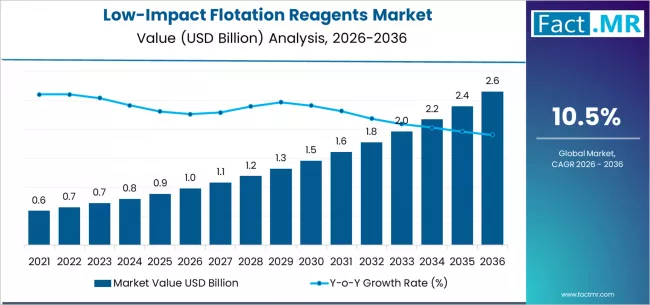
Defining trends involve the replacement of traditional, often toxic or persistent xanthates and dithiophosphates with biodegradable, plant-derived, or engineered green alternatives. Innovation is rapidly advancing in reagent design for selective flotation of complex, low-grade ores and critical battery metal mixes, minimizing downstream processing environmental impact. Integration of these novel reagents with digital process control and water recycling systems is becoming critical for achieving sustainable mining operations that meet stringent discharge regulations.
Regulatory frameworks enforcing stricter limits on effluent toxicity, particularly concerning cyanide, heavy metals, and persistent organic compounds from tailings, are the primary market drivers. Policies promoting responsible mining certifications (e.g., IRMA, TSM) and the circular economy of water act as significant catalysts, positioning low-impact reagents as essential for securing social license to operate and reducing environmental liability.
Low-Impact Flotation Reagents in Mining Market
| Metric | Value |
|---|---|
| Market Value (2026) | USD 0.98 Billion |
| Market Forecast Value (2036) | USD 2.65 Billion |
| Forecast CAGR (2026-2036) | 10.5% |
Category
| Category | Segments |
|---|---|
| Reagent Type | Eco-bio-based collectors & fatty-acid alternatives, Low-impact frothers (biodegradable & low-toxicity), Low-toxicity modifiers & depressants & pH modifiers, Specialty surfactants with rapid biodegradation, Reclaimed & recycled additive concentrates, Proprietary green reagent blends (vendor engineered) |
| Ore Type | Base metals (Cu, Zn, Ni), Precious metals (Au, Ag), Critical battery metals (Li, Co, Ni mixes), Industrial minerals (phosphate, potash), Rare earth ores |
| Functional Role | Collector (hydrophobicity enhancers), Frother (bubble stabilization), Modifiers (depressants & activators), pH & physicochemical modifiers, Specialty additives (selectivity & eco boosters) |
| Region | North America, Latin America, Western Europe, Eastern Europe, East Asia, South Asia & Pacific, MEA |
Segmental Analysis
By Reagent Type, Which Technology is Central to Replacing High-Impact Traditional Chemistry?
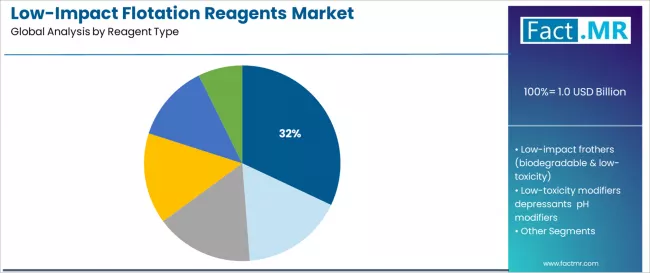
Eco-bio-based collectors & fatty-acid alternatives lead the segment with a 32% share. This dominance is due to their role as direct substitutes for sulfide collectors like xanthates. Derived from renewable sources (e.g., vegetable oils, tall oil), they provide effective hydrophobicity for mineral surfaces while offering rapid biodegradability and lower aquatic toxicity. This directly addresses the major environmental concern of persistent collector residues in tailings dams and wastewater, making them the focus of reformulation efforts, especially in base metal flotation.
By Ore Type, Which Sector Combines High Volume with Intensive Reagent Use and Regulatory Scrutiny?
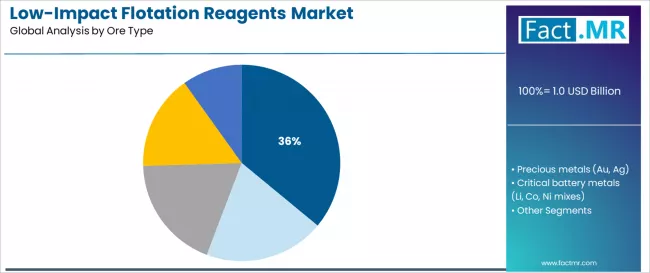
Base metals (Cu, Zn, Ni) command the largest ore type share at 36%. The flotation of copper, zinc, and nickel sulfides is the largest-volume application for reagents globally. These operations face intense pressure regarding acid mine drainage and tailings management. Transitioning to low-impact collectors and frothers in this high-tonnage sector represents the single greatest opportunity for reducing the overall environmental footprint of mining, driving significant R&D and pilot-scale adoption.
By Functional Role, Which Component is Fundamental to the Flotation Process and Environmental Profile?
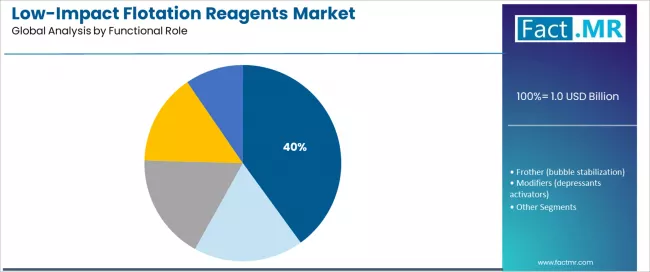
Collectors represent the leading functional role at 40.00%. Collectors are the active chemicals that selectively attach to target mineral surfaces, enabling separation. Their molecular design dictates not only process efficiency but also the environmental fate of residual reagents. Developing high-performance, biodegradable collectors is therefore the most critical and impactful challenge in green flotation chemistry, as they are used in significant quantities and directly influence downstream water treatment needs.
What are the Drivers, Restraints, and Key Trends of the Low-Impact Flotation Reagents in Mining Market?
Market growth is driven by increasingly stringent global and local regulations on mine effluent and tailings storage facility (TSF) water quality. Mining companies’ ESG commitments and pursuit of sustainability certifications require demonstrable reductions in chemical footprint. Community and investor pressure for responsible water stewardship is accelerating the adoption of benign reagents. The processing of more complex, lower-grade ores also sometimes necessitates novel, selective reagent chemistries that can be designed with green principles in mind.
A significant restraint is the performance gap perceived or real between some green alternatives and optimized traditional reagents in terms of recovery rate, selectivity, or dosage required. The higher cost of some novel bio-based or specialty reagents can impact operating costs. Resistance to change in a conservative industry and the risk of disrupting stable, well-understood plant operations can slow adoption. Furthermore, the lack of standardized global regulations creates a complex landscape for reagent suppliers and miners.
Key trends include the molecular design of reagents for selective recovery of battery metals (Li, Co, Ni) from complex ores. There is a growing use of digital chemistry and AI to screen and design new biodegradable molecules with target properties. The development of multi-functional reagents that combine collecting and frothing properties is gaining attention to simplify chemical handling. Furthermore, the integration of reagent selection with closed-water-loop simulation models is becoming a best practice.
Analysis of the Low-Impact Flotation Reagents in Mining Market by Key Countries
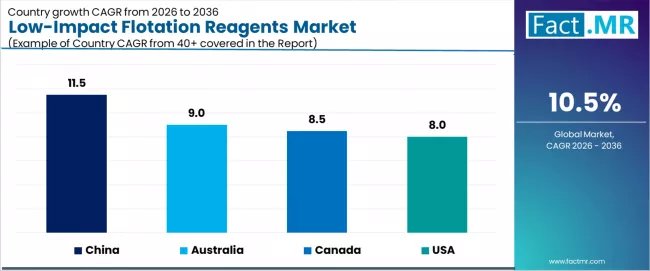
| Country | CAGR (2026-2036) |
|---|---|
| China | 11.50% |
| Australia | 9.00% |
| Canada | 8.50% |
| USA | 8.00% |
| Chile | 7.50% |
How does China's Mining Scale and Environmental Policy Shift Drive Market Leadership?
China leads with an 11.50% CAGR, driven by the massive scale of its domestic mining industry and a decisive policy shift towards "ecological civilization." Stricter enforcement of environmental laws is forcing mines and processors to adopt cleaner technologies. China's significant production of base metals, industrial minerals, and REEs creates vast demand. Domestic chemical companies are actively developing and scaling low-impact reagents to supply this market and reduce import dependence.
Why is Australia's Export-Oriented Mining and Water-Scarce Environment a Key Driver?
Australia's 9.00% growth is fueled by its world-leading export-oriented mining sector operating in environmentally sensitive and often water-scarce regions. Australian miners are under significant stakeholder pressure to demonstrate sustainable water and tailings management. The high level of technical expertise and innovation in the Australian mining sector makes it a key testing ground for advanced, low-impact reagent systems, particularly for copper, gold, and lithium ores.
What Role does Canada's Mining Industry and Strict Regulatory Framework Play?
Canada's 8.50% growth is underpinned by a large mining industry operating under a stringent federal and provincial regulatory environment. Canada’s focus on green mining initiatives and indigenous community engagement pushes operators toward best available technologies. The presence of major potash and base metal mines, along with a growing battery metals sector, creates diverse demand for specialized, environmentally sound flotation chemistries.
How does the USA's Mining Industry and Superfund Liability Concerns Influence Adoption?
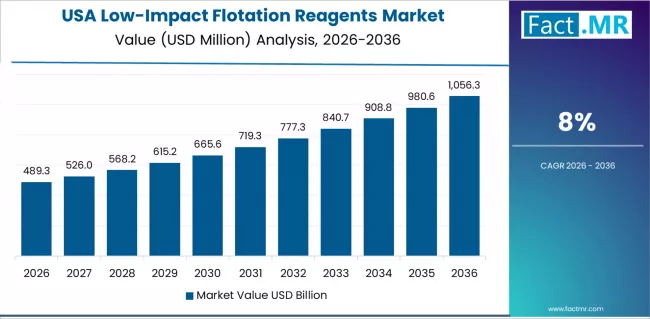
The USA's 8.00% growth is driven by the mining industry's need to manage long-term liability under regulations like CERCLA (Superfund). Reducing the toxicity profile of reagents used in operations minimizes future environmental risk and cleanup costs. The nascent development of critical mineral projects (e.g., rare earths, lithium) is also adopting modern reagent philosophies from the outset to facilitate permitting and community acceptance.
What Factors Underpin Chile's Copper Industry and Water Stewardship Focus?
Chile's 7.50% growth is anchored in its dominant copper industry, which faces extreme water scarcity and global scrutiny. Chilean copper producers are leaders in water recycling and tailings management innovation. The transition to low-impact flotation reagents that are compatible with closed-water loops and produce less toxic tailings is a strategic priority to ensure the long-term sustainability and social license of the sector.
Competitive Landscape of the Low-Impact Flotation Reagents in Mining Market
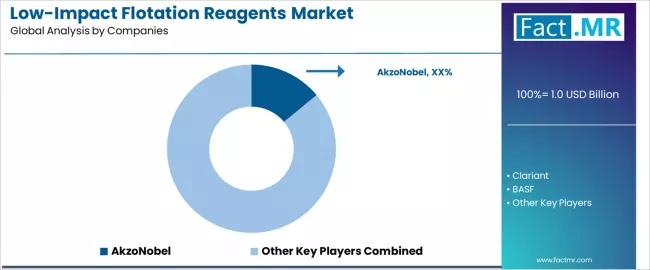
The competitive landscape is concentrated among global specialty chemical companies with deep expertise in mineral processing. Leaders like AkzoNobel (via Nouryon), Clariant, and BASF compete by offering extensive portfolios of collectors, frothers, and modifiers, backed by strong R&D and application-specific technical service teams.
Companies like Solvay, Kemira, and SNF compete with strengths in specific polymer and surfactant chemistries for depressants and flocculants that complement green flotation. Chemical giants Dow and Arkema leverage their broad feedstock and synthesis capabilities. Competition intensifies around forming strategic, site-specific partnerships with major mining houses, conducting successful pilot trials that prove both efficacy and economic viability, and providing lifecycle assessment data for the reagent's environmental footprint.
Key Players in the Low-Impact Flotation Reagents in Mining Market
- AkzoNobel
- Clariant
- BASF
- Solvay
- Kemira & SNF
- Dow
- Arkema
Scope of Report
| Items | Values |
|---|---|
| Quantitative Units | USD Billion |
| Reagent Type | Eco-bio-based collectors, Low-impact frothers, Low-toxicity modifiers/depressants, Specialty surfactants, Reclaimed concentrates, Proprietary blends |
| Ore Type | Base metals, Precious metals, Critical battery metals, Industrial minerals, Rare earth ores |
| Functional Role | Collector, Frother, Modifier, pH modifier, Specialty additive |
| Key Countries | China, Australia, Canada, USA, Chile |
| Key Companies | AkzoNobel, Clariant, BASF, Solvay, Kemira & SNF, Dow, Arkema |
| Additional Analysis | Analysis of biodegradability (OECD tests), aquatic toxicity, metal selectivity performance, compatibility with water treatment systems, impact on downstream metallurgy (smelting), and total cost-in-use versus conventional reagents. |
Low-Impact Flotation Reagents in Mining Market by Segments
-
Reagent Type :
- Eco-bio-based collectors & fatty-acid alternatives
- Low-impact frothers (biodegradable & low-toxicity)
- Low-toxicity modifiers & depressants & pH modifiers
- Specialty surfactants with rapid biodegradation
- Reclaimed & recycled additive concentrates
- Proprietary green reagent blends (vendor engineered)
-
Ore Type :
- Base metals (Cu, Zn, Ni)
- Precious metals (Au, Ag)
- Critical battery metals (Li, Co, Ni mixes)
- Industrial minerals (phosphate, potash)
- Rare earth ores
-
Functional Role :
- Collector (hydrophobicity enhancers)
- Frother (bubble stabilization)
- Modifiers (depressants & activators)
- pH & physicochemical modifiers
- Specialty additives (selectivity & eco boosters)
-
Region :
-
North America
- USA
- Canada
-
Latin America
- Chile
- Peru
- Brazil
- Argentina
- Mexico
- Rest of Latin America
-
Western Europe
- Germany
- UK
- France
- Italy
- Spain
- BENELUX
- Sweden
- Rest of Western Europe
-
Eastern Europe
- Russia
- Poland
- Czech Republic
- Rest of Eastern Europe
-
East Asia
- China
- Japan
- South Korea
- Rest of East Asia
-
South Asia & Pacific
- Australia
- India
- Indonesia
- Rest of South Asia & Pacific
-
MEA
- South Africa
- Saudi Arabia
- Rest of MEA
-
Table of Content
- Executive Summary
- Global Market Outlook
- Demand to side Trends
- Supply to side Trends
- Technology Roadmap Analysis
- Analysis and Recommendations
- Market Overview
- Market Coverage / Taxonomy
- Market Definition / Scope / Limitations
- Market Background
- Market Dynamics
- Drivers
- Restraints
- Opportunity
- Trends
- Scenario Forecast
- Demand in Optimistic Scenario
- Demand in Likely Scenario
- Demand in Conservative Scenario
- Opportunity Map Analysis
- Product Life Cycle Analysis
- Supply Chain Analysis
- Investment Feasibility Matrix
- Value Chain Analysis
- PESTLE and Porter’s Analysis
- Regulatory Landscape
- Regional Parent Market Outlook
- Production and Consumption Statistics
- Import and Export Statistics
- Market Dynamics
- Global Market Analysis 2021 to 2025 and Forecast, 2026 to 2036
- Historical Market Size Value (USD Million) Analysis, 2021 to 2025
- Current and Future Market Size Value (USD Million) Projections, 2026 to 2036
- Y to o to Y Growth Trend Analysis
- Absolute $ Opportunity Analysis
- Global Market Pricing Analysis 2021 to 2025 and Forecast 2026 to 2036
- Global Market Analysis 2021 to 2025 and Forecast 2026 to 2036, By Reagent Type
- Introduction / Key Findings
- Historical Market Size Value (USD Million) Analysis By Reagent Type, 2021 to 2025
- Current and Future Market Size Value (USD Million) Analysis and Forecast By Reagent Type, 2026 to 2036
- Eco-bio-based collectors & fatty-acid alternatives
- Low-impact frothers (biodegradable & low-toxicity)
- Low-toxicity modifiers depressants pH modifiers
- Specialty surfactants with rapid biodegradation
- Reclaimed & recycled additive concentrates
- Proprietary green reagent blends (vendor engineered)
- Eco-bio-based collectors & fatty-acid alternatives
- Y to o to Y Growth Trend Analysis By Reagent Type, 2021 to 2025
- Absolute $ Opportunity Analysis By Reagent Type, 2026 to 2036
- Global Market Analysis 2021 to 2025 and Forecast 2026 to 2036, By Ore Type
- Introduction / Key Findings
- Historical Market Size Value (USD Million) Analysis By Ore Type, 2021 to 2025
- Current and Future Market Size Value (USD Million) Analysis and Forecast By Ore Type, 2026 to 2036
- Base metals (Cu, Zn, Ni)
- Precious metals (Au, Ag)
- Critical battery metals (Li, Co, Ni mixes)
- Industrial minerals (phosphate, potash)
- Rare earth ores
- Base metals (Cu, Zn, Ni)
- Y to o to Y Growth Trend Analysis By Ore Type, 2021 to 2025
- Absolute $ Opportunity Analysis By Ore Type, 2026 to 2036
- Global Market Analysis 2021 to 2025 and Forecast 2026 to 2036, By Functional Role
- Introduction / Key Findings
- Historical Market Size Value (USD Million) Analysis By Functional Role, 2021 to 2025
- Current and Future Market Size Value (USD Million) Analysis and Forecast By Functional Role, 2026 to 2036
- Collector (hydrophobicity enhancers)
- Frother (bubble stabilization)
- Modifiers (depressants activators)
- pH physicochemical modifiers
- Specialty additives (selectivity eco boosters)
- Collector (hydrophobicity enhancers)
- Y to o to Y Growth Trend Analysis By Functional Role, 2021 to 2025
- Absolute $ Opportunity Analysis By Functional Role, 2026 to 2036
- Global Market Analysis 2021 to 2025 and Forecast 2026 to 2036, By Region
- Introduction
- Historical Market Size Value (USD Million) Analysis By Region, 2021 to 2025
- Current Market Size Value (USD Million) Analysis and Forecast By Region, 2026 to 2036
- North America
- Latin America
- Western Europe
- Eastern Europe
- East Asia
- South Asia and Pacific
- Middle East & Africa
- Market Attractiveness Analysis By Region
- North America Market Analysis 2021 to 2025 and Forecast 2026 to 2036, By Country
- Historical Market Size Value (USD Million) Trend Analysis By Market Taxonomy, 2021 to 2025
- Market Size Value (USD Million) Forecast By Market Taxonomy, 2026 to 2036
- By Country
- USA
- Canada
- Mexico
- By Reagent Type
- By Ore Type
- By Functional Role
- By Country
- Market Attractiveness Analysis
- By Country
- By Reagent Type
- By Ore Type
- By Functional Role
- Key Takeaways
- Latin America Market Analysis 2021 to 2025 and Forecast 2026 to 2036, By Country
- Historical Market Size Value (USD Million) Trend Analysis By Market Taxonomy, 2021 to 2025
- Market Size Value (USD Million) Forecast By Market Taxonomy, 2026 to 2036
- By Country
- Brazil
- Chile
- Rest of Latin America
- By Reagent Type
- By Ore Type
- By Functional Role
- By Country
- Market Attractiveness Analysis
- By Country
- By Reagent Type
- By Ore Type
- By Functional Role
- Key Takeaways
- Western Europe Market Analysis 2021 to 2025 and Forecast 2026 to 2036, By Country
- Historical Market Size Value (USD Million) Trend Analysis By Market Taxonomy, 2021 to 2025
- Market Size Value (USD Million) Forecast By Market Taxonomy, 2026 to 2036
- By Country
- Germany
- UK
- Italy
- Spain
- France
- Nordic
- BENELUX
- Rest of Western Europe
- By Reagent Type
- By Ore Type
- By Functional Role
- By Country
- Market Attractiveness Analysis
- By Country
- By Reagent Type
- By Ore Type
- By Functional Role
- Key Takeaways
- Eastern Europe Market Analysis 2021 to 2025 and Forecast 2026 to 2036, By Country
- Historical Market Size Value (USD Million) Trend Analysis By Market Taxonomy, 2021 to 2025
- Market Size Value (USD Million) Forecast By Market Taxonomy, 2026 to 2036
- By Country
- Russia
- Poland
- Hungary
- Balkan & Baltic
- Rest of Eastern Europe
- By Reagent Type
- By Ore Type
- By Functional Role
- By Country
- Market Attractiveness Analysis
- By Country
- By Reagent Type
- By Ore Type
- By Functional Role
- Key Takeaways
- East Asia Market Analysis 2021 to 2025 and Forecast 2026 to 2036, By Country
- Historical Market Size Value (USD Million) Trend Analysis By Market Taxonomy, 2021 to 2025
- Market Size Value (USD Million) Forecast By Market Taxonomy, 2026 to 2036
- By Country
- China
- Japan
- South Korea
- By Reagent Type
- By Ore Type
- By Functional Role
- By Country
- Market Attractiveness Analysis
- By Country
- By Reagent Type
- By Ore Type
- By Functional Role
- Key Takeaways
- South Asia and Pacific Market Analysis 2021 to 2025 and Forecast 2026 to 2036, By Country
- Historical Market Size Value (USD Million) Trend Analysis By Market Taxonomy, 2021 to 2025
- Market Size Value (USD Million) Forecast By Market Taxonomy, 2026 to 2036
- By Country
- India
- ASEAN
- Australia & New Zealand
- Rest of South Asia and Pacific
- By Reagent Type
- By Ore Type
- By Functional Role
- By Country
- Market Attractiveness Analysis
- By Country
- By Reagent Type
- By Ore Type
- By Functional Role
- Key Takeaways
- Middle East & Africa Market Analysis 2021 to 2025 and Forecast 2026 to 2036, By Country
- Historical Market Size Value (USD Million) Trend Analysis By Market Taxonomy, 2021 to 2025
- Market Size Value (USD Million) Forecast By Market Taxonomy, 2026 to 2036
- By Country
- Kingdom of Saudi Arabia
- Other GCC Countries
- Turkiye
- South Africa
- Other African Union
- Rest of Middle East & Africa
- By Reagent Type
- By Ore Type
- By Functional Role
- By Country
- Market Attractiveness Analysis
- By Country
- By Reagent Type
- By Ore Type
- By Functional Role
- Key Takeaways
- Key Countries Market Analysis
- USA
- Pricing Analysis
- Market Share Analysis, 2025
- By Reagent Type
- By Ore Type
- By Functional Role
- Canada
- Pricing Analysis
- Market Share Analysis, 2025
- By Reagent Type
- By Ore Type
- By Functional Role
- Mexico
- Pricing Analysis
- Market Share Analysis, 2025
- By Reagent Type
- By Ore Type
- By Functional Role
- Brazil
- Pricing Analysis
- Market Share Analysis, 2025
- By Reagent Type
- By Ore Type
- By Functional Role
- Chile
- Pricing Analysis
- Market Share Analysis, 2025
- By Reagent Type
- By Ore Type
- By Functional Role
- Germany
- Pricing Analysis
- Market Share Analysis, 2025
- By Reagent Type
- By Ore Type
- By Functional Role
- UK
- Pricing Analysis
- Market Share Analysis, 2025
- By Reagent Type
- By Ore Type
- By Functional Role
- Italy
- Pricing Analysis
- Market Share Analysis, 2025
- By Reagent Type
- By Ore Type
- By Functional Role
- Spain
- Pricing Analysis
- Market Share Analysis, 2025
- By Reagent Type
- By Ore Type
- By Functional Role
- France
- Pricing Analysis
- Market Share Analysis, 2025
- By Reagent Type
- By Ore Type
- By Functional Role
- India
- Pricing Analysis
- Market Share Analysis, 2025
- By Reagent Type
- By Ore Type
- By Functional Role
- ASEAN
- Pricing Analysis
- Market Share Analysis, 2025
- By Reagent Type
- By Ore Type
- By Functional Role
- Australia & New Zealand
- Pricing Analysis
- Market Share Analysis, 2025
- By Reagent Type
- By Ore Type
- By Functional Role
- China
- Pricing Analysis
- Market Share Analysis, 2025
- By Reagent Type
- By Ore Type
- By Functional Role
- Japan
- Pricing Analysis
- Market Share Analysis, 2025
- By Reagent Type
- By Ore Type
- By Functional Role
- South Korea
- Pricing Analysis
- Market Share Analysis, 2025
- By Reagent Type
- By Ore Type
- By Functional Role
- Russia
- Pricing Analysis
- Market Share Analysis, 2025
- By Reagent Type
- By Ore Type
- By Functional Role
- Poland
- Pricing Analysis
- Market Share Analysis, 2025
- By Reagent Type
- By Ore Type
- By Functional Role
- Hungary
- Pricing Analysis
- Market Share Analysis, 2025
- By Reagent Type
- By Ore Type
- By Functional Role
- Kingdom of Saudi Arabia
- Pricing Analysis
- Market Share Analysis, 2025
- By Reagent Type
- By Ore Type
- By Functional Role
- Turkiye
- Pricing Analysis
- Market Share Analysis, 2025
- By Reagent Type
- By Ore Type
- By Functional Role
- South Africa
- Pricing Analysis
- Market Share Analysis, 2025
- By Reagent Type
- By Ore Type
- By Functional Role
- USA
- Market Structure Analysis
- Competition Dashboard
- Competition Benchmarking
- Market Share Analysis of Top Players
- By Regional
- By Reagent Type
- By Ore Type
- By Functional Role
- Competition Analysis
- Competition Deep Dive
- AkzoNobel
- Overview
- Product Portfolio
- Profitability by Market Segments (Product/Age /Sales Channel/Region)
- Sales Footprint
- Strategy Overview
- Marketing Strategy
- Product Strategy
- Channel Strategy
- Clariant
- BASF
- Solvay
- Kemira & SNF
- Dow
- Arkema
- AkzoNobel
- Competition Deep Dive
- Assumptions & Acronyms Used
- Research Methodology
List Of Table
- Table 1: Global Market Value (USD Million) Forecast by Region, 2021 to 2036
- Table 2: Global Market Value (USD Million) Forecast by Reagent Type, 2021 to 2036
- Table 3: Global Market Value (USD Million) Forecast by Ore Type, 2021 to 2036
- Table 4: Global Market Value (USD Million) Forecast by Functional Role, 2021 to 2036
- Table 5: North America Market Value (USD Million) Forecast by Country, 2021 to 2036
- Table 6: North America Market Value (USD Million) Forecast by Reagent Type, 2021 to 2036
- Table 7: North America Market Value (USD Million) Forecast by Ore Type, 2021 to 2036
- Table 8: North America Market Value (USD Million) Forecast by Functional Role, 2021 to 2036
- Table 9: Latin America Market Value (USD Million) Forecast by Country, 2021 to 2036
- Table 10: Latin America Market Value (USD Million) Forecast by Reagent Type, 2021 to 2036
- Table 11: Latin America Market Value (USD Million) Forecast by Ore Type, 2021 to 2036
- Table 12: Latin America Market Value (USD Million) Forecast by Functional Role, 2021 to 2036
- Table 13: Western Europe Market Value (USD Million) Forecast by Country, 2021 to 2036
- Table 14: Western Europe Market Value (USD Million) Forecast by Reagent Type, 2021 to 2036
- Table 15: Western Europe Market Value (USD Million) Forecast by Ore Type, 2021 to 2036
- Table 16: Western Europe Market Value (USD Million) Forecast by Functional Role, 2021 to 2036
- Table 17: Eastern Europe Market Value (USD Million) Forecast by Country, 2021 to 2036
- Table 18: Eastern Europe Market Value (USD Million) Forecast by Reagent Type, 2021 to 2036
- Table 19: Eastern Europe Market Value (USD Million) Forecast by Ore Type, 2021 to 2036
- Table 20: Eastern Europe Market Value (USD Million) Forecast by Functional Role, 2021 to 2036
- Table 21: East Asia Market Value (USD Million) Forecast by Country, 2021 to 2036
- Table 22: East Asia Market Value (USD Million) Forecast by Reagent Type, 2021 to 2036
- Table 23: East Asia Market Value (USD Million) Forecast by Ore Type, 2021 to 2036
- Table 24: East Asia Market Value (USD Million) Forecast by Functional Role, 2021 to 2036
- Table 25: South Asia and Pacific Market Value (USD Million) Forecast by Country, 2021 to 2036
- Table 26: South Asia and Pacific Market Value (USD Million) Forecast by Reagent Type, 2021 to 2036
- Table 27: South Asia and Pacific Market Value (USD Million) Forecast by Ore Type, 2021 to 2036
- Table 28: South Asia and Pacific Market Value (USD Million) Forecast by Functional Role, 2021 to 2036
- Table 29: Middle East & Africa Market Value (USD Million) Forecast by Country, 2021 to 2036
- Table 30: Middle East & Africa Market Value (USD Million) Forecast by Reagent Type, 2021 to 2036
- Table 31: Middle East & Africa Market Value (USD Million) Forecast by Ore Type, 2021 to 2036
- Table 32: Middle East & Africa Market Value (USD Million) Forecast by Functional Role, 2021 to 2036
List Of Figures
- Figure 1: Global Market Pricing Analysis
- Figure 2: Global Market Value (USD Million) Forecast 2021 to 2036
- Figure 3: Global Market Value Share and BPS Analysis by Reagent Type, 2026 and 2036
- Figure 4: Global Market Y to o to Y Growth Comparison by Reagent Type, 2026 to 2036
- Figure 5: Global Market Attractiveness Analysis by Reagent Type
- Figure 6: Global Market Value Share and BPS Analysis by Ore Type, 2026 and 2036
- Figure 7: Global Market Y to o to Y Growth Comparison by Ore Type, 2026 to 2036
- Figure 8: Global Market Attractiveness Analysis by Ore Type
- Figure 9: Global Market Value Share and BPS Analysis by Functional Role, 2026 and 2036
- Figure 10: Global Market Y to o to Y Growth Comparison by Functional Role, 2026 to 2036
- Figure 11: Global Market Attractiveness Analysis by Functional Role
- Figure 12: Global Market Value (USD Million) Share and BPS Analysis by Region, 2026 and 2036
- Figure 13: Global Market Y to o to Y Growth Comparison by Region, 2026 to 2036
- Figure 14: Global Market Attractiveness Analysis by Region
- Figure 15: North America Market Incremental Dollar Opportunity, 2026 to 2036
- Figure 16: Latin America Market Incremental Dollar Opportunity, 2026 to 2036
- Figure 17: Western Europe Market Incremental Dollar Opportunity, 2026 to 2036
- Figure 18: Eastern Europe Market Incremental Dollar Opportunity, 2026 to 2036
- Figure 19: East Asia Market Incremental Dollar Opportunity, 2026 to 2036
- Figure 20: South Asia and Pacific Market Incremental Dollar Opportunity, 2026 to 2036
- Figure 21: Middle East & Africa Market Incremental Dollar Opportunity, 2026 to 2036
- Figure 22: North America Market Value Share and BPS Analysis by Country, 2026 and 2036
- Figure 23: North America Market Value Share and BPS Analysis by Reagent Type, 2026 and 2036
- Figure 24: North America Market Y to o to Y Growth Comparison by Reagent Type, 2026 to 2036
- Figure 25: North America Market Attractiveness Analysis by Reagent Type
- Figure 26: North America Market Value Share and BPS Analysis by Ore Type, 2026 and 2036
- Figure 27: North America Market Y to o to Y Growth Comparison by Ore Type, 2026 to 2036
- Figure 28: North America Market Attractiveness Analysis by Ore Type
- Figure 29: North America Market Value Share and BPS Analysis by Functional Role, 2026 and 2036
- Figure 30: North America Market Y to o to Y Growth Comparison by Functional Role, 2026 to 2036
- Figure 31: North America Market Attractiveness Analysis by Functional Role
- Figure 32: Latin America Market Value Share and BPS Analysis by Country, 2026 and 2036
- Figure 33: Latin America Market Value Share and BPS Analysis by Reagent Type, 2026 and 2036
- Figure 34: Latin America Market Y to o to Y Growth Comparison by Reagent Type, 2026 to 2036
- Figure 35: Latin America Market Attractiveness Analysis by Reagent Type
- Figure 36: Latin America Market Value Share and BPS Analysis by Ore Type, 2026 and 2036
- Figure 37: Latin America Market Y to o to Y Growth Comparison by Ore Type, 2026 to 2036
- Figure 38: Latin America Market Attractiveness Analysis by Ore Type
- Figure 39: Latin America Market Value Share and BPS Analysis by Functional Role, 2026 and 2036
- Figure 40: Latin America Market Y to o to Y Growth Comparison by Functional Role, 2026 to 2036
- Figure 41: Latin America Market Attractiveness Analysis by Functional Role
- Figure 42: Western Europe Market Value Share and BPS Analysis by Country, 2026 and 2036
- Figure 43: Western Europe Market Value Share and BPS Analysis by Reagent Type, 2026 and 2036
- Figure 44: Western Europe Market Y to o to Y Growth Comparison by Reagent Type, 2026 to 2036
- Figure 45: Western Europe Market Attractiveness Analysis by Reagent Type
- Figure 46: Western Europe Market Value Share and BPS Analysis by Ore Type, 2026 and 2036
- Figure 47: Western Europe Market Y to o to Y Growth Comparison by Ore Type, 2026 to 2036
- Figure 48: Western Europe Market Attractiveness Analysis by Ore Type
- Figure 49: Western Europe Market Value Share and BPS Analysis by Functional Role, 2026 and 2036
- Figure 50: Western Europe Market Y to o to Y Growth Comparison by Functional Role, 2026 to 2036
- Figure 51: Western Europe Market Attractiveness Analysis by Functional Role
- Figure 52: Eastern Europe Market Value Share and BPS Analysis by Country, 2026 and 2036
- Figure 53: Eastern Europe Market Value Share and BPS Analysis by Reagent Type, 2026 and 2036
- Figure 54: Eastern Europe Market Y to o to Y Growth Comparison by Reagent Type, 2026 to 2036
- Figure 55: Eastern Europe Market Attractiveness Analysis by Reagent Type
- Figure 56: Eastern Europe Market Value Share and BPS Analysis by Ore Type, 2026 and 2036
- Figure 57: Eastern Europe Market Y to o to Y Growth Comparison by Ore Type, 2026 to 2036
- Figure 58: Eastern Europe Market Attractiveness Analysis by Ore Type
- Figure 59: Eastern Europe Market Value Share and BPS Analysis by Functional Role, 2026 and 2036
- Figure 60: Eastern Europe Market Y to o to Y Growth Comparison by Functional Role, 2026 to 2036
- Figure 61: Eastern Europe Market Attractiveness Analysis by Functional Role
- Figure 62: East Asia Market Value Share and BPS Analysis by Country, 2026 and 2036
- Figure 63: East Asia Market Value Share and BPS Analysis by Reagent Type, 2026 and 2036
- Figure 64: East Asia Market Y to o to Y Growth Comparison by Reagent Type, 2026 to 2036
- Figure 65: East Asia Market Attractiveness Analysis by Reagent Type
- Figure 66: East Asia Market Value Share and BPS Analysis by Ore Type, 2026 and 2036
- Figure 67: East Asia Market Y to o to Y Growth Comparison by Ore Type, 2026 to 2036
- Figure 68: East Asia Market Attractiveness Analysis by Ore Type
- Figure 69: East Asia Market Value Share and BPS Analysis by Functional Role, 2026 and 2036
- Figure 70: East Asia Market Y to o to Y Growth Comparison by Functional Role, 2026 to 2036
- Figure 71: East Asia Market Attractiveness Analysis by Functional Role
- Figure 72: South Asia and Pacific Market Value Share and BPS Analysis by Country, 2026 and 2036
- Figure 73: South Asia and Pacific Market Value Share and BPS Analysis by Reagent Type, 2026 and 2036
- Figure 74: South Asia and Pacific Market Y to o to Y Growth Comparison by Reagent Type, 2026 to 2036
- Figure 75: South Asia and Pacific Market Attractiveness Analysis by Reagent Type
- Figure 76: South Asia and Pacific Market Value Share and BPS Analysis by Ore Type, 2026 and 2036
- Figure 77: South Asia and Pacific Market Y to o to Y Growth Comparison by Ore Type, 2026 to 2036
- Figure 78: South Asia and Pacific Market Attractiveness Analysis by Ore Type
- Figure 79: South Asia and Pacific Market Value Share and BPS Analysis by Functional Role, 2026 and 2036
- Figure 80: South Asia and Pacific Market Y to o to Y Growth Comparison by Functional Role, 2026 to 2036
- Figure 81: South Asia and Pacific Market Attractiveness Analysis by Functional Role
- Figure 82: Middle East & Africa Market Value Share and BPS Analysis by Country, 2026 and 2036
- Figure 83: Middle East & Africa Market Value Share and BPS Analysis by Reagent Type, 2026 and 2036
- Figure 84: Middle East & Africa Market Y to o to Y Growth Comparison by Reagent Type, 2026 to 2036
- Figure 85: Middle East & Africa Market Attractiveness Analysis by Reagent Type
- Figure 86: Middle East & Africa Market Value Share and BPS Analysis by Ore Type, 2026 and 2036
- Figure 87: Middle East & Africa Market Y to o to Y Growth Comparison by Ore Type, 2026 to 2036
- Figure 88: Middle East & Africa Market Attractiveness Analysis by Ore Type
- Figure 89: Middle East & Africa Market Value Share and BPS Analysis by Functional Role, 2026 and 2036
- Figure 90: Middle East & Africa Market Y to o to Y Growth Comparison by Functional Role, 2026 to 2036
- Figure 91: Middle East & Africa Market Attractiveness Analysis by Functional Role
- Figure 92: Global Market - Tier Structure Analysis
- Figure 93: Global Market - Company Share Analysis
- FAQs -
How big is the low-impact flotation reagents market in 2026?
The global low-impact flotation reagents market is estimated to be valued at USD 1.0 billion in 2026.
What will be the size of low-impact flotation reagents market in 2036?
The market size for the low-impact flotation reagents market is projected to reach USD 2.6 billion by 2036.
How much will be the low-impact flotation reagents market growth between 2026 and 2036?
The low-impact flotation reagents market is expected to grow at a 10.5% CAGR between 2026 and 2036.
What are the key product types in the low-impact flotation reagents market?
The key product types in low-impact flotation reagents market are eco-bio-based collectors & fatty-acid alternatives, low-impact frothers (biodegradable & low-toxicity), low-toxicity modifiers depressants ph modifiers, specialty surfactants with rapid biodegradation, reclaimed & recycled additive concentrates and proprietary green reagent blends (vendor engineered).
Which ore type segment to contribute significant share in the low-impact flotation reagents market in 2026?
In terms of ore type, base metals (cu, zn, ni) segment to command 36.0% share in the low-impact flotation reagents market in 2026.