- Market Value (2025): USD 130.1 Mn
- Estimated Value (2026): USD 136.0 Mn
- Forecast Value (2036): USD 211.2 Mn
- CAGR (2026-2036): 4.5%
What is the Diving Semi-drysuits Market forecast to be worth by 2036?
USD 136.0 million in 2026 to USD 211.2 million by 2036 at a 4.5% CAGR.
- The diving semi-drysuits market was valued at USD 130.1 million in 2025, with recreational divers buying most suits through dive shops.
- By 2036 the market will reach USD 211.2 million, up from USD 136.0 million in 2026, as dive travel recovers and professional teams renew their exposure kit.
- Revenue will compound at a 4.5% CAGR over 2026 to 2036, a moderate pace for a replacement-led category where a well-kept suit lasts several seasons.
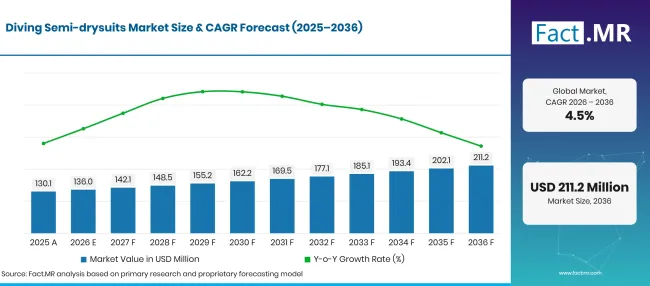
Factmr Diving Semi Drysuits Market Forecast Global | Source: Fact.MR
| Year | Basis | Market Value (USD million) |
|---|---|---|
| 2025 | Actual | 130.1 |
| 2026 | Estimate | 136.0 |
| 2036 | Forecast | 211.2 |
| CAGR 2026 to 2036 | Forecast period | 4.5% |
Source: Fact.MR analysis. Updated Oct 22, 2026
What are the defining numbers behind Diving Semi-drysuits Market growth?
The decade adds USD 75.2 million in new revenue, with recreational buyers and neoprene suits taking most of it.
- Demand Drivers in the Market
- Dive travel is growing again, and every trip in a cool season or a cool current creates a reason to buy a warmer suit. The Japan National Tourism Organization counted 42,683,600 visitor arrivals in 2025, up 15.8% on 2024 [1]. Winter and spring visitors to Japan, Brazil and southern Europe often meet water colder than brochure photos suggest.
- Professional diving teams need exposure protection that survives daily use and repeated donning. A January 2025 OSHA notice on the U.S. Commercial Diving Operations Standard listed 930 business respondents and about 2,900 professional divers [2]. Scientific, public safety and inspection divers in cool inland water often choose semi-drysuits over drysuits for shorter jobs.
- Better neoprene and seal design keep the category attractive to divers who find drysuits slow and costly. Current flagship models combine 7 mm to 8 mm stretch neoprene, plush thermal linings and double zippered cuffs, which narrows the warmth gap with drysuits at a lower price.
- Women’s and gender-specific cuts are widening the buyer base. Brands that once sold one men’s pattern now offer separate women’s patterns in the same model line, and a better fit means less water flushing through the suit.
- Specialty dive shops convert first-time buyers through try-on, seal trimming and advice on thickness. Shops also bundle suits with courses, which ties the first purchase to a training plan.
- Key Segments Analyzed
- By Product Type: Men’s Semi-drysuits will hold 42.3% share in 2026, since men still make up the larger part of active certified divers and buy across all suit thicknesses.
- By Application: Recreational Diving will account for 61.4% share in 2026, owing to leisure divers who extend their season into spring and autumn and travel to cool-water destinations.
- By Material: Neoprene will capture 54.1% share in 2026, as closed-cell foam gives warmth and some buoyancy at a price most hobby divers accept.
- By Distribution Channel: Specialty Dive Shops will command 42.7% share in 2026, given that fit and seal sizing decide whether a semi-drysuit actually stays warm.
- Analyst Opinion at Fact.MR
- Shambhu Nath Jha, Principal Consultant at Fact.MR, states, “A semi-drysuit is bought for the third and fourth dive of a cold day, not the first, so buyers judge it on how little water it lets in over time. Neoprene will keep most of the volume, while trilaminate gains ground with professional teams that need fast drying and low bulk. Brands that fit women well, train shop staff on seal sizing and publish clear temperature ratings will win more repeat buyers through 2036.”
- Strategic Implications
- Suit makers should widen women’s and unisex size grids, given that poor fit is the main reason a semi-drysuit flushes cold water.
- Dive retailers should run try-on days and seal fitting before peak season, since buyers who leave without a proper fit tend to return the suit or switch to online discounts.
- Material suppliers should document thermal ratings by water temperature, which helps retail staff explain which diver needs a 7 mm suit and which needs an 8/7 mm suit.
- Brands targeting professional and military buyers should test zips, seals and abrasion panels to agency standards, because institutional buyers rank service life ahead of unit price.
With a 5.8% CAGR, Brazil leads the five, where record foreign arrivals and busy marine parks bring more people into dive training. Japan follows at 5.0% as visitors fill Okinawa and divers on Honshu need warm suits for cooler months. Germany grows at 4.3%, carried by lake and quarry diving and by offshore work in the North and Baltic Seas. A 3.9% pace in the United States reflects a mature diver base that replaces suits on a steady cycle. The United Kingdom rounds out the group at 3.3%, where year-round cold sea diving keeps demand stable but leaves little room for new buyers.
How does the Diving Semi-drysuits Market break down by segment?
Men’s Semi-drysuits will lead Product Type at 42.3%; Recreational Diving will top Application at 61.4%; Neoprene will head Material at 54.1%; Specialty Dive Shops will take first place in Distribution Channel at 42.7%.
Which Product Type leads?
Men’s Semi-drysuits take 42.3% of 2026 sales.
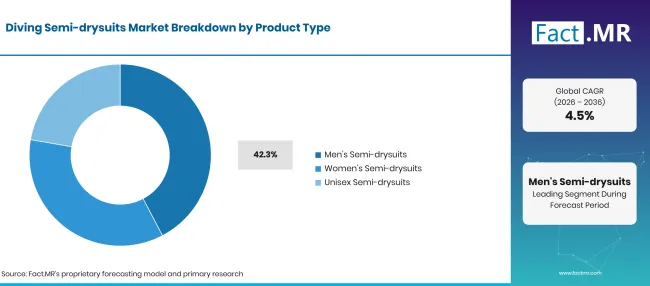
Factmr Diving Semi Drysuits Market Breakdown Product Type | Source: Fact.MR
| Product Type | Share (2026) |
|---|---|
| Men’s Semi-drysuits (Leading segment) | 42.3% |
| Other segments combined | 57.7%* |
| Total | 100.0% |
Source: Fact.MR analysis. Updated Oct 22, 2026
Male divers have long formed the bigger share of certified divers, and many brands built their semi-dry lines around a men’s pattern first. Men’s models also come in more length options, such as short and tall sizes, which helps shops convert buyers on the spot. Women’s Semi-drysuits are the segment to watch. Brands now cut women’s versions with their own chest, hip and torso shapes instead of resized men’s patterns. Unisex suits serve dive centers and rental fleets that need one design across many users, much as the wider wetsuit range does at the entry level.
What supports Recreational Diving within Application?
Recreational Diving makes up 61.4% of 2026 revenue.
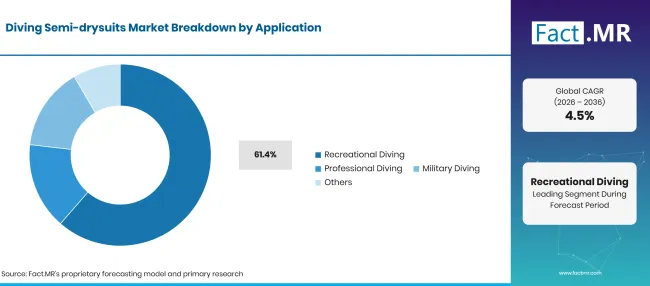
Factmr Diving Semi Drysuits Market Breakdown Application | Source: Fact.MR
| Application | Share (2026) |
|---|---|
| Recreational Diving (Leading segment) | 61.4% |
| Other segments combined | 38.6%* |
| Total | 100.0% |
Source: Fact.MR analysis. Updated Oct 22, 2026
Leisure divers want to dive more months of the year without the training and cost of a drysuit. A semi-drysuit lets them keep diving in spring, autumn and on cool-water trips, and growth in nature-based travel adds new divers each year. Professional Diving covers scientific, inspection, aquaculture and public safety divers who spend many hours in the water each week. Military Diving buys smaller volumes but sets strict rules on seal life and abrasion. Teams operating from rigid inflatable boats value suits that dry fast between launches.
What leads the Material segment?
Neoprene accounts for 54.1% of 2026 demand.
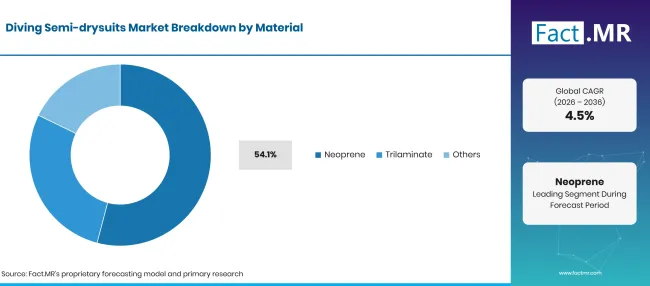
Factmr Diving Semi Drysuits Market Breakdown Material | Source: Fact.MR
| Material | Share (2026) |
|---|---|
| Neoprene (Leading segment) | 54.1% |
| Other segments combined | 45.9%* |
| Total | 100.0% |
Source: Fact.MR analysis. Updated Oct 22, 2026
Closed-cell foam traps gas bubbles that slow heat loss, and the material stretches to fit a wide range of body shapes. Factories already know how to glue, blind-stitch and line neoprene, which keeps unit costs within reach of hobby divers. Trilaminate suits use thin layered fabric, often with a coated face, and rely on undergarments for warmth. Its gains come from professional and travel divers who want low bulk and quick drying. Advances in coated technical textiles are making these shells lighter and tougher.
How does Distribution Channel shape demand?
Specialty Dive Shops represent 42.7% of the 2026 market.
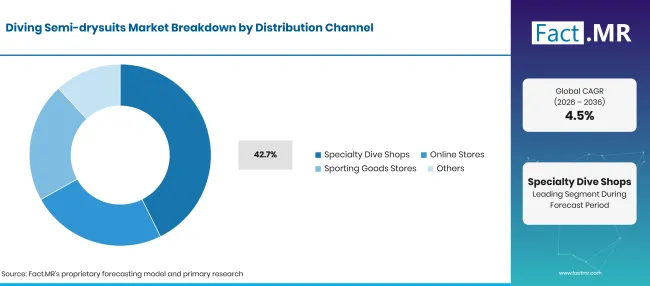
Factmr Diving Semi Drysuits Market Breakdown Distribution Channel | Source: Fact.MR
| Distribution Channel | Share (2026) |
|---|---|
| Specialty Dive Shops (Leading segment) | 42.7% |
| Other segments combined | 57.3%* |
| Total | 100.0% |
Source: Fact.MR analysis. Updated Oct 22, 2026
Buyers who try on several sizes and get seals trimmed by staff tend to buy in store. Many shops also sell suits as part of a course package, which locks in the first purchase. Online Stores serve experienced divers who already know their size. The U.S. Census Bureau reported retail e-commerce sales of USD 340.2 billion in the second quarter of 2026, or 17.1% of total retail [3]. In Japan, METI put 2024 B2C e-commerce merchandise sales at JPY 15.2 trillion, up 3.7% [4]. Sporting Goods Stores carry entry-level models next to general sports equipment, mostly for casual buyers.
What is accelerating Diving Semi-drysuits Market adoption, and what is holding it back?
Longer dive seasons, cool-water travel and steady professional work keep pulling divers toward suits that seal better than a wetsuit. Price gaps with standard wetsuits, limited awareness in warm-water markets and the need for careful fitting slow the move for first-time buyers.
Drivers Impact Analysis
| DRIVER | (~) % IMPACT ON CAGR | GEOGRAPHIC RELEVANCE | IMPACT TIMELINE |
|---|---|---|---|
| Recreational dive travel and longer diving seasons in cool water | +1.4% | Global; Western Europe, East Asia, Latin America | Short term (<= 2 years) |
| Professional diving for inspection, science, aquaculture and public safety | +1.0% | North America, Western Europe, East Asia | Medium term (2-4 years) |
| Stretch neoprene and improved seal design narrowing the gap with drysuits | +0.8% | Global | Medium term (2-4 years) |
| Military and agency purchasing of durable exposure suits | +0.6% | North America, Western Europe, East Asia | Long term (>= 4 years) |
Source: Fact.MR analysis. Updated Oct 22, 2026
Opportunity Impact Analysis
| OPPORTUNITY | (~) % IMPACT ON CAGR | GEOGRAPHIC RELEVANCE | IMPACT TIMELINE |
|---|---|---|---|
| Women’s and unisex fit ranges for a growing female diver base | +0.7% | Global | Medium term (2-4 years) |
| Trilaminate suits for professional and military teams | +0.5% | North America, Western Europe, East Asia | Medium term (2-4 years) |
| Online sales to experienced divers far from dive shops | +0.4% | East Asia, Latin America | Long term (>= 4 years) |
Source: Fact.MR analysis. Updated Oct 22, 2026
Restraints Impact Analysis
| RESTRAINT | (~) % IMPACT ON CAGR | GEOGRAPHIC RELEVANCE | IMPACT TIMELINE |
|---|---|---|---|
| Higher price than standard wetsuits for entry-level buyers | -0.8% | Global | Short term (<= 2 years) |
| Fit and seal sizing that requires in-store help | -0.5% | Global | Medium term (2-4 years) |
| Low awareness of semi-drysuit benefits in warm-water markets | -0.4% | East Asia, Latin America | Medium term (2-4 years) |
| Neoprene raw material cost swings | -0.3% | Global | Long term (>= 4 years) |
Source: Fact.MR analysis. Updated Oct 22, 2026
Which countries are scaling the Diving Semi-drysuits Market through 2036?
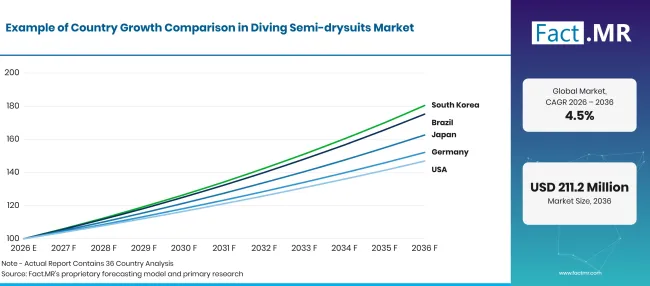
Factmr Diving Semi Drysuits Market Growth Index | Source: Fact.MR
| Country | CAGR (2026 to 2036) |
|---|---|
| Brazil | 5.8% |
| Japan | 5.0% |
| Germany | 4.3% |
| United States | 3.9% |
| United Kingdom | 3.3% |
Source: Fact.MR analysis. Updated Oct 22, 2026
What is supporting Brazil’s growth?
5.8% CAGR, driven by record foreign arrivals and rising visits to marine and coastal parks.
Brazil’s dive sites, from Fernando de Noronha to Arraial do Cabo, are mostly warm, so the case here is about new divers, not cold water. The Bahia state tourism secretariat reported that Brazil received 9.3 million international tourists in 2025, up 37% [5]. Federal conservation units recorded about 28.5 million visits in 2025, a record since the series began in 2000, according to ICMBio data [6]. Upwelling at Arraial do Cabo and winter dives in the south give local divers a reason to own a thicker suit.
How is Japan developing demand?
5.0% CAGR, backed by rising dive tourism in Okinawa and cool-season diving on Honshu.
Most Japanese leisure diving happens in warm Okinawan waters, but many divers live on Honshu, where Izu and other coastal sites cool sharply in winter. Okinawa Prefecture counted 10,935,300 incoming tourists in fiscal 2025, up 9.9%, with foreign visitors up 28.3% to 2,940,900 [7]. Local dive shops rent and sell semi-drysuits to divers who travel between the two climates.
What is supporting Germany’s adoption?
4.3% CAGR, helped by inland lake diving and offshore work in the North and Baltic Seas.
German divers train in lakes and quarries where water below the surface stays cold for much of the year. Destatis counted a record 169 million multi-day domestic trips in 2025, up 3.9% [8]. Offshore work adds a professional layer, with 9.5 GW of offshore wind capacity in operation in the Baltic and North Seas at the end of 2025, according to the Bundesnetzagentur [9].
How does the United States perform?
3.9% CAGR, reflecting a mature diver base with steady replacement buying.
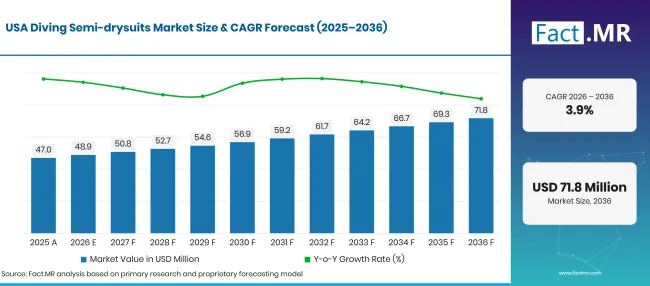
Factmr Diving Semi Drysuits Market Forecast Usa | Source: Fact.MR
The United States combines warm-water diving in Florida and Hawaii with cold diving in California, the Pacific Northwest, New England and the Great Lakes. The Bureau of Economic Analysis reported that boating and fishing added USD 38.4 billion in value in 2024, the top conventional outdoor activity [10]. Divers often keep one semi-drysuit for cool local sites and a thinner suit for travel.
What supports adoption in the United Kingdom?
3.3% CAGR, on the back of year-round cold sea diving and steady professional demand.
UK sea temperatures stay cool even in summer, so many club divers move from semi-drysuits to drysuits after a few seasons, which limits growth. The Health and Safety Executive requires anyone working as a professional diver to hold a qualification on its approved list [11]. Offshore wind capacity grew 3.2% in 2025, with England holding 70% of it, according to DESNZ [12]. That work keeps inspection and survey teams active in cold water.
Who leads the Diving Semi-drysuits Market?
Three groups shape supply. Full-line dive brands, such as Aqualung, SCUBAPRO and Mares, carry semi-drysuits next to regulators and BCDs, so they win shop shelf space through bundles and dealer programs; current flagships include the Aqualung Iceland, the SCUBAPRO NovaScotia and the Mares Pro Therm 8/7.
Exposure specialists compete on fit, seals and warmth. Waterproof Diving International builds the SD Neoflex with double glide-skin seals and a dry zip, while BARE sells the 8/7 Velocity Ultra 2.0 Semi Dry. Hollis offers the NeoTek 8/7/6 V2 Semi-Dry. A third tier is mass retail, where Decathlon sells its SUBEA 7 mm semi-dry suit at a lower price to entry-level buyers. Seal life, women’s fit and honest temperature ratings will decide which brands keep repeat buyers and which are left competing on price.
Which companies are the key providers?
Key companies include Aqualung; SCUBAPRO; Mares; Waterproof Diving International; BARE; Hollis; and Decathlon (SUBEA).
- Aqualung
- SCUBAPRO
- Mares
- Waterproof Diving International
- BARE
- Hollis
- Decathlon (SUBEA)
Bibliography
- [1] Japan National Tourism Organization. (2026, January 21). Number of visitor arrivals to Japan in December 2025.
- [2] Occupational Safety and Health Administration. (2025, January 6). Commercial Diving Operations Standard; Extension of the Office of Management and Budget’s (OMB) Approval of Information Collection (Paperwork) Requirements.
- [3] U.S. Census Bureau. (2026, August 18). Quarterly Retail E-Commerce Sales: 2nd Quarter 2026.
- [4] Ministry of Economy, Trade and Industry, Japan. (2025, August 26). Results of FY2024 E-Commerce Market Survey Compiled.
- [5] Secretaria de Turismo do Estado da Bahia (SETUR/SUFOTUR). (2026, April 7). Nota Técnica: Brasil no cenário do turismo internacional 2024/2025 [Technical note: Brazil in international tourism 2024/2025].
- [6] Agência Brasil. (2026, May 9). Visitação recorde em parques nacionais injeta R$ 20 bilhões no PIB [Record visits to national parks add R$ 20 billion to GDP].
- [7] Okinawa Prefecture. (2026, June). 令和7年度 沖縄県入域観光客統計概況(確定版) [Okinawa incoming tourist statistics overview for FY2025, final].
- [8] Statistisches Bundesamt (Destatis). (2026, August 17). Weniger Reisen, aber Rekordwert bei mehrtägigen Inlandsreisen 2025 [Fewer trips, but a record for multi-day domestic trips in 2025].
- [9] Bundesnetzagentur. (2026, January 8). Growth in renewable energy in 2025.
- [10] U.S. Bureau of Economic Analysis. (2026, March 5). Outdoor Recreation Economic Statistics, U.S. and States, 2024.
- [11] Health and Safety Executive. (2026, February 25). Training and qualifications.
- [12] Department for Energy Security and Net Zero. (2026, September 29). Regional renewable electricity in 2025.
This Report Answers
- What does each product type, application, material and channel contribute to semi-drysuit revenue?
- Why does each leading subsegment hold its 2026 share, and which buyer needs keep it there?
- How do dive travel, training and professional work differ across Brazil, Japan, Germany, the United States and the United Kingdom?
- Where do full-line dive brands, exposure specialists and mass retailers compete, and what wins repeat buyers?
- Which fit, seal and temperature rating choices shape suit selection for recreational and professional divers?
What does the Diving Semi-drysuits Market cover?
This market tracks semi-drysuits built from neoprene or trilaminate, with a sealed zip and cuffs or seals that cut water exchange. Men’s, women’s and unisex suits are all counted.
Buyers range from leisure divers and dive centers to scientific, inspection, public safety and military teams. Revenue is measured at the finished suit level, at the price paid by the end buyer or operator.
What is included in the scope?
Full semi-drysuits with attached or separate hoods, sealed zips and replaceable seals count in both material forms. Suits bought by dive centers for rental fleets are valued at their purchase price.
Where a semi-drysuit is sold in a package with undergarments or gloves, only the suit value is recorded. Women’s and unisex models sold under the same model line as men’s suits are counted in their own product type.
What is excluded from the scope?
Full drysuits, standard open-cell or unsealed wetsuits, rash guards and stand-alone thermal layers fall outside this market. Fins, masks, regulators and buoyancy devices add nothing to revenue.
Rental income at dive operators, seal replacement and suit repair services are not counted. Paddle-sport suits sold with kayaks and canoes are also left out.
How Was the Analysis Built?
The analysis draws on 120+ sources, 35+ company portfolios, 25+ countries, and more than 20 industry interviews.
- Primary Research: Primary research includes discussions with manufacturers, service providers, technology developers, distributors, end users, and subject-matter experts. These conversations examine purchasing priorities, product adoption, operational challenges, approval requirements, competitive positioning, and the factors that influence wider market acceptance.
- Desk Research: Desk research covers government statistics, regulatory publications, company filings, trade data, technical studies, industry associations, standards, public policy, and other authoritative sources. Every source used in the analysis is documented in the bibliography.
- Market Sizing and Forecasting: Market estimates combine historical performance, demand indicators, pricing and volume trends, segment shares, company participation, country-level growth, adoption patterns, investment activity, and barriers to market expansion.
- Data Validation and Update Cycle: Findings are validated by comparing primary interviews with public data, company activity, regulatory changes, trade patterns, and industry developments. Regular updates review new product launches, capacity changes, partnerships, approvals, and shifts in commercial adoption.
Segmentation
What is the report’s scope and coverage?
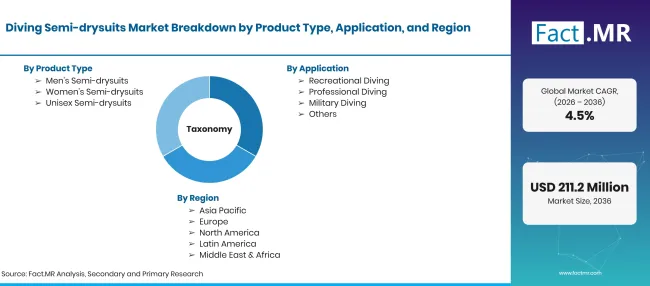
Factmr Diving Semi Drysuits Market Taxonomy | Source: Fact.MR
| Attribute | Details |
|---|---|
| Quantitative Units | USD million in 2026 to USD million by 2036 at CAGR |
| Market Definition | Diving suits made from neoprene or trilaminate with a sealed zip and wrist, ankle or neck seals that limit water exchange. The scope covers suits sold to recreational, professional and military divers. |
| Product Type | Men’s Semi-drysuits; Women’s Semi-drysuits; Unisex Semi-drysuits |
| Application | Recreational Diving; Professional Diving; Military Diving |
| Material | Neoprene; Trilaminate |
| Distribution Channel | Specialty Dive Shops; Online Stores; Sporting Goods Stores |
| Regions Covered | North America; Latin America; Western Europe; Eastern Europe; East Asia; South Asia & Pacific; Middle East & Africa |
| Countries Covered | Brazil; Japan; Germany; United States; United Kingdom |
| Companies Profiled | Aqualung; SCUBAPRO; Mares; Waterproof Diving International; BARE; Hollis; Decathlon (SUBEA) |
| Forecast Period | 2026 to 2036 |
| Approach | Hybrid top-down and bottom-up approach using active diver numbers by country; suit replacement cycles; neoprene and trilaminate mix; channel split; and brand portfolio review. |
Source: Fact.MR analysis. Updated Oct 22, 2026
How is the market segmented?
-
By Product Type
- Men’s Semi-drysuits
- Women’s Semi-drysuits
- Unisex Semi-drysuits
-
By Application
- Recreational Diving
- Professional Diving
- Military Diving
-
By Material
- Neoprene
- Trilaminate
-
By Distribution Channel
- Specialty Dive Shops
- Online Stores
- Sporting Goods Stores
-
By Region
- North America
- Latin America
- Western Europe
- Eastern Europe
- East Asia
- South Asia & Pacific
- Middle East & Africa
Frequently Asked Questions
How big is the diving semi-drysuits market in 2026?
What is the CAGR of the diving semi-drysuits market from 2026 to 2036?
Which product type leads the diving semi-drysuits market?
Which application leads the diving semi-drysuits market?
Which material leads the diving semi-drysuits market?
Which distribution channel leads the diving semi-drysuits market?
Which country will grow the most in the diving semi-drysuits market?
Who are the main companies in the diving semi-drysuits market?
Who worked on this report


Preview the report firsthand - request a free sample
Free SampleGet the brochure for pricing and purchase details
Download PDF