- Market Value (2025): USD 7.77 Bn
- Estimated Value (2026): USD 8.06 Bn
- Forecast Value (2036): USD 11.7 Bn
- CAGR (2026-2036): 3.8%
What is the Fluid Catalytic Cracking (FCC) Market forecast to be worth by 2036?
USD 8.06 Billion in 2026 to USD 11.7 Billion by 2036 at a 3.8% CAGR.
- At USD 7.77 Billion in 2025, the fluid catalytic cracking market drew stable operational momentum from global refinery runs, heavy crude upgrading, and sustained demand for high-octane motor gasoline.
- Sales will expand from USD 8.06 Billion in 2026 to USD 11.7 Billion by 2036 as refineries invest in petrochemical co-production, ZSM-5 zeolite catalyst additives, and sulfur reduction technologies.
- Compounding at a steady 3.8% CAGR over the 2026 to 2036 forecast window, market expansion is reinforced by rising global chemical demand, refinery-petrochemical integration, and resid-cracking modernization projects.
The economic trajectory of the market reflects continuous non-discretionary operational expenditures across downstream energy infrastructure. Because fluid catalytic cracking units operate under harsh conditions characterized by temperatures exceeding 500 degrees Celsius, intense catalyst attrition, and severe hydrodynamic erosion within riser reactors and regenerators, refiners continuously add fresh equilibrium catalyst (e-cat) while purging deactivated fines. This continuous daily catalyst makeup, combined with multi-million-dollar triennial turnaround revamps, establishes an exceptionally sticky, recurring revenue foundation for catalyst synthesizers, chemical engineering contractors, and refinery technology licensors worldwide.
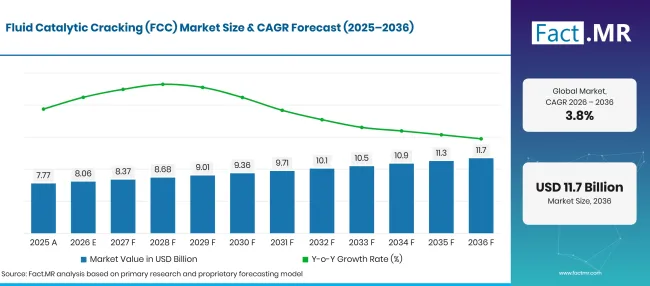
Fluid Catalytic Cracking Fcc Market Forecast Global | Source: Fact.MR
| Year | Basis | Market Value (USD Billion) |
|---|---|---|
| 2025 | Actual | 7.8 |
| 2026 | Estimate | 8.06 |
| 2036 | Forecast | 11.7 |
| CAGR 2026 to 2036 | Forecast period | 3.8% |
Source: Fact.MR analysis. Updated Oct 27, 2026
What are the defining numbers behind Fluid Catalytic Cracking (FCC) Market growth?
Between 2026 and 2036, the fluid catalytic cracking industry will unlock an absolute dollar opportunity of USD 3.6 Billion, propelled by expanding global demand for petrochemical-grade propylene, heavy bottom-of-the-barrel residue processing, and advanced environmental emissions reduction catalysts.
- Demand Drivers in the Market
- Refinery utilization keeps FCC modernization commercially relevant. The United States retained 18.2 million barrels per calendar day of operable atmospheric distillation capacity across 130 refineries on January 1, 2026 [1]. That installed base keeps uptime, yield control, and debottlenecking high on refinery investment agendas.
- Changing crude and product balances reward flexible conversion. OPEC’s 2025 statistical review tracks refinery capacity, throughput, and petroleum-product output across producing and consuming countries [2]. These benchmarks help operators adjust FCC severity and catalyst strategy as regional demand patterns change.
- Compliance requirements are reshaping FCC operation. U.S. refinery NESHAP provisions specifically cover catalytic cracking units under 40 CFR Part 63, Subpart UUU [3]. The rule sustains spending on combustion monitoring, particulate control, operating discipline, and emissions-performance upgrades.
- Japan’s concentrated refining network favors selective upgrades rather than broad capacity additions. The country operated 19 refineries with 3,110,400 barrels per day of designed crude-processing capacity at the end of March 2025 [4]. This installed base supports catalyst replacement, energy-efficiency work, and targeted FCC revamps.
- European product demand still requires capable conversion assets. Germany recorded 89.62 million tonnes of petroleum-product sales in 2025, up 1.43%, including 17.88 million tonnes of gasoline and 33.44 million tonnes of diesel [5]. The demand mix keeps yield optimization and emissions-controlled FCC operation commercially relevant.
- Key Segments Analyzed
- By Type: Gasoline represents the leading product output with a 42.3% share in 2026, serving as the essential high-octane blending component for global automotive spark-ignition engines.
- By Catalyst Type: Zeolite dominates catalyst demand with a 54.8% share in 2026, owing to its crystalline microporous architecture that delivers exceptional cracking selectivity and acid-site hydrothermal stability.
- By Application: Refineries generate 68.4% of total market revenue in 2026, functioning as the primary heavy-oil conversion installations operating high-throughput commercial FCC complexes.
- Analyst Opinion at Fact.MR
- Shambhu Nath Jha, Principal Consultant at Fact.MR, states, "The fluid catalytic cracking landscape is navigating a pivotal transition toward the petrochemical era. While FCC units were historically designed and operated purely to maximize transportation gasoline yields, forward-thinking refiners are aggressively modifying their riser reactors to operate under high-severity conditions. By incorporating specialized ZSM-5 pentasil zeolite additives and optimizing riser outlet temperatures, modern FCC units can boost propylene yields from historical levels of 4% to 5% up to 18% to 22% of total liquid volume. This shift decouples refinery margins from fluctuating retail gasoline consumption and aligns operational output directly with global polymer and chemical manufacturing. Furthermore, as refiners process heavier, more discounted crude slates containing high concentrations of nickel, vanadium, and basic nitrogen poisons, demand for advanced catalyst matrix architectures with built-in metal traps is surging. Catalysts that preserve surface area while suppressing dehydrogenation reactions represent the highest-margin growth segment in the downstream market."
- Strategic Implications
- Catalyst manufacturers should expand production of specialized ZSM-5 matrix additives to help refining clients pivot product yields rapidly between summer gasoline and winter propylene [1].
- Refinery operators must upgrade regenerator cyclone systems and electrostatic precipitators to maintain compliance with strict regional particulate matter emissions standards [2].
- Downstream engineering contractors should design modular high-severity risers that enable existing FCC units to co-process pyrolysis oils derived from waste plastic recycling [4].
- Petroleum refiners must establish long-term supply agreements for rare-earth promoters like lanthanum and cerium to stabilize unit cell size and preserve catalyst activity against hydro-thermal deactivation [5].
German FCC market demand will compound at a 3.6% CAGR through 2036, sustained by central European refinery-chemical clusters upgrading conversion efficiency and integrating renewable bio-feedstocks.
How does the Fluid Catalytic Cracking (FCC) Market break down by segment?
Gasoline leads Type at 42.3%, Zeolite commands Catalyst Type at 54.8%, and Refineries account for 68.4% of Application revenue in 2026.
Which Type dominates?
Gasoline captures 42.3% of 2026 product value.
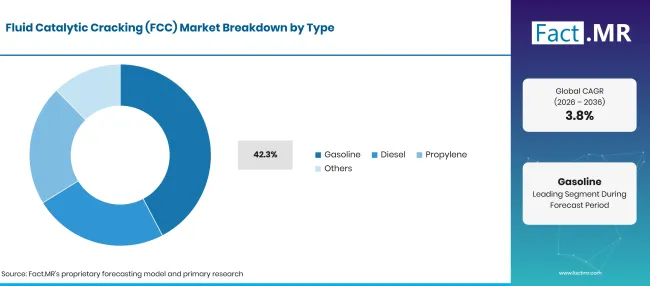
Fluid Catalytic Cracking Fcc Market Breakdown Type | Source: Fact.MR
Finished and blending-grade motor gasoline represents the primary economic output of commercial fluid catalytic cracking units. In conventional petroleum refining, light atmospheric naphtha lacks the required research octane number (RON) to satisfy modern internal combustion engine anti-knock requirements. Catalytic cracking converts heavy vacuum gas oil into highly branched paraffinic, olefinic, and aromatic hydrocarbons that produce an FCC gasoline stream with an outstanding octane rating typically ranging between 90 and 95 RON. This high-octane stream serves as the foundational blending component for regular and premium retail gasoline grades. Even as electric vehicle adoption accelerates in mature regions, the expanding automotive vehicle parc in developing Asia, Latin America, and Africa ensures sustained global demand for transport gasoline. Refiners utilize integrated upstream hydrocarbon production operations and downhole well servicing and intervention strategies to secure stable heavy crude feedstocks that maximize FCC unit conversion economics.
| Type | Share (2026) |
|---|---|
| Gasoline (Leading segment) | 42.3% |
| Other segments combined | 57.7%* |
| Total | 100.0% |
Source: Fact.MR analysis. Updated Oct 27, 2026
Which Catalyst Type leads the market?
Zeolite commands 54.8% of 2026 catalyst demand.
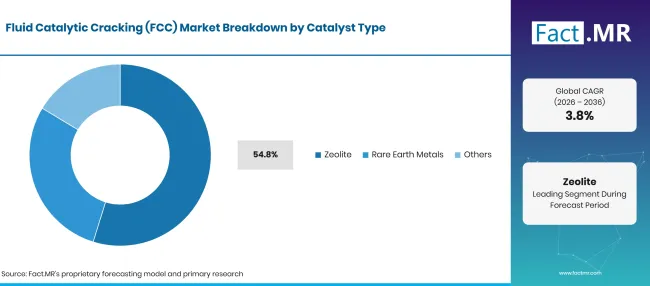
Fluid Catalytic Cracking Fcc Market Breakdown Catalyst Type | Source: Fact.MR
Synthetic crystalline zeolites, predominantly ultrastable Y-type (USY) zeolites and specialized pentasil ZSM-5 additives, constitute the indispensable active catalyst component in FCC units. Zeolites possess highly uniform three-dimensional pore networks featuring precisely calibrated microscopic cages and strong Brønsted acid sites that facilitate carbonium ion cracking mechanisms. These microscopic crystalline structures enable selective cracking of large hydrocarbon molecules into gasoline-range molecules while suppressing over-cracking to dry gas and coke. Modern catalyst synthesis involves modifying the silica-to-alumina ratio and incorporating rare-earth elements such as lanthanum to maintain structural crystallinity at regenerator temperatures exceeding 700 degrees Celsius in the presence of steam. Refiners coordinate catalyst additions with petroleum drilling fluids and additives and refinery transfer piping systems to maintain steady fluidization velocities and prevent catalyst bed agglomeration.
| Catalyst Type | Share (2026) |
|---|---|
| Zeolite (Leading segment) | 54.8% |
| Other segments combined | 45.2%* |
| Total | 100.0% |
Source: Fact.MR analysis. Updated Oct 27, 2026
Which Application captures the largest market share?
Refineries account for 68.4% of 2026 application revenue.
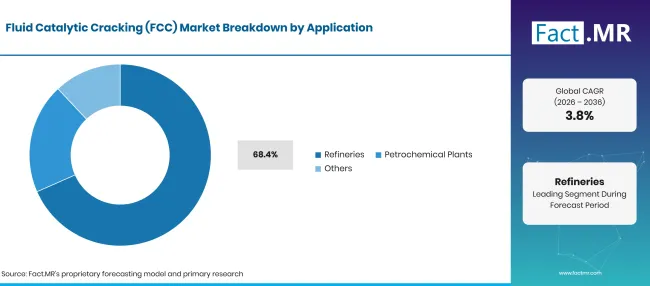
Fluid Catalytic Cracking Fcc Market Breakdown Application | Source: Fact.MR
Integrated petroleum refineries represent the primary commercial application of fluid catalytic cracking technology. An FCC unit is frequently referred to as the heart of a modern conversion refinery because it dictates overall plant conversion efficiency, product slate balance, and operating profitability. By upgrading low-value, heavy atmospheric residues and vacuum gas oils into high-margin liquid fuels and light olefins, the FCC unit allows refiners to purchase discounted sour crude slates without sacrificing finished product yields. Commercial refinery installations feature complex processing loops encompassing riser reactors, catalyst stripper vessels, two-stage regenerators, main fractionator columns, and gas concentration plants. To maintain continuous multi-year operating campaigns without unscheduled shutdowns, refinery engineering teams rely on corrosion-resistant flexible process lines and refinery fluid pumping machinery designed to handle abrasive catalyst slurries at elevated operating pressures.
| Application | Share (2026) |
|---|---|
| Refineries (Leading segment) | 68.4% |
| Other segments combined | 31.6%* |
| Total | 100.0% |
Source: Fact.MR analysis. Updated Oct 27, 2026
What is accelerating Fluid Catalytic Cracking (FCC) Market adoption, and what is holding it back?
Adoption is propelled by refinery-petrochemical integration, heavy crude processing demands, and high-severity propylene riser revamps, while growth is restrained by vehicle fleet electrification, high unit capital turnaround costs, and strict sulfur oxide emission caps.
Drivers Impact Analysis
| DRIVER | (~) % IMPACT ON CAGR | GEOGRAPHIC RELEVANCE | IMPACT TIMELINE |
|---|---|---|---|
| Strategic modernization of FCC units to maximize chemical-grade propylene yields | +1.1% | North America, East Asia, Western Europe | Short term (<= 2 years) |
| Increasing processing of discounted, heavy and sour crudes requiring metal-tolerant catalysts | +0.9% | Global | Short term (<= 2 years) |
| Continuous operational makeup requirements for fresh equilibrium cracking catalysts | +0.7% | Global | Short term (<= 2 years) |
| Refinery-petrochemical complex integration boosting light olefin demand | +0.6% | North America, East Asia | Medium term (2-4 years) |
| Strict environmental standards mandating SOx and NOx reducing catalyst additives | +0.5% | Western Europe, North America | Medium term (2-4 years) |
| Co-processing of circular bio-oils and plastic pyrolysis oils within commercial FCC risers | +0.4% | Western Europe, North America | Long term (>= 4 years) |
Source: Fact.MR analysis. Updated Oct 27, 2026
Opportunity Impact Analysis
| OPPORTUNITY | (~) % IMPACT ON CAGR | GEOGRAPHIC RELEVANCE | IMPACT TIMELINE |
|---|---|---|---|
| Commercial deployment of deep catalytic cracking (DCC) technology for direct chemical output | +0.6% | East Asia, North America | Medium term (2-4 years) |
| Circular recycling and precious metals recovery from spent equilibrium cracking catalysts | +0.5% | Western Europe, North America | Long term (>= 4 years) |
| Development of zero-rare-earth zeolite catalyst matrices resistant to nickel and vanadium poisoning | +0.4% | Global | Medium term (2-4 years) |
| Optimization of bottom-of-the-barrel resid cracking in developing country refinery expansions | +0.3% | Latin America, South Asia & Pacific | Long term (>= 4 years) |
Source: Fact.MR analysis. Updated Oct 27, 2026
Restraints Impact Analysis
| RESTRAINT | (~) % IMPACT ON CAGR | GEOGRAPHIC RELEVANCE | IMPACT TIMELINE |
|---|---|---|---|
| Long-term structural plateauing of transportation gasoline consumption in mature economies | -0.5% | Western Europe, North America | Long term (>= 4 years) |
| Extreme capital expenditure required for major FCC unit regenerator and riser turnaround revamps | -0.4% | Global | Short term (<= 2 years) |
| Tightening municipal air quality limits on refinery particulate matter and carbon emissions | -0.3% | Western Europe, North America | Medium term (2-4 years) |
| Price volatility in specialty rare-earth metals including lanthanum and cerium precursors | -0.3% | Global | Short term (<= 2 years) |
Source: Fact.MR analysis. Updated Oct 27, 2026
Which countries are scaling the Fluid Catalytic Cracking (FCC) Market through 2036?
Sustained capital investments across mature refining clusters and expanding coastal petrochemical processing hubs propel country-level fluid catalytic cracking demand through 2036.
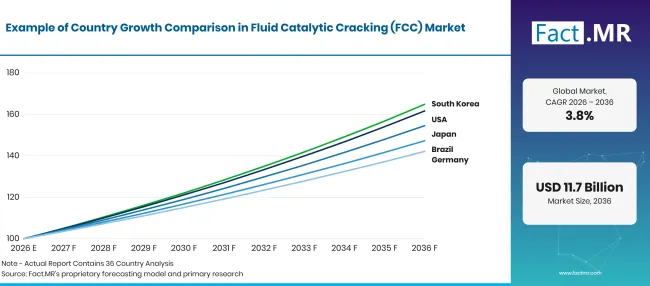
Fluid Catalytic Cracking Fcc Market Growth Index | Source: Fact.MR
| Country | CAGR (2026 to 2036) |
|---|---|
| Germany | 3.6% |
| Brazil | 4.0% |
| United States | 4.9% |
| United Kingdom | 3.2% |
| Japan | 4.5% |
Source: Fact.MR analysis. Updated Oct 27, 2026
What supports Germany's adoption?
3.6% CAGR, driven by industrial refinery modernization, integrated chemical parks, and circular bio-feedstock co-processing.
Germany’s FCC market is defined by the need to protect output from a tighter feedstock position. Federal data show 2025 petroleum-product sales rising 1.43% to 89.62 million tonnes while crude-oil imports fell 4.44% to 80.40 million tonnes [6]. That divergence encourages projects focused on conversion efficiency, operating flexibility, and yield preservation.
How does Brazil perform?
4.0% CAGR, supported by domestic offshore pre-salt crude refining, Petrobras downstream expansions, and expanding transport fuel demand.
Brazil is moving from crude expansion toward fuller domestic value capture. ANP reported average oil production of 3.8 million barrels per day in 2025, 12% above 2024, while refinery output reached 2.2 million barrels per day, or 86.4% of installed capacity [7]. The operating gap creates room for FCC catalyst demand, reliability services, and throughput improvement.
What is supporting United States adoption?
4.9% CAGR, fueled by the world's largest commercial FCC refining capacity, petrochemical integration, and heavy shale oil blending.
The United States offers scale, but refinery consolidation is raising performance expectations. Operable refining capacity stood at 18.2 million barrels per calendar day on January 1, 2026, and two closures during 2025 removed roughly 400,000 barrels per day [8]. Remaining sites have stronger incentives to improve uptime, conversion economics, and product yield.
How is the United Kingdom developing demand?
3.2% CAGR, anchored by North Sea coastal refineries, petrochemical pipeline connections, and emissions reduction retrofits.
The UK is becoming a concentrated maintenance and optimization market. Refinery production reached 48 million tonnes in 2025, down 4.8% from 2024 after operations ended at Grangemouth and Lindsey [9]. Spending is therefore more likely to favor compliance, availability, and selective conversion work at the remaining plants.
How is Japan scaling demand?
4.5% CAGR, underpinned by high-severity petrochemical cracking, propylene yield maximization, and energy-efficient refinery integration.
Japan presents a mature replacement cycle where precision matters more than new-build volume. Its refining system comprised 19 refineries with 3,110,400 barrels per day of designed crude-processing capacity at the end of March 2025 [10]. That concentration favors investments in catalyst performance, process control, high-severity conversion, and energy-efficient operation.
Who leads the Fluid Catalytic Cracking (FCC) Market?
The competitive landscape of the global fluid catalytic cracking market is led by integrated multinational energy corporations, proprietary process technology licensors, and specialized catalyst manufacturing giants. Market leaders protect their commercial positions through extensive catalyst formulation patent portfolios, proprietary riser cyclone designs, and global technical service teams that perform on-site catalyst optimization and hydrodynamic modeling for refiners. Leading technology licensors maintain dedicated pilot plant facilities to evaluate client-specific crude blends and formulate customized catalyst formulations that maximize product margins under variable operating conditions.
Industry participants are actively differentiating their portfolios through specialized additive chemistries and mechanical hardware revamps. In the catalyst sector, producers manufacture tailored micro-spherical catalyst particles engineered with controlled attrition resistance, optimized matrix pore distributions, and active metal traps that passivate nickel and vanadium poisons. Concurrently, equipment licensors design low-pressure-drop feed injectors, high-efficiency riser termination devices, and advanced flue gas scrubbing systems. Operators routinely deploy fluid flow management systems and in-line process chemical sensors to monitor hydrocarbon feed rates, while upgrading refinery process cooling towers and industrial process heat recovery systems to lower overall refinery energy intensity.
Which companies are the key providers?
Key companies include ExxonMobil Corporation; Shell plc; Chevron Corporation; BP plc; TotalEnergies SE; Valero Energy Corporation; Marathon Petroleum Corporation; Phillips 66; Indian Oil Corporation Limited; Reliance Industries Limited.
- ExxonMobil Corporation
- Shell plc
- Chevron Corporation
- BP plc
- TotalEnergies SE
- Valero Energy Corporation
- Marathon Petroleum Corporation
- Phillips 66
- Indian Oil Corporation Limited
- Reliance Industries Limited
Bibliography
- [1] U.S. Energy Information Administration. (2026, June 29). U.S. refining capacity decreased during 2025.
- [2] Organization of the Petroleum Exporting Countries. (2025). 2025 OPEC annual statistical bulletin (60th ed.).
- [3] Electronic Code of Federal Regulations. (2026). 40 C.F.R. Part 63, Subpart UUU: National emission standards for hazardous air pollutants for petroleum refineries: Catalytic cracking units, catalytic reforming units, and sulfur recovery units.
- [4] Petroleum Association of Japan. (2025, March). Location of refineries and crude oil processing capacity in Japan.
- [5] Bundesamt für Wirtschaft und Ausfuhrkontrolle. (2026, July 15). MineralölINFO Dezember 2025 (Mineralölabsatz).
- [6] Bundesamt für Wirtschaft und Ausfuhrkontrolle. (2026, July 15). MineralölINFO Dezember 2025 (Mineralölabsatz).
- [7] Agência Nacional do Petróleo, Gás Natural e Biocombustíveis. (2026, June 30). ANP divulga dados consolidados do setor regulado em 2025.
- [8] U.S. Energy Information Administration. (2026, June 29). U.S. refining capacity decreased during 2025.
- [9] Department for Energy Security and Net Zero. (2026). Digest of UK energy statistics 2026: Chapter 3, oil and oil products.
- [10] Petroleum Association of Japan. (2025, December). Petroleum industry in Japan 2025.
This Report Answers
- The study analyzes how fluid catalytic cracking operating parameters and riser conditions influence product distribution between high-octane gasoline blendstocks, ultra-low sulfur diesel, and chemical-grade propylene.
- Catalyst benchmarking details performance dynamics between ultrastable Y zeolites, pentasil ZSM-5 matrix additives, rare-earth promoters, and bottom-cracking active alumina matrices.
- Application mapping quantifies commercial demand across standalone fuel refineries, highly integrated refinery-petrochemical complexes, and specialized heavy residue upgrading facilities.
- Emissions compliance analysis evaluates operational strategies for mitigating sulfur dioxide, nitrogen oxides, carbon monoxide, and particulate matter discharges from FCC regenerator flue gases.
- Country performance evaluations establish ten-year market projections across Germany, Brazil, the United States, the United Kingdom, and Japan, linking refinery throughput to regional transport fuel demand and petrochemical capacity additions.
- Competitive profiling examines the refinery processing assets, catalyst manufacturing facilities, process patent filings, and crude-to-chemicals investment strategies of the ten leading global energy and refining corporations.
What does the Fluid Catalytic Cracking (FCC) Market cover?
The fluid catalytic cracking market covers all commercial processing units, fluidized cracking catalyst formulations, operational chemical additives, and auxiliary reaction equipment engineered to convert high-boiling petroleum fractions into high-value transportation fuels and petrochemical precursors. As the central conversion engine in modern petroleum refining, FCC technology utilizes finely powdered solid catalysts fluidizing in an upward vapor flow within a vertical riser reactor to crack vacuum gas oils, deasphalted oils, and atmospheric residues at high reaction temperatures. The scope tracks total economic value generated through FCC unit operations, including refined product stream realizations (gasoline, light cycle oil, propylene, butylene) and annual refinery catalyst and additive turnover.
Financial valuations evaluate primary revenues derived from commercial refinery operations, catalyst manufacturer shipments, technology licensing fees, and engineering turnaround services. Segmental reporting covers standard gas oil FCC units, deep catalytic cracking (DCC) petrochemical units, residue catalytic cracking (RFCC) units, and high-severity FCC revamps. Associated catalyst systems measured within the market include fresh equilibrium zeolite catalysts, fluid cracking additives (combustion promoters, SOx-reducing agents, ZSM-5 propylene enhancers), and specialized catalyst matrix passivators.
What is included in the scope?
Included in the report's coverage are fluid catalytic cracking units operating across petroleum refineries and integrated petrochemical manufacturing complexes worldwide. Product stream breakdowns quantify output volumes and realizations across finished high-octane motor gasoline, light cycle oil (diesel blending component), chemical-grade and polymer-grade propylene, liquefied petroleum gases, and petrochemical aromatics feedstocks. Catalyst coverage captures synthetic zeolite cracking catalysts, rare-earth modified USY formulations, alumina-sol binders, and functional additives that control carbon monoxide combustion, sulfur emissions, and heavy metal contamination.
Geographic coverage is comprehensive, tracking market activity across North America, Latin America, Western Europe, Eastern Europe, East Asia, South Asia & Pacific, and the Middle East & Africa. Channel mapping covers commercial transactions between petroleum refiners, international energy corporations, independent catalyst synthesizers, process engineering licensors, and industrial turnaround contractors.
What is excluded from the scope?
Excluded from market scope are primary atmospheric crude oil distillation units (CDUs) and vacuum distillation units (VDUs) that perform physical separation without catalytic chemical conversion. Similarly, thermal cracking processes such as delayed coking, visbreaking, and fluid coking that operate purely through thermal mechanisms without solid catalysts are excluded from the fluid catalytic cracking accounting boundary. Hydrocracking units, which operate under high hydrogen partial pressures with stationary catalyst beds rather than fluidized circulation, are classified under separate refining technology categories.
Furthermore, upstream crude oil extraction platforms, offshore floating production storage and offloading (FPSO) vessels, and midstream interstate crude oil pipelines are excluded. Standalone post-combustion carbon capture and sequestration (CCS) plants that are not physically integrated into the FCC regenerator flue gas ductwork fall outside the primary analytical perimeter.
How Was the Analysis Built?
The analysis draws on 120+ sources, 35+ company portfolios, 25+ countries, and more than 20 industry interviews.
- Primary Research: Primary research includes discussions with manufacturers, service providers, technology developers, distributors, end users, and subject-matter experts. These conversations examine purchasing priorities, product adoption, operational challenges, approval requirements, competitive positioning, and the factors that influence wider market acceptance.
- Desk Research: Desk research covers government statistics, regulatory publications, company filings, trade data, technical studies, industry associations, standards, public policy, and other authoritative sources. Every source used in the analysis is documented in the bibliography.
- Market Sizing and Forecasting: Market estimates combine historical performance, demand indicators, pricing and volume trends, segment shares, company participation, country-level growth, adoption patterns, investment activity, and barriers to market expansion.
- Data Validation and Update Cycle: Findings are validated by comparing primary interviews with public data, company activity, regulatory changes, trade patterns, and industry developments. Regular updates review new product launches, capacity changes, partnerships, approvals, and shifts in commercial adoption.
Segmentation
What is the report’s scope and coverage?
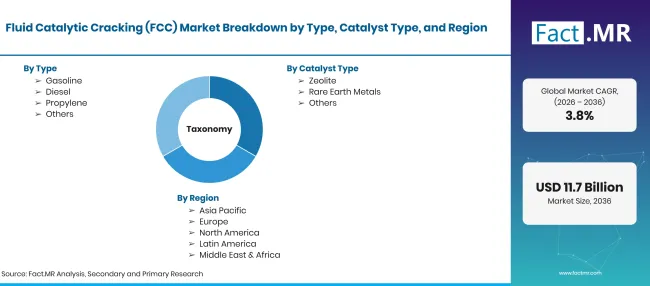
Fluid Catalytic Cracking Fcc Market Taxonomy | Source: Fact.MR
| Attribute | Details |
|---|---|
| Quantitative Units | USD Billion |
| Market Definition | Fluid catalytic cracking (FCC) encompasses the operational units, cracking catalyst formulations, process additives, and licensed technology systems deployed in petroleum refineries and petrochemical complexes to convert heavy vacuum gas oils and atmospheric residues into high-octane gasoline, diesel, and light olefins. Market value is measured across refined product output realization and operating catalyst turnover. |
| Type | Gasoline; Diesel; Propylene; Others |
| Catalyst Type | Zeolite; Rare Earth Metals; Others |
| Application | Refineries; Petrochemical Plants; Others |
| Regional Coverage | North America; Latin America; Western Europe; Eastern Europe; East Asia; South Asia & Pacific; Middle East & Africa |
| Key Countries Analyzed | Germany; Brazil; United States; United Kingdom; Japan |
| Key Players Profiled | ExxonMobil Corporation; Shell plc; Chevron Corporation; BP plc; TotalEnergies SE; Valero Energy Corporation; Marathon Petroleum Corporation; Phillips 66; Indian Oil Corporation Limited; Reliance Industries Limited |
| Historical Base Year | 2025 (USD 7.8 Billion) |
| Forecast Timeframe | 2026 (USD 8.1 Billion) to 2036 (USD 11.7 Billion) |
Source: Fact.MR analysis. Updated Oct 27, 2026
How is the market segmented?
-
By Type
- Gasoline
- Diesel
- Propylene
- Others
-
By Catalyst Type
- Zeolite
- Rare Earth Metals
- Others
-
By Application
- Refineries
- Petrochemical Plants
- Others
-
By Region
- North America
- Latin America
- Western Europe
- Eastern Europe
- East Asia
- South Asia & Pacific
- Middle East & Africa
Frequently Asked Questions
How big is the fluid catalytic cracking (FCC) market in 2026?
What is the CAGR of the fluid catalytic cracking market from 2026 to 2036?
Which product type dominates fluid catalytic cracking output?
Which catalyst type commands the highest market share?
Which application accounts for the majority of market demand?
Which country will expand at the fastest rate through 2036?
Who are the key players operating in the fluid catalytic cracking market?
Who worked on this report


Preview the report firsthand - request a free sample
Free SampleGet the brochure for pricing and purchase details
Download PDF