- Market Value (2025): USD 63.2 Mn
- Estimated Value (2026): USD 66.2 Mn
- Forecast Value (2036): USD 104.5 Mn
- CAGR (2026-2036): 4.7%
What is the Fluoride Ion Selective Electrodes Market forecast to be worth by 2036?
USD 66.2 million in 2026 to USD 104.5 million by 2036, at a 4.7% CAGR.
- The fluoride ion selective electrodes market reached USD 63.2 million in 2025.
- As per Fact.MR analysis, sales are projected to rise from USD 66.2 million in 2026 to USD 104.5 million by 2036 as water testing sites renew electrodes and meter accessories.
- From 2026 to 2036, the market is forecast to record a 4.7% CAGR, reflecting regular analytical use and purchases linked to water-quality programs.
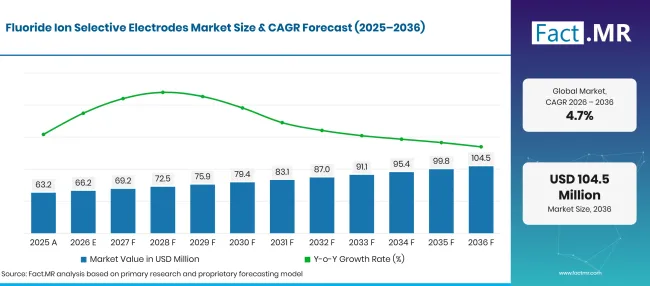
Fluoride Ion Selective Electrodes Market Forecast Global | Source: Fact.MR
| Year | Basis | Market Value (USD million) |
|---|---|---|
| 2025 | Actual | 63.2 |
| 2026 | Estimate | 66.2 |
| 2036 | Forecast | 104.5 |
| CAGR 2026 to 2036 | Forecast period | 4.7% |
Source: Fact.MR analysis. Updated Oct 26, 2026
What are the defining numbers behind Fluoride Ion Selective Electrodes Market growth?
USD 38.3 million in absolute market opportunity by 2036, with water treatment and industrial testing central to spending.
- Demand Drivers in the Market
- Utility technicians use fluoride measurements to check treated water against operating targets. The U.S. Environmental Protection Agency lists a secondary fluoride standard of 2.0 mg/L in its drinking-water guidance [2]. The primary fluoride limit of 4.0 mg/L and the secondary standard of 2.0 mg/L give water laboratories separate regulatory benchmarks for reporting fluoride concentrations.
- Environmental testing services assess fluoride in groundwater and discharge samples when project requirements call for the parameter. Selection depends on the sample matrix and the laboratory’s existing meter platform.
- Industrial laboratories value an electrode that measures fluoride without a lengthy instrument startup. Calibration standards and ionic-strength adjustment remain part of the workflow, so staff training can shape repeat purchasing and product selection.
- Key Segments Analyzed
- By Product Type: Solid-State Electrodes hold 44.2% of 2026 sales, supported by crystal-membrane designs used for aqueous fluoride analysis.
- By Application: Water Treatment accounts for 32.4% of 2026 revenue because routine checks require repeat measurement across treated-water samples.
- By End-User: Industrial users contribute 43.8% of 2026 market value, reflecting testing within plant laboratories and process-water operations.
- Analyst Opinion at Fact.MR
- Shambhu Nath Jha, Principal Consultant at Fact.MR, states, “Laboratories compare fluoride electrodes by how consistently they measure routine samples. Buyers compare electrode life with ease of cleaning and the availability of matching standards. Replacement sales are expected to favor suppliers offering clear procedures for calibration and support when sample chemistry interferes with a reading.”
- Strategic Implications
- Electrode manufacturers should publish clear matrix limits and calibration procedures so laboratories can compare instruments before purchase.
- Water testing laboratories benefit from using consistent standards and documenting how samples are prepared before comparing results.
- Distributors can hold replacement sensors and filling solutions close to routine laboratory users to reduce instrument downtime.
- Industrial quality teams should assess total ownership cost, including conditioning solutions and operator time, alongside the initial electrode price.
Germany is projected to record 5.8% CAGR through 2036 as analytical laboratories serve industrial and water-quality work. Japan follows at 5.2% where controlled test procedures shape purchasing. The United Kingdom is estimated at 4.9% amid drinking-water monitoring. Brazil is forecast at 4.5% as public water surveillance provides a testing use case. The United States is projected to post 3.3% as established programs maintain steady replacement requirements.
How does the Fluoride Ion Selective Electrodes Market break down by segment?
Solid-State Electrodes account for 44.2%; Water Treatment represents 32.4%; Industrial End-Users contribute 43.8% in 2026.
Which Product Type dominates?
Solid-State Electrodes account for 44.2% of 2026 sales.
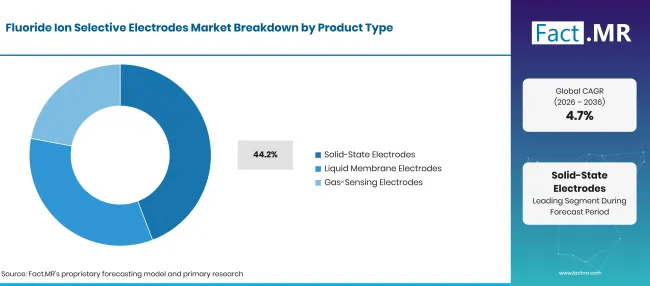
Fluoride Ion Selective Electrodes Market Breakdown Product Type | Source: Fact.MR
| Product Type | Share (2026) |
|---|---|
| Solid-State Electrodes (Leading segment) | 44.2% |
| Other segments combined | 55.8% |
| Total | 100.0% |
Source: Fact.MR analysis. Updated Oct 26, 2026
Solid-state fluoride electrodes use a crystal membrane that responds to fluoride ions in solution. Their established design helps laboratories use familiar calibration methods and compare readings across batches. Metrohm describes its fluoride sensor as a crystal-membrane ion-selective electrode intended for fluoride measurements and titrations.
What leads the Application segment?
Water Treatment represents 32.4% of 2026 demand.
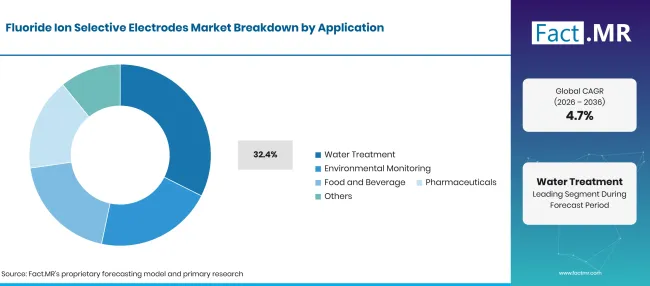
Fluoride Ion Selective Electrodes Market Breakdown Application | Source: Fact.MR
| Application | Share (2026) |
|---|---|
| Water Treatment (Leading segment) | 32.4% |
| Other segments combined | 67.6% |
| Total | 100.0% |
Source: Fact.MR analysis. Updated Oct 26, 2026
Water treatment laboratories make repeated fluoride measurements on raw water and finished water. A direct electrode reading can fit a scheduled testing program when sample preparation and calibration are controlled. The U.S. National Environmental Methods Index identifies the fluoride electrode method as a drinking-water test with an applicable concentration range starting at 0.1 mg/L [5].
How does End-User influence sales?
Industrial end-users account for 43.8% of 2026 revenue.
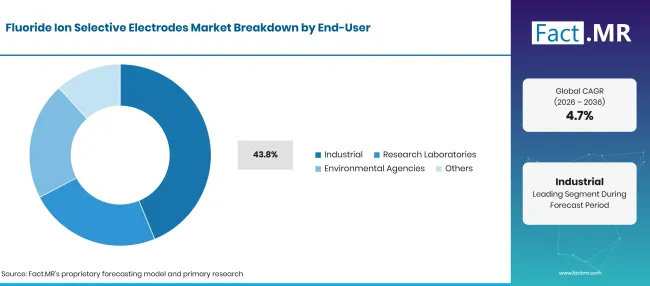
Fluoride Ion Selective Electrodes Market Breakdown End User | Source: Fact.MR
| End-User | Share (2026) |
|---|---|
| Industrial (Leading segment) | 43.8% |
| Other segments combined | 56.2% |
| Total | 100.0% |
Source: Fact.MR analysis. Updated Oct 26, 2026
Industrial operators use fluoride measurements when a process stream or incoming water has a fluoride specification. Some installations handle sample preparation in the plant laboratory while others send samples to an outside testing service. Electrode replacement then depends on workload and sample conditions.
What is accelerating Fluoride Ion Selective Electrodes Market adoption, and what is holding it back?
Regular water testing and laboratory replacement cycles provide steady sales opportunities. Measurement accuracy depends on electrode condition and sample treatment, while alternative analytical methods create a practical comparison for laboratories.
Drivers Impact Analysis
| DRIVER | (~) % IMPACT ON CAGR | GEOGRAPHIC RELEVANCE | IMPACT TIMELINE |
|---|---|---|---|
| Drinking-water fluoride checks | +1.0% | United States, United Kingdom | Short term (<= 2 years) |
| Electrode replacement in working laboratories | +0.8% | Global | Short term (<= 2 years) |
| Industrial process-water testing | +0.7% | Germany, Japan, United States | Medium term (2–4 years) |
| Training and documented measurement procedures | +0.5% | Global | Medium term (2–4 years) |
| Local access to replacement sensors | +0.4% | Brazil and other distributor-led markets | Medium term (2–4 years) |
Source: Fact.MR analysis. Updated Oct 26, 2026
Opportunity Impact Analysis
| OPPORTUNITY | (~) % IMPACT ON CAGR | GEOGRAPHIC RELEVANCE | IMPACT TIMELINE |
|---|---|---|---|
| Method support for public laboratories | +0.8% | Brazil, United Kingdom | Medium term (2–4 years) |
| Replacement sensor and standards bundles | +0.6% | Global | Short term (<= 2 years) |
| Service support for industrial sites | +0.5% | Germany, Japan | Medium term (2–4 years) |
| Water testing training materials | +0.4% | Global | Long term (>= 4 years) |
Source: Fact.MR analysis. Updated Oct 26, 2026
Restraints Impact Analysis
| RESTRAINT | (~) % IMPACT ON CAGR | GEOGRAPHIC RELEVANCE | IMPACT TIMELINE |
|---|---|---|---|
| Sample matrix interference | -0.8% | Global | Short term (<= 2 years) |
| Recurring standards and maintenance cost | -0.6% | Global | Short term (<= 2 years) |
| Competition from alternative analytical methods | -0.5% | Mature testing markets | Medium term (2–4 years) |
| Laboratory procedure approval | -0.4% | Regulated water testing | Medium term (2–4 years) |
Source: Fact.MR analysis. Updated Oct 26, 2026
Which countries are scaling the Fluoride Ion Selective Electrodes Market through 2036?
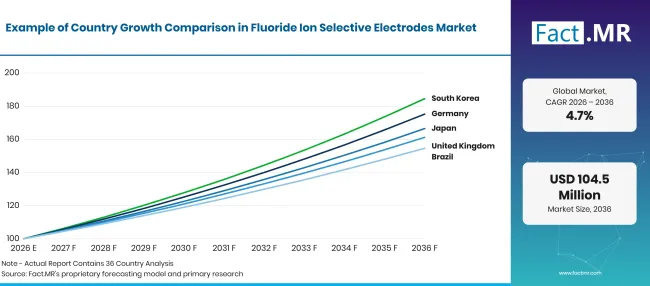
Fluoride Ion Selective Electrodes Market Growth Index | Source: Fact.MR
| Country | CAGR (2026 to 2036) |
|---|---|
| Germany | 5.8% |
| Japan | 5.2% |
| United Kingdom | 4.9% |
| Brazil | 4.5% |
| United States | 3.3% |
Source: Fact.MR analysis. Updated Oct 26, 2026
What supports Germany adoption?
5.8% CAGR, supported by routine industrial and water-testing electrode replacement.
Germany’s industrial laboratories are expected to maintain steady purchases of fluoride electrodes for water and production-sample checks. Testing teams commonly compare electrode slope, calibration time and support for sample preparation before choosing a replacement sensor. The European Food Safety Authority reviewed fluoride exposure in July 2025 and discussed a drinking-water concentration of 1.5 mg/L as a relevant exposure level [7].
What supports Japan adoption?
5.2% CAGR, linked to structured fluoride testing and defined water-quality standards.
Japanese laboratories use documented measurement steps when checking fluoride in drinking water and environmental samples. The Ministry of the Environment publishes a fluoride quality standard of 0.8 mg/L for drinking water, which gives laboratories a clear concentration reference for method selection [8].
What supports United Kingdom adoption?
4.9% CAGR, supported by utility and contract-laboratory fluoride monitoring.
Water utilities and contract laboratories in the United Kingdom measure fluoride as part of drinking-water quality work. In March 2026, the UK Health Security Agency reported that roughly one in ten people in England lived in areas with added fluoride in public water [9].
What supports Brazil adoption?
4.5% CAGR, driven by public-health water surveillance and repeat fluoride testing.
Brazilian public-health laboratories have a direct reason to measure fluoride concentrations in treated drinking water. The Ministry of Health’s Vigiagua program explicitly includes fluoride among the water-quality parameters monitored by health authorities [6].
What supports United States adoption?
3.3% CAGR, sustained by established drinking-water requirements and sensor replacement.
United States water-testing laboratories regularly assess fluoride against applicable drinking-water requirements. The Environmental Protection Agency described a 4.0 mg/L federal maximum contaminant level for fluoride in its 2026 drinking-water review [1]. U.S. fluoride electrode sales are projected to advance at a 3.3% CAGR from 2026 to 2036 as laboratories renew sensors within existing testing systems.
Who leads in the Fluoride Ion Selective Electrodes Market?
Companies with identifiable fluoride-electrode product lines include Thermo Fisher Scientific and Metrohm. Thermo Scientific lists its Orion 9609BNWP fluoride electrode for aqueous samples [4]. Metrohm offers a crystal-membrane fluoride sensor for ion measurements and titrations [3].
HORIBA and OMEGA also have technical documentation for fluoride-specific electrode designs. Other listed analytical instrument and distribution businesses may serve this category indirectly. Market participation depends on a suitable fluoride electrode product, rather than a broad laboratory equipment portfolio.
Which companies are the key providers?
Key companies include Thermo Fisher Scientific Inc.; Metrohm AG; Hanna Instruments; HORIBA, Ltd.; Mettler-Toledo International Inc.; Cole-Parmer Instrument Company LLC; Avantor, Inc.; Bante Instruments Inc.; OMEGA Engineering, Inc.
- Thermo Fisher Scientific Inc.
- Metrohm AG
- Hanna Instruments
- HORIBA, Ltd.
- Mettler-Toledo International Inc.
- Cole-Parmer Instrument Company LLC
- Avantor, Inc.
- Bante Instruments Inc.
- OMEGA Engineering, Inc.
Bibliography
- 1] U.S. Environmental Protection Agency. (2026, August 3). Fluoride in drinking water.
- [2] U.S. Environmental Protection Agency. (2025, December 29). Drinking water regulations and contaminants.
- [3] Metrohm. (n.d.). Ion-selective electrode, F.
- [4] Thermo Fisher Scientific. (n.d.). Orion™ fluoride ion selective electrodes. https://www.thermofisher.com/order/catalog/product/in/en/9609BNWP
- [5] National Environmental Methods Index. (n.d.). Standard Methods: 4500-F-C: Ion-selective electrode method. https://www.nemi.gov/methods/method_summary/5709/
- [6] Ministério da Saúde. (n.d.). Programa Nacional de Vigilância da Qualidade da Água para Consumo Humano (Vigiagua). https://www.gov.br/saude/pt-br/composicao/seidigi/demas/situacao-de-saude/vigiagua
- [7] European Food Safety Authority. (2025, July 22). Fluoride safety: Updated intake levels for all ages. https://www.efsa.europa.eu/en/news/fluoride-safety-updated-intake-levels-all-ages
- [8] Ministry of the Environment, Government of Japan. (n.d.).[Water quality standard items and standard values (52 items)]. https://www.env.go.jp/water/water_supply/kijun/kijunchi.html
- [9] UK Health Security Agency. (2026, March 30). Water fluoridation: Health monitoring report 2026, short summary. https://www.gov.uk/government/publications/water-fluoridation-health-monitoring-report-for-england-2026/short-summary
This Report Addresses
- The report addresses how solid-state, liquid-membrane and gas-sensing electrode formats differ in fluoride measurement applications.
- Application analysis explains how fluoride electrodes are used across water treatment, environmental monitoring, research laboratories, food and beverage testing, and pharmaceutical analysis.
- End-user analysis examines purchasing needs among industrial laboratories, environmental agencies and other testing organizations.
- Country analysis compares how water-quality requirements, laboratory replacement cycles and testing procedures influence adoption across Germany, Japan, the United Kingdom, Brazil and the United States.
- Competitive analysis reviews suppliers with identifiable fluoride-electrode products and the importance of calibration support, replacement availability and technical documentation.
What does the Fluoride Ion Selective Electrodes Market cover?
The market covers analytical fluoride-selective electrodes used to determine fluoride ion concentration in liquid samples. The core scope includes standalone electrodes and combination electrode formats offered for laboratory and suitable industrial testing. Revenue relates to the fluoride-specific electrode product rather than an entire multi-parameter instrument system.
What is included in the scope?
Electrodes with solid-state fluoride-sensitive membranes and compatible reference designs are included.
The application list covers water treatment, environmental monitoring and laboratory analysis when fluoride concentration is the measured parameter. Supplier bundles may be reviewed where the fluoride electrode is separately identifiable.
What is excluded from the scope?
General pH electrodes, conductivity probes and meters sold without a fluoride-selective sensor fall outside the core electrode scope.
Broad chemical analysis instruments and unrelated gas detectors are excluded. A gas-sensing product belongs only when it is specifically configured to determine fluoride using a validated liquid-sample electrode step.
How Was the Analysis Built?
The analysis draws on 120+ sources, 35+ company portfolios, 25+ countries, and more than 20 industry interviews.
- Primary Research: Primary research includes discussions with manufacturers, service providers, technology developers, distributors, end users, and subject-matter experts. These conversations examine purchasing priorities, product adoption, operational challenges, approval requirements, competitive positioning, and the factors that influence wider market acceptance.
- Desk Research: Desk research covers government statistics, regulatory publications, company filings, trade data, technical studies, industry associations, standards, public policy, and other authoritative sources. Every source used in the analysis is documented in the bibliography.
- Market Sizing and Forecasting: Market estimates combine historical performance, demand indicators, pricing and volume trends, segment shares, company participation, country-level growth, adoption patterns, investment activity, and barriers to market expansion.
- Data Validation and Update Cycle: Findings are validated by comparing primary interviews with public data, company activity, regulatory changes, trade patterns, and industry developments. Regular updates review new product launches, capacity changes, partnerships, approvals, and shifts in commercial adoption.
Segmentation
What is the report’s scope and coverage?
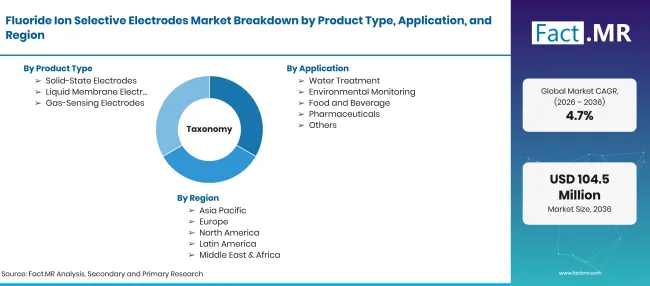
Factmr Fluoride Ion Selective Electrodes Market Taxonomy | Source: Fact.MR
| Attribute | Details |
|---|---|
| Quantitative Units | USD million |
| Market Definition | Electrodes specifically intended to measure fluoride ion concentration in prepared liquid samples. |
| Product Type | Solid-State Electrodes; Liquid Membrane Electrodes; Gas-Sensing Electrodes |
| Application | Water Treatment; Environmental Monitoring; Research Laboratories; Food and Beverage; Pharmaceuticals; Others |
| End-User | Industrial; Environmental Agencies; Others |
| Regions Covered | North America; Latin America; Western Europe; Eastern Europe; East Asia; South Asia & Pacific; Middle East & Africa |
| Countries Covered | Germany; Brazil; USA; UK; Japan |
| Companies Profiled | Thermo Fisher Scientific Inc.; Metrohm AG; Hanna Instruments; HORIBA, Ltd.; Mettler-Toledo International Inc.; Cole-Parmer Instrument Company LLC; Avantor, Inc.; Bante Instruments Inc.; OMEGA Engineering, Inc. |
| Forecast Period | 2026 to 2036 |
| Approach | Application-based assessment of test volumes, laboratory equipment replacement and published technical product scope |
Source: Fact.MR analysis. Updated Oct 26, 2026
How is the market segmented?
-
By Product Type
- Solid-State Electrodes
- Liquid Membrane Electrodes
- Gas-Sensing Electrodes
-
By Application
- Water Treatment
- Environmental Monitoring
- Research Laboratories
- Food and Beverage
- Pharmaceuticals
- Others
-
By End-User
- Industrial
- Environmental Agencies
- Others
-
By Region
- North America
- Latin America
- Western Europe
- Eastern Europe
- East Asia
- South Asia & Pacific
- Middle East & Africa
Frequently Asked Questions
How big is the fluoride ion selective electrodes market in 2026?
What is the market CAGR from 2026 to 2036?
Which product type leads sales?
What application represents the greatest share?
Who are the main companies in the fluoride ion selective electrodes market?
Who worked on this report


Preview the report firsthand - request a free sample
Free SampleGet the brochure for pricing and purchase details
Download PDF