- Market Value (2025): USD 310.6 Mn
- Estimated Value (2026): USD 355.0 Mn
- Forecast Value (2036): USD 1350.0 Mn
- CAGR (2026-2036): 14.3%
What is the Cell-to-Pack Adhesive Tapes Market forecast to be worth by 2036?
USD 355.0 million in 2026 to USD 1,350.0 million by 2036 at 14.3% CAGR.
- The Cell-to-Pack Adhesive Tapes Market crossed USD 310.6 million in 2025 as battery manufacturers widened tape qualification.
- Demand is projected to increase from USD 355.0 million in 2026 to USD 1,350.0 million by 2036.
- The market is forecast to register a 14.3% CAGR from 2026 to 2036 as module-less battery platforms enter repeat production.
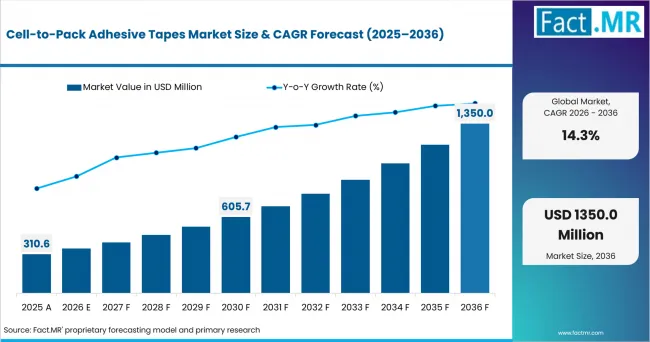
Cell To Pack Adhesive Tapes Market Market Value Analysis | Source: Fact.MR
What are the defining numbers behind Cell-to-Pack Adhesive Tapes Market growth?
USD 995.0 million absolute opportunity by 2036 led by EV Packs and Acrylic Foam alongside Cell-to-Pack architecture.
- Demand Drivers in the Market
- Battery manufacturers are adopting lightweight adhesive tapes to secure cells without increasing overall pack weight.
- Cell-to-pack battery platforms rely on electrically insulating tapes to improve safety around exposed cell surfaces.
- Automated battery assembly lines are increasing demand for fixation tapes that support consistent and high-speed application.
- Flame-resistant adhesive tapes are gaining importance around high-voltage components to improve battery safety.
- Key Segments Analyzed
- By Tape Function: Fixation is likely to account for 29% of the market in 2026, as battery cells continue to rely on secure mounting within pack assemblies.
- By Battery Architecture: Cell-to-Pack is expected to represent 33% of the market in 2026, reflecting the wider shift toward designs that remove intermediate modules.
- By Material: Acrylic Foam is estimated to hold 34% share in 2026 because it adapts well to uneven battery surfaces while providing reliable bonding.
- By Application: EV Packs are expected to make up 52% of the market in 2026, supported by steady growth in electric vehicle battery production.
- By Performance: Flame Retardant tapes are likely to account for 31% share in 2026, driven by increasing emphasis on battery fire protection.
- Analyst Opinion at Fact.MR
- Shambhu Nath Jha, Senior Analyst at Fact.MR, states, “adhesive tapes are becoming essential components within module-less battery packs. Advanced products can combine fixation with electrical insulation and cushioning. Commercial adoption will favor tape manufacturers that support automated application and controlled disassembly.”
- Strategic Implications
- Validate adhesive bonds across realistic operating temperatures to improve long-term pack reliability and qualification outcomes.
- Cell producers are evaluating insulation performance after mechanical aging to confirm durability under extended operating conditions.
- Pack engineers are assessing tape thickness before modifying battery architecture to balance thermal performance with space efficiency.
- Material converters are maintaining high die-cut precision to improve assembly consistency and reduce production variability.
Cell-to-pack architecture removes conventional module frames from battery assemblies. The approach can increase active material volume within the available pack space. Adhesive tapes support cell fixation and insulation without adding heavy mechanical components. tesa states that its 58656 structural insulation tape supports cell-to-pack and cell-to-chassis designs. The company reports that these designs can reach 72% volume utilization efficiency. The tape uses a UV-activated adhesive for structural cell wrapping.
China is expected to record a 19.3% CAGR through 2036 driven by battery manufacturing scale. India is projected to post a 17.9% CAGR during the forecast period. Germany is anticipated to advance at a 16.4% CAGR through 2036. Brazil is estimated to register a 15.0% CAGR during the period. The United States is forecast to post a 13.6% CAGR through 2036.
How does the Cell-to-Pack Adhesive Tapes Market break down by segment?
EV Packs lead at 52% with application segment, while Acrylic Foam leads at 34% for material segment.
Where is Tape Function demand strongest?
Fixation holds 29% share in 2026.
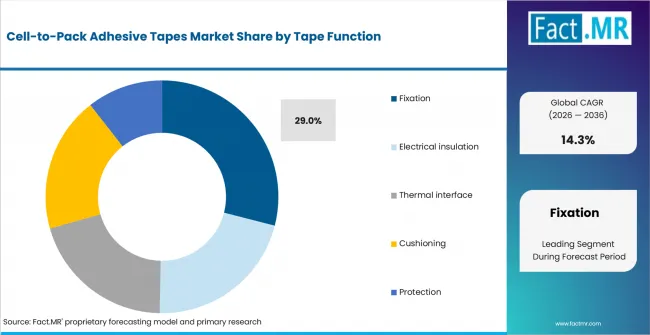
Cell To Pack Adhesive Tapes Market Analysis By Tape Function | Source: Fact.MR
Fixation leads the market because module-less battery packs require stable cell positioning throughout assembly and operation. Electrical insulation tapes protect cells and conductive components from electrical contact. Thermal interface tapes secure heat management materials to battery pack surfaces. Cushioning tapes absorb assembly tolerances around battery components. Protection tapes reduce abrasion and prevent damage during manufacturing. In April 2024, Avery Dennison introduced electrode fixing tapes for EV battery cells. The products bond current collector foils with separator layers and use acrylic adhesives designed for electrolyte compatibility.
What supports Battery Architecture adoption?
Cell-to-Pack holds 33% share in 2026.
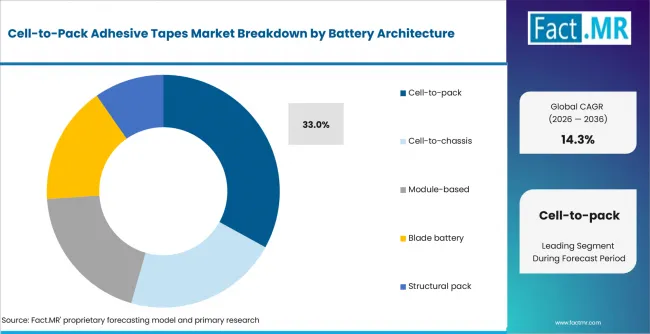
Cell To Pack Adhesive Tapes Market Analysis By Battery Architecture | Source: Fact.MR
Cell-to-Pack leads the market as it removes the intermediate module layer and creates more space for battery cells while reducing overall pack weight. Cell-to-Chassis designs integrate battery cells directly into the vehicle structure to improve space efficiency. Module-Based systems continue to see demand as they offer a familiar architecture and simplify maintenance. tesa introduced 58656 structural electrical insulation tape in 2025. The product supports cell-to-pack and cell-to-chassis battery architecture. The tape uses a UV-activated structural adhesive and provides dielectric protection around the cell.
Which Material dominates?
Acrylic Foam holds 34% share in 2026.
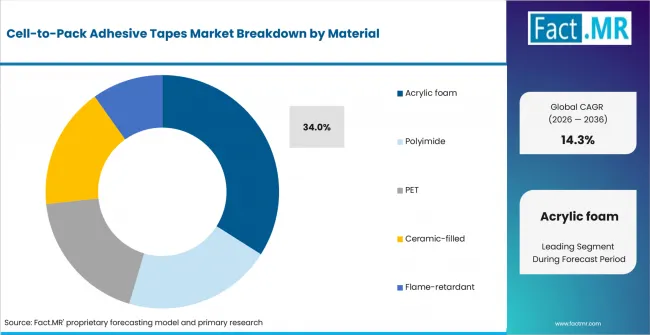
Cell To Pack Adhesive Tapes Market Analysis By Material | Source: Fact.MR
Acrylic Foam leads the market because it fills uneven gaps and delivers durable adhesion across battery pack assemblies. Polyimide remains a preferred material for applications that require reliable electrical insulation at high temperatures. tesa announced an automated battery sealing collaboration in 2024. The program combined tesa tape with application technology from partner companies. tesa ACXplus 76730 provides a watertight seal around battery pack covers. The tape can also be reopened during repair.
What leads the Application segment?
EV Packs hold 52% share in 2026.
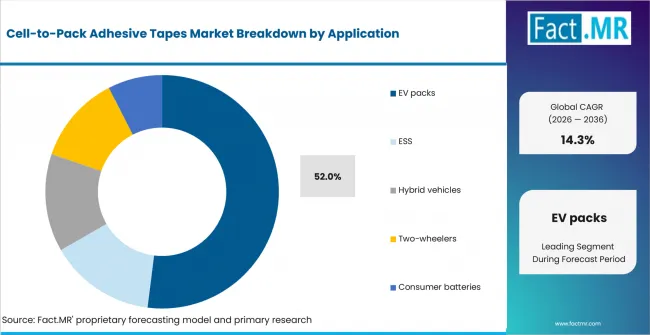
Cell To Pack Adhesive Tapes Market Analysis By Application | Source: Fact.MR
EV Packs lead application segment due to expanding battery electric vehicle production. Hybrid vehicles use compact adhesive solutions to fit smaller battery packs without affecting performance. Two-Wheelers rely on lightweight materials to maximize the limited space available inside battery packs. Avery Dennison introduced cell wrapping tapes during June 2024. The products provide dielectric protection around EV battery cells.
How does Performance shape demand?
Flame Retardant holds 31% share in 2026.
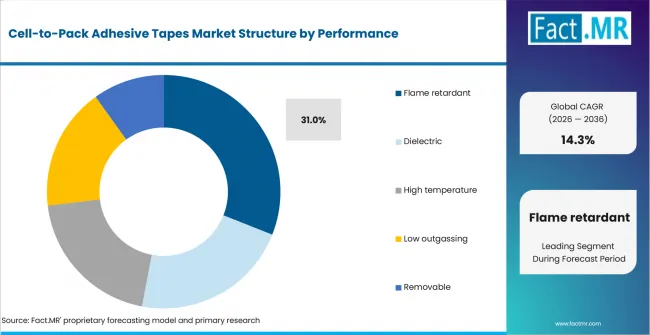
Cell To Pack Adhesive Tapes Market Analysis By Performance | Source: Fact.MR
Flame Retardant materials lead the market as battery safety remains a priority across next-generation battery pack designs. Dielectric grades are widely used to prevent electrical arcing between critical components. High-Temperature tapes retain their bonding performance under prolonged heat exposure. tesa presented Debonding on Demand applications in 2025. The technology is intended to improve battery repair and recycling. The tape maintains a strong bond during vehicle operation. Targeted activation allows components to separate during service.
What is accelerating Cell-to-Pack Adhesive Tapes Market adoption and what is holding it back?
Module elimination is anticipated to accelerate adoption while qualification complexity restrains replacement.
Drivers Impact Analysis
| DRIVER | (~) % IMPACT ON CAGR | GEOGRAPHIC RELEVANCE | IMPACT TIMELINE |
|---|---|---|---|
| Expansion of cell-to-pack architecture | +0.9% | China and Europe | Medium term |
| Automated battery assembly | +0.7% | Asia Pacific and North America | Short term |
| Electrical insulation requirements | +0.6% | Global battery plants | Medium term |
| Lightweight pack construction | +0.5% | Global automotive markets | Long term |
| Growth of structural battery systems | +0.4% | Europe and China | Medium term |
Source: Fact.MR analysis. Updated Jul 14, 2026
- Cell-to-pack architecture: Module elimination creates new fixation and insulation requirements. Adhesive tapes can secure cells without heavy brackets. Demand expands when module-less designs enter large-scale production.
- Automated battery assembly: Tape dispensing can be integrated within automated production lines. Precut parts also support rapid installation. Consistent application reduces manual variability.
- Electrical insulation: High-voltage battery systems need dielectric protection around exposed surfaces. Thin tapes can isolate cell cans and conductive parts. Cell wrapping provides broad insulation without thick housings.
- Lightweight construction: Mechanical fasteners add weight and consume pack space. Adhesive tapes offer a lower-mass bonding route. Reduced component count can also simplify inventory.
- Structural batteries: Structural packs transfer vehicle loads through the battery enclosure. Tape products can support fixation and sealing. Greater mechanical stress raises qualification requirements.
Opportunity Impact Analysis
| OPPORTUNITY | (~) % IMPACT ON CAGR | GEOGRAPHIC RELEVANCE | IMPACT TIMELINE |
|---|---|---|---|
| Structural insulation tapes | +0.6% | Global EV production centers | Medium term |
| Debonding tapes for battery repair | +0.5% | Europe and North America | Long term |
| Automated box sealing systems | +0.4% | China and Europe | Short term |
| Flame-retardant barrier lamination | +0.4% | Global | Medium term |
| Electrolyte-resistant in-cell tapes | +0.3% | Asia Pacific | Short term |
Source: Fact.MR analysis. Updated Jul 14, 2026
- Structural insulation tapes: One tape can combine mechanical fixation with dielectric protection. This reduces separate pack components. Cell-to-pack designs create a strong commercial route for such products.
- Debonding technology: Battery repair requires controlled separation of bonded components. Triggered-release tapes can protect surrounding materials during service. Their use can also improve end-of-life recovery.
- Automated box sealing: Preformed adhesive seals can replace liquid sealants. Tape application avoids curing delays. Packs can also be reopened after end-of-line testing.
- Barrier lamination: Thermal runaway sheets need reliable attachment inside packs. Flame-retardant tapes can bond mica and ceramic barriers. Thin constructions preserve cell volume.
- In-cell tapes: Electrode stacks require chemical stability within battery electrolyte. Specialized tapes can bind separators and foils. Growing cell production creates recurring demand.
Restraints Impact Analysis
| RESTRAINT | (~) % IMPACT ON CAGR | GEOGRAPHIC RELEVANCE | IMPACT TIMELINE |
|---|---|---|---|
| Long automotive qualification cycles | -0.5% | Global | Medium term |
| Surface preparation requirements | -0.4% | Battery production centers | Short term |
| Aging under heat and electrolyte exposure | -0.4% | Global | Medium term |
| Difficulty repairing permanent bonds | -0.3% | Europe and North America | Long term |
| Tape placement tolerance | -0.2% | High-volume plants | Short term |
Source: Fact.MR analysis. Updated Jul 14, 2026
- Qualification cycles: Tape changes can affect pack strength and electrical safety. Vehicle manufacturers require repeated environmental testing. Approval can extend across several design stages.
- Surface preparation: Adhesive performance depends on clean bonding surfaces. Oil and dust can reduce final strength. Automated cleaning adds production complexity.
- Chemical aging: Battery tapes may face electrolyte vapour and high temperatures. Adhesives can soften or lose strength. Product approval requires long-term exposure data.
- Repair difficulty: Permanent tape bonds can restrict access to damaged cells. Removing components may damage nearby insulation. Debonding products can reduce this concern.
- Placement tolerance: Thin cells require accurate tape alignment. Misplaced tape can interfere with busbars or cooling paths. Automated vision systems may be required.
Which countries are scaling Cell-to-Pack Adhesive Tapes Market fastest?
China 19.3%, India 17.9%, Germany 16.4%, Brazil 15.0%, United States 13.6%.
Regional analysis covers North America and Europe. Coverage also includes Asia Pacific and Central and South America. The Middle East and Africa complete the geographic view.
.webp "Top Country Growth Comparison Cell To Pack Adhesive Tapes Market Cagr (2026 2036)")
Top Country Growth Comparison Cell To Pack Adhesive Tapes Market Cagr (2026 2036) | Source: Fact.MR
| COUNTRY | CAGR |
|---|---|
| China | 19.3% |
| India | 17.9% |
| Germany | 16.4% |
| Brazil | 15.0% |
| United States | 13.6% |
Source: Fact.MR analysis. Updated Jul 14, 2026
How is China developing demand?
19.3% CAGR driven by cell manufacturing and module-less battery production.
China has established a strong lithium-ion cell manufacturing base supported by large-scale battery production. Domestic manufacturers are expanding the use of blade battery and cell-to-pack designs across a wide range of vehicle platforms. The market is expected to grow at a CAGR of 19.3% through 2036. Regional tape coating and converting facilities help reduce delivery times and improve supply reliability. At the same time, consistent quality across wide tape rolls remains a key requirement, while effective defect control continues to play an important role in supplier approval.
What underpins growth in India?
17.9% CAGR supported by battery assembly and electric mobility.
India is expanding EV production across passenger vehicles and two-wheelers. Local battery pack assembly creates new fixation demand. As more die-cut components are produced locally, manufacturers can reduce their reliance on imported parts and shorten procurement timelines. Cost remains a key consideration when selecting materials for two-wheeler battery platforms, particularly in price-sensitive vehicle segments. Thin PET tapes are expected to see wider adoption where lower weight and efficient space utilization are priorities. At the same time, products must withstand high humidity and varying climatic conditions across different regions. Battery manufacturers are also placing greater emphasis on how adhesives perform after prolonged exposure to elevated temperatures, ensuring long-term reliability throughout the battery's service life.
What is driving growth in Germany through 2036?
16.4% CAGR due to automotive engineering and structural battery development.
Germany maintains a strong automotive research and manufacturing base that continues to support battery innovation. Cell-to-pack architectures are gaining wider adoption as vehicle manufacturers focus on reducing weight and improving energy efficiency. The market is anticipated to expand at a CAGR of 16.4% through 2036. Electrical insulation and long-term serviceability are important factors during tape qualification.
What is supporting demand in Brazil?
15.0% CAGR supported by vehicle assembly and electric transport.
Brazil has a large automotive manufacturing sector. Electric bus programs are expected to support higher battery pack production, with the market projected to grow at a 15.0% CAGR through 2036. Local tape conversion could make pack assembly more efficient and reduce reliance on imported finished components. Because batteries often operate in warm and humid conditions, tapes will need to maintain adhesion and insulation performance under prolonged heat and moisture exposure. Imported materials may support the first phase of production, but regional coating and converting capacity could develop as demand becomes more established.
What supports the United States outlook?
13.6% CAGR driven by domestic battery manufacturing and EV investment.
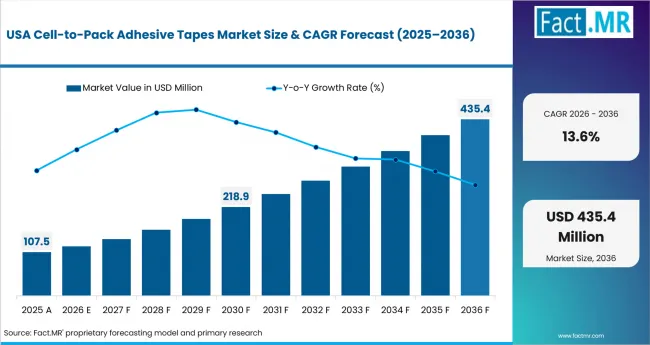
Cell To Pack Adhesive Tapes Market Country Value Analysis | Source: Fact.MR
The United States is expanding battery production capacity. Vehicle manufacturers are also developing structural battery packs. The market is forecast to post a 13.6% CAGR by 2036. Domestic tape production can support supply chain requirements. Avery Dennison manufactures selected electrode fixing tapes in the United States. The products are designed to support Inflation Reduction Act requirements. New battery plants will create qualification opportunities. Tape manufacturers with nearby laboratories can shorten development cycles.
Who leads the Cell-to-Pack Adhesive Tapes Market?
Tesa and Avery Dennison lead through dedicated EV battery tape portfolios. 3M and Nitto Denko strengthen competition through electrical insulation and battery assembly materials.
Tesa offers cell wrapping tapes and box sealing products for battery packs. Its portfolio also covers electrical insulation and fire protection. UV-activated structural tapes address cell-to-pack applications. Avery Dennison provides electrode fixing tapes and cell wrapping tapes. The company also offers barrier lamination and electrical insulation products. Its battery portfolio uses several pressure-sensitive adhesive technologies. 3M supplies dielectric tapes and thermal management materials for battery systems. Nitto Denko contributes protection tapes and electrical insulation products. Lohmann develops thermally conductive tapes for lithium-ion batteries.
Saint-Gobain provides tape solutions and converted components for battery protection. Its products support sealing and thermal runaway mitigation. Competitive position will depend on automation support and regional availability.
Which companies are the key providers?
Tesa and Avery Dennison are key providers. 3M and Nitto Denko are also profiled. Lohmann and Saint-Gobain complete the company set.
- tesa SE
- Avery Dennison Corporation
- 3M Company
- Nitto Denko Corporation
- Lohmann GmbH & Co. KG
- Saint-Gobain
Bibliography
- Avery Dennison Corporation. (2024, April 9). Avery Dennison introduces electrode fixing tapes for EV battery cells. Avery Dennison Corporation.
- Avery Dennison Corporation. (2024, June 14). Avery Dennison introduces pressure-sensitive tape solutions for EV battery cell wrapping applications. Avery Dennison Corporation.
- tesa SE. (2025, October 7). tesa® 58656 structural electrical insulation helps to increase the energy density of batteries. tesa SE.
- tesa SE. (2025, November 7). Powering collaboration. tesa SE.
- tesa SE. (2025, December 8). Debonding on Demand. tesa SE.
This Report Addresses
- The report provides strategic intelligence across Tape Function and Battery Architecture.
- Segment analysis identifies EV Packs and Acrylic Foam as major categories.
- Regional assessment examines China and India alongside Germany.
- Brazil and the United States complete the country comparison.
- Competitive analysis profiles tesa and Avery Dennison alongside 3M.
- Performance analysis covers flame resistance and dielectric protection.
What does the Cell-to-Pack Adhesive Tapes Market cover?
Fixation and insulation tapes used within module-less battery packs.
The Cell-to-Pack Adhesive Tapes Market covers adhesive materials used around battery cells and pack components. These products provide fixation and insulation during battery operation.
The market differs from general automotive tapes because battery performance drives the purchase. Products without a battery-specific function are outside the boundary.
What is included in the scope?
Adhesive tapes used across EV Packs and Energy Storage Systems.
The scope includes Fixation and Electrical Insulation products. Thermal Interface and Cushioning tapes are also covered.
Cell-to-Pack and Cell-to-Chassis architecture are included. Blade and Structural Pack designs are covered when tape supports battery assembly.
Included revenue covers qualified tapes and die-cut components. Engineering support related to application is reflected within competitive positioning.
What is excluded from the scope?
General automotive mounting tapes are outside the scope.
The scope excludes liquid structural adhesives. Mechanical fasteners are also excluded.
Battery cells and complete battery packs are not counted. General wire harness tapes sit outside the boundary.
How was the analysis built?
120+ sources and 40+ manufacturer product ranges were reviewed. The assessment also covered 25+ countries and 20+ interviews.
- Primary Research:
- Primary research includes discussions with tape manufacturers and battery engineers. It covers pack designers involved in product qualification.
- Input from converters supports commercial assessment. Interviews examine automation and insulation requirements.
- Desk Research:
- Desk research reviews official company technical records. Battery production programs support regional assessment.
- Product data sheets inform material comparisons. Company announcements identify current tape developments.
- Market-Sizing and Forecasting:
- Forecasting uses battery production and EV output. Models consider tape content within each pack.
- Segment shares support market allocation. Country forecasts reflect manufacturing investment.
- Data Validation and Update Cycle:
- Forecasts are tested through industry interviews. Regional estimates are compared with battery output.
- Product launches support periodic forecast revisions. Company expansions also inform competitive analysis.
Segmentation
What is the report’s scope and coverage?
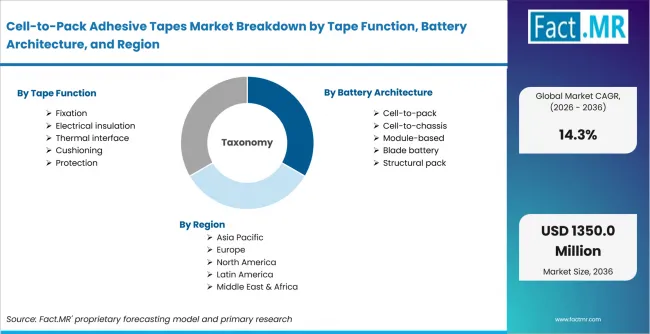
Cell To Pack Adhesive Tapes Market Breakdown By Tape Function, Battery Architecture, And Region | Source: Fact.MR
| Attribute | Details |
|---|---|
| Quantitative Units | USD Million in 2026 to USD Million by 2036 at CAGR |
| Market Definition | Adhesive tapes used for bonding and insulation within cell-to-pack battery architecture |
| Tape Function | Fixation, Electrical Insulation, Thermal Interface, Cushioning, Protection |
| Battery Architecture | Cell-to-Pack, Cell-to-Chassis, Module-Based, Blade Battery, Structural Pack |
| Material | Acrylic Foam, Polyimide, PET, Ceramic-Filled, Flame-Retardant |
| Application | EV Packs, ESS, Hybrid Vehicles, Two-Wheelers, Consumer Batteries |
| Performance | Flame Retardant, Dielectric, High Temperature, Low Outgassing, Removable |
| Regions Covered | North America, Europe, Asia Pacific, Central and South America, Middle East and Africa |
| Countries Covered | China, India, Germany, Brazil, United States |
| Key Companies Profiled | tesa, Avery Dennison, 3M, Nitto Denko, Lohmann, Saint-Gobain |
| Forecast Period | 2026 to 2036 |
| Approach | Hybrid assessment using battery output and tape adoption alongside qualification activity |
Source: Fact.MR analysis. Updated Jul 14, 2026
How is the market segmented?
-
By Tape Function:
- Fixation
- Electrical Insulation
- Thermal Interface
- Cushioning
- Protection
-
By Battery Architecture:
- Cell-to-Pack
- Cell-to-Chassis
- Module-Based
- Blade Battery
- Structural Pack
-
By Material:
- Acrylic Foam
- Polyimide
- PET
- Ceramic-Filled
- Flame-Retardant
-
By Application:
- EV Packs
- ESS
- Hybrid Vehicles
- Two-Wheelers
- Consumer Batteries
-
By Performance:
- Flame Retardant
- Dielectric
- High Temperature
- Low Outgassing
- Removable
-
By Region:
- North America
- United States
- Canada
- Europe
- Germany
- United Kingdom
- France
- Italy
- Spain
- Asia Pacific
- China
- India
- Japan
- South Korea
- Australia
- Central and South America
- Brazil
- Argentina
- Mexico
- Chile
- Middle East and Africa
- UAE
- Saudi Arabia
- South Africa
- North America
Frequently Asked Questions
Which Tape Function leads the Cell-to-Pack Adhesive Tapes Market?
Which Battery Architecture leads the Cell-to-Pack Adhesive Tapes Market?
Which Material leads the Cell-to-Pack Adhesive Tapes Market?
Which Application leads the Cell-to-Pack Adhesive Tapes Market?
Which Performance category leads the Cell-to-Pack Adhesive Tapes Market?
Which country records the highest CAGR in the Cell-to-Pack Adhesive Tapes Market?
How does India perform in the Cell-to-Pack Adhesive Tapes Market?
How does Germany perform in the Cell-to-Pack Adhesive Tapes Market?
What is the primary driver in the Cell-to-Pack Adhesive Tapes Market?
What is the main restraint in the Cell-to-Pack Adhesive Tapes Market?
Why is Fixation important?
Why do EV Packs dominate demand?
Who worked on this report


Preview the report firsthand - request a free sample
Free SampleGet the brochure for pricing and purchase details
Download PDF