- Base Value(2025): 1297 Mn
- Forecast Value (2035): 2987 Mn
- CAGR (2035): 9.5%
Flux Chipper Market Outlook 2025 to 2035
The global flux chipper market is expected to reach USD 2,987 million by 2035, up from USD 1,297 million in 2025. During the forecast period 2025 to 2035, the industry is projected to expand at a CAGR of 8.7%
The flux chipper market is being propelled by demand for durable and customizable performance, alongside steady growth in industrial applications. Ongoing technological innovations and industry-specific preferences are expected to sustain their expansion across diverse end-user segments.
Quick Stats for Flux Chipper Market
- Industry Value (2025): USD 1,297 Million
- Projected Value (2035): USD 2,987 Million
- Forecast CAGR (2025 to 2035): 8.7%
- Leading Segment (2025): Horizontal Flux Chippers (36.5% Market Share)
- Fastest Growing Country (2025-2035): India (11.3% CAGR)
- Top Key Players: Aurora Tools, Chicago Pneumatic, CS UNITEC, Ingersoll Rand, and Jet Tools
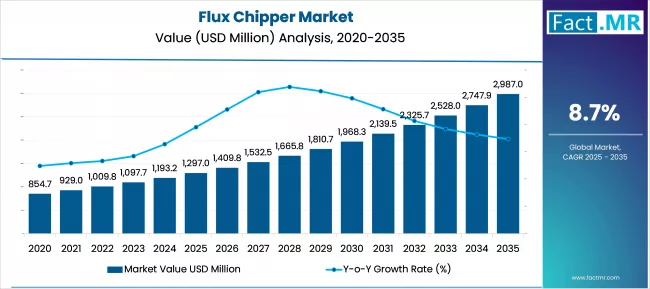
Flux Chipper Market Market Value Analysis | Source: Fact.MR
What are the drivers of the flux chipper market?
The flux chipper market is under acetate of technical, functional and user centric factors that are all influencing the demand in industries. The market has been growing steadily with the end users’ demand for long-term performance and customized performance of UAV platforms. As operators focus on high-quality and mission-capable parts, niche upgrades are becoming a mainstream product, just as propellers and ESCs have standardized over the years.
Flux chippers used with motors, gearboxes, gimbals, and payload mounts can help improve flight performance by providing better maneuverability during flight, increasing hover times, lowering levels of noise and reducing rotor, servo, and stabilizing system loads.
Safety and reliability are also important issues, and it is supported by the confidence of the users in the low-friction and low-vibration functioning that guarantees smoother and more stable flights. New technologies in closed-loop, sealed, and non-corrosive designs, including hybrid ceramic designs, and clean-room lubricants are expanding the scope of market in commercial, defense, and hobbyist markets. Accessibility is also being increased in developing territories via e-commerce, direct shops, and electronic shops with specialization in selling electronics.
The innovations in terms of lubrication chemistry, thin-section geometries, and new coating materials such as DLC and TiN contribute to a prolonged service life at various temperature and humidity levels. Sustainability also has an effect on demand where alloys that are lighter to recycle and those that have a prolonged life cycle decrease the amount of waste.
Perceptions of aesthetics and performance are also strengthened by social media, FPV communities, and content created by creators, which is faster to adopt. Purchasing repeatability and consistency in the market are initiated by the standardized OEM and retrofit packages.
What are the regional trends of the flux chipper market?
The U.S has a well-developed market in North America which is facilitated by the robust use of UAV in defense, public safety, and industrial inspection. Buyers are also focusing on refined performance in addition to reliability, and upgrades to reduce vibration, as well as longer service life, are becoming the norm. Established aerospace supply networks and strong brand names of major bearing and motors offer stability and lead to consistent innovation.
The European market is expanding at a steady pace, especially in the U.K., Germany and France where the sustainability norms and strict air worthiness conditions define the market. Lightweight low noise flux chipper products which meet the requirements of REACH and RoHS directives are becoming popular. Greener lubricants, traceable materials, and increased transparency are some of the regulatory pressures that are driving the push toward eco-friendly procurement.
Asia Pacific is also the quickest expanding region due to the increasing capital investments and fast commercialization of UAV in China, India, and Indonesia. Both international and regional players are increasing portfolios and specialize in specifications to local industries, such as agriculture, mapping and logistics. This dynamism in the region makes Asia Pacific one centre of long-term growth.
The focus of market development in the Middle East and Africa is in mature urban centers and special economic zones. The high demand of corrosion-resistant and high-temperature designs is associated with security, oil and gas inspection, and infrastructure monitoring. The procurement plans in these industries are biased towards prolonged lifespan and functioning protection in harsh environments.
Brazil and Mexico are driving the Latin America growth based on the developing robotics ecosystem and enhanced maintenance standards. Chile and Colombia are also moving in the right direction, and urban UAV operators are now adding flux chippers to preventative maintenance. These innovations are gradually enhancing the adoption of the region in a wide range of uses.
What are the challenges and restraining factors of the Flux Chipper market?
In flux chipper market, several constraints are present, and this restricts its development. Among the problems is the variability and exorbitant costs of aerospace grade steels, ceramic balls, precision cages and specialty lubricants. These are the contributions that make the price of the unit go up to the point that advanced designs cannot be purchased by the UAV platforms that are cost-sensitive. Additionally, a lengthy and expensive process of qualification and certification (particularly of the defense export control and airworthiness regulations) makes the process slow to adopt in the market.
Environmental and regulatory pressure is on the increase, along with restrictions on the use of PFAS-based greases, plating chemistry, and noise levels are driving manufacturers into complicated re-designs. Reduced friction and corrosion resistance in a sustainability objective is an engineering trade-off that is difficult to achieve. The severe conditions that come with operations like dust, salt spray, shock loads and thermal fluctuation are wear accelerating factors and as far as sealing improves the durability, it introduces drag and flight efficiency.
Additional risk is supply-chain fragmentation and proliferation of fake bearings over the Internet because inconsistency in tolerances and heat treatment mistakes may cause vibration and hasty motor life and even catastrophic on-board failures. Maintenance practices as well are also a problem since the gains made over the advanced design is normally reversed by the poor installation, over lubrication or contamination in event of field replacement.
There are also threats of substitutes initially with substitutes such as large stator direct-drive motors, magnetic suspension gimbals and polymer bushing linkages which do not require high-spec bearings. Technical support, high levels of importation duties and lack of knowledge on the benefits of lifecycle have hindered its application in the developing markets, however, through gradual change in education and innovations in materials, these challenges can be overcome.
Country-Wise Insights
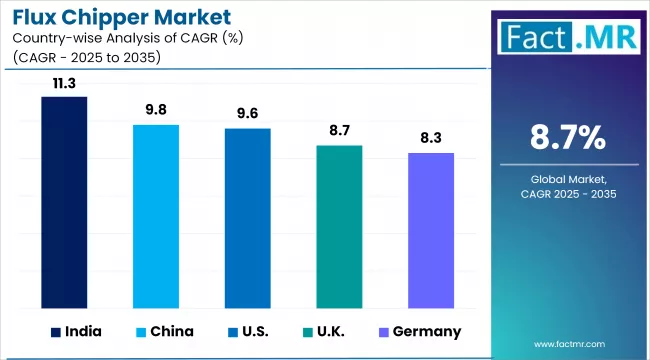
Flux Chipper Market Cagr Analysis By Country | Source: Fact.MR
Sustainability Standards and Precision Engineering Drive Germany’s Flux Chipper Integration in UAV Platforms
The market of flux chippers in Germany has the advantage that it is a strong aerospace and industrial manufacturing region where the contributors to UAV usage are heavily concerned with adhering to the requirements of the REACH and RoHS standards. The focus of demand is on light, low-noise, and recyclable bearing systems designed in the inspection, defense, and industrial automation segments. To improve the serviceability of corrosion and flight reliability suppliers are targeting hybrid-ceramic and sealed assemblies. Sophisticated machining and surface treatment is strengthening lifecycle efficiency, with the German OEMs entrenching sustainability objectives in procurement.
Technological Innovation and Regulatory Evolution Boost Japan’s Flux Chipper Market for Advanced Robotics and UAVs
Japan is experiencing an increase in the use of flux chippers as Japan has a well-established robotics industry and is increasingly using UAVs in logistics, mapping and infrastructure. The high-precision bearings that allow the product to have extended hover times, less vibration, and minimal friction usage can be well-suited to the engineering culture of the Japanese. The regulatory forces prefer PFAS-free greases, recyclable alloys as well as quiet-operation designs. Local companies are embracing DLC and TiN finishes to provide durability in diverse environments and distributors are increasing access by robotics clusters and innovation areas.
Energy Security and Harsh Environment Demands Propel Middle East Flux Chipper Adoption in UAV Surveillance
Middle East market is marked by the use of UAVs in oil and gas, security applications and flux chippers used in the areas should withstand the dust, high heat and corrosion. Procurement focuses on sealed, high temperature design and hybrid-ceramic designs. UAVs are used by governments inspection and border patrols, which have generated a need to be reliable and have extended service life. The makers of the region are designing chemistries and coating to the extremes of climate and are also creating distribution arrangements in the strategic centers such as UAE and Saudi Arabia.
Urban Expansion and Robotics Ecosystems Advance Brazil’s Flux Chipper Market in Latin America
Brazil is pursuing a regional leadership in the implementation of UAVs, and flux chipper is increasingly in demand in the agricultural industry, logistics, and in urban infrastructure inspections. The operators are more concerned with hygienic, low maintenance bearings that minimize vibration and enhance efficiency in humid tropical environments.
The use of corrosion resistant and closed systems is being encouraged through local robotics ecosystems and international collaboration with suppliers. The increasing e-commerce intermediaries, along with the uniform retrofit packages, are empowering small and medium enterprises and startups to obtain sophisticated designs in major metropolitan areas.
Category-Wise Analysis
Horizontal and Vertical Flux Chippers Define Core Industrial Performance
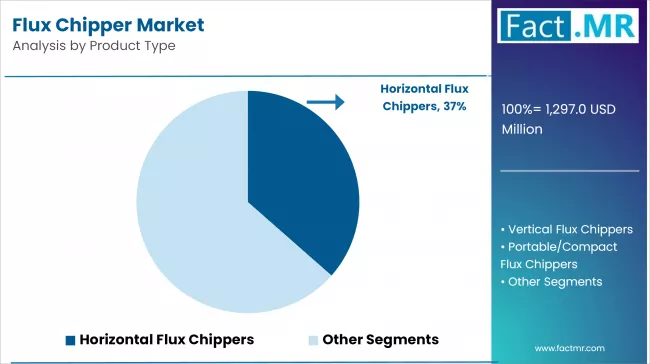
Flux Chipper Market Analysis By Product Type | Source: Fact.MR
The horizontal flux chippers prevail in heavy-duty applications where steady throughput and equal rotor dynamics are required in scrap recycling and demolition applications. Their designs focus on longevity, consistent cutting forces and flexibility to mixed waste streams. Comparatively, vertical flux chippers have been applied in precision-oriented applications in smelting and metallurgy and are well-suited in areas where controlled particle sizing and minimization of vibration are important.
Small operators and on-site demolition jobs are the customers of the portable and compact models, which are appreciated due to portability and modular maintenance. Industrial versions are heavy-duty with utilities and energy scaling services with automated feeding and sealed bearings to provide long service in high-loads. The combination of these product types is an indication of a shift of mobility to industrial endurance.
Manual, Semi-Automatic, and Fully Automatic Systems Anchor Operational Efficiency
Manual flux chippers are still used sparsely where price is more important, especially with the small-time recyclers and municipal programs. Semi-automatic provides a valuable compromise, giving operators control, with feeding and discharge automation built into them, and are used in construction and mid-size metallurgical plants.
Fully automatic systems are becoming popular with energy utilities and industrial operators they have safety benefits, accurate bearings, and predictable throughput which lessen downtime and labor reliance. Buyers are gradually considering automation as a lifecycle cost advantage, which is in line with the sustainability aim and less operational risk. The direction is towards automation as the standard of all end use.
Metal Recycling and Foundry Applications Drive Core Market Adoption
Uses in metal recycling are the base of flux chipper demand and operators want sturdy machines that can withstand shock loads, dust abrasiveness, and extreme temperatures. Waste processing construction and demolition waste is closely behind and this is advantaged by the versatile chipper systems that can process mixed inputs with reliability. The foundry and smelting business rely on vertical and heavy-duty flux chippers that can handle molten or semi-solid materials with their focus being on corrosion resistance and safety.
The requirements of energy and utility services are closed, heat-resistant, and in this case, the uptime and ability to operate at high temperatures cannot be compromised. Municipal, agriculture, and other emerging applications are on an increasing trend and are using compact and portable models with an emphasis on mobility, sustainability, and affordability.
Competitive Analysis
There is growing interest in the flux chipper market where buyers focus on longer lifespan, lower noise, and repeatability precision amongst missions of UAVs. The increasing compliance and sustainability pressures are hastening the move towards mainstream use of premium designs. Manufacturers are developing hybrid-ceramic assemblies and those made with sealed long-life lubricants, PFAS-free formulations and recycleable housings.
Certified sourcing and anti-counterfeit are the most important elements to develop user trust. The market is consolidating, with major companies increasing their OEM relations, investing in local assembly, and application-driven R&D to make their brands more reliable with advanced coatings, thin-section geometries, and standardized retrofit kits to serve the needs of international operators.
Key players in the flux chipper market include Aurora Tools, Chicago Pneumatic, CS UNITEC, Ingersoll Rand, Jet Tools, KC Tools, MIGHTY SEVEN, NAKATANI KIKAI, NITTO KOHKI, PUMA INDUSTRIAL, STEELMAN, TFT-PNEUMATIC and TOKU PNEUMATIC.
Recent Development
- In May 2025, Chicago Pneumatic announced a new customized reaction arm design service for its CP86 cordless and CP66 pneumatic torque-wrench series. This is meant to improve accuracy, repeatability, and safety - key features overlapping with flux-chipper market trends of precision, low vibration, and rugged duty components.
Fact.MR has provided detailed information about the price points of key manufacturers of Flux Chipper Market positioned across regions, sales growth, production capacity, and speculative technological expansion, in the recently published report.
Segmentation
Segmentation of Flux Chipper Market
-
By Product Type :
- Horizontal Flux Chippers
- Vertical Flux Chippers
- Portable/Compact Flux Chippers
- Heavy-Duty Industrial Flux Chippers
- Others
-
By Operation Mode :
- Manual
- Semi-Automatic
- Fully Automatic
-
By Application :
- Metal Recycling
- Construction & Demolition Waste Processing
- Foundry & Smelting Operations
- Power & Energy
- Other Industrial Applications
-
By End-Use Industry :
- Automotive & Metal Fabrication
- Mining & Metallurgy
- Construction Materials
- Energy & Utilities
- Others (Municipal, Agriculture)
-
By Region :
- North America
- Latin America
- Western Europe
- Eastern Europe
- East Asia
- South Asia & Pacific
- Middle East & Africa
Frequently Asked Questions
What was the Global Flux Chipper Market Size Reported by Fact.MR for 2025?
Who are the Major Players Operating in the Flux Chipper Market?
What is the Estimated Valuation of the Flux Chipper Market in 2035?
What Value CAGR did the Flux Chipper Market Exhibit Over the Last Five Years?
Who worked on this report


Preview the report firsthand - request a free sample
Free SampleGet the brochure for pricing and purchase details
Download PDF