- Market Value (2025): USD 1.8 Bn
- Estimated Value (2026): USD 1.9 Bn
- Forecast Value (2036): USD 3.34 Bn
- CAGR (2026-2036): 5.8%
What is the Flywheel Damper Market forecast to be worth by 2036?
USD 1.8 billion in 2025, rising from USD 1.9 billion in 2026 to USD 3.34 billion by 2036 at a 5.8% CAGR.
- The flywheel damper market was valued at USD 1.8 billion in 2025.
- Revenue is forecast to reach from USD 1.9 billion in 2026 to USD 3.34 billion by 2036 as vehicle production and repairs sustain demand for damped flywheel assemblies.
- The reported 5.8% CAGR for 2026 to 2036 reflects Fact.MR’s forecast for smoother engine-to-gearbox torque delivery and service demand for worn components.
| Year | Basis | Market Value (USD billion) |
|---|---|---|
| 2025 | Actual | 1.8 |
| 2026 | Estimate | 1.9 |
| 2036 | Forecast | 3.34 |
| CAGR 2026 to 2036 | Forecast period | 5.8% |
Source: Fact.MR analysis. Updated Nov 11, 2026
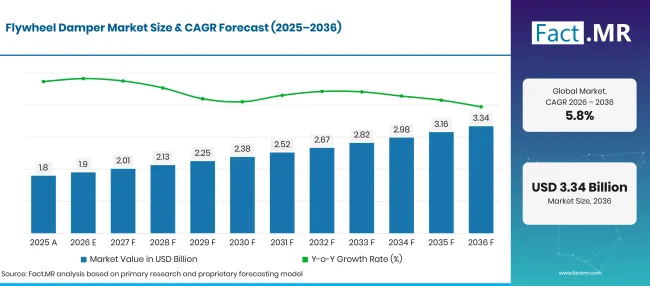
Flywheel Damper Market Forecast Global | Source: Fact.MR
What are the defining numbers behind Flywheel Damper Market growth?
USD 1.4 billion in additional market value by 2036; individual bent spring designs, automotive applications and steel components lead.
- Demand Drivers in the Market
- Powertrain engineers need a damper that can absorb repeated torque pulses before they reach gear teeth. A two-mass flywheel lets its spring arrangement filter engine vibration while keeping the clutch assembly within the vehicle packaging envelope.
- Automakers working with combustion and hybrid drivetrains match dampers to torque curves and operating speeds. The VDA recorded 2,857,591 new passenger-car registrations in Germany during 2025 in its February 2026 update.
- Repair workshops need reliable fitment information because a worn flywheel can resemble a clutch or bearing fault. Technicians assess abnormal idle noise and vibration before ordering a complete replacement, keeping diagnosis central to the aftermarket sale.
- Transmission makers weigh steel strength against rotating mass during design. They also consider spring fatigue and heat exposure because a component that performs well at steady speed must still cope with engine starts and abrupt load changes.
- Industrial machinery operators use damping where an engine or other pulsating drive transfers power through a flywheel. The design must suit shaft alignment and service access, so application engineering matters more than a broad catalogue description.
- Key Segments Analyzed
- By Design Type: Individual Bent Spring is forecast to hold 42.1% share in 2026 because a compact spring arrangement gives designers a familiar way to filter torsional movement.
- By Application: Automotive Industry is estimated to account for 42.3% share in 2026, reflecting damper installations across vehicle powertrains and replacement work.
- By Material Type: Steel is projected to represent 64.8% share in 2026 owing to its strength and suitability for repeated mechanical loading.
- Analyst Opinion at Fact.MR
- Shambhu Nath Jha, Principal Consultant at Fact.MR, states, “A damper must control vibration under real engine loads and fit the intended clutch and gearbox assembly. This makes application-specific engineering and reliable repair support important to buyers. Clear diagnostic guidance also helps workshops distinguish a worn flywheel from other causes of drivetrain noise.”
- Strategic Implications
- Flywheel manufacturers can test spring response across engine-speed and torque ranges because catalogue fit alone does not confirm vibration performance under load. Complete-system testing helps reduce mismatched designs.
- Vehicle manufacturers need to assess flywheel behavior with the complete clutch and gearbox assembly before confirming a production specification. Vehicle integration shares engineering concerns with the automotive drivetrain category.
- Distributors benefit from maintaining clear vehicle and engine cross-references so workshops order compatible assemblies and avoid repeat gearbox removal.
- Repair networks can document checks for abnormal noise and worn clutch components before recommending replacement of an expensive dual-mass unit.
Germany is projected to post 6.7% CAGR through 2036, supported by its vehicle component base. Brazil follows at 6.1%, linked to domestic vehicle assembly and replacement demand. The USA is forecast at 5.5%, while the UK reaches 4.9% and Japan 4.4%.
How does the Flywheel Damper Market break down by segment?
Individual Bent Spring leads Design Type at 42.1%; Automotive Industry leads Application at 42.3%; Steel leads Material Type at 64.8%.
Which Design Type dominates?
Individual Bent Spring represents 42.1% of 2026 value.
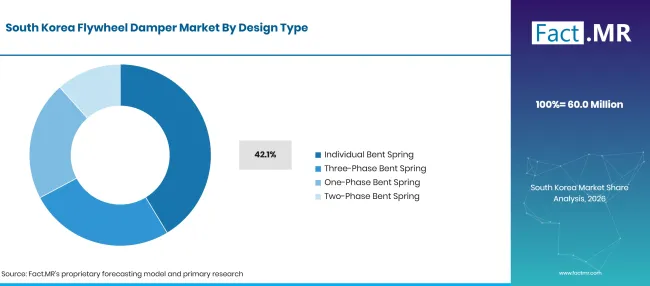
Factmr Flywheel Damper Market South Korea By Design Type | Source: Fact.MR
| Design Type | Share (2026) |
|---|---|
| Individual Bent Spring (Leading segment) | 42.1% |
| Other designs combined | 57.9% |
| Total | 100.0% |
Source: Fact.MR analysis. Updated Nov 11, 2026
Individual bent spring designs help absorb changes in engine torque before those vibrations reach the gearbox. Engineers choose the spring arrangement according to available movement between the flywheel masses, expected engine loads and space around the transmission. One-phase, two-phase and three-phase configurations offer different ways of tuning that response. AISIN describes a two-part flywheel connected by coil springs, illustrating why spring travel and fatigue performance matter when manufacturers qualify a design.
What leads the Application segment?
Automotive Industry accounts for 42.3% of 2026 value.
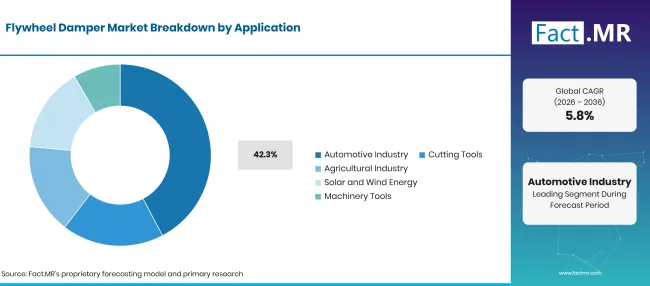
Flywheel Damper Market Breakdown Application | Source: Fact.MR
| Application | Share (2026) |
|---|---|
| Automotive Industry (Leading segment) | 42.3% |
| Other applications combined | 57.7% |
| Total | 100.0% |
Source: Fact.MR analysis. Updated Nov 11, 2026
Automotive demand includes new-vehicle fitment and repair. A damper affects gearbox noise and clutch response. Cutting Tools and Machinery Tools may use dampers under changing loads. Agricultural Industry equipment faces different duty cycles. Industrial and renewable-energy uses require separate review because their torsional damping systems may differ from automotive dual-mass flywheel assemblies. Revenue inclusion depends on the components defined in the market methodology. Vehicle designs provide repeatable part specifications and established service channels.
How does Material Type shape demand?
Steel captures 64.8% of 2026 value.
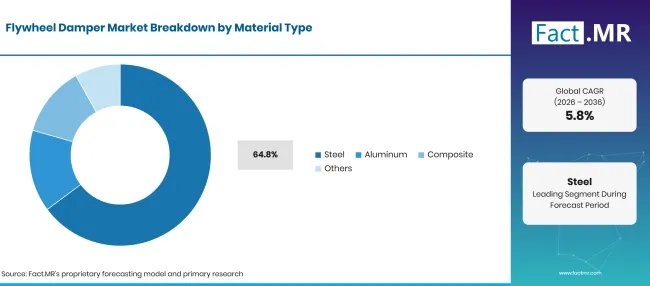
Flywheel Damper Market Breakdown Material Type | Source: Fact.MR
| Material Type | Share (2026) |
|---|---|
| Steel (Leading segment) | 64.8% |
| Other materials combined | 35.2% |
| Total | 100.0% |
Source: Fact.MR analysis. Updated Nov 11, 2026
Steel holds the leading material position because damper assemblies need strength and consistent dimensions while handling repeated torque pulses. Manufacturers select suitable grades with fatigue life and machining requirements in mind, since the flywheel must work reliably beside the clutch and transmission. Aluminum offers possible weight savings but requires separate checks for heat and wear, while composite designs need their own durability assessment.
What is accelerating Flywheel Damper Market adoption, and what is holding it back?
Adoption will grow through lower drivetrain vibration, replacement of worn flywheel assemblies and demand from hybrid and downsized engines. Spring-fatigue validation, costly clutch repairs and the shift toward battery-electric powertrains will limit how quickly demand expands.
Drivers Impact Analysis
| DRIVER | (~) % IMPACT ON CAGR | GEOGRAPHIC RELEVANCE | IMPACT TIMELINE |
|---|---|---|---|
| Demand for lower drivetrain vibration | +1.2% | Europe, East Asia | Medium term (2–4 years) |
| Replacement of worn flywheel assemblies | +1.0% | North America, Europe | Short term (≤ 2 years) |
| Hybrid and engine downsizing requirements | +0.8% | Europe, Japan | Long term (≥ 4 years) |
| Higher tolerance requirements for gearboxes | +0.6% | Global | Medium term (2–4 years) |
| Application-specific machinery damping | +0.4% | Asia, Latin America | Long term (≥ 4 years) |
Source: Fact.MR analysis. Updated Nov 11, 2026
Opportunity Impact Analysis
| OPPORTUNITY | (~) % IMPACT ON CAGR | GEOGRAPHIC RELEVANCE | IMPACT TIMELINE |
|---|---|---|---|
| Vehicle-specific replacement kits | +0.7% | Europe, North America | Short term (≤ 2 years) |
| Low-speed vibration filtering designs | +0.5% | Germany, Japan | Medium term (2–4 years) |
| Local assembly and repair supply | +0.4% | Brazil, North America | Medium term (2–4 years) |
Source: Fact.MR analysis. Updated Nov 11, 2026
Restraints Impact Analysis
| RESTRAINT | (~) % IMPACT ON CAGR | GEOGRAPHIC RELEVANCE | IMPACT TIMELINE |
|---|---|---|---|
| Complex validation of spring fatigue | -0.5% | Global | Medium term (2–4 years) |
| Price of complete clutch repair | -0.4% | Europe, Latin America | Short term (≤ 2 years) |
| Battery-electric powertrain substitution | -0.7% | Europe, North America | Long term (≥ 4 years) |
Source: Fact.MR analysis. Updated Nov 11, 2026
Which countries are scaling the Flywheel Damper Market through 2036?
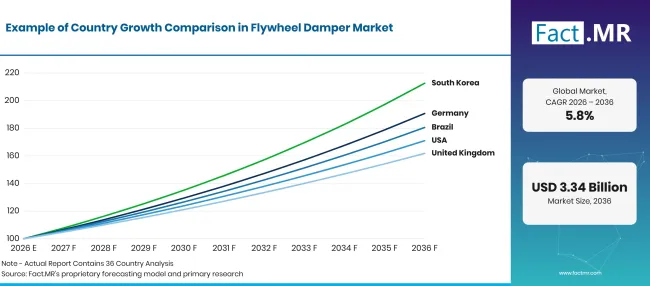
Flywheel Damper Market Growth Index | Source: Fact.MR
| Country | CAGR (2026 to 2036) |
|---|---|
| Germany | 6.7% |
| Brazil | 6.1% |
| USA | 5.5% |
| UK | 4.9% |
| Japan | 4.4% |
Source: Fact.MR analysis. Updated Nov 11, 2026
What supports Flywheel Damper Market adoption in Germany?
6.7% CAGR, linked to transmission manufacturing and the replacement base.
Germany's vehicle and gearbox makers give flywheel damper suppliers a base of engineering customers. In January 2026, the German Association of the Automotive Industry reported that approximately 4.15 million passenger cars were manufactured in Germany during 2025, about 2% more than in 2024. In January 2026, the Federal Motor Transport Authority recorded a passenger-car fleet of 49,486,487 vehicles.
How is the Flywheel Damper Market developing in Brazil?
6.1% CAGR, with vehicle assembly and repair activity shaping sales.
Brazilian damper sales depend on local vehicle assembly and access to replacement parts for cars already on the road. ANFAVEA reported in January 2026 that Brazilian factories made 2.644 million motor vehicles during 2025. The association recorded a 32.1% rise in vehicle exports over the same year. Export models widen the range of engine and transmission combinations that component makers must understand.
What is supporting the Flywheel Damper Market in the USA?
5.5% CAGR, tied to vehicle service and selected combustion drivetrains.
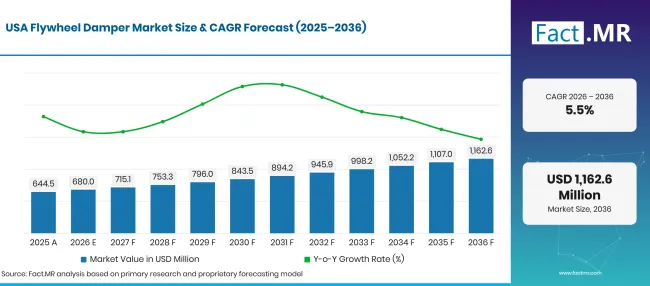
Flywheel Damper Market Forecast Usa | Source: Fact.MR
American vehicle owners create a service market for flywheel dampers fitted to compatible manual and selected automated transmissions. The National Automobile Dealers Association reported in December 2025 that US light-vehicle sales reached 16.2 million units during 2025. The US Environmental Protection Agency stated in February 2026 that manual transmissions accounted for less than 1% of new vehicle production in recent model years.
How does the UK Flywheel Damper Market perform?
4.9% CAGR, with repairs and vehicle mix influencing demand.
British flywheel damper activity is shaped by vehicle production contracts and independent workshop repairs. The Society of Motor Manufacturers and Traders reported in January 2026 that UK factories produced 764,715 vehicles during 2025. The same release put passenger-car output at 717,371 units. A smaller factory base gives repair demand more weight in the sales mix.
What shapes Flywheel Damper Market growth in Japan?
4.4% CAGR, reflecting focused engineering and model-specific demand.
Japan's transmission engineering base supports flywheel damper design for selected combustion and hybrid applications. The Japan Automobile Manufacturers Association reported in its 2026 industry statistics that automobile-related exports had a value of JPY 21.9 trillion in 2025. The association reported automotive manufacturing equipment investment of JPY 2.0037 trillion for fiscal 2025.
Who leads the Flywheel Damper Market?
The Flywheel Damper Market brings together manufacturers that supply flywheel assemblies for vehicle production and companies that serve the repair trade. Customers assess a supplier first by the damper's fit with a specific engine and gearbox.
Spring travel, operating temperature and the way the unit filters torque pulses influence that decision. The suppliers that make selection easier for both vehicle engineers and workshops are expected to defend repeat orders more effectively.
Schaeffler AG serves the market through its LuK dual-mass flywheel range. Its product information explains the role of a two-mass arrangement in reducing torsional vibration before it reaches the gearbox.
ZF Friedrichshafen AG serves related needs through SACHS drivetrain replacement products. The firm's position in transmission and chassis systems gives repair customers access to established technical support. Consistent fitment records are especially useful when a workshop must choose between similar assemblies for different engine variants.
Valeo SE offers dual-mass flywheels and clutch-related parts. Its transmission portfolio describes damping arrangements intended to manage engine vibration and improve driving comfort. Valeo's repair offering is relevant where a garage prefers a complete set of compatible parts. AISIN Corporation describes a flywheel damper that connects two rotating masses by coil springs. Its product explanation offers a clear example of how stored spring energy absorbs changes in engine torque.
Which companies are the key providers?
Companies included in the Flywheel Damper Market competitive coverage are Schaeffler AG; ZF Friedrichshafen AG; Valeo SE; AISIN Corporation; EXEDY Corporation; AmTech International; Platinum Driveline, Inc.; and AMS Automotive LLC.
- Schaeffler AG
- ZF Friedrichshafen AG
- Valeo SE
- AISIN Corporation
- EXEDY Corporation
- AmTech International
- Platinum Driveline, Inc.
- AMS Automotive LLC
Bibliography
- Banco Central do Brasil. (2026). Vendas de autoveículos (total). Portal de Dados Abertos..
- Department for Transport. (2026, April 29). Vehicle licensing statistics, United Kingdom: 2025. GOV.UK..
- Ministry of Economy, Trade and Industry, Japan. (2026, June 30). Current Survey of Production: 2025 Yearbook.
- Statistisches Bundesamt (Destatis). (2026). Produktion im Verarbeitenden Gewerbe: Deutschland, Jahre, Güterverzeichnis – Kraftwagen und Kraftwagenteile (Table 42131-0003). GENESIS-Online.
- Statistisches Bundesamt (Destatis). (2026, March 23). Bestand an Kraftfahrzeugen und Schienenfahrzeugen für die Jahre 2021 bis 2025.
- Statistisches Bundesamt (Destatis). (2026, March 23). Neuzulassungen von Kraftfahrzeugen in Deutschland.
- U.S. Bureau of Economic Analysis. (2026, September 30). Motor Vehicle Output, Table 7.2.5U..
- U.S. Environmental Protection Agency. (2026, February). The 2025 EPA Automotive Trends Report: Greenhouse Gas Emissions, Fuel Economy, and Technology Since 1975.
This Report Answers
- The report explains how bent-spring damper designs respond to different engine and equipment torque conditions.
- Segmentation analysis identifies the automotive application and the steel material category as prominent areas of spending.
- Country analysis compares Germany, Brazil, the USA, the UK and Japan on vehicle production and service conditions.
- Competitive coverage examines the fitment and engineering factors that separate suppliers of complete damper systems.
- The study considers the effect of electrification on conventional flywheel-damper uses and aftermarket sales.
What does the Flywheel Damper Market cover?
The market covers complete flywheel damper products designed to manage torsional vibration between an engine or rotating drive source and the connected drivetrain. Automotive applications include compatible original-equipment and replacement systems. The analysis also considers specified machinery and power equipment applications when a flywheel damper performs the relevant mechanical function.
What is included in the scope?
Spring-loaded dual-mass flywheels and comparable flywheel damping assemblies fall within the boundary where they are sold as vibration-control components.
Products are classified by design arrangement and primary application. Steel, aluminum and composite categories describe the material focus without assuming that every part of a complete assembly uses only one material.
What is excluded from the scope?
Solid flywheels without a dedicated damping function fall outside the damper-specific category.
Clutch plates, pressure plates and standalone crankshaft pulleys are excluded when sold separately. Electric drive parts without a flywheel damper function are also outside the revenue boundary, even if they reduce vibration by another mechanism.
How Was the Analysis Built?
The analysis draws on 120+ sources, 35+ company portfolios, 25+ countries, and more than 20 industry interviews.
- Primary Research: Primary research includes discussions with manufacturers, service providers, technology developers, distributors, end users, and subject-matter experts. These conversations examine purchasing priorities, product adoption, operational challenges, approval requirements, competitive positioning, and the factors that influence wider market acceptance.
- Desk Research: Desk research covers government statistics, regulatory publications, company filings, trade data, technical studies, industry associations, standards, public policy, and other authoritative sources. Every source used in the analysis is documented in the bibliography.
- Market Sizing and Forecasting: Market estimates combine historical performance, demand indicators, pricing and volume trends, segment shares, company participation, country-level growth, adoption patterns, investment activity, and barriers to market expansion.
- Data Validation and Update Cycle: Findings are validated by comparing primary interviews with public data, company activity, regulatory changes, trade patterns, and industry developments. Regular updates review new product launches, capacity changes, partnerships, approvals, and shifts in commercial adoption.
Segmentation
What is the report’s scope and coverage?
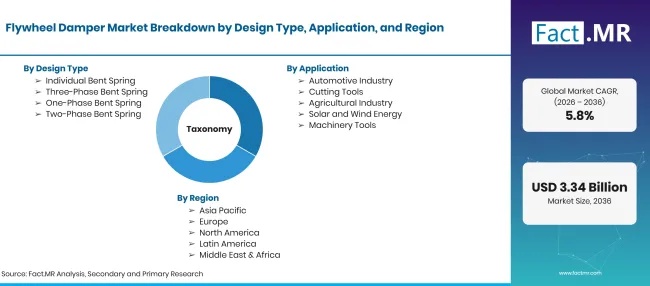
Flywheel Damper Market Taxonomy | Source: Fact.MR
| Attribute | Details |
|---|---|
| Quantitative Units | USD billion |
| Market Definition | Spring-loaded flywheel damper assemblies that reduce torsional vibration between a drive source and connected transmission or driven machinery. |
| Design Type | Individual Bent Spring; Three-Phase Bent Spring; One-Phase Bent Spring; Two-Phase Bent Spring |
| Application | Automotive Industry; Cutting Tools; Agricultural Industry; Solar and Wind Energy; Machinery Tools |
| Material Type | Steel; Aluminum; Composite; Others |
| Regions Covered | North America; Latin America; Western Europe; Eastern Europe; East Asia; South Asia & Pacific; Middle East & Africa |
| Countries Covered | Germany; Brazil; USA; UK; Japan |
| Companies Profiled | Schaeffler AG; ZF Friedrichshafen AG; Valeo SE; AISIN Corporation; EXEDY Corporation; AmTech International; Platinum Driveline, Inc.; and AMS Automotive LLC |
| Forecast Period | 2026 to 2036 |
| Approach | Application-level demand assessment of vehicle production, repair cycles, material choice and supplier product coverage. |
Source: Fact.MR analysis. Updated Nov 11, 2026
How is the market segmented?
-
By Design Type
- Individual Bent Spring
- Three-Phase Bent Spring
- One-Phase Bent Spring
- Two-Phase Bent Spring
-
By Application
- Automotive Industry
- Cutting Tools
- Agricultural Industry
- Solar and Wind Energy
- Machinery Tools
-
By Material Type
- Steel
- Aluminum
- Composite
- Others
-
By Region
- North America
- Latin America
- Western Europe
- Eastern Europe
- East Asia
- South Asia & Pacific
- Middle East & Africa
Frequently Asked Questions
How big is the flywheel damper market in 2026?
What is the Flywheel Damper Market CAGR from 2026 to 2036?
Which design type leads the Flywheel Damper Market?
Which application leads the Flywheel Damper Market?
Which material type leads the Flywheel Damper Market?
Which country grows quickest in the Flywheel Damper Market?
Which companies are profiled in the Flywheel Damper Market?
Who worked on this report


Preview the report firsthand - request a free sample
Free SampleGet the brochure for pricing and purchase details
Download PDF