- Base Value(2025): 5.0 Bn
- Estimated Value(2026): 5.4 Bn
- Forecast Value (2036): 9.8 Bn
- CAGR (2026 - 2036): 6.1%
Active Suspension Damper Actuator Systems Market Forecast and Outlook by Fact.MR
- The active suspension damper actuator systems market was valued at USD 5.0 billion in 2025.
- According to Fact.MR, demand is projected to reach USD 5.4 billion in 2026 and expand to USD 9.8 billion by 2036, reflecting a CAGR of 6.1% during the forecast period.
- The market is expected to create an absolute opportunity of USD 4.4 billion between 2026 and 2036, supported by increasing adoption of electronically controlled suspension systems.
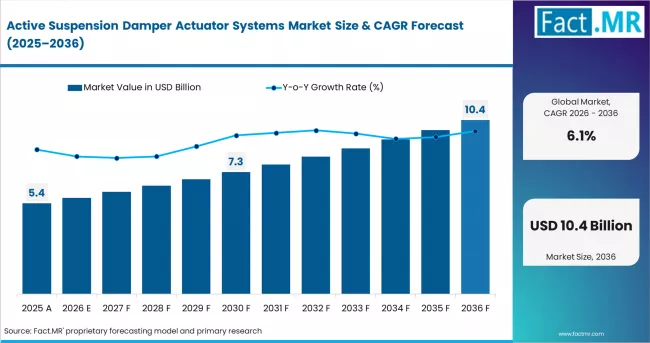
Active Suspension Damper Actuator Systems Market Value Analysis | Source: Fact.MR
| Metric | Value |
|---|---|
| Estimated Value in 2026 | USD 5.4 billion |
| Forecast Value in 2036 | USD 9.8 billion |
| Forecast CAGR (2026 to 2036) | 6.1% |
Source: Fact.MR analysis. Updated May 12, 2026
Summary of the Active Suspension Damper Actuator Systems Market
- Market Definition
- The active suspension damper actuator systems market includes electronically controlled damper and suspension actuation hardware that continuously adjusts vehicle ride and body-motion behavior.
- Demand Drivers
- Vehicle platforms need better balance between ride comfort and body control across wider driving conditions.
- OEMs are moving toward software-defined chassis systems that depend on fast actuator response at each wheel.
- Premium EV and luxury vehicle programs are expanding the addressable base for active damping and roll-control systems.
- Key Segments Analyzed
- By Actuator Type: Valve-Controlled Damper Actuators are expected to account for 37.0% share in 2026, supported by their central role in today’s semi-active and adaptive damping systems.
- By Vehicle Type: Passenger Cars are projected to hold 61.0% share in 2026 because active damping is spreading beyond flagship models into broader premium passenger platforms.
- By Suspension Architecture: Semi-Active Suspension Systems are expected to capture 34.0% share in 2026 as CDC-style technologies remain the strongest commercial bridge between passive and fully active systems.
- By Geography, China leads growth with a 6.8% CAGR through 2036, supported by EV scale and demand for advanced chassis content.
- Analyst Opinion at Fact.MR
- Shambhu Nath Jha, Senior Analyst at Fact.MR, opines, the strongest shift in this market is that damper actuation is no longer just a comfort enhancer. It is becoming part of a coordinated chassis-control layer. Once damping, roll behavior, and steering feel are tuned together through software and sensors, the actuator inside the damper becomes a strategic chassis component rather than a hidden refinement feature.”
- Strategic Implications
- Suppliers that combine fast damping response, strong calibration flexibility, and software integration will be better placed in next-generation vehicle programs.
- OEMs need suspension-actuator vendors that support full chassis tuning rather than isolated damper hardware supply.
- Aftermarket participants gain more from exact fitment and calibration compatibility than from low-cost generic replacement.
- Methodology
- Market sizing used passenger-vehicle production, premium mix, and active-chassis penetration as baseline anchors.
- Analysis incorporated supplier positioning around CDC, sMOTION, ESS, and semi-active damping control.
- Forecasts were checked against current public chassis-system announcements and product roadmaps.
Growth remains firm because damper actuation is no longer evaluated only on ride softness. Buyers increasingly assess how effectively these systems improve body control, enable software-led chassis tuning, and maintain motion stability under varying load and road conditions. ZF Friedrichshafen states that its Continuous Damping Control (CDC) technology has been widely deployed and can continuously adapt damping at each wheel. The company also positions its sMOTION system within its Chassis 2.0 portfolio as an active suspension solution designed for real-time damping adjustment. Commercial demand is increasingly tied to vehicle dynamics and control precision rather than passive comfort alone. Automakers are prioritizing actuator systems that enhance handling, improve safety, and integrate with broader vehicle control software, supporting steady market expansion. [1]
China is projected to remain the fastest-growing country, with a CAGR of 6.8% through 2036, followed by Germany at 6.4% and the United States at 6.1%. Japan is expected to expand at 5.8%, South Korea at 5.6%. Fact.MR views this spread as a reflection of differences in premium vehicle content, EV adoption, and the pace at which active chassis systems move into broader passenger-vehicle platforms. ZF’s recent public messaging around sMOTION and connected chassis systems suggests that premium EV and software-defined vehicle programs are a major driver of near-term adoption.
Segmental Analysis
Active Suspension Damper Actuator Systems Market Analysis by Actuator Type
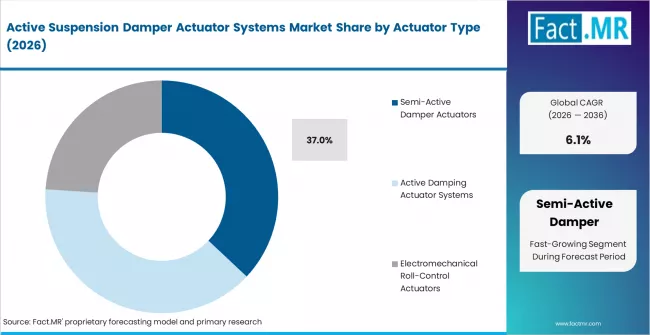
Active Suspension Damper Actuator Systems Market Analysis By Actuator Type | Source: Fact.MR
Valve-controlled damper actuators are expected to hold 37.0% share in 2026. Their lead comes from the fact that they remain the most established and commercially scalable way to vary damping force in real time. ZF states that CDC uses a solenoid-controlled valve at each wheel to deliver ideal damping force, while its sMOTION system is based on CDC with two external valves that independently control compression and rebound. This gives valve-based actuation a strong lead because it provides a practical bridge between passive damping and fuller active chassis motion control. This segment stays ahead because OEMs prefer migration paths that improve wheel-level control without forcing an immediate jump to entirely new suspension architectures. Semi-active valve actuation already has broad validation history, and newer software layers can add more value on top of that installed base. ZF’s CES 2026 release, which links active noise reduction to intelligent control of CDC dampers, reinforces the continuing headroom of this architecture. [3]
- Execution maturity: Valve-based damping control has stronger commercial history than newer fully active alternatives.
- Software leverage: OEMs can unlock more value through tuning and control logic without fully replacing damper hardware architecture.
- Scalable adoption: The format works across compact cars, luxury sedans, and performance EV platforms.
Active Suspension Damper Actuator Systems Market Analysis by Vehicle Type
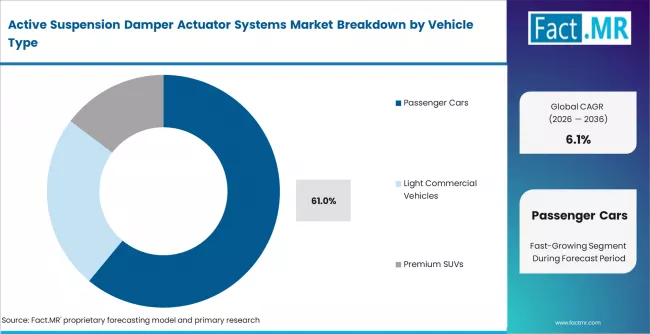
Active Suspension Damper Actuator Systems Market Analysis By Vehicle Type | Source: Fact.MR
Passenger cars are projected to hold 61.0% share in 2026. The lead comes from the fact that active damping commercialization remains centered on premium and upper-volume passenger vehicles rather than on broad commercial fleets. ZF’s public references to Porsche Panamera and Taycan usage of sMOTION damper and valve technology underscore that current adoption momentum is strongest in advanced passenger programs. Continental also positions electronic suspension systems primarily for cars and vans, especially luxury limousines, SUVs, and wagons.
- Commercial readiness: Passenger vehicles are where active damping is already visible in current production programs.
- Feature pull: Comfort, performance, and software-defined ride tuning matter more in premium passenger platforms.
- Volume pathway: Once proven, passenger models offer the clearest route to larger-scale actuator adoption.
Active Suspension Damper Actuator Systems Market Analysis by Suspension Architecture
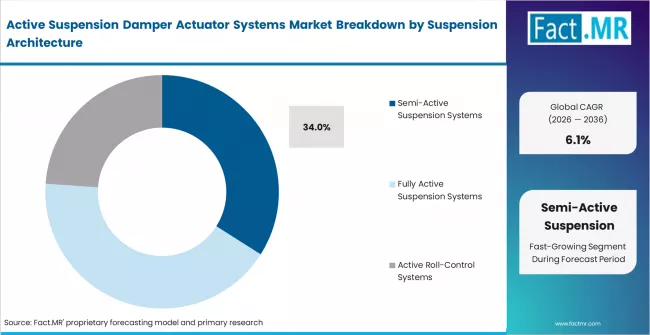
Active Suspension Damper Actuator Systems Market Analysis By Suspension Architecture | Source: Fact.MR
Semi-active suspension systems are expected to capture 34.0% share in 2026. Their rise comes from the fact that CDC-style technologies remain the most practical balance between dynamic performance gains and manageable system complexity. Bosch’s semi-active damping control adjusts damper actuators to reduce vibration and improve comfort and safety, while ZF describes CDC as proven millions of times and applicable from compact vehicles to luxury sedans. This commercial depth keeps semi-active systems ahead of more complex fully active alternatives in the near term. [4]
- Adoption balance: Semi-active systems offer meaningful ride and control gains without the highest system complexity.
- Calibration flexibility: OEMs can tailor vehicle character through software while keeping a manageable hardware base.
- Upgrade path: CDC-style systems create a practical bridge toward more integrated active chassis solutions.
Active Suspension Damper Actuator Systems Market Drivers, Restraints, and Opportunities
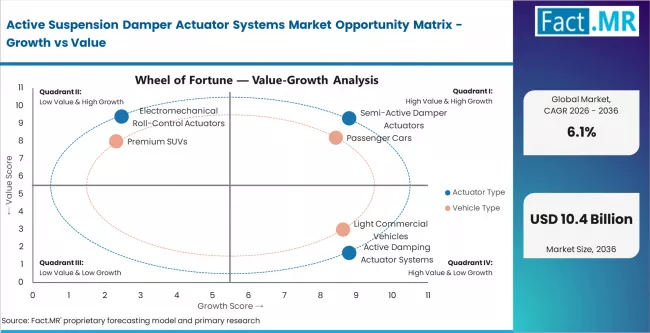
Active Suspension Damper Actuator Systems Market Opportunity Matrix Growth Vs Value | Source: Fact.MR
The strongest market driver is the need to improve ride comfort and body control without sacrificing software-led adaptability. ZF’s public materials show CDC, sMOTION, and ERC being woven into a connected chassis environment, while Bosch frames semi-active damping as actuator control that reduces vibration and improves safety and comfort. This gives OEMs a clear incentive to adopt actuator-managed damping systems where ride refinement, handling stability, and system integration all matter commercially.
The main restraint is system complexity under cost and packaging pressure. More active damping capability brings more value, but it also raises integration burden across sensors, valves, actuators, and central control. BWI Group’s commentary on MagneRide and semi-active roll control shows that software tunability and hardware choice remain important competitive tradeoffs, which also highlights why adoption grows steadily rather than instantly across all vehicle classes. [5]
Opportunities in the Active Suspension Damper Actuator Systems Market
- Premium EV platform rollout: Advanced EVs create stronger demand for actuator-controlled damping that improves comfort without losing body control. ZF’s Porsche-related references support this direction.
- Connected chassis integration: Damper actuators gain more value when paired with shared chassis sensors and software-defined vehicle stacks. ZF’s Smart Chassis Sensor release supports this pathway.
- Software-led tuning upgrades: Systems like CDC and MagneRide show that software-calibrated damping behavior can create regional and platform differentiation without redesigning the entire suspension architecture.
Regional Analysis
Based on the regional analysis, the Active Suspension Damper Actuator Systems Market is segmented into East Asia, Europe, North America, South Asia and Pacific, Latin America, and Middle East and Africa across 40 plus countries.
.webp "Top Country Growth Comparison Active Suspension Damper Actuator Systems Market Cagr (2026 2036)")
Top Country Growth Comparison Active Suspension Damper Actuator Systems Market Cagr (2026 2036) | Source: Fact.MR
| Country | CAGR (2026 to 2036) |
|---|---|
| China | 6.8% |
| Germany | 6.4% |
| United States | 6.1% |
| Japan | 5.8% |
| South Korea | 5.6% |
Source: Fact.MR analysis. Updated May 12, 2026
Source: Fact.MR analysis, based on proprietary forecasting model and primary research
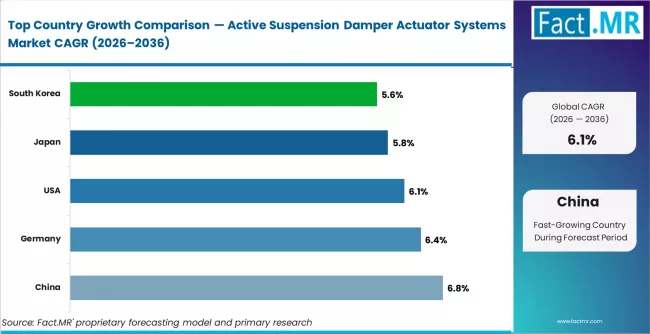
Active Suspension Damper Actuator Systems Market Cagr Analysis By Country | Source: Fact.MR
East Asia Active Suspension Damper Actuator Systems Market Analysis
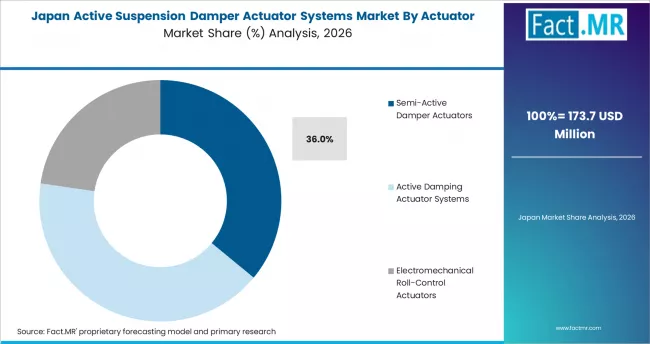
Active Suspension Damper Actuator Systems Market Japan Market Share Analysis By Actuator Type | Source: Fact.MR
East Asia remains the strongest production and adoption base for this market. The region combines high EV output with faster deployment of advanced chassis technologies and strong demand for premium ride differentiation. ZF’s April 2025 statement that sMOTION is attracting strong interest from Chinese customers supports the view that East Asia is not only a volume base but also an early adoption zone for next-generation damping actuation.
- China: Active suspension damper actuator systems demand in China is projected to grow at a CAGR of 6.8% through 2036. The market benefits from premium EV rollout, stronger chassis-content competition, and visible supplier interest in active damping adoption.
- Japan: Japanese demand is projected to expand at a CAGR of 5.8% through 2036. Growth is steadier because the market is more mature and places stronger emphasis on ride refinement, calibration discipline, and long-cycle reliability.
- South Korea: South Korea is expected to grow at a CAGR of 5.6% through 2036. Its role is tied to electronics-rich vehicle platforms and higher-value chassis differentiation in passenger vehicles.
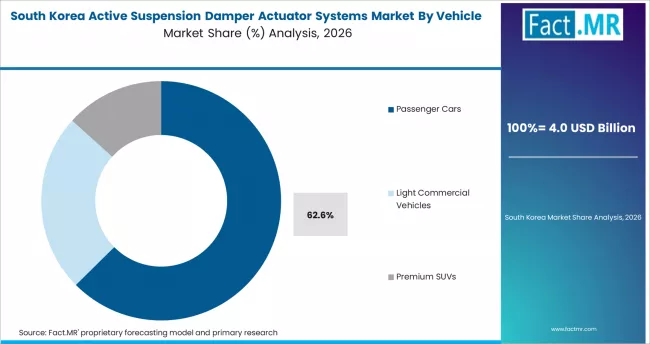
Active Suspension Damper Actuator Systems Market South Korea Market Share Analysis By Vehicle Type | Source: Fact.MR
Fact.MR’s report also covers ASEAN, Australia and New Zealand, and other South Asia and Pacific markets. These countries matter where EV adoption broadens and where imported or localized active chassis platforms start to scale beyond flagship vehicles.
North America Active Suspension Damper Actuator Systems Market Analysis
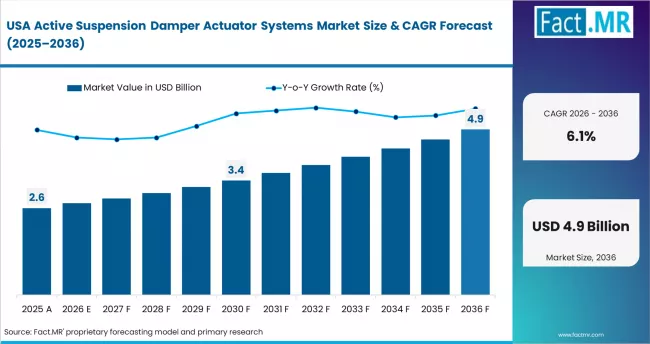
Active Suspension Damper Actuator Systems Market Country Value Analysis | Source: Fact.MR
North America is shaped by demand for premium ride quality, larger passenger vehicles, and growing EV platform activity. Active damping matters in this region because comfort and body control both carry high commercial weight, especially in larger passenger vehicles and SUVs. Continental’s positioning of electronically controlled suspension systems for luxury vehicles and vans aligns closely with this regional mix.
- United States: Active suspension damper actuator systems demand in the United States is projected to rise at a CAGR of 6.1% through 2036. The market is supported by EV program activity, premium vehicle content, and stronger demand for software-tunable ride behavior.
Fact.MR’s report also includes Canada and the broader North American passenger-vehicle supply ecosystem. Additional value comes from premium SUVs, electrified vehicles, and the spread of higher-value adaptive suspension content.
Europe Active Suspension Damper Actuator Systems Market Analysis
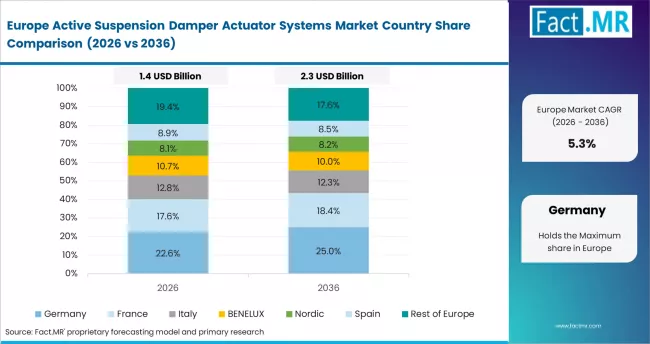
Active Suspension Damper Actuator Systems Market Europe Country Market Share Analysis, 2026 & 2036 | Source: Fact.MR
Europe remains a high-discipline market rather than the largest growth center. Vehicle makers in the region place strong weight on ride-control sophistication, premium chassis tuning, and software-defined vehicle integration. ZF’s public releases around sMOTION, CDC, and connected chassis systems, along with current Porsche-related usage references, underscore Europe’s role as an engineering and commercialization center for active damping technology.
- Germany: Germany is projected to expand at a CAGR of 6.4% through 2036. Its importance comes from premium passenger-vehicle engineering, strong supplier depth, and faster adoption of advanced active chassis systems.
Fact.MR’s report also covers France, Italy, the United Kingdom, Spain, and the rest of Europe. These markets add commercial depth through premium vehicle production and continued investment in software-led chassis technologies.
Competitive Aligners for Market Players
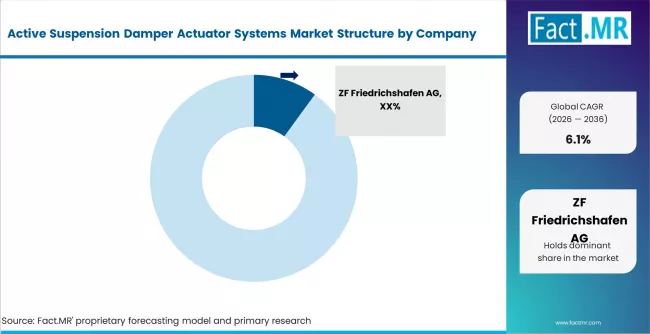
Active Suspension Damper Actuator Systems Market Analysis By Company | Source: Fact.MR
The active suspension damper actuator systems market is moderately consolidated. Buyers do not choose suppliers only on damping range. They choose on actuator response speed, software integration, tuning flexibility, and the supplier’s ability to support full chassis calibration. ZF, Bosch, Continental, and BWI Group remain highly visible because they operate at the point where damping hardware meets motion-control software and vehicle-level tuning.
Established suppliers hold an advantage because damper actuator performance is closely tied to the full chassis-control stack rather than a standalone component. A new entrant may offer a capable valve or actuator, but matching OEM confidence is more difficult when ride quality, body control, and software-driven differentiation depend on integrated system behavior. ZF Friedrichshafen reinforces this system-level approach through its Chassis 2.0 platform and Smart Chassis Sensor positioning, where damping, sensing, and control functions operate together. Buyer leverage remains relevant, though moderated by calibration complexity and architecture dependence. OEMs seek measurable gains in comfort, handling, and vehicle dynamics, but they also prioritize low risk in components that directly influence ride perception and stability. Validation and tuning requirements limit rapid supplier switching.
Key Players in Active Suspension Damper Actuator Systems Market
- ZF Friedrichshafen AG
- Robert Bosch GmbH
- Continental AG
- BWI Group
- Marelli
- Tenneco
- thyssenkrupp Bilstein
- KYB Corporation
- Hitachi Astemo, Ltd.
- Mando Corporation
- Schaeffler AG
- Aptiv PLC
Bibliography
- [1] ZF. Systematic damping / Continuous Damping Control. Official page describing CDC with a solenoid-controlled valve at each wheel.
- [2] Bosch Mobility. Semi-active damping control system. Official page describing actuator adjustment in dampers to reduce vibration and improve safety and comfort.
- [3] ZF Press. Next-Gen Smart Chassis Sensor: More Data for More Comfort. Official release linking the sensor to CDC, sMOTION, and ERC.
- [4] Bosch white paper. Software-defined vehicles and standardized interfaces. Mentions Bosch electronic suspension control hardware and SDV-ready mechatronic products for semi-active damping and air suspension.
- [5] BWI Group. SARC / automatic mode update. Official news item on active roll-control system development.
This Report Addresses
- Strategic demand outlook for active suspension damper actuator systems across premium and electrified vehicle chassis architectures.
- Market forecast from USD 5.4 billion in 2026 to USD 9.8 billion by 2036.
- The growing role of CDC, active damping, and roll-control actuation in software-defined chassis systems.
- The effect of premium EV adoption and connected chassis integration on damper actuator demand.
- OEM versus aftermarket demand patterns in a calibration-sensitive suspension category.
- Regional differences in active chassis adoption, premium vehicle content, and supplier depth.
- Competitive positioning of suppliers active in adaptive damping and active suspension actuation.
- Segment analysis by actuator type, vehicle type, suspension architecture, sales channel, and geography.
Active Suspension Damper Actuator Systems Market Definition
The market covers actuator-controlled systems that vary damping force or related suspension behavior in real time through electronically managed valves, electromechanical roll-control hardware, or integrated active suspension modules. This includes semi-active and active damper actuation technologies used to improve ride comfort, body control, and chassis stability in passenger vehicles. The category is distinct because it focuses on damping-force actuation and suspension response control rather than passive dampers or full suspension corner modules alone. Bosch and ZF both describe these systems around actuator adjustment of damper behavior rather than static damping hardware. [2]
Active Suspension Damper Actuator Systems Market Inclusions
The market includes semi-active damper actuator units, solenoid-controlled damping valves, active damping modules, electromechanical roll-control actuators, and integrated chassis-control-linked suspension actuation systems. ZF’s CDC, sMOTION, and ERC references all fit this scope, while Bosch’s semi-active damping control and Continental’s electronically controlled suspension systems support inclusion of electronically adjusted damping hardware and its immediate control layer.
Active Suspension Damper Actuator Systems Market Exclusions
The market excludes passive shock absorbers without active adjustment logic, basic air springs where damper actuation cannot be isolated, full air-suspension systems with no damping-control value separation, and non-automotive motorcycle damping systems. It also excludes broader chassis sensors when actuator value is not part of the specific suspension-control system.
Active Suspension Damper Actuator Systems Market Research Methodology
- Primary Research
- Interviews with chassis-control engineers, suspension integration teams, vehicle dynamics specialists, premium vehicle platform managers, and aftermarket suspension-service distributors.
- Desk Research
- Review of official damping-system product pages, active chassis press releases, connected-chassis materials, and suspension technology references from ZF, Bosch, Continental, and BWI Group.
- Market-Sizing and Forecasting
- Fact.MR used a blended model based on passenger-vehicle production, premium and EV mix, active chassis penetration, semi-active versus active suspension adoption, and higher-value damping content per vehicle.
- Data Validation and Update Cycle
- Forecasts were cross-checked through recent supplier commercialization signals, public active-chassis announcements, and current product positioning around CDC, sMOTION, and electronically controlled suspension systems.
Segmentation
Scope of the Report
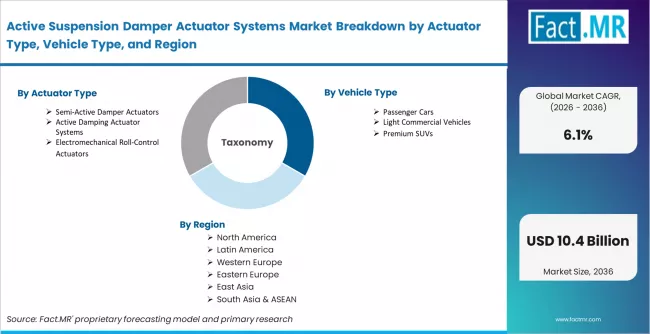
Active Suspension Damper Actuator Systems Market Breakdown By Actuator Type, Vehicle Type, And Region | Source: Fact.MR
| Attribute | Details |
|---|---|
| Quantitative Units | USD 5.4 billion in 2026 to USD 9.8 billion in 2036, at a CAGR of 6.1% |
| Market Definition | Active suspension damper actuator systems that electronically vary damping force or related suspension behavior in passenger-vehicle chassis systems. |
| Actuator Type Segmentation | Semi-Active Damper Actuators, Active Damping Actuator Systems, Electromechanical Roll-Control Actuators, Valve-Controlled Damper Actuators, Others |
| Vehicle Type Segmentation | Passenger Cars, Light Commercial Vehicles, Premium SUVs, Electric Vehicles |
| Suspension Architecture Segmentation | Semi-Active Suspension Systems, Fully Active Suspension Systems, Active Roll-Control Systems, Others |
| Sales Channel Segmentation | OEM, Aftermarket |
| Regions Covered | East Asia, Europe, North America, South Asia and Pacific, Latin America, Middle East and Africa |
| Countries Covered | China, Germany, United States, Japan, South Korea, India, Mexico, and 40+ countries |
| Key Companies Profiled | ZF, Bosch, Continental, BWI Group, Marelli, Tenneco, Bilstein, KYB, Hitachi Astemo, Mando, Schaeffler, Aptiv |
| Forecast Period | 2026 to 2036 |
| Approach | Fact.MR combined primary interviews with chassis and suspension stakeholders, desk research across official supplier materials, and a forecast model anchored in passenger-vehicle production, premium mix, and active suspension penetration. |
Source: Fact.MR analysis. Updated May 12, 2026
Active Suspension Damper Actuator Systems Market by Segments
-
By Actuator Type:
- Semi-Active Damper Actuators
- Active Damping Actuator Systems
- Electromechanical Roll-Control Actuators
- Valve-Controlled Damper Actuators
- Others
-
By Vehicle Type:
- Passenger Cars
- Light Commercial Vehicles
- Premium SUVs
- Electric Vehicles
-
By Suspension Architecture:
- Semi-Active Suspension Systems
- Fully Active Suspension Systems
- Active Roll-Control Systems
- Others
-
By Region:
- North America
- United States
- Canada
- Mexico
- Latin America
- Brazil
- Argentina
- Rest of Latin America
- Europe
- Germany
- France
- United Kingdom
- Italy
- Spain
- Rest of Europe
- East Asia
- China
- Japan
- South Korea
- South Asia and Pacific
- India
- ASEAN
- Australia and New Zealand
- Rest of South Asia and Pacific
- Middle East and Africa
- GCC Countries
- South Africa
- Turkey
- Rest of Middle East and Africa
- North America
Frequently Asked Questions
What is the estimated size of the active suspension damper actuator systems market in 2026?
How large is the market expected to become by 2036?
What is the forecast CAGR for 2026 to 2036?
Which actuator type leads the market?
Which vehicle type dominates demand?
Why does the OEM channel dominate?
Why are active damper actuators important here?
What is the strongest demand driver?
What is the key restraint?
Which country is growing fastest?
Why is China ahead?
How does Germany compare?
Why does the United States rank strongly?
How do EVs affect this market?
Is this a fragmented supplier market?
What do OEM buyers prioritize?
Why do active roll-control actuators matter in this segment?
Is the aftermarket attractive?
Which companies are most visible in this market?
Who worked on this report


Preview the report firsthand - request a free sample
Free SampleGet the brochure for pricing and purchase details
Download PDF