Adaptive Suspension Damper Market (2026 - 2036)
Adaptive Suspension Damper Market Size and Share Forecast Outlook 2026 to 2036
Core Findings
Adaptive Suspension Damper Market Forecast Outlook 2026 to 2036
The adaptive suspension damper market is expected to reach USD 5.2 billion in 2026 and USD 9.1 billion by 2036, with a compound annual growth rate (CAGR) of 5.8%. Regulatory oversight will play a pivotal role in shaping market dynamics, as automotive manufacturers face increasing pressure to meet stringent safety, environmental, and performance standards.
Key Takeaways from Adaptive Suspension Damper Market
- Adaptive Suspension Damper Market Value (2026): USD 5.2 billion
- Adaptive Suspension Damper Market Forecast Value (2036): USD 9.1 billion
- Adaptive Suspension Damper Market Forecast CAGR 2026 to 2036: 5.8%
- Leading Segment in Adaptive Suspension Damper Market: First Fit (OEM) Sales Channel (74%)
- Key Growth Region in Adaptive Suspension Damper Market: Asia Pacific
- Key Players in Adaptive Suspension Damper Market: ZF Friedrichshafen AG (ZF), Tenneco Inc. (Monroe / Ride Control Group), KYB Corporation, Hitachi Astemo Ltd., Sachs, BWI Group (BWI Company Ltd.), Mando Corporation, Bilstein GmbH, Gabriel, Continental AG
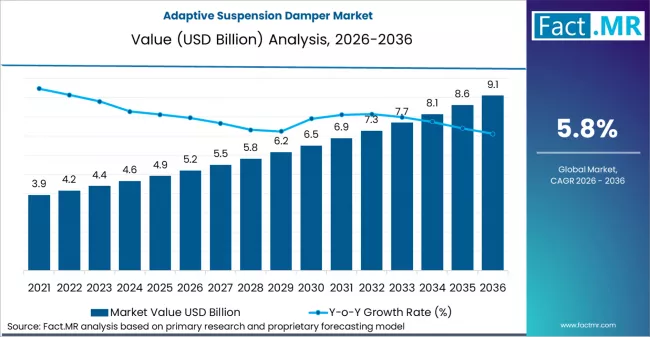
Compliance costs are expected to rise, especially with the introduction of global regulatory frameworks that require adherence to specific vehicle performance and environmental benchmarks. This will influence vendor positioning, with companies prioritizing investments in research and development to meet compliance criteria. The complexity of obtaining certifications for adaptive suspension systems can slow adoption, particularly for smaller players with limited resources. Vendors that can navigate these regulatory challenges while ensuring product performance and cost efficiency will be better positioned to capitalize on emerging demand. The ability to manage compliance and certification effectively will be a key determinant of long-term success in the market.
Adaptive Suspension Damper Market
| Metric | Value |
|---|---|
| Estimated Value in (2026E) | USD 5.2 billion |
| Forecast Value in (2036F) | USD 9.1 billion |
| Forecast CAGR (2026 to 2036) | 5.8% |
Category
| Category | Segments |
|---|---|
| Sales Channel | First Fit (OEM); Aftermarket |
| Technology | Electronically Controlled (CDC); Magnetorheological; Self-leveling or Variable Hydraulic |
| Vehicle Segment | Premium Passenger; SUV or Pickup; Mass-market Passenger |
| Powertrain | ICE or HEV; BEV |
| Region | North America; Europe; Asia Pacific; Latin America; Middle East & Africa |
Segmental Analysis
What is Driving the Dominance of the Premium Passenger Segment in the Adaptive Suspension Damper Market?
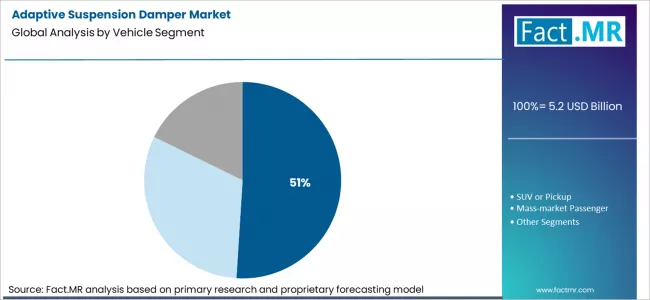
The premium passenger segment holds a majority 51% market share in 2026. Adaptive damping has become a key differentiator in the luxury vehicle space, often bundled with air suspension and AI-driven predictive control systems. Manufacturers such as Mercedes-Benz (Magic Body Control) and BMW (Executive Drive Pro) have made adaptive damping a standard feature in vehicles above the E-segment classification. ZF Friedrichshafen remains a market leader, supplying 40% of all semi-active dampers globally. Their Continuous Damping Control (CDC) system, now enhanced with Active Noise Reduction software, improves cabin tranquility, especially in premium EVs. As a result, the "Dollar Content" per vehicle for premium models is rising due to integration with Road Preview technology, which anticipates road surface changes and adjusts damping forces in milliseconds.
What is Influencing the Dominance of ICE or HEV Powertrains in the Adaptive Suspension Damper Market?
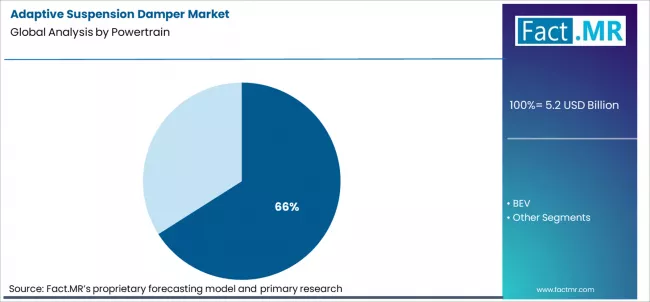
The ICE or HEV powertrain segment leads the market with 66% of the share in 2026. The need to manage torque blending and varying weight distributions in hybrid batteries has made adaptive dampers essential for maintaining ride quality without sacrificing handling. Companies like Tenneco have captured significant market share with their Monroe Intelligent Suspension system, particularly in China and India, where premium hybrid models are being launched rapidly. Tenneco’s CVSAe technology is favored for its low power consumption in HEV platforms. Semi-active hydraulic dampers dominate the ICE/HEV sub-segment, accounting for 58% of the revenue due to their balance of cost and performance. While ICE/HEV still leads, the BEV segment is the fastest-growing, projected to grow at a 10.7% CAGR due to the need for high-resolution damping in heavier EV platforms.
Adaptive Suspension Damper Market - Drivers, Restraints & Trends
| Country | Drivers | Restraints | Trends |
|---|---|---|---|
| USA | Strong demand for SUVs, performance vehicles, and premium comfort systems increases adoption of adaptive dampers. | High component and calibration costs constrain uptake in entry segments. | Integration with vehicle dynamics and driver assist systems. |
| China | Rapid growth in premium and electric vehicle segments supports higher adaptive damper demand. | Price sensitivity limits adoption in mass market models. | Expansion of localized production and SUV centric suspension tuning. |
| India | Rising sale of premium and comfort oriented vehicles fuels demand for adaptive dampers. | Cost constraints and lower consumer penetration in non premium segments. | Aftermarket growth for comfort upgrades. |
| Germany | Premium OEM focus on ride quality and performance drives strong adoption of adaptive dampers. | EV and lightweight chassis design shifts may alter traditional damper roles. | Use of advanced sensors, predictive damping, and integration with stability control. |
| Japan | Established automotive industry emphasis on refinement and comfort supports adaptive damper use. | Slower growth in large premium segments limits incremental volume. | Focus on compact, efficient adaptive systems suited to hybrid platforms. |
Analysis of the Adaptive Suspension Damper Market by Key Country
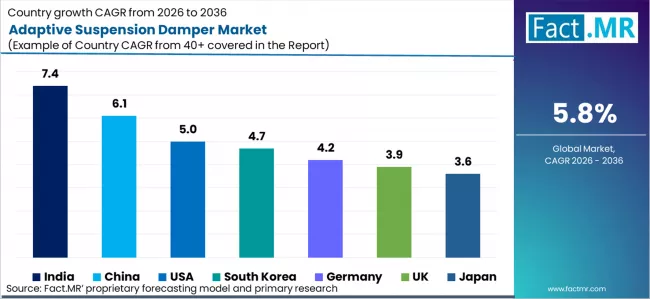
| Country | CAGR (Forecast Period) |
|---|---|
| USA | 5.0% |
| China | 6.1% |
| India | 7.4% |
| Germany | 4.2% |
| Japan | 3.6% |
| South Korea | 4.7% |
| UK | 3.9% |
What Drives the 5.0% Growth in the USA Adaptive Suspension Damper Market?
The USA adaptive suspension damper market is growing at 5.0%, primarily due to the NHTSA’s 2026 vehicle safety guidelines that emphasize rollover mitigation and stability in high-center-of-gravity vehicles, such as electric SUVs and pickups. Adaptive dampers are key to these vehicles, offering immediate stiffness adjustments to counteract body roll during emergency maneuvers. Additionally, Off-Road Intelligent systems are surging, with trucks like the 2026 Chevrolet Silverado EV and Ford F-150 Lightning using advanced dampers to provide a "cloud-like" ride on highways while adjusting for rugged terrain. This trend is aligned with NHTSA safety mandates to enhance stability in electric and hybrid vehicles.
Why is the China Adaptive Suspension Damper Market Projected to Expand at a 6.1% Rate?
The China adaptive suspension damper market is projected to expand at 6.1%, driven by the mainstreaming of smart chassis technology in New Energy Vehicles (NEVs). The Ministry of Industry and Information Technology (MIIT) has made "Intelligent Chassis" a priority, leading to the adoption of Continuous Damping Control (CDC) systems in mid-range EVs from brands like NIO, XPeng, and Li Auto. These systems, which were once reserved for luxury imports, are now in high demand as Level 3 Autonomous Driving technologies are implemented in major cities. Adaptive dampers in these vehicles are essential for maintaining cabin stability during non-driving activities.
How Does the 7.4% Growth Reflect the India Adaptive Suspension Damper Market Expansion?
India leads the market with a 7.4% growth rate, largely due to the premiumization of the automotive sector and the Production Linked Incentive (PLI) Scheme. In 2026, advanced electronic suspension components qualify for high-tier government incentives, prompting global suppliers like Tenneco (Monroe) and ZF to expand their manufacturing in India. The country’s rapid infrastructure development is also spurring demand for SUVs that require adaptive suspension systems capable of handling both urban speed bumps and high-speed stability on expressways. This "dual-nature" capability is critical for the growing market of Indian SUVs.
What Supports the 4.2% Growth for the Germany Adaptive Suspension Damper Market?
The Germany adaptive suspension damper market is growing at 4.2%, driven by the upcoming Euro 7 regulations in late 2026. These regulations focus on reducing non-exhaust emissions, such as tire and brake dust, pushing manufacturers to optimize tire-to-road contact through adaptive dampers. German luxury brands like Mercedes-Benz, BMW, and Porsche are pioneering "Fully Active" systems that use 48V electrical architectures to actively adjust individual wheels to “erase” road imperfections, enhancing both NVH (Noise, Vibration, and Harshness) performance and ride comfort. This innovation sets new global benchmarks for luxury vehicles.
How Does Japan Achieve Growth in the Adaptive Suspension Damper Market?
Japan’s adaptive suspension damper market is growing at 3.6%, driven by the METI Green Transformation (GX) 2040 Vision, which promotes energy efficiency. Japanese suppliers like Hitachi Astemo and KYB are focusing on low-power adaptive dampers to extend the range of compact EVs and hybrids. In 2026, adaptive dampers are also integrated with vehicle ingress/egress systems to lower the ride height automatically, aiding elderly passengers in entering and exiting vehicles, which is particularly significant for Japan’s aging population. These developments contribute to adoption in the high-volume passenger car segment.
Why Does South Korea Exhibit 4.7% Growth in Adaptive Suspension Dampers?
South Korea’s 4.7% growth is supported by the K-Mobility Strategy, which focuses on Integrated Smart Chassis modules. South Korean manufacturers like HL Mando are now producing low-cost electronically controlled suspension systems that target the global mid-range market, competing with premium European offerings. A key innovation in 2026 is the integration of V2X communication with adaptive dampers, allowing vehicles to share road surface quality data. This data enables a trailing vehicle to pre-configure its dampers based on road imperfections detected by the vehicle ahead, offering a revolutionary "Preview" suspension experience.
How is the UK Adaptive Suspension Damper Market Maintaining a 3.9% Rate?
The UK adaptive suspension damper market is growing at 3.9%, driven by the country’s leadership in high-end automotive engineering and the specialist vehicle sector. The Advanced Propulsion Centre (APC) in the UK is funding research into Regenerative Dampers that can convert kinetic energy from road bumps into electricity for the vehicle’s battery. Additionally, luxury SUVs like Range Rover and Bentley are increasingly incorporating Active Roll Control via adaptive dampers to balance British luxury with dynamic handling on narrow, winding UK rural roads. This innovation ensures premium comfort in the country’s luxury segment.
How Are Participants Competing in the Adaptive Suspension Market?
The adaptive suspension market is shifting from traditional mechanical damping systems to software-defined motion management. Key players like ZF, Tenneco, and BWI are leading this transformation by decoupling hardware from software, allowing for advanced predictive damping and acoustic management. ZF’s Chassis 2.0 modular approach, launched in 2026, integrates dampers as network-capable actuators, enabling OEMs to run proprietary damping algorithms. Tenneco’s CVSA2, a dual-valve electro-hydraulic system, addresses the heavy battery loads in electric SUVs and pickups by independently controlling rebound and compression. Moving forward, predictive damping powered by AI and active noise reduction will become mainstream, offering both ride comfort and interior cabin silencing. Sustainability is also a key focus, with companies like KYB launching carbon-neutral shock absorber fluids. As the industry progresses toward Software-Defined Vehicles, firms that adapt to motion orchestration and integrate suspension data into broader vehicle systems will capture high-margin opportunities, leaving traditional suppliers behind.
Recent Industry Developments
- Adaptive Dampers Featured on 2023 Mercedes-AMG C 63 S E PERFORMANCE: Tenneco’s Monroe Intelligent Suspension CVSA2 adaptive dampers were selected for the 2023 Mercedes-AMG C 63 S E PERFORMANCE plug-in hybrid. These adaptive dampers use electro-hydraulic control with independent rebound and compression valves to continuously adjust damping based on vehicle dynamics such as steering, speed, and body movement. ????
- Patent for Adjustable Hydraulic Suspension Damper (2023): A U.S. patent (US11577575B2) was granted covering an adjustable hydraulic suspension damper, which embodies variable damping mechanisms relevant to adaptive suspension architectures that can be tuned for different driving conditions. ????
- ZF sMOTION Active Damper System in Serial Production (Dec 2024): ZF Friedrichshafen AG announced serial production of its sMOTION active damper system, which is designed to control pitching and rolling through adaptive damping and enhanced chassis control. This represents a verified OEM rollout of advanced adaptive suspension hardware. ????
Key Players of the Adaptive Suspension Damper Market
- ZF Friedrichshafen AG (ZF)
- Tenneco Inc. (Monroe / Ride Control Group)
- KYB Corporation
- Hitachi Astemo Ltd.
- Sachs
- BWI Group (BWI Company Ltd.)
- Mando Corporation
- Bilstein GmbH
- Gabriel
- Continental AG
Scope of the Report
| Items | Values |
|---|---|
| Quantitative Units (2026) | USD Billion |
| Sales Channel | First Fit (OEM), Aftermarket |
| Technology | Electronically Controlled (CDC), Magnetorheological, Self-leveling or Variable Hydraulic |
| Vehicle Segment | Premium Passenger, SUV or Pickup, Mass-market Passenger |
| Powertrain | ICE or HEV, BEV |
| Regions Covered | North America, Europe, Asia Pacific, Latin America, Middle East & Africa |
| Countries Covered | United States, Canada, Mexico, Germany, United Kingdom, France, Japan, South Korea, China, India, Brazil, and other countries |
| Key Companies Profiled | ZF Friedrichshafen AG (ZF), Tenneco Inc. (Monroe / Ride Control Group), KYB Corporation, Hitachi Astemo Ltd., Sachs, BWI Group (BWI Company Ltd.), Mando Corporation, Bilstein GmbH, Gabriel, Continental AG |
| Additional Attributes | Dollar revenue by sales channel, technology, vehicle segment, powertrain, and region; regional demand trends, competitive landscape, technological advancements in adaptive suspension dampers, operational performance optimization initiatives, and product development strategies |
Adaptive Suspension Damper Market Key Segments
-
Sales Channel :
- First Fit (OEM)
- Aftermarket
-
Technology :
- Electronically Controlled (CDC)
- Magnetorheological
- Self-leveling or Variable Hydraulic
-
Vehicle Segment :
- Premium Passenger
- SUV or Pickup
- Mass-market Passenger
-
Powertrain :
- ICE or HEV
- BEV
-
Region :
- North America
- USA
- Canada
- Mexico
- Europe
- Germany
- UK
- France
- Italy
- Spain
- Nordic Countries
- BENELUX
- Rest of Europe
- Asia Pacific
- China
- Japan
- South Korea
- India
- Australia
- Rest of Asia Pacific
- Latin America
- Brazil
- Argentina
- Rest of Latin America
- Middle East and Africa
- Kingdom of Saudi Arabia
- United Arab Emirates
- South Africa
- Rest of Middle East and Africa
- Other Regions
- Oceania
- Central Asia
- Other Markets
- North America
Bibliographies
- Society of Automotive Engineers (SAE). (2023). Magnetorheological dampers and electronically controlled suspension systems for passenger vehicles. SAE Technical Paper Series.
- Institute of Electrical and Electronics Engineers (IEEE). (2024). Control of magnetorheological fluid dampers for real-time vehicle ride and handling optimization. IEEE Xplore Digital Library.
- International Organization for Standardization. (2023). ISO 26262: Road vehicles - Functional safety of electrical and electronic systems. ISO.
- United Nations Economic Commission for Europe (UNECE). (2024). Vehicle stability and suspension control considerations under UN Regulation No. 13 and No. 140. UNECE Transport Division.
- National Highway Traffic Safety Administration (NHTSA). (2023). Electronic stability control, ride dynamics, and suspension system performance in passenger vehicles. U.S. Department of Transportation.
Table of Content
- Executive Summary
- Global Market Outlook
- Demand to side Trends
- Supply to side Trends
- Technology Roadmap Analysis
- Analysis and Recommendations
- Market Overview
- Market Coverage / Taxonomy
- Market Definition / Scope / Limitations
- Research Methodology
- Chapter Orientation
- Analytical Lens and Working Hypotheses
- Market Structure, Signals, and Trend Drivers
- Benchmarking and Cross-market Comparability
- Market Sizing, Forecasting, and Opportunity Mapping
- Research Design and Evidence Framework
- Desk Research Programme (Secondary Evidence)
- Company Annual and Sustainability Reports
- Peer-reviewed Journals and Academic Literature
- Corporate Websites, Product Literature, and Technical Notes
- Earnings Decks and Investor Briefings
- Statutory Filings and Regulatory Disclosures
- Technical White Papers and Standards Notes
- Trade Journals, Industry Magazines, and Analyst Briefs
- Conference Proceedings, Webinars, and Seminar Materials
- Government Statistics Portals and Public Data Releases
- Press Releases and Reputable Media Coverage
- Specialist Newsletters and Curated Briefings
- Sector Databases and Reference Repositories
- FMR Internal Proprietary Databases and Historical Market Datasets
- Subscription Datasets and Paid Sources
- Social Channels, Communities, and Digital Listening Inputs
- Additional Desk Sources
- Expert Input and Fieldwork (Primary Evidence)
- Primary Modes
- Qualitative Interviews and Expert Elicitation
- Quantitative Surveys and Structured Data Capture
- Blended Approach
- Why Primary Evidence is Used
- Field Techniques
- Interviews
- Surveys
- Focus Groups
- Observational and In-context Research
- Social and Community Interactions
- Stakeholder Universe Engaged
- C-suite Leaders
- Board Members
- Presidents and Vice Presidents
- R&D and Innovation Heads
- Technical Specialists
- Domain Subject-matter Experts
- Scientists
- Physicians and Other Healthcare Professionals
- Governance, Ethics, and Data Stewardship
- Research Ethics
- Data Integrity and Handling
- Primary Modes
- Tooling, Models, and Reference Databases
- Desk Research Programme (Secondary Evidence)
- Data Engineering and Model Build
- Data Acquisition and Ingestion
- Cleaning, Normalisation, and Verification
- Synthesis, Triangulation, and Analysis
- Quality Assurance and Audit Trail
- Market Background
- Market Dynamics
- Drivers
- Restraints
- Opportunity
- Trends
- Scenario Forecast
- Demand in Optimistic Scenario
- Demand in Likely Scenario
- Demand in Conservative Scenario
- Opportunity Map Analysis
- Product Life Cycle Analysis
- Supply Chain Analysis
- Investment Feasibility Matrix
- Value Chain Analysis
- PESTLE and Porter’s Analysis
- Regulatory Landscape
- Regional Parent Market Outlook
- Production and Consumption Statistics
- Import and Export Statistics
- Market Dynamics
- Global Market Analysis 2021 to 2025 and Forecast, 2026 to 2036
- Historical Market Size Value (USD Million) Analysis, 2021 to 2025
- Current and Future Market Size Value (USD Million) Projections, 2026 to 2036
- Y to o to Y Growth Trend Analysis
- Absolute $ Opportunity Analysis
- Global Market Pricing Analysis 2021 to 2025 and Forecast 2026 to 2036
- Global Market Analysis 2021 to 2025 and Forecast 2026 to 2036, By Sales Channel
- Introduction / Key Findings
- Historical Market Size Value (USD Million) Analysis By Sales Channel, 2021 to 2025
- Current and Future Market Size Value (USD Million) Analysis and Forecast By Sales Channel, 2026 to 2036
- First Fit (OEM)
- Aftermarket
- First Fit (OEM)
- Y to o to Y Growth Trend Analysis By Sales Channel, 2021 to 2025
- Absolute $ Opportunity Analysis By Sales Channel, 2026 to 2036
- Global Market Analysis 2021 to 2025 and Forecast 2026 to 2036, By Technology
- Introduction / Key Findings
- Historical Market Size Value (USD Million) Analysis By Technology, 2021 to 2025
- Current and Future Market Size Value (USD Million) Analysis and Forecast By Technology, 2026 to 2036
- Electronically Controlled (CDC)
- Magnetorheological
- Self-leveling or Variable Hydraulic
- Electronically Controlled (CDC)
- Y to o to Y Growth Trend Analysis By Technology, 2021 to 2025
- Absolute $ Opportunity Analysis By Technology, 2026 to 2036
- Global Market Analysis 2021 to 2025 and Forecast 2026 to 2036, By Vehicle Segment
- Introduction / Key Findings
- Historical Market Size Value (USD Million) Analysis By Vehicle Segment, 2021 to 2025
- Current and Future Market Size Value (USD Million) Analysis and Forecast By Vehicle Segment, 2026 to 2036
- Premium Passenger
- SUV or Pickup
- Mass-market Passenger
- Premium Passenger
- Y to o to Y Growth Trend Analysis By Vehicle Segment, 2021 to 2025
- Absolute $ Opportunity Analysis By Vehicle Segment, 2026 to 2036
- Global Market Analysis 2021 to 2025 and Forecast 2026 to 2036, By Powertrain
- Introduction / Key Findings
- Historical Market Size Value (USD Million) Analysis By Powertrain, 2021 to 2025
- Current and Future Market Size Value (USD Million) Analysis and Forecast By Powertrain, 2026 to 2036
- ICE or HEV
- BEV
- ICE or HEV
- Y to o to Y Growth Trend Analysis By Powertrain, 2021 to 2025
- Absolute $ Opportunity Analysis By Powertrain, 2026 to 2036
- Global Market Analysis 2021 to 2025 and Forecast 2026 to 2036, By Region
- Introduction
- Historical Market Size Value (USD Million) Analysis By Region, 2021 to 2025
- Current Market Size Value (USD Million) Analysis and Forecast By Region, 2026 to 2036
- North America
- Latin America
- Western Europe
- Eastern Europe
- East Asia
- South Asia and Pacific
- Middle East & Africa
- Market Attractiveness Analysis By Region
- North America Market Analysis 2021 to 2025 and Forecast 2026 to 2036, By Country
- Historical Market Size Value (USD Million) Trend Analysis By Market Taxonomy, 2021 to 2025
- Market Size Value (USD Million) Forecast By Market Taxonomy, 2026 to 2036
- By Country
- USA
- Canada
- Mexico
- By Sales Channel
- By Technology
- By Vehicle Segment
- By Powertrain
- By Country
- Market Attractiveness Analysis
- By Country
- By Sales Channel
- By Technology
- By Vehicle Segment
- By Powertrain
- Key Takeaways
- Latin America Market Analysis 2021 to 2025 and Forecast 2026 to 2036, By Country
- Historical Market Size Value (USD Million) Trend Analysis By Market Taxonomy, 2021 to 2025
- Market Size Value (USD Million) Forecast By Market Taxonomy, 2026 to 2036
- By Country
- Brazil
- Chile
- Rest of Latin America
- By Sales Channel
- By Technology
- By Vehicle Segment
- By Powertrain
- By Country
- Market Attractiveness Analysis
- By Country
- By Sales Channel
- By Technology
- By Vehicle Segment
- By Powertrain
- Key Takeaways
- Western Europe Market Analysis 2021 to 2025 and Forecast 2026 to 2036, By Country
- Historical Market Size Value (USD Million) Trend Analysis By Market Taxonomy, 2021 to 2025
- Market Size Value (USD Million) Forecast By Market Taxonomy, 2026 to 2036
- By Country
- Germany
- UK
- Italy
- Spain
- France
- Nordic
- BENELUX
- Rest of Western Europe
- By Sales Channel
- By Technology
- By Vehicle Segment
- By Powertrain
- By Country
- Market Attractiveness Analysis
- By Country
- By Sales Channel
- By Technology
- By Vehicle Segment
- By Powertrain
- Key Takeaways
- Eastern Europe Market Analysis 2021 to 2025 and Forecast 2026 to 2036, By Country
- Historical Market Size Value (USD Million) Trend Analysis By Market Taxonomy, 2021 to 2025
- Market Size Value (USD Million) Forecast By Market Taxonomy, 2026 to 2036
- By Country
- Russia
- Poland
- Hungary
- Balkan & Baltic
- Rest of Eastern Europe
- By Sales Channel
- By Technology
- By Vehicle Segment
- By Powertrain
- By Country
- Market Attractiveness Analysis
- By Country
- By Sales Channel
- By Technology
- By Vehicle Segment
- By Powertrain
- Key Takeaways
- East Asia Market Analysis 2021 to 2025 and Forecast 2026 to 2036, By Country
- Historical Market Size Value (USD Million) Trend Analysis By Market Taxonomy, 2021 to 2025
- Market Size Value (USD Million) Forecast By Market Taxonomy, 2026 to 2036
- By Country
- China
- Japan
- South Korea
- By Sales Channel
- By Technology
- By Vehicle Segment
- By Powertrain
- By Country
- Market Attractiveness Analysis
- By Country
- By Sales Channel
- By Technology
- By Vehicle Segment
- By Powertrain
- Key Takeaways
- South Asia and Pacific Market Analysis 2021 to 2025 and Forecast 2026 to 2036, By Country
- Historical Market Size Value (USD Million) Trend Analysis By Market Taxonomy, 2021 to 2025
- Market Size Value (USD Million) Forecast By Market Taxonomy, 2026 to 2036
- By Country
- India
- ASEAN
- Australia & New Zealand
- Rest of South Asia and Pacific
- By Sales Channel
- By Technology
- By Vehicle Segment
- By Powertrain
- By Country
- Market Attractiveness Analysis
- By Country
- By Sales Channel
- By Technology
- By Vehicle Segment
- By Powertrain
- Key Takeaways
- Middle East & Africa Market Analysis 2021 to 2025 and Forecast 2026 to 2036, By Country
- Historical Market Size Value (USD Million) Trend Analysis By Market Taxonomy, 2021 to 2025
- Market Size Value (USD Million) Forecast By Market Taxonomy, 2026 to 2036
- By Country
- Kingdom of Saudi Arabia
- Other GCC Countries
- Turkiye
- South Africa
- Other African Union
- Rest of Middle East & Africa
- By Sales Channel
- By Technology
- By Vehicle Segment
- By Powertrain
- By Country
- Market Attractiveness Analysis
- By Country
- By Sales Channel
- By Technology
- By Vehicle Segment
- By Powertrain
- Key Takeaways
- Key Countries Market Analysis
- USA
- Pricing Analysis
- Market Share Analysis, 2025
- By Sales Channel
- By Technology
- By Vehicle Segment
- By Powertrain
- Canada
- Pricing Analysis
- Market Share Analysis, 2025
- By Sales Channel
- By Technology
- By Vehicle Segment
- By Powertrain
- Mexico
- Pricing Analysis
- Market Share Analysis, 2025
- By Sales Channel
- By Technology
- By Vehicle Segment
- By Powertrain
- Brazil
- Pricing Analysis
- Market Share Analysis, 2025
- By Sales Channel
- By Technology
- By Vehicle Segment
- By Powertrain
- Chile
- Pricing Analysis
- Market Share Analysis, 2025
- By Sales Channel
- By Technology
- By Vehicle Segment
- By Powertrain
- Germany
- Pricing Analysis
- Market Share Analysis, 2025
- By Sales Channel
- By Technology
- By Vehicle Segment
- By Powertrain
- UK
- Pricing Analysis
- Market Share Analysis, 2025
- By Sales Channel
- By Technology
- By Vehicle Segment
- By Powertrain
- Italy
- Pricing Analysis
- Market Share Analysis, 2025
- By Sales Channel
- By Technology
- By Vehicle Segment
- By Powertrain
- Spain
- Pricing Analysis
- Market Share Analysis, 2025
- By Sales Channel
- By Technology
- By Vehicle Segment
- By Powertrain
- France
- Pricing Analysis
- Market Share Analysis, 2025
- By Sales Channel
- By Technology
- By Vehicle Segment
- By Powertrain
- India
- Pricing Analysis
- Market Share Analysis, 2025
- By Sales Channel
- By Technology
- By Vehicle Segment
- By Powertrain
- ASEAN
- Pricing Analysis
- Market Share Analysis, 2025
- By Sales Channel
- By Technology
- By Vehicle Segment
- By Powertrain
- Australia & New Zealand
- Pricing Analysis
- Market Share Analysis, 2025
- By Sales Channel
- By Technology
- By Vehicle Segment
- By Powertrain
- China
- Pricing Analysis
- Market Share Analysis, 2025
- By Sales Channel
- By Technology
- By Vehicle Segment
- By Powertrain
- Japan
- Pricing Analysis
- Market Share Analysis, 2025
- By Sales Channel
- By Technology
- By Vehicle Segment
- By Powertrain
- South Korea
- Pricing Analysis
- Market Share Analysis, 2025
- By Sales Channel
- By Technology
- By Vehicle Segment
- By Powertrain
- Russia
- Pricing Analysis
- Market Share Analysis, 2025
- By Sales Channel
- By Technology
- By Vehicle Segment
- By Powertrain
- Poland
- Pricing Analysis
- Market Share Analysis, 2025
- By Sales Channel
- By Technology
- By Vehicle Segment
- By Powertrain
- Hungary
- Pricing Analysis
- Market Share Analysis, 2025
- By Sales Channel
- By Technology
- By Vehicle Segment
- By Powertrain
- Kingdom of Saudi Arabia
- Pricing Analysis
- Market Share Analysis, 2025
- By Sales Channel
- By Technology
- By Vehicle Segment
- By Powertrain
- Turkiye
- Pricing Analysis
- Market Share Analysis, 2025
- By Sales Channel
- By Technology
- By Vehicle Segment
- By Powertrain
- South Africa
- Pricing Analysis
- Market Share Analysis, 2025
- By Sales Channel
- By Technology
- By Vehicle Segment
- By Powertrain
- USA
- Market Structure Analysis
- Competition Dashboard
- Competition Benchmarking
- Market Share Analysis of Top Players
- By Regional
- By Sales Channel
- By Technology
- By Vehicle Segment
- By Powertrain
- Competition Analysis
- Competition Deep Dive
- ZF Friedrichshafen AG (ZF)
- Overview
- Product Portfolio
- Profitability by Market Segments (Product/Age /Sales Channel/Region)
- Sales Footprint
- Strategy Overview
- Marketing Strategy
- Product Strategy
- Channel Strategy
- Tenneco Inc. (Monroe / Ride Control Group)
- KYB Corporation
- Hitachi Astemo Ltd.
- Sachs
- BWI Group (BWI Company Ltd.)
- Mando Corporation
- Bilstein GmbH
- Gabriel
- Continental AG
- ZF Friedrichshafen AG (ZF)
- Competition Deep Dive
- Assumptions & Acronyms Used
List Of Table
- Table 1: Global Market Value (USD Million) Forecast by Region, 2021 to 2036
- Table 2: Global Market Value (USD Million) Forecast by Sales Channel, 2021 to 2036
- Table 3: Global Market Value (USD Million) Forecast by Technology, 2021 to 2036
- Table 4: Global Market Value (USD Million) Forecast by Vehicle Segment, 2021 to 2036
- Table 5: Global Market Value (USD Million) Forecast by Powertrain, 2021 to 2036
- Table 6: North America Market Value (USD Million) Forecast by Country, 2021 to 2036
- Table 7: North America Market Value (USD Million) Forecast by Sales Channel, 2021 to 2036
- Table 8: North America Market Value (USD Million) Forecast by Technology, 2021 to 2036
- Table 9: North America Market Value (USD Million) Forecast by Vehicle Segment, 2021 to 2036
- Table 10: North America Market Value (USD Million) Forecast by Powertrain, 2021 to 2036
- Table 11: Latin America Market Value (USD Million) Forecast by Country, 2021 to 2036
- Table 12: Latin America Market Value (USD Million) Forecast by Sales Channel, 2021 to 2036
- Table 13: Latin America Market Value (USD Million) Forecast by Technology, 2021 to 2036
- Table 14: Latin America Market Value (USD Million) Forecast by Vehicle Segment, 2021 to 2036
- Table 15: Latin America Market Value (USD Million) Forecast by Powertrain, 2021 to 2036
- Table 16: Western Europe Market Value (USD Million) Forecast by Country, 2021 to 2036
- Table 17: Western Europe Market Value (USD Million) Forecast by Sales Channel, 2021 to 2036
- Table 18: Western Europe Market Value (USD Million) Forecast by Technology, 2021 to 2036
- Table 19: Western Europe Market Value (USD Million) Forecast by Vehicle Segment, 2021 to 2036
- Table 20: Western Europe Market Value (USD Million) Forecast by Powertrain, 2021 to 2036
- Table 21: Eastern Europe Market Value (USD Million) Forecast by Country, 2021 to 2036
- Table 22: Eastern Europe Market Value (USD Million) Forecast by Sales Channel, 2021 to 2036
- Table 23: Eastern Europe Market Value (USD Million) Forecast by Technology, 2021 to 2036
- Table 24: Eastern Europe Market Value (USD Million) Forecast by Vehicle Segment, 2021 to 2036
- Table 25: Eastern Europe Market Value (USD Million) Forecast by Powertrain, 2021 to 2036
- Table 26: East Asia Market Value (USD Million) Forecast by Country, 2021 to 2036
- Table 27: East Asia Market Value (USD Million) Forecast by Sales Channel, 2021 to 2036
- Table 28: East Asia Market Value (USD Million) Forecast by Technology, 2021 to 2036
- Table 29: East Asia Market Value (USD Million) Forecast by Vehicle Segment, 2021 to 2036
- Table 30: East Asia Market Value (USD Million) Forecast by Powertrain, 2021 to 2036
- Table 31: South Asia and Pacific Market Value (USD Million) Forecast by Country, 2021 to 2036
- Table 32: South Asia and Pacific Market Value (USD Million) Forecast by Sales Channel, 2021 to 2036
- Table 33: South Asia and Pacific Market Value (USD Million) Forecast by Technology, 2021 to 2036
- Table 34: South Asia and Pacific Market Value (USD Million) Forecast by Vehicle Segment, 2021 to 2036
- Table 35: South Asia and Pacific Market Value (USD Million) Forecast by Powertrain, 2021 to 2036
- Table 36: Middle East & Africa Market Value (USD Million) Forecast by Country, 2021 to 2036
- Table 37: Middle East & Africa Market Value (USD Million) Forecast by Sales Channel, 2021 to 2036
- Table 38: Middle East & Africa Market Value (USD Million) Forecast by Technology, 2021 to 2036
- Table 39: Middle East & Africa Market Value (USD Million) Forecast by Vehicle Segment, 2021 to 2036
- Table 40: Middle East & Africa Market Value (USD Million) Forecast by Powertrain, 2021 to 2036
List Of Figures
- Figure 1: Global Market Pricing Analysis
- Figure 2: Global Market Value (USD Million) Forecast 2021 to 2036
- Figure 3: Global Market Value Share and BPS Analysis by Sales Channel, 2026 and 2036
- Figure 4: Global Market Y to o to Y Growth Comparison by Sales Channel, 2026 to 2036
- Figure 5: Global Market Attractiveness Analysis by Sales Channel
- Figure 6: Global Market Value Share and BPS Analysis by Technology, 2026 and 2036
- Figure 7: Global Market Y to o to Y Growth Comparison by Technology, 2026 to 2036
- Figure 8: Global Market Attractiveness Analysis by Technology
- Figure 9: Global Market Value Share and BPS Analysis by Vehicle Segment, 2026 and 2036
- Figure 10: Global Market Y to o to Y Growth Comparison by Vehicle Segment, 2026 to 2036
- Figure 11: Global Market Attractiveness Analysis by Vehicle Segment
- Figure 12: Global Market Value Share and BPS Analysis by Powertrain, 2026 and 2036
- Figure 13: Global Market Y to o to Y Growth Comparison by Powertrain, 2026 to 2036
- Figure 14: Global Market Attractiveness Analysis by Powertrain
- Figure 15: Global Market Value (USD Million) Share and BPS Analysis by Region, 2026 and 2036
- Figure 16: Global Market Y to o to Y Growth Comparison by Region, 2026 to 2036
- Figure 17: Global Market Attractiveness Analysis by Region
- Figure 18: North America Market Incremental Dollar Opportunity, 2026 to 2036
- Figure 19: Latin America Market Incremental Dollar Opportunity, 2026 to 2036
- Figure 20: Western Europe Market Incremental Dollar Opportunity, 2026 to 2036
- Figure 21: Eastern Europe Market Incremental Dollar Opportunity, 2026 to 2036
- Figure 22: East Asia Market Incremental Dollar Opportunity, 2026 to 2036
- Figure 23: South Asia and Pacific Market Incremental Dollar Opportunity, 2026 to 2036
- Figure 24: Middle East & Africa Market Incremental Dollar Opportunity, 2026 to 2036
- Figure 25: North America Market Value Share and BPS Analysis by Country, 2026 and 2036
- Figure 26: North America Market Value Share and BPS Analysis by Sales Channel, 2026 and 2036
- Figure 27: North America Market Y to o to Y Growth Comparison by Sales Channel, 2026 to 2036
- Figure 28: North America Market Attractiveness Analysis by Sales Channel
- Figure 29: North America Market Value Share and BPS Analysis by Technology, 2026 and 2036
- Figure 30: North America Market Y to o to Y Growth Comparison by Technology, 2026 to 2036
- Figure 31: North America Market Attractiveness Analysis by Technology
- Figure 32: North America Market Value Share and BPS Analysis by Vehicle Segment, 2026 and 2036
- Figure 33: North America Market Y to o to Y Growth Comparison by Vehicle Segment, 2026 to 2036
- Figure 34: North America Market Attractiveness Analysis by Vehicle Segment
- Figure 35: North America Market Value Share and BPS Analysis by Powertrain, 2026 and 2036
- Figure 36: North America Market Y to o to Y Growth Comparison by Powertrain, 2026 to 2036
- Figure 37: North America Market Attractiveness Analysis by Powertrain
- Figure 38: Latin America Market Value Share and BPS Analysis by Country, 2026 and 2036
- Figure 39: Latin America Market Value Share and BPS Analysis by Sales Channel, 2026 and 2036
- Figure 40: Latin America Market Y to o to Y Growth Comparison by Sales Channel, 2026 to 2036
- Figure 41: Latin America Market Attractiveness Analysis by Sales Channel
- Figure 42: Latin America Market Value Share and BPS Analysis by Technology, 2026 and 2036
- Figure 43: Latin America Market Y to o to Y Growth Comparison by Technology, 2026 to 2036
- Figure 44: Latin America Market Attractiveness Analysis by Technology
- Figure 45: Latin America Market Value Share and BPS Analysis by Vehicle Segment, 2026 and 2036
- Figure 46: Latin America Market Y to o to Y Growth Comparison by Vehicle Segment, 2026 to 2036
- Figure 47: Latin America Market Attractiveness Analysis by Vehicle Segment
- Figure 48: Latin America Market Value Share and BPS Analysis by Powertrain, 2026 and 2036
- Figure 49: Latin America Market Y to o to Y Growth Comparison by Powertrain, 2026 to 2036
- Figure 50: Latin America Market Attractiveness Analysis by Powertrain
- Figure 51: Western Europe Market Value Share and BPS Analysis by Country, 2026 and 2036
- Figure 52: Western Europe Market Value Share and BPS Analysis by Sales Channel, 2026 and 2036
- Figure 53: Western Europe Market Y to o to Y Growth Comparison by Sales Channel, 2026 to 2036
- Figure 54: Western Europe Market Attractiveness Analysis by Sales Channel
- Figure 55: Western Europe Market Value Share and BPS Analysis by Technology, 2026 and 2036
- Figure 56: Western Europe Market Y to o to Y Growth Comparison by Technology, 2026 to 2036
- Figure 57: Western Europe Market Attractiveness Analysis by Technology
- Figure 58: Western Europe Market Value Share and BPS Analysis by Vehicle Segment, 2026 and 2036
- Figure 59: Western Europe Market Y to o to Y Growth Comparison by Vehicle Segment, 2026 to 2036
- Figure 60: Western Europe Market Attractiveness Analysis by Vehicle Segment
- Figure 61: Western Europe Market Value Share and BPS Analysis by Powertrain, 2026 and 2036
- Figure 62: Western Europe Market Y to o to Y Growth Comparison by Powertrain, 2026 to 2036
- Figure 63: Western Europe Market Attractiveness Analysis by Powertrain
- Figure 64: Eastern Europe Market Value Share and BPS Analysis by Country, 2026 and 2036
- Figure 65: Eastern Europe Market Value Share and BPS Analysis by Sales Channel, 2026 and 2036
- Figure 66: Eastern Europe Market Y to o to Y Growth Comparison by Sales Channel, 2026 to 2036
- Figure 67: Eastern Europe Market Attractiveness Analysis by Sales Channel
- Figure 68: Eastern Europe Market Value Share and BPS Analysis by Technology, 2026 and 2036
- Figure 69: Eastern Europe Market Y to o to Y Growth Comparison by Technology, 2026 to 2036
- Figure 70: Eastern Europe Market Attractiveness Analysis by Technology
- Figure 71: Eastern Europe Market Value Share and BPS Analysis by Vehicle Segment, 2026 and 2036
- Figure 72: Eastern Europe Market Y to o to Y Growth Comparison by Vehicle Segment, 2026 to 2036
- Figure 73: Eastern Europe Market Attractiveness Analysis by Vehicle Segment
- Figure 74: Eastern Europe Market Value Share and BPS Analysis by Powertrain, 2026 and 2036
- Figure 75: Eastern Europe Market Y to o to Y Growth Comparison by Powertrain, 2026 to 2036
- Figure 76: Eastern Europe Market Attractiveness Analysis by Powertrain
- Figure 77: East Asia Market Value Share and BPS Analysis by Country, 2026 and 2036
- Figure 78: East Asia Market Value Share and BPS Analysis by Sales Channel, 2026 and 2036
- Figure 79: East Asia Market Y to o to Y Growth Comparison by Sales Channel, 2026 to 2036
- Figure 80: East Asia Market Attractiveness Analysis by Sales Channel
- Figure 81: East Asia Market Value Share and BPS Analysis by Technology, 2026 and 2036
- Figure 82: East Asia Market Y to o to Y Growth Comparison by Technology, 2026 to 2036
- Figure 83: East Asia Market Attractiveness Analysis by Technology
- Figure 84: East Asia Market Value Share and BPS Analysis by Vehicle Segment, 2026 and 2036
- Figure 85: East Asia Market Y to o to Y Growth Comparison by Vehicle Segment, 2026 to 2036
- Figure 86: East Asia Market Attractiveness Analysis by Vehicle Segment
- Figure 87: East Asia Market Value Share and BPS Analysis by Powertrain, 2026 and 2036
- Figure 88: East Asia Market Y to o to Y Growth Comparison by Powertrain, 2026 to 2036
- Figure 89: East Asia Market Attractiveness Analysis by Powertrain
- Figure 90: South Asia and Pacific Market Value Share and BPS Analysis by Country, 2026 and 2036
- Figure 91: South Asia and Pacific Market Value Share and BPS Analysis by Sales Channel, 2026 and 2036
- Figure 92: South Asia and Pacific Market Y to o to Y Growth Comparison by Sales Channel, 2026 to 2036
- Figure 93: South Asia and Pacific Market Attractiveness Analysis by Sales Channel
- Figure 94: South Asia and Pacific Market Value Share and BPS Analysis by Technology, 2026 and 2036
- Figure 95: South Asia and Pacific Market Y to o to Y Growth Comparison by Technology, 2026 to 2036
- Figure 96: South Asia and Pacific Market Attractiveness Analysis by Technology
- Figure 97: South Asia and Pacific Market Value Share and BPS Analysis by Vehicle Segment, 2026 and 2036
- Figure 98: South Asia and Pacific Market Y to o to Y Growth Comparison by Vehicle Segment, 2026 to 2036
- Figure 99: South Asia and Pacific Market Attractiveness Analysis by Vehicle Segment
- Figure 100: South Asia and Pacific Market Value Share and BPS Analysis by Powertrain, 2026 and 2036
- Figure 101: South Asia and Pacific Market Y to o to Y Growth Comparison by Powertrain, 2026 to 2036
- Figure 102: South Asia and Pacific Market Attractiveness Analysis by Powertrain
- Figure 103: Middle East & Africa Market Value Share and BPS Analysis by Country, 2026 and 2036
- Figure 104: Middle East & Africa Market Value Share and BPS Analysis by Sales Channel, 2026 and 2036
- Figure 105: Middle East & Africa Market Y to o to Y Growth Comparison by Sales Channel, 2026 to 2036
- Figure 106: Middle East & Africa Market Attractiveness Analysis by Sales Channel
- Figure 107: Middle East & Africa Market Value Share and BPS Analysis by Technology, 2026 and 2036
- Figure 108: Middle East & Africa Market Y to o to Y Growth Comparison by Technology, 2026 to 2036
- Figure 109: Middle East & Africa Market Attractiveness Analysis by Technology
- Figure 110: Middle East & Africa Market Value Share and BPS Analysis by Vehicle Segment, 2026 and 2036
- Figure 111: Middle East & Africa Market Y to o to Y Growth Comparison by Vehicle Segment, 2026 to 2036
- Figure 112: Middle East & Africa Market Attractiveness Analysis by Vehicle Segment
- Figure 113: Middle East & Africa Market Value Share and BPS Analysis by Powertrain, 2026 and 2036
- Figure 114: Middle East & Africa Market Y to o to Y Growth Comparison by Powertrain, 2026 to 2036
- Figure 115: Middle East & Africa Market Attractiveness Analysis by Powertrain
- Figure 116: Global Market - Tier Structure Analysis
- Figure 117: Global Market - Company Share Analysis
- Frequently Asked Questions -
How big is the adaptive suspension damper market in 2026?
The global adaptive suspension damper market is estimated to be valued at USD 5.2 billion in 2026.
What will be the size of adaptive suspension damper market in 2036?
The market size for the adaptive suspension damper market is projected to reach USD 9.1 billion by 2036.
How much will be the adaptive suspension damper market growth between 2026 and 2036?
The adaptive suspension damper market is expected to grow at a 5.8?GR between 2026 and 2036.
What are the key product types in the adaptive suspension damper market?
The key product types in adaptive suspension damper market are first fit (oem) and aftermarket.
Which technology segment to contribute significant share in the adaptive suspension damper market in 2026?
In terms of technology, electronically controlled (cdc) segment to command 49.0% share in the adaptive suspension damper market in 2026.