Food-as-Medicine Prescription Services Market Size, Share, Growth and Forecast (2026 - 2036)

The Food-as-Medicine Prescription Services Market is segmented by Service Type, by Condition Focus, by Customer Type, by Delivery Model, by End Use and Region. Forecast for 2026 to 2036.

What is the food-as-medicine prescription services market forecast to be worth by 2036?

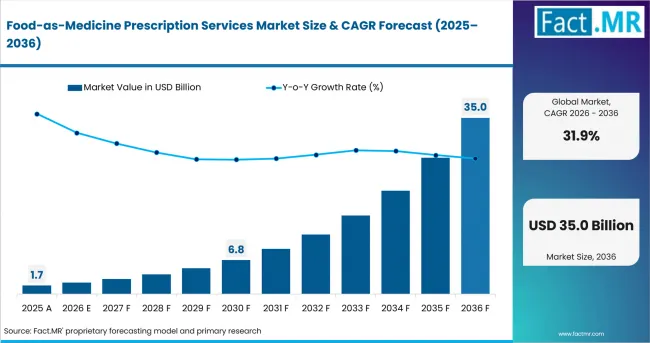
USD 2.2 billion in 2026 to USD 35.0 billion by 2036, at 31.9% CAGR.

  • The food-as-medicine prescription services market crossed a valuation of USD 1.7 billion in 2025.
  • Demand is expected to increase from USD 2.2 billion in 2026 to USD 35.0 billion by 2036.
  • The market is forecast to record 31.9% CAGR during 2026 to 2036 as Medicaid pilots and GLP-1 nutrition support expand.
Food As Medicine Prescription Services Market Value Analysis

What are the defining numbers behind food-as-medicine prescription services growth?

USD 32.8 billion absolute opportunity by 2036, led by the United States and Canada.

  • Demand Drivers in the Market
    • Payers need nutrition interventions that can reduce avoidable chronic disease costs.
    • Clinicians need practical food prescriptions for diabetes and cardiovascular care.
    • Employers need nutrition support as GLP-1 use increases and metabolic care shifts.
    • Health plans need benefit platforms that can deliver food and track member engagement.
  • Key Segments Analyzed
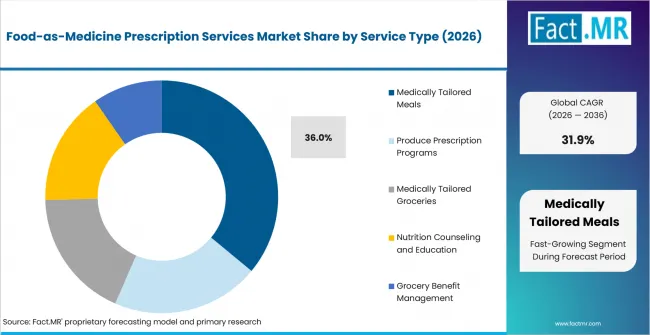
    • By Service Type: Medically Tailored Meals are expected to hold 36.0% share in 2026 because severe chronic disease patients need ready-to-eat therapeutic meals.
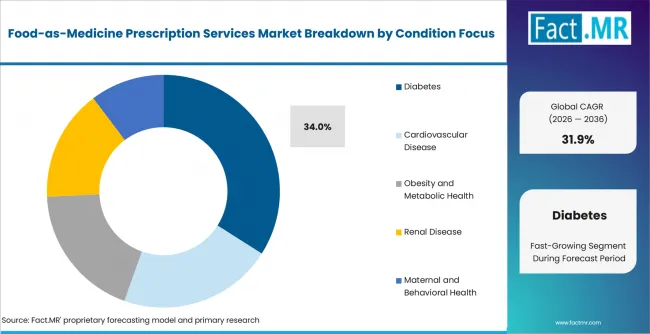
    • By Condition Focus: Diabetes leads because food choices directly affect glucose control. The share is projected at 34.0% in 2026.
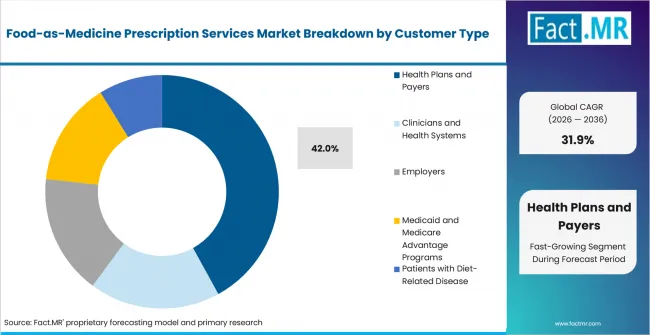
    • By Customer Type: Health Plans and Payers are likely to account for 42.0% share in 2026 because reimbursement drives program scale.
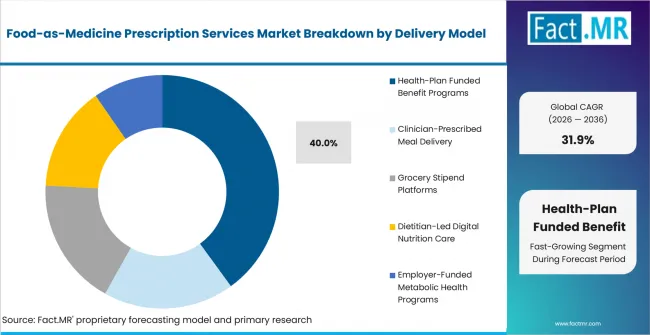
    • By Delivery Model: Health-Plan Funded Benefit Programs lead as insurers fund eligible meals and produce. The model is projected to hold 40.0% share in 2026.
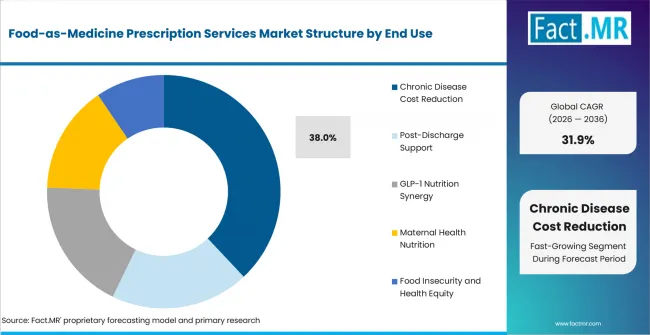
    • By End Use: Chronic Disease Cost Reduction is expected to hold 38.0% share in 2026 because payers need measurable medical savings.
    • By Geography: The United States is projected to record 35.2% CAGR through 2036 as Medicaid and employer-funded programs scale.
  • Analyst Opinion at Fact.MR
    • Shambhu Nath Jha, Senior Analyst at Fact.MR, states, “Food-as-medicine is becoming a reimbursed care service with a clear role in chronic disease management. Payers are looking at which food benefits can improve outcomes and reduce avoidable costs. Providers that combine clinical nutrition and delivery support will gain stronger access to chronic care budgets.”
  • Strategic Implications
    • Health plans should link food benefits with disease management and member engagement programs.
    • Clinicians need referral workflows that make prescribed meals and groceries easy to access.
    • Food providers should build dietitian oversight and condition-specific nutrition standards.
    • Employers can use food-as-medicine support alongside GLP-1 and metabolic health programs.

Medically tailored meals and grocery-benefit services prescribed by clinicians and reimbursed by insurers to treat diet-related disease. HHS states that Food Is Medicine approaches integrate access to diet- and nutrition-related resources and that federal investment is supporting these approaches across settings. [1] This gives the market a policy base.

CMS states that Medicare Advantage plans can provide Special Supplemental Benefits for the Chronically Ill when the benefit has a reasonable expectation of improving or maintaining health or function. [2] This creates a payer route for food and nutrition services tied to chronic disease.

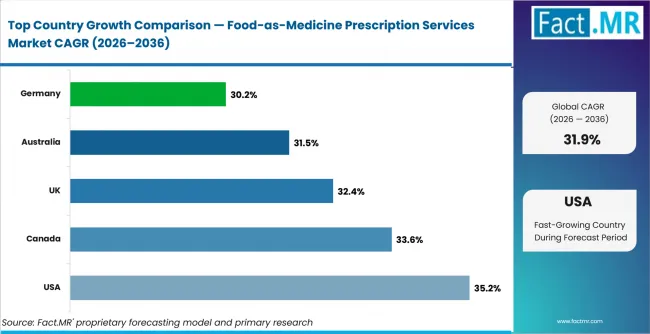
The United States is projected to record 35.2% CAGR from 2026 to 2036 as Medicaid and employer-funded programs scale. Canada is likely to post 33.6% CAGR as health plans and chronic care providers test nutrition support. The United Kingdom is expected to register 32.4% CAGR as food prescription models and social prescribing frameworks expand. Australia is forecast to advance at 31.5% CAGR as chronic disease and dietitian-led programs gain traction. Germany is set to record 30.2% CAGR by 2036 as payer interest in prevention and metabolic health rises.

How does the food-as-medicine prescription services market break down by segment?

Medically Tailored Meals lead at 36.0%; Diabetes leads at 34.0%.

Which service type dominates?

Medically Tailored Meals hold 36.0% share in 2026.
Food As Medicine Prescription Services Market Analysis By Service Type

Medically Tailored Meals are expected to hold 36.0% share in 2026 because severe chronic disease patients need ready-to-eat therapeutic meals. HHS states that these meals are typically provided to patients with complex medical conditions and tailored by registered dietitian nutritionists. [3] Demand is strongest for people who cannot shop or manage complex diets without support. Meal providers also gain because prepared food creates the most direct clinical service model.

Which condition focus dominates?

Diabetes leads because food choices directly affect glucose control.
Food As Medicine Prescription Services Market Analysis By Condition Focus

Diabetes leads because prescribed food programs can target blood sugar and cardiometabolic risk at the same time. The American Diabetes Association’s 2025 Standards of Care states that nutrition therapy plays an integral role in diabetes management and that people with diabetes should work with the care team to develop individualized eating plans [4]. The condition focus is projected to capture 34.0% share in 2026 as health plans test nutrition support for high-cost members. Diabetes programs can combine dietitian guidance with benefit-funded groceries or meals.

Which customer type dominates?

Health Plans and Payers hold 42.0% share in 2026.
Food As Medicine Prescription Services Market Analysis By Customer Type

Health Plans and Payers are likely to account for 42.0% share in 2026 because reimbursement drives program scale. CMS rules require Medicare Advantage plans to support SSBCI benefits with evidence that the items or services improve or maintain health or function. [2] Payers need food programs that can be documented and measured. This customer group leads because most eligible patients cannot pay for ongoing medically tailored food on their own.

Which delivery model dominates?

Health-Plan Funded Benefit Programs lead because reimbursed access creates scale.
Food As Medicine Prescription Services Market Analysis By Delivery Model

Health-Plan Funded Benefit Programs lead because insurers can route members to meals, produce or grocery benefits through care management. The model is projected to hold 40.0% share in 2026 as Medicare Advantage and commercial plans test nutrition support.

Which end use dominates?

Chronic Disease Cost Reduction holds 38.0% share in 2026.
Food As Medicine Prescription Services Market Analysis By End Use

Chronic Disease Cost Reduction leads because payers need proof that food benefits reduce avoidable medical spend. The end use is expected to hold 38.0% share in 2026 as food-as-medicine programs target members with diabetes and renal disease.

What is accelerating food-as-medicine prescription services demand, and what is holding it back?

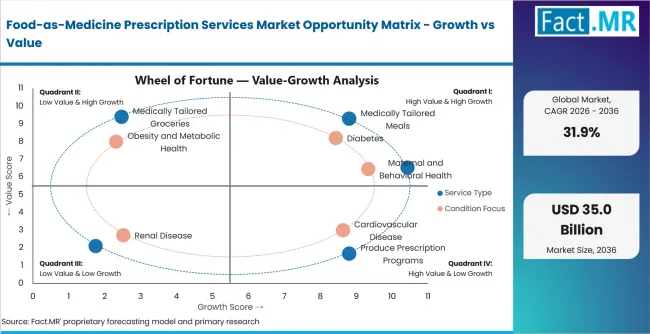
Payer pilots and GLP-1 nutrition needs drive demand; reimbursement complexity restrains adoption.
Food As Medicine Prescription Services Market Opportunity Matrix Growth Vs Value

Payer coverage is the main driver of demand for food-as-medicine prescription services. HHS states that Medicaid managed care organizations may offer additional services that include Food Is Medicine interventions, while Medicare Advantage supplemental benefits can include meals and food or produce for chronically ill enrollees [5]. Health plans are looking at medically tailored meals and grocery benefits as tools to support members with chronic conditions. Coverage support can turn nutrition programs from optional wellness services into reimbursed care pathways.

The main restraint is reimbursement complexity. Food-as-medicine services are funded through different benefit pathways and health-plan contracts. Eligibility rules can vary by condition and plan type. Providers must manage clinical documentation and outcomes reporting before programs can scale across payers.

Where do the biggest food-as-medicine prescription service opportunities sit?

Medically tailored meals and GLP-1 nutrition support.
  • Medically Tailored Meals: Providers can serve high-need chronic disease patients with ready-to-eat therapeutic meals.
  • Produce Prescriptions: Platforms can fund fruits and vegetables for patients with cardiometabolic risk.
  • GLP-1 Nutrition Support: Employers and plans can add protein and meal guidance during weight-management treatment.

Which countries are scaling food-as-medicine prescription services fastest?

United States 35.2%, Canada 33.6%, United Kingdom 32.4%, Australia 31.5%, Germany 30.2%.

Based on regional analysis, the food-as-medicine prescription services market is segmented into North America, Western Europe, Asia Pacific, Latin America, and Middle East and Africa.

Top Country Growth Comparison Food As Medicine Prescription Services Market Cagr (2026 2036)

Country CAGR
United States 35.2%
Canada 33.6%
United Kingdom 32.4%
Australia 31.5%
Germany 30.2%

Food As Medicine Prescription Services Market Cagr Analysis By Country

What is powering the United States lead?
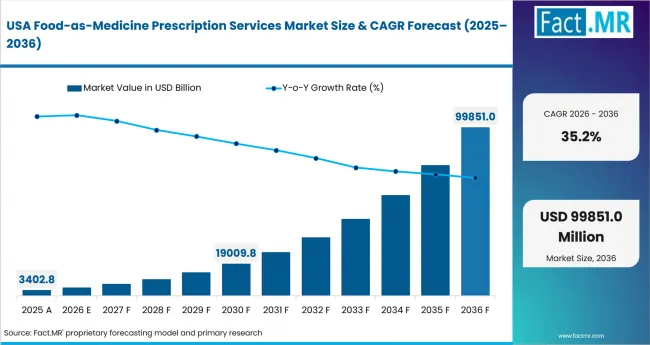
Food As Medicine Prescription Services Market Country Value Analysis

The United States is projected to record a 35.2% CAGR through 2036, supported by Medicaid and employer-funded program expansion. Demand will grow around diabetes care and post-discharge nutrition support. Providers that connect clinical referrals with measurable food delivery will gain stronger market access.

How is Canada scaling food-as-medicine prescription demand?

Canada is likely to post 33.6% CAGR through 2036 as health plans and chronic care providers test nutrition support. Diabetes and obesity create demand for structured food benefits. Canadian employers and insurers can use food-as-medicine services as part of chronic disease management. Providers will need culturally relevant food options and dietitian oversight. Demand will favor partnerships between insurers and community health providers.

What supports the United Kingdom outlook?

The United Kingdom is expected to register 32.4% CAGR through 2036 as food prescription models and social prescribing frameworks expand. NHS-linked social prescribing gives the country a pathway for food and nutrition referrals. Patients with diabetes and obesity need practical nutrition support beyond advice. Food-as-medicine services can connect dietitians and community organizations. Demand will favor produce prescriptions and medically tailored grocery models before prepared meal coverage reaches scale.

How is Australia scaling food-as-medicine prescription services?

Australia is forecast to advance at 31.5% CAGR through 2036 as chronic disease and dietitian-led programs gain traction. Food-as-medicine services can support people with diabetes and obesity through meal planning and healthy grocery access. Private insurers and employers may fund nutrition support to reduce long-term medical cost. Digital delivery makes programs easier to deploy across urban and regional populations. Demand will favor models that include registered dietitian support and measurable member engagement.

Why is Germany an important food-as-medicine market?

Germany is set to record 30.2% CAGR through 2036 as payer interest in prevention and metabolic health rises. German sickness funds and employers are likely to evaluate nutrition services as chronic disease costs increase. Food-as-medicine programs will need strong clinical governance, privacy safeguards and dietitian-led methods. Diabetes and cardiovascular disease care will be early focus areas. Demand will favor medically tailored groceries and counseling before large prepared meal programs scale. Providers that connect digital care and physician referral pathways will be better placed.

Who leads the food-as-medicine prescription services landscape?

Instacart Health and NourishedRx lead through grocery benefits and health-plan partnerships.
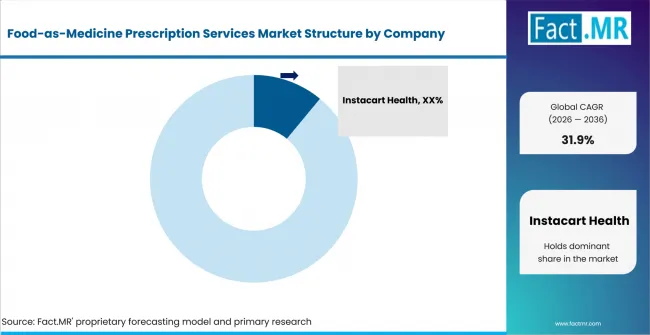
Food As Medicine Prescription Services Market Analysis By Company

Food-as-medicine prescription services are used by health plans and members who need nutrition support tied to disease care. Instacart Health provides Fresh Funds and shoppable guidance that can support food-as-medicine programs. Season Health provides a platform that combines clinical nutrition care and meal delivery.

NourishedRx supports health plans using Food Is Medicine programs for chronic disease and care transitions. FarmboxRx provides produce delivery and nutrition education as a health-plan benefit. Performance Kitchen provides medically tailored meals developed by chefs and registered dietitians.

Competition through 2036 will depend on payer integration and outcomes reporting. Providers that combine clinical nutrition with benefit administration will be better placed. Grocery platforms can win produce prescription and stipend programs. Meal providers can win high-acuity chronic disease programs. Digital nutrition platforms can win employer and health-plan contracts if they show engagement and cost outcomes.

Which companies are the key players?

Instacart Health, Season Health, NourishedRx, FarmboxRx and Performance Kitchen.

  • Instacart Health
  • Season Health
  • NourishedRx
  • FarmboxRx
  • Performance Kitchen

Bibliography

  • [1] U.S. Department of Health and Human Services, Office of Disease Prevention and Health Promotion. (2025, November 19). Food Is Medicine: A project to unify and advance collective action.
  • [2] Centers for Medicare & Medicaid Services. (2024, April 4). Contract Year 2025 Medicare Advantage and Part D Final Rule (CMS-4205-F).
  • [3] U.S. Department of Health and Human Services, Office of Disease Prevention and Health Promotion. (2025, February). Food Is Medicine Landscape Summary.
  • [4] American Diabetes Association Professional Practice Committee. (2025). 5. Facilitating positive health behaviors and well-being to improve health outcomes: Standards of Care in Diabetes—2025. Diabetes Care, 48(Supplement_1), S86–S127.
  • [5] U.S. Department of Health and Human Services, Office of Disease Prevention and Health Promotion. (2024, September 12). Select Policy Pathways for Food Is Medicine Interventions.

This Report Addresses

  • Strategic intelligence on food-as-medicine prescription services across service type, condition focus and customer type.
  • Forecast mapping from USD 2.2 billion in 2026 to USD 35.0 billion by 2036.
  • Segment analysis covering Medically Tailored Meals, Diabetes, Health Plans and Payers, Health-Plan Funded Benefit Programs and Chronic Disease Cost Reduction.
  • Regional outlook covering the United States, Canada, United Kingdom, Australia and Germany.
  • Competitive analysis of Instacart Health, Season Health, NourishedRx, FarmboxRx and Performance Kitchen.
  • Service assessment covering medically tailored meals, produce prescriptions, medically tailored groceries and grocery benefit management.
  • Condition assessment covering diabetes, cardiovascular disease, obesity, renal disease and maternal health.
  • Primary interviews, provider checks, official source review and payer program validation support the forecast.

What does the food-as-medicine prescription services market cover?

Clinician-prescribed meals and grocery benefits for diet-related disease care.

The food-as-medicine prescription services market covers healthcare-linked food services that treat or manage diet-related disease. It includes medically tailored meals and grocery benefit management. The market differs from general meal delivery because food is prescribed and often funded through health plans or public programs.

What is included in the scope?

Prescribed meals and nutrition counseling.

The scope includes medically tailored meals designed for conditions such as diabetes and cancer. It covers produce prescriptions and dietitian-supported meal planning. It includes clinician referrals and condition-specific nutrition education. It also includes digital platforms that connect care teams with grocery ordering and delivery.

What is excluded from the scope?

General grocery delivery and wellness food subscriptions without clinical prescription.

The scope excludes standard meal kits and diet apps unless a clinical or payer-linked food prescription is included. It excludes restaurant delivery with no medical tailoring. It excludes general nutrition education without a food benefit. It also excludes food retail loyalty programs unless they are tied to prescribed nutrition support or reimbursed health benefits.

How was the analysis built?

100+ sources, 45+ company portfolios, 25+ countries, 20+ interviews.

  • Primary Research:
    • Primary research includes interviews with health plan benefit teams and food-as-medicine providers. It includes input from registered dietitians and employer benefits leaders.
  • Desk Research:
    • Desk research reviews HHS Food Is Medicine sources and provider service disclosures. It covers medically tailored meal programs and produce prescription models.
  • Market-Sizing and Forecasting:
    • Forecasting uses diet-related chronic disease populations and program attachment rates. Medicaid pilots and employer-funded chronic care programs support the market assessment.
  • Data Validation and Update Cycle:
    • Forecasts are validated through provider checks and payer program review. Policy updates and clinical nutrition program disclosures help confirm market direction.

What is the report’s scope and coverage?
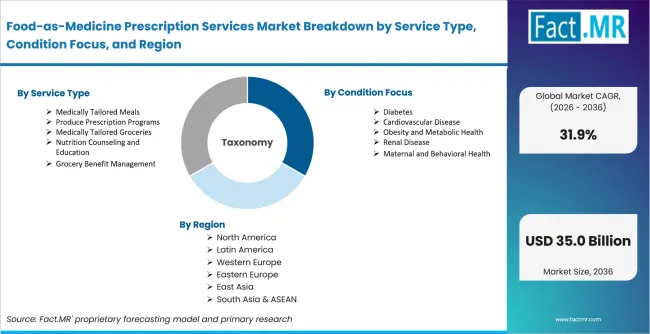
Food As Medicine Prescription Services Market Breakdown By Service Type, Condition Focus, And Region

Attribute Details
Quantitative Units USD Billion in services in 2026 to USD Billion by 2036
Market Definition Medically tailored meals, produce prescriptions and grocery-benefit services prescribed by clinicians and reimbursed by insurers
Service Type Medically Tailored Meals, Produce Prescription Programs, Medically Tailored Groceries, Nutrition Counseling and Education, Grocery Benefit Management
Condition Focus Diabetes, Cardiovascular Disease, Obesity and Metabolic Health, Renal Disease, Maternal and Behavioral Health
Customer Type Health Plans and Payers, Clinicians and Health Systems, Employers, Medicaid and Medicare Advantage Programs, Patients with Diet-Related Disease
Delivery Model Health-Plan Funded Benefit Programs, Clinician-Prescribed Meal Delivery, Grocery Stipend Platforms, Dietitian-Led Digital Nutrition Care, Employer-Funded Metabolic Health Programs
End Use Chronic Disease Cost Reduction, Post-Discharge Support, GLP-1 Nutrition Synergy, Maternal Health Nutrition, Food Insecurity and Health Equity
Regions Covered North America, Western Europe, Asia Pacific, Latin America, Middle East and Africa
Countries Covered United States, Canada, United Kingdom, Australia, Germany
Key Companies Profiled Instacart Health, Season Health, NourishedRx, FarmboxRx and Performance Kitchen
Forecast Period 2026 to 2036
Approach Hybrid top-down and bottom-up approach using chronic disease populations, payer program adoption, benefit attachment rates, food delivery intensity and provider validation

How is the market segmented?

  • By Service Type:

    • Medically Tailored Meals
    • Produce Prescription Programs
    • Medically Tailored Groceries
    • Nutrition Counseling and Education
    • Grocery Benefit Management
  • By Condition Focus:

    • Diabetes
    • Cardiovascular Disease
    • Obesity and Metabolic Health
    • Renal Disease
    • Maternal and Behavioral Health
  • By Customer Type:

    • Health Plans and Payers
    • Clinicians and Health Systems
    • Employers
    • Medicaid and Medicare Advantage Programs
    • Patients with Diet-Related Disease
  • By Delivery Model:

    • Health-Plan Funded Benefit Programs
    • Clinician-Prescribed Meal Delivery
    • Grocery Stipend Platforms
    • Dietitian-Led Digital Nutrition Care
    • Employer-Funded Metabolic Health Programs
  • By End Use:

    • Chronic Disease Cost Reduction
    • Post-Discharge Support
    • GLP-1 Nutrition Synergy
    • Maternal Health Nutrition
    • Food Insecurity and Health Equity
  • By Region:

    • North America
      • United States
      • Canada
    • Europe
      • United Kingdom
      • Germany
      • France
      • Netherlands
      • Spain
    • Asia Pacific
      • Australia
      • Japan
      • Singapore
      • South Korea
      • India
    • Latin America
      • Brazil
      • Mexico
      • Chile
    • Middle East & Africa
      • GCC Countries
      • South Africa
      • Israel

- Frequently Asked Questions -

Which service type leads the Food-as-Medicine Prescription Services Market?

Medically Tailored Meals lead with 36.0% share in 2026 because severe chronic disease patients need therapeutic meals.

Which country expands faster in the Food-as-Medicine Prescription Services Market?

The United States is projected to record 35.2% CAGR through 2036 as Medicaid and employer-funded programs scale.

How does Canada perform in the Food-as-Medicine Prescription Services Market?

Canada is likely to post 33.6% CAGR through 2036 as health plans and chronic care providers test nutrition support.

How does the United Kingdom perform in the Food-as-Medicine Prescription Services Market?

The United Kingdom is expected to register 32.4% CAGR through 2036 as food prescription models and social prescribing frameworks expand.

How does Australia perform in the Food-as-Medicine Prescription Services Market?

Australia is forecast to advance at 31.5% CAGR through 2036 as chronic disease and dietitian-led programs gain traction.

How does Germany perform in the Food-as-Medicine Prescription Services Market?

Germany is set to record 30.2% CAGR through 2036 as payer interest in prevention and metabolic health rises.

What is the primary driver in the Food-as-Medicine Prescription Services Market?

The primary driver is payer funding for prescribed food interventions that can support chronic disease management.

What is the main restraint in the Food-as-Medicine Prescription Services Market?

The main restraint is reimbursement complexity because eligibility and documentation rules differ by payer and program.

Why are medically tailored meals important in this market?

Medically tailored meals are important because they provide condition-specific nutrition support for high-need chronic disease patients.

Table of Content

  1. Executive Summary
    • Global Market Outlook
    • Demand to side Trends
    • Supply to side Trends
    • Technology Roadmap Analysis
    • Analysis and Recommendations
  2. Market Overview
    • Market Coverage / Taxonomy
    • Market Definition / Scope / Limitations
  3. Research Methodology
    • Chapter Orientation
    • Analytical Lens and Working Hypotheses
      • Market Structure, Signals, and Trend Drivers
      • Benchmarking and Cross-market Comparability
      • Market Sizing, Forecasting, and Opportunity Mapping
    • Research Design and Evidence Framework
      • Desk Research Programme (Secondary Evidence)
        • Company Annual and Sustainability Reports
        • Peer-reviewed Journals and Academic Literature
        • Corporate Websites, Product Literature, and Technical Notes
        • Earnings Decks and Investor Briefings
        • Statutory Filings and Regulatory Disclosures
        • Technical White Papers and Standards Notes
        • Trade Journals, Industry Magazines, and Analyst Briefs
        • Conference Proceedings, Webinars, and Seminar Materials
        • Government Statistics Portals and Public Data Releases
        • Press Releases and Reputable Media Coverage
        • Specialist Newsletters and Curated Briefings
        • Sector Databases and Reference Repositories
        • Fact.MR Internal Proprietary Databases and Historical Market Datasets
        • Subscription Datasets and Paid Sources
        • Social Channels, Communities, and Digital Listening Inputs
        • Additional Desk Sources
      • Expert Input and Fieldwork (Primary Evidence)
        • Primary Modes
          • Qualitative Interviews and Expert Elicitation
          • Quantitative Surveys and Structured Data Capture
          • Blended Approach
        • Why Primary Evidence is Used
        • Field Techniques
          • Interviews
          • Surveys
          • Focus Groups
          • Observational and In-context Research
          • Social and Community Interactions
        • Stakeholder Universe Engaged
          • C-suite Leaders
          • Board Members
          • Presidents and Vice Presidents
          • R&D and Innovation Heads
          • Technical Specialists
          • Domain Subject-matter Experts
          • Scientists
          • Physicians and Other Healthcare Professionals
        • Governance, Ethics, and Data Stewardship
          • Research Ethics
          • Data Integrity and Handling
      • Tooling, Models, and Reference Databases
    • Data Engineering and Model Build
      • Data Acquisition and Ingestion
      • Cleaning, Normalisation, and Verification
      • Synthesis, Triangulation, and Analysis
    • Quality Assurance and Audit Trail
  4. Market Background
    • Market Dynamics
      • Drivers
      • Restraints
      • Opportunity
      • Trends
    • Scenario Forecast
      • Demand in Optimistic Scenario
      • Demand in Likely Scenario
      • Demand in Conservative Scenario
    • Opportunity Map Analysis
    • Product Life Cycle Analysis
    • Supply Chain Analysis
    • Investment Feasibility Matrix
    • Value Chain Analysis
    • PESTLE and Porter’s Analysis
    • Regulatory Landscape
    • Regional Parent Market Outlook
    • Production and Consumption Statistics
    • Import and Export Statistics
  5. Global Market Analysis 2021 to 2025 and Forecast, 2026 to 2036
    • Historical Market Size Value (USD Million) Analysis, 2021 to 2025
    • Current and Future Market Size Value (USD Million) Projections, 2026 to 2036
      • Y to o to Y Growth Trend Analysis
      • Absolute $ Opportunity Analysis
  6. Global Market Pricing Analysis 2021 to 2025 and Forecast 2026 to 2036
  7. Global Market Analysis 2021 to 2025 and Forecast 2026 to 2036, By Service Type
    • Introduction / Key Findings
    • Historical Market Size Value (USD Million) Analysis By Service Type , 2021 to 2025
    • Current and Future Market Size Value (USD Million) Analysis and Forecast By Service Type , 2026 to 2036
      • Medically Tailored Meals
      • Produce Prescription Programs
      • Medically Tailored Groceries
      • Nutrition Counseling and Education
      • Grocery Benefit Management
    • Y to o to Y Growth Trend Analysis By Service Type , 2021 to 2025
    • Absolute $ Opportunity Analysis By Service Type , 2026 to 2036
  8. Global Market Analysis 2021 to 2025 and Forecast 2026 to 2036, By Condition Focus
    • Introduction / Key Findings
    • Historical Market Size Value (USD Million) Analysis By Condition Focus, 2021 to 2025
    • Current and Future Market Size Value (USD Million) Analysis and Forecast By Condition Focus, 2026 to 2036
      • Diabetes
      • Cardiovascular Disease
      • Obesity and Metabolic Health
      • Renal Disease
      • Maternal and Behavioral Health
    • Y to o to Y Growth Trend Analysis By Condition Focus, 2021 to 2025
    • Absolute $ Opportunity Analysis By Condition Focus, 2026 to 2036
  9. Global Market Analysis 2021 to 2025 and Forecast 2026 to 2036, By Customer Type
    • Introduction / Key Findings
    • Historical Market Size Value (USD Million) Analysis By Customer Type, 2021 to 2025
    • Current and Future Market Size Value (USD Million) Analysis and Forecast By Customer Type, 2026 to 2036
      • Health Plans and Payers
      • Clinicians and Health Systems
      • Employers
      • Medicaid and Medicare Advantage Programs
      • Patients with Diet-Related Disease
    • Y to o to Y Growth Trend Analysis By Customer Type, 2021 to 2025
    • Absolute $ Opportunity Analysis By Customer Type, 2026 to 2036
  10. Global Market Analysis 2021 to 2025 and Forecast 2026 to 2036, By Delivery Model
    • Introduction / Key Findings
    • Historical Market Size Value (USD Million) Analysis By Delivery Model, 2021 to 2025
    • Current and Future Market Size Value (USD Million) Analysis and Forecast By Delivery Model, 2026 to 2036
      • Health-Plan Funded Benefit Programs
      • Clinician-Prescribed Meal Delivery
      • Grocery Stipend Platforms
      • Dietitian-Led Digital Nutrition Care
      • Employer-Funded Metabolic Health Programs
    • Y to o to Y Growth Trend Analysis By Delivery Model, 2021 to 2025
    • Absolute $ Opportunity Analysis By Delivery Model, 2026 to 2036
  11. Global Market Analysis 2021 to 2025 and Forecast 2026 to 2036, By End Use
    • Introduction / Key Findings
    • Historical Market Size Value (USD Million) Analysis By End Use, 2021 to 2025
    • Current and Future Market Size Value (USD Million) Analysis and Forecast By End Use, 2026 to 2036
      • Chronic Disease Cost Reduction
      • Post-Discharge Support
      • GLP-1 Nutrition Synergy
      • Maternal Health Nutrition
      • Food Insecurity and Health Equity
    • Y to o to Y Growth Trend Analysis By End Use, 2021 to 2025
    • Absolute $ Opportunity Analysis By End Use, 2026 to 2036
  12. Global Market Analysis 2021 to 2025 and Forecast 2026 to 2036, By Region
    • Introduction
    • Historical Market Size Value (USD Million) Analysis By Region, 2021 to 2025
    • Current Market Size Value (USD Million) Analysis and Forecast By Region, 2026 to 2036
      • North America
      • Latin America
      • Western Europe
      • Eastern Europe
      • East Asia
      • South Asia and Pacific
      • Middle East & Africa
    • Market Attractiveness Analysis By Region
  13. North America Market Analysis 2021 to 2025 and Forecast 2026 to 2036, By Country
    • Historical Market Size Value (USD Million) Trend Analysis By Market Taxonomy, 2021 to 2025
    • Market Size Value (USD Million) Forecast By Market Taxonomy, 2026 to 2036
      • By Country
        • USA
        • Canada
        • Mexico
      • By Service Type
      • By Condition Focus
      • By Customer Type
      • By Delivery Model
      • By End Use
    • Market Attractiveness Analysis
      • By Country
      • By Service Type
      • By Condition Focus
      • By Customer Type
      • By Delivery Model
      • By End Use
    • Key Takeaways
  14. Latin America Market Analysis 2021 to 2025 and Forecast 2026 to 2036, By Country
    • Historical Market Size Value (USD Million) Trend Analysis By Market Taxonomy, 2021 to 2025
    • Market Size Value (USD Million) Forecast By Market Taxonomy, 2026 to 2036
      • By Country
        • Brazil
        • Chile
        • Rest of Latin America
      • By Service Type
      • By Condition Focus
      • By Customer Type
      • By Delivery Model
      • By End Use
    • Market Attractiveness Analysis
      • By Country
      • By Service Type
      • By Condition Focus
      • By Customer Type
      • By Delivery Model
      • By End Use
    • Key Takeaways
  15. Western Europe Market Analysis 2021 to 2025 and Forecast 2026 to 2036, By Country
    • Historical Market Size Value (USD Million) Trend Analysis By Market Taxonomy, 2021 to 2025
    • Market Size Value (USD Million) Forecast By Market Taxonomy, 2026 to 2036
      • By Country
        • Germany
        • UK
        • Italy
        • Spain
        • France
        • Nordic
        • BENELUX
        • Rest of Western Europe
      • By Service Type
      • By Condition Focus
      • By Customer Type
      • By Delivery Model
      • By End Use
    • Market Attractiveness Analysis
      • By Country
      • By Service Type
      • By Condition Focus
      • By Customer Type
      • By Delivery Model
      • By End Use
    • Key Takeaways
  16. Eastern Europe Market Analysis 2021 to 2025 and Forecast 2026 to 2036, By Country
    • Historical Market Size Value (USD Million) Trend Analysis By Market Taxonomy, 2021 to 2025
    • Market Size Value (USD Million) Forecast By Market Taxonomy, 2026 to 2036
      • By Country
        • Russia
        • Poland
        • Hungary
        • Balkan & Baltic
        • Rest of Eastern Europe
      • By Service Type
      • By Condition Focus
      • By Customer Type
      • By Delivery Model
      • By End Use
    • Market Attractiveness Analysis
      • By Country
      • By Service Type
      • By Condition Focus
      • By Customer Type
      • By Delivery Model
      • By End Use
    • Key Takeaways
  17. East Asia Market Analysis 2021 to 2025 and Forecast 2026 to 2036, By Country
    • Historical Market Size Value (USD Million) Trend Analysis By Market Taxonomy, 2021 to 2025
    • Market Size Value (USD Million) Forecast By Market Taxonomy, 2026 to 2036
      • By Country
        • China
        • Japan
        • South Korea
      • By Service Type
      • By Condition Focus
      • By Customer Type
      • By Delivery Model
      • By End Use
    • Market Attractiveness Analysis
      • By Country
      • By Service Type
      • By Condition Focus
      • By Customer Type
      • By Delivery Model
      • By End Use
    • Key Takeaways
  18. South Asia and Pacific Market Analysis 2021 to 2025 and Forecast 2026 to 2036, By Country
    • Historical Market Size Value (USD Million) Trend Analysis By Market Taxonomy, 2021 to 2025
    • Market Size Value (USD Million) Forecast By Market Taxonomy, 2026 to 2036
      • By Country
        • India
        • ASEAN
        • Australia & New Zealand
        • Rest of South Asia and Pacific
      • By Service Type
      • By Condition Focus
      • By Customer Type
      • By Delivery Model
      • By End Use
    • Market Attractiveness Analysis
      • By Country
      • By Service Type
      • By Condition Focus
      • By Customer Type
      • By Delivery Model
      • By End Use
    • Key Takeaways
  19. Middle East & Africa Market Analysis 2021 to 2025 and Forecast 2026 to 2036, By Country
    • Historical Market Size Value (USD Million) Trend Analysis By Market Taxonomy, 2021 to 2025
    • Market Size Value (USD Million) Forecast By Market Taxonomy, 2026 to 2036
      • By Country
        • Kingdom of Saudi Arabia
        • Other GCC Countries
        • Turkiye
        • South Africa
        • Other African Union
        • Rest of Middle East & Africa
      • By Service Type
      • By Condition Focus
      • By Customer Type
      • By Delivery Model
      • By End Use
    • Market Attractiveness Analysis
      • By Country
      • By Service Type
      • By Condition Focus
      • By Customer Type
      • By Delivery Model
      • By End Use
    • Key Takeaways
  20. Key Countries Market Analysis
    • USA
      • Pricing Analysis
      • Market Share Analysis, 2025
        • By Service Type
        • By Condition Focus
        • By Customer Type
        • By Delivery Model
        • By End Use
    • Canada
      • Pricing Analysis
      • Market Share Analysis, 2025
        • By Service Type
        • By Condition Focus
        • By Customer Type
        • By Delivery Model
        • By End Use
    • Mexico
      • Pricing Analysis
      • Market Share Analysis, 2025
        • By Service Type
        • By Condition Focus
        • By Customer Type
        • By Delivery Model
        • By End Use
    • Brazil
      • Pricing Analysis
      • Market Share Analysis, 2025
        • By Service Type
        • By Condition Focus
        • By Customer Type
        • By Delivery Model
        • By End Use
    • Chile
      • Pricing Analysis
      • Market Share Analysis, 2025
        • By Service Type
        • By Condition Focus
        • By Customer Type
        • By Delivery Model
        • By End Use
    • Germany
      • Pricing Analysis
      • Market Share Analysis, 2025
        • By Service Type
        • By Condition Focus
        • By Customer Type
        • By Delivery Model
        • By End Use
    • UK
      • Pricing Analysis
      • Market Share Analysis, 2025
        • By Service Type
        • By Condition Focus
        • By Customer Type
        • By Delivery Model
        • By End Use
    • Italy
      • Pricing Analysis
      • Market Share Analysis, 2025
        • By Service Type
        • By Condition Focus
        • By Customer Type
        • By Delivery Model
        • By End Use
    • Spain
      • Pricing Analysis
      • Market Share Analysis, 2025
        • By Service Type
        • By Condition Focus
        • By Customer Type
        • By Delivery Model
        • By End Use
    • France
      • Pricing Analysis
      • Market Share Analysis, 2025
        • By Service Type
        • By Condition Focus
        • By Customer Type
        • By Delivery Model
        • By End Use
    • India
      • Pricing Analysis
      • Market Share Analysis, 2025
        • By Service Type
        • By Condition Focus
        • By Customer Type
        • By Delivery Model
        • By End Use
    • ASEAN
      • Pricing Analysis
      • Market Share Analysis, 2025
        • By Service Type
        • By Condition Focus
        • By Customer Type
        • By Delivery Model
        • By End Use
    • Australia & New Zealand
      • Pricing Analysis
      • Market Share Analysis, 2025
        • By Service Type
        • By Condition Focus
        • By Customer Type
        • By Delivery Model
        • By End Use
    • China
      • Pricing Analysis
      • Market Share Analysis, 2025
        • By Service Type
        • By Condition Focus
        • By Customer Type
        • By Delivery Model
        • By End Use
    • Japan
      • Pricing Analysis
      • Market Share Analysis, 2025
        • By Service Type
        • By Condition Focus
        • By Customer Type
        • By Delivery Model
        • By End Use
    • South Korea
      • Pricing Analysis
      • Market Share Analysis, 2025
        • By Service Type
        • By Condition Focus
        • By Customer Type
        • By Delivery Model
        • By End Use
    • Russia
      • Pricing Analysis
      • Market Share Analysis, 2025
        • By Service Type
        • By Condition Focus
        • By Customer Type
        • By Delivery Model
        • By End Use
    • Poland
      • Pricing Analysis
      • Market Share Analysis, 2025
        • By Service Type
        • By Condition Focus
        • By Customer Type
        • By Delivery Model
        • By End Use
    • Hungary
      • Pricing Analysis
      • Market Share Analysis, 2025
        • By Service Type
        • By Condition Focus
        • By Customer Type
        • By Delivery Model
        • By End Use
    • Kingdom of Saudi Arabia
      • Pricing Analysis
      • Market Share Analysis, 2025
        • By Service Type
        • By Condition Focus
        • By Customer Type
        • By Delivery Model
        • By End Use
    • Turkiye
      • Pricing Analysis
      • Market Share Analysis, 2025
        • By Service Type
        • By Condition Focus
        • By Customer Type
        • By Delivery Model
        • By End Use
    • South Africa
      • Pricing Analysis
      • Market Share Analysis, 2025
        • By Service Type
        • By Condition Focus
        • By Customer Type
        • By Delivery Model
        • By End Use
  21. Market Structure Analysis
    • Competition Dashboard
    • Competition Benchmarking
    • Market Share Analysis of Top Players
      • By Regional
      • By Service Type
      • By Condition Focus
      • By Customer Type
      • By Delivery Model
      • By End Use
  22. Competition Analysis
    • Competition Deep Dive
      • Instacart Health
        • Overview
        • Product Portfolio
        • Profitability by Market Segments (Product/Age /Sales Channel/Region)
        • Sales Footprint
        • Strategy Overview
          • Marketing Strategy
          • Product Strategy
          • Channel Strategy
      • Season Health
      • NourishedRx
      • FarmboxRx
      • Performance Kitchen
  23. Assumptions & Acronyms Used

List Of Table

  • Table 1: Global Market Value (USD Million) Forecast by Region, 2021 to 2036
  • Table 2: Global Market Value (USD Million) Forecast by Service Type, 2021 to 2036
  • Table 3: Global Market Value (USD Million) Forecast by Condition Focus, 2021 to 2036
  • Table 4: Global Market Value (USD Million) Forecast by Customer Type, 2021 to 2036
  • Table 5: Global Market Value (USD Million) Forecast by Delivery Model, 2021 to 2036
  • Table 6: Global Market Value (USD Million) Forecast by End Use, 2021 to 2036
  • Table 7: North America Market Value (USD Million) Forecast by Country, 2021 to 2036
  • Table 8: North America Market Value (USD Million) Forecast by Service Type, 2021 to 2036
  • Table 9: North America Market Value (USD Million) Forecast by Condition Focus, 2021 to 2036
  • Table 10: North America Market Value (USD Million) Forecast by Customer Type, 2021 to 2036
  • Table 11: North America Market Value (USD Million) Forecast by Delivery Model, 2021 to 2036
  • Table 12: North America Market Value (USD Million) Forecast by End Use, 2021 to 2036
  • Table 13: Latin America Market Value (USD Million) Forecast by Country, 2021 to 2036
  • Table 14: Latin America Market Value (USD Million) Forecast by Service Type, 2021 to 2036
  • Table 15: Latin America Market Value (USD Million) Forecast by Condition Focus, 2021 to 2036
  • Table 16: Latin America Market Value (USD Million) Forecast by Customer Type, 2021 to 2036
  • Table 17: Latin America Market Value (USD Million) Forecast by Delivery Model, 2021 to 2036
  • Table 18: Latin America Market Value (USD Million) Forecast by End Use, 2021 to 2036
  • Table 19: Western Europe Market Value (USD Million) Forecast by Country, 2021 to 2036
  • Table 20: Western Europe Market Value (USD Million) Forecast by Service Type, 2021 to 2036
  • Table 21: Western Europe Market Value (USD Million) Forecast by Condition Focus, 2021 to 2036
  • Table 22: Western Europe Market Value (USD Million) Forecast by Customer Type, 2021 to 2036
  • Table 23: Western Europe Market Value (USD Million) Forecast by Delivery Model, 2021 to 2036
  • Table 24: Western Europe Market Value (USD Million) Forecast by End Use, 2021 to 2036
  • Table 25: Eastern Europe Market Value (USD Million) Forecast by Country, 2021 to 2036
  • Table 26: Eastern Europe Market Value (USD Million) Forecast by Service Type, 2021 to 2036
  • Table 27: Eastern Europe Market Value (USD Million) Forecast by Condition Focus, 2021 to 2036
  • Table 28: Eastern Europe Market Value (USD Million) Forecast by Customer Type, 2021 to 2036
  • Table 29: Eastern Europe Market Value (USD Million) Forecast by Delivery Model, 2021 to 2036
  • Table 30: Eastern Europe Market Value (USD Million) Forecast by End Use, 2021 to 2036
  • Table 31: East Asia Market Value (USD Million) Forecast by Country, 2021 to 2036
  • Table 32: East Asia Market Value (USD Million) Forecast by Service Type, 2021 to 2036
  • Table 33: East Asia Market Value (USD Million) Forecast by Condition Focus, 2021 to 2036
  • Table 34: East Asia Market Value (USD Million) Forecast by Customer Type, 2021 to 2036
  • Table 35: East Asia Market Value (USD Million) Forecast by Delivery Model, 2021 to 2036
  • Table 36: East Asia Market Value (USD Million) Forecast by End Use, 2021 to 2036
  • Table 37: South Asia and Pacific Market Value (USD Million) Forecast by Country, 2021 to 2036
  • Table 38: South Asia and Pacific Market Value (USD Million) Forecast by Service Type, 2021 to 2036
  • Table 39: South Asia and Pacific Market Value (USD Million) Forecast by Condition Focus, 2021 to 2036
  • Table 40: South Asia and Pacific Market Value (USD Million) Forecast by Customer Type, 2021 to 2036
  • Table 41: South Asia and Pacific Market Value (USD Million) Forecast by Delivery Model, 2021 to 2036
  • Table 42: South Asia and Pacific Market Value (USD Million) Forecast by End Use, 2021 to 2036
  • Table 43: Middle East & Africa Market Value (USD Million) Forecast by Country, 2021 to 2036
  • Table 44: Middle East & Africa Market Value (USD Million) Forecast by Service Type, 2021 to 2036
  • Table 45: Middle East & Africa Market Value (USD Million) Forecast by Condition Focus, 2021 to 2036
  • Table 46: Middle East & Africa Market Value (USD Million) Forecast by Customer Type, 2021 to 2036
  • Table 47: Middle East & Africa Market Value (USD Million) Forecast by Delivery Model, 2021 to 2036
  • Table 48: Middle East & Africa Market Value (USD Million) Forecast by End Use, 2021 to 2036

List Of Figures

  • Figure 1: Global Market Pricing Analysis
  • Figure 2: Global Market Value (USD Million) Forecast 2021-2036
  • Figure 3: Global Market Value Share and BPS Analysis by Service Type, 2026 and 2036
  • Figure 4: Global Market Y-o-Y Growth Comparison by Service Type, 2026 to 2036
  • Figure 5: Global Market Attractiveness Analysis by Service Type
  • Figure 6: Global Market Value Share and BPS Analysis by Condition Focus, 2026 and 2036
  • Figure 7: Global Market Y-o-Y Growth Comparison by Condition Focus, 2026 to 2036
  • Figure 8: Global Market Attractiveness Analysis by Condition Focus
  • Figure 9: Global Market Value Share and BPS Analysis by Customer Type, 2026 and 2036
  • Figure 10: Global Market Y-o-Y Growth Comparison by Customer Type, 2026 to 2036
  • Figure 11: Global Market Attractiveness Analysis by Customer Type
  • Figure 12: Global Market Value Share and BPS Analysis by Delivery Model, 2026 and 2036
  • Figure 13: Global Market Y-o-Y Growth Comparison by Delivery Model, 2026 to 2036
  • Figure 14: Global Market Attractiveness Analysis by Delivery Model
  • Figure 15: Global Market Value Share and BPS Analysis by End Use, 2026 and 2036
  • Figure 16: Global Market Y-o-Y Growth Comparison by End Use, 2026 to 2036
  • Figure 17: Global Market Attractiveness Analysis by End Use
  • Figure 18: Global Market Value (USD Million) Share and BPS Analysis by Region, 2026 and 2036
  • Figure 19: Global Market Y-o-Y Growth Comparison by Region, 2026 to 2036
  • Figure 20: Global Market Attractiveness Analysis by Region
  • Figure 21: North America Market Incremental Dollar Opportunity, 2026 to 2036
  • Figure 22: Latin America Market Incremental Dollar Opportunity, 2026 to 2036
  • Figure 23: Western Europe Market Incremental Dollar Opportunity, 2026 to 2036
  • Figure 24: Eastern Europe Market Incremental Dollar Opportunity, 2026 to 2036
  • Figure 25: East Asia Market Incremental Dollar Opportunity, 2026 to 2036
  • Figure 26: South Asia and Pacific Market Incremental Dollar Opportunity, 2026 to 2036
  • Figure 27: Middle East & Africa Market Incremental Dollar Opportunity, 2026 to 2036
  • Figure 28: North America Market Value Share and BPS Analysis by Country, 2026 and 2036
  • Figure 29: North America Market Value Share and BPS Analysis by Service Type, 2026 and 2036
  • Figure 30: North America Market Y-o-Y Growth Comparison by Service Type, 2026 to 2036
  • Figure 31: North America Market Attractiveness Analysis by Service Type
  • Figure 32: North America Market Value Share and BPS Analysis by Condition Focus, 2026 and 2036
  • Figure 33: North America Market Y-o-Y Growth Comparison by Condition Focus, 2026 to 2036
  • Figure 34: North America Market Attractiveness Analysis by Condition Focus
  • Figure 35: North America Market Value Share and BPS Analysis by Customer Type, 2026 and 2036
  • Figure 36: North America Market Y-o-Y Growth Comparison by Customer Type, 2026 to 2036
  • Figure 37: North America Market Attractiveness Analysis by Customer Type
  • Figure 38: North America Market Value Share and BPS Analysis by Delivery Model, 2026 and 2036
  • Figure 39: North America Market Y-o-Y Growth Comparison by Delivery Model, 2026 to 2036
  • Figure 40: North America Market Attractiveness Analysis by Delivery Model
  • Figure 41: North America Market Value Share and BPS Analysis by End Use, 2026 and 2036
  • Figure 42: North America Market Y-o-Y Growth Comparison by End Use, 2026 to 2036
  • Figure 43: North America Market Attractiveness Analysis by End Use
  • Figure 44: Latin America Market Value Share and BPS Analysis by Country, 2026 and 2036
  • Figure 45: Latin America Market Value Share and BPS Analysis by Service Type, 2026 and 2036
  • Figure 46: Latin America Market Y-o-Y Growth Comparison by Service Type, 2026 to 2036
  • Figure 47: Latin America Market Attractiveness Analysis by Service Type
  • Figure 48: Latin America Market Value Share and BPS Analysis by Condition Focus, 2026 and 2036
  • Figure 49: Latin America Market Y-o-Y Growth Comparison by Condition Focus, 2026 to 2036
  • Figure 50: Latin America Market Attractiveness Analysis by Condition Focus
  • Figure 51: Latin America Market Value Share and BPS Analysis by Customer Type, 2026 and 2036
  • Figure 52: Latin America Market Y-o-Y Growth Comparison by Customer Type, 2026 to 2036
  • Figure 53: Latin America Market Attractiveness Analysis by Customer Type
  • Figure 54: Latin America Market Value Share and BPS Analysis by Delivery Model, 2026 and 2036
  • Figure 55: Latin America Market Y-o-Y Growth Comparison by Delivery Model, 2026 to 2036
  • Figure 56: Latin America Market Attractiveness Analysis by Delivery Model
  • Figure 57: Latin America Market Value Share and BPS Analysis by End Use, 2026 and 2036
  • Figure 58: Latin America Market Y-o-Y Growth Comparison by End Use, 2026 to 2036
  • Figure 59: Latin America Market Attractiveness Analysis by End Use
  • Figure 60: Western Europe Market Value Share and BPS Analysis by Country, 2026 and 2036
  • Figure 61: Western Europe Market Value Share and BPS Analysis by Service Type, 2026 and 2036
  • Figure 62: Western Europe Market Y-o-Y Growth Comparison by Service Type, 2026 to 2036
  • Figure 63: Western Europe Market Attractiveness Analysis by Service Type
  • Figure 64: Western Europe Market Value Share and BPS Analysis by Condition Focus, 2026 and 2036
  • Figure 65: Western Europe Market Y-o-Y Growth Comparison by Condition Focus, 2026 to 2036
  • Figure 66: Western Europe Market Attractiveness Analysis by Condition Focus
  • Figure 67: Western Europe Market Value Share and BPS Analysis by Customer Type, 2026 and 2036
  • Figure 68: Western Europe Market Y-o-Y Growth Comparison by Customer Type, 2026 to 2036
  • Figure 69: Western Europe Market Attractiveness Analysis by Customer Type
  • Figure 70: Western Europe Market Value Share and BPS Analysis by Delivery Model, 2026 and 2036
  • Figure 71: Western Europe Market Y-o-Y Growth Comparison by Delivery Model, 2026 to 2036
  • Figure 72: Western Europe Market Attractiveness Analysis by Delivery Model
  • Figure 73: Western Europe Market Value Share and BPS Analysis by End Use, 2026 and 2036
  • Figure 74: Western Europe Market Y-o-Y Growth Comparison by End Use, 2026 to 2036
  • Figure 75: Western Europe Market Attractiveness Analysis by End Use
  • Figure 76: Eastern Europe Market Value Share and BPS Analysis by Country, 2026 and 2036
  • Figure 77: Eastern Europe Market Value Share and BPS Analysis by Service Type, 2026 and 2036
  • Figure 78: Eastern Europe Market Y-o-Y Growth Comparison by Service Type, 2026 to 2036
  • Figure 79: Eastern Europe Market Attractiveness Analysis by Service Type
  • Figure 80: Eastern Europe Market Value Share and BPS Analysis by Condition Focus, 2026 and 2036
  • Figure 81: Eastern Europe Market Y-o-Y Growth Comparison by Condition Focus, 2026 to 2036
  • Figure 82: Eastern Europe Market Attractiveness Analysis by Condition Focus
  • Figure 83: Eastern Europe Market Value Share and BPS Analysis by Customer Type, 2026 and 2036
  • Figure 84: Eastern Europe Market Y-o-Y Growth Comparison by Customer Type, 2026 to 2036
  • Figure 85: Eastern Europe Market Attractiveness Analysis by Customer Type
  • Figure 86: Eastern Europe Market Value Share and BPS Analysis by Delivery Model, 2026 and 2036
  • Figure 87: Eastern Europe Market Y-o-Y Growth Comparison by Delivery Model, 2026 to 2036
  • Figure 88: Eastern Europe Market Attractiveness Analysis by Delivery Model
  • Figure 89: Eastern Europe Market Value Share and BPS Analysis by End Use, 2026 and 2036
  • Figure 90: Eastern Europe Market Y-o-Y Growth Comparison by End Use, 2026 to 2036
  • Figure 91: Eastern Europe Market Attractiveness Analysis by End Use
  • Figure 92: East Asia Market Value Share and BPS Analysis by Country, 2026 and 2036
  • Figure 93: East Asia Market Value Share and BPS Analysis by Service Type, 2026 and 2036
  • Figure 94: East Asia Market Y-o-Y Growth Comparison by Service Type, 2026 to 2036
  • Figure 95: East Asia Market Attractiveness Analysis by Service Type
  • Figure 96: East Asia Market Value Share and BPS Analysis by Condition Focus, 2026 and 2036
  • Figure 97: East Asia Market Y-o-Y Growth Comparison by Condition Focus, 2026 to 2036
  • Figure 98: East Asia Market Attractiveness Analysis by Condition Focus
  • Figure 99: East Asia Market Value Share and BPS Analysis by Customer Type, 2026 and 2036
  • Figure 100: East Asia Market Y-o-Y Growth Comparison by Customer Type, 2026 to 2036
  • Figure 101: East Asia Market Attractiveness Analysis by Customer Type
  • Figure 102: East Asia Market Value Share and BPS Analysis by Delivery Model, 2026 and 2036
  • Figure 103: East Asia Market Y-o-Y Growth Comparison by Delivery Model, 2026 to 2036
  • Figure 104: East Asia Market Attractiveness Analysis by Delivery Model
  • Figure 105: East Asia Market Value Share and BPS Analysis by End Use, 2026 and 2036
  • Figure 106: East Asia Market Y-o-Y Growth Comparison by End Use, 2026 to 2036
  • Figure 107: East Asia Market Attractiveness Analysis by End Use
  • Figure 108: South Asia and Pacific Market Value Share and BPS Analysis by Country, 2026 and 2036
  • Figure 109: South Asia and Pacific Market Value Share and BPS Analysis by Service Type, 2026 and 2036
  • Figure 110: South Asia and Pacific Market Y-o-Y Growth Comparison by Service Type, 2026 to 2036
  • Figure 111: South Asia and Pacific Market Attractiveness Analysis by Service Type
  • Figure 112: South Asia and Pacific Market Value Share and BPS Analysis by Condition Focus, 2026 and 2036
  • Figure 113: South Asia and Pacific Market Y-o-Y Growth Comparison by Condition Focus, 2026 to 2036
  • Figure 114: South Asia and Pacific Market Attractiveness Analysis by Condition Focus
  • Figure 115: South Asia and Pacific Market Value Share and BPS Analysis by Customer Type, 2026 and 2036
  • Figure 116: South Asia and Pacific Market Y-o-Y Growth Comparison by Customer Type, 2026 to 2036
  • Figure 117: South Asia and Pacific Market Attractiveness Analysis by Customer Type
  • Figure 118: South Asia and Pacific Market Value Share and BPS Analysis by Delivery Model, 2026 and 2036
  • Figure 119: South Asia and Pacific Market Y-o-Y Growth Comparison by Delivery Model, 2026 to 2036
  • Figure 120: South Asia and Pacific Market Attractiveness Analysis by Delivery Model
  • Figure 121: South Asia and Pacific Market Value Share and BPS Analysis by End Use, 2026 and 2036
  • Figure 122: South Asia and Pacific Market Y-o-Y Growth Comparison by End Use, 2026 to 2036
  • Figure 123: South Asia and Pacific Market Attractiveness Analysis by End Use
  • Figure 124: Middle East & Africa Market Value Share and BPS Analysis by Country, 2026 and 2036
  • Figure 125: Middle East & Africa Market Value Share and BPS Analysis by Service Type, 2026 and 2036
  • Figure 126: Middle East & Africa Market Y-o-Y Growth Comparison by Service Type, 2026 to 2036
  • Figure 127: Middle East & Africa Market Attractiveness Analysis by Service Type
  • Figure 128: Middle East & Africa Market Value Share and BPS Analysis by Condition Focus, 2026 and 2036
  • Figure 129: Middle East & Africa Market Y-o-Y Growth Comparison by Condition Focus, 2026 to 2036
  • Figure 130: Middle East & Africa Market Attractiveness Analysis by Condition Focus
  • Figure 131: Middle East & Africa Market Value Share and BPS Analysis by Customer Type, 2026 and 2036
  • Figure 132: Middle East & Africa Market Y-o-Y Growth Comparison by Customer Type, 2026 to 2036
  • Figure 133: Middle East & Africa Market Attractiveness Analysis by Customer Type
  • Figure 134: Middle East & Africa Market Value Share and BPS Analysis by Delivery Model, 2026 and 2036
  • Figure 135: Middle East & Africa Market Y-o-Y Growth Comparison by Delivery Model, 2026 to 2036
  • Figure 136: Middle East & Africa Market Attractiveness Analysis by Delivery Model
  • Figure 137: Middle East & Africa Market Value Share and BPS Analysis by End Use, 2026 and 2036
  • Figure 138: Middle East & Africa Market Y-o-Y Growth Comparison by End Use, 2026 to 2036
  • Figure 139: Middle East & Africa Market Attractiveness Analysis by End Use
  • Figure 140: Global Market - Tier Structure Analysis
  • Figure 141: Global Market - Company Share Analysis

Food-as-Medicine Prescription Services Market

Buy Report Now