- Estimated Value(2026): 16.1 Bn
- Forecast Value (2036): 29.4 Bn
- CAGR (2026 - 2036): 6.2%
Blood Sugar Tester Market Forecast and Outlook 2026 to 2036
In 2025, the blood sugar tester market surpassed a valuation of USD 15.2 billion. Based on Fact.MR analysis, demand for blood sugar testers is estimated to grow to USD 16.1 billion in 2026 and USD 29.4 billion by 2036. Fact.MR projects a CAGR of 6.2% during the forecast period.
The market is projected to create an absolute dollar opportunity of USD 13.3 billion between 2026 and 2036, a genuinely transformational expansion anchored by two concurrent structural forces: the global diabetes epidemic, now estimated by The Lancet in November 2024 to affect 828 million adults including 212 million in India alone, and the progressive cost reduction in continuous glucose monitoring sensor technology that is opening CGM access to type 2 and uninsured patient populations previously restricted to fingerstick devices.
Dr. Thomas Schinecker, CEO of Roche Group said, "Our AI algorithms in Diagnostics sharpen disease detection so patients can be diagnosed earlier than ever before... We are setting new standards in diagnostics... With our strong financial performance and our continued progress in innovation, we are well positioned for growth.
Country growth reflects diabetes prevalence, public programme scale, reimbursement depth, and care infrastructure. China leads at 8.9% CAGR under its 2024-2030 Diabetes Action Plan mandating community-level monitoring. India follows at 8.1%, driven by the ‘75 by 25’ initiative expanding diagnostics access across 400 districts. The US grows at 5.8% with G7 15-Day clearance and CGM integration gains. Germany posts 5.2% on reimbursement expansion, while Brazil records 4.9% through SUS-supported strip provisioning.
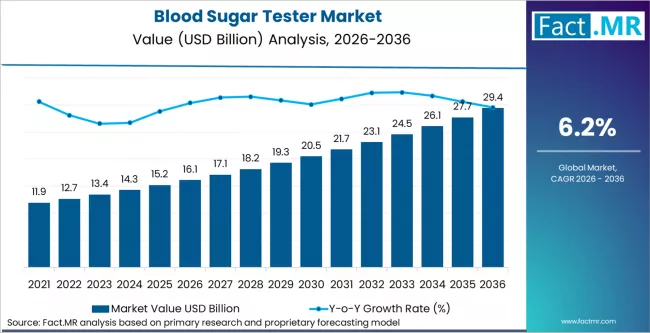
Blood Sugar Tester Market Market Value Analysis | Source: Fact.MR
| Metric | Value |
|---|---|
| Estimated Value in 2026 | USD 16.1 billion |
| Forecast Value in 2036 | USD 29.4 billion |
| Forecast CAGR (2026 to 2036) | 6.2% |
Source: Fact.MR analysis. Updated Feb 28, 2026
Market Definition
The blood sugar tester market includes devices and consumables used to measure blood glucose. Key products are fingerstick SMBG meters with test strips, continuous glucose monitoring wearable sensors, and hospital point-of-care glucose analysers used across home, hospital, and diagnostic settings.
Market Inclusions
The report provides global and regional forecasts from 2026 to 2036 by product type, end user, and region. It covers SMBG devices, CGM systems, and hospital analysers, including pricing, reimbursement trends, and digital connectivity adoption.
Market Exclusions
The scope excludes insulin pumps and pens unless integrated with monitoring, laboratory HbA1c analysers, research-only CGM systems, non-cleared non-invasive devices, and standalone diabetes apps.
Research Methodology
- Primary Research: Interviews were conducted with endocrinologists, nurses, procurement directors, distributors, and patient groups across major regions.
- Desk Research: Sources included manufacturer reports, FDA and CE approvals, insurance reimbursement updates, WHO and IDF data, and verified corporate disclosures.
- Market Sizing and Forecasting: A hybrid model combined diabetes population data with testing frequency, device penetration, and average pricing benchmarks.
- Data Validation and Update Cycle: Findings were cross-checked against shipment data, reimbursement databases, tenders, and global epidemiology sources. Forecasts are reviewed annually.
Summary
- Market Definition
- The market covers SMBG meters and strips, CGM wearable systems, and hospital glucose analysers used for diabetes management globally.
- Demand Drivers
- The global diabetes burden, with 828 million adults affected in 2024, creates sustained monitoring demand.
- China’s 2024-2030 Diabetes Action Plan mandates standardised monitoring at community level.
- Falling CGM costs from Abbott and Dexcom are expanding reimbursement and type 2 adoption.
- Key Segments Analyzed
- By Product Type: SMBG devices hold about 68% share in 2026 due to large installed base and recurring strip sales.
- By End User: Home care represents roughly 56% of demand as chronic management shifts outside hospitals.
- By Geography: Asia Pacific leads growth, with China at 8.9% CAGR and India at 8.1% CAGR.
- Analyst Opinion at FACT.MR
- Shambhu Nath Jha notes market value is split between high-volume strips in emerging markets and premium CGM subscriptions in developed systems.
- Strategic Implications / Executive Takeaways
- SMBG suppliers should target public health procurement in China and India.
- CGM firms should prioritise reimbursement expansion in Germany, France, and Japan.
- Hospitals should dual-source SMBG and CGM to optimise clinical fit and pricing leverage.
- Methodology
- Market size based on diabetes prevalence, testing frequency, and pricing benchmarks.
- Shares validated through shipment data and reimbursement records.
- Forecasts built using WHO and IDF data, procurement pipelines, and reimbursement expansion timelines.
Segmental Analysis
Blood Sugar Tester Market Analysis by Product Type
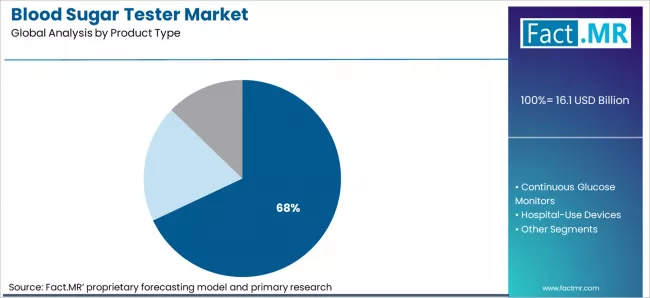
Blood Sugar Tester Market Analysis By Product Type | Source: Fact.MR
Self-monitoring devices are projected to hold 68% share in 2026 due to low cost, universal reimbursement, and recurring strip consumption across global diabetes populations.
- Roche Accu-Chek SmartGuide CE Mark and European CGM Entry: Roche’s 14-day SmartGuide CGM with AI alerts received CE Mark in July 2024, integrating with mySugr and strengthening Roche’s competitive position in Europe. [1]
- Dexcom G7 15-Day FDA Clearance and Abbott-Medtronic Integration: Dexcom’s G7 15-Day gained FDA clearance in 2025, matching Abbott’s wear duration. Abbott’s 2024 Medtronic partnership supports integrated CGM-pump platforms. [3][6]
- Sinocare International Expansion and Emerging Market Volume Growth: Sinocare continues expanding SMBG exports across Asia, Africa, and Latin America, benefiting from government procurement in strip-dominant markets. [7]
Blood Sugar Tester Market Analysis by End User
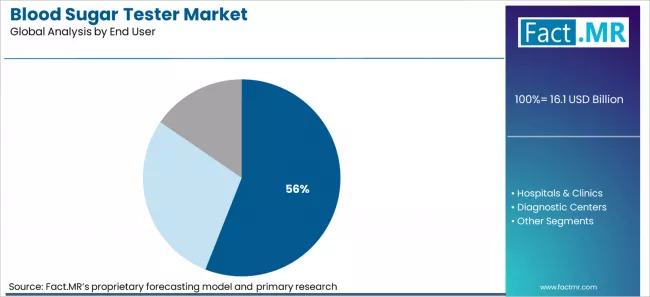
Blood Sugar Tester Market Analysis By End User | Source: Fact.MR
Home care is projected to hold 56% share in 2026 as diabetes management increasingly shifts outside hospitals, supported by both SMBG and CGM usage.
- Abbott FreeStyle Libre OTC Access Expansion in the US: OTC CGM launches such as Dexcom Stelo and Abbott’s Rio expand monitoring access beyond prescriptions, targeting up to 100 million US prediabetes and non-insulin patients.
- India 75-by-25 Roadmap Expanding Primary Care Glucose Monitoring: India’s ‘75 by 25’ initiative mandates glucose monitoring equipment in primary care centres nationwide, expanding SMBG access. [4]
- Hospital Glucose Monitoring Demand Driven by Inpatient Hyperglycaemia Management: ADA Standards of Care 2025 reinforce intensive inpatient monitoring, increasing demand for hospital glucose analysers and professional SMBG devices. [8]
Drivers, Restraints, and Opportunities
FACT.MR notes the blood sugar tester market has closely tracked global diabetes prevalence for decades, making it large and recession-resilient. The USD 15.2 billion 2025 valuation reflects both rising patient numbers and higher testing frequency, especially as CGM enables continuous monitoring. China’s 2024-2030 Action Plan and The Lancet’s estimate of 828 million adults with diabetes, including 212 million in India, have strengthened the long-term growth mandate.
The market is shifting from a simple CGM-versus-strip split to a tiered structure. Lower CGM prices are expanding adoption into type 2 patients, while AI-enabled systems such as Roche’s Smart Guide create a premium layer. Strip volumes remain high due to population growth, but revenue share is shifting toward CGM in developed markets, while emerging markets remain strip-dominant.
- China Diabetes Action Plan 2024-2030 as National Procurement Engine: China’s 2024-2030 plan targets over 70% standardised primary care coverage for type 2 patients by 2030, driving large-scale public procurement of meters and strips. Sinocare is expanding capacity to serve domestic and export demand. [2]
- CGM Regulatory Approvals Expanding Access and Clinical Legitimacy: Roche received CE Mark for Accu-Chek SmartGuide in July 2024. Dexcom gained FDA clearance for G7 15-Day in 2025. These approvals intensify competition and support reimbursement expansion in Europe and Japan.
- India WHO Partnership Scaling Blood Glucose Monitoring Infrastructure: A 2024 WHO-India initiative targets 75 million people under structured care by 2025, mandating diagnostic access in 400 districts. This drives large-scale SMBG procurement. [5]
Regional Analysis
The blood sugar tester market is analysed across North America, Europe, Asia Pacific, Latin America, and Middle East and Africa, spanning over 40+ countries. The full report also offers market attractiveness analysis by region based on diabetes prevalence trajectory, reimbursement policy depth, CGM versus SMBG adoption rate, and government programme procurement scale.
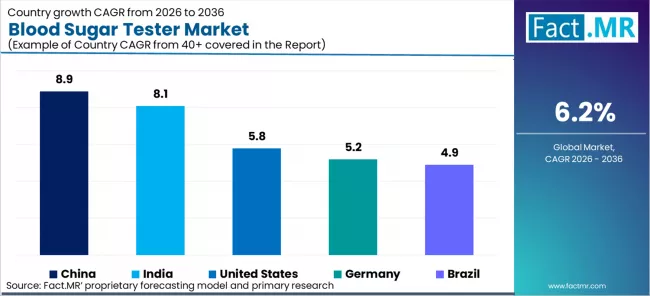
Blood Sugar Tester Market Cagr Analysis By Country | Source: Fact.MR
| Country | CAGR (2026-2036) |
|---|---|
| China | 8.9% |
| India | 8.1% |
| United States | 5.8% |
| Germany | 5.2% |
| Brazil | 4.9% |
Source: Fact.MR analysis. Updated Feb 28, 2026
Source: Fact.MR (FACT.MR) analysis, based on proprietary forecasting model and primary research
Asia Pacific Blood Sugar Tester Market Analysis
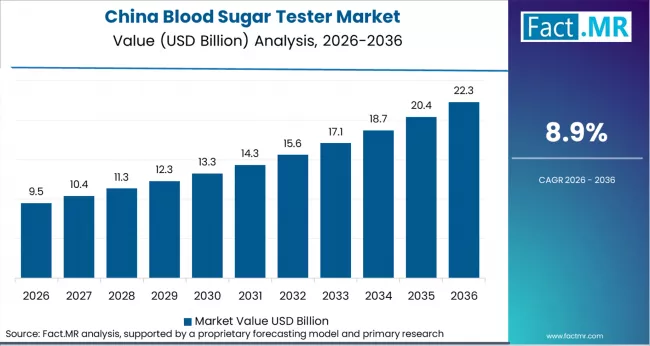
Blood Sugar Tester Market Country Value Analysis | Source: Fact.MR
Asia Pacific is the fastest-growing region due to large diabetes populations, public screening mandates, and strong domestic manufacturing.
- China: Demand is projected to grow at 8.9% CAGR through 2036. The 2024-2030 Action Plan mandates broad screening and >70% standardized management coverage, driving mass procurement. Updated 2025 guidelines promote CGM for type 1 patients. Sinocare remains a key domestic and export supplier. [2][9]
- India: Demand is projected to grow at 8.1% CAGR through 2036. The Lancet estimates 212 million adults with diabetes, 133 million untreated. Government and WHO programmes launched in 2024 are scaling diagnostics access nationwide. Abbott and Roche serve premium and mid-tier segments.
FACT.MR’s Asia Pacific coverage includes China, Japan, South Korea, India, Australia and New Zealand, ASEAN, and Rest of Asia Pacific.
Europe Blood Sugar Tester Market Analysis
Europe leads in CGM reimbursement, especially in Germany and France, supporting high per-capita adoption. Abbott, Roche, and Dexcom compete for formulary access.
- Germany: Demand is projected to grow at 5.2% CAGR through 2036. Statutory insurance reimburses CGM broadly, supporting high adoption. Roche’s SmartGuide launch intensifies competition. Strong specialist networks sustain strip demand.
FACT.MR’s European coverage includes Germany, France, United Kingdom, Norway, Spain, Netherlands, Nordics, and Rest of Europe.
North America Blood Sugar Tester Market Analysis
North America is the highest unit-value market, with strong CGM penetration and growing OTC adoption. Abbott and Dexcom dominate CGM.
- United States: Demand is projected to grow at 5.8% CAGR through 2036. Dexcom’s G7 15-Day clearance, OTC CGM expansion, and ADA 2025 guideline updates are broadening access. Abbott’s Medtronic integration supports pump-linked CGM growth.
FACT.MR’s North American coverage includes the United States, Canada, and Mexico, focusing on reimbursement, OTC expansion, and hospital procurement trends.
Latin America Blood Sugar Tester Market Analysis
Latin America is an emerging growth region driven by expanding public healthcare coverage, rising diagnosed diabetes prevalence, and gradual private insurance adoption of CGM. The market remains SMBG-dominant, with strips accounting for most volume. Brazil is the largest and most structurally significant market in the region.
- Brazil: Demand is projected to grow at 4.9% CAGR through 2036. The SUS public health system supports structured strip provisioning in primary care, while private insurance coverage is gradually expanding CGM access in urban centres. Abbott continues physician engagement and brand development initiatives.
FACT.MR’s Latin America coverage includes Brazil, Chile, Ecuador, and Rest of Latin America, detailing public procurement volumes, private CGM penetration, and strip consumption trends.
Competitive Aligners for Market Players
The blood sugar tester market has two very different competitive landscapes. In continuous glucose monitoring, the field is tightly controlled by Abbott and Dexcom, which together account for most global CGM revenue. Roche has begun expanding into Europe, while Medtronic competes mainly through integrated pump-CGM systems. In contrast, the self-monitoring blood glucose segment is far more fragmented. Global brands such as Accu-Chek, FreeStyle, Contour NEXT, Sinocare, and OneTouch are well established, but regional and private-label suppliers remain strong in price-sensitive emerging markets. CGM competition revolves around sensor accuracy, wear duration, connectivity, and reimbursement access, while SMBG competition is driven largely by strip pricing and distribution reach.
Sustainable advantage increasingly depends on reimbursement coverage and ecosystem lock-in rather than production scale alone. Libre’s factory-calibrated, globally approved sensor platform anchors patients within Abbott’s consumable model. Dexcom benefits from deep integration with automated insulin delivery systems, strengthening endocrinologist preference. Roche is leveraging its large strip user base to transition patients into its CGM platform. Ultimately, payer negotiations, formulary positioning, and demonstrated cost-effectiveness are now as critical as product innovation in shaping market share.
Recent Development
- In August 2024, Abbott and Medtronic announced a global partnership to develop an integrated CGM system using Abbott FreeStyle Libre technology designed to connect exclusively with Medtronic automated insulin delivery and smart insulin pen systems, expanding the addressable prescription pool for Abbott's sensor platform.
- In December 2025, Dexcom received FDA clearance for its G7 15-Day continuous glucose monitoring sensor, the longest-wear FDA-cleared CGM system, with a MARD of 8.0%, intended to launch in the second half of 2025 for integration with automated insulin delivery pump systems.
Key Players
- Roche Diagnostics
- Abbott
- LifeScan
- Ascensia Diabetes Care
- Dexcom
Bibliography
- [1] Roche. (2024, July 9). Roche receives CE Mark for its AI-enabled continuous glucose monitoring solution offering critical predictions to people living with diabetes. Roche Media Release.
- [2] The Lancet Public Health / National Health Commission China. (2024, November 20). Diabetes in China part 2: prevention, challenges, and progress.
- [3] Citeline Medtech Insight. (2025). Dexcom Wins FDA Nod For 15-Day G7 CGM, Closing Gap With Abbott's 14-Day FreeStyle Libre. Citeline. https://insights.citeline.com/medtech-insight
- [4] World Diabetes Foundation. (2024). WDF, WHO, and Government of India collaborate on landmark national project to strengthen NCD care. WDF News.
- [5] Odisha Plus / International Diabetes Federation. (2025, November 15). India Reaches 212 Million Diabetes Cases; WHO Issues Diabetes Plan.
- [6] Love My Libre / Abbott and Medtronic. (2025, January 18). What's ahead for Diabetes Medtech in 2025 and beyond?
- [7] CACLP. (2024). Latest Trends in International and Chinese Branded Diabetes Testing: Sinocare and Roche CGM developments. CACLP Industry News
- [8] American Diabetes Association. (2025, January). Standards of Care in Diabetes 2025. Diabetes Care, Volume 48, Supplement 1.
This Report Addresses
- Strategic intelligence on product development, CGM vs SMBG investment, payer access strategy, and response to Roche’s 2024 CGM entry and Abbott-Medtronic integration.
- Market size and forecast: USD 16.1 billion in 2026, reaching USD 29.4 billion by 2036 at 6.2% CAGR, segmented by product type, end user, and region.
- Growth mapping across China’s 2024-2030 Action Plan, India’s ‘75 by 25’ programme, US OTC CGM expansion, and reimbursement growth in Germany and France.
- Regional outlook with CAGR for China 8.9%, India 8.1%, US 5.8%, Germany 5.2%, Brazil 4.9%, with product and end-user splits.
- Competitive analysis of Abbott, Dexcom, Roche, Ascensia, and LifeScan covering sensor accuracy, wear duration, reimbursement access, AID integration, and OTC strategy.
- Technology tracking of AI-enabled CGM, 15-day FDA-cleared sensors, CGM-AID integration, OTC launches, and calibration transitions.
- Regulatory review of FDA iCGM standards, CE Mark rules, German GKV reimbursement, WHO 2030 targets, China’s Action Plan, and India’s diagnostics mandate.
- Report delivered in Excel datasets, PowerPoint summary, and detailed PDF with verified regulatory and manufacturer sources.
Segmentation
Scope of Report
| Items | Values |
|---|---|
| Quantitative Units | USD 16.1 billion (2026) to USD 29.4 billion (2036), at a CAGR of 6.2% |
| Market Definition | Blood sugar testers include SMBG meters and test strips, CGM wearable sensor systems with transmitters and readers, and hospital point-of-care glucose analysers used to monitor and manage glucose levels across type 1, type 2, gestational, and prediabetic patients. |
| Product Type Segmentation | Self-Monitoring Devices, Continuous Glucose Monitors, Hospital-Use Devices |
| End User Segmentation | Home Care Settings, Hospitals & Clinics, Diagnostic Centers |
| Application Coverage | Type 1 diabetes daily glucose management and CGM automated insulin delivery integration, type 2 diabetes self-monitoring between clinic visits, gestational diabetes pregnancy glucose control, prediabetes risk monitoring, hospital inpatient hyperglycaemia management, intensive care real-time glucose surveillance, OTC wellness glucose tracking for non-insulin users |
| Regions Covered | Asia Pacific, Europe, North America, Latin America, Middle East and Africa |
| Countries Covered | China, Japan, South Korea, India, Australia and New Zealand, ASEAN, Rest of Asia Pacific, Germany, United Kingdom, France, Norway, Spain, Netherlands, Nordics, Rest of Europe, United States, Canada, Mexico, Brazil, Chile, Ecuador, Rest of Latin America, Kingdom of Saudi Arabia, United Arab Emirates, South Africa, Turkey, Rest of Middle East and Africa |
| Key Companies Profiled | Roche Diagnostics, Abbott, LifeScan, Ascensia Diabetes Care, Dexcom |
| Forecast Period | 2026 to 2036 |
| Approach | A hybrid top-down and bottom-up model was used. Top-down inputs included WHO and IDF diabetes prevalence data, device penetration rates, and government procurement volumes. Bottom-up inputs covered testing frequency by product type, average selling prices for meters, strips, and CGM sensors, and reimbursement expansion timelines based on distributor and hospital interviews. |
Source: Fact.MR analysis. Updated Feb 28, 2026
Blood Sugar Tester Market by Segment
-
By Product Type :
- Self-Monitoring Devices
- Continuous Glucose Monitors
- Hospital-Use Devices
-
By End User :
- Home Care Settings
- Hospitals & Clinics
- Diagnostic Centers
-
By Region :
- North America
- United States
- Canada
- Mexico
- Europe
- Germany
- United Kingdom
- France
- Norway
- Spain
- Netherlands
- Nordics
- Rest of Europe
- Asia Pacific
- China
- Japan
- South Korea
- India
- Australia and New Zealand
- ASEAN
- Rest of Asia Pacific
- Latin America
- Brazil
- Chile
- Ecuador
- Rest of Latin America
- Middle East and Africa
- Kingdom of Saudi Arabia
- United Arab Emirates
- South Africa
- Turkey
- Rest of Middle East and Africa
- North America
Frequently Asked Questions
How large is the blood sugar tester market in 2025?
What will the market size be in 2026?
What is the projected market size by 2036?
What is the expected CAGR for the forecast period 2026 to 2036?
Which product type segment is poised to lead the blood sugar tester market?
Which end-user segment holds the largest share?
Which country shows the fastest growth rate?
How fast is the blood sugar tester market expected to expand in India?
What growth rate is expected for Germany's blood sugar tester market?
How is the blood sugar tester market in Brazil expected to grow?
How is the blood sugar tester market in the United States expected to grow?
Who worked on this report


Preview the report firsthand - request a free sample
Free SampleGet the brochure for pricing and purchase details
Download PDF