- Market Value (2025): USD 178.5 Mn
- Estimated Value (2026): USD 188.2 Mn
- Forecast Value (2036): USD 319.4 Mn
- CAGR (2026-2036): 5.4%
What is the Foramen Ovale Electrodes Market forecast to be worth by 2036?
USD 188.2 million in 2026 to USD 319.4 million by 2036 at a 5.4% CAGR.
- In 2025, the foramen ovale electrodes market was worth USD 178.5 million, with sales concentrated in hospital epilepsy monitoring units.
- Revenue will advance from USD 188.2 million in 2026 to USD 319.4 million by 2036 as more referral centres add presurgical intracranial recording.
- A 5.4% CAGR reflects a specialist procedure base that grows with trained teams and approved single-use electrode sets.
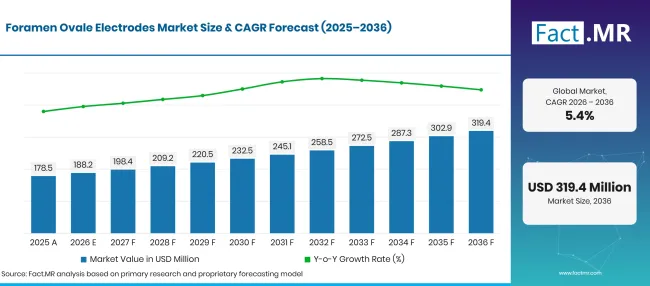
Foramen Ovale Electrodes Market Forecast Global | Source: Fact.MR
| Year | Basis | Market Value (USD million) |
|---|---|---|
| 2025 | Actual | 178.5 |
| 2026 | Estimate | 188.2 |
| 2036 | Forecast | 319.4 |
| CAGR 2026 to 2036 | Forecast period | 5.4% |
Source: Fact.MR analysis. Updated Nov 3, 2026
What are the defining numbers behind Foramen Ovale Electrodes Market growth?
Between 2026 and 2036, the market will gain USD 131.2 million in new value, most of it from hospital epilepsy surgery programmes.
- Demand Drivers in the Market
- Neurological conditions affect more than one in three people worldwide, according to the WHO Global status report on neurology, which drew on data from 102 Member States [1]. Epilepsy is part of that burden. Patients who keep having seizures despite acute repetitive seizures rescue therapy and daily medicines are the group referred for surgical evaluation with intracranial recording.
- Single-use construction supports infection control in theatre. Ad-Tech’s current instructions for its foramen ovale depth electrodes state that the devices are for single use only, are not to be re-sterilised and are for short-term use of under 30 days [2]. That design keeps hospitals buying fresh sets for each monitoring episode.
- Electrode innovation keeps intracranial recording in front of epilepsy surgeons. DIXI Medical reported the first European implantations of its MICRODEEP PIXEL electrodes in June 2026 after CE marking, with insular placements in Madrid and Lyon [3]. Each new depth platform widens the toolkit that centres combine with foramen ovale recording.
- New surgical programmes keep adding intracranial recording capacity in Europe. UZ Gent in Belgium completed its first SEEG procedure with DIXI electrodes in October 2026, after months of joint work to set up the programme [4]. Each new centre adds a team that can weigh foramen ovale recording for mesial temporal cases, where placement gives a bilateral view of both temporal lobes in one short procedure.
- Key Segments Analyzed
- By Product Type: Disposable Electrodes will hold 58.7% share in 2026 because sterile single-use sets remove reprocessing work from hospital teams.
- By Application: Epilepsy Monitoring will account for 52.3% of 2026 revenue, since seizure localisation before surgery is the main clinical reason for placement.
- By End-User: Hospitals will capture 52.8% of 2026 value, as electrode placement needs an operating theatre and an inpatient video-EEG unit.
- Analyst Opinion at Fact.MR
- Shambhu Nath Jha, Principal Consultant at Fact.MR, states, “Foramen ovale electrodes will keep a defined role in epilepsy surgery work-ups because they give a bilateral mesial temporal view without opening the skull. Suppliers that pair dependable electrode sets with clear placement instructions will win repeat orders from referral centres. Growth will follow the opening of new specialist programmes in Germany, Brazil and the United States more than any shift in general neurology volumes.”
- Strategic Implications
- Manufacturers should keep contact spacing, diameter and sterile packaging consistent across lots so that epilepsy teams can repeat their montage set-up without retesting.
- Distributors should hold small but reliable buffer stocks for referral hospitals, since monitoring admissions are booked weeks ahead and a missed delivery cancels the slot.
- Hospital procurement teams should match electrode configurations to the recording plan agreed by neurologists and neurosurgeons before each admission.
- Investors should judge suppliers on regulatory documentation and surgeon training support, as these shape how quickly a new centre adopts a product.
Germany leads the five-country set at 6.7%, helped by dense university hospital epilepsy surgery capacity. Brazil follows at 6.1% as federal reviews of epilepsy surgery support widen access through the public system. The United States reaches 5.5% from a large installed base of monitoring units. The United Kingdom grows at 4.9% through a centralised tertiary referral model. Japan closes the group at 4.4%, where regional care networks steer patients to a limited number of surgical centres.
How does the Foramen Ovale Electrodes Market break down by segment?
Disposable Electrodes will lead Product Type at 58.7%; Epilepsy Monitoring will head Application at 52.3%; Hospitals will hold End-User at 52.8% in 2026.
Which Product Type leads?
Disposable Electrodes take 58.7% of 2026 sales.
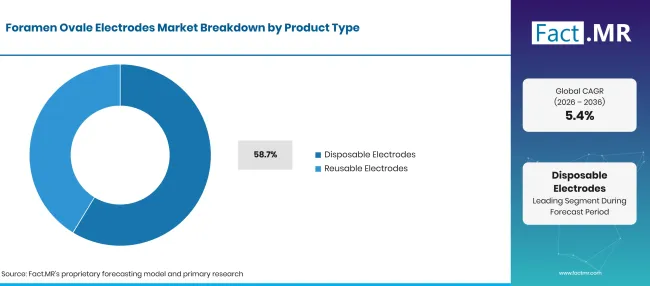
Foramen Ovale Electrodes Market Breakdown Product Type | Source: Fact.MR
| Product Type | Share (2026) |
|---|---|
| Disposable Electrodes (Leading segment) | 58.7% |
| Other segments combined | 41.3%* |
| Total | 100.0% |
Source: Fact.MR analysis. Updated Nov 3, 2026
Hospitals prefer sterile, pre-packed sets because a single failed contact can compromise a costly monitoring admission. Current foramen ovale electrodes are labelled for single use and must not be re-sterilised [2]. Each set arrives with platinum contacts and introducing needles, which simplifies theatre preparation and keeps traceability within one lot. Reusable electrodes form the second category in the segmentation. Their use depends on validated reprocessing steps and on what each product’s instructions allow. Buyers comparing the two types often look at wider disposable EEG electrode trends, where single-use formats have already become routine in clinical neurophysiology.
What supports Epilepsy Monitoring within Application?
Epilepsy Monitoring represents 52.3% of 2026 revenue.
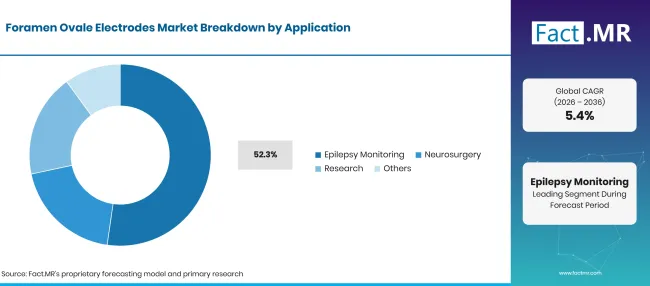
Foramen Ovale Electrodes Market Breakdown Application | Source: Fact.MR
| Application | Share (2026) |
|---|---|
| Epilepsy Monitoring (Leading segment) | 52.3% |
| Other segments combined | 47.7%* |
| Total | 100.0% |
Source: Fact.MR analysis. Updated Nov 3, 2026
Seizure localisation before resective surgery is the main reason surgeons place these electrodes. The recording window usually runs for several days in a video-EEG unit, and the electrodes connect to amplifiers built for scalp and intracranial use. Centres often run these studies alongside other brain monitoring devices in the same unit. Neurosurgery and research form the other application groups. Neurosurgical use covers intraoperative mapping and planning, where nerve monitoring devices and electrode recordings support the surgical team. Research use is limited to approved protocols in academic centres. These studies often examine hippocampal networks and memory, and they buy small batches of electrodes on grant cycles.
How does End-User shape demand?
Hospitals account for 52.8% of 2026 value.
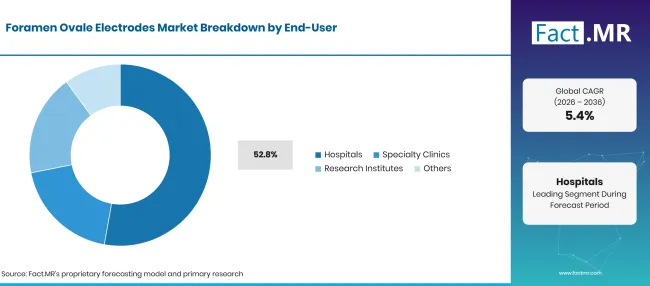
Foramen Ovale Electrodes Market Breakdown End User | Source: Fact.MR
| End-User | Share (2026) |
|---|---|
| Hospitals (Leading segment) | 52.8% |
| Other segments combined | 47.2%* |
| Total | 100.0% |
Source: Fact.MR analysis. Updated Nov 3, 2026
Electrode placement needs fluoroscopy or navigation in an operating theatre, followed by inpatient video-EEG recording. Few settings outside hospitals can offer both, so tertiary neurology departments place most orders. These departments also manage intracranial pressure monitoring and other neurocritical care equipment, which helps them share staff and theatre time. Specialty clinics take part in patient selection, outpatient EEG and follow-up after surgery. Research institutes buy smaller volumes for approved studies on mesial temporal networks. Both groups depend on hospital partners for the placement procedure itself.
What is accelerating Foramen Ovale Electrodes Market adoption, and what is holding it back?
Growth comes from more specialist epilepsy surgery programmes, sterile single-use designs and wider referral of drug-resistant patients. Stereo-EEG competes for the same patients, and the small pool of eligible cases limits volume. Placement skill is scarce, and approval rules differ by country, which slows entry for new suppliers.
Drivers Impact Analysis
| DRIVER | (~) % IMPACT ON CAGR | GEOGRAPHIC RELEVANCE | IMPACT TIMELINE |
|---|---|---|---|
| Wider presurgical evaluation of drug-resistant epilepsy | +0.9% | Global | Medium term (2-4 years) |
| Need for bilateral mesial temporal recording | +0.8% | North America, Western Europe | Short term (<=2 years) |
| Growth of specialist epilepsy surgery centres | +0.7% | Global | Medium term (2-4 years) |
| Preference for sterile single-use electrode sets | +0.5% | Global | Short term (<=2 years) |
| Refined contact spacing and connector design | +0.4% | Global | Long term (>=4 years) |
Source: Fact.MR analysis. Updated Nov 3, 2026
Opportunity Impact Analysis
| OPPORTUNITY | (~) % IMPACT ON CAGR | GEOGRAPHIC RELEVANCE | IMPACT TIMELINE |
|---|---|---|---|
| New epilepsy surgery programmes in public health systems | +0.8% | Latin America, East Asia | Medium term (2-4 years) |
| Placement accessories and navigation guides | +0.6% | Global | Medium term (2-4 years) |
| Access to presurgical evaluation in emerging markets | +0.5% | Emerging markets | Long term (>=4 years) |
| Improved connection systems for EEG amplifiers | +0.4% | Global | Short term (<=2 years) |
Source: Fact.MR analysis. Updated Nov 3, 2026
Restraints Impact Analysis
| RESTRAINT | (~) % IMPACT ON CAGR | GEOGRAPHIC RELEVANCE | IMPACT TIMELINE |
|---|---|---|---|
| Small pool of eligible clinical cases | -0.8% | Global | Short term (<=2 years) |
| Scarce placement and recording expertise | -0.6% | Global | Medium term (2-4 years) |
| Device approval and documentation requirements | -0.5% | Global | Medium term (2-4 years) |
| Competition from stereo-EEG depth electrodes | -0.4% | Global | Long term (>=4 years) |
Source: Fact.MR analysis. Updated Nov 3, 2026
Which countries are scaling the Foramen Ovale Electrodes Market through 2036?
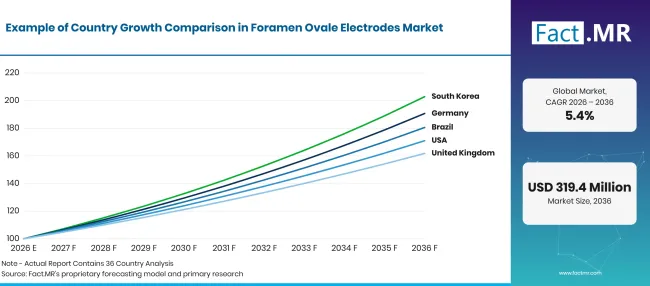
Foramen Ovale Electrodes Market Growth Index | Source: Fact.MR
| Country | CAGR (2026 to 2036) |
|---|---|
| Germany | 6.7% |
| Brazil | 6.1% |
| United States | 5.5% |
| United Kingdom | 4.9% |
| Japan | 4.4% |
Source: Fact.MR analysis. Updated Nov 3, 2026
What supports foramen ovale electrode adoption in Germany?
6.7% CAGR, supported by university hospital epilepsy surgery capacity.
German epilepsy centres run high volumes of inpatient diagnostics, which keeps intracranial recording close to routine care. The Statistical Office of Berlin-Brandenburg reported that 10,014 people were treated as inpatients for epilepsy across Berlin and Brandenburg in 2024, up 3.7% on 2023 [5]. Berlin alone accounted for 6,025 of those patients. Hospital-based workflows of this kind give suppliers a steady stream of monitoring admissions. German centres also tend to combine foramen ovale recording with stereo-EEG in complex cases, which raises electrode use per patient.
How is Brazil developing demand?
6.1% CAGR, as federal health bodies review epilepsy surgery support.
Brazil’s public system is building a formal framework around epilepsy surgery. CONITEC opened Public Consultation No. 89/2026 on intraoperative neurophysiological monitoring in patients with epilepsy undergoing resection of the epileptogenic focus, with comments accepted from 4 to 23 September 2026 [6]. The Ministry of Health also updated the annex of its Clinical Protocol and Therapeutic Guidelines for Epilepsy on 5 May 2026 [7]. Both steps will help referral hospitals plan presurgical work-ups under SUS.
What is supporting United States adoption?
5.5% CAGR, backed by a wide network of epilepsy monitoring units.
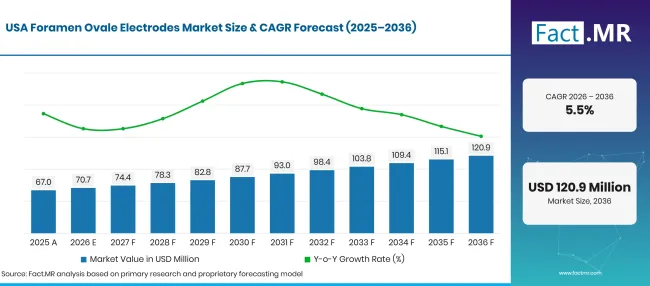
Foramen Ovale Electrodes Market Forecast Usa | Source: Fact.MR
The United States has a large base of comprehensive epilepsy centres that already use intracranial electrodes. The CDC runs the National Neurological Conditions Surveillance System to study the burden of neurological conditions and to inform research and patient care [8]. Device innovation also stays active. NeuroPace reported 18-month NAUTILUS results in December 2025 and stated its plan to file a PMA supplement with the FDA to extend its RNS System indication [9].
How is the United Kingdom developing demand?
4.9% CAGR, reflecting a centralised tertiary referral model.
NHS epilepsy surgery is concentrated in a limited set of tertiary centres. NICE guideline NG217 was last reviewed in November 2025. It covers diagnosis and management of epilepsy across all ages and includes referral to tertiary services [10]. That referral route channels complex cases to the units that place intracranial electrodes. Volume growth will depend on how quickly these centres expand theatre and video-EEG capacity.
What supports Japan’s adoption?
4.4% CAGR, owing to regional epilepsy care networks.
Japan organises specialist epilepsy care through prefectural networks with designated support base hospitals. Tochigi Prefecture’s September 2025 briefing describes a programme that began in 2015 as a Ministry of Health, Labour and Welfare model project, with Jichi Medical University Hospital as its epilepsy support base hospital [11]. Networks of this kind route drug-resistant patients toward surgical centres. Uptake of foramen ovale recording will grow as more prefectures strengthen these links.
Who leads the Foramen Ovale Electrodes Market?
Competition falls into three tiers. Ad-Tech Medical Instrument Corporation is the specialist that lists dedicated foramen ovale electrodes, with platinum contacts, introducing needles and current instructions for use [2].
A second tier of depth electrode makers, DIXI Medical and NeuroOne Medical Technologies, competes for the same presurgical budget through stereo-EEG systems. DIXI keeps widening that platform, and in November 2026 it introduced SEEG-Tx, an FDA-cleared power-controlled radiofrequency ablation system that works through implanted SEEG electrodes [12]. The third tier covers recording and neuromodulation: Natus Medical supplies amplifiers for scalp and intracranial epilepsy monitoring, FHC, Inc. offers SEEG and neurophysiology solutions, and NeuroPace develops its brain-responsive RNS System [9]. Specialists win on placement-specific design and surgeon familiarity. Platform suppliers win on breadth across the monitoring workflow. Through 2036, the edge will go to firms that cut set-up time in theatre and keep regulatory files current in each market.
Which companies are the key providers?
Key companies in the Foramen Ovale Electrodes Market include Ad-Tech Medical Instrument Corporation, DIXI Medical, NeuroOne Medical Technologies, Natus Medical, FHC, Inc. and NeuroPace.
- Ad-Tech Medical Instrument Corporation
- DIXI Medical
- NeuroOne Medical Technologies
- Natus Medical
- FHC, Inc.
- NeuroPace
Bibliography
- [1] World Health Organization. (2025, October 12). Global status report on neurology.
- [2] Ad-Tech Medical Instrument Corporation. (2025). Instructions for use: Foramen ovale depth electrodes (AT10035-1-B, Rev. E).
- [3] DIXI Medical. (2026, June 18). First MICRODEEP PIXEL implantations in Europe following CE Mark.
- [4] DIXI Medical. (2026, October 6). UZ Gent performs its first SEEG procedure with DIXI electrodes.
- [5] Amt für Statistik Berlin-Brandenburg. (2026, February 9). 10.014 Menschen in der Region wegen Epilepsie stationär behandelt.
- [6] Comissão Nacional de Incorporação de Tecnologias no SUS. (2026, September 3). Consultas públicas encerradas: 2026.
- [7] Ministério da Saúde. (2026, May 5). Epilepsia: Protocolo Clínico e Diretrizes Terapêuticas.
- [8] Centers for Disease Control and Prevention. (2026, June 11). About NNCSS.
- [9] NeuroPace, Inc. (2025, December 8). NeuroPace Announces Positive 18-Month NAUTILUS Trial Results in Idiopathic Generalized Epilepsy.
- [10] National Institute for Health and Care Excellence. (2025, November 25). Epilepsies in children, young people and adults (NG217).
- [11] Tochigi Prefecture. (2025, September 9). Tochigi Prefecture epilepsy care collaboration system development project.
- [12] DIXI Medical. (2026, November 2). DIXI medical introduces SEEG-Tx.
This Report Answers
- How large the foramen ovale electrodes market will be in 2026 and 2036, and how fast it will grow.
- Why disposable sets lead product demand and where reusable electrodes still find use.
- Which clinical uses, from seizure localisation to research, drive electrode orders.
- How hospitals, specialty clinics and research institutes differ in buying behaviour.
- What separates growth in Germany, Brazil, the United States, the United Kingdom and Japan.
- Which suppliers compete for presurgical recording budgets, and on what basis.
What does the Foramen Ovale Electrodes Market cover?
This market tracks dedicated electrodes passed through the foramen ovale to sample activity from the hippocampus and adjacent mesial temporal cortex. Products differ by diameter, contact count and spacing, contact material and connector type.
Valuation is based on manufacturer revenue from electrode sets sold to end users, including placement needles and cables when sold as part of the set. Values are in USD million at constant 2025 prices. Service fees for placement, monitoring time and interpretation are not counted, since they accrue to hospitals and clinicians.
What is included in the scope?
Sterile single-use foramen ovale electrode sets with introducing needles.
Reusable foramen ovale electrodes that carry approval for this placement.
Connection cables and adaptors sold with the electrode system.
Use in epilepsy monitoring, neurosurgical mapping and approved research.
What is excluded from the scope?
Scalp EEG electrodes and general-purpose recording electrodes.
Stereo-EEG depth electrodes and subdural grids or strips not designed for foramen ovale placement.
Deep brain stimulation leads and responsive neurostimulation implants.
EEG amplifiers, review software, functional brain imaging systems and other capital equipment.
How Was the Analysis Built?
The analysis draws on 120+ sources, 35+ company portfolios, 25+ countries, and more than 20 industry interviews.
- Primary Research: Primary research includes discussions with manufacturers, service providers, technology developers, distributors, end users, and subject-matter experts. These conversations examine purchasing priorities, product adoption, operational challenges, approval requirements, competitive positioning, and the factors that influence wider market acceptance.
- Desk Research: Desk research covers government statistics, regulatory publications, company filings, trade data, technical studies, industry associations, standards, public policy, and other authoritative sources. Every source used in the analysis is documented in the bibliography.
- Market Sizing and Forecasting: Market estimates combine historical performance, demand indicators, pricing and volume trends, segment shares, company participation, country-level growth, adoption patterns, investment activity, and barriers to market expansion.
- Data Validation and Update Cycle: Findings are validated by comparing primary interviews with public data, company activity, regulatory changes, trade patterns, and industry developments. Regular updates review new product launches, capacity changes, partnerships, approvals, and shifts in commercial adoption.
Segmentation
What is the report’s scope and coverage?
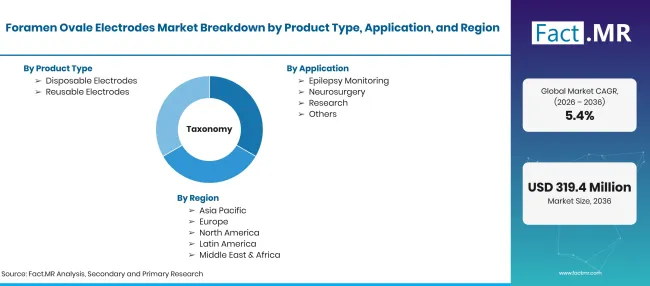
Foramen Ovale Electrodes Market Taxonomy | Source: Fact.MR
| Attribute | Details |
|---|---|
| Quantitative Units | USD million in 2026 to USD million by 2036 at CAGR |
| Market Definition | The market covers intracranial electrodes inserted through the foramen ovale to record electrical activity from mesial temporal brain structures during epilepsy evaluation. |
| Product Type | Disposable Electrodes; Reusable Electrodes |
| Application | Epilepsy Monitoring; Neurosurgery; Research; Others |
| End-User | Hospitals; Specialty Clinics; Research Institutes; Others |
| Regions Covered | North America; Latin America; Western Europe; Eastern Europe; East Asia; South Asia & Pacific; Middle East & Africa |
| Countries Covered | Germany; Brazil; United States; United Kingdom; Japan |
| Companies Profiled | Ad-Tech Medical Instrument Corporation; DIXI Medical; NeuroOne Medical Technologies; Natus Medical; FHC, Inc.; NeuroPace |
| Forecast Period | 2026 to 2036 |
| Approach | Procedure-based sizing built from epilepsy surgery capacity, electrode set use per admission and device documentation. |
Source: Fact.MR analysis. Updated Nov 3, 2026
How is the market segmented?
-
By Product Type
- Disposable Electrodes
- Reusable Electrodes
-
By Application
- Epilepsy Monitoring
- Neurosurgery
- Research
- Others
-
By End-User
- Hospitals
- Specialty Clinics
- Research Institutes
- Others
-
By Region
- North America
- Latin America
- Western Europe
- Eastern Europe
- East Asia
- South Asia & Pacific
- Middle East & Africa
Frequently Asked Questions
How large is the foramen ovale electrodes market in 2026?
What growth rate will the foramen ovale electrodes market record?
Which product type leads?
Which application leads?
Which end-user leads?
Which country will grow quickest?
Who are the main companies?
What holds the market back?
Who worked on this report


Preview the report firsthand - request a free sample
Free SampleGet the brochure for pricing and purchase details
Download PDF