- Market Value (2025):USD 2.89 Bn
- Estimated Value (2026):USD 3.08 Bn
- Forecast Value (2036):USD 5.87 Bn
- CAGR (2026-2036):6.7%
How Big Is the Force Sensors Market in 2026?
The global force sensors market is valued at USD 3.08 billion in 2026, up from USD 2.89 billion in 2025, and is projected by Fact.MR to reach USD 5.87 billion by 2036, expanding at a 6.7% CAGR from 2026 to 2036 and generating USD 2.80 billion in incremental revenue over the 10-year forecast period.
| Market Metric | Valuation / Share / Forecast Benchmark |
|---|---|
| 2025 Market Size (Historical) | USD 2.89 billion |
| 2026 Market Size (Estimated) | USD 3.08 billion |
| 2036 Market Size (Projected) | USD 5.87 billion |
| CAGR (2026 to 2036) | 6.7% |
| Incremental Dollar Opportunity (2026 to 2036) | USD 2.80 billion (1.90x the 2026 base) |
| Dominant Sensor Type (2026 share) | Strain gauge force sensors, 38.2% (about USD 1.18 billion) |
| Leading Application (2026 share) | Automotive, 28.6% (about USD 0.89 billion) |
| Leading Technology (2026 share) | Analog output, 56.3% (about USD 1.75 billion) |
| Largest Country Markets (2026 share) | United States 20.0%, Germany 15.0%, Brazil 12.0% |
| Fastest-Growing Countries (CAGR, 2026 to 2036) | Brazil 8.6%, United Kingdom 8.1%, Japan 7.3% |
| Leading Tier-1 Companies | Honeywell, TE Connectivity, Sensata Technologies, ABB |
Source: Fact.MR analysis. Updated Nov 13, 2026
Source: Fact.MR analysis of the force sensors market, 2026.
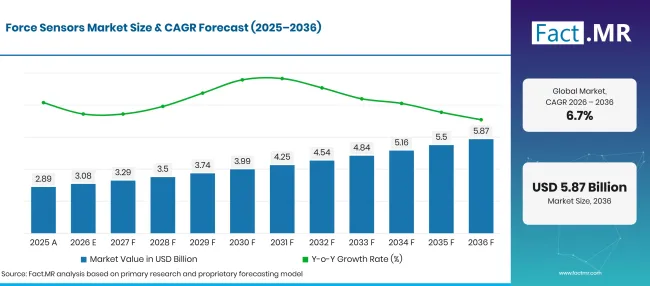
Force Sensors Market Forecast Global | Source: Fact.MR
Executive Market Overview
Demand for force sensors is led by automotive, the largest application at 28.6% of 2026 revenue, ahead of industrial manufacturing, medical devices, aerospace and consumer electronics. Press-fit stations, battery assembly lines, infusion pumps, brake calipers, robot wrists and test rigs all need to measure push, pull, weight or torque and react to it. Many of these uses are safety- or quality-critical, so sensors are specified by name and replaced on fixed calibration schedules, which gives the market a steady base of repeat orders. Among the named countries, the United States (20.0%), Germany (15.0%) and Brazil (12.0%) are the largest. China, South Korea, India and Southeast Asia account for most of the 33.0% earned elsewhere.
Growth in force sensor revenue is broad across the named countries. Brazil (8.6% CAGR), the United Kingdom (8.1%), Japan (7.3%) and the United States (6.8%) grow faster than the global 6.7%, with Germany (5.0%) trailing as its car industry restructures. Price competition is fiercest in standard strain gauge load cells, which many suppliers can make. Higher value comes from digital outputs, multi-axis force-torque designs, miniature medical sensors and safety-rated automotive parts such as brake force sensors, where qualification takes years and suppliers are hard to replace once designed in. Fact.MR sizes the market to include strain gauge, piezoelectric, piezoresistive, capacitive and other force sensors and load cells sold as components or OEM modules, while excluding pressure sensors, torque-only transducers, weighing scales sold as finished instruments and data acquisition hardware.
Analyst Perspective
"Force sensor revenue will grow faster than unit volume, because carmakers, robot builders and medical OEMs are paying more for digital, multi-axis and safety-qualified sensors than for plain analog load cells. The main risk is weaker European vehicle output, which would slow tooling and test-rig spending in Germany, the largest named market in Europe."
Shambhu Nath Jha, Principal Consultant, Fact.MR
Major Market Trends and Insights
- Brake-by-Wire Puts Force Sensors Inside the Wheel: Sales of force sensors to vehicle chassis systems are rising as electromechanical braking replaces hydraulics. Sensata Technologies (October 2026) announced that its brake force sensors, which sit inside the caliper and measure clamping force in real time, now enable electromechanical braking systems in production electric vehicles. The sensor feeds closed-loop control that lets each wheel brake independently and removes brake fluid from the vehicle. Each braked wheel needs its own sensor, so per-vehicle content rises sharply when a model adopts the technology, and suppliers that qualify early gain multi-year platform awards.
- Multi-Axis Force-Torque Sensing Spreads in Testing and Robotics: Adoption of multi-axis sensors is growing because robot wrists, grippers and test rigs need forces and moments in several directions at once. Interface (accessed November 2026) offers its 5AR 5-axis force/torque load cells in 70 and 110 mm diameters at a height of only 20 mm, paired with a six-channel CANbus and Ethernet amplifier. ATI Industrial Automation (accessed November 2026) sells six-axis sensors for robotic assembly, product testing and surgical robotics. These products link closely to the industrial robotics market, where collaborative robots and humanoid prototypes use force feedback to handle parts safely.
- Strain Measurement Moves Onto the Machine Structure: Use of structure-mounted strain sensors is rising in mobile machinery, where conventional load cells are hard to fit. Gefran (November 2025) previewed its SLR strain sensor at Agritechnica 2025, designed to read deformation of agricultural, lifting and material-handling machines without a separate load cell. The sensor is rated to IP69K, so it withstands dust and high-pressure hot-water cleaning, and its standard form makes it easy to stock. This approach opens retrofit sales on existing equipment and lowers the cost of adding load monitoring to tractors, cranes and forklifts.
What Are the Main Drivers, Restraints, and Opportunities?
Force sensor demand rests on vehicle electrification, factory automation and growing use in medical and aerospace equipment. Calibration and integration costs restrain purchases, while digital, multi-axis and safety-rated sensors are the main premium opportunity.
Driver: Electric Vehicle Production and Automated Assembly
Production of electric vehicles adds force-measurement points on every battery module, motor and brake assembly line, where press-fit, joining and clamping steps must be checked.
The International Energy Agency (May 2026) reports that global electric car sales grew 20% to more than 20 million in 2025, a quarter of all new cars sold, and expects about 23 million in 2026 despite an 8% drop in the first quarter. Rising EV output in Europe, China and the Americas adds production lines and end-of-line test benches that need force sensors. The same trend lifts demand in the automotive test equipment market, where durability and crash rigs use large numbers of load cells.
Restraint: Calibration and Integration Costs
Calibration and integration costs restrain force sensor purchases, because high-accuracy sensors must be calibrated, matched to signal conditioning and fitted mechanically to each machine.
The International Organization for Standardization (accessed November 2026) sets calibration and classification rules for force-proving instruments under ISO 376, and regulated buyers must keep sensors within these limits throughout their service life. Each recalibration takes the sensor or the machine out of service. Smaller manufacturers often delay upgrades when calibration, downtime and integration cost more than the expected process gain, which slows the shift to newer sensors.
Opportunity: Digital, Miniature and Safety-Qualified Sensors
Spending on digital, miniature and safety-qualified sensors is rising because these products plug straight into controllers or meet medical and automotive rules, and they sell at higher prices. Honeywell (accessed November 2026) offers its MicroForce FMA series with analog and digital outputs for medical and industrial equipment, and TE Connectivity (accessed November 2026) uses its Microfused piezoresistive technology in miniature OEM load cells.
HITEC Sensors (May 2026) gained AS9100D certification at its US plant, opening aerospace and defence work. Suppliers that offer design-in support and long-term supply agreements can lock in revenue for the life of a customer's product.
How Is the Force Sensors Market Segmented?
Fact.MR segments force sensors by sensor type, application, technology, end user and country, valuing every segment in USD million at the point of first sale.
| Segmentation Axis | Sub-Segments Covered | 2026 Leading Segment & Share | Main Growth Benchmark (2026 to 2036) |
|---|---|---|---|
| Sensor Type | Strain gauge, piezoelectric, capacitive, others | Strain gauge, 38.2% (USD 1,184.2 million) | Global market 6.7% CAGR, USD 3.10 billion to USD 5.90 billion |
| Application | Automotive, medical and healthcare, industrial manufacturing, aerospace and defence, consumer electronics, others | Automotive, 28.6% (USD 886.6 million) | USD 2.80 billion added across all applications |
| Technology | Analog, digital | Analog, 56.3% (USD 1,745.3 million) | Global market grows 1.90x by 2036 |
| End User | Automotive, healthcare, industrial, aerospace and defence, consumer electronics, others | Automotive, 28.6% (USD 886.6 million) | Automotive remains the largest buyer group through 2036 |
| Region / Country | North America, Latin America, Europe, East Asia, South Asia and Pacific, Middle East and Africa | United States, 20.0% (USD 620.0 million) | Brazil fastest at 8.6% CAGR; Germany slowest named country at 5.0% |
Source: Fact.MR analysis. Updated Nov 13, 2026
Source: Fact.MR analysis of the force sensors market, 2026.
Why Does the Strain Gauge Segment Lead by Sensor Type?
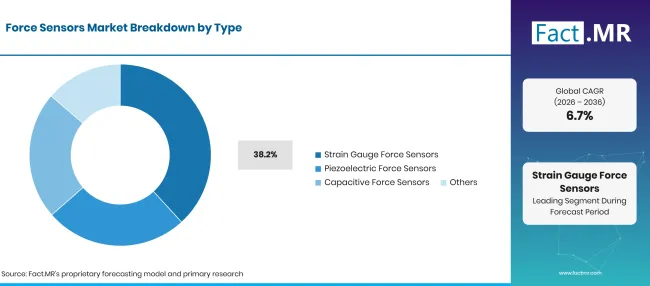
Force Sensors Market Breakdown Type 1 | Source: Fact.MR
Strain gauge sensors generate 38.2% of 2026 revenue, about USD 1.18 billion. They cover loads from a few newtons to many meganewtons, are well understood by engineers and can be built into beams, buttons, S-types and multi-axis cells. Interface (accessed November 2026) builds its multi-axis cells on strain gauge channels, and Gefran (November 2025) uses strain measurement for its SLR machine sensor. Their long track record makes them the default choice in test, weighing and process applications. Piezoelectric sensors serve fast dynamic forces such as impacts and machining, while capacitive designs suit compact, low-force uses in consumer devices.
Why Does the Automotive Segment Lead by Application?
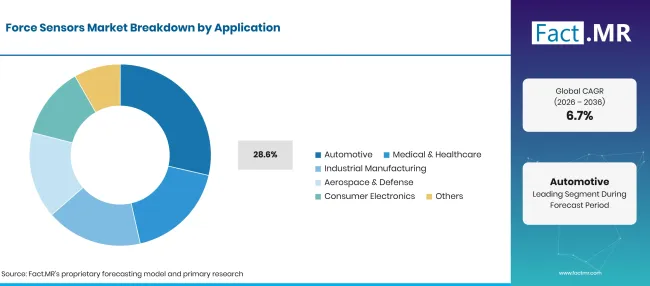
Force Sensors Market Breakdown Application 1 | Source: Fact.MR
Use of force sensors in automotive accounts for 28.6% of 2026 revenue, about USD 0.89 billion. Force sensors check press-fits, welds and fasteners on assembly lines, validate components on test rigs and now sit inside safety systems such as brakes and seat occupancy detection. Sensata Technologies (October 2026) shows how brake-by-wire turns force sensing from a factory tool into vehicle content. The Society of Motor Manufacturers and Traders (October 2026) reported that UK car production rose 38.6% to 70,831 units in September 2026, a reminder that output swings feed straight through to sensor orders. Industrial manufacturing is the second-largest application, followed by medical devices.
Why Does the Analog Segment Lead by Technology?
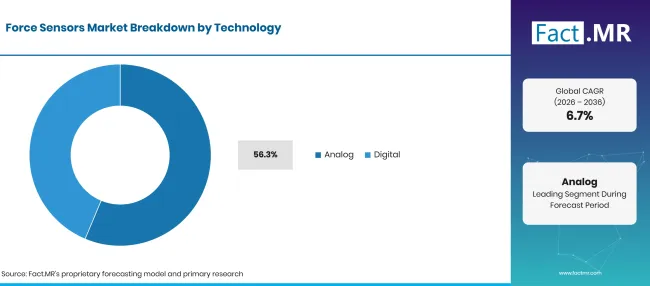
Force Sensors Market Breakdown Technology | Source: Fact.MR
Analog force sensors account for 56.3% of 2026 revenue, about USD 1.75 billion, because most installed controllers, amplifiers and data acquisition systems accept millivolt or 4 to 20 mA signals. Replacement and expansion orders therefore tend to stay analog, and many buyers prefer to keep one signal type across a plant. Digital outputs are gaining share in robots, medical devices and new production lines, where Honeywell (accessed November 2026) and others offer I²C and SPI options that cut wiring and signal-conditioning cost. Interface (accessed November 2026) pairs its multi-axis cells with CANbus and Ethernet amplifiers for the same reason.
Force Sensors Market by Region and Country (2026 to 2036)
Revenue from force sensors is concentrated in the United States, Germany, Brazil, the United Kingdom and Japan, which together account for 67.0% of 2026 revenue (USD 2,077.0 million), rising to 69.6% by 2036 as four of the five grow faster than the global rate. Brazil gains the most share, while Germany loses the most as its automotive industry restructures.
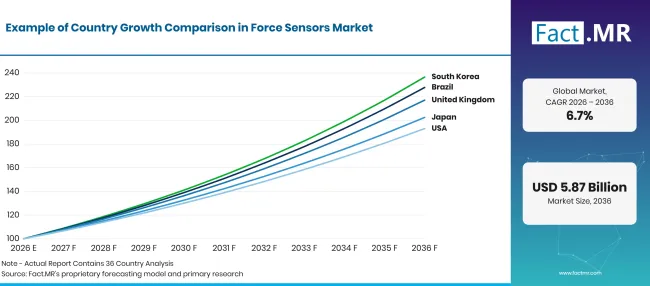
Force Sensors Market Growth Index | Source: Fact.MR
| Country | 2026 Revenue | 2036 Revenue | 10-Year Addition | 2026 to 2036 CAGR | Global Share (2026 → 2036) |
|---|---|---|---|---|---|
| United States | USD 620.0 million | USD 1,197.0 million | USD 577.0 million | 6.8% | 20.0% → 20.3% |
| Germany | USD 465.0 million | USD 757.4 million | USD 292.4 million | 5.0% | 15.0% → 12.8% |
| Brazil | USD 372.0 million | USD 848.9 million | USD 476.9 million | 8.6% | 12.0% → 14.4% |
| United Kingdom | USD 310.0 million | USD 675.5 million | USD 365.5 million | 8.1% | 10.0% → 11.4% |
| Japan | USD 310.0 million | USD 627.1 million | USD 317.1 million | 7.3% | 10.0% → 10.6% |
| Rest of world | USD 1,023.0 million | USD 1,794.1 million | USD 771.1 million | 5.8% | 33.0% → 30.4% |
| Global total | USD 3,100.0 million | USD 5,900.0 million | USD 2,800.0 million | 6.7% | 100.0% → 100.0% |
Source: Fact.MR analysis. Updated Nov 13, 2026
Source: Fact.MR analysis of the force sensors market, 2026.
United States
Sales of force sensors in the United States are projected to rise from USD 620.0 million in 2026 to USD 1,197.0 million by 2036 at a 6.8% CAGR, adding USD 577.0 million (1.93x) and nudging the US share from 20.0% to 20.3%. Automation, aerospace and medical OEMs make up much of the demand. TE Connectivity (November 2026) reported fiscal 2026 net sales up 15.2% to USD 19.885 billion, with Industrial Solutions up 25.8%, and Interlink Electronics (August 2026) cited higher shipments of force-sensing products in its first-half revenue growth. Reshoring of electronics and battery manufacturing adds new production lines that need force measurement.
Germany
Demand for force sensors in Germany, the second-largest market, is projected to grow from USD 465.0 million in 2026 to USD 757.4 million by 2036 at a 5.0% CAGR, the slowest of the named countries. It adds USD 292.4 million (1.63x), while its share falls from 15.0% to 12.8%. Car plants and machine builders are the core buyers. The German Association of the Automotive Industry (January 2026) reported 2025 passenger car output of 4.15 million, with electric cars reaching 1.67 million, about 40% of domestic production. The International Federation of Robotics (September 2025) puts German robot density at 449 units per 10,000 employees, the highest in Europe, which supports steady replacement demand.
Brazil
Adoption of force sensors in Brazil is the fastest among the named markets, lifting revenue from USD 372.0 million in 2026 to USD 848.9 million by 2036 at an 8.6% CAGR. The USD 476.9 million addition (2.28x) lifts its share from 12.0% to 14.4%. Vehicle and component plants are investing in automated lines and testing, and new electrified models are entering local production. Agência Brasil (July 2026), citing ANFAVEA, reported that Brazil produced 1.372 million vehicles in the first half of 2026, up 8.8% year on year. Agricultural machinery makers add demand for load sensors on tractors and harvesters.
United Kingdom
UK revenue from force sensors is projected to grow from USD 310.0 million in 2026 to USD 675.5 million by 2036 at an 8.1% CAGR, adding USD 365.5 million (2.18x) and raising its share from 10.0% to 11.4%. Aerospace, motorsport, medical device and automotive engineering firms are the main buyers, many of them running large test facilities. The Society of Motor Manufacturers and Traders (October 2026) reported that UK vehicle production rose 36.3% to 74,031 units in September 2026, with electrified models making up 42.3% of cars built. Sensata Technologies (October 2026) announced its brake force milestone from Swindon, underlining the UK's role in sensor design.
Japan
Purchases of force sensors in Japan are projected to grow from USD 310.0 million in 2026 to USD 627.1 million by 2036 at a 7.3% CAGR, adding USD 317.1 million (2.02x) and lifting its share from 10.0% to 10.6%. Robot builders, machine tool makers and electronics plants drive demand for compact, high-precision sensors. The Japan Machine Tool Builders' Association (May 2026) reported record March 2026 orders of ¥193.47 billion, up 31.8% year on year, which adds machines that use force feedback in assembly and inspection. Japanese robot makers also build force-torque sensing into collaborative robots for export.
Rest of World
Outside the named countries, force sensor revenue is projected to grow from USD 1,023.0 million in 2026 to USD 1,794.1 million by 2036 at a 5.8% CAGR, adding USD 771.1 million (1.75x) as the share eases from 33.0% to 30.4%. China, South Korea, India and Southeast Asia lead through electronics, automotive and appliance manufacturing. Local Chinese suppliers compete hard on price for standard load cells, which keeps growth in value below growth in units. Global suppliers focus on qualified automotive and medical parts in these markets, where local makers are still building track records.
Competitive Environment and Notable Companies
The force sensor supply base is led by Honeywell, TE Connectivity, Sensata Technologies and ABB, which form the Tier-1 group with broad sensor portfolios and long-standing OEM relationships. Tier-2 includes specialists such as Interface, ATI Industrial Automation, Gefran, SENSY, HITEC Sensors and Interlink Electronics, which compete on custom designs and specific applications. Many OEMs also buy sensors as private-label modules built to their own specifications. Distributors and online catalogues serve the long tail of small industrial buyers.
How Are Companies Positioned in the Force Sensors Market?
Competition among force sensor suppliers falls into three positions. Honeywell and TE Connectivity compete on miniature, high-volume OEM sensors for medical, robotics and test equipment. Sensata Technologies and ABB focus on automotive safety and heavy industrial process measurement, with ABB's Pressductor load cells used in steel and paper lines. Interface, ATI, Gefran and SENSY compete on engineering depth in multi-axis, high-capacity and custom transducers, often designing a sensor for a single customer.
What Matters When a Buyer Selects a Force Sensor Supplier?
Buyers of force sensors start with measurement range and load direction, whether tension, compression, shear or multi-axis. They then compare accuracy, repeatability, overload capacity, temperature stability and long-term drift, along with output type and mounting dimensions. Automotive and aerospace buyers add functional-safety and quality certification, while medical OEMs focus on size and consistency across large production runs. Calibration support and lead times often decide between products with similar specifications.
Which Capabilities Distinguish Product Offers?
Product offers in force sensors are now separated by sensing technology, integrated electronics and qualification. TE Connectivity (accessed November 2026) uses Microfused silicon strain elements for stable miniature sensors, and Sensata Technologies (October 2026) has qualified brake force sensors for production vehicles. SENSY (accessed November 2026) builds custom transducers up to very high capacities, and Interface (accessed November 2026) offers calibration services alongside its multi-axis range. Integrated amplifiers and digital interfaces are becoming standard on new designs.
How Does Geographic Reach Affect Competition?
Local engineering and calibration shape force sensor sales, because sensors must be calibrated, replaced and sometimes redesigned close to the customer. Honeywell, TE Connectivity and Sensata support global OEMs from plants and design centres across North America, Europe and Asia. Specialists rely on distributors and partners, and HITEC Sensors (May 2026) strengthened its position with US aerospace buyers by gaining AS9100D certification. Suppliers with accredited calibration labs in each region are better placed to win repeat orders from multi-plant manufacturers.
| Verified Company Evidence (2026) | Commercial Effect | Buyer Action |
|---|---|---|
| 22 May 2026: HITEC Sensors achieved AS9100D certification at its US manufacturing facility (HITEC Sensors, May 2026). | Qualifies a US force sensor maker for more aerospace and defence programmes. | Add certified domestic suppliers to approved vendor lists for aerospace load measurement. |
| 13 August 2026: Interlink Electronics reported second-quarter 2026 results, citing higher shipments of force-sensing products (Interlink Electronics, August 2026). | Shows rising demand for thin-film force sensing in consumer and industrial devices. | Check lead times and second-source options for thin-film force sensors. |
| 14 October 2026: Sensata Technologies announced that its brake force sensors now enable electromechanical braking systems in production electric vehicles (Sensata Technologies, October 2026). | Moves force sensing into series vehicle content, with one sensor per braked wheel. | Assess functional-safety documentation and supply capacity before brake-by-wire sourcing. |
Source: Fact.MR analysis. Updated Nov 13, 2026
Source: Verified corporate disclosures and Fact.MR analysis, 2026.
| Company | Core Positioning | Verified Activity & Source Attribution |
|---|---|---|
| Honeywell (Tier-1) | MicroForce and board-mount force sensors for medical and industrial OEMs | MicroForce FMA series with analog and digital outputs (Honeywell, accessed November 2026). |
| TE Connectivity (Tier-1) | Microfused piezoresistive force sensors and OEM load cells | Fiscal 2026 net sales of USD 19.885 billion; force sensor portfolio for medical, aerospace and test (TE Connectivity, November 2026; TE Connectivity, accessed November 2026). |
| Sensata Technologies (Tier-1) | Automotive brake force and pedal force sensors | Brake force sensors in production electromechanical braking systems (Sensata Technologies, October 2026). |
| ABB (Tier-1) | Pressductor load cells for heavy industry | Pressductor magnetoelastic load cells for steel, paper and tension control (ABB, accessed November 2026). |
| ATI Industrial Automation (Tier-2) | Six-axis force/torque sensors for robots | Multi-axis sensors for robotic assembly, testing and surgical robotics (ATI Industrial Automation, accessed November 2026). |
| Interface (Tier-2) | Load cells and multi-axis force/torque sensors | 5AR 5-axis force/torque load cells (Interface, accessed November 2026). |
| Gefran (Tier-2) | Industrial force transducers and strain sensors | Previewed the SLR strain sensor at Agritechnica 2025 (Gefran, November 2025). |
| HITEC Sensors (Tier-2) | Custom force and load sensors for aerospace and test | AS9100D certification at US plant (HITEC Sensors, May 2026). |
| Interlink Electronics (Tier-2) | Thin-film force-sensing resistors | Higher force-sensing product shipments in first-half 2026 (Interlink Electronics, August 2026). |
Source: Fact.MR analysis. Updated Nov 13, 2026
Research Sources and Bibliography
- ABB. (Accessed 2026, November 12). Pressductor force measurement load cells.
- Agência Brasil. (2026, July 7). Produção de veículos sobe 8,8% no primeiro semestre, diz Anfavea
- ATI Industrial Automation. (Accessed 2026, November 12). Multi-axis force/torque sensors
- Gefran. (2025, November). Gefran at Agritechnica 2025: Innovation for the future of agriculture
- German Association of the Automotive Industry. (2026, January 6). Passenger car production in 2025 slightly above previous year's level.
- HITEC Sensors. (2026, May 22). HITEC Sensors achieves AS9100D certification at U.S. manufacturing facility.
- Honeywell. (Accessed 2026, November 12). Pressure and force sensors.
- Interface. (Accessed 2026, November 12). 5AR 5-axis force/torque load cells.
- Interlink Electronics. (2026, August 13). Interlink Electronics reports second quarter 2026 results.
- International Energy Agency. (2026, May 20). Global EV Outlook 2026: Trends in electric cars
- International Federation of Robotics. (2025, September). World Robotics 2025: Industrial robots, executive summary.
- International Organization for Standardization. (Accessed 2026, November 12). ISO 376:2011 Metallic materials: Calibration of force-proving instruments used for the verification of uniaxial testing machines.
- Japan Machine Tool Builders' Association. (2026, May). JMTBA Notes 2026-04: Monthly machine tool orders, March 2026
- Sensata Technologies. (2026, October 14). Sensata Technologies announces brake force sensors enabling next-generation electromechanical braking systems in production EVs.
- SENSY. (Accessed 2026, November 12). Load cells and force transducers.
- Society of Motor Manufacturers and Traders. (2026, October 29). UK vehicle production, September 2026.
- TE Connectivity. (Accessed 2026, November 12). Force sensors.
- TE Connectivity. (2026, November). Annual report on Form 10-K for fiscal year 2026.
Segmentation
Force Sensors Market Report Scope and Research Methodology
Fact.MR builds the force sensor estimate from unit shipments by sensor type and application in each country, multiplied by average selling prices for standard, miniature, multi-axis and safety-rated sensors. Shipment assumptions are tested against vehicle and machinery production, robot installations, medical device output and supplier financial disclosures. Country revenue is counted where the sensor is first sold to an OEM or end user. The five named countries are modelled individually, and all other countries form the rest-of-world residual.
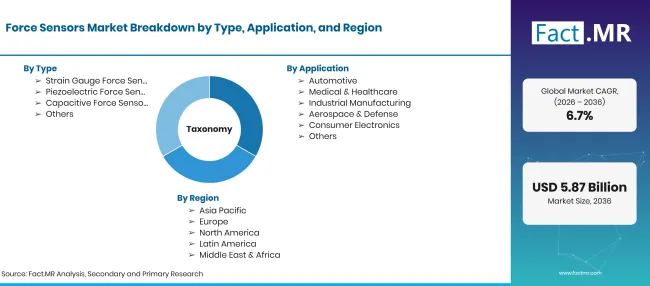
Force Sensors Market Taxonomy | Source: Fact.MR
| Coverage Field | Report Scope |
|---|---|
| Market definition | Sensors and load cells that convert applied mechanical force into an electrical signal |
| Product types | Strain gauge, piezoelectric, capacitive and other force sensors |
| Variants | Single-axis and multi-axis; miniature, standard and high-capacity; analog and digital output |
| Ingredients included | Sensing element, flexure or body, bridge circuit, integrated amplifier and cable or connector |
| Packaging formats | Discrete sensors, board-mount packages, OEM modules and load cell assemblies |
| Distribution channels | Direct OEM supply, distributors and online catalogues |
| End users | Automotive, healthcare, industrial, aerospace and defence, consumer electronics and others |
| Exclusions | Pressure sensors, torque-only transducers, finished weighing scales and data acquisition hardware |
| Quantitative units | USD million and USD billion for value; percentage for share and CAGR |
| Volume basis | Units of force sensors shipped, counted once at first sale |
| Value basis | Manufacturer selling price in the country of first sale, constant 2026 USD |
| Regions covered | North America, Latin America, Europe, East Asia, South Asia and Pacific, Middle East and Africa |
| National coverage | United States, Germany, Brazil, United Kingdom, Japan, with the rest of the world as a residual |
| Companies covered | Honeywell, TE Connectivity, Sensata Technologies, ABB, ATI Industrial Automation, Interface, Gefran, SENSY, HITEC Sensors, Interlink Electronics |
Source: Fact.MR analysis. Updated Nov 13, 2026
Frequently Asked Questions
How big is the force sensors market in 2026?
How fast is the force sensors market expected to grow through 2036?
Which sensor type leads the force sensors market?
Which application leads the force sensors market?
Which technology leads the force sensors market?
Which country is the largest force sensors market?
Which country is expected to grow fastest in the force sensors market?
What limits growth in the force sensors market?
Who worked on this report


Preview the report firsthand - request a free sample
Free SampleGet the brochure for pricing and purchase details
Download PDF