- Base Value(2025): 253 Bn
- Estimated Value(2026): 270 Bn
- Forecast Value (2036): 516.4 Bn
- CAGR (2026 - 2036): 6.7%
Sensors Market Forecast and Outlook By Fact.MR
In 2025, the sensors market was valued at USD 253 billion. Based on Fact.MR analysis, demand for sensors is estimated to grow to USD 270 billion in 2026 and USD 516.4 billion by 2036. FACT.MR projects a CAGR of 6.7% during the forecast period.
From 2026 to 2036, the market is anticipated to unlock an absolute dollar opportunity of approximately USD 246.4 billion. Expansion is largely supported by increasing integration of sensors in autonomous mobility platforms, smart manufacturing systems, and next-generation healthcare diagnostics. At the same time, market momentum may face moderate pressure from semiconductor demand cycles, price compression in consumer-grade sensors, and supply chain concentration within key East Asian fabrication centers. The sensors market is expanding across automotive and industrial end markets as electrification and factory automation drive embedded sensor content per unit higher.
Country growth reflects semiconductor investment, automotive production scale, and industrial automation adoption. China leads at 8.2% CAGR driven by domestic EV production and state-backed sensor fab investment. South Korea follows at 7.8% supported by Samsung and SK Hynix image sensor capacity expansion. Japan records 7.6% through Sony CMOS sensor dominance and automotive electronics output. Germany grows at 7.4% driven by ADAS procurement mandates. France advances at 7.2% through STMicroelectronics MEMS production. The United States posts 7.1% supported by industrial automation and defense sensor spending. The United Kingdom grows at 6.9% driven by aerospace and industrial IoT adoption.
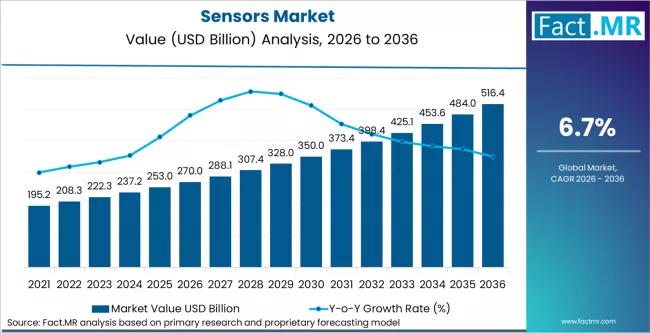
Sensors Market Market Value Analysis | Source: Fact.MR
| Metric | Value |
|---|---|
| Estimated Value in 2026 | USD 270 billion |
| Forecast Value in 2036 | USD 516.4 billion |
| Forecast CAGR (2026 to 2036) | 6.7% |
Source: Fact.MR analysis. Updated Mar 13, 2026
Market Definition
The sensors market includes electronic devices that detect physical parameters such as acceleration, pressure, temperature, light, and biological signals and convert them into electrical outputs for control systems and connected devices.
Market Inclusions
Includes global forecasts from 2026 to 2036 by sensor type, technology, and end user. Covers accelerometer, image, biosensor, optical, pressure, temperature, and touch sensors across CMOS, MEMS, and NEMS platforms.
Market Exclusions
Excludes signal conditioning ICs, microcontrollers without sensing elements, raw sensing materials, and finished products such as smartphones or vehicles containing embedded sensors.
Research Methodology
- Primary Research: Interviews with automotive sensor buyers, industrial automation engineers, medical device designers, consumer electronics procurement teams, and sensor distributors.
- Desk Research: Sources include SEMI semiconductor reports, automotive electronics standards, FDA medical sensor approvals, industrial IoT deployment data, and OEM filings.
- Market Sizing and Forecasting; A hybrid model using sensor shipment volumes, technology-based price trends, end-user capital expenditure data, and automotive and industrial production forecasts.
- Data Validation and Update Cycle: Forecasts validated through OEM revenue disclosures, SEMI equipment reports, automotive production databases, and interviews with sensor design engineers.
Summary of Sensors Market
- Market Definition
- The sensors market includes accelerometers, image sensors, biosensors, pressure, temperature, optical, and touch sensors used across automotive, industrial, healthcare, and electronics systems.
- Demand Drivers
- Growth in automotive ADAS and electric vehicles is increasing the number of sensors integrated into each vehicle platform.
- Industrial IoT and smart factory programs are expanding sensor deployment for predictive maintenance and real-time monitoring.
- Healthcare wearable devices and remote patient monitoring are increasing demand for biosensors and optical sensors.
- Key Segments Analyzed
- By Type: Accelerometer and speed sensors hold about 48% share in 2026 due to wide use in automotive, industrial motion systems, and consumer electronics.
- By Technology: CMOS technology leads with around 60% share in 2026 due to strong use in image sensing and optical applications.
- By End User: Automotive is the largest segment in 2026 supported by ADAS systems, EV sensor integration, and autonomous vehicle development.
- By Geography: Asia Pacific hold largest share.
- Analyst Opinion at FACT.MR
- Shambhu Nath Jha, Principal Consultant at Fact.MR, opines that CXOs will find the strongest growth opportunities in automotive ADAS sensors, medical biosensor modules, and industrial IoT sensing platforms.
- Strategic Implications
- Sensor manufacturers should develop AEC-Q100 certified sensors to secure long-term automotive supply agreements.
- Companies should invest in MEMS biosensor miniaturization for wearable healthcare monitoring devices.
- Industrial sensor vendors should design safety-certified sensors aligned with IEC functional safety standards for smart factories.
- Methodology
- Market sizing used sensor shipment volumes and price trends validated with OEM revenue disclosures and SEMI semiconductor reports.
- Automotive production data, industrial IoT adoption trends, and medical device approvals supported demand analysis.
- Forecasts incorporated semiconductor capacity expansion, EV production roadmaps, automation investment cycles, and interviews with sensor procurement engineers.
Segmental Analysis
Sensors Market Analysis by Type
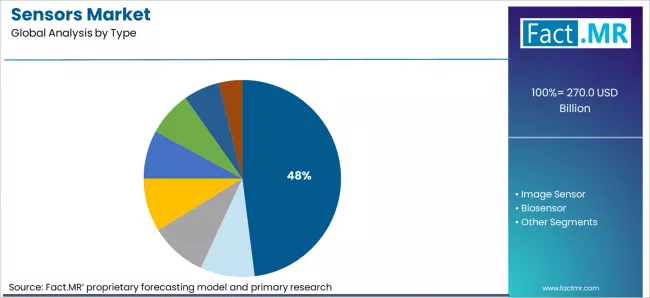
Sensors Market Analysis By Type | Source: Fact.MR
Based on FACT.MR analysis, Accelerometer and Speed Sensors are expected to hold about 48% share in 2026 due to widespread use across automotive safety systems, industrial machinery, aerospace platforms, and consumer electronics devices.
- Bosch Sensortec ADAS Sensor Investment: Bosch Sensortec expanded production of its BMI088 6 axis IMU sensor in 2025 targeting Level 2 and Level 3 ADAS vehicle systems with supply commitments from European OEMs. [5]
- STMicroelectronics MEMS Technology Development: STMicroelectronics launched the ASM330LHHX MEMS accelerometer in 2024 meeting AEC Q100 Grade 1 certification for safety critical automotive applications. [6]
- Automotive Image Sensor Adoption Trend: Sony Semiconductor Solutions reported automotive image sensor revenue growth of 28% in FY2024 driven by rear view camera regulations and surround view systems in EV platforms. [7]
Sensors Market Analysis by Technology
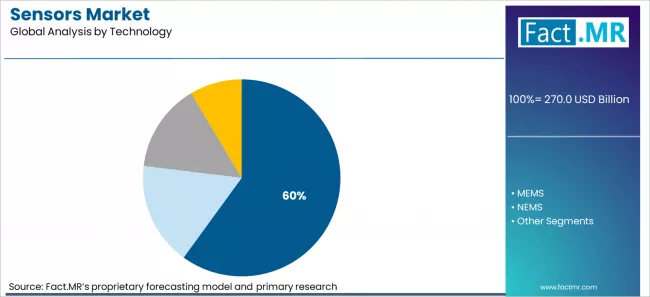
Sensors Market Analysis By Technology | Source: Fact.MR
Based on FACT.MR analysis, CMOS technology is projected to hold about 60% share in 2026 due to high integration capability and cost efficient semiconductor manufacturing for imaging and optical sensors.
- Samsung CMOS Image Sensor Capacity Investment: Samsung Electronics announced a KRW 20 trillion investment in 2025 to expand CMOS image sensor production capacity at its Hwaseong fabrication facility. [8]
- Infineon MEMS Sensor Technology Development: Infineon introduced the DPS368 MEMS barometric pressure sensor in 2025 designed for industrial IoT and low power consumer devices. [9]
- NEMS Sensor Commercialisation Trend: DARPA reported progress in 2024 on NEMS chemical sensors with prototype development contracts awarded to Honeywell and TE Connectivity for industrial and aerospace sensing systems. [10]
Drivers, Restraints, and Opportunities
FACT.MR analysts note that the sensors market, has grown through long-term MEMS and CMOS cost reductions that enabled mass deployment across electronics and automotive systems. Growth is now shifting toward higher value automotive, industrial, and medical sensors while consumer sensor growth slows.
The market is balancing lower priced consumer sensors with higher value automotive and industrial sensing platforms. Consumer MEMS sensor prices have declined, but ADAS grade sensors used in autonomous and advanced vehicle systems command significantly higher pricing.
- EU Automotive ADAS Mandate: Euro NCAP’s 2025 safety framework requires Level 2 ADAS systems including braking, lane keeping, and driver monitoring sensors on new vehicles sold in the EU, increasing sensor content per vehicle. [2]
- China Semiconductor Sensor Investment: China’s NDRC approved a CNY 344 billion third phase National IC Fund in 2024 to expand domestic CMOS image sensor and MEMS pressure sensor manufacturing capacity. [3]
- Industry 4.0 Sensor Standardisation: Germany’s Platform Industry 4.0 introduced updated standards in 2024 enabling interoperability for industrial temperature, pressure, and vibration sensors across factory automation systems. [4]
Regional Analysis
The sensors market is analysed across Asia Pacific, Europe, North America, Latin America, and Middle East and Africa, covering 40+ countries with distinct demand profiles shaped by automotive production scale, semiconductor fabrication investment, industrial automation adoption, and regulatory requirements. The full report offers market attractiveness analysis based on automotive production forecasts, industrial capex pipelines, and semiconductor investment timelines.
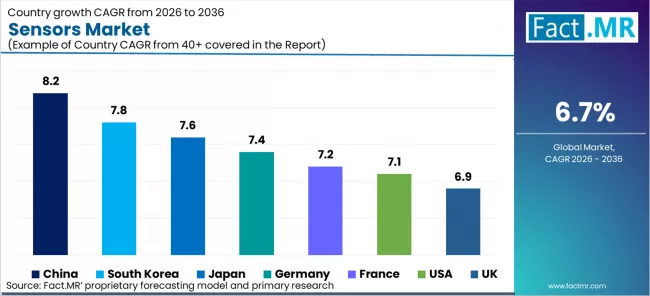
Sensors Market Cagr Analysis By Country | Source: Fact.MR
| Country | CAGR (2026-2036) |
|---|---|
| China | 8.2% |
| South Korea | 7.8% |
| Japan | 7.6% |
| Germany | 7.4% |
| France | 7.2% |
| United States | 7.1% |
| United Kingdom | 6.9% |
Source: Fact.MR analysis. Updated Mar 13, 2026
Source: Fact.MR (FACT.MR) analysis, based on proprietary forecasting model and primary research
Asia Pacific Sensors Market Analysis
Asia Pacific is the global manufacturing hub for sensors due to strong semiconductor fabrication capacity and large electronics production ecosystems. Major companies such as Sony, Samsung, and Bosch Sensortec operate large production facilities, while Chinese sensor suppliers are increasing pricing competition across consumer and automotive markets.
- China: China’s sensors market grows at 8.2% CAGR through 2036 supported by domestic semiconductor investment. The Ministry of Industry and Information Technology released a sensor industry development plan in 2024 targeting self-sufficiency in automotive ADAS and industrial IoT sensors. The National IC Fund third phase approved in May 2024 supports CMOS image sensor and MEMS pressure sensor production at SMIC and YMTC. BYD reported domestic MEMS sourcing rising from 38% to 54% in its 2025 EV procurement disclosure.
- South Korea: South Korea expands at 7.8% CAGR through 2036 driven by electronics manufacturing and automotive demand. Samsung Electro Mechanics announced expansion of its Busan CMOS image sensor packaging facility in March 2025 to support Hyundai and Kia EV camera modules. SK Hynix increased its CMOS sensor research budget to KRW 800 billion for 2025 to 2027. The Ministry of Science and ICT sensor cluster initiative provides tax incentives for MEMS sensor development.
- Japan: Japan grows at 7.6% CAGR through 2036 supported by automotive electronics and semiconductor innovation. Sony Semiconductor Solutions announced capacity expansion in 2025 targeting automotive image sensor growth driven by Toyota and Honda ADAS camera supply contracts. Japan’s Ministry of Economy Trade and Industry allocated JPY 200 billion for advanced CMOS sensor development under its 2024 semiconductor strategy.
FACT.MR’s analysis of the sensors market in Asia Pacific consists of country wise assessment including China, Japan, South Korea, India, ASEAN, Australia and New Zealand, and Rest of South Asia and Pacific. Readers can find country level CAGR forecasts, semiconductor fabrication investments, automotive sensor sourcing benchmarks, and adoption trends by sensor type and technology.
Europe Sensors Market Analysis
Europe is a major centre for automotive and industrial sensors due to strict safety regulations and strong manufacturing ecosystems. Companies such as STMicroelectronics and Infineon lead MEMS sensor production for automotive and industrial automation markets.
- Germany: Germany records 7.4% CAGR through 2036 driven by automotive ADAS mandates and industrial automation investment. Euro NCAP 2025 safety regulations require advanced braking and lane keeping sensors on new vehicles. Bosch disclosed EUR 2.1 billion investment in automotive sensor research in its 2025 report covering radar and MEMS technologies. Platform Industry 4.0 standards accelerated industrial sensor integration across BASF, Siemens, and BMW factories.
- France: France expands at 7.2% CAGR through 2036 supported by semiconductor investment and industrial modernization. STMicroelectronics announced a EUR 7.5 billion fab investment in 2024 expanding MEMS sensor production in Crolles and Tours. Bpifrance launched a EUR 500 million program supporting sensor enabled factory upgrades at Safran, Airbus, and automotive suppliers. Renault confirmed higher MEMS sensor allocation for future EV models.
- United Kingdom: The United Kingdom grows at 6.9% CAGR through 2036 through innovation funding and healthcare monitoring demand. The UK Advanced Research and Invention Agency allocated GBP 85 million in sensor technology grants in 2024 covering biosensor and photonic sensing research. The Automotive Council roadmap prioritizes domestic EV sensor supply chains while Jaguar Land Rover plans increased local sourcing. NHS Digital expanded remote monitoring sensors to 420000 patients in 2025.
FACT.MR’s analysis of the sensors market in Europe consists of country wise assessment including Germany, France, the United Kingdom, Italy, Spain, Nordic countries, BENELUX, and Rest of Western Europe. Readers can find EU ADAS safety regulation timelines, industrial IoT deployment benchmarks, semiconductor investment tracking, and country level forecasts by sensor type and technology.
North America Sensors Market Analysis
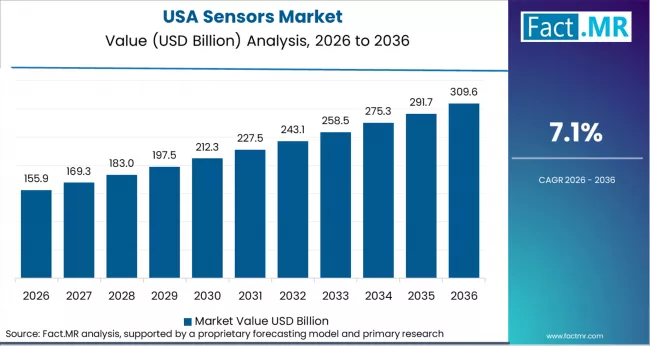
Sensors Market Country Value Analysis | Source: Fact.MR
North America remains a leading revenue market for advanced sensor platforms due to strong defense spending, industrial automation adoption, and automotive safety system integration. Major companies including Texas Instruments, Honeywell, and Analog Devices provide integrated sensing solutions across multiple industries.
- United States: The United States market grows at 7.1% CAGR through 2036 driven by semiconductor investment and automotive electronics demand. The CHIPS and Science Act supports MEMS sensor fabrication expansion at Texas Instruments’ Sherman Texas facility scheduled for production from 2026. The Department of Defense Microelectronics Commons program funds MEMS and photonic sensor development across national research hubs. Ford confirmed Analog Devices and Honeywell as key ADAS sensor suppliers for its 2026 EV models.
FACT.MR’s analysis of the sensors market in North America consists of country wise assessment including the United States, Canada, and Mexico. Readers can find CHIPS Act semiconductor investment data, defense electronics sensor procurement tracking, automotive sourcing benchmarks, and country level forecasts by sensor type and end user.
Competitive Aligners for Market Players
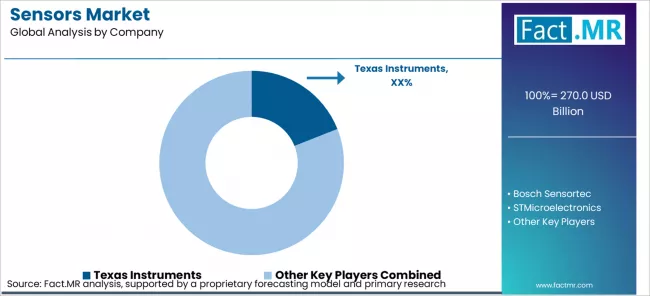
Sensors Market Analysis By Company | Source: Fact.MR
The global sensors market has a mixed competitive structure. Some segments are dominated by a few large companies, while others remain fragmented with many specialized suppliers. In high-volume CMOS image sensors, companies such as Sony, Samsung, and OmniVision lead the market by competing on image quality, pixel density, and performance in low-light conditions, especially for automotive cameras and consumer electronics. In the MEMS sensor category, Bosch Sensortec, STMicroelectronics, and Texas Instruments maintain strong positions due to their broad product portfolios and long-standing relationships with automotive manufacturers.
Certain firms also dominate specialized sensing applications. Honeywell, TE Connectivity, and Analog Devices are widely used in industrial automation, aerospace systems, and medical devices where precision, reliability, and certification standards are critical. Companies like Bosch Sensortec and STMicroelectronics benefit from owning their MEMS manufacturing facilities, allowing tighter process control and lower production costs. Texas Instruments leverages its analog electronics ecosystem, enabling customers to integrate sensors and signal processing components from one supplier.
Automotive manufacturers usually qualify two or three sensor suppliers for each component to maintain pricing flexibility. However, replacing an approved ADAS sensor during a vehicle programme is complex and expensive because safety systems must be revalidated. This gives existing suppliers a strong advantage once their sensors are integrated into vehicle platforms.
Key Players
- Texas Instruments
- Bosch Sensortec
- STMicroelectronics
- Honeywell International Inc.
- NXP Semiconductors
- Infineon Technologies
- Analog Devices Inc.
- TE Connectivity
- Omron Corporation
- Sensirion AG
Bibliography
- [1] Euro NCAP. (2024). Euro NCAP 2025 Roadmap: Updated Safety Assessment Protocol Including Mandatory ADAS Sensor System Requirements for Passenger Vehicle Ratings. October 2024.
- [2] National Development and Reform Commission, People's Republic of China. (2024). National Integrated Circuit Industry Investment Fund Phase III Approval: CMOS Image Sensor and MEMS Pressure Sensor Fabrication Capacity Investment. May 2024.
- [3] Platform Industry 4.0, Germany. (2024). Asset Administration Shell Implementation Guide Update: Industrial Sensor Data Exchange Interoperability Standards for Smart Manufacturing Applications. September 2024.
- [4] Bosch Group. (2025). Annual Report 2024: Automotive MEMS Sensor R&D Investment, BMI088 IMU Production Volume Ramp, and European OEM ADAS Supply Agreement Disclosures. February 2025.
- [5] STMicroelectronics. (2024). Product Launch Press Release: ASM330LHHX Automotive MEMS Accelerometer AEC-Q100 Grade 1 Qualification for Functional Safety-Critical ADAS Applications. October 2024.
- [6] Sony Semiconductor Solutions Corporation. (2025). Fiscal Year 2024 Annual Results: Automotive Image Sensor Revenue Growth and ADAS Imaging Market Share. March 2025.
- [7] Samsung Electronics. (2025). Q4 2024 Earnings Supplement: CMOS Image Sensor Production Expansion Investment at Hwaseong Facility for Automotive and Mobile Sensor Demand. January 2025.
- [8] Infineon Technologies. (2025). Product Launch: DPS368 MEMS Barometric Pressure Sensor with Integrated Temperature Sensing for Industrial IoT Applications. January 2025.
- [9] Defense Advanced Research Projects Agency (DARPA). (2024). Electronics Resurgence Initiative Annual Progress Report: NEMS Chemical Sensor Commercialisation and Prototype Contract Awards for Industrial Safety Applications. September 2024.
This Report Addresses
- Strategic intelligence on Euro NCAP ADAS mandates, China MIIT sensor policy, US CHIPS Act MEMS investment, Japan METI subsidies, and Germany Industry 4.0 standards shaping sensor demand.
- Market forecast from USD 270 billion in 2026 to USD 516.4 billion by 2036 at 6.7% CAGR across sensor type, technology, end user, and region.
- Growth opportunities across China IC Fund MEMS and CMOS fabs, South Korea image sensor expansion, Germany automotive ADAS procurement, France MEMS investment, and US semiconductor manufacturing support.
- Country CAGR outlook: China 8.2%, South Korea 7.8%, Japan 7.6%, Germany 7.4%, France 7.2%, United States 7.1%, United Kingdom 6.9%.
- Competitive analysis of Texas Instruments, Bosch Sensortec, STMicroelectronics, Honeywell, NXP Semiconductors, Infineon Technologies, Analog Devices, TE Connectivity, Omron, and Sensirion.
- Technology tracking of automotive MEMS accelerometers, next generation CMOS image sensors, NEMS gas sensors, and industrial IoT sensing platforms.
- Regulatory analysis covering Euro NCAP ADAS rules, US CHIPS Act provisions, China MIIT sensor plan, EU Machinery Regulation, and FDA biosensor approvals.
- Report delivered in PDF, Excel datasets, PowerPoint summary, and dashboard formats supported by production data, SEMI reports, government records, and primary interviews.
Segmentation
Scope of Report
| Attribute | Details |
|---|---|
| Quantitative Units | USD 270 billion (2026) to USD 516.4 billion (2036), at a CAGR of 6.7% |
| Market Definition | Electronic devices that detect and measure physical and environmental parameters and convert them into digital outputs for automotive, industrial, consumer electronics, healthcare, and aerospace applications. |
| Type Segmentation | Accelerometer & Speed Sensor, Image Sensor, Biosensor, Optical Sensor, Pressure Sensor, Temperature Sensor, Touch Sensor, Others |
| Technology Segmentation | CMOS, MEMS, NEMS, Others |
| End User Segmentation | Automotive, Aerospace & Defense, Electronics, Healthcare, Industrial, IT & Telecom, Others |
| Application Coverage | ADAS and autonomous vehicle sensing, industrial automation and process control, consumer electronics imaging, medical diagnostics and patient monitoring, smart infrastructure and IoT connectivity. |
| Regions Covered | Asia Pacific, Europe, North America, Latin America, Middle East and Africa |
| Countries Covered | China, Japan, South Korea, India, Australia and New Zealand, ASEAN, Rest of South Asia and Pacific, Germany, UK, France, Italy, Spain, Nordic, BENELUX, Rest of Western Europe, Russia, Poland, Hungary, USA, Canada, Mexico, Brazil, Chile, Ecuador, Rest of Latin America, Saudi Arabia, GCC, Turkey, South Africa, Rest of MEA |
| Key Companies Profiled | Texas Instruments, Bosch Sensortec, STMicroelectronics, Honeywell International Inc., NXP Semiconductors, Infineon Technologies, Analog Devices Inc., TE Connectivity, Omron Corporation, Sensirion AG |
| Forecast Period | 2026 to 2036 |
| Approach | Hybrid top-down and bottom-up model using sensor shipment volumes, average selling price trends by type and technology, end-user segment spending, automotive production forecasts, and primary interviews with OEM procurement leads and industrial electronics manufacturers. |
Source: Fact.MR analysis. Updated Mar 13, 2026
Sensors Market by Segments
-
By Type:
- Accelerometer & Speed Sensor
- Image Sensor
- Biosensor
- Optical Sensor
- Pressure Sensor
- Temperature Sensor
- Touch Sensor
- Others
-
By Technology:
- CMOS
- MEMS
- NEMS
- Others
-
By End User:
- Aerospace & Defense
- Automotive
- Electronics
- Healthcare
- Industrial
- IT & Telecom
- Others
-
By Region:
- North America
- United States
- Canada
- Mexico
- Latin America
- Brazil
- Chile
- Ecuador
- Rest of Latin America
- Western Europe
- Germany
- United Kingdom
- France
- Italy
- Spain
- Nordic
- BENELUX
- Rest of Western Europe
- Eastern Europe
- Russia
- Poland
- Hungary
- Balkan and Baltic
- Rest of Eastern Europe
- East Asia
- China
- Japan
- South Korea
- South Asia and Pacific
- India
- ASEAN
- Australia and New Zealand
- Rest of South Asia and Pacific
- Middle East and Africa
- Kingdom of Saudi Arabia
- Other GCC Countries
- Turkey
- South Africa
- Other African Union
- Rest of Middle East and Africa
- North America
Frequently Asked Questions
How large is the sensors market in 2025?
What will the market size be in 2026?
What is the projected market size by 2036?
What is the expected CAGR?
Which sensor type leads the market?
Which technology platform dominates?
Which end-user segment holds the largest share?
Which country shows the fastest growth?
What is the primary restraint?
Who worked on this report


Preview the report firsthand - request a free sample
Free SampleGet the brochure for pricing and purchase details
Download PDF