- Market Value (2025): USD 2.93 Bn
- Estimated Value (2026): USD 3.14 Bn
- Forecast Value (2036): USD 6.29 Bn
- CAGR (2026-2036): 7.2%
What is the Consumer MEMS Inertial Sensors Market forecast to be worth by 2036?
USD 3.14 billion in 2026 to USD 6.29 billion by 2036, at a 7.19% CAGR.
- As per Fact.MR analysis, the consumer MEMS inertial sensors market reached USD 2.93 billion in 2025.
- Demand will increase from USD 3.14 billion in 2026 to USD 6.29 billion in 2036.
- The market is forecast to grow at 7.2% CAGR from 2026 to 2036. Motion-aware phones, wearables and gaming devices will sustain component demand, with power consumption and integration shaping the value of each design win.
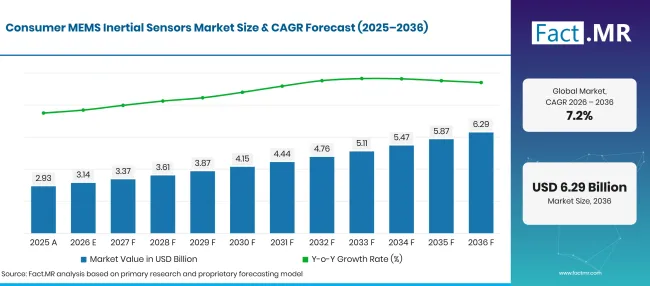
Factmr Consumer Mems Inertial Sensors Market Forecast Global | Source: Fact.MR
| Year | Basis | Market Value (USD billion) |
|---|---|---|
| 2025 | Actual | 2.93 |
| 2026 | Estimate | 3.14 |
| 2036 | Forecast | 6.29 |
| CAGR 2026 to 2036 | Forecast period | 7.2% |
Source: Fact.MR analysis. Updated Oct 16, 2026
What are the defining numbers behind Consumer MEMS Inertial Sensors Market growth?
USD 3.15 billion absolute opportunity between 2026 and 2036.
- Demand Drivers in the Market
- Always-on features change the battery budget. A watch may need to recognise motion while its main processor sleeps. Bosch’s wearable portfolio includes low-power sensors and devices with embedded processing. This creates a selling opportunity for components that carry out useful work without waking the rest of the system unnecessarily. [2]
- Camera features require motion data that arrives quickly and consistently. ST’s LSM6DSV16X supports separate processing channels for user-interface and image-stabilisation tasks. A phone maker can therefore judge a device on more than raw sensor accuracy. Timing, software integration and behaviour across operating modes also affect whether it fits the camera design. [7]
- Gaming adds motion-sensitive hardware outside the phone. PlayStation VR2 specifies six-axis sensing in both the headset and its controllers. Wearable gaming accessories need prompt tracking and repeatable response during movement. These requirements can support more capable sensor packages, although each finished device still represents a specific component configuration. [6]
- Software support makes sensor output usable. Android distinguishes physical sensors from software-derived measurements and provides a framework for accessing them. In the wider MEMS sensors business, component vendors that help developers handle calibration and operating modes can reduce integration work. That support is commercially useful even when the underlying sensing element is established. [3]
- Key Segments Analyzed
- By Sensor Type: Accelerometers lead at 42.3% of 2026 revenue, serving basic motion detection as well as more complex device functions.
- By Application: Smartphones account for 47.2% in 2026. Camera, orientation and user-interface requirements support their component content.
- By End-User: Consumer Electronics holds 68.4% in 2026. Automotive and healthcare uses form separate end-user categories within the defined motion-sensor coverage.
- Analyst Opinion at Fact.MR
- Shambu Nath Jha, Lead Consultant at Fact.MR says, “A sensor wins business when the finished device performs better within its power and size limits. Adding more axes does not automatically create more revenue if a combined package replaces separate chips. The strongest vendors can show customers what the complete sensing function will cost to integrate and operate.”
- Strategic Implications
- Present power consumption alongside the operating mode used to measure it. A headline low-power figure is of little use if the customer needs a higher sampling rate or continuous processing. Wearable design teams need a realistic comparison of the tasks the sensor can complete at each setting. [2]
- Build the commercial proposal around a complete motion function. Within inertial sensors, a combination device may replace several discrete parts. Vendors should make the trade-off between package cost, board space and software work clear before a customer commits to the design. [8]
- Treat health-related features as a separate qualification conversation. Accelerometer medical sensors may support clinical devices, but a motion chip in a fitness watch is not automatically a medically validated system. Product teams should distinguish consumer activity functions from claims that require additional evidence and approval. [1]
- Maintain reference software and clear migration support. Apple’s developer materials show how sensor data feeds application features across devices. A manufacturer changing its sensor should not have to rebuild every gesture or orientation function from the beginning. Predictable interfaces can help retain the account through later hardware revisions. [1]
Germany has the fastest forecast growth among the five markets. Each country presents a different route to an account: sensor design expertise, mass-market phones, software-led wearables or motion-intensive gaming hardware.
How does the Consumer MEMS Inertial Sensors Market break down by segment?
Accelerometers 42.3%; Smartphones 47.2%; Consumer Electronics 68.4% in 2026.
Which Sensor Type segment leads demand?
The Accelerometers segment holds 42.3% share in 2026.
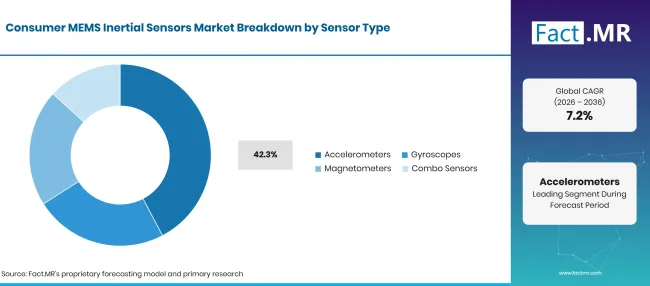
Factmr Consumer Mems Inertial Sensors Market Breakdown Sensor Type | Source: Fact.MR
| Sensor Type | Share (2026) |
|---|---|
| Accelerometers (Leading segment) | 42.3% |
| Other segments combined | 57.7%* |
| Total | 100.0% |
Source: Fact.MR analysis. Updated Oct 16, 2026
Accelerometers cover a broad set of basic motion tasks. Gyroscopes add rotational measurement, while combo sensors integrate functions into one package. Magnetometers are retained in the commercial segmentation as companion orientation sensors, not as inertial sensing elements. This distinction matters when comparing a six-axis IMU with a system that also uses magnetic heading information. [3] [8]
Which Application segment leads demand?
The Smartphones segment holds 47.2% share in 2026.
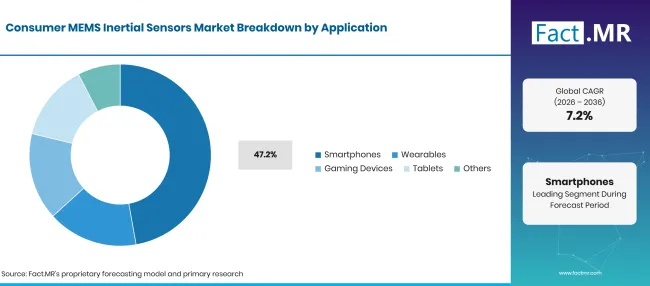
Factmr Consumer Mems Inertial Sensors Market Breakdown Application | Source: Fact.MR
| Application | Share (2026) |
|---|---|
| Smartphones (Leading segment) | 47.2% |
| Other segments combined | 52.8%* |
| Total | 100.0% |
Source: Fact.MR analysis. Updated Oct 16, 2026
Smartphones combine high shipment volumes with demanding integration work. Wearables give greater weight to battery life and compact packaging. Gaming devices prioritise responsive tracking, while tablets use motion data for orientation and selected applications. The most attractive design is not necessarily the one with the most sensors; it is the one whose functions make the component difficult to replace without retesting the product. [2] [6]
Which End-User segment leads demand?
The Consumer Electronics segment holds 68.4% share in 2026.
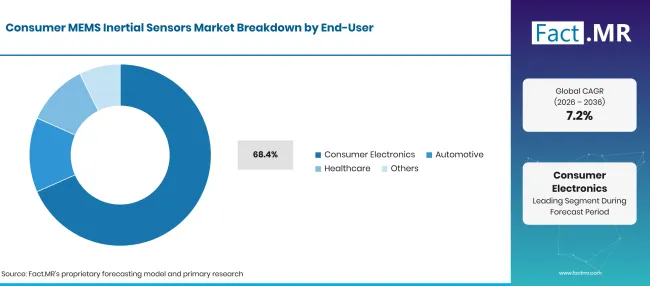
Factmr Consumer Mems Inertial Sensors Market Breakdown End User | Source: Fact.MR
| End-User | Share (2026) |
|---|---|
| Consumer Electronics (Leading segment) | 68.4% |
| Other segments combined | 31.6%* |
| Total | 100.0% |
Source: Fact.MR analysis. Updated Oct 16, 2026
Consumer electronics is the largest end-user group. The automotive and healthcare categories cover relevant motion and orientation components supplied into those applications. They should not absorb unrelated pressure sensors or complete navigation systems. Qualification, operating conditions and claims differ by customer, so a consumer-grade part cannot be treated as interchangeable with every specialised device. [3] [7]
What is accelerating Consumer MEMS Inertial Sensors Market adoption, and what is holding it back?
The main tension is between richer motion functions and falling component content through integration. Low-power processing and dependable software can support value per device. Price pressure, calibration work and long customer design cycles make it difficult to convert a technically capable part into a lasting production order.
Drivers Impact Analysis
| DRIVER | (~) % IMPACT ON CAGR | GEOGRAPHIC RELEVANCE | IMPACT TIMELINE |
|---|---|---|---|
| Always-on wearable motion functions | +1.7% | Global wearable programmes | Medium term (2 to 4 years) |
| Handset stabilisation and motion interfaces | +1.3% | Global smartphone supply chains | Short term (up to 2 years) |
| Six-axis gaming and headset designs | +0.9% | Japan, United States, Europe | Medium term (2 to 4 years) |
| Embedded sensor processing | +0.8% | Premium consumer electronics | Medium term (2 to 4 years) |
| Motion features across connected devices | +0.6% | Global | Long term (4 years or more) |
Source: Fact.MR analysis. Updated Oct 16, 2026
Opportunity Impact Analysis
| OPPORTUNITY | (~) % IMPACT ON CAGR | GEOGRAPHIC RELEVANCE | IMPACT TIMELINE |
|---|---|---|---|
| Low-power sensor fusion packages | +1.2% | Wearables and mobile devices | Medium term (2 to 4 years) |
| Camera-specific application support | +0.9% | Smartphone design centres | Short term (up to 2 years) |
| Customer software migration support | +0.4% | Global OEM accounts | Short term (up to 2 years) |
| Qualified health-related motion functions | +0.7% | United States, Europe, Japan | Long term (4 years or more) |
Source: Fact.MR analysis. Updated Oct 16, 2026
Restraints Impact Analysis
| RESTRAINT | (~) % IMPACT ON CAGR | GEOGRAPHIC RELEVANCE | IMPACT TIMELINE |
|---|---|---|---|
| Consumer component price erosion | -1.2% | Global | Short term (up to 2 years) |
| Fewer discrete parts through integration | -0.8% | High-volume electronics | Medium term (2 to 4 years) |
| Calibration and software validation effort | -0.9% | New device designs | Medium term (2 to 4 years) |
| Uneven handset replacement cycles | -0.5% | Smartphone-dependent accounts | Short term (up to 2 years) |
Source: Fact.MR analysis. Updated Oct 16, 2026
Which countries are scaling the Consumer MEMS Inertial Sensors Market through 2036?
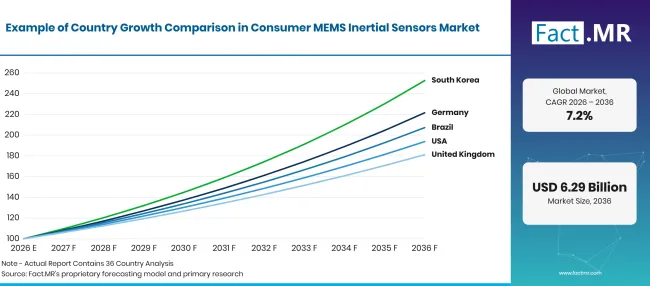
Factmr Consumer Mems Inertial Sensors Market Growth Index | Source: Fact.MR
| Country | CAGR (2026 to 2036) |
|---|---|
| Germany | 8.28% |
| Brazil | 7.56% |
| United States | 6.84% |
| United Kingdom | 6.12% |
| Japan | 5.40% |
Source: Fact.MR analysis. Updated Oct 16, 2026
What gives Germany a strong development position?
8.28% CAGR. Low-power design expertise supports higher-value customer programmes.
Bosch Sensortec’s wearable range puts Germany close to the engineering decisions behind activity tracking and compact connected devices. The commercial opportunity is to secure a role in the customer’s next platform through power performance and application support. Domestic sensor expertise does not mean all related finished-device demand is German. Growth should be understood through the country’s purchasing and design activity rather than the worldwide shipments of a German-headquartered supplier. [2]
How does Brazil’s phone market shape the opportunity?
7.56% CAGR. Mainstream handset programmes matter alongside premium devices.
Samsung markets the Galaxy A56 through a dedicated Brazilian product page, illustrating a mainstream local handset offer. For sensor companies, the engineering decision sits upstream with the device maker rather than the retailer. Android’s motion-sensor framework shows the functions that handset applications can access. The account opportunity depends on the components selected for a production programme and where its finished devices are sold. [5] [3]
Why is software important to the United States outlook?
6.84% CAGR. Application features help sustain demand for capable motion hardware.
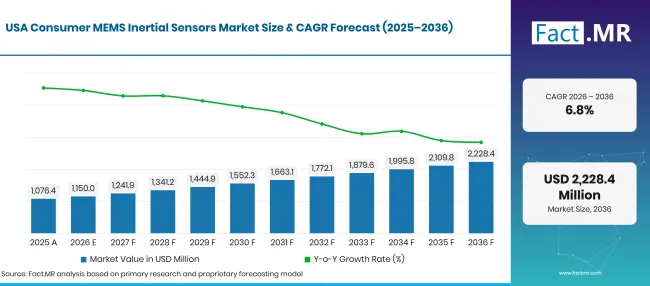
Factmr Consumer Mems Inertial Sensors Market Forecast Usa | Source: Fact.MR
Apple’s device-sensor documentation explains how applications use motion inputs across its device family. This makes developer support a practical part of the U.S. opportunity. A component that supplies consistent data can support several application features without requiring a different sensor for each one. Vendors benefit when their hardware and software remain usable through product updates, rather than relying solely on an annual increase in device shipments. [1]
Where can UK suppliers and developers add value?
6.12% CAGR. Accessible development hardware supports integration and prototyping.
Raspberry Pi’s Sense HAT documentation includes an accelerometer, gyroscope and magnetometer on one development platform. It illustrates how UK-linked engineering activity can lower the barrier to testing motion-based applications. Commercial value appears later when a prototype becomes a supported product design. Small development-board sales are not a proxy for the whole consumer market, but accessible tools can help component vendors reach new design teams. [4]
What distinguishes Japan’s motion-sensing demand?
5.40% CAGR. Gaming creates requirements beyond everyday orientation sensing.
Sony’s PlayStation VR2 specifies motion sensing in the headset and in the handheld controllers. This creates a concrete example of several motion-sensitive devices working together within one entertainment system. Japanese gaming and electronics programmes offer opportunities for accurate, responsive components with dependable calibration. The relevant business case is the hardware configuration and its production cycle, not a general rise in time spent playing games. [6]
Who leads the Consumer MEMS Inertial Sensors Market?
Bosch Sensortec, STMicroelectronics and TDK InvenSense offer documented motion-sensor portfolios. Their products combine sensing, embedded functions and software support in different ways. Buyers compare the entire implementation: power at the required operating mode, package footprint and the effort needed to qualify the part. A low-priced sensor can be less attractive if it adds substantial work elsewhere in the device. [2] [7] [8]
The broader comparison includes suppliers with differing exposure to consumer, automotive and industrial motion sensing. Procurement teams should compare current part families rather than assume that every company competes for the same smartphone socket. A vendor’s ability to support the next product revision may be as important as its specification advantage in the current design.
Which companies are the key providers?
The company coverage below spans motion-sensor suppliers with different consumer and adjacent application portfolios.
- Bosch Sensortec GmbH
- STMicroelectronics
- TDK Corporation
- Murata Manufacturing
- Analog Devices
- NXP Semiconductors
- Texas Instruments
- Honeywell International
- Kionix (ROHM)
- Panasonic
Bibliography
- [1]Apple. (n.d.). Device sensors.
- [2] Bosch Sensortec. (n.d.). Sensing solutions for wearables.
- [3] Google. (2026, October 1). Sensors overview. Android Developers.
- [4] Raspberry Pi. (n.d.). Sense HAT.
- [5] Samsung Electronics. (2025, March 2). Galaxy A56 5G.
- [6] Sony Interactive Entertainment. (n.d.). PlayStation VR2 tech specs.
- [7] STMicroelectronics. (n.d.). LSM6DSV16X: 6-axis inertial measurement unit (IMU) with embedded AI and sensor fusion, Qvar for high-end applications.
- [8] TDK InvenSense. (n.d.). TDK SmartMotion® MEMS inertial sensors.
This Report Answers
- How do power budgets influence the choice between discrete and combination sensors?
- Which smartphone functions create demanding motion-data requirements?
- What separates consumer activity tracking from medically claimed applications?
- How do developer tools help a sensor reach a finished product?
- Why can richer sensing functions coexist with fewer discrete components?
What does the Consumer MEMS Inertial Sensors Market cover?
Coverage centres on MEMS accelerometers, gyroscopes and integrated motion devices for the listed applications. Companion magnetometers are shown separately because they contribute heading information but do not measure inertia. The end-user view includes the relevant automotive and healthcare component business specified in the segmentation.
What is included in the scope?
Revenue includes the motion or orientation sensor component sold, whether discrete or integrated. Combination devices are counted once. Smartphone, wearable, gaming and tablet applications provide separate views of the same component market.
What is excluded from the scope?
Finished phones, watches and gaming systems are excluded. Software subscriptions, application revenue and standalone medical services are not sensor sales. Pressure, temperature and optical sensors are outside the defined component set, as are complete industrial navigation systems.
How Was the Analysis Built?
The analysis draws on 120+ sources, 35+ company portfolios, 25+ countries, and more than 20 industry interviews.
- Primary Research: Primary research includes discussions with manufacturers, service providers, technology developers, distributors, end users, and subject-matter experts. These conversations examine purchasing priorities, product adoption, operational challenges, approval requirements, competitive positioning, and the factors that influence wider market acceptance.
- Desk Research: Desk research covers government statistics, regulatory publications, company filings, trade data, technical studies, industry associations, standards, public policy, and other authoritative sources. Every source used in the analysis is documented in the bibliography.
- Market Sizing and Forecasting: Market estimates combine historical performance, demand indicators, pricing and volume trends, segment shares, company participation, country-level growth, adoption patterns, investment activity, and barriers to market expansion.
- Data Validation and Update Cycle: Findings are validated by comparing primary interviews with public data, company activity, regulatory changes, trade patterns, and industry developments. Regular updates review new product launches, capacity changes, partnerships, approvals, and shifts in commercial adoption.
Segmentation
What is the report’s scope and coverage?
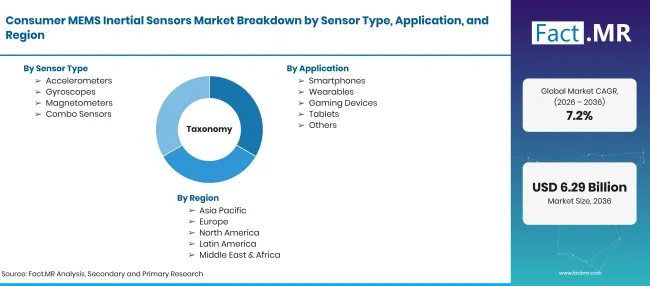
Factmr Consumer Mems Inertial Sensors Market Taxonomy | Source: Fact.MR
| Attribute | Details |
|---|---|
| Quantitative Units | USD billion in 2026 and 2036; CAGR for 2026 to 2036 |
| Market Definition | MEMS motion-sensing components used in consumer-oriented devices, with companion magnetometers and relevant adjacent end-user applications included in the stated taxonomy. |
| Sensor Type | Accelerometers; Gyroscopes; Magnetometers; Combo Sensors |
| Application | Smartphones; Wearables; Gaming Devices; Tablets; Others |
| End-User | Consumer Electronics; Automotive; Healthcare; Others |
| Regions Covered | North America; Latin America; Western Europe; Eastern Europe; East Asia; South Asia & Pacific; Middle East & Africa |
| Countries Covered | Germany; Brazil; United States; United Kingdom; Japan |
| Companies Profiled | Bosch Sensortec GmbH; STMicroelectronics; TDK Corporation; Murata Manufacturing; Analog Devices; NXP Semiconductors; Texas Instruments; Honeywell International; Kionix (ROHM); Panasonic |
| Forecast Period | 2026 to 2036 |
| Approach | Component-function review, OEM integration requirements, developer documentation and motion-enabled product examples. |
Source: Fact.MR analysis. Updated Oct 16, 2026
How is the market segmented?
-
By Sensor Type
- Accelerometers
- Gyroscopes
- Magnetometers
- Combo Sensors
-
By Application
- Smartphones
- Wearables
- Gaming Devices
- Tablets
- Others
-
By End-User
- Consumer Electronics
- Automotive
- Healthcare
- Others
-
By Region
- North America
- Latin America
- Western Europe
- Eastern Europe
- East Asia
- South Asia & Pacific
- Middle East & Africa
Frequently Asked Questions
How big is the consumer MEMS inertial sensors market in 2026?
What is the CAGR from 2026 to 2036?
Which sensor type segment leads?
Which application segment leads?
Why are magnetometers shown in the segmentation?
Who worked on this report


Preview the report firsthand - request a free sample
Free SampleGet the brochure for pricing and purchase details
Download PDF