- Base Value(2025): 5.1 Bn
- Estimated Value(2026): 6.0 Bn
- Forecast Value (2036): 35.6 Bn
- CAGR (2026 - 2036): 19.5%
Fully Digital Instrument Cluster Display Systems Market Forecast and Outlook by Fact.MR
In 2025, the fully digital instrument cluster display systems market was valued at USD 5.1 billion. Based on Fact.MR analysis, demand for fully digital instrument cluster display systems is estimated to grow to USD 6.0 billion in 2026 and USD 35.6 billion by 2036. FACT.MR projects a CAGR of 19.5% during the forecast period.
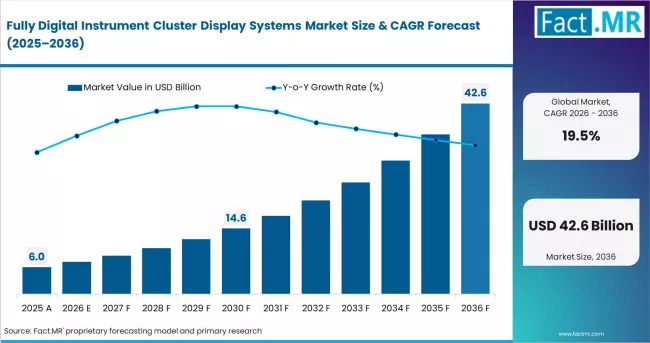
Fully Digital Instrument Cluster Display Systems Market Value Analysis | Source: Fact.MR
Summary Fully Digital Instrument Cluster Display Systems Market
- Market Definition
- The market includes fully digital TFT-LCD and OLED instrument cluster display systems replacing analogue gauges in passenger cars and SUVs across global OEM production platforms.
- Demand Drivers
- OEM Digital Cockpit Mandates: Chinese NEV OEMs are standardising fully digital instrument clusters across all new model platforms, accelerating volume replacement of analogue and hybrid cluster systems.
- NHTSA Display Safety Guidelines: Updated U.S. NHTSA guidelines for in-vehicle display systems are increasing OEM demand for certified ADAS-integrated digital cluster platforms meeting distraction mitigation requirements.
- OLED Premium Uptake: European and South Korean premium OEMs are specifying OLED digital clusters in luxury and EV models, driving average selling price uplift and Tier 1 supplier differentiation.
- Key Segments Analyzed
- By Cluster Type: Fully digital clusters lead with 55% share in 2026. They are replacing semi-digital hybrids. OEMs are standardising digital cockpit systems across segments.
- By Display Technology: TFT-LCD holds over 60% share in 2026. Growth is driven by cost efficiency and supply maturity. OLED is the fastest-growing in luxury and EV segments.
- By Vehicle Type: Passenger cars lead with 56.6% share in 2026. SUVs are expanding quickly. This is due to higher feature integration and premium cockpit demand.
- By Geography: China leads with 21.4% CAGR through 2036. Growth is driven by NEV expansion. OEMs are mandating full-digital cockpits in mass-market EVs.
- Analyst Opinion at FACT.MR
- Shambhu Nath Jha, Principal Consultant at Fact.MR, opines, CXOs will see automotive-grade OLED qualification depth as a key contract factor. Integrated cockpit software certification will also shape decisions. Suppliers without functional safety-certified cluster platforms will face exclusion. They risk missing next-generation OEM programme cycles through 2036.
- Strategic Implications
- Invest in ASIL-B and ASIL-D functional safety-certified digital cluster platforms to qualify for premium OEM programmes in Germany, South Korea, and the United States.
- Build OLED automotive display production capacity targeting luxury and EV segment OEM design wins where TFT-LCD cost efficiency does not offset premium cluster specification requirements.
- Develop integrated instrument-infotainment cockpit architectures to capture OEM demand shifting away from standalone cluster procurement toward combined digital cockpit platform sourcing.
- Methodology
- Market sizing uses OEM vehicle production volumes, digital cluster attach rates, and average selling prices by display technology. Validated with 2024–2025 procurement data.
- Incorporates NHTSA display safety guidelines, EU vehicle type approval updates, China NEV cluster mandates, and Tier 1 supplier revenue disclosures.
- Forecasts factor in OLED cost curve trajectories, OEM platform electrification timelines, and ASIL certification cycle lengths across cluster types.
| Metric | Value |
|---|---|
| Estimated Value in 2026 | USD 6.0 billion |
| Forecast Value in 2036 | USD 35.6 billion |
| Forecast CAGR (2026 to 2036) | 19.5% |
Between 2026 and 2036, the market is projected to generate an absolute opportunity of USD 29.6 billion. Growth is transformational, not incremental. OEM mandates for digital cockpit integration are accelerating platform-wide cluster replacement. Demand is rising across Asia, North America, and Europe. Growth is moderated by display driver IC supply constraints, ASIL-B and ASIL-D functional safety certification timelines, and integration complexity at high-volume mid-range vehicle platforms.
Procurement trends are shifting toward integrated digital cockpit solutions. Standalone cluster units are being replaced by combined instrument-infotainment architectures. Continental AG and Bosch Mobility are securing multi-year OEM cluster contracts. Buyers are tightening display uniformity, colour gamut, and ADAS data overlay specifications. Automotive-grade OLED qualification cycles span 18 to 24 months, reinforcing incumbent supplier positions.
China leads with a projected CAGR of 21.4% through 2036, driven by new energy vehicle platform proliferation and OEM mandates for full-digital cockpits in mass-market EV models. South Korea follows at 20.8%, anchored by Samsung Display and LG Display automotive-grade OLED supply for export vehicle programmes. The United States records 19.8%, supported by EV transition investment and NHTSA advanced display safety guideline adoption. Germany records 19.2%, led by Continental, Bosch, and Volkswagen Group cockpit digitalisation across premium segments. Japan grows at 18.7%, driven by Toyota and Honda platform digital cluster mandates across global production models. Mature European markets face higher ASIL certification costs and longer OEM platform qualification cycles as structural constraints.
Segmental Analysis
Fully Digital Instrument Cluster Display Systems Market Analysis by Cluster Type
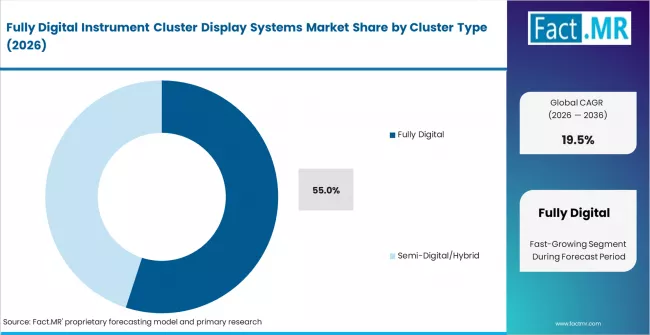
Fully Digital Instrument Cluster Display Systems Market Analysis By Cluster Type | Source: Fact.MR
Based on FACT.MR, fully digital clusters hold 55% share in 2026. OEMs are eliminating semi-digital clusters at the design stage. Integrated cockpit systems reduce wiring complexity. They also enable software-based configuration across markets.
- Continental AG Investment: Continental AG announced a EUR 250 million investment in 2024. The focus is digital cockpit manufacturing in Germany. Production supports major OEM programmes from 2025. [4]
- Visteon Technology Development: Visteon launched SmartCore Cockpit Domain Controller 2.0 in Q1 2025. It integrates cluster and infotainment into one platform. The solution targets cost-efficient OEM programmes. [5]
- Cluster Transition Trend: DSCC data shows digital cluster adoption rising globally. Attach rates increased from 38% in 2022 to 52% in 2024. China exceeded 65% in NEV segments. Hybrid clusters declined significantly. [6]
Fully Digital Instrument Cluster Display Systems Market Analysis by Display Technology
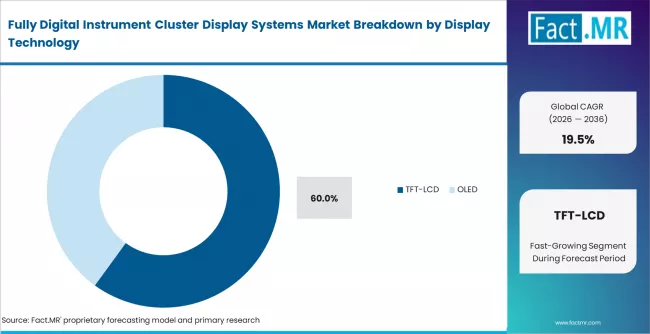
Fully Digital Instrument Cluster Display Systems Market Analysis By Display Technology | Source: Fact.MR
Based on FACT.MR, TFT-LCD holds over 60% share in 2026. It leads due to mature supply chains and lower costs. Pricing remains 40–60% below OLED. High-volume vehicles depend on TFT-LCD sourcing.
- Samsung Display Investment: Samsung Display expanded OLED production in Q4 2024. The Cheonan facility added 30,000 monthly substrates. Output targets automotive display programmes. [7]
- LG Display Development: LG Display launched its P-OLED cluster panels in Q1 2025. Sizes include 10.25-inch and 12.3-inch formats. Panels achieved ASIL-B certification. They target EV platforms in North America and Europe. [8]
- OLED Cost Curve Trend: DSCC projects OLED prices declining by 18% between 2024 and 2027. Scale-up by Samsung and LG is the key driver. This is accelerating OEM adoption in mid-premium vehicles.
Drivers, Restraints, and Opportunities
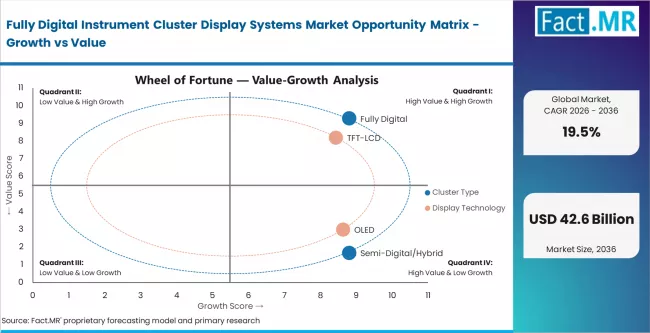
Fully Digital Instrument Cluster Display Systems Market Opportunity Matrix Growth Vs Value | Source: Fact.MR
FACT.MR analysis indicates that the fully digital instrument cluster display systems market is undergoing rapid transition. OEM cockpit electrification is a key driver. NEV platform mandates are accelerating adoption. The shift from analogue and hybrid clusters to fully digital systems is expanding across segments. China’s NEV scale is the primary demand driver in 2026.
Semi-digital clusters are losing share in mid-range platforms. Fully digital TFT-LCD clusters are replacing them at scale. OLED clusters carry 40–60% price premiums. OEMs absorb this in luxury and EV segments. Cockpit experience is a key differentiator. TFT-LCD remains dominant in mass-market vehicles due to cost and supply maturity.
- NEV Platform Mandates: China’s Ministry of Industry and Information Technology updated NEV standards in 2024. Digital cluster interfaces are now mandated for vehicles above RMB 150,000. BYD and NIO standardised fully digital clusters in 2025 models. This is driving procurement from Continental AG and Visteon Corporation. [1]
- NHTSA Display Safety Policy: NHTSA issued updated display guidelines in Q3 2024. It defined limits on driver glance duration. U.S. OEMs are adopting ADAS-integrated cluster systems. Demand is rising for safety-certified platforms. [2]
- EU Vehicle Type Approval: The European Commission updated UN ECE Regulation 48 in 2024. New rules cover luminance and colour standards. OEMs like Volkswagen Group and BMW accelerated cluster qualification. This is creating structured supplier demand. [3]
Regional Analysis
The fully digital instrument cluster display systems market is assessed across Asia Pacific, North America, Europe, Latin America, and Middle East and Africa, covering 40+ countries with distinct OEM procurement structures, vehicle electrification timelines, and display technology qualification frameworks. The full report offers market attractiveness analysis by region and country.
.webp "Top Country Growth Comparison Fully Digital Instrument Cluster Display Systems Market Cagr (2026 2036)")
Top Country Growth Comparison Fully Digital Instrument Cluster Display Systems Market Cagr (2026 2036) | Source: Fact.MR
| Country | CAGR (2026 to 2036) |
|---|---|
| China | 21.4% |
| South Korea | 20.8% |
| United States | 19.8% |
| Germany | 19.2% |
| Japan | 18.7% |
Source: Fact.MR (FACT.MR) analysis, based on proprietary forecasting model and primary research
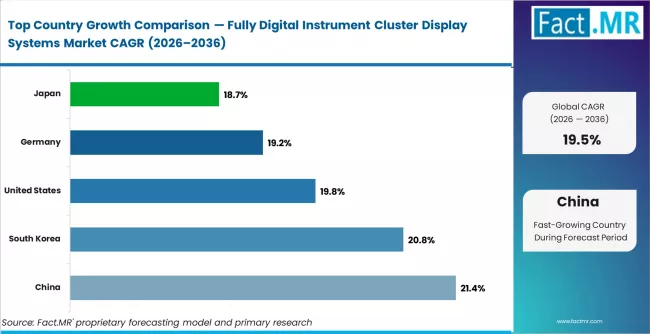
Fully Digital Instrument Cluster Display Systems Market Cagr Analysis By Country | Source: Fact.MR
Asia Pacific Fully Digital Instrument Cluster Display Systems Market Analysis
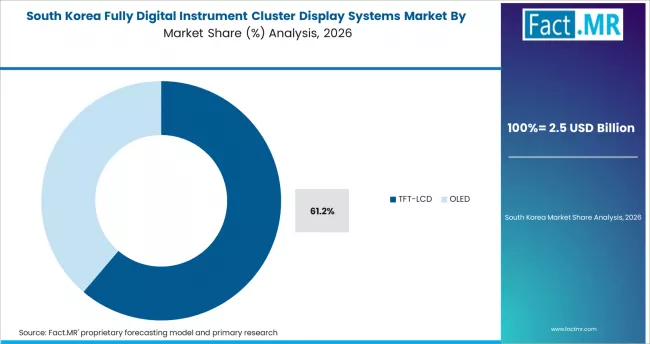
Fully Digital Instrument Cluster Display Systems Market South Korea Market Share Analysis By Display Technology | Source: Fact.MR
Asia Pacific leads in both scale and innovation. Growth is anchored by China’s NEV expansion and South Korea’s OLED leadership. China drives mass-market cluster replacement. Samsung Display, LG Display, and Visteon Corporation anchor regional supply through OEM partnerships.
- China: China represents a scale-driven transformation market. Demand is projected to rise at 21.4% CAGR through 2036. NEV standards updated in 2024 mandate digital clusters. OEMs like BYD, NIO, and Li Auto are standardizing full-digital cockpits. Visteon reported 6 million annual unit wins in 2024. Regional subsidies in Guangdong and Shanghai are accelerating NEV adoption.
- South Korea: South Korea operates as a technology export hub. Demand is projected to rise at 20.8% CAGR through 2036. OLED production expansion is a key driver. Samsung Display scaled its Cheonan facility in 2024. Hyundai Mobis launched an integrated cluster-HUD controller. The country leads next-gen cockpit system exports.
- Japan: Japan reflects platform-driven standardization. Demand is projected to rise at 18.7% CAGR through 2036. Toyota and Honda are deploying global digital cluster platforms. Toyota mandated digital clusters across its new architecture in 2024. Japan Display secured TFT-LCD supply agreements. This supports high-volume domestic and export production.
Fact.MR’s analysis covers China, South Korea, Japan, India, ASEAN, and Australia and New Zealand. It includes NEV mandates, OLED production, and cockpit pipeline trends.
North America Fully Digital Instrument Cluster Display Systems Market Analysis
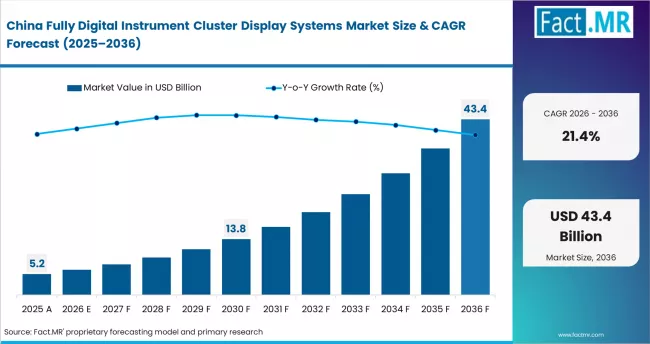
Fully Digital Instrument Cluster Display Systems Market Country Value Analysis | Source: Fact.MR
North America is driven by regulation and OEM scale. NHTSA guidelines shape certification needs. OEMs like GM, Ford, and Stellantis anchor demand. Continental AG and Visteon Corporation hold strong Tier 1 positions.
- United States: The U.S. market is compliance-focused and EV-led. Demand is projected to rise at 19.8% CAGR through 2036. NHTSA updated display safety rules in 2024. OEMs must meet glance duration and ADAS integration standards. General Motors standardised digital clusters across Ultium EVs. Continental AG is a key supplier for these programmes.
Fact.MR’s analysis covers the United States, Canada, and Mexico. It includes compliance timelines, electric vehicle adoption, and procurement benchmarks.
Europe Fully Digital Instrument Cluster Display Systems Market Analysis
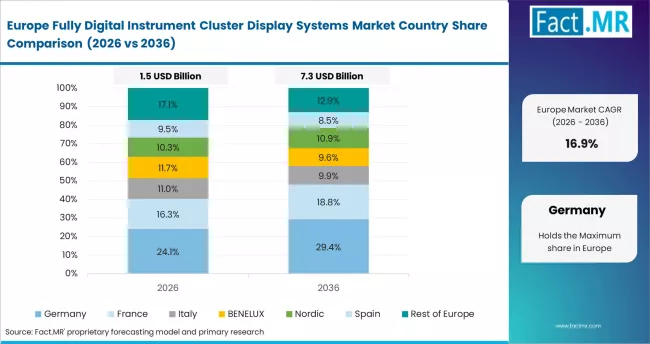
Fully Digital Instrument Cluster Display Systems Market Europe Country Market Share Analysis, 2026 & 2036 | Source: Fact.MR
Europe is a premium and regulation-led market. EU standards define global benchmarks. Electrification timelines are accelerating adoption. Continental AG and Bosch Mobility dominate Tier 1 supply.
- Germany: Germany stands as the engineering and production core. Demand is projected to rise at 19.2% CAGR through 2036. OEMs like Volkswagen, BMW, and Mercedes are scaling digital cockpits. UN ECE Regulation 48 updates are driving compliance. Continental’s EUR 250 million investment supports OEM supply. Germany remains the European hub for digital cluster systems.
Fact.MR’s analysis covers Germany, France, the United Kingdom, Italy, Spain, and Rest of Europe. It includes regulatory timelines, OLED adoption, and supplier programme data.
Competitive Aligners for Market Players
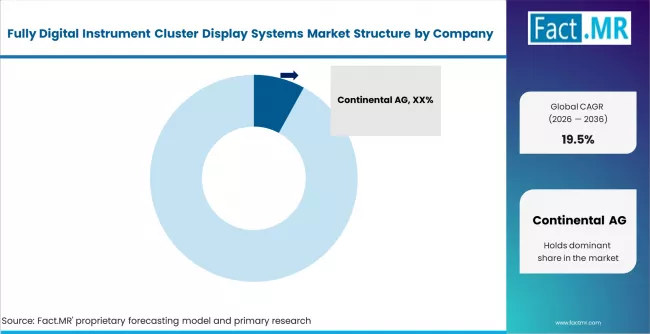
Fully Digital Instrument Cluster Display Systems Market Analysis By Company | Source: Fact.MR
The competitive landscape of the fully digital instrument cluster display systems market is highly consolidated. It is led by a few Tier 1 suppliers and display manufacturers. Continental AG, Visteon Corporation, and Bosch Mobility dominate global supply. They rely on long-term OEM contracts and deep integration capabilities. Competition is shifting toward integrated cockpit solutions. Suppliers are combining clusters with infotainment, HUD, and ADAS systems. Unified platforms reduce complexity for OEMs. This strengthens supplier positioning in vehicle programmes.
Display technology is a key differentiator. Samsung Display and LG Display lead in OLED innovation. They focus on premium and EV segments. TFT-LCD remains dominant in volume markets. It benefits from cost efficiency and mature supply chains.
Regional dynamics influence competition. China drives large-scale NEV demand. Suppliers compete for high-volume contracts. Europe and North America focus on compliance and safety certification. Software validation is becoming critical in procurement.The market is moving toward platform-based competition. Suppliers must offer hardware, software, and certification together. Scalable manufacturing is also essential. Those with integrated capabilities will secure future OEM contracts and sustain growth.
Key Players
- Continental AG
- Robert Bosch GmbH (Bosch Mobility)
- Visteon Corporation
- Nippon Seiki Co., Ltd.
- Samsung Display Co., Ltd.
- LG Display Co., Ltd.
- Hyundai Mobis Co., Ltd.
- Yazaki Corporation
- Denso Corporation
- Japan Display Inc.
Bibliography
- [1] Ministry of Industry and Information Technology, China. (2024). NEV Technical Standards Update 2024: Digital Instrument Cluster Interface Mandates for New Energy Vehicle Models Above RMB 150,000 Including BYD and NIO Platform Implementation Requirements. 2024. miit.gov.cn/english
- [2] National Highway Traffic Safety Administration. (Q3 2024). Guidelines for In-Vehicle Visual Displays: Revised Distraction Mitigation Standards and Maximum Glance Duration Requirements for Digital Instrument Cluster and ADAS Data Integration in Passenger Vehicles. Q3 2024. nhtsa.gov
- [3] United Nations Economic Commission for Europe. (2024). ECE Regulation 48 Amendment: Digital Instrument Cluster Luminance and Colour Temperature Requirements for Vehicle Type Approval in European Union Member States. 2024. unece.org/transport/vehicle-regulations
- [4] Continental AG. (Q3 2024). Capital Investment Disclosure: EUR 250 Million Digital Cockpit Display Manufacturing Capacity Expansion at Regensburg Facility Targeting Fully Digital Instrument Cluster Supply for Volkswagen Group, BMW, and Stellantis OEM Programmes. Q3 2024. continental.com/en/investors
- [5] Visteon Corporation. (Q1 2025). Product Launch: SmartCore Cockpit Domain Controller 2.0 Integrating Fully Digital Instrument Cluster and Infotainment Processing for Mass-Market OEM Programmes in China and North America. January 2025. visteon.com/news
- [6] Display Supply Chain Consultants. (2024). Automotive Display Market Report 2024: Fully Digital Instrument Cluster Attach Rate Growth from 38% in 2022 to 52% in 2024 Globally, OLED Automotive Panel ASP Decline of 18% Projected 2024 to 2027. 2024. displaysupplychain.com
- [7] Samsung Display Co., Ltd. (Q4 2024). Operations Update: Automotive-Grade P-OLED Production Line Expansion at Cheonan Facility Adding 30,000 Monthly Substrate Starts for Instrument Cluster and Integrated Cockpit Display Programmes at Korean and European OEMs. Q4 2024. samsungdisplay.com/eng/about/news
- [8] LG Display Co., Ltd. (Q1 2025). Product Launch: P-OLED Automotive Cluster Panel Series in 10.25-Inch and 12.3-Inch Configurations with ASIL-B Display Controller Certification Specified for GM and Stellantis EV Platform Instrument Cluster Programmes. January 2025. lgdisplay.com/eng/media
This Report Addresses
- Strategic intelligence on fully digital instrument cluster display system demand across TFT-LCD and OLED display technologies for passenger car and SUV OEM procurement programmes globally.
- Market forecast from USD 6.0 billion in 2026 to USD 35.6 billion by 2036 at a CAGR of 19.5%.
- Growth opportunity mapping across China NEV platform cluster mandates, U.S. NHTSA display safety compliance, South Korea OLED automotive technology leadership, Germany premium cockpit digitalisation, and Japan global platform cluster standardisation.
- Segment analysis by cluster type (fully digital, semi-digital/hybrid), display technology (TFT-LCD, OLED), and vehicle type (passenger cars, SUVs) across global and regional markets.
- Regional outlook covering Asia Pacific NEV-driven cluster procurement, North America NHTSA-catalysed safety certification demand, and Europe EU vehicle type approval and premium OEM digital cockpit rollout.
- Competitive analysis of Continental AG, Bosch Mobility, Visteon Corporation, Nippon Seiki, Samsung Display, LG Display, Hyundai Mobis, and Denso covering ASIL certification depth, OEM programme tenure, and integrated cockpit platform positioning.
- Regulatory impact analysis covering NHTSA in-vehicle display safety guidelines, EU UN ECE Regulation 48 digital cluster standards, China MIIT NEV technical requirements, and EU vehicle type approval display luminance specifications.
- Report delivered in PDF, Excel datasets, and presentation formats. Supported by primary interviews, OEM programme disclosures, DSCC automotive display shipment data, and Tier 1 supplier revenue filings.
Fully Digital Instrument Cluster Display Systems Market Definition
The market covers fully digital instrument cluster display systems using TFT-LCD and OLED panels integrated into passenger cars and SUVs, replacing analogue gauges with configurable digital interfaces for speed, navigation, ADAS warnings, and vehicle data presentation.
Fully Digital Instrument Cluster Display Systems Market Inclusions
Covers global and regional forecasts from 2026 to 2036 by cluster type and display technology. Includes fully digital and semi-digital hybrid clusters in TFT-LCD and OLED grades. Applications covered include passenger cars and SUVs across direct OEM and Tier 1 supplier channels.
Fully Digital Instrument Cluster Display Systems Market Exclusions
Excludes head-up displays and standalone infotainment touchscreens unless embedded within instrument cluster architectures. Omits analogue gauge clusters and finished vehicle cockpit assemblies. Excludes display driver ICs and backlight components as standalone components not integrated into cluster systems.
Fully Digital Instrument Cluster Display Systems Market Research Methodology
- Primary Research
- Interviews with OEM cockpit procurement managers, Tier 1 cluster suppliers, display panel manufacturers, and automotive software certification engineers across China, Germany, United States, Japan, and South Korea.
- Desk Research
- Analysis of filings from Continental AG, Bosch Mobility, and Samsung Display, alongside NHTSA display safety guidelines, EU vehicle type approval updates, and automotive display shipment data from DSCC (2024–2025).
- Market-Sizing and Forecasting
- Hybrid approach using OEM vehicle production volumes by platform, digital cluster attach rates by segment, and average selling prices by display technology and cluster type.
- Data Validation and Update Cycle
- Validated through OEM procurement disclosures, Tier 1 supplier revenue data, and global vehicle production statistics. Updated annually with display technology cost curve inputs.
Scope of Report
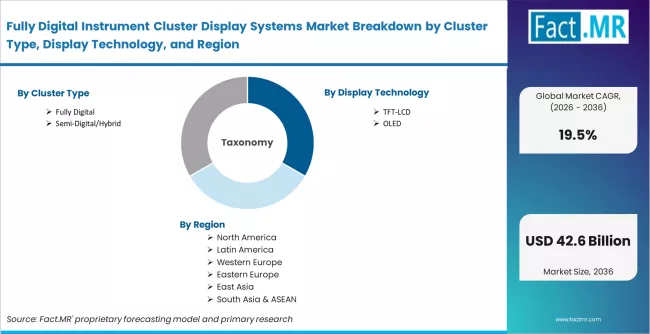
Fully Digital Instrument Cluster Display Systems Market Breakdown By Cluster Type Display Technology And Region | Source: Fact.MR
| Attribute | Details |
|---|---|
| Quantitative Units | USD 6.0 billion (2026) to USD 35.6 billion (2036), at a CAGR of 19.5% |
| Market Definition | Fully digital TFT-LCD and OLED instrument cluster display systems deployed in passenger cars and SUVs, replacing analogue gauges with configurable digital interfaces for vehicle data, ADAS warnings, and navigation across global OEM production platforms. |
| Cluster Type Segmentation | Fully Digital, Semi-Digital/Hybrid |
| Display Technology Segmentation | TFT-LCD, OLED |
| Vehicle Type Segmentation | Passenger Cars, SUVs |
| Application Coverage | Passenger car and SUV OEM digital cockpit programmes, NEV platform instrument cluster procurement, integrated cluster-infotainment domain controller supply, premium OLED cluster qualification, and ASIL-certified functional safety cluster platform programmes. |
| Regions Covered | North America, Europe, Asia Pacific, Latin America, Middle East and Africa |
| Countries Covered | USA, Canada, Mexico, Germany, UK, France, Italy, Spain, Nordic, BENELUX, China, Japan, South Korea, India, ASEAN, Australia and New Zealand, Brazil, Argentina, Chile, Saudi Arabia, GCC, Turkey, South Africa, Rest of MEA |
| Key Companies Profiled | Continental AG, Robert Bosch GmbH, Visteon Corporation, Nippon Seiki, Samsung Display, LG Display, Hyundai Mobis, Yazaki Corporation, Denso Corporation, Japan Display Inc. |
| Forecast Period | 2026 to 2036 |
| Approach | Hybrid top-down and bottom-up model using OEM vehicle production volumes by platform, digital cluster attach rates by segment and region, average selling prices by display technology, and primary interviews with OEM cockpit procurement managers and Tier 1 cluster suppliers. |
Fully Digital Instrument Cluster Display Systems Market by Segments
-
By Cluster Type:
- Fully Digital
- Semi-Digital/Hybrid
-
By Display Technology:
- TFT-LCD
- OLED
-
By Vehicle Type:
- Passenger Cars
- SUVs
-
By Region:
- North America
- United States
- Canada
- Mexico
- Latin America
- Brazil
- Mexico
- Argentina
- Chile
- Rest of Latin America
- Western Europe
- Germany
- United Kingdom
- France
- Italy
- Spain
- Nordic Countries
- BENELUX
- Rest of Western Europe
- Eastern Europe
- Russia
- Poland
- Hungary
- Balkan and Baltic
- Rest of Eastern Europe
- East Asia
- China
- Japan
- South Korea
- South Asia and Pacific
- India
- ASEAN
- Australia and New Zealand
- Rest of South Asia and Pacific
- Middle East and Africa
- Kingdom of Saudi Arabia
- Other GCC Countries
- Turkey
- South Africa
- Rest of Middle East and Africa
- North America