- Market Value (2025): USD 517.2 Mn
- Estimated Value (2026): USD 553.4 Mn
- Forecast Value (2036): USD 1087.5 Mn
- CAGR (2026-2036): 7.0%
What is the Functional Polymer Sponge Market forecast to be worth by 2036?
USD 553.4 million in 2026 to USD 1087.6 million by 2036 at a CAGR of 7.0%.
- As per Fact.MR analysis, the functional polymer sponge market was valued at USD 517.2 million in 2025.
- Demand is forecast to rise from USD 553.4 million in 2026 to USD 1087.5 million by 2036.
- The forecast indicates a 7.0% CAGR over 2026–2036, supported by demand across water filtration, medical applications, automotive uses, and industrial processes.
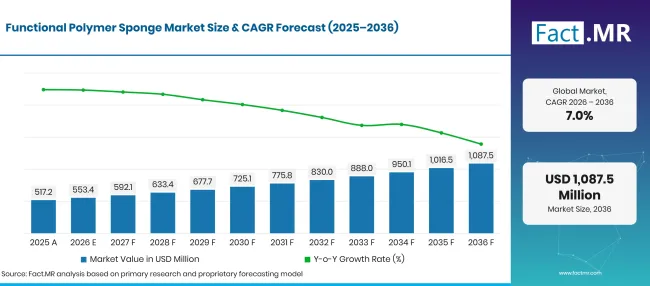
Functional Polymer Sponge Market Forecast Global | Source: Fact.MR
| Year | Basis | Market Value (USD million) |
|---|---|---|
| 2025 | Actual | 517.2 |
| 2026 | Estimate | 553.4 |
| 2036 | Forecast | 1087.5 |
| CAGR 2026 to 2036 | Forecast period | 7.0% |
Source: Fact.MR analysis. Updated Oct 26, 2026
What are the defining numbers behind Functional Polymer Sponge Market growth?
USD 534.2 million absolute opportunity between 2026 and 2036.
- Demand Drivers in the Market
- Water treatment and filtration has driven the market growth. Demand for filtration media creates opportunities for porous polymer materials that can retain particles or support liquid handling. Eurostat reported in June 2026 that wastewater treatment projects accounted for 37.7% of EU environmental protection investment in 2025, reflecting the importance of wastewater infrastructure spending. [1]
- Rising demand for water conservation and infrastructure upgrades supports the market growth.
- Industrial fluid management need the functional polymer sponge in large number. Oil absorption and liquid-handling applications value predictable uptake, chemical compatibility, and ease of recovery or replacement. Product performance needs to be established for the specific liquid and operating conditions.
- Key Segments Analyzed
- By Material Type: Polyurethane leads with a 38.5% share in 2026. Its broad processing flexibility supports a range of cellular material designs, although the share should be confirmed against the original market table.
- By Application: Water filtration accounts for a 32.1% share in 2026. Oil absorption, medical, automotive, and other applications form the remaining application categories.
- By End-User Industry: Healthcare captures 29.8% of the market in 2026. Healthcare leads due to demand for absorbent medical sponges used in wound care, fluid management, clinical procedures, and hygiene-sensitive applications.
- Analyst Opinion at Fact.MR
- Shambhu Nath Jha, Principal Consultant at Fact.MR, states, “Functional polymer sponges are selected according to the interaction between pore structure, fluid behavior, and operating conditions. Suppliers that demonstrate consistent absorption or filtration performance while meeting application-specific durability and safety requirements are better positioned to serve specialized industrial and healthcare needs.”
- Strategic Implications
- Manufacturers must specify pore structure, density, absorption capacity, compression recovery, and chemical resistance against the intended application.
- Filtration suppliers can validate performance with the target liquid and contaminant profile rather than relying on general absorbency claims.
- Healthcare suppliers need to verify applicable biocompatibility, cleanliness, and product-quality requirements before positioning a sponge for medical use.
- Automotive and industrial buyers prioritize service life, dimensional stability and resistance to operating fluids when evaluating material alternatives.
- Product developers differentiate general polymer foam from functional sponges engineered for specific absorption, filtration or contact applications.
Germany is set to record 8.3% CAGR through 2036. Brazil is set to post 7.6%, followed by the USA at 6.8%. The UK is estimated to advance at 6.1%, while Japan is forecast at 5.4%.
How does the Functional Polymer Sponge Market break down by segment?
Fact.MR’s identifies polyurethane at 38.5% by material type, water filtration at 32.1% by application, and healthcare at 29.8% by end-user industry.
Which Material Type dominates?
Polyurethane hold a 38.5% share in 2026.
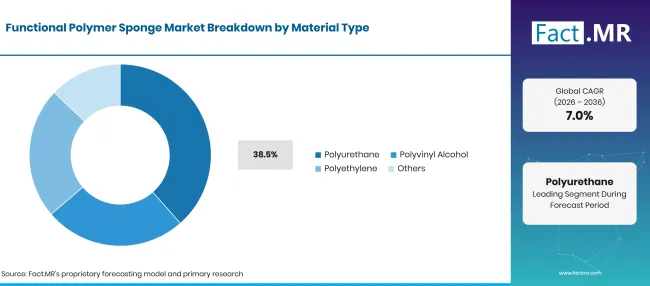
Functional Polymer Sponge Market Breakdown Material Type | Source: Fact.MR
| Material Type | Share |
|---|---|
| Polyurethane (leading segment) | 38.5% |
| Other segments combined | 61.5%* |
| Total | 100.0% |
Source: Fact.MR analysis. Updated Oct 26, 2026
Polyurethane can be formulated into cellular structures with different levels of flexibility, resilience, and density. These properties make it useful in applications such as cushioning, sealing, and selected fluid-handling tasks. Its suitability for a particular functional sponge depends on the formulation and pore architecture. Polyvinyl alcohol may be relevant where hydrophilic behavior and liquid uptake are priorities, while polyethylene-based materials serve more specialized requirements depending on processing and structure.
What leads the Application segment?
Water Filtration is set to represent a 32.1% share in 2026.
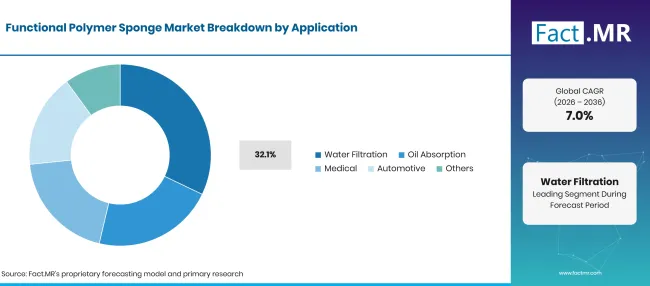
Functional Polymer Sponge Market Breakdown Application | Source: Fact.MR
| Application | Share |
|---|---|
| Water Filtration (leading segment) | 32.1% |
| Other segments combined | 67.9%* |
| Total | 100.0% |
Source: Fact.MR analysis. Updated Oct 26, 2026
Water filtration applications require materials that perform consistently under the relevant flow rate, pressure, and water-quality conditions. A sponge-like structure may support particle retention or serve as a component within a filtration system, but performance varies with pore size, permeability, fouling behavior, and cleaning requirements. Product specifications and system testing determine suitability; absorbency alone is not sufficient evidence of filtration performance.
How does End-User Industry shape demand?
Healthcare is likely to account for a 29.8% share in 2026.
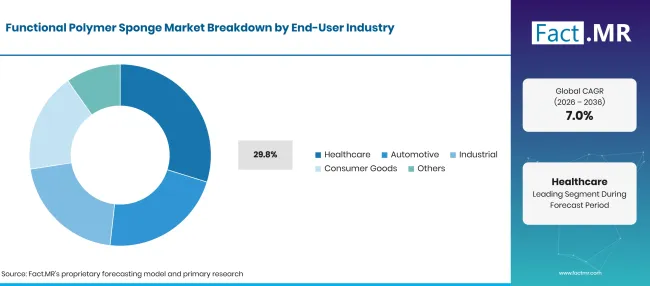
Functional Polymer Sponge Market Breakdown End User Industry | Source: Fact.MR
| End-User Industry | Share |
|---|---|
| Healthcare (leading segment) | 29.8% |
| Other segments combined | 70.2%* |
| Total | 100.0% |
Source: Fact.MR analysis. Updated Oct 26, 2026
Healthcare demand may include products that require predictable fluid uptake and controlled material contact. These applications can involve more demanding quality and traceability requirements than general-purpose cleaning or cushioning products. Automotive and industrial users evaluate durability, dimensional stability, chemical compatibility, and performance under repeated use. Consumer goods applications tend to emphasize usability, feel, cleaning effectiveness, and cost.
What is accelerating Functional Polymer Sponge Market adoption, and what is holding it back?
Filtration, specialized healthcare uses, and demand for application-specific foam materials support adoption, while material qualification and performance consistency can slow purchasing decisions.
Drivers Impact Analysis
| DRIVER | (~) % IMPACT ON CAGR | GEOGRAPHIC RELEVANCE | IMPACT TIMELINE |
|---|---|---|---|
| Water filtration and wastewater treatment needs | +1.0% | Europe, North America, Asia | Medium term (2–4 years) |
| Demand for specialized healthcare materials | +0.8% | Global | Medium term (2–4 years) |
| Industrial liquid and oil absorption | +0.6% | Global | Short term (≤ 2 years) |
| Automotive sealing and cushioning requirements | +0.5% | Europe, North America, Asia | Medium term (2–4 years) |
| New formulations and specialized foam processing | +0.4% | Global | Long term (≥ 4 years) |
Source: Fact.MR analysis. Updated Oct 26, 2026
Opportunity Impact Analysis
| OPPORTUNITY | (~) % IMPACT ON CAGR | GEOGRAPHIC RELEVANCE | IMPACT TIMELINE |
|---|---|---|---|
| Application-specific filtration media | +0.8% | Global | Medium term (2–4 years) |
| Recycled or renewable-content polymer materials | +0.6% | Europe, North America | Long term (≥ 4 years) |
| Higher-performance medical foam materials | +0.5% | Global | Medium term (2–4 years) |
| Custom pore structures and absorption profiles | +0.4% | Global | Short term (≤ 2 years) |
Source: Fact.MR analysis. Updated Oct 26, 2026
Restraints Impact Analysis
| RESTRAINT | (~) % IMPACT ON CAGR | GEOGRAPHIC RELEVANCE | IMPACT TIMELINE |
|---|---|---|---|
| Qualification and testing costs | -0.7% | Global | Short term (≤ 2 years) |
| Variability in absorption or filtration performance | -0.6% | Global | Medium term (2–4 years) |
| Raw material and processing cost volatility | -0.5% | Global | Short term (≤ 2 years) |
| Medical compliance and quality requirements | -0.4% | Global | Medium term (2–4 years) |
Source: Fact.MR analysis. Updated Oct 26, 2026
Which countries are scaling the Functional Polymer Sponge Market through 2036?
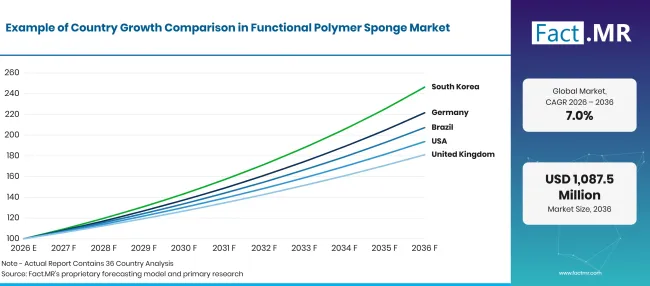
Functional Polymer Sponge Market Growth Index | Source: Fact.MR
| Country | CAGR (2026–2036) |
|---|---|
| Germany | 8.3% |
| Brazil | 7.6% |
| USA | 6.8% |
| UK | 6.1% |
| Japan | 5.4% |
Source: Fact.MR analysis. Updated Oct 26, 2026
What supports Germany adoption?
8.3% CAGR, supported by demand for specialized industrial materials and filtration solutions.
Germany's industrial base provides a potential market for polymer materials used in filtration, automotive components, and industrial equipment. Germany's automotive manufacturing base provides a relevant demand signal for functional polymer sponges used in vehicle interiors, sealing systems, cushioning and fluid management. According to the German Association of the Automotive Industry (VDA), Germany produced approximately 4.15 million passenger cars in 2025, representing a 2% increase from 2024.
Electric passenger cars accounted for around 40% of domestic production, highlighting the evolving requirements for lightweight materials and specialized components. These manufacturing trends provide a basis for assessing potential applications of functional polymer sponges in automotive systems, although they do not directly quantify market demand [3].
How is Brazil developing functional polymer sponge adoption?
7.6% CAGR, shaped by industrial demand and the need for materials suited to fluid-handling applications.
Brazil's market opportunity may include water treatment, industrial processing, automotive components, and consumer cleaning products. Adoption depends on local production, import availability, material cost, and the ability of suppliers to demonstrate performance under the conditions of each application.
What supports United States adoption?
6.8% CAGR, led by filtration infrastructure investment and specialized material applications.
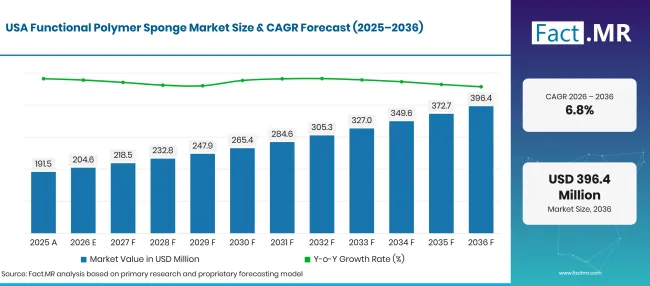
Functional Polymer Sponge Market Forecast Usa | Source: Fact.MR
The US Environmental Protection Agency announced a USD 40 million WIFIA loan on June 5, 2026, to support upgrades and expansion of wastewater treatment services in northeastern Nebraska [2]. Such projects illustrate continuing infrastructure investment. The direct effect on functional polymer sponge demand depends on whether the selected treatment equipment uses sponge-based or other polymeric media.
How is the United Kingdom building adoption?
6.1% CAGR, backed by water-network management and industrial applications.
The UK water sector continues to face operational efficiency challenges, creating a relevant context for specialized polymer materials used in water treatment and industrial filtration. According to the Environment Agency's 2024–2025 water resources review, England's water companies lost approximately 2,617 million litres of water per day through distribution network leakage, equivalent to approximately 19% of water put into supply. The review also reported average household water consumption of 136.5 litres per person per day. These indicators highlight the importance of water conservation and treatment infrastructure, although demand for functional polymer sponges depends on specific applications involving filtration, cleaning, fluid absorption and equipment protection [4].
What supports Japan adoption?
5.4% CAGR, as demand for engineered materials in manufacturing and consumer applications.
Japan's opportunity may be associated with precision manufacturing, automotive components, industrial fluid management, and cleaning products. Japan's automotive and precision manufacturing industries provide a relevant demand base for functional polymer sponges used in sealing, cushioning, cleaning and fluid management. According to the International Organization of Motor Vehicle Manufacturers (OICA), Japan produced approximately 8.41 million motor vehicles in 2025, underscoring the scale of its automotive supply chain. This manufacturing activity creates potential applications for polymer sponge materials requiring consistent pore structure, dimensional stability and resistance to operating fluids. However, actual demand depends on component specifications and the suitability of sponge materials for individual applications [5]
Who leads the Functional Polymer Sponge Market?
Fact.MR finds that BASF SE, SINOYQX, Shanghai Junhua High-Tech Materials Co., Ltd., Rogers Corporation and Ramer Ltd. are profiled across the functional polymer sponge and specialty foam value chain.
BASF SE and SINOYQX are relevant to melamine foam materials used in acoustic insulation and cleaning applications. Shanghai Junhua High-Tech Materials Co., Ltd. supplies melamine foam products for acoustic management and other specialized applications. Rogers Corporation participates in engineered foam materials used for cushioning, sealing and performance-critical applications.
Commercial competition depends on material performance, product consistency and application-specific suitability. Industrial buyers prioritize durability and dimensional stability. Product developers evaluate absorption capacity, chemical compatibility and compression behavior. Manufacturers compete through specialized formulations, customized product formats and solutions tailored to industrial and consumer applications.
Which companies are the key providers?
Key companies include BASF SE; SINOYQX; Shanghai Junhua High-Tech Materials Co., Ltd.; Rogers Corporation; and Ramer Ltd.
- BASF SE
- SINOYQX
- Shanghai Junhua High-Tech Materials Co., Ltd.
- Rogers Corporation
- Ramer Ltd.
Bibliography
- [1] Eurostat. (2026, June 24). Wastewater drives investments in environmental protection. European Commission.
- [2] U.S. Environmental Protection Agency. (2026, June 5). EPA announces $40 million WIFIA loan to expand wastewater services in northeastern Nebraska.
- [3] Verband der Automobilindustrie. (2026, January 5). Passenger car production in 2025 slightly above previous year's level.
- [4] Environment Agency. (2025, November 18). Water resources 2024 to 2025: Analysis of the water industry’s annual water resources performance. GOV.UK.
- [5] International Organization of Motor Vehicle Manufacturers. (2025). World motor vehicle production by country/region and type: 2025.
- [6] BASF SE. (2026, February 27). Trends in the chemical industry. In BASF Report 2025.
This Report Answers
- The report describes how functional polymer sponges are used across cleaning, absorption, filtration, sealing, cushioning and other specified applications.
- Segment analysis compares the specified polymer types, functional properties and application categories alongside their 2026 market shares.
- Country analysis discusses Germany, Brazil, USA, UK and Japan in relation to industrial manufacturing, automotive production and relevant end-use demand indicators.
- The competitive overview profiles BASF SE, SINOYQX, Shanghai Junhua High-Tech Materials Co., Ltd., Rogers Corporation and Ramer Ltd.
- Application analysis distinguishes cleaning and fluid absorption from acoustic insulation, industrial filtration and other specialized uses.
What does the Functional Polymer Sponge Market cover?
The market covers polymer sponge products designed to provide specific functional properties for industrial and consumer applications. These materials may be used for cleaning, fluid absorption, filtration, cushioning, sealing and acoustic insulation. Product coverage depends on the specified polymer chemistry and functional characteristics, while application coverage distinguishes general-purpose sponge products from materials engineered for defined performance requirements. Purchasing decisions depend on pore structure, chemical compatibility, compression behavior, durability and end-use specifications.
What is included in the scope?
Included products comprise polymer sponge materials sold for functional applications such as absorption, cleaning, filtration, sealing, cushioning and acoustic management. The value boundary covers the specified polymer types and finished sponge products supplied to industrial and consumer end users. The segmentation also covers the identified application categories, distribution channels and geographic markets.
What is excluded from the scope?
The analysis excludes conventional solid polymer products that do not have a sponge or cellular structure. General-purpose polymer resins and raw materials sold without conversion into the defined functional sponge products are outside the finished-product revenue boundary. Unrelated household cleaning products, filtration equipment and acoustic insulation systems are excluded unless the defined product category specifically includes the functional polymer sponge component. Sales of machinery and equipment used to manufacture or process sponge materials are also excluded.
How Was the Analysis Built?
The analysis draws on 120+ sources, 35+ company portfolios, 25+ countries, and more than 20 industry interviews.
- Primary Research: Primary research includes discussions with manufacturers, service providers, technology developers, distributors, end users, and subject-matter experts. These conversations examine purchasing priorities, product adoption, operational challenges, approval requirements, competitive positioning, and the factors that influence wider market acceptance.
- Desk Research: Desk research covers government statistics, regulatory publications, company filings, trade data, technical studies, industry associations, standards, public policy, and other authoritative sources. Every source used in the analysis is documented in the bibliography.
- Market Sizing and Forecasting: Market estimates combine historical performance, demand indicators, pricing and volume trends, segment shares, company participation, country-level growth, adoption patterns, investment activity, and barriers to market expansion.
- Data Validation and Update Cycle: Findings are validated by comparing primary interviews with public data, company activity, regulatory changes, trade patterns, and industry developments. Regular updates review new product launches, capacity changes, partnerships, approvals, and shifts in commercial adoption.
Segmentation
What is the report’s scope and coverage?
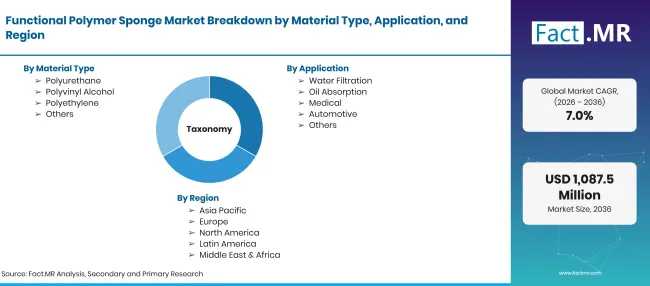
Functional Polymer Sponge Market Taxonomy | Source: Fact.MR
| Attribute | Details |
|---|---|
| Quantitative Units | USD million |
| 2026 Market Estimate | USD 553.4 million |
| 2036 Market Forecast | USD 1,087.6 million |
| Forecast CAGR | 7.0% |
| Market Definition | Functional polymer sponge materials used for absorption and filtration as well as liquid retention and cleaning in industrial and consumer applications. |
| Material Type | Polyurethane; Polyvinyl Alcohol; Polyethylene; Others |
| Application | Water Filtration; Oil Absorption; Medical; Automotive; Others |
| End-User Industry | Healthcare; Automotive; Industrial; Consumer Goods; Others |
| Countries Covered | Germany; Brazil; USA; UK; Japan |
| Companies Profiled | BASF SE; SINOYQX; Shanghai Junhua High-Tech Materials Co., Ltd.; Rogers Corporation; and Ramer Ltd. |
| Forecast Period | 2026 to 2036 |
| Approach | Segment-based forecast analysis supported by official infrastructure indicators and company product information |
Source: Fact.MR analysis. Updated Oct 26, 2026
How is the market segmented?
-
By Material Type
- Polyurethane
- Polyvinyl Alcohol
- Polyethylene
- Others
-
By Application
- Water Filtration
- Oil Absorption
- Medical
- Automotive
- Others
-
By End-User Industry
- Healthcare
- Automotive
- Industrial
- Consumer Goods
- Others
-
By Region
- North America
- Latin America
- Western Europe
- Eastern Europe
- East Asia
- South Asia & Pacific
- Middle East & Africa
Frequently Asked Questions
How big is the Functional Polymer Sponge Market in 2026?
What is the CAGR from 2026 to 2036?
Which material type has the largest share?
Which application has the largest share?
Which end-user industry has the largest share?
Which companies are covered?
Who worked on this report


Preview the report firsthand - request a free sample
Free SampleGet the brochure for pricing and purchase details
Download PDF