- Market Value (2025): USD 463.4 Mn
- Estimated Value (2026): USD 500.0 Mn
- Forecast Value (2036): USD 1069.5 Mn
- CAGR (2026-2036): 7.9%
What is the Functional Pea Flours Market forecast to be worth by 2036?
USD 500.0 million in 2026 to USD 1,069.5 million by 2036 at a 7.9% CAGR.
- The Functional Pea Flours Market crossed a valuation of USD 463.4 million in 2025.
- Demand is projected to increase from USD 500.0 million in 2026 to USD 1,069.5 million by 2036.
- The market is forecast to record 7.9% CAGR from 2026 to 2036 as food manufacturers use pea flour for protein enrichment and process-friendly texture.
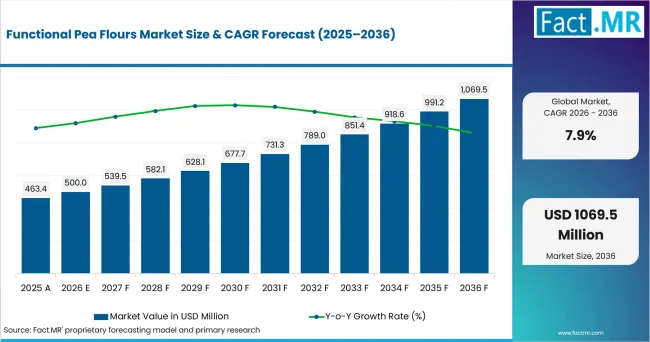
Functional Pea Flours Market Value Analysis | Source: Fact.MR
What are the defining numbers behind Functional Pea Flours Market growth?
An absolute opportunity of USD 569.5 million is expected between 2026 and 2036.
- Demand Drivers in the Market
- Bakery formulators need wheat-reduction systems that still hold moisture. Whole yellow pea flour fits breads and crackers where a neutral base is useful.
- Pulse supply supports ingredient availability. USDA NASS reported in January 2026 that U.S. dry edible pea production was estimated at 18.5 million cwt in 2025, up 9% from the previous season.
- Plant-protein developers need ingredients that support claim value and texture. Pea flour gives nutrition foods a dry ingredient that also supports structure.
- European policy attention is lifting interest in local plant-protein crops. In its July 2026 Protein Action Plan, the European Commission said the EU aims to increase the share of protein from oilseeds and protein crops produced in the EU and used as animal feed from 25.8% to 35% by 2035.
- Key Segments Analyzed
- By Pea Flour Type: Whole yellow pea flour is expected to hold 38.00% share in 2026 because it gives formulators a broad-use pea base for bakery and savory blends.
- By Functional Performance: Water binding & viscosity is projected to account for 29.00% share in 2026 as hydration control remains central to dough and sauce performance.
- By Food Application: Bakery & snacks are anticipated to capture 30.00% share in 2026 since pea flour supports structure and nutrition positioning in dry food systems.
- By Processing Route: Dry milling is estimated to represent 44.00% share in 2026 owing to lower processing complexity and its fit with whole yellow pea flour output.
- Analyst Opinion at Fact.MR
- Shambhu Nath Jha, Principal Consultant at Fact.MR, states, “Functional pea flour is becoming a practical tool for brands that need structure and protein. Buyers are expected to reward processors that control particle size, microbial quality and flavor consistency. Better suppliers combine crop access, milling know-how and application support.”
- Strategic Implications
- Milling companies should document particle size and hydration behavior so food brands reduce trial cycles during reformulation.
- Plant-based food manufacturers should validate protein-enriched pea flour against taste and texture targets before scaling meat-alternative recipes.
- Regional distributors should secure yellow pea and processed flour availability as buyers compare domestic reliability with imported options.
France is projected to record 9.7% CAGR through 2036 due to plant-protein policy support. The USA is expected to post 8.9% CAGR with dry pea supply. The UK is forecast to reach 8.5% CAGR through free-from bakery demand. Germany advances at 7.5% CAGR, while Japan holds 7.1% CAGR through nutrition-food use.
How does the Functional Pea Flours Market break down by segment?
Whole yellow pea flour leads at 38.00%; dry milling leads at 44.00%.
Which Pea Flour Type dominates?
Whole yellow pea flour is expected to hold 38.0% share in 2026.
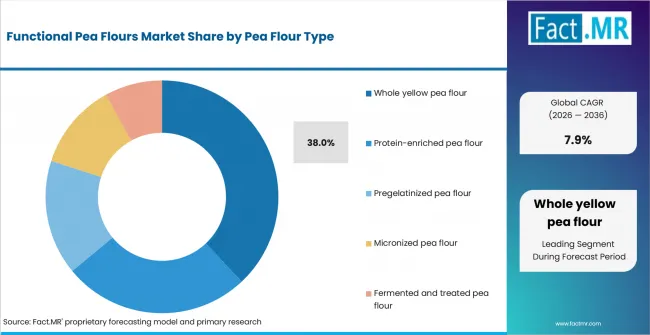
Functional Pea Flours Market Analysis By Pea Flour Type | Source: Fact.MR
Whole yellow pea flour leads because it provides manufacturers with a versatile functional base across bakery, snacks, savory foods, and nutrition products. Its balanced composition supports texture, binding, and protein contribution, while protein-enriched and pregelatinized pea flours remain relevant for specialized nutrition and instant-hydration applications.
What leads the Functional Performance segment?
Water binding & viscosity is projected to account for 29.0% share in 2026.
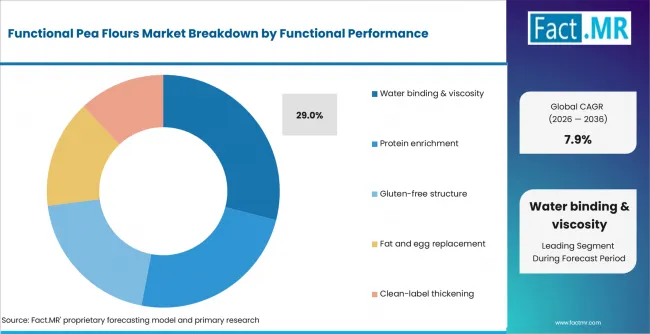
Functional Pea Flours Market Analysis By Functional Performance | Source: Fact.MR
Water binding & viscosity leads because pea flour helps control texture, moisture retention, and consistency across multiple food formulations. This functionality supports bakery, sauces, soups, and prepared foods, while protein enrichment and gluten-free structuring remain important where manufacturers need added nutrition or dependable structure without conventional wheat ingredients.
How does Food Application shape demand?
Bakery & snacks are anticipated to capture 30.0% share in 2026.
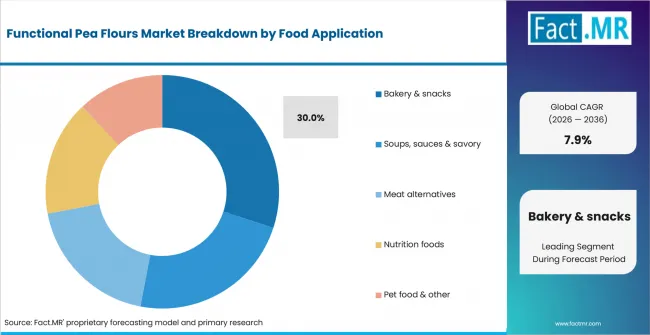
Functional Pea Flours Market Analysis By Food Application | Source: Fact.MR
Bakery & snacks lead because pea flour integrates readily into dry mixes, baked products, crackers, and snack formulations. Manufacturers value its contribution to texture, protein content, and gluten-free positioning. Soups, sauces, savory foods, and meat alternatives also create demand where binding and structural performance matter.
What supports Dry Milling within Processing Route?
Dry milling is estimated to represent 44.0% share in 2026.
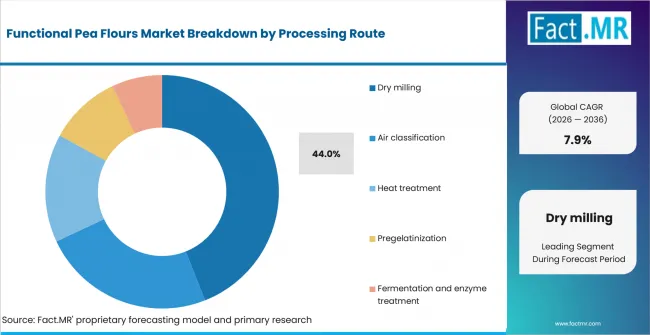
Functional Pea Flours Market Analysis By Processing Route | Source: Fact.MR
Dry milling leads because cleaned peas can move directly into functional flour production with relatively straightforward processing. The route supports broad food applications while preserving useful protein and starch functionality. Air classification and heat treatment remain relevant where manufacturers need greater protein concentration, flavor adjustment, or modified hydration performance.
What is accelerating Functional Pea Flours Market adoption, and what is holding it back?
Bakery reformulation drives it; crop variability restrains it.
Drivers Impact Analysis
| DRIVER | (~) % IMPACT ON CAGR | GEOGRAPHIC RELEVANCE | IMPACT TIMELINE |
|---|---|---|---|
| Bakery and snack reformulation | +1.5% | USA, UK, France | Short term (<= 2 years) |
| Dry pea supply and milling capacity | +1.2% | USA, Germany, France | Medium term (2-4 years) |
| Protein enrichment in everyday foods | +0.9% | Global | Medium term (2-4 years) |
| Water binding in sauces and savory foods | +0.7% | Europe, Japan | Long term (>= 4 years) |
Source: Fact.MR analysis. Updated Sep 2, 2026
- Bakery and snack reformulation: Pea flour helps brands reduce wheat dependence while maintaining useful dough structure and texture. Suppliers with formulation and test-kitchen support can shorten development trials and help manufacturers adapt pea flour across gluten-free bakery and snack applications.
- Dry pea supply and milling capacity: Strong pulse availability supports more reliable pea flour production and sourcing. Milling programs gain value when crop supply, flour specifications, viscosity, and application requirements are aligned across food and pet food formulations.
- Protein enrichment in everyday foods: Pea flour gives product developers a protein-bearing ingredient that can function similarly to conventional dry flour. It supports nutrition-focused formulations where manufacturers need both claim value and compatibility with established processing conditions.
- Water binding in sauces and savory foods: Soups, sauces, and savory fillings require stable thickness during heating and storage. Pea flour supports these applications when hydration and flavor are carefully controlled, making it suitable for clean-label thickening and texture management in prepared foods.
Opportunity Impact Analysis
| OPPORTUNITY | (~) % IMPACT ON CAGR | GEOGRAPHIC RELEVANCE | IMPACT TIMELINE |
|---|---|---|---|
| Clean-label thickening in soups and sauces | +1.0% | Europe, North America | Short term (<= 2 years) |
| Protein-enriched bakery and snack systems | +0.8% | USA, UK, France | Medium term (2-4 years) |
| Regional plant-protein policy support | +0.6% | European Union, France, Germany | Long term (>= 4 years) |
Source: Fact.MR analysis. Updated Sep 2, 2026
- Clean-label thickening in soups and sauces: Pea flour can replace part of modified starch where manufacturers prefer shorter ingredient lists. Supplier selection depends on reliable viscosity, heat stability, and texture performance across soups, sauces, and other prepared-food applications.
- Protein-enriched bakery and snack systems: Manufacturers can use pea flour in crackers, bars, and baked snacks where protein enrichment and familiar processing behavior are both important. Broader plant-protein portfolios also support formulation flexibility across bakery and snack applications.
- Regional plant-protein policy support: European policy attention to protein crops supports development of regional plant-protein value chains. Such programs can encourage processing investment, ingredient development, and stronger connections between pulse production and food manufacturing.
Restraints Impact Analysis
| RESTRAINT | (~) % IMPACT ON CAGR | GEOGRAPHIC RELEVANCE | IMPACT TIMELINE |
|---|---|---|---|
| Crop area and quality variability | -0.6% | USA, UK, Germany | Short term (<= 2 years) |
| Flavor masking and off-note control | -0.4% | Global | Medium term (2-4 years) |
| Shelf-price pressure in packaged foods | -0.3% | USA, UK, France, Japan | Medium term (2-4 years) |
Source: Fact.MR analysis. Updated Sep 2, 2026
- Crop area and quality variability: Pea flour depends on consistent yellow pea supply and predictable protein levels. Changes in crop availability and quality can tighten sourcing conditions, making tighter specifications and dependable supplier relationships important for manufacturers.
- Flavor masking and off-note control: Pea notes can limit use in delicate bakery or nutrition products. Suppliers need testing and formulation support so manufacturers understand how processing and heat treatment affect flavor. Sensory validation can help shorten product approval cycles.
- Shelf-price pressure in packaged foods: Price-sensitive packaged food categories have limited room for higher-cost specialty ingredients. Manufacturers therefore need to balance functional performance, formulation benefits, and ingredient costs when incorporating pea flour into mainstream products.
Which countries are scaling the Functional Pea Flours Market through 2036?
- The country comparison spans 2.64 percentage points and forms two practical growth bands across the forecast period.
- France remains 0.82 percentage point above the USA through plant-protein projects and food-processing trials.
- The USA remains 0.47 percentage point above the UK as dry pea supply supports domestic formulation activity.
- The UK remains 0.95 percentage point above Germany through free-from bakery activity and food manufacturing scale.
- Germany remains 0.40 percentage point above Japan through pea acreage expansion and meat-alternative manufacturing.
- Japan closes the displayed range through nutrition-food use and compact ingredient systems.
Comparable CAGRs create different entry conditions due to crop availability, food-price pressure and application testing depth. Full coverage includes North America, Latin America, Western Europe, Eastern Europe, East Asia, South Asia & Pacific, and Middle East & Africa.
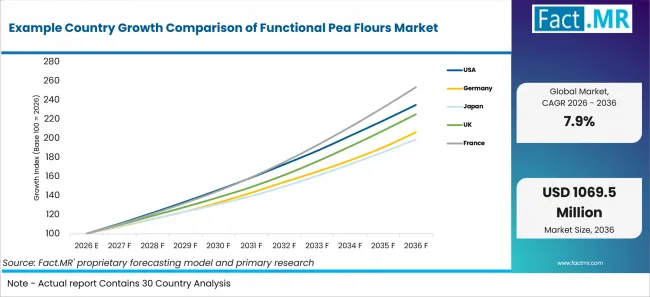
Example Country Growth Comparison Of Functional Pea Flours Market | Source: Fact.MR
| Country | CAGR (2026-2036) |
|---|---|
| France | 9.7% |
| USA | 8.9% |
| UK | 8.5% |
| Germany | 7.5% |
| Japan | 7.1% |
Source: Fact.MR analysis. Updated Sep 2, 2026
What is powering France's lead?
9.7% CAGR, driven by plant-protein policy support and food-ingredient projects.
France has a policy base that supports legume projects and ingredient trials. The French Ministry of Agriculture selected 10 territorial legume-project winners in July 2025. France is projected to record 9.7% CAGR through 2036 as traceable pea flour moves into bakery and savory trials.
How is the USA scaling functional pea flour demand?
8.9% CAGR, supported by dry pea output and packaged food reformulation.
The USA has a crop and ingredient base that supports domestic pea flour supply. USDA NASS reported in January 2026 that Montana produced 8,580,000 cwt of dry edible peas in 2025. BLS reported cereals and bakery products up 2.7% over 12 months to July 2026. The USA is expected to post 8.9% CAGR through 2036 as brands use pea flour in bakery and snack reformulation.
What supports the UK outlook?
8.5% CAGR, backed by free-from bakery demand and food manufacturing scale.
UK demand is linked to free-from bakery and packaged food manufacturing. Defra reported in July 2026 that, in real terms at constant 2023 prices, total consumer expenditure on food and alcoholic drinks was GBP 303.3 billion in 2025. ONS reported that food and non-alcoholic beverage prices rose 1.3% in the 12 months to July 2026. The UK is anticipated to advance at 8.5% CAGR through 2036 as formulators use pea flour in bakery and savory applications.
What underpins Germany's growth?
7.5% CAGR, driven by pea acreage and meat-alternative manufacturing.
Germany has a pea-crop base and a meat-alternative manufacturing channel suited to functional flour use. Destatis estimated in May 2026 that pea acreage for grain would rise 6.6% to 147,400 hectares for harvest 2026. Destatis reported 124,900 tonnes of meat substitutes produced in 2025. Germany is estimated to reach 7.5% CAGR through 2036 as pea flour supports savory texture.
How does Japan perform?
7.1% CAGR, supported by nutrition foods and compact formulation needs.
Japan’s growth is tied to nutrition foods and compact bakery formats. MAFF reported in August 2026 that Japan’s production-value food self-sufficiency ratio was 66% in fiscal 2025. The Statistics Bureau reported average monthly consumption expenditure of 314,001 yen for two-or-more-person households in 2025. Japan is forecast to hold 7.1% CAGR through 2036 as pea flour supports protein enrichment and savory formulation.
Who leads the Functional Pea Flours Market?
Ingredion Incorporated lead direct pea ingredient coverage, while AGT Food and Ingredients Inc. and Parrish & Heimbecker, Limited (P&H Milling) strengthen flour-based supply.
Ingredion Incorporated and AGT Food and Ingredients Inc. have direct relevance because each connects pea ingredients with food formulation. Ingredion Incorporated’s HOMECRAFT ingredient statement lists multiple yellow and green pea flour grades. AGT Food and Ingredients Inc. lists PulsePlus pea flours for bakery, extruded snacks, soups and sauces. Avena Foods Limited and Parrish & Heimbecker, Limited (P&H Milling) add depth through pea proteins and fractions, pulse flours and specialty ingredient supply.
Which companies are the key providers?
Key companies include AGT Food and Ingredients Inc., Ingredion Incorporated, Avena Foods Limited, and Parrish & Heimbecker, Limited (P&H Milling).
- AGT Food and Ingredients Inc.
- Ingredion Incorporated
- Avena Foods Limited
- Parrish & Heimbecker, Limited (P&H Milling)
Bibliography
- U.S. Department of Agriculture, National Agricultural Statistics Service. (2026, January 12). Crop production 2025 summary.
- U.S. Bureau of Labor Statistics. (2026, August 12). Consumer Price Index—July 2026.
- Department for Environment, Food & Rural Affairs. (2026, July 9). Agriculture in the United Kingdom 2025.
- Department for Environment, Food & Rural Affairs. (2026, July 29). Food statistics in your pocket.
- Office for National Statistics. (2026, August 19). Consumer price inflation, UK: July 2026.
- Statistisches Bundesamt (Destatis). (2026, May 19). Getreideanbaufläche 2026 hat sich nach Tiefststand von 2024 weiter stabilisiert.
- Statistisches Bundesamt (Destatis). (2026, May 18). Nach jahrelangem Anstieg: Fleischersatz-Produktion sinkt 2025 um 1,2 % gegenüber dem Vorjahr.
- Ministère de l’Agriculture et de la Souveraineté alimentaire. (2025, July 2). Planification écologique : 11,7 millions d’euros d’aides en faveur de la souveraineté protéique en France.
- FranceAgriMer. (2025, June 19). Le plan de structuration des filières protéines végétales.
- Institut national de la statistique et des études économiques. (2026, January 15). Further slowdown in annual average consumer prices in 2025.
- European Commission. (2026, July 7). Reducing the plant protein deficit of the EU.
- Statistics Bureau of Japan. (2026, February 6). 2025 yearly average.
- Avena Foods Limited. (2025, July 21). Launching Avena Regen Ag Protocol oat and pulse ingredients.
- Ingredion Incorporated. (2024, October 9). HOMECRAFT® Pulse Pea Flours ingredient statement.
This Report Answers
- The report explains where functional pea flour fits within the broader pulse flour market and the adjacent pea flour market.
- Segment analysis compares whole yellow pea flour with protein-enriched formats used in gluten-free bakery products.
- Application analysis reviews bakery and savory systems where soluble flour substitutes help formulators manage texture.
- Country analysis examines France and the USA. It also covers the UK, Germany and Japan using official crop and food-price data.
- Competitive analysis reviews AGT Food and Ingredients Inc. It also covers Ingredion Incorporated, Avena Foods Limited and Parrish & Heimbecker, Limited (P&H Milling).
What does the Functional Pea Flours Market cover?
Whole yellow, protein-enriched, pregelatinized and micronized pea flours used for food formulation.
The Functional Pea Flours Market covers pea-based flour formats that change texture, water behavior or protein content in formulated foods. It includes bakery and savory use. Meat-alternative, nutrition-food and pet-food uses are also covered.
The scope maps pea flour against adjacent plant protein ingredients and the wider pulses market where crop supply shapes ingredient availability.
What is included in the scope?
Functional pea flour systems used in formulated food and pet food applications.
The scope includes pea flour used by manufacturers in bakery and snacks. gluten-free baking mixes show how dry blended systems can use pulse flours for structure.
It also includes soups, sauces and savory systems where hydration control is needed. Adjacent gluten-free products help define where pea flour competes with rice, tapioca and other flour bases.
Meat alternatives and nutrition foods remain inside the scope when pea flour provides structure or protein support. The adjacent yellow pea protein category is referenced only where flour and protein positioning overlap.
What is excluded from the scope?
Finished packaged foods and isolated protein ingredients are outside the scope.
Finished foods are outside the core scope when pea flour is only one component in a retail recipe. Standalone pea starch and fiber are outside the flour scope, although pea starch clean-label confectionery applications remain useful for adjacent texture analysis.
Pure pea protein isolates and concentrates are outside the flour scope unless sold as blended functional flour systems. General wheat flour, rice flour and starch-only products are also outside the market boundary.
How Was the Analysis Built?
120+ sources, 35+ company portfolios, 25+ countries, and more than 20 interviews.
- Primary Research: Interviews include ingredient manufacturers, food formulators, milling specialists, distributors, bakery developers and savory-food teams. Discussions cover functionality, quality expectations, trial barriers and supplier selection.
- Desk Research: Desk research covers government statistics, food data, agricultural publications, company portfolios, product pages, ingredient statements and public policy material.
- Market Sizing and Forecasting: Market estimates combine food-ingredient use, pea flour applications, processing-route mix, country demand indicators, supplier activity and segment shares.
- Data Validation and Update Cycle: Findings are checked against interviews, public data, company activity, country statistics and portfolio reviews before forecast updates.
Segmentation
What is the report’s scope and coverage?
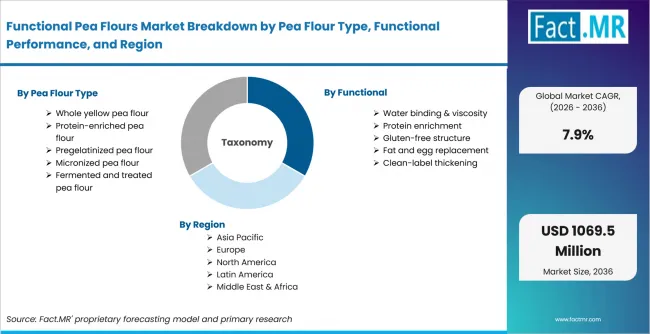
Functional Pea Flours Market Breakdown By Pea Flour Type, Functional Performance, And Region | Source: Fact.MR
| Attribute | Details |
|---|---|
| Quantitative Units | USD million in 2026 to USD million by 2036 at a CAGR |
| Market Definition | Pea-based flour formats used for texture, water binding, protein enrichment, gluten-free structure and clean-label thickening. |
| Pea Flour Type | Whole yellow pea flour; Protein-enriched; Pregelatinized; Micronized; Fermented and treated |
| Functional Performance | Water binding & viscosity; Protein enrichment; Gluten-free structure; Fat and egg replacement; Clean-label thickening |
| Food Application | Bakery & snacks; Soups, sauces & savory; Meat alternatives; Nutrition foods; Pet food & other |
| Processing Route | Dry milling; Air classification; Heat treatment; Pregelatinization; Fermentation and enzyme treatment |
| Countries Covered | France; USA; UK; Germany; Japan |
| Companies Profiled | AGT Food and Ingredients Inc.; Ingredion Incorporated; Avena Foods Limited; Parrish & Heimbecker, Limited (P&H Milling) |
| Forecast Period | 2026 to 2036 |
Source: Fact.MR analysis. Updated Sep 2, 2026
How is the market segmented?
-
By Pea Flour Type
- Whole yellow pea flour
- Protein-enriched pea flour
- Pregelatinized pea flour
- Micronized pea flour
- Fermented and treated pea flour
-
By Functional Performance
- Water binding & viscosity
- Protein enrichment
- Gluten-free structure
- Fat and egg replacement
- Clean-label thickening
-
By Food Application
- Bakery & snacks
- Soups, sauces & savory
- Meat alternatives
- Nutrition foods
- Pet food & other
-
By Processing Route
- Dry milling
- Air classification
- Heat treatment
- Pregelatinization
- Fermentation and enzyme treatment
-
By Region
- North America
- Latin America
- Western Europe
- Eastern Europe
- East Asia
- South Asia & Pacific
- Middle East & Africa
Frequently Asked Questions
How big is the functional pea flours market in 2026?
What is the CAGR of the functional pea flours market from 2026 to 2036?
Which pea flour type leads the functional pea flours market?
Which functional performance leads the functional pea flours market?
Who are the leading companies in the functional pea flours market?
Who worked on this report


Preview the report firsthand - request a free sample
Free SampleGet the brochure for pricing and purchase details
Download PDF