- Market Value (2025): USD 1092.6 Mn
- Estimated Value (2026): USD 1180.0 Mn
- Forecast Value (2036): USD 2548.0 Mn
- CAGR (2026-2036): 8.0%
What is the Functional Soy Concentrates Market forecast to be worth by 2036?
USD 1,180.0 million in 2026 to USD 2,548.0 million by 2036 at an 8.0% CAGR.
- The Functional Soy Concentrates Market reached USD 1,092.6 million in 2025.
- Demand is projected to increase from USD 1,180.0 million in 2026 to USD 2,548.0 million by 2036.
- The market is forecast to record 8.0% CAGR from 2026 to 2036 as meat-alternative brands and nutrition formulators use soy concentrates for protein density and texture control.
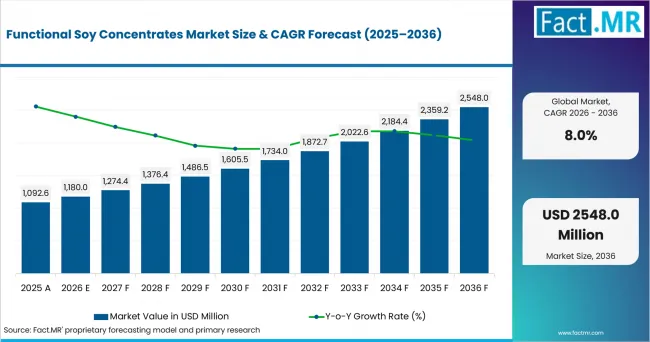
Functional Soy Concentrates Market Value Analysis | Source: Fact.MR
What are the defining numbers behind Functional Soy Concentrates Market growth?
USD 1,368.0 million absolute opportunity between 2026 and 2036.
- Demand Drivers in the Market
- Meat-alternative developers need protein systems that bind water and fat while keeping bite quality stable after heating.
- Cost pressure is raising interest in plant protein systems. The U.S. Bureau of Labor Statistics reported in August 2026 that food-at-home prices were 2.7% higher in July 2026 than in July 2025.
- Bakery manufacturers value functional concentrates when dough handling and moisture retention must align with protein claims in mainstream products.
- Beverage teams need soluble protein options that avoid chalky texture and keep dispersion manageable during high-volume production runs.
- Key Segments Analyzed
- By Product: Isolates are expected to hold 42.0% share in 2026 because higher purity helps formulators manage taste and protein density.
- By Process: Aqueous extraction is projected to account for 38.0% share in 2026, supported by familiar processing economics in soy ingredient production.
- By Function: Nutrition is anticipated to represent 36.0% share in 2026 as brands use soy concentrates to raise protein content in everyday foods.
- By Application: Meat alternatives are forecast to capture 35.0% share in 2026 owing to demand for structure and juiciness in plant-based formats.
- Analyst Opinion at Fact.MR
- Shambhu Nath Jha, Principal Consultant at Fact.MR, states, “Functional soy concentrates are being judged by how they behave inside a finished recipe. The market is expected to reward suppliers that document taste, hydration and texture performance across meat alternatives and nutrition formats. Buying teams should look for application data, regional sourcing options and repeatable batch quality before moving a supplier into core formulas.”
- Strategic Implications
- Ingredient suppliers should document water binding, fat binding and protein quality by application so formulators shorten validation work.
- Regional sourcing plans deserve close review. Destatis reported in May 2026 that Germany’s soybean area was expected to reach 51,000 hectares in 2026.
- Nutrition product manufacturers should evaluate solubility and flavor carryover early because protein claims lose value when mouthfeel is weak.
- Regional processors should connect soybean sourcing, extraction method and allergen controls in one supplier file for large brand approvals.
The USA is forecast to post 8.8% CAGR through 2036, supported by soybean processing depth and meat-alternative formulation needs. Germany follows at 8.4% as meat-substitute production and local soy programs keep ingredient qualification active. Japan records 7.8% given established soy-food demand and functional protein use in packaged foods. France advances at 7.5% where plant-protein naming clarity and food manufacturing depth support adoption. Brazil reaches 7.2%, reinforced by soybean scale and export-oriented agro-industrial capacity.
How does the Functional Soy Concentrates Market break down by segment?
Isolates lead Product at 42.0%; Aqueous extraction leads Process at 38.0%.
Which Product dominates?
Isolates are expected to hold 42.0% share in 2026.
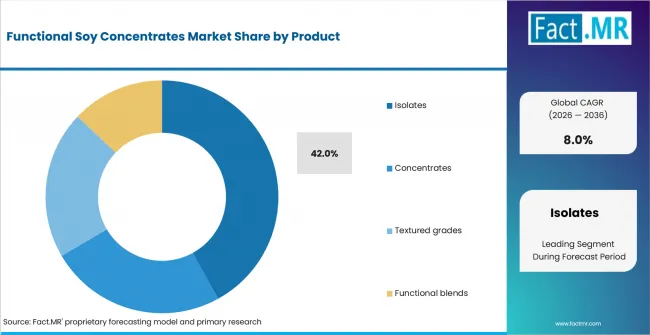
Functional Soy Concentrates Market Analysis By Product | Source: Fact.MR
Isolates lead because food formulators often start with protein concentration and taste neutrality before testing texture systems. Their higher protein level gives nutrition brands more room to meet label claims without lifting serving size or changing the full ingredient deck.
Functional soy concentrates retain a clear role where texture and water management count more than maximum protein purity. Meat analogues and extended-meat recipes use them to stabilize juiciness and processing yield.
What leads the Process segment?
Aqueous extraction is projected to account for 38.0% share in 2026.
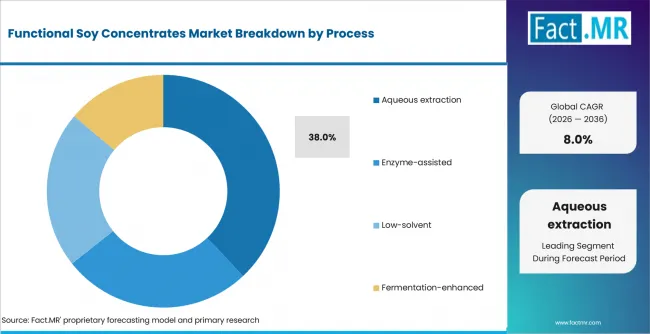
Functional Soy Concentrates Market Analysis By Process | Source: Fact.MR
Aqueous extraction leads the process mix because it is familiar to soy processors and fits many food-grade concentrate systems. Formulators understand the performance profile, which lowers technical risk during customer trials.
Enzyme-assisted and fermentation-enhanced routes are useful when solubility or flavor requires narrower functionality. Their adoption is more selective because processing cost and customer validation are harder to justify in routine formulations.
How does Function shape demand?
Nutrition is anticipated to represent 36.0% share in 2026.
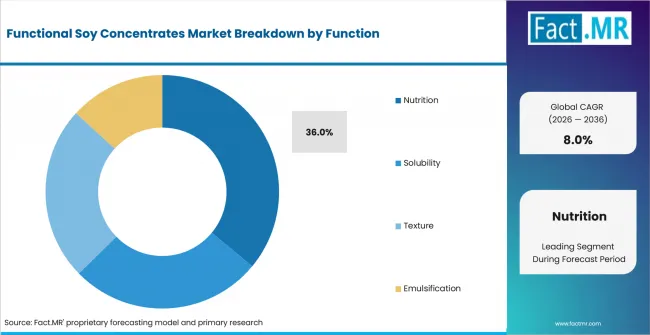
Functional Soy Concentrates Market Analysis By Function | Source: Fact.MR
Nutrition leads the function mix as food brands use soy concentrates to increase protein content in products with established manufacturing routes. Agreste reported in December 2025 that French food and beverage industries commercialized EUR 162 billion of products in 2024.
Solubility, texture and emulsification remain practical functions for formulators. They carry weight when a protein ingredient needs to perform during hydration, heat treatment or fat dispersion.
What supports Application demand?
Meat alternatives are forecast to capture 35.0% share in 2026.
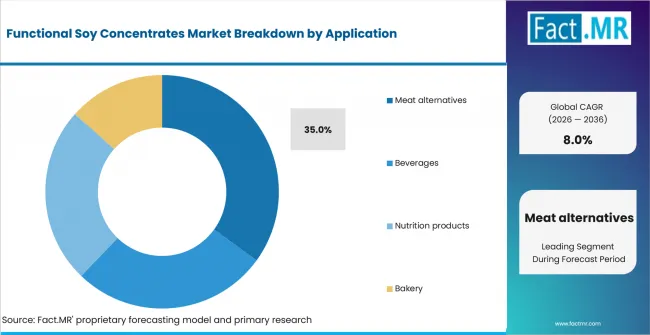
Functional Soy Concentrates Market Analysis By Application | Source: Fact.MR
Meat alternatives lead application use because soy concentrates help manage the product features consumers notice first. Bite quality, juiciness and cooking performance are central when a plant-based recipe competes with familiar meat formats.
Cost control gives the application a second route for adoption. Functional concentrates help product teams tune yield and protein content without treating soy only as a nutrition powder.
What is accelerating Functional Soy Concentrates Market adoption, and what is holding it back?
Demand is expected to rise as brands use soy concentrates for protein density, texture and formulation economics. Adoption is constrained by allergen labelling, crop-price swings and competition from pea, wheat and other plant proteins.
Drivers Impact Analysis
| DRIVER | (~) % IMPACT ON CAGR | GEOGRAPHIC RELEVANCE | IMPACT TIMELINE |
|---|---|---|---|
| Protein fortification in meat and bakery formulations | +0.9% | Global | Short term (<= 2 years) |
| Cost-in-use pressure in meat extension and hybrids | +0.7% | North America, Europe | Short term (<= 2 years) |
| Soybean processing scale and regional sourcing | +0.6% | Americas, Europe | Medium term (2-4 years) |
| Texture requirements in meat alternatives | +0.5% | Global | Medium term (2-4 years) |
Source: Fact.MR analysis. Updated Aug 31, 2026
- Protein fortification in meat and bakery formulations: Brands use functional soy concentrates when protein claims must fit familiar production lines and stable cost targets.
- Cost-in-use pressure in meat extension and hybrids: Concentrates help processors maintain texture and yield while reducing dependence on higher-cost animal protein inputs.
- Soybean processing scale and regional sourcing: Established soybean crushing and protein-processing assets give manufacturers more options for contracting and validation.
Opportunity Impact Analysis
| OPPORTUNITY | (~) % IMPACT ON CAGR | GEOGRAPHIC RELEVANCE | IMPACT TIMELINE |
|---|---|---|---|
| Low-solvent and flavor-managed processing | +0.5% | Europe, North America | Medium term (2-4 years) |
| Soluble concentrates for beverages | +0.4% | USA, Japan | Short term (<= 2 years) |
| Regional non-GMO soy programs | +0.3% | Europe, Japan | Long term (>= 4 years) |
Source: Fact.MR analysis. Updated Aug 31, 2026
- Low-solvent and flavor-managed processing: Suppliers gain customer approvals when concentrates deliver cleaner taste while preserving texture and hydration.
- Soluble concentrates for beverages: Beverage formulators need soy proteins that disperse cleanly and avoid sediment in protein drinks and meal-replacement products.
- Regional non-GMO soy programs: European and Japanese customers value traceability when soy ingredients are used in products with strict label review.
Restraints Impact Analysis
| RESTRAINT | (~) % IMPACT ON CAGR | GEOGRAPHIC RELEVANCE | IMPACT TIMELINE |
|---|---|---|---|
| Soy allergen and consumer-perception limits | -0.5% | Global | Short term (<= 2 years) |
| Competition from pea and wheat proteins | -0.4% | North America, Europe | Medium term (2-4 years) |
| Soybean crop and processing-cost volatility | -0.3% | Americas, Asia | Medium term (2-4 years) |
Source: Fact.MR analysis. Updated Aug 31, 2026
- Soy allergen and consumer-perception limits: Brands must manage allergen statements and buyer preferences when adding soy protein to mainstream foods.
- Competition from pea and wheat proteins: Formulators compare soy with other plant proteins when taste, allergen profile or sourcing claims affect product positioning.
- Soybean crop and processing-cost volatility: Crop changes alter input economics and push manufacturers to qualify more than one protein system.
Which countries are scaling the Functional Soy Concentrates Market through 2036?
- The country comparison spans 1.6 percentage points between the USA and Brazil across the forecast period.
- The USA remains 0.4 percentage point above Germany through domestic soybean supply and meat-alternative formulation work.
- Germany remains 0.6 percentage point above Japan because meat-substitute production keeps soy functionality visible to processors.
- Japan remains 0.3 percentage point above France through soy-food familiarity and packaged plant-protein use.
- France remains 0.3 percentage point above Brazil where naming clarity and food-industry depth support reformulation.
- Brazil closes the displayed range while soybean scale supports regional protein-ingredient economics.
Comparable CAGRs create different entry conditions due to soy supply, ingredient processing, label rules and meat-alternative maturity. Full report coverage includes North America, Latin America, Western Europe, Eastern Europe, East Asia, South Asia & Pacific, Middle East & Africa.
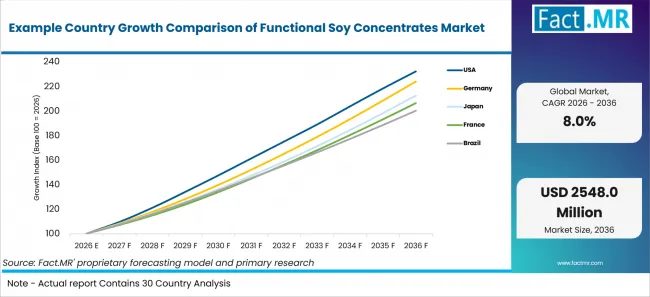
Example Country Growth Comparison Of Functional Soy Concentrates Market | Source: Fact.MR
| Country | CAGR (2026-2036) |
|---|---|
| USA | 8.8% |
| Germany | 8.4% |
| Japan | 7.8% |
| France | 7.5% |
| Brazil | 7.2% |
Source: Fact.MR analysis. Updated Aug 31, 2026
What supports USA adoption?
8.8% CAGR, linked to soybean processing depth and meat-alternative formulation.
U.S. formulators evaluate soy concentrates for yield control, hydration and texture before moving recipes into scaled production. USDA NASS reported in September 2025 that soybean production was forecast at 4.30 billion bushels. That crop base gives ingredient processors a domestic feedstock platform for food-grade concentrate systems. It also gives meat-alternative and bakery teams a familiar soy supply chain for trials that require repeatable functionality.
How is Germany scaling demand?
8.4% CAGR, shaped by meat-substitute production and domestic soy acreage.
German product teams test soy concentrates inside meat-free products where bite and cooking stability must be approved before wider use. Destatis reported in May 2026 that Germany produced 124,900 tonnes of meat-substitute products in 2025. That production base gives soy systems a clear application channel. Local acreage growth and retailer document checks are expected to keep supplier selection tied to batch consistency and allergen control.
What supports the Japan outlook?
7.8% CAGR, supported by soy-food familiarity and packaged plant-protein use.
Japan has long experience with food-grade soy behavior through tofu, natto and miso processing. USDA FAS/Tokyo estimated Japan’s MY 2025/26 soybean production area at 141,000 hectares, based on Zen-noh production and sales estimates. That local base gives product developers a practical reference point for food-grade soy quality. Beverage and nutrition formulators are expected to focus on solubility, flavor carryover and clean dispersion.
How does France support adoption?
7.5% CAGR, backed by plant-protein naming clarity and food-industry scale.
France gives soy concentrate suppliers a food-manufacturing base that is open to plant-protein reformulation. INSEE reported in July 2026 that the value of French oilseed and protein-crop production reached EUR 3.2 billion in 2025. That crop and processing context supports ingredient testing in meat alternatives, beverages and nutrition products. On January 28, 2025, France’s Conseil d’État annulled two decrees that had prohibited certain meat-related terms, such as “steak” and “sausage,” for foods containing plant proteins.
How does Brazil perform?
7.2% CAGR, reinforced by soybean scale and export-oriented food processing.
Brazil’s role in soybean agriculture gives concentrate producers a large raw-material base for regional ingredient economics. Conab reported in February 2026 that the 2025/26 soybean crop was projected at 178 million tonnes. That scale supports applications in meat extension, bakery and nutrition products where cost-in-use is visible. Export-oriented flows mean food-grade concentrate programs are expected to depend on dedicated processing and customer documentation.
Who leads the Functional Soy Concentrates Market?
ADM remains a visible functional soy concentrate supplier through its Arcon portfolio for meat extension, meat alternatives, bakery and extrusion. Wilmar International Limited, Shandong Yuwang Ecological Food Industry Co., Ltd., Bunge Global SA based on their soy-processing and food-ingredient portfolios.
Bunge Global SA completed its acquisition of IFF’s soy protein concentrate, lecithin and soy crush businesses on March 2, 2026. Accordingly, the former IFF soy protein concentrate portfolio, including the Response®, Alpha® and Procon® brands, is treated within Bunge Global SA for current company profiling. Supplier comparison can consider taste and sensory performance, protein functionality, product consistency and technical application support.
Which companies are the key providers?
Key companies include ADM, Wilmar International Limited, Shandong Yuwang Ecological Food Industry Co., Ltd., Bunge Global SA.
- ADM
- Wilmar International Limited
- Shandong Yuwang Ecological Food Industry Co., Ltd.
- Bunge Global SA
Bibliography
- ADM. (2026, May 20). ADM advances protein innovation with new ingredient solutions.
- Bunge. (2026, March 2). Bunge completes acquisition of IFF’s soy protein concentrate, lecithin, and crush business.
- U.S. Bureau of Labor Statistics. (2026, August 12). Consumer Price Index—July 2026.
- U.S. Department of Agriculture, National Agricultural Statistics Service. (2025, September 12). Crop Production.
- Federal Statistical Office (Destatis). (2026, May 18). Nach jahrelangem Anstieg: Fleischersatz-Produktion sinkt 2025 um 1,2 % gegenüber dem Vorjahr [After years of increases: Meat-substitute production falls 1.2% in 2025 compared with the previous year].
- Federal Statistical Office (Destatis). (2026, May 19). Getreideanbaufläche 2026 hat sich nach Tiefststand von 2024 weiter stabilisiert.
- Sasatani, D. (2026, March 31). Oilseeds and products annual: Japan (GAIN Report No. JA2026-0016). U.S. Department of Agriculture, Foreign Agricultural Service.
- Mosny, E., Ramonet, M., & Wukovits, A. (2026, July 7). Le compte provisoire de l’agriculture en 2025 : Les prix et les volumes rebondissent après la chute de 2024. Insee Première, 2116.
- Renaud, A. (2025, December 17). Productions commercialisées des industries agroalimentaires 2024 : léger recul des ventes mais un niveau toujours élevé. Agreste.
- Conseil d’État. (2025, January 28). Les dénominations « steaks de soja », « saucisses végétales »… peuvent être utilisées en France.
- Companhia Nacional de Abastecimento. (2026, February 12). Estimativa da produção de grãos na safra 2025/26 é atualizada para 353,4 milhões de toneladas.
This Report Answers
- The report explains where functional soy concentrates are used across product, process and function. It also covers application demand across meat alternatives, beverages, nutrition products and bakery formulations.
- Segment analysis identifies the leading product, processing and functional categories and explains why formulators prioritize protein density, hydration, texture, solubility and emulsification.
- Country analysis examines the listed markets and the soybean supply, food-processing and formulation conditions supporting functional soy concentrate adoption.
- Competitive analysis reviews current providers across soy protein concentrates, isolates, textured grades and functional blends, with attention to taste, consistency and application support.
- Application analysis assesses how water binding, fat binding, protein quality, solubility and texture influence ingredient selection across meat alternatives, beverages, nutrition products and bakery applications.
What does the Functional Soy Concentrates Market cover?
The Functional Soy Concentrates Market covers food-grade soy protein ingredients used to improve nutrition, texture, hydration, solubility and emulsification in finished foods. It includes isolates, concentrates, textured grades and functional blends when soy protein functionality is the purchase reason.
The assessment covers aqueous extraction, enzyme-assisted processing, low-solvent routes and fermentation-enhanced processes across meat alternatives, beverages, nutrition products and bakery applications. Demand is assessed across the listed countries and broader regional coverage.
What is included in the scope?
The scope includes soy protein concentrate systems sold to food manufacturers, ingredient distributors and contract manufacturers for formulation use. It includes concentrates used in meat extension, plant-based meat, beverage protein systems, bakery enrichment and nutrition products.
It includes application-specific grades where the supplier markets hydration, texture, dispersion, emulsification or protein-quality benefits as part of the ingredient proposition.
What is excluded from the scope?
The scope excludes commodity soybean meal, animal feed meals, edible soybean oil and unprocessed soybeans sold without a food-grade functional protein claim. It excludes consumer-ready meat alternatives sold as finished foods.
General plant-protein blends are outside scope when soy concentrate is absent as the active functional ingredient. Industrial soy derivatives and non-food soy ingredients are outside the market boundary.
How Was the Analysis Built?
The analysis draws on 120+ sources, 35+ company portfolios, 25+ countries, and more than 20 industry interviews.
- Primary Research: Primary research includes discussions with ingredient manufacturers, food processors, distributors, product-development teams, buying managers and formulation specialists. These conversations examine purchasing priorities, product adoption, approval requirements and factors that influence wider market acceptance.
- Desk Research: Desk research covers government statistics, company releases, trade data, agricultural data, regulatory decisions, public institutions and authoritative sources. Every source used in the analysis is documented in the bibliography.
- Market Sizing and Forecasting: Market estimates combine historical performance, demand indicators, segment shares, country-level growth, provider activity, application adoption and barriers to market expansion.
- Data Validation and Update Cycle: Findings are validated by comparing primary interviews with public data, company activity, crop conditions, regulatory changes and food-manufacturing developments. Regular updates review new product launches, sourcing shifts and commercial adoption.
Segmentation
What is the report’s scope and coverage?
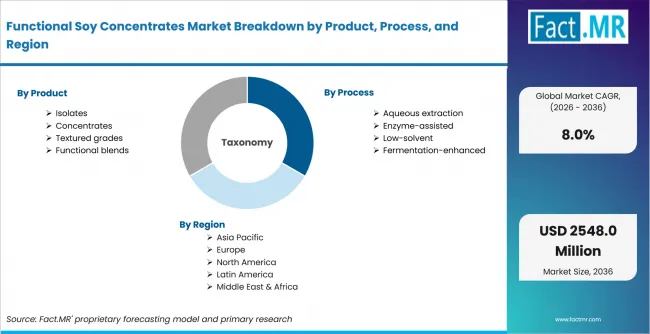
Functional Soy Concentrates Market Breakdown By Product, Process, And Region | Source: Fact.MR
| Attribute | Details |
|---|---|
| Quantitative Units | USD million |
| Market Definition | Food-grade soy protein concentrate and related functional soy protein ingredients used to deliver nutrition, texture, solubility and emulsification in finished food and beverage formulations. |
| Product | Isolates; Concentrates; Textured grades; Functional blends |
| Process | Aqueous extraction; Enzyme-assisted; Low-solvent; Fermentation-enhanced |
| Function | Nutrition; Solubility; Texture; Emulsification |
| Application | Meat alternatives; Beverages; Nutrition products; Bakery |
| Regions Covered | North America; Latin America; Western Europe; Eastern Europe; East Asia; South Asia & Pacific; Middle East & Africa |
| Countries Covered | USA; Germany; Japan; France; Brazil |
| Companies Profiled | ADM; Wilmar International Limited; Shandong Yuwang Ecological Food Industry Co., Ltd.; Bunge Global SA |
| Forecast Period | 2026 to 2036 |
| Approach | Hybrid top-down and bottom-up approach using soy supply indicators, food formulation demand, application mix, country growth and provider portfolio review. |
Source: Fact.MR analysis. Updated Aug 31, 2026
How is the market segmented?
-
By Product:
- Isolates
- Concentrates
- Textured grades
- Functional blends
-
By Process:
- Aqueous extraction
- Enzyme-assisted
- Low-solvent
- Fermentation-enhanced
-
By Function:
- Nutrition
- Solubility
- Texture
- Emulsification
-
By Application:
- Meat alternatives
- Beverages
- Nutrition products
- Bakery
-
By Region:
- North America
- Latin America
- Western Europe
- Eastern Europe
- East Asia
- South Asia & Pacific
- Middle East & Africa
Frequently Asked Questions
How big is the functional soy concentrates market in 2026?
What is the CAGR of the functional soy concentrates market from 2026 to 2036?
Which product leads the functional soy concentrates market?
Which process leads the functional soy concentrates market?
Who are the leading companies in the functional soy concentrates market?
Who worked on this report


Preview the report firsthand - request a free sample
Free SampleGet the brochure for pricing and purchase details
Download PDF