Furnace Maintenance and Repair Consumables Market (2026 - 2036)
Furnace Maintenance and Repair Consumables Market Size and Share Forecast Outlook 2026 to 2036
Core Findings
Furnace Maintenance and Repair Consumables Market Forecast Outlook 2026 to 2036
The furnace maintenance and repair consumables market is expected to reach USD 4.3 billion in 2026, growing to USD 6.8 billion by 2036, with a CAGR of 4.7%.
Key Takeaways from Furnace Maintenance and Repair Consumables Market
- Furnace Maintenance and Repair Consumables Market Value (2026): USD 4.3 billion
- Furnace Maintenance and Repair Consumables Market Forecast Value (2036): USD 6.8 billion
- Furnace Maintenance and Repair Consumables Market Forecast CAGR (2026 to 2036): 4.7%
- Leading Segment in Furnace Maintenance and Repair Consumables Market: Long-term Supply Contracts Purchase Mode (58%)
- Key Growth Region in Furnace Maintenance and Repair Consumables Market: Asia Pacific
- Key Players in Furnace Maintenance and Repair Consumables Market: RHI Magnesita N.V., Vesuvius plc, Saint-Gobain S.A., Calderys, HarbisonWalker International, Inc., Morgan Advanced Materials plc, Shinagawa Refractories Co., Ltd., Krosaki Harima Corporation, Imerys S.A., Resco Products, Inc.
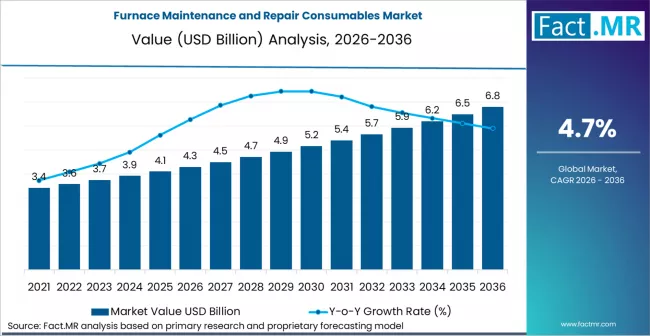
Production concentration will be a key driver, with a significant share of manufacturing concentrated in regions with established industrial hubs. This creates an opportunity for suppliers in these regions but also ties the market to the economic performance and stability of these areas. Regional manufacturing control will play a crucial role in ensuring timely production and minimizing supply chain disruptions.
However, as the demand for high-quality consumables increases, suppliers must navigate challenges in sourcing raw materials, often influenced by global price fluctuations. Supply reliability will be tested as global trade uncertainties and logistical constraints continue to impact the flow of critical components. Companies will need to focus on building resilient supply chains and managing dependencies to maintain competitive positioning in this evolving market.
Furnace Maintenance and Repair Consumables Market
| Metric | Value |
|---|---|
| Estimated Value in (2026E) | USD 4.3 billion |
| Forecast Value in (2036F) | USD 6.8 billion |
| Forecast CAGR (2026 to 2036) | 4.7% |
Category
| Category | Segments |
|---|---|
| Consumable Type | Refractory Repair and Gunning Mixes; Insulating Linings and Boards; Protective Coatings and Mortars; Burner or Lance Wear Parts |
| Furnace Type | EAF and Ladle Furnaces; Reheat or Annealing Furnaces; Vacuum or Heat Treatment Furnaces |
| Refractory Chemistry | Alumina-based; Magnesia-based; Silica or Other |
| Purchase Mode | Long-term Supply Contracts; Spot Purchases |
| Steelmaking Route | BF-BOF; EAF |
| Region | North America; Europe; Asia Pacific; Latin America; Middle East & Africa |
Segmental Analysis
What is the Analysis of the Purchase Mode Segment in the Furnace Maintenance and Repair Consumables Market?
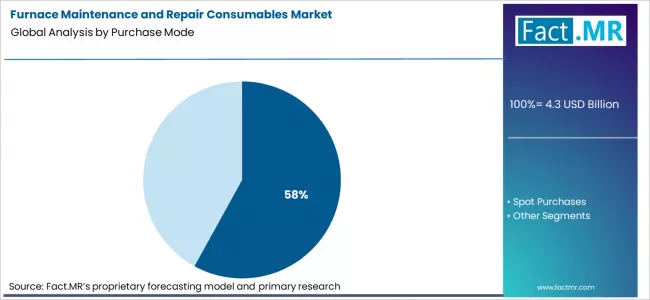
In 2026, the furnace maintenance and repair consumables market is primarily driven by long-term supply contracts, which hold 58% of the market share. These contracts are preferred by large-scale industrial operators who seek a stable supply of essential consumables like refractories, electrodes, and heating elements. The consistency offered by these contracts helps mitigate supply chain disruptions and fluctuations in raw material prices, including synthetic graphite and alumina. On the other hand, the spot purchases segment holds 42% of the market share. This segment caters mainly to smaller foundries or emergency procurement needs for unplanned maintenance activities. As a result, spot pricing is more volatile, especially in 2026, due to tightening export quotas on key minerals, which affects the availability and cost of critical materials used in furnace maintenance.
What is the Analysis of the Steelmaking Route Segment in the Furnace Maintenance and Repair Consumables Market?
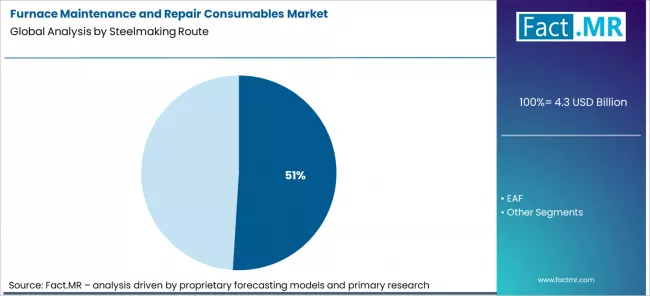
The steelmaking route plays a crucial role in the demand for furnace consumables, with the BF-BOF (Blast Furnace-Basic Oxygen Furnace) route maintaining a 51% market share in 2026. This route remains dominant, particularly in integrated steel plants in regions like India and China, where it is used for primary steel production. Refractory bricks for furnace linings and oxygen injection lances are the main consumables in this segment. The EAF (Electric Arc Furnace) segment has seen significant growth, now accounting for 49% of the market share. The shift toward electrification and scrap-based steel production has contributed to the rise of EAF in regions like North America and the European Union. The EAF share has increased from about 32% in recent years, driven by decarbonization efforts and the implementation of global mandates to reduce carbon emissions in the steel sector.
Country
| Country | Drivers | Restraints | Trends |
|---|---|---|---|
| USA | Strong industrial output in steel, cement, and metal processing supports refractory and consumable demand. Refractory market, including repair materials, is projected to grow robustly through 2034. | High labor and energy costs moderate investment in frequent maintenance cycles. | Shift toward engineered, longer life refractory consumables to extend furnace service intervals. |
| China | Massive manufacturing and steel production capacity drives highest refractory consumption globally, fueling maintenance consumables demand. | Raw material supply chain volatility for refractory inputs can constrain local consumables pricing. | Expansion of chloride slag furnaces and new furnace builds increases specialized consumables usage. |
| India | Rapid industrialization and expanding steel, cement sectors underpin growing need for furnace linings and maintenance consumables. | Skill shortages in advanced refractory application may delay adoption of higher performance consumables. | Demand for monolithic refractory systems and repair composites rises with capacity expansions. |
| Germany | Established industrial base (steel, automotive, chemicals) supports stable refractory and maintenance consumables demand. | High environmental compliance costs can increase overall maintenance spend. | Adoption of advanced refractory grades for energy efficiency and reduced downtime. |
| Japan | Advanced manufacturing efficiency drives use of high performance refractory consumables for maintenance in precision industries. | Slow overall industrial growth limits rapid expansion of consumables demand. | Focus on longer life refractory materials and analytics based maintenance planning. |
| South Korea | Strong steel, electronics, and heavy industry markets drive substantial refractory consumables use. | Fluctuating raw material costs can compress margins for consumables producers. | Increasing deployment of specialized monolithic and ceramic consumables. |
| Brazil | Growing construction and metals processing sectors support refractory and furnace maintenance consumables demand. | Economic volatility can delay capital maintenance projects. | Integration of durable ceramic composites to improve furnace uptime. |
Analysis of the Furnace Maintenance and Repair Consumables Market by Key Country
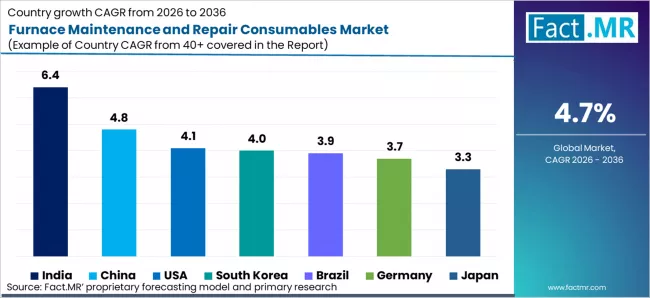
| Country | CAGR (Forecast Period) |
|---|---|
| USA | 4.1% |
| China | 4.8% |
| India | 6.4% |
| Germany | 3.7% |
| Japan | 3.3% |
| South Korea | 4.0% |
| Brazil | 3.9% |
The report covers an in-depth analysis of 40+ countries; top-performing countries are highlighted below.
What Factors Drive Growth in the USA Furnace Maintenance Consumables Market?
The furnace maintenance consumables market in the USA sees a 4.1% growth rate, largely driven by the Environmental Protection Agency (EPA) through the American Innovation and Manufacturing (AIM) Act. This legislation prohibits the manufacture and import of certain high-GWP equipment, encouraging industrial operators to upgrade furnace systems. Operators are adopting ceramic fiber insulation and specialized gaskets to reduce thermal leakage and meet emission standards. Additionally, Occupational Safety and Health Administration (OSHA) inspections enforce the use of certified repair consumables for high-heat equipment, ensuring that maintenance activities prioritize both environmental sustainability and workplace safety.
What Influences Growth in the China Furnace Maintenance Consumables Market?
China's furnace maintenance consumables market is projected to grow at a 4.8% rate, driven by the Ministry of Industry and Information Technology (MIIT) under the Steel Industry Growth Plan (2025-2026). The plan mandates a shift towards green and digital transformation of thermal equipment, with a focus on upgrading aging blast furnaces and adopting electric arc furnaces (EAFs). This transition requires high-performance refractory materials like magnesia-carbon bricks and advanced casting materials. Policy measures to phase out inefficient plants by 2026 drive the demand for specialized repair consumables that support high-frequency smelting and ultra-low emissions.
How Does India Achieve Growth in the Furnace Maintenance Consumables Market?
India's furnace maintenance consumables market is expected to grow by 6.4%, supported by the Bureau of Energy Efficiency (BEE) through the Perform, Achieve and Trade (PAT) scheme. The scheme sets mandatory energy reduction targets for industries like iron, steel, and cement, encouraging the adoption of high-efficiency insulation wool and monolithic refractories to reduce heat loss. The Ministry of Steel’s Purvodaya initiative is modernizing secondary steel sectors, particularly in the eastern industrial corridor. These regulatory frameworks prioritize furnace maintenance as a strategic necessity to meet energy intensity benchmarks and avoid penalties.
What Drives Growth in the Germany Furnace Maintenance Consumables Market?
The 3.7% growth rate in Germany is influenced by the Federal Ministry of Economic Affairs and Climate Action (BMWK) through the Carbon Contracts for Difference (CCfD) program. This initiative incentivizes the transition to hydrogen-based and electric heating processes. As a result, demand for specialized maintenance consumables, such as refractory linings that withstand hydrogen combustion, is growing. The Plattform Industrie 4.0 framework also promotes the use of smart sensors for real-time furnace monitoring, creating a just-in-time procurement model for repair materials. These measures help German manufacturers meet climate neutrality goals while ensuring the longevity of thermal processing assets.
How Does Japan Achieve Growth in the Furnace Maintenance Consumables Market?
Japan's 3.3% growth rate in the furnace maintenance consumables market is shaped by the Ministry of Economy, Trade and Industry (METI) and its Basic Policy for the Realization of GX (Green Transformation). METI encourages a shift to non-fossil fuel energy sources for industrial furnaces, promoting thermal insulation and advanced heat-resistant alloys to improve energy efficiency. The focus on Green Steel certifications further drives the need for premium maintenance consumables that extend furnace campaign lives. These initiatives help reduce the environmental impact of frequent relining procedures and improve the sustainability of Japan’s domestic metallurgy sector.
Why Does South Korea Exhibit Growth in the Furnace Maintenance Consumables Market?
South Korea's furnace maintenance consumables market is growing at 4.0%, driven by the Ministry of Trade, Industry and Energy (MOTIE) and amendments to the Energy Use Rationalization Act. These amendments strengthen the Minimum Energy Performance Standards (MEPS), requiring manufacturers to maintain furnaces at higher efficiency levels. The Materials, Parts, and Equipment (MPE) Industry initiative supports R&D for next-generation heat-resistant materials and repair technologies. The mandatory implementation of the K-ETS (Emission Trading Scheme) also incentivizes the use of advanced refractory castables to improve heat retention and reduce carbon intensity, further driving market demand for furnace maintenance consumables.
What Influences Growth in the Brazil Furnace Maintenance Consumables Market?
The 3.9% growth rate in Brazil is anchored by the National Mining Agency (ANM) and its updated Regulatory Standards for Mining (NRM). These standards emphasize the operational continuity of industrial facilities, including smelting furnaces. As Brazilian mills strive to optimize fixed costs, there is increased demand for localized furnace repairs rather than expensive full-scale replacements. Additionally, environmental licensing requirements under IBAMA drive the adoption of high-sealing materials and advanced refractory mortars in the primary metals sector, further supporting the market for furnace maintenance consumables in Brazil.
How Will the Shift to Lifecycle Carbon Management and Autonomous Repair Systems Transform the Furnace Consumables Market?
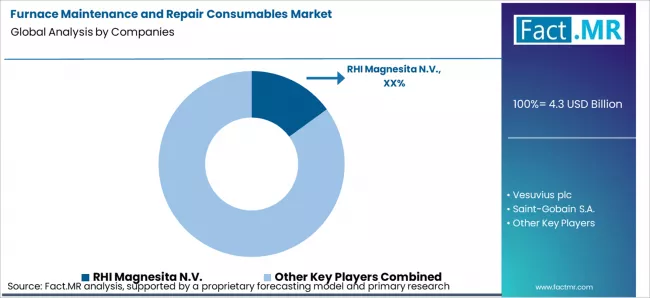
The furnace maintenance and repair consumables market is rapidly evolving from product supply to service-based solutions. As decarbonization becomes central to industrial strategy, companies like RHI Magnesita and Vesuvius are transitioning to closed-loop maintenance contracts where entire furnace lifecycles, from installation to recycling, are managed to reduce Scope 3 emissions. This shift is complemented by lightweight and rapid-turnaround technologies like cold-repair and hot-gunning, which minimize downtime and energy restart costs. Beyond 2026, the integration of digitalized monitoring through Digital Twin models will enable predictive maintenance, further enhancing operational uptime. The future competitiveness of furnace operations will hinge on securing thermal uptime and moving away from traditional commodity-focused cost management, positioning availability as a service at the heart of business strategy.
Key Players of the Furnace Maintenance and Repair Consumables Market
- RHI Magnesita N.V.
- Vesuvius plc
- Saint-Gobain S.A.
- Calderys
- HarbisonWalker International, Inc.
- Morgan Advanced Materials plc
- Shinagawa Refractories Co., Ltd.
- Krosaki Harima Corporation
- Imerys S.A.
- Resco Products, Inc.
Scope of the Report
| Items | Values |
|---|---|
| Quantitative Units (2026) | USD Billion |
| Consumable Type | Refractory Repair and Gunning Mixes, Insulating Linings and Boards, Protective Coatings and Mortars, Burner or Lance Wear Parts |
| Furnace Type | EAF and Ladle Furnaces, Reheat or Annealing Furnaces, Vacuum or Heat Treatment Furnaces |
| Refractory Chemistry | Alumina-based, Magnesia-based, Silica or Other |
| Purchase Mode | Long-term Supply Contracts, Spot Purchases |
| Steelmaking Route | BF-BOF, EAF |
| Regions Covered | North America, Europe, Asia Pacific, Latin America, Middle East & Africa |
| Countries Covered | United States, Canada, Mexico, Germany, United Kingdom, France, Japan, South Korea, China, India, Brazil, and other countries |
| Key Companies Profiled | RHI Magnesita N.V., Vesuvius plc, Saint-Gobain S.A., Calderys, HarbisonWalker International, Inc., Morgan Advanced Materials plc, Shinagawa Refractories Co., Ltd., Krosaki Harima Corporation, Imerys S.A., Resco Products, Inc. |
| Additional Attributes | Dollar revenue by consumable type, furnace type, refractory chemistry, purchase mode, steelmaking route, and region; regional demand trends, competitive landscape, technological advancements in furnace maintenance and repair consumables, operational performance optimization initiatives, and product development strategies |
Furnace Maintenance and Repair Consumables Market Key Segments
-
Consumable Type :
- Refractory Repair and Gunning Mixes
- Insulating Linings and Boards
- Protective Coatings and Mortars
- Burner or Lance Wear Parts
-
Furnace Type :
- EAF and Ladle Furnaces
- Reheat or Annealing Furnaces
- Vacuum or Heat Treatment Furnaces
-
Refractory Chemistry :
- Alumina-based
- Magnesia-based
- Silica or Other
-
Purchase Mode :
- Long-term Supply Contracts
- Spot Purchases
-
Steelmaking Route :
- BF-BOF
- EAF
-
Region :
- North America
- USA
- Canada
- Mexico
- Europe
- Germany
- UK
- France
- Italy
- Spain
- Nordic Countries
- BENELUX
- Rest of Europe
- Asia Pacific
- China
- Japan
- South Korea
- India
- Australia
- Rest of Asia Pacific
- Latin America
- Brazil
- Argentina
- Rest of Latin America
- Middle East and Africa
- Kingdom of Saudi Arabia
- United Arab Emirates
- South Africa
- Rest of Middle East and Africa
- Other Regions
- Oceania
- Central Asia
- Other Markets
- North America
Bibliographies
- European Commission, Joint Research Centre. (2023). Best available techniques (BAT) reference document for iron and steel production. European Union.
- World Steel Association. (2024). Refractory use, furnace maintenance practices, and lifecycle performance in steelmaking. World Steel Association.
- International Organization for Standardization. (2023). Refractory materials-Classification, testing, and performance evaluation standards. ISO.
- Occupational Safety and Health Administration. (2024). Maintenance and repair safety considerations for high-temperature industrial furnaces. U.S. Department of Labor.
- U.S. Department of Energy. (2024). High-temperature process efficiency and refractory system durability in industrial furnaces. Office of Energy Efficiency and Renewable Energy.
Table of Content
- Executive Summary
- Global Market Outlook
- Demand to side Trends
- Supply to side Trends
- Technology Roadmap Analysis
- Analysis and Recommendations
- Market Overview
- Market Coverage / Taxonomy
- Market Definition / Scope / Limitations
- Research Methodology
- Chapter Orientation
- Analytical Lens and Working Hypotheses
- Market Structure, Signals, and Trend Drivers
- Benchmarking and Cross-market Comparability
- Market Sizing, Forecasting, and Opportunity Mapping
- Research Design and Evidence Framework
- Desk Research Programme (Secondary Evidence)
- Company Annual and Sustainability Reports
- Peer-reviewed Journals and Academic Literature
- Corporate Websites, Product Literature, and Technical Notes
- Earnings Decks and Investor Briefings
- Statutory Filings and Regulatory Disclosures
- Technical White Papers and Standards Notes
- Trade Journals, Industry Magazines, and Analyst Briefs
- Conference Proceedings, Webinars, and Seminar Materials
- Government Statistics Portals and Public Data Releases
- Press Releases and Reputable Media Coverage
- Specialist Newsletters and Curated Briefings
- Sector Databases and Reference Repositories
- FMR Internal Proprietary Databases and Historical Market Datasets
- Subscription Datasets and Paid Sources
- Social Channels, Communities, and Digital Listening Inputs
- Additional Desk Sources
- Expert Input and Fieldwork (Primary Evidence)
- Primary Modes
- Qualitative Interviews and Expert Elicitation
- Quantitative Surveys and Structured Data Capture
- Blended Approach
- Why Primary Evidence is Used
- Field Techniques
- Interviews
- Surveys
- Focus Groups
- Observational and In-context Research
- Social and Community Interactions
- Stakeholder Universe Engaged
- C-suite Leaders
- Board Members
- Presidents and Vice Presidents
- R&D and Innovation Heads
- Technical Specialists
- Domain Subject-matter Experts
- Scientists
- Physicians and Other Healthcare Professionals
- Governance, Ethics, and Data Stewardship
- Research Ethics
- Data Integrity and Handling
- Primary Modes
- Tooling, Models, and Reference Databases
- Desk Research Programme (Secondary Evidence)
- Data Engineering and Model Build
- Data Acquisition and Ingestion
- Cleaning, Normalisation, and Verification
- Synthesis, Triangulation, and Analysis
- Quality Assurance and Audit Trail
- Market Background
- Market Dynamics
- Drivers
- Restraints
- Opportunity
- Trends
- Scenario Forecast
- Demand in Optimistic Scenario
- Demand in Likely Scenario
- Demand in Conservative Scenario
- Opportunity Map Analysis
- Product Life Cycle Analysis
- Supply Chain Analysis
- Investment Feasibility Matrix
- Value Chain Analysis
- PESTLE and Porter’s Analysis
- Regulatory Landscape
- Regional Parent Market Outlook
- Production and Consumption Statistics
- Import and Export Statistics
- Market Dynamics
- Global Market Analysis 2021 to 2025 and Forecast, 2026 to 2036
- Historical Market Size Value (USD Million) Analysis, 2021 to 2025
- Current and Future Market Size Value (USD Million) Projections, 2026 to 2036
- Y to o to Y Growth Trend Analysis
- Absolute $ Opportunity Analysis
- Global Market Pricing Analysis 2021 to 2025 and Forecast 2026 to 2036
- Global Market Analysis 2021 to 2025 and Forecast 2026 to 2036, By Consumable Type
- Introduction / Key Findings
- Historical Market Size Value (USD Million) Analysis By Consumable Type, 2021 to 2025
- Current and Future Market Size Value (USD Million) Analysis and Forecast By Consumable Type, 2026 to 2036
- Refractory Repair and Gunning Mixes
- Insulating Linings and Boards
- Protective Coatings and Mortars
- Burner or Lance Wear Parts
- Refractory Repair and Gunning Mixes
- Y to o to Y Growth Trend Analysis By Consumable Type, 2021 to 2025
- Absolute $ Opportunity Analysis By Consumable Type, 2026 to 2036
- Global Market Analysis 2021 to 2025 and Forecast 2026 to 2036, By Furnace Type
- Introduction / Key Findings
- Historical Market Size Value (USD Million) Analysis By Furnace Type, 2021 to 2025
- Current and Future Market Size Value (USD Million) Analysis and Forecast By Furnace Type, 2026 to 2036
- EAF and Ladle Furnaces
- Reheat or Annealing Furnaces
- Vacuum or Heat Treatment Furnaces
- EAF and Ladle Furnaces
- Y to o to Y Growth Trend Analysis By Furnace Type, 2021 to 2025
- Absolute $ Opportunity Analysis By Furnace Type, 2026 to 2036
- Global Market Analysis 2021 to 2025 and Forecast 2026 to 2036, By Refractory Chemistry
- Introduction / Key Findings
- Historical Market Size Value (USD Million) Analysis By Refractory Chemistry, 2021 to 2025
- Current and Future Market Size Value (USD Million) Analysis and Forecast By Refractory Chemistry, 2026 to 2036
- Alumina-based
- Magnesia-based
- Silica or Other
- Alumina-based
- Y to o to Y Growth Trend Analysis By Refractory Chemistry, 2021 to 2025
- Absolute $ Opportunity Analysis By Refractory Chemistry, 2026 to 2036
- Global Market Analysis 2021 to 2025 and Forecast 2026 to 2036, By Purchase Mode
- Introduction / Key Findings
- Historical Market Size Value (USD Million) Analysis By Purchase Mode, 2021 to 2025
- Current and Future Market Size Value (USD Million) Analysis and Forecast By Purchase Mode, 2026 to 2036
- Long-term Supply Contracts
- Spot Purchases
- Long-term Supply Contracts
- Y to o to Y Growth Trend Analysis By Purchase Mode, 2021 to 2025
- Absolute $ Opportunity Analysis By Purchase Mode, 2026 to 2036
- Global Market Analysis 2021 to 2025 and Forecast 2026 to 2036, By Steelmaking Route
- Introduction / Key Findings
- Historical Market Size Value (USD Million) Analysis By Steelmaking Route, 2021 to 2025
- Current and Future Market Size Value (USD Million) Analysis and Forecast By Steelmaking Route, 2026 to 2036
- BF-BOF
- EAF
- BF-BOF
- Y to o to Y Growth Trend Analysis By Steelmaking Route, 2021 to 2025
- Absolute $ Opportunity Analysis By Steelmaking Route, 2026 to 2036
- Global Market Analysis 2021 to 2025 and Forecast 2026 to 2036, By Region
- Introduction
- Historical Market Size Value (USD Million) Analysis By Region, 2021 to 2025
- Current Market Size Value (USD Million) Analysis and Forecast By Region, 2026 to 2036
- North America
- Latin America
- Western Europe
- Eastern Europe
- East Asia
- South Asia and Pacific
- Middle East & Africa
- Market Attractiveness Analysis By Region
- North America Market Analysis 2021 to 2025 and Forecast 2026 to 2036, By Country
- Historical Market Size Value (USD Million) Trend Analysis By Market Taxonomy, 2021 to 2025
- Market Size Value (USD Million) Forecast By Market Taxonomy, 2026 to 2036
- By Country
- USA
- Canada
- Mexico
- By Consumable Type
- By Furnace Type
- By Refractory Chemistry
- By Purchase Mode
- By Steelmaking Route
- By Country
- Market Attractiveness Analysis
- By Country
- By Consumable Type
- By Furnace Type
- By Refractory Chemistry
- By Purchase Mode
- By Steelmaking Route
- Key Takeaways
- Latin America Market Analysis 2021 to 2025 and Forecast 2026 to 2036, By Country
- Historical Market Size Value (USD Million) Trend Analysis By Market Taxonomy, 2021 to 2025
- Market Size Value (USD Million) Forecast By Market Taxonomy, 2026 to 2036
- By Country
- Brazil
- Chile
- Rest of Latin America
- By Consumable Type
- By Furnace Type
- By Refractory Chemistry
- By Purchase Mode
- By Steelmaking Route
- By Country
- Market Attractiveness Analysis
- By Country
- By Consumable Type
- By Furnace Type
- By Refractory Chemistry
- By Purchase Mode
- By Steelmaking Route
- Key Takeaways
- Western Europe Market Analysis 2021 to 2025 and Forecast 2026 to 2036, By Country
- Historical Market Size Value (USD Million) Trend Analysis By Market Taxonomy, 2021 to 2025
- Market Size Value (USD Million) Forecast By Market Taxonomy, 2026 to 2036
- By Country
- Germany
- UK
- Italy
- Spain
- France
- Nordic
- BENELUX
- Rest of Western Europe
- By Consumable Type
- By Furnace Type
- By Refractory Chemistry
- By Purchase Mode
- By Steelmaking Route
- By Country
- Market Attractiveness Analysis
- By Country
- By Consumable Type
- By Furnace Type
- By Refractory Chemistry
- By Purchase Mode
- By Steelmaking Route
- Key Takeaways
- Eastern Europe Market Analysis 2021 to 2025 and Forecast 2026 to 2036, By Country
- Historical Market Size Value (USD Million) Trend Analysis By Market Taxonomy, 2021 to 2025
- Market Size Value (USD Million) Forecast By Market Taxonomy, 2026 to 2036
- By Country
- Russia
- Poland
- Hungary
- Balkan & Baltic
- Rest of Eastern Europe
- By Consumable Type
- By Furnace Type
- By Refractory Chemistry
- By Purchase Mode
- By Steelmaking Route
- By Country
- Market Attractiveness Analysis
- By Country
- By Consumable Type
- By Furnace Type
- By Refractory Chemistry
- By Purchase Mode
- By Steelmaking Route
- Key Takeaways
- East Asia Market Analysis 2021 to 2025 and Forecast 2026 to 2036, By Country
- Historical Market Size Value (USD Million) Trend Analysis By Market Taxonomy, 2021 to 2025
- Market Size Value (USD Million) Forecast By Market Taxonomy, 2026 to 2036
- By Country
- China
- Japan
- South Korea
- By Consumable Type
- By Furnace Type
- By Refractory Chemistry
- By Purchase Mode
- By Steelmaking Route
- By Country
- Market Attractiveness Analysis
- By Country
- By Consumable Type
- By Furnace Type
- By Refractory Chemistry
- By Purchase Mode
- By Steelmaking Route
- Key Takeaways
- South Asia and Pacific Market Analysis 2021 to 2025 and Forecast 2026 to 2036, By Country
- Historical Market Size Value (USD Million) Trend Analysis By Market Taxonomy, 2021 to 2025
- Market Size Value (USD Million) Forecast By Market Taxonomy, 2026 to 2036
- By Country
- India
- ASEAN
- Australia & New Zealand
- Rest of South Asia and Pacific
- By Consumable Type
- By Furnace Type
- By Refractory Chemistry
- By Purchase Mode
- By Steelmaking Route
- By Country
- Market Attractiveness Analysis
- By Country
- By Consumable Type
- By Furnace Type
- By Refractory Chemistry
- By Purchase Mode
- By Steelmaking Route
- Key Takeaways
- Middle East & Africa Market Analysis 2021 to 2025 and Forecast 2026 to 2036, By Country
- Historical Market Size Value (USD Million) Trend Analysis By Market Taxonomy, 2021 to 2025
- Market Size Value (USD Million) Forecast By Market Taxonomy, 2026 to 2036
- By Country
- Kingdom of Saudi Arabia
- Other GCC Countries
- Turkiye
- South Africa
- Other African Union
- Rest of Middle East & Africa
- By Consumable Type
- By Furnace Type
- By Refractory Chemistry
- By Purchase Mode
- By Steelmaking Route
- By Country
- Market Attractiveness Analysis
- By Country
- By Consumable Type
- By Furnace Type
- By Refractory Chemistry
- By Purchase Mode
- By Steelmaking Route
- Key Takeaways
- Key Countries Market Analysis
- USA
- Pricing Analysis
- Market Share Analysis, 2025
- By Consumable Type
- By Furnace Type
- By Refractory Chemistry
- By Purchase Mode
- By Steelmaking Route
- Canada
- Pricing Analysis
- Market Share Analysis, 2025
- By Consumable Type
- By Furnace Type
- By Refractory Chemistry
- By Purchase Mode
- By Steelmaking Route
- Mexico
- Pricing Analysis
- Market Share Analysis, 2025
- By Consumable Type
- By Furnace Type
- By Refractory Chemistry
- By Purchase Mode
- By Steelmaking Route
- Brazil
- Pricing Analysis
- Market Share Analysis, 2025
- By Consumable Type
- By Furnace Type
- By Refractory Chemistry
- By Purchase Mode
- By Steelmaking Route
- Chile
- Pricing Analysis
- Market Share Analysis, 2025
- By Consumable Type
- By Furnace Type
- By Refractory Chemistry
- By Purchase Mode
- By Steelmaking Route
- Germany
- Pricing Analysis
- Market Share Analysis, 2025
- By Consumable Type
- By Furnace Type
- By Refractory Chemistry
- By Purchase Mode
- By Steelmaking Route
- UK
- Pricing Analysis
- Market Share Analysis, 2025
- By Consumable Type
- By Furnace Type
- By Refractory Chemistry
- By Purchase Mode
- By Steelmaking Route
- Italy
- Pricing Analysis
- Market Share Analysis, 2025
- By Consumable Type
- By Furnace Type
- By Refractory Chemistry
- By Purchase Mode
- By Steelmaking Route
- Spain
- Pricing Analysis
- Market Share Analysis, 2025
- By Consumable Type
- By Furnace Type
- By Refractory Chemistry
- By Purchase Mode
- By Steelmaking Route
- France
- Pricing Analysis
- Market Share Analysis, 2025
- By Consumable Type
- By Furnace Type
- By Refractory Chemistry
- By Purchase Mode
- By Steelmaking Route
- India
- Pricing Analysis
- Market Share Analysis, 2025
- By Consumable Type
- By Furnace Type
- By Refractory Chemistry
- By Purchase Mode
- By Steelmaking Route
- ASEAN
- Pricing Analysis
- Market Share Analysis, 2025
- By Consumable Type
- By Furnace Type
- By Refractory Chemistry
- By Purchase Mode
- By Steelmaking Route
- Australia & New Zealand
- Pricing Analysis
- Market Share Analysis, 2025
- By Consumable Type
- By Furnace Type
- By Refractory Chemistry
- By Purchase Mode
- By Steelmaking Route
- China
- Pricing Analysis
- Market Share Analysis, 2025
- By Consumable Type
- By Furnace Type
- By Refractory Chemistry
- By Purchase Mode
- By Steelmaking Route
- Japan
- Pricing Analysis
- Market Share Analysis, 2025
- By Consumable Type
- By Furnace Type
- By Refractory Chemistry
- By Purchase Mode
- By Steelmaking Route
- South Korea
- Pricing Analysis
- Market Share Analysis, 2025
- By Consumable Type
- By Furnace Type
- By Refractory Chemistry
- By Purchase Mode
- By Steelmaking Route
- Russia
- Pricing Analysis
- Market Share Analysis, 2025
- By Consumable Type
- By Furnace Type
- By Refractory Chemistry
- By Purchase Mode
- By Steelmaking Route
- Poland
- Pricing Analysis
- Market Share Analysis, 2025
- By Consumable Type
- By Furnace Type
- By Refractory Chemistry
- By Purchase Mode
- By Steelmaking Route
- Hungary
- Pricing Analysis
- Market Share Analysis, 2025
- By Consumable Type
- By Furnace Type
- By Refractory Chemistry
- By Purchase Mode
- By Steelmaking Route
- Kingdom of Saudi Arabia
- Pricing Analysis
- Market Share Analysis, 2025
- By Consumable Type
- By Furnace Type
- By Refractory Chemistry
- By Purchase Mode
- By Steelmaking Route
- Turkiye
- Pricing Analysis
- Market Share Analysis, 2025
- By Consumable Type
- By Furnace Type
- By Refractory Chemistry
- By Purchase Mode
- By Steelmaking Route
- South Africa
- Pricing Analysis
- Market Share Analysis, 2025
- By Consumable Type
- By Furnace Type
- By Refractory Chemistry
- By Purchase Mode
- By Steelmaking Route
- USA
- Market Structure Analysis
- Competition Dashboard
- Competition Benchmarking
- Market Share Analysis of Top Players
- By Regional
- By Consumable Type
- By Furnace Type
- By Refractory Chemistry
- By Purchase Mode
- By Steelmaking Route
- Competition Analysis
- Competition Deep Dive
- RHI Magnesita N.V.
- Overview
- Product Portfolio
- Profitability by Market Segments (Product/Age /Sales Channel/Region)
- Sales Footprint
- Strategy Overview
- Marketing Strategy
- Product Strategy
- Channel Strategy
- Vesuvius plc
- Saint-Gobain S.A.
- Calderys
- HarbisonWalker International, Inc.
- Morgan Advanced Materials plc
- Shinagawa Refractories Co., Ltd.
- Krosaki Harima Corporation
- Imerys S.A.
- Resco Products, Inc.
- RHI Magnesita N.V.
- Competition Deep Dive
- Assumptions & Acronyms Used
List Of Table
- Table 1: Global Market Value (USD Million) Forecast by Region, 2021 to 2036
- Table 2: Global Market Value (USD Million) Forecast by Consumable Type, 2021 to 2036
- Table 3: Global Market Value (USD Million) Forecast by Furnace Type, 2021 to 2036
- Table 4: Global Market Value (USD Million) Forecast by Refractory Chemistry, 2021 to 2036
- Table 5: Global Market Value (USD Million) Forecast by Purchase Mode, 2021 to 2036
- Table 6: Global Market Value (USD Million) Forecast by Steelmaking Route, 2021 to 2036
- Table 7: North America Market Value (USD Million) Forecast by Country, 2021 to 2036
- Table 8: North America Market Value (USD Million) Forecast by Consumable Type, 2021 to 2036
- Table 9: North America Market Value (USD Million) Forecast by Furnace Type, 2021 to 2036
- Table 10: North America Market Value (USD Million) Forecast by Refractory Chemistry, 2021 to 2036
- Table 11: North America Market Value (USD Million) Forecast by Purchase Mode, 2021 to 2036
- Table 12: North America Market Value (USD Million) Forecast by Steelmaking Route, 2021 to 2036
- Table 13: Latin America Market Value (USD Million) Forecast by Country, 2021 to 2036
- Table 14: Latin America Market Value (USD Million) Forecast by Consumable Type, 2021 to 2036
- Table 15: Latin America Market Value (USD Million) Forecast by Furnace Type, 2021 to 2036
- Table 16: Latin America Market Value (USD Million) Forecast by Refractory Chemistry, 2021 to 2036
- Table 17: Latin America Market Value (USD Million) Forecast by Purchase Mode, 2021 to 2036
- Table 18: Latin America Market Value (USD Million) Forecast by Steelmaking Route, 2021 to 2036
- Table 19: Western Europe Market Value (USD Million) Forecast by Country, 2021 to 2036
- Table 20: Western Europe Market Value (USD Million) Forecast by Consumable Type, 2021 to 2036
- Table 21: Western Europe Market Value (USD Million) Forecast by Furnace Type, 2021 to 2036
- Table 22: Western Europe Market Value (USD Million) Forecast by Refractory Chemistry, 2021 to 2036
- Table 23: Western Europe Market Value (USD Million) Forecast by Purchase Mode, 2021 to 2036
- Table 24: Western Europe Market Value (USD Million) Forecast by Steelmaking Route, 2021 to 2036
- Table 25: Eastern Europe Market Value (USD Million) Forecast by Country, 2021 to 2036
- Table 26: Eastern Europe Market Value (USD Million) Forecast by Consumable Type, 2021 to 2036
- Table 27: Eastern Europe Market Value (USD Million) Forecast by Furnace Type, 2021 to 2036
- Table 28: Eastern Europe Market Value (USD Million) Forecast by Refractory Chemistry, 2021 to 2036
- Table 29: Eastern Europe Market Value (USD Million) Forecast by Purchase Mode, 2021 to 2036
- Table 30: Eastern Europe Market Value (USD Million) Forecast by Steelmaking Route, 2021 to 2036
- Table 31: East Asia Market Value (USD Million) Forecast by Country, 2021 to 2036
- Table 32: East Asia Market Value (USD Million) Forecast by Consumable Type, 2021 to 2036
- Table 33: East Asia Market Value (USD Million) Forecast by Furnace Type, 2021 to 2036
- Table 34: East Asia Market Value (USD Million) Forecast by Refractory Chemistry, 2021 to 2036
- Table 35: East Asia Market Value (USD Million) Forecast by Purchase Mode, 2021 to 2036
- Table 36: East Asia Market Value (USD Million) Forecast by Steelmaking Route, 2021 to 2036
- Table 37: South Asia and Pacific Market Value (USD Million) Forecast by Country, 2021 to 2036
- Table 38: South Asia and Pacific Market Value (USD Million) Forecast by Consumable Type, 2021 to 2036
- Table 39: South Asia and Pacific Market Value (USD Million) Forecast by Furnace Type, 2021 to 2036
- Table 40: South Asia and Pacific Market Value (USD Million) Forecast by Refractory Chemistry, 2021 to 2036
- Table 41: South Asia and Pacific Market Value (USD Million) Forecast by Purchase Mode, 2021 to 2036
- Table 42: South Asia and Pacific Market Value (USD Million) Forecast by Steelmaking Route, 2021 to 2036
- Table 43: Middle East & Africa Market Value (USD Million) Forecast by Country, 2021 to 2036
- Table 44: Middle East & Africa Market Value (USD Million) Forecast by Consumable Type, 2021 to 2036
- Table 45: Middle East & Africa Market Value (USD Million) Forecast by Furnace Type, 2021 to 2036
- Table 46: Middle East & Africa Market Value (USD Million) Forecast by Refractory Chemistry, 2021 to 2036
- Table 47: Middle East & Africa Market Value (USD Million) Forecast by Purchase Mode, 2021 to 2036
- Table 48: Middle East & Africa Market Value (USD Million) Forecast by Steelmaking Route, 2021 to 2036
List Of Figures
- Figure 1: Global Market Pricing Analysis
- Figure 2: Global Market Value (USD Million) Forecast 2021 to 2036
- Figure 3: Global Market Value Share and BPS Analysis by Consumable Type, 2026 and 2036
- Figure 4: Global Market Y to o to Y Growth Comparison by Consumable Type, 2026 to 2036
- Figure 5: Global Market Attractiveness Analysis by Consumable Type
- Figure 6: Global Market Value Share and BPS Analysis by Furnace Type, 2026 and 2036
- Figure 7: Global Market Y to o to Y Growth Comparison by Furnace Type, 2026 to 2036
- Figure 8: Global Market Attractiveness Analysis by Furnace Type
- Figure 9: Global Market Value Share and BPS Analysis by Refractory Chemistry, 2026 and 2036
- Figure 10: Global Market Y to o to Y Growth Comparison by Refractory Chemistry, 2026 to 2036
- Figure 11: Global Market Attractiveness Analysis by Refractory Chemistry
- Figure 12: Global Market Value Share and BPS Analysis by Purchase Mode, 2026 and 2036
- Figure 13: Global Market Y to o to Y Growth Comparison by Purchase Mode, 2026 to 2036
- Figure 14: Global Market Attractiveness Analysis by Purchase Mode
- Figure 15: Global Market Value Share and BPS Analysis by Steelmaking Route, 2026 and 2036
- Figure 16: Global Market Y to o to Y Growth Comparison by Steelmaking Route, 2026 to 2036
- Figure 17: Global Market Attractiveness Analysis by Steelmaking Route
- Figure 18: Global Market Value (USD Million) Share and BPS Analysis by Region, 2026 and 2036
- Figure 19: Global Market Y to o to Y Growth Comparison by Region, 2026 to 2036
- Figure 20: Global Market Attractiveness Analysis by Region
- Figure 21: North America Market Incremental Dollar Opportunity, 2026 to 2036
- Figure 22: Latin America Market Incremental Dollar Opportunity, 2026 to 2036
- Figure 23: Western Europe Market Incremental Dollar Opportunity, 2026 to 2036
- Figure 24: Eastern Europe Market Incremental Dollar Opportunity, 2026 to 2036
- Figure 25: East Asia Market Incremental Dollar Opportunity, 2026 to 2036
- Figure 26: South Asia and Pacific Market Incremental Dollar Opportunity, 2026 to 2036
- Figure 27: Middle East & Africa Market Incremental Dollar Opportunity, 2026 to 2036
- Figure 28: North America Market Value Share and BPS Analysis by Country, 2026 and 2036
- Figure 29: North America Market Value Share and BPS Analysis by Consumable Type, 2026 and 2036
- Figure 30: North America Market Y to o to Y Growth Comparison by Consumable Type, 2026 to 2036
- Figure 31: North America Market Attractiveness Analysis by Consumable Type
- Figure 32: North America Market Value Share and BPS Analysis by Furnace Type, 2026 and 2036
- Figure 33: North America Market Y to o to Y Growth Comparison by Furnace Type, 2026 to 2036
- Figure 34: North America Market Attractiveness Analysis by Furnace Type
- Figure 35: North America Market Value Share and BPS Analysis by Refractory Chemistry, 2026 and 2036
- Figure 36: North America Market Y to o to Y Growth Comparison by Refractory Chemistry, 2026 to 2036
- Figure 37: North America Market Attractiveness Analysis by Refractory Chemistry
- Figure 38: North America Market Value Share and BPS Analysis by Purchase Mode, 2026 and 2036
- Figure 39: North America Market Y to o to Y Growth Comparison by Purchase Mode, 2026 to 2036
- Figure 40: North America Market Attractiveness Analysis by Purchase Mode
- Figure 41: North America Market Value Share and BPS Analysis by Steelmaking Route, 2026 and 2036
- Figure 42: North America Market Y to o to Y Growth Comparison by Steelmaking Route, 2026 to 2036
- Figure 43: North America Market Attractiveness Analysis by Steelmaking Route
- Figure 44: Latin America Market Value Share and BPS Analysis by Country, 2026 and 2036
- Figure 45: Latin America Market Value Share and BPS Analysis by Consumable Type, 2026 and 2036
- Figure 46: Latin America Market Y to o to Y Growth Comparison by Consumable Type, 2026 to 2036
- Figure 47: Latin America Market Attractiveness Analysis by Consumable Type
- Figure 48: Latin America Market Value Share and BPS Analysis by Furnace Type, 2026 and 2036
- Figure 49: Latin America Market Y to o to Y Growth Comparison by Furnace Type, 2026 to 2036
- Figure 50: Latin America Market Attractiveness Analysis by Furnace Type
- Figure 51: Latin America Market Value Share and BPS Analysis by Refractory Chemistry, 2026 and 2036
- Figure 52: Latin America Market Y to o to Y Growth Comparison by Refractory Chemistry, 2026 to 2036
- Figure 53: Latin America Market Attractiveness Analysis by Refractory Chemistry
- Figure 54: Latin America Market Value Share and BPS Analysis by Purchase Mode, 2026 and 2036
- Figure 55: Latin America Market Y to o to Y Growth Comparison by Purchase Mode, 2026 to 2036
- Figure 56: Latin America Market Attractiveness Analysis by Purchase Mode
- Figure 57: Latin America Market Value Share and BPS Analysis by Steelmaking Route, 2026 and 2036
- Figure 58: Latin America Market Y to o to Y Growth Comparison by Steelmaking Route, 2026 to 2036
- Figure 59: Latin America Market Attractiveness Analysis by Steelmaking Route
- Figure 60: Western Europe Market Value Share and BPS Analysis by Country, 2026 and 2036
- Figure 61: Western Europe Market Value Share and BPS Analysis by Consumable Type, 2026 and 2036
- Figure 62: Western Europe Market Y to o to Y Growth Comparison by Consumable Type, 2026 to 2036
- Figure 63: Western Europe Market Attractiveness Analysis by Consumable Type
- Figure 64: Western Europe Market Value Share and BPS Analysis by Furnace Type, 2026 and 2036
- Figure 65: Western Europe Market Y to o to Y Growth Comparison by Furnace Type, 2026 to 2036
- Figure 66: Western Europe Market Attractiveness Analysis by Furnace Type
- Figure 67: Western Europe Market Value Share and BPS Analysis by Refractory Chemistry, 2026 and 2036
- Figure 68: Western Europe Market Y to o to Y Growth Comparison by Refractory Chemistry, 2026 to 2036
- Figure 69: Western Europe Market Attractiveness Analysis by Refractory Chemistry
- Figure 70: Western Europe Market Value Share and BPS Analysis by Purchase Mode, 2026 and 2036
- Figure 71: Western Europe Market Y to o to Y Growth Comparison by Purchase Mode, 2026 to 2036
- Figure 72: Western Europe Market Attractiveness Analysis by Purchase Mode
- Figure 73: Western Europe Market Value Share and BPS Analysis by Steelmaking Route, 2026 and 2036
- Figure 74: Western Europe Market Y to o to Y Growth Comparison by Steelmaking Route, 2026 to 2036
- Figure 75: Western Europe Market Attractiveness Analysis by Steelmaking Route
- Figure 76: Eastern Europe Market Value Share and BPS Analysis by Country, 2026 and 2036
- Figure 77: Eastern Europe Market Value Share and BPS Analysis by Consumable Type, 2026 and 2036
- Figure 78: Eastern Europe Market Y to o to Y Growth Comparison by Consumable Type, 2026 to 2036
- Figure 79: Eastern Europe Market Attractiveness Analysis by Consumable Type
- Figure 80: Eastern Europe Market Value Share and BPS Analysis by Furnace Type, 2026 and 2036
- Figure 81: Eastern Europe Market Y to o to Y Growth Comparison by Furnace Type, 2026 to 2036
- Figure 82: Eastern Europe Market Attractiveness Analysis by Furnace Type
- Figure 83: Eastern Europe Market Value Share and BPS Analysis by Refractory Chemistry, 2026 and 2036
- Figure 84: Eastern Europe Market Y to o to Y Growth Comparison by Refractory Chemistry, 2026 to 2036
- Figure 85: Eastern Europe Market Attractiveness Analysis by Refractory Chemistry
- Figure 86: Eastern Europe Market Value Share and BPS Analysis by Purchase Mode, 2026 and 2036
- Figure 87: Eastern Europe Market Y to o to Y Growth Comparison by Purchase Mode, 2026 to 2036
- Figure 88: Eastern Europe Market Attractiveness Analysis by Purchase Mode
- Figure 89: Eastern Europe Market Value Share and BPS Analysis by Steelmaking Route, 2026 and 2036
- Figure 90: Eastern Europe Market Y to o to Y Growth Comparison by Steelmaking Route, 2026 to 2036
- Figure 91: Eastern Europe Market Attractiveness Analysis by Steelmaking Route
- Figure 92: East Asia Market Value Share and BPS Analysis by Country, 2026 and 2036
- Figure 93: East Asia Market Value Share and BPS Analysis by Consumable Type, 2026 and 2036
- Figure 94: East Asia Market Y to o to Y Growth Comparison by Consumable Type, 2026 to 2036
- Figure 95: East Asia Market Attractiveness Analysis by Consumable Type
- Figure 96: East Asia Market Value Share and BPS Analysis by Furnace Type, 2026 and 2036
- Figure 97: East Asia Market Y to o to Y Growth Comparison by Furnace Type, 2026 to 2036
- Figure 98: East Asia Market Attractiveness Analysis by Furnace Type
- Figure 99: East Asia Market Value Share and BPS Analysis by Refractory Chemistry, 2026 and 2036
- Figure 100: East Asia Market Y to o to Y Growth Comparison by Refractory Chemistry, 2026 to 2036
- Figure 101: East Asia Market Attractiveness Analysis by Refractory Chemistry
- Figure 102: East Asia Market Value Share and BPS Analysis by Purchase Mode, 2026 and 2036
- Figure 103: East Asia Market Y to o to Y Growth Comparison by Purchase Mode, 2026 to 2036
- Figure 104: East Asia Market Attractiveness Analysis by Purchase Mode
- Figure 105: East Asia Market Value Share and BPS Analysis by Steelmaking Route, 2026 and 2036
- Figure 106: East Asia Market Y to o to Y Growth Comparison by Steelmaking Route, 2026 to 2036
- Figure 107: East Asia Market Attractiveness Analysis by Steelmaking Route
- Figure 108: South Asia and Pacific Market Value Share and BPS Analysis by Country, 2026 and 2036
- Figure 109: South Asia and Pacific Market Value Share and BPS Analysis by Consumable Type, 2026 and 2036
- Figure 110: South Asia and Pacific Market Y to o to Y Growth Comparison by Consumable Type, 2026 to 2036
- Figure 111: South Asia and Pacific Market Attractiveness Analysis by Consumable Type
- Figure 112: South Asia and Pacific Market Value Share and BPS Analysis by Furnace Type, 2026 and 2036
- Figure 113: South Asia and Pacific Market Y to o to Y Growth Comparison by Furnace Type, 2026 to 2036
- Figure 114: South Asia and Pacific Market Attractiveness Analysis by Furnace Type
- Figure 115: South Asia and Pacific Market Value Share and BPS Analysis by Refractory Chemistry, 2026 and 2036
- Figure 116: South Asia and Pacific Market Y to o to Y Growth Comparison by Refractory Chemistry, 2026 to 2036
- Figure 117: South Asia and Pacific Market Attractiveness Analysis by Refractory Chemistry
- Figure 118: South Asia and Pacific Market Value Share and BPS Analysis by Purchase Mode, 2026 and 2036
- Figure 119: South Asia and Pacific Market Y to o to Y Growth Comparison by Purchase Mode, 2026 to 2036
- Figure 120: South Asia and Pacific Market Attractiveness Analysis by Purchase Mode
- Figure 121: South Asia and Pacific Market Value Share and BPS Analysis by Steelmaking Route, 2026 and 2036
- Figure 122: South Asia and Pacific Market Y to o to Y Growth Comparison by Steelmaking Route, 2026 to 2036
- Figure 123: South Asia and Pacific Market Attractiveness Analysis by Steelmaking Route
- Figure 124: Middle East & Africa Market Value Share and BPS Analysis by Country, 2026 and 2036
- Figure 125: Middle East & Africa Market Value Share and BPS Analysis by Consumable Type, 2026 and 2036
- Figure 126: Middle East & Africa Market Y to o to Y Growth Comparison by Consumable Type, 2026 to 2036
- Figure 127: Middle East & Africa Market Attractiveness Analysis by Consumable Type
- Figure 128: Middle East & Africa Market Value Share and BPS Analysis by Furnace Type, 2026 and 2036
- Figure 129: Middle East & Africa Market Y to o to Y Growth Comparison by Furnace Type, 2026 to 2036
- Figure 130: Middle East & Africa Market Attractiveness Analysis by Furnace Type
- Figure 131: Middle East & Africa Market Value Share and BPS Analysis by Refractory Chemistry, 2026 and 2036
- Figure 132: Middle East & Africa Market Y to o to Y Growth Comparison by Refractory Chemistry, 2026 to 2036
- Figure 133: Middle East & Africa Market Attractiveness Analysis by Refractory Chemistry
- Figure 134: Middle East & Africa Market Value Share and BPS Analysis by Purchase Mode, 2026 and 2036
- Figure 135: Middle East & Africa Market Y to o to Y Growth Comparison by Purchase Mode, 2026 to 2036
- Figure 136: Middle East & Africa Market Attractiveness Analysis by Purchase Mode
- Figure 137: Middle East & Africa Market Value Share and BPS Analysis by Steelmaking Route, 2026 and 2036
- Figure 138: Middle East & Africa Market Y to o to Y Growth Comparison by Steelmaking Route, 2026 to 2036
- Figure 139: Middle East & Africa Market Attractiveness Analysis by Steelmaking Route
- Figure 140: Global Market - Tier Structure Analysis
- Figure 141: Global Market - Company Share Analysis
- FAQs -
How big is the furnace maintenance and repair consumables market in 2026?
The global furnace maintenance and repair consumables market is estimated to be valued at USD 4.3 billion in 2026.
What will be the size of furnace maintenance and repair consumables market in 2036?
The market size for the furnace maintenance and repair consumables market is projected to reach USD 6.8 billion by 2036.
How much will be the furnace maintenance and repair consumables market growth between 2026 and 2036?
The furnace maintenance and repair consumables market is expected to grow at a 4.7% CAGR between 2026 and 2036.
What are the key product types in the furnace maintenance and repair consumables market?
The key product types in furnace maintenance and repair consumables market are refractory repair and gunning mixes, insulating linings and boards, protective coatings and mortars and burner or lance wear parts.
Which furnace type segment to contribute significant share in the furnace maintenance and repair consumables market in 2026?
In terms of furnace type, eaf and ladle furnaces segment to command 47.0% share in the furnace maintenance and repair consumables market in 2026.