- Market Value (2025): USD 1.45 Bn
- Estimated Value (2026): USD 1.5 Bn
- Forecast Value (2036): USD 2.5 Bn
- CAGR (2026-2036): 5.2%
Fuse Holders Market Forecast and Outlook 2026 to 2036
Demand for fuse holders is rising as electrification and grid investment add circuits that need overcurrent protection. Sales of fuse holders are projected to grow from USD 1.5 billion in 2026 to USD 2.5 billion by 2036, a CAGR of 5.2%, adding about USD 1.0 billion in absolute opportunity.
Adoption of fuse holders is supported by power-sector investment. For example, in January 2026, Germany's Federal Network Agency reported approval of about 2,000 km of power lines in 2025, around 45% more than in 2024. Similar network build-outs are projected to drive sales of fuse holders in countries expanding electricity infrastructure.
Key Takeaways from the Fuse Holders Market
- The fuse holders market crossed a valuation of USD 1.45 billion in 2025
- Fuse Holders Market Value (2026): USD 1.5 billion
- Fuse Holders Market Forecast Value (2036): USD 2.5 billion
- Fuse Holders Market Forecast CAGR (2026-2036): 5.2%
- Leading Type: Open Fuse Holders (28.3%)
- Key Market Participants: Littelfuse, Inc., Eaton Corporation, Siemens AG, ABB Ltd., Mersen S.A., Phoenix Contact GmbH & Co. KG, Hubbell Incorporated, Legrand S.A.
- Key Growth Regions: Germany, Brazil, United States, United Kingdom, Japan
In February 2026, the International Energy Agency projected global electricity demand to grow by an average of 3.6% a year from 2026 to 2030, led by industrial activity and electric vehicle uptake. Demand for fuse holders is growing as installations in industrial plants, buildings and vehicles multiply, and suppliers are widening ranges across in-line, panel-mount and PCB-mount formats. Continued electricity growth is expected to increase sales of fuse holders across Europe, North America and Asia.
Fuse Holders Market
| Metric | Value |
|---|---|
| Estimated Value in (2026) | USD 1.5 billion |
| Forecast Value in (2036) | USD 2.5 billion |
| Forecast CAGR (2026 to 2036) | 5.2% |
Source: Fact.MR analysis. Updated Nov 18, 2026
Source: Fact.MR analysis
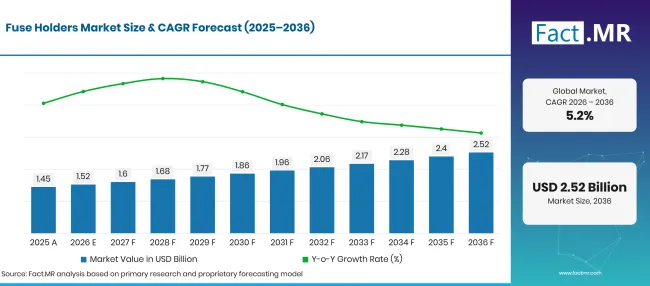
Fuse Holders Market Forecast Global | Source: Fact.MR
Category
| Category | Segments |
|---|---|
| Type | Open Fuse Holders, Enclosed Fuse Holders, Panel Mount Fuse Holders, PCB Mount Fuse Holders |
| Application | Automotive, Electrical and Electronics, Industrial, Energy and Utilities, Others |
| Voltage Rating | Low Voltage, Medium Voltage, High Voltage |
| End User | Industrial, Residential, Commercial |
| Region | Germany; Brazil; USA; UK; Japan |
Source: Fact.MR analysis. Updated Nov 18, 2026
Segmental Analysis
Why does the open type lead demand in the Fuse Holders Market?
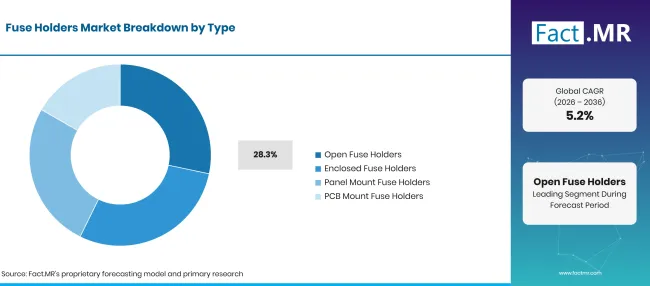
Fuse Holders Market Breakdown Type | Source: Fact.MR
Demand for open fuse holders accounts for 28.3% of the fuse holders market in 2026 as buyers favor formats that keep installation and replacement accessible. Suppliers are maintaining open, enclosed, panel-mount and PCB-mount lines to match different equipment requirements. This preference for accessible formats should keep open fuse holders the leading type through 2036. Distributors play a part as well, since stocking depth across formats decides how quickly equipment makers and maintenance teams can source a compatible holder. Buyers also weigh how easily installed units can be inspected, which supports repeat purchases from facilities that service their own equipment. Fact.MR expects the open type to hold its lead as these purchasing habits persist through the forecast period.
Why does automotive lead application demand in the Fuse Holders Market?
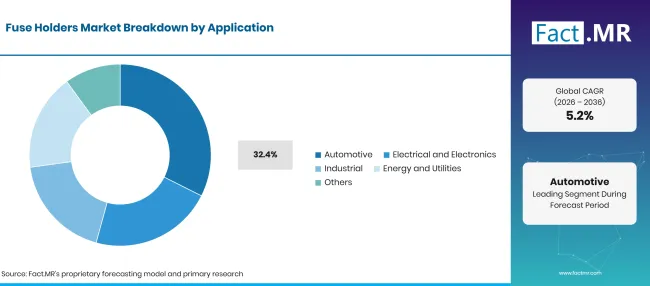
Fuse Holders Market Breakdown Application | Source: Fact.MR
Sales of fuse holders to automotive applications account for 32.4% of 2026 revenue as vehicles carry more electrical and electronic systems. Adoption is rising alongside vehicle electrical complexity, and suppliers are positioning compact, dependable formats for vehicle makers. Growth in vehicle electrical content is projected to keep automotive the largest application through 2036. Vehicle makers specify components years ahead of production, so suppliers that earn a place on a platform secure volumes across several model cycles. Electrical and electronic equipment, industrial installations and energy projects follow as the other application groups, each adding demand according to its own load profile. This spread of uses cushions the market against weakness in any single application.
Why does low voltage lead demand by voltage rating?
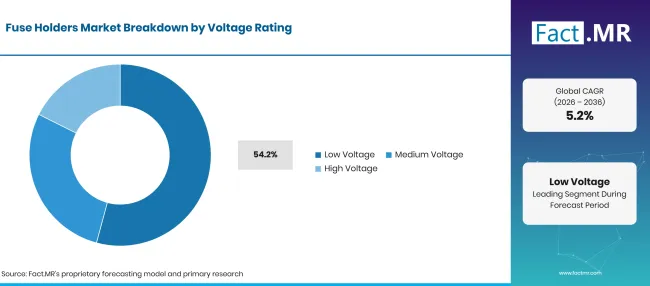
Fuse Holders Market Breakdown Voltage Rating | Source: Fact.MR
Demand for low-voltage fuse holders accounts for 54.2% of 2026 revenue because building circuits and equipment-level protection make up the bulk of installations. Medium- and high-voltage demand is smaller and follows rated voltage and installation requirements. The breadth of low-voltage installations is expected to keep this segment the largest. Medium-voltage and high-voltage demand sits mainly with utilities and larger industrial sites, where projects are fewer but individual orders are larger. Opportunities in low voltage keep widening as new buildings, equipment and vehicles each add circuits. Suppliers are therefore prioritizing low-voltage ranges in their catalogs while maintaining selective coverage of the higher ratings.
Why do industrial users lead end-user demand in the Fuse Holders Market?
Fuse Holders Market Breakdown End User | Source: Fact.MR
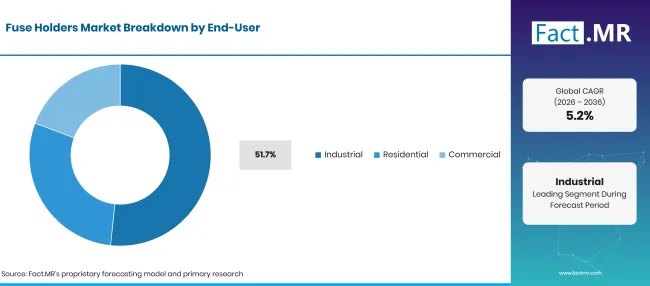
Demand from industrial users accounts for 51.7% of end-user revenue in 2026 as factories require protection across machinery and distribution assemblies. For example, in July 2026, the U.S. Department of Energy named data centers and expanding domestic manufacturing among the factors raising transmission need. Facility build-outs of this kind are projected to drive sales of fuse holders to industrial buyers, while residential and commercial users add the balance. Buyers in this group evaluate fuse holders on electrical ratings and maintenance requirements as much as on price, which rewards suppliers able to provide clear technical documentation. Procurement tends to follow plant expansions and electrical upgrades, so demand rises in step with industrial investment and the build-out of power networks that serve it.
Fuse Holders Market-Drivers, Restraints & Trends
Drivers
Demand for fuse holders is rising as electricity use and grid investment grow. For example, in February 2026, the IEA projected global electricity demand growth of 3.6% a year from 2026 to 2030. Fact.MR rates industrial electrical installations at about +0.9% on the CAGR, grid modernization at +0.8%, vehicle electrical content at +0.7% and data center and commercial facility demand at +0.6%. Continued demand growth is projected to drive sales of fuse holders through the forecast period.
Restraints
Sales of fuse holders face pressure from price competition among established suppliers, rated at about -0.7% on the CAGR, along with compatibility requirements across fuse formats (-0.5%) and compliance and testing obligations (-0.4%). Substitution by other circuit protection devices adds -0.3% over the long term. Suppliers must document ratings and compatibility clearly to protect sales in price-sensitive applications.
Trend
Compact and PCB-Mounted Formats Demand for smaller assemblies is rising as equipment makers compress designs. Fact.MR rates development of compact fuse holders at +0.6% on the CAGR and wider use of PCB-mounted formats at +0.4%. Suppliers are stocking panel-mount and PCB-mount ranges to serve different manufacturers, a shift expected to increase sales in electronics and automotive uses.
Trend
Renewable and Storage Installations Opportunities are building as renewable power and storage projects add protection requirements, estimated at +0.5% on the CAGR over the long term. For example, in 2026, Brazil's Energy Research Office reported 24.6 GW of generation capacity added in 2025, a 10.4% rise on 2024. Capacity additions of this scale are projected to drive adoption of fuse holders across Europe, Asia and the Americas.
Fuse Holders Market by Analysis by Key Country
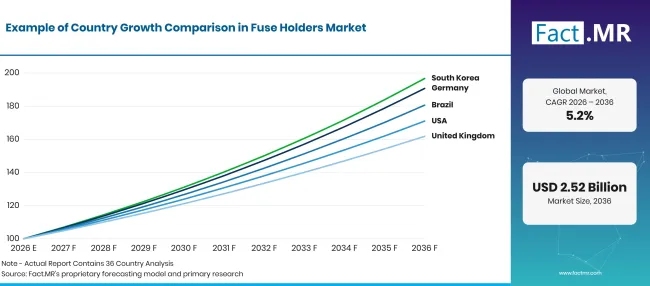
Fuse Holders Market Growth Index | Source: Fact.MR
| Country | CAGR (2026-2036) |
|---|---|
| Germany | 6.7% |
| Brazil | 6.1% |
| USA | 5.5% |
| UK | 4.9% |
| Japan | 4.4% |
Source: Fact.MR analysis. Updated Nov 18, 2026
Source: Fact.MR analysis
What is driving fuse holder demand in Germany?
Demand for fuse holders in Germany is projected to grow at a 6.7% CAGR, the fastest among the five key countries, as network expansion and industrial activity add installations.
For example, in January 2026, the Federal Network Agency reported approval of about 2,000 km of power lines in 2025, around 45% more than in 2024. Suppliers are serving German panel builders and equipment makers, and grid investment should sustain sales through 2036, although the data measures network investment rather than fuse holder purchases. Industrial buyers and building contractors remain the main customers, and established suppliers with local service hold an advantage in tenders.
How are renewable additions supporting fuse holder sales in Brazil?
Sales of fuse holders in Brazil are projected to grow at a 6.1% CAGR as renewable capacity additions raise requirements for distribution and protection components.
For example, in 2026, the Energy Research Office reported 24.6 GW of generation capacity added in 2025, up 10.4% from 2024. Suppliers are positioning low-voltage holders for control assemblies in solar and wind projects. Distributors serving regional equipment makers benefit from the same build-out, and suppliers that localize stock and documentation are better placed to win orders. The country's position as the second-fastest of the five reflects how quickly new generation capacity is being connected to the grid, and it points to continued opportunities in protection components for the period to 2036.
What is shaping fuse holder demand in the United States?
Demand for fuse holders in the United States is projected to grow at a 5.5% CAGR as data centers and manufacturing add electrical loads.
For example, in July 2026, the U.S. Department of Energy's draft National Transmission Needs Study named both among the factors increasing transmission need. Suppliers are matching products to the voltage and current ratings of each installation, and load growth should keep orders growing. Operators of large facilities specify protection equipment early in project design, which gives suppliers visibility into orders. Distributors holding panel-mount and PCB-mount stock can serve equipment makers on short lead times, and this availability supports repeat business as new capacity comes online across the country.
How is growing electricity demand supporting adoption in the United Kingdom?
Adoption of fuse holders in the United Kingdom is projected to grow at a 4.9% CAGR as electricity demand rises.
For example, in June 2026, the National Energy System Operator said Great Britain's electricity demand could grow by more than 30% by the mid-2030s. Suppliers are serving distribution panels and assemblies, and network reinforcement is expected to support sales through 2036. Network operators and equipment builders are the main buyers, and orders follow reinforcement programs that tend to run over several years. Suppliers able to document ratings and compatibility clearly reduce installation errors, which supports repeat purchases and strengthens their position with panel builders serving the domestic market.
Why is fuse holder growth slowest in Japan?
Demand for fuse holders in Japan is projected to grow at a 4.4% CAGR, the slowest among the five countries, as grid modernization and demand from data centers and semiconductor facilities build gradually.
For example, in October 2026, the IEA's Japan 2026 review linked both to renewed electricity demand growth. Modernization of this kind should keep sales growing across power systems and industrial equipment. Established domestic demand means growth comes from upgrades rather than new installations, and buyers value dependable ratings and long-term availability. Suppliers serving data center and semiconductor projects have the clearest near-term opportunities, while industrial equipment makers continue to provide a steady base of orders.
Competitive Landscape for Fuse Holders Market
Competition in the fuse holders market is divided between circuit-protection specialists and diversified electrical groups. Littelfuse, Eaton, Siemens, ABB and Mersen compete through dedicated fuse holder and base ranges, while Phoenix Contact competes through terminal-block formats. Hubbell and Legrand are part of the company set, although their current fuse holder ranges should be checked before product-level comparison.
Competition rests on ratings, mounting formats and compatibility. Suppliers with broad portfolios and clear technical documentation are best placed to serve panel assemblies and equipment makers across industrial, automotive and energy uses.
Recent Developments
- In October 2026, the International Energy Agency published its Japan 2026 review, tying data centers and semiconductor activity to renewed electricity demand growth and calling for grid modernization.
- In July 2026, the U.S. Department of Energy released its 2026 draft National Transmission Needs Study, which names data centers and expanding domestic manufacturing as drivers of transmission need.
- In June 2026, the National Energy System Operator said Great Britain's electricity demand could rise by more than 30% by the mid-2030s.
- In February 2026, the International Energy Agency's Electricity 2026 report projected global electricity demand growth of 3.6% a year on average from 2026 to 2030.
Key Players in Fuse Holders Market
Key companies profiled include Littelfuse, Inc.; Eaton Corporation; Siemens AG; ABB Ltd.; Mersen S.A.; Phoenix Contact GmbH & Co. KG; Hubbell Incorporated; and Legrand S.A.
- Littelfuse, Inc.
- Eaton Corporation
- Siemens AG
- ABB Ltd.
- Mersen S.A.
- Phoenix Contact GmbH & Co. KG
- Hubbell Incorporated
- Legrand S.A.
Bibliography
- ABB. n.d. D0 fuse sockets and fuse switch disconnectors. ABB Low Voltage Products.
- Bundesnetzagentur. 2026. Energy transition clears crucial hurdle: significant progress in electricity grid expansion in 2025. Bonn: Bundesnetzagentur.
- Eaton. n.d. Fuse holders, clips and accessories. Eaton Circuit Protection.
- Empresa de Pesquisa Energética. 2026. Anuário estatístico de energia elétrica 2026: Destaques. Rio de Janeiro: EPE.
- International Energy Agency. 2026. Electricity 2026. Paris: IEA.
- International Energy Agency. 2026. Japan 2026. Paris: IEA.
- Littelfuse. n.d. Fuses and circuit protection products. Chicago: Littelfuse.
- Mersen. n.d. Fuse holders and systems. Mersen.
- National Energy System Operator. 2026. The future for Great Britain's electricity infrastructure for the 2030s and beyond. London: NESO.
- Phoenix Contact. n.d. Fuse terminal blocks, component terminal blocks and diode terminal blocks. Blomberg: Phoenix Contact.
- Siemens. 2025. Fuse systems. Nuremberg: Siemens.
- U.S. Department of Energy. 2026. DOE's Office of Electricity publishes 2026 draft National Transmission Needs Study. Washington, DC: DOE.
Segmentation
Scope of Report
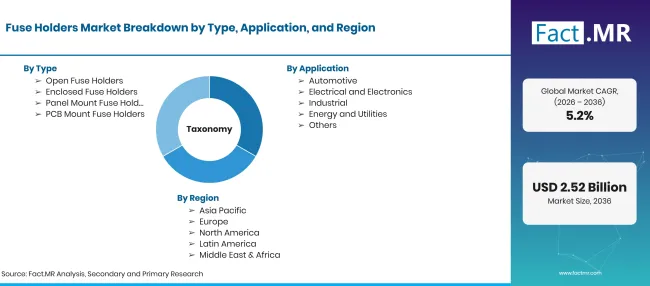
Fuse Holders Market Taxonomy | Source: Fact.MR
| Items | Values |
|---|---|
| Quantitative Units (2026) | USD 1.5 Billion |
| Market Definition | Electrical components that hold fuses securely within circuits, helping protect equipment from excessive current in automotive systems, industrial machinery, electrical panels and power distribution systems. |
| Type | Open Fuse Holders, Enclosed Fuse Holders, Panel Mount Fuse Holders, PCB Mount Fuse Holders |
| Application | Automotive, Electrical and Electronics, Industrial, Energy and Utilities, Others |
| Voltage Rating | Low Voltage, Medium Voltage, High Voltage |
| End User | Industrial, Residential, Commercial |
| Regions Covered | North America, Latin America, Western Europe, Eastern Europe, East Asia, South Asia & Pacific, Middle East & Africa |
| Countries Covered | Germany, Brazil, USA, UK, Japan |
| Key Companies Profiled | Littelfuse, Eaton, Siemens, ABB, Mersen, Phoenix Contact, Hubbell, Legrand |
| Additional Attributes | Scenario-based segmentation analysis supported by electricity infrastructure trends and company product portfolios. Value covers fuse holders and bases only; standalone fuse links, replacement cartridges, circuit breakers and complete panels are excluded, apart from holders built into them. |
Source: Fact.MR analysis. Updated Nov 18, 2026
Fuse Holders Market by Segments
-
Type
- Open Fuse Holders
- Enclosed Fuse Holders
- Panel Mount Fuse Holders
- PCB Mount Fuse Holders
-
Application
- Automotive
- Electrical and Electronics
- Industrial
- Energy and Utilities
- Others
-
Voltage Rating
- Low Voltage
- Medium Voltage
- High Voltage
-
End User
- Industrial
- Residential
- Commercial
-
Region:
- North America
- United States
- Canada
- Mexico
- Europe
- Germany
- United Kingdom
- France
- Italy
- Spain
- Rest of Europe
- Asia Pacific
- China
- India
- Japan
- South Korea
- Australia
- Rest of Asia Pacific
- Latin America
- Brazil
- Mexico
- Argentina
- Rest of Latin America
- Middle East & Africa
- GCC Countries
- South Africa
- Rest of Middle East & Africa
- North America
Frequently Asked Questions
What is the value of the Fuse Holders Market in 2026 and by 2036?
At what rate are fuse holders sales projected to grow through 2036?
Which application contributes the most revenue?
Which country is expected to grow fastest?
Who worked on this report


Preview the report firsthand - request a free sample
Free SampleGet the brochure for pricing and purchase details
Download PDF