- Market Value (2025): USD 543.9 Mn
- Estimated Value (2026): USD 588.8 Mn
- Forecast Value (2036): USD 1301.0 Mn
- CAGR (2026-2036): 8.2%
UHF RFID Printer Market Forecast and Outlook 2026 to 2036
The UHF RFID printer market was valued at USD 543.9 million in 2025. Revenue is projected to increase from USD 588.8 million in 2026 to USD 1,301.0 million by 2036, corresponding to an 8.2% CAGR.
Retail chains and distribution teams are moving toward labels that combine a printed identity with machine-readable radio data. Industrial printers suit large tagging runs, while desktop units give stores a way to encode labels closer to the point of use. In June 2025, TSC Auto ID added RFID functions to its MB241 industrial series, including upgrade options for current machines. That approach gives organizations a choice between replacing printers and adapting installed printing capacity. More companies are linking tags to DPP-enabled smart labels and inlays for goods that need a digital record.
Key Takeaways from the UHF RFID Printer Market
- UHF RFID Printer Market Value (2025): USD 543.9 million
- UHF RFID Printer Market Value (2026): USD 588.8 million
- UHF RFID Printer Market Forecast Value (2036): USD 1,301.0 million
- UHF RFID Printer Market Forecast CAGR (2026-2036): 8.2%
- Leading Component: Hardware (58.6%)
- Companies covered: Zebra Technologies Corporation, Honeywell International Inc., SATO Holdings Corporation, Toshiba Tec Corporation, Avery Dennison Corporation, TSC Auto ID Technology Co. Ltd., Printronix Auto ID, Postek Electronics Co. Ltd.
- Countries with growth forecasts: Germany, Brazil, USA, UK, Japan
In September 2025, TSC Auto ID introduced built-in RAIN UHF RFID functionality for its TH Series desktop printers. The change gives organizations with moderate label volumes a smaller setup option. Market purchases are shaped by where encoding occurs: at high-volume distribution facilities, at individual stores or at a workstation near a production line. That separation affects printer configuration, media costs and the software needed to prevent duplicate or unreadable tags.
UHF RFID Printer Market
| Metric | Value |
|---|---|
| Estimated Value in (2026) | USD 588.8 million |
| Forecast Value in (2036) | USD 1,301.0 million |
| Forecast CAGR (2026 to 2036) | 8.2% |
Source: Fact.MR analysis. Updated Nov 18, 2026
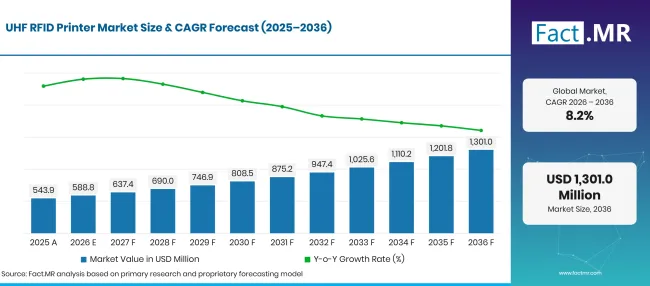
Uhf Rfid Printer Market Forecast Global | Source: Fact.MR
Category
| Category | Segments |
|---|---|
| Product Type | Industrial Printers, Desktop Printers, Mobile Printers |
| Application | Retail, Healthcare, Transportation and Logistics, Manufacturing, Government, Others |
| Component | Hardware, Software, Services |
| Frequency Band | Ultra-High Frequency, Low Frequency, High Frequency |
| Region | Germany, Brazil, USA, UK, Japan |
Source: Fact.MR analysis. Updated Nov 18, 2026
Segmental Analysis
Why do high-volume facilities invest in industrial RFID printers?
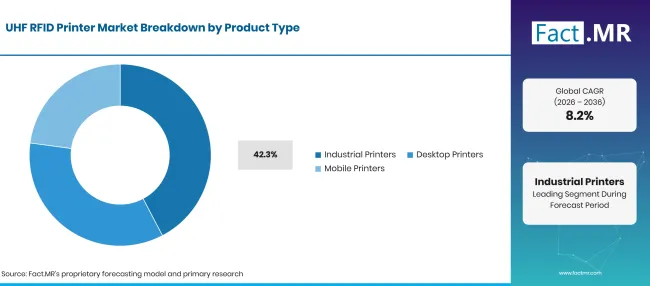
Uhf Rfid Printer Market Breakdown Product Type | Source: Fact.MR
Industrial printers account for 42.3% of UHF RFID printer revenue in 2026. Shipping centers use these units for repeated runs of encoded labels across receiving and dispatch. A printer that checks the RFID chip before a label leaves the machine helps staff identify encoding problems earlier in the process. Label roll size, print-head life and integration with current warehouse records affect purchasing choices. Factory systems may retain an important place in high-volume tagging operations where steady output supports uninterrupted packing and shipment work. Printed output also depends on industrial labels when goods require long-lasting codes during handling.
How do store inventories influence UHF RFID printer purchases?
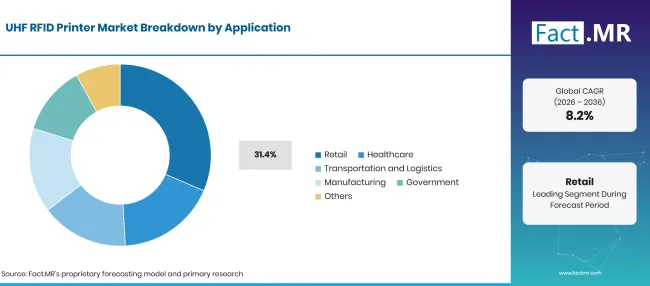
Uhf Rfid Printer Market Breakdown Application | Source: Fact.MR
Retail accounts for 31.4% of sales by application in 2026. Apparel chains and other stores with large item ranges are looking for more dependable ways to connect their stock records with physical goods. UHF tags can be encoded during labeling before products move to another site, which gives store teams a common item identity. The business appeal depends on the number of goods handled and the way stores complete stock counts. Retailers may favor printers that fit current stock-management routines and handle label reprints without disrupting daily work. Retail stock control has links to retail self-scanning solutions where store teams need to scan goods during day-to-day work.
Why does hardware retain the main component share?
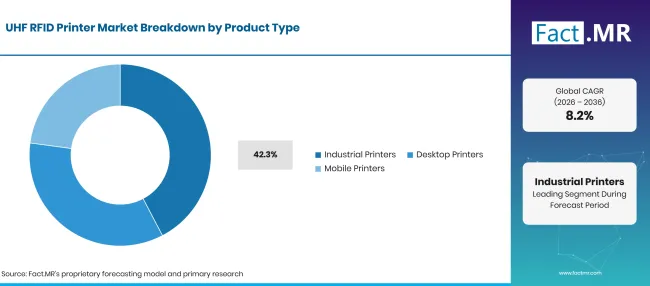
Uhf Rfid Printer Market Breakdown Product Type 1 | Source: Fact.MR
Hardware represents 42.3% of component revenue in 2026. Printer engines and integrated RFID encoders are the core hardware required to produce labels that hold an item identity. Software helps turn item records into the encoded data, while support services help teams install and maintain the printers. These elements serve different stages of one workflow, so spending may reflect the type of site and its daily label volume. Vendors that make setup straightforward may attract teams seeking steady output across several workstations. Such workflows sit alongside label classification systems because both rely on a common item record.
What explains the UHF frequency band position?
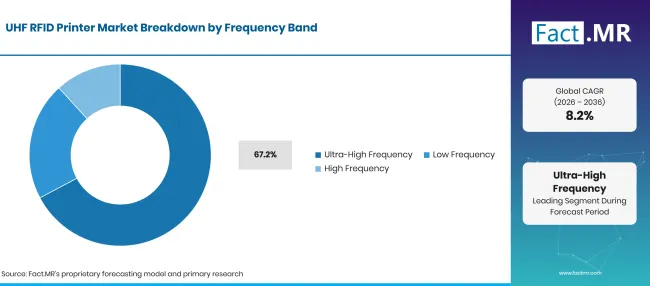
Uhf Rfid Printer Market Breakdown Frequency Band | Source: Fact.MR
Within the report's broader RFID printer frequency-band classification, ultra-high frequency systems are assigned a 67.2% share in 2026. This category reflects the use of UHF encoding for item ID in retail and logistics workflows. Low- and high-frequency label systems serve different ID requirements, so their role in the wider printer category needs to be separated from UHF applications. Media fit and tag performance checks influence which UHF printing system a company selects. Setups that combine compatible tags with steady print performance could support repeat printer spending. Warehouse setups can work alongside RFID portals when goods pass through shared handling points.
UHF RFID Printer Market-Drivers, Restraints & Trends
Drivers
Retail inventory control may support orders for UHF RFID printers, particularly where retailers need steady item records between a store and its distribution center. In September 2025, TSC Auto ID introduced built-in RAIN UHF RFID feature for its TH Series desktop printers. The development shows how encoding is becoming available in printers suited to local workstations. Smaller deployments may widen the range of retail locations able to create encoded labels when goods need to be relabeled.
Restraints
RFID label materials need careful testing because a tag that performs well on one package may behave differently on another. Warehouse teams assess the surface of the goods and the expected handling needs before they approve a label. These checks add time to a rollout, particularly when an organization handles many packaging formats. Equipment vendors that help match printers with compatible media may make setup planning easier.
Trend
In June 2025, TSC Auto ID expanded the MB241 industrial series with RFID functions, including options for factory installation and upgrades to matching printers. These choices are relevant to warehouses with established printing systems because setup plans vary between sites. Suppliers may compete on how easily teams can add encoding to a current labeling workflow.
UHF RFID Printer Market by Analysis by Key Country
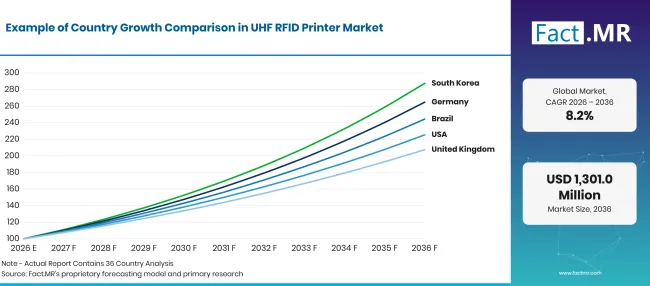
Uhf Rfid Printer Market Growth Index | Source: Fact.MR
| Country | CAGR (2026-2036) |
|---|---|
| Germany | 10.2% |
| Brazil | 9.4% |
| USA | 8.5% |
| UK | 7.6% |
| Japan | 6.7% |
Source: Fact.MR analysis. Updated Nov 18, 2026
How is industrial activity supporting UHF RFID printer demand in Germany?
Germany's factory and shipping networks may support sustained demand for UHF RFID printers, particularly where goods pass through several handling points.
According to Germany's Federal Statistical Office, real retail-trade turnover increased by 3.3% in 2025 compared with 2024 [1]. This measures trading activity across the retail sector and provides a useful setting for decisions about stock systems. Factory printers are suited to repeated label runs at packaging stations, while smaller printers can serve local relabeling work. UHF RFID printer sales in Germany are forecast to advance at a 10.2% CAGR from 2026 to 2036.
What is shaping UHF RFID printer demand in Brazil?
Brazil's retail chains may create opportunities for UHF RFID printers as they connect store stock records with shipping centers serving large geographic areas.
In February 2026, the Brazilian Institute of Geography and Statistics reported that national retail sales volume increased 1.6% in 2025 [2]. The statistic describes retail trade and provides a wider view of the setting in which inventory investments take place. Regional warehouses could benefit from printing labels close to dispatch, where encoded records can be checked before goods leave a facility. UHF RFID printer revenue in Brazil is forecast to grow at a 9.4% CAGR between 2026 and 2036. Service coverage may influence printer choices because a distant store may rely on local technicians when a printer needs attention.
Why does warehouse coordination influence UHF RFID printer sales in the USA?
The USA has extensive store and fulfillment networks where UHF RFID printing may help keep item records steady as goods move between locations.
In March 2026, the U.S. Census Bureau reported that e-commerce accounted for 16.4% of total U.S. retail sales during 2025 [3]. This provides a measure of the share of retail trading carried out online. Teams serving both store and online orders can use encoded labels to support stock ID and reduce manual checks at handling points. The USA market is projected to record an 8.5% CAGR from 2026 to 2036. Industrial units are relevant to larger shipping centers, while desktop printers are suited to smaller batches of replacement labels.
How are retail workflows affecting UHF RFID printer adoption in the UK?
Retail replenishment and returns handling may shape UK demand for UHF RFID printers.
The Office for National Statistics reported in January 2026 that retail sales volumes in Great Britain increased 1.3% during 2025. A retailer with several store formats may need factory encoding at its distribution center and compact printers for local relabeling. The UK UHF RFID printer market may expand at a 7.6% CAGR from 2026 to 2036. The business case depends on how easily RFID label creation connects with current store records, particularly when returned goods need a fresh label. Teams may compare staff training needs alongside the purchase cost of the printer and tags.
What explains the UHF RFID printer outlook in Japan?
Japan's emphasis on accurate ID at factory and retail handling points may sustain interest in UHF RFID printing.
The Statistics Bureau of Japan reported in its 2026 statistical publication that 56.9% of two-or-more-person households used online shopping during 2025. Industrial printers are relevant where labels are produced in repeat batches, while desktop systems can serve local packing and replacement tasks. The Japanese UHF RFID printer market is forecast to grow at a 6.7% CAGR from 2026 to 2036. Domestic teams may focus on output accuracy and stable daily performance because printing errors can interrupt later ID steps. Tag selection remains linked to the material being labeled and to the demands of each site.
Competitive Landscape for UHF RFID Printer Market
Competition in UHF RFID printers concerns more than print speed. Zebra Technologies offers RFID-capable desktop and factory systems, alongside label design tools. SATO markets industrial printers and planned RFID-enabled CL4/6-SXR models for release later in 2026. TSC Auto ID and Printronix Auto ID compete through industrial and desktop labeling systems. Buyers assess whether a supplier supports the preferred tag media, handles encode failures and can provide service where the printers is installed.
The broader ID supply chain includes companies with different roles. Avery Dennison makes RFID inlays and labels, so its main role in this market is supplying the RFID labels used by printers. Honeywell, Toshiba Tec, and Postek have printer or ID portfolios, and each printer providing serves a set ID workflow. Teams can review which models support UHF encoding when choosing printers for their sites. Market competition is shaped by proven system fit and local support. RFID technology is used in contactless ticketing systems as well as in stock labeling, although the print settings serve different needs.
Recent Developments
- In June 2025, TSC Auto ID expanded its MB241 industrial printer series with preinstalled RFID feature and an upgrade kit for matching machines.
- In September 2025, SATO announced its CL4/6-SXR industrial printer line. RFID-enabled versions were scheduled for introduction later in 2026, separate from the initial rollout.
- In April 2025, Avery Dennison announced an RFID inlay production facility in India to expand its regional label-material supply network.
Key Players in UHF RFID Printer Market
Key companies profiled include Zebra Technologies Corporation; Honeywell International Inc.; SATO Holdings Corporation; Toshiba Tec Corporation; Avery Dennison Corporation; TSC Auto ID Technology Co. Ltd.; Printronix Auto ID; and Postek Electronics Co. Ltd.
- Zebra Technologies Corporation
- Honeywell International Inc.
- SATO Holdings Corporation
- Toshiba Tec Corporation
- Avery Dennison Corporation
- TSC Auto ID Technology Co. Ltd.
- Printronix Auto ID
- Postek Electronics Co. Ltd.
Bibliography
- Avery Dennison Corporation. (2025, April 24). Avery Dennison opens its first India-based RFID production facility and unveils unique inlay innovation to meet local customer needs.
- Federal Statistical Office of Germany. (2026, April 28). Industry, trade and services.
- Instituto Brasileiro de Geografia e Estatística. (2026, February 13). Retail sales close 2025 with rise of 1.6%.
- Office for National Statistics. (2026, January 23). Retail sales, Great Britain: December 2025.
- SATO Corporation. (2025, September 1). SATO unveils CL4/6-SXR industrial printer line to empower the future workplace.
- SATO Corporation. (2025, December 16). SATO launches next-generation flagship industrial label printer.
- Statistics Bureau of Japan. (2026). Statistical handbook of Japan 2026.
- TSC Auto ID Technology Co., Ltd. (2025, June 25). TSC Auto ID augments MB241 Series with RFID technology.
- TSC Auto ID Technology Co., Ltd. (2025, September 30). TSC Auto ID unveils new upgrades for TH Series desktop printers.
- U.S. Census Bureau. (2026, March 10). Quarterly retail e-commerce sales: Fourth quarter 2025.
Segmentation
Scope of Report
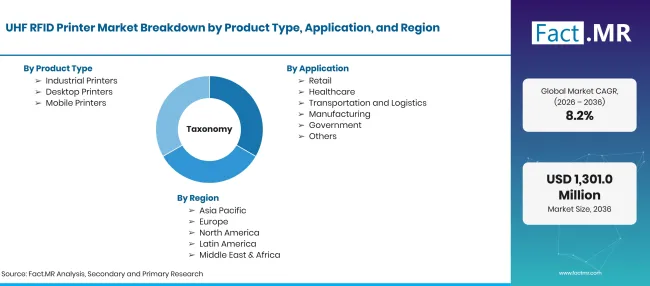
Uhf Rfid Printer Market Taxonomy | Source: Fact.MR
| Items | Values |
|---|---|
| Quantitative Units (2026) | USD 588.8 Million |
| Product Type | Industrial Printers, Desktop Printers, Mobile Printers |
| Application | Retail, Healthcare, Transportation and Logistics, Manufacturing, Government, Others |
| Component | Hardware, Software, Services |
| Frequency Band | Ultra-High Frequency, Low Frequency, High Frequency |
| Regions Covered | North America, Latin America, Europe, East Asia, South Asia and Pacific, Middle East & Africa |
| Countries Covered | Germany, Brazil, USA, UK, Japan and other countries |
| Key Companies Profiled | Zebra Technologies Corporation, Honeywell International Inc., SATO Holdings Corporation, Toshiba Tec Corporation, Avery Dennison Corporation, TSC Auto ID Technology Co. Ltd., Printronix Auto ID, Postek Electronics Co. Ltd. |
| Additional Attributes | Revenue segmentation by printer form, application, component, frequency band and region. UHF RFID encoding and label creation are included. |
Source: Fact.MR analysis. Updated Nov 18, 2026
UHF RFID Printer Market by Segments
-
Product Type
- Industrial Printers
- Desktop Printers
- Mobile Printers
-
Application
- Retail
- Healthcare
- Transportation and Logistics
- Manufacturing
- Government
- Others
-
Component
- Hardware
- Software
- Services
-
Frequency Band
- Ultra-High Frequency
- Low Frequency
- High Frequency
-
Region:
- North America
- USA
- Canada
- Mexico
- Europe
- Germany
- UK
- France
- Italy
- Spain
- Rest of Europe
- Asia Pacific
- China
- India
- Japan
- South Korea
- Australia
- Rest of Asia Pacific
- Latin America
- Brazil
- Mexico
- Argentina
- Rest of Latin America
- Middle East & Africa
- GCC Countries
- South Africa
- Rest of Middle East & Africa
- North America
Frequently Asked Questions
How big is the global UHF RFID Printer Market in 2026?
What is the forecast value of the UHF RFID Printer Market in 2036?
At what CAGR is the UHF RFID Printer Market forecast to grow?
Which product type accounts for the main share?
Which application has the main UHF RFID printer share?
Which component has the main revenue share?
Which frequency band has the main share?
Who worked on this report


Preview the report firsthand - request a free sample
Free SampleGet the brochure for pricing and purchase details
Download PDF