- Market Value (2025): USD 1.99 Bn
- Estimated Value (2026): USD 2.03 Bn
- Forecast Value (2036): USD 2.47 Bn
- CAGR (2026-2036): 2.0%
Magnetic Heads Market Forecast and Outlook 2026 to 2036
As per the Fact.MR analysis, the magnetic heads market surpassed a value of USD 1.99 billion in 2025 and is projected to grow from USD 2.03 billion in 2026 to USD 2.47 billion by 2036. Demand for magnetic heads is likely to grow at a CAGR of 2.0% over the forecast period.
Demand for magnetic heads is rising as cloud and AI data centers buy high-capacity hard drives to store training data at lower cost per terabyte than flash. Suppliers of magnetic heads are developing heat-assisted recording heads that write smaller bits. For example, in January 2024, Seagate launched its HAMR-based Mozaic 3+ platform delivering 3 TB per platter. Similar density advances are projected to drive sales of magnetic heads through 2036.
Key Takeaways from the Magnetic Heads Market
- Magnetic Heads Market Value (2025): USD 1.99 billion
- Magnetic Heads Market Value (2026): USD 2.03 billion
- Magnetic Heads Market Forecast Value (2036): USD 2.47 billion
- Magnetic Heads Market Forecast CAGR (2026-2036): 2.0%
- Leading Type: Recording Heads (38.5%)
- Key Market Participants: TDK Corporation, Proterial Ltd., Sony, Western Digital, Seagate Technology, Fujitsu
- Key Growth Regions: Germany, Brazil, Japan, United States, United Kingdom
In February 2025, Western Digital completed the spin-off of its flash business as SanDisk, leaving it focused on hard drives for data centers. Demand for magnetic heads is growing as drive makers concentrate on nearline storage. Suppliers of magnetic heads are aligning capacity with hyperscaler orders. Similar focus is projected to drive sales of magnetic heads across cloud markets.
Magnetic Heads Market
| Metric | Value |
|---|---|
| Estimated Value in (2026) | USD 2.03 billion |
| Forecast Value in (2036) | USD 2.47 billion |
| Forecast CAGR (2026 to 2036) | 2.0% |
Source: Fact.MR analysis. Updated Nov 18, 2026
Source: Fact.MR analysis. Updated 16 Nov 2026
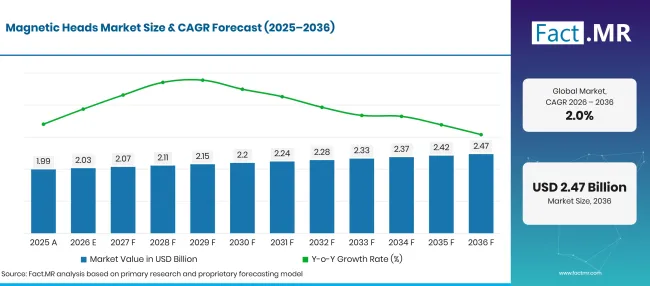
Magnetic Heads Market Forecast Global | Source: Fact.MR
Category
| Category | Segments |
|---|---|
| Type | Recording Heads, Playback Heads, Erase Heads |
| Application | Consumer Electronics, Automotive, Healthcare, Industrial, Others |
| Technology | Digital, Analog |
| Material | Thin-Film, Ferrite, Metal-In-Gap |
| Region | Germany; Brazil; Japan; United States; United Kingdom |
Source: Fact.MR analysis. Updated Nov 18, 2026
Source: Fact.MR analysis. Updated 16 Nov 2026
Segmental Analysis
What drives recording heads’ lead in type demand for the Magnetic Heads Market?
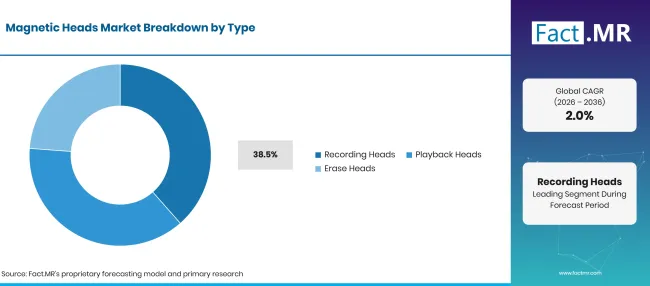
Magnetic Heads Market Breakdown Type | Source: Fact.MR
Recording heads are expected to remain the leading product type in the magnetic heads market, accounting for 38.5% of global revenue in 2026, about USD 770 million based on the USD 2.0 billion market estimate. Demand is supported by continued reliance on hard disk drives (HDDs) for high-capacity data storage in cloud infrastructure and enterprise data centers. Each active recording surface in an HDD requires a read/write head, while higher-capacity drives use multiple platters and increasingly sophisticated recording technologies. The U.S. Department of Energy's 2026 United States Data Center Energy Usage Report: 2025 Update estimates that data centers could consume 11.8% of total U.S. electricity by 2030, with a scenario range of 9.5% to 15.3%. This projection reflects the expanding scale of data center infrastructure and the associated need for computing and storage equipment. The U.S. Energy Information Administration also reported in May 2026 that data center servers accounted for an estimated 7% of U.S. commercial-sector electricity consumption in 2025. Its Annual Energy Outlook 2026 projects server electricity use could reach 22%–33% of commercial-building electricity consumption by 2050.
What’s behind consumer electronics dominance in application demand for the Magnetic Heads Market?
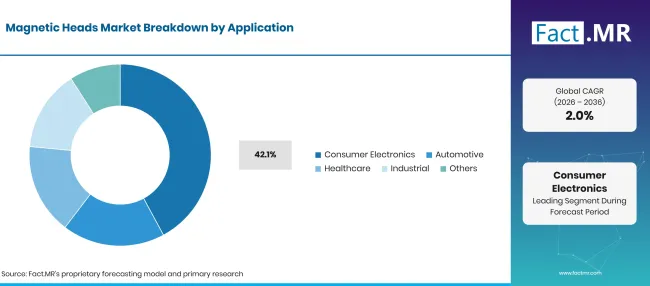
Magnetic Heads Market Breakdown Application | Source: Fact.MR
Demand from consumer electronics is supported by the continued use of magnetic storage in external HDDs, desktop computers and gaming systems. These applications require read/write heads to record and retrieve data for personal files, games and digital content. In July 2026, Cyber Media Research reported that India’s external HDD shipments increased 42% quarter over quarter in Q1 2026 and forecast 18–22% year-over-year growth for the full year. It also noted that 2 TB drives accounted for 48% of external HDD shipments, highlighting demand for higher-capacity consumer storage. Consumer electronics demand for magnetic heads is supported by continued sales of personal computers, gaming consoles and external storage devices. These products rely on hard disk drives (HDDs) and other magnetic storage components to record and retrieve digital information. The segment is estimated to account for 42.1% of application revenue in 2026, about USD 842 million based on the USD 2.0 billion market estimate.
How has digital technology come to dominate the Magnetic Heads Market?
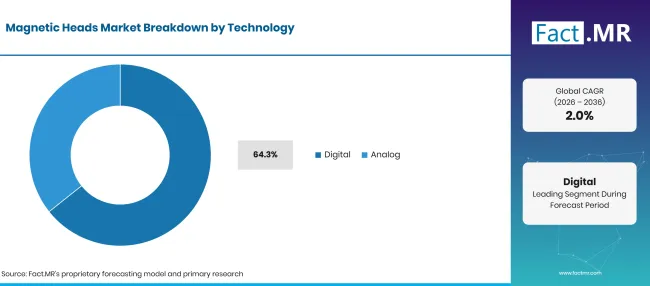
Magnetic Heads Market Breakdown Technology | Source: Fact.MR
Sales of digital heads are projected to capture 64.3% of magnetic heads market revenue in 2026, representing approximately USD 1.29 billion of the estimated USD 2.0 billion market. Demand is supported by the growing use of digital storage across enterprise data centers, cloud platforms and archival systems. The U.S. Energy Information Administration reported in May 2026 that data center servers accounted for approximately 7% of U.S. commercial-sector electricity consumption in 2025, reflecting the expanding scale of digital infrastructure. In addition, the 2026 LTO tape shipment report recorded a 57% year-over-year increase in shipped storage capacity in Q1 2026, indicating stronger demand for high-capacity digital archiving. These developments support sales of digital recording and playback heads used in HDDs and magnetic tape systems. As organizations continue investing in high-capacity storage and long-term data retention, manufacturers are expected to prioritize digital head technologies over analog applications. This is likely to sustain the digital segment's leading position through the forecast period.
Why does thin-film lead material demand in the Magnetic Heads Market?
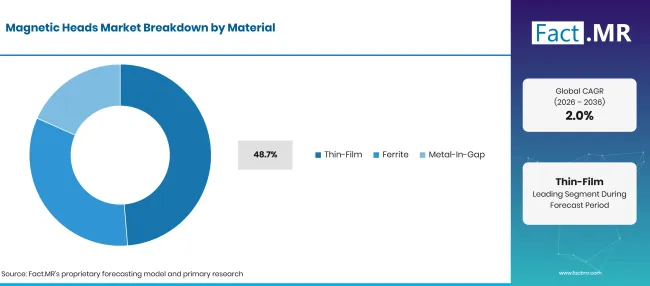
Magnetic Heads Market Breakdown Material | Source: Fact.MR
Thin-film heads are expected to maintain their leading position in the magnetic heads market, accounting for an estimated 48.7% of revenue in 2026. Based on the USD 2.0 billion market estimate, this represents USD 974 million. Demand is supported by the growing need for high-capacity hard disk drives (HDDs) in hyperscale data centers, cloud storage and enterprise systems. Thin-film technology enables the precise fabrication of read and write elements required for higher recording densities. In November 2026, industry analyst Thomas Coughlin reported that global HDD capacity shipments reached 527.8 exabytes in Q3 2026, increasing 4.7% quarter over quarter. Seagate's Mozaic 4+ HAMR platform also supports HDD capacities of up to 44 TB, demonstrating the industry's shift toward higher-density recording technologies. These capacity advancements are expected to sustain demand for precision-engineered thin-film heads.
Magnetic Heads Market-Drivers, Restraints & Trends
Drivers:
Demand for magnetic heads is increasing as hyperscale data centers expand their storage infrastructure to support AI workloads, cloud services and video content. Hard disk drives remain important for storing large volumes of data where capacity and cost per terabyte matter. The U.S. Department of Energy's Lawrence Berkeley National Laboratory reported in June 2026 that U.S. data-center electricity consumption reached an estimated 192 TWh in 2024, equivalent to 4.7% of national electricity use. Its reference case projects consumption to reach 649 TWh by 2030, representing 11.8% of U.S. electricity use. This expansion in data-center infrastructure is expected to support demand for high-capacity HDDs and their magnetic read/write heads.
Restraints:
Sales of magnetic heads faces competition from solid-state drives (SSDs), particularly in PCs, laptops and applications requiring faster access speeds and lower latency. SSDs use semiconductor memory rather than magnetic recording components, reducing the need for magnetic heads in devices that shift away from HDD storage. The U.S. Department of Energy's Federal Energy Management Program identifies SSDs as offering faster read and access speeds, while noting that they are generally more expensive than conventional hard disks. This performance advantage supports SSD adoption in speed-sensitive applications, limiting HDD and magnetic-head demand in some client-device categories. However, HDDs remain relevant for cost-efficient, high-capacity storage in data centers.
Opportunity: Heat-Assisted Magnetic Recording
The transition toward higher-capacity HDDs is creating opportunities for manufacturers of heat-assisted magnetic recording (HAMR) heads. HAMR technology uses a laser-assisted recording process to increase the amount of data stored on each disk surface. As cloud providers seek drives with capacities above 30 TB, demand for advanced recording heads and integrated near-field transducers is expected to increase. Seagate's March 2026 announcement that its Mozaic 4+ platform had entered production with two major cloud providers and supports capacities of up to 44 TB demonstrates commercial progress in this technology. Meanwhile, the U.S. Department of Energy's 2026 data-center report projects substantial growth in electricity use as computing and storage infrastructure expands, providing a broader demand indicator for high-capacity storage systems.
Trend: Tape for Cold Archives
The use of magnetic tape for long-term data archiving remains an important trend as organizations seek cost-effective ways to retain large volumes of infrequently accessed information. Tape systems complement HDDs and SSDs by supporting offline or cold-storage applications, including backup and digital preservation. In July 2026, the U.S. Library of Congress described how its digital collections workflow transfers files from physical media into managed storage and then copies selected content to magnetic tape for long-term preservation. This demonstrates the continued institutional use of magnetic tape for archival storage. Growing digital collections and long-term retention requirements are expected to support demand for tape drives and their associated magnetic read/write heads.
Magnetic Heads Market by Analysis by Key Country
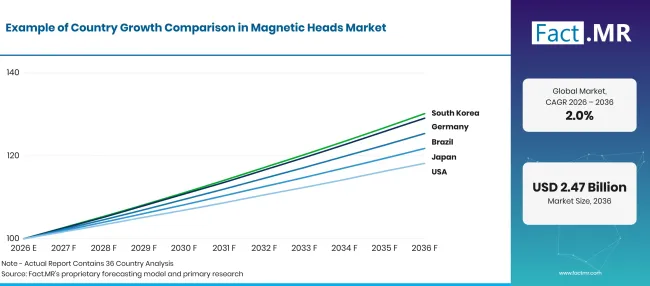
Magnetic Heads Market Growth Index | Source: Fact.MR
| Country | CAGR (2026-2036) |
|---|---|
| Germany | 2.6% |
| Brazil | 2.3% |
| Japan | 2.0% |
| United States | 1.7% |
| United Kingdom | 1.4% |
Source: Fact.MR analysis. Updated Nov 18, 2026
Source: Fact.MR analysis.
Why is Germany the fastest-growing market for magnetic heads?
Demand for magnetic heads in Germany is projected to increase at a 2.6% CAGR, the fastest among the five key countries, supported by the expansion of data centers and cloud infrastructure.
Germany Trade and Invest reports that domestic data-center power capacity is expected to reach 2,330 MW by 2030, while the country's data-center sector is projected to grow at a 6.6% CAGR from 2025 to 2030. The agency also identifies 529 data-center companies operating in Germany. The Energy Efficiency Act (EnEfG) requires data centers to improve energy efficiency and increase renewable energy use. These measures support investment in efficient infrastructure and high-capacity storage systems, creating a favorable environment for magnetic-head suppliers serving HDD manufacturers.
What is supporting magnetic head demand in Brazil?
Sales of magnetic heads in Brazil are projected to hold 2.3% CAGR, supported by investment in cloud infrastructure and data-center capacity.
In June 2026, Brazil's Ministry of Mines and Energy reported 205 operating data centers and said projects under construction represented more than R$114.5 billion in investment. The ministry also reported 38 GW of data-center connection requests, including 7.1 GW associated with R$159 billion in projected investment. In September 2026, Brazil enacted the REDATA tax regime, which provides tax incentives for data-center equipment purchases and requires beneficiaries to make domestic research investments. These measures are expected to encourage storage infrastructure expansion and support demand for magnetic heads used in HDD systems.
What is shaping magnetic head demand in Japan?
Demand for magnetic heads in Japan is estimated to record a 2.0% CAGR, supported by the country's established electronics industry and planned data-center expansion.
A 2026 Japanese government planning document lists several data-center projects scheduled to begin operations during 2026, including a 100 MVA SoftBank project in Osaka, a 72 MVA ESR project in Kyoto and a 50 MW NTT Global Data Centers project in Chiba. Separately, Japan's electricity-system planning estimates that new data centers and semiconductor plants will add 830,000 kW of peak electricity demand in fiscal 2026 compared with fiscal 2025. This infrastructure expansion is expected to increase demand for high-capacity storage systems and the magnetic heads used in HDDs.
What is shaping magnetic head sales in the United States?
Sales of magnetic heads in the United States are projected to represent a 1.7% CAGR, supported by hyperscale data-center investment and demand for high-capacity storage.
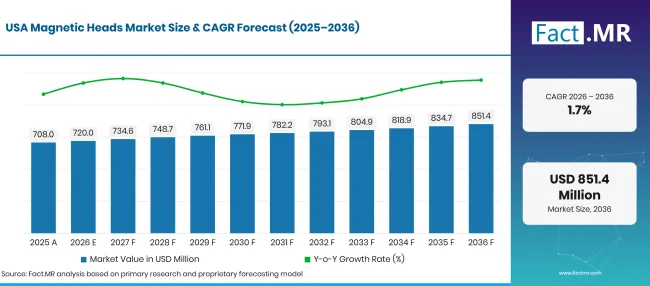
Magnetic Heads Market Forecast Usa | Source: Fact.MR
In May 2026, the U.S. Energy Information Administration reported that data-center servers accounted for an estimated 7% of U.S. commercial-sector electricity consumption in 2025. Its 2026 outlook projects server electricity consumption of between 446 billion and 818 billion kWh by 2050, depending on the scenario. The growing scale of AI computing and cloud infrastructure is expected to sustain investment in HDDs for large-scale data storage. This creates opportunities for magnetic-head suppliers serving major drive manufacturers, including Seagate and Western Digital.
Why is magnetic head growth slower in the United Kingdom?
Demand for magnetic heads in the United Kingdom is estimated to record a 1.4% CAGR, the slowest among the five key countries, partly reflecting constraints on electricity-grid connections for new data centers.
In September 2026, the UK government reported that 72.8 GW of data-center capacity had been allocated in Great Britain's electricity connection queue, while acknowledging that oversubscription was contributing to connection delays. Ofgem also reported in July 2026 that demand connection applications had increased from 41 GW to 125 GW in less than a year, with data-center projects accounting for at least 80 GW. Although the government is reforming connection procedures to prioritize viable strategic projects, delays could affect the pace of new data-center development and moderate demand growth for magnetic heads.
Competitive Landscape for Magnetic Heads Market
Competition in the magnetic heads market is concentrated among a few drive makers and head suppliers. Seagate and Western Digital make heads largely in-house, while TDK supplies heads to Toshiba and others. Proterial, Sony, Fujitsu, Mitsubishi Electric, Panasonic and Samsung serve tape, sensor and legacy uses. Buyers select heads on areal density, reliability and yield.
From 2024 onward, competition shifted toward HAMR and other energy-assisted designs. Seagate shipped HAMR at scale while rivals extended other technologies. Suppliers with energy-assisted head capacity are best placed to grow.
Recent Developments
- In January 2024, Seagate launched its Mozaic 3+ HAMR platform.
- In February 2025, Western Digital completed the SanDisk spin-off.
- In March 2026, Seagate qualified its next-generation Mozaic 4+ HAMR platform and began production with two major cloud providers. The technology supports hard drives with capacities of up to 44 TB.
- In February 2026, Western Digital introduced technology that allows multiple magnetic heads to read and write data simultaneously. The innovation can deliver up to twice the bandwidth of conventional hard drives.
- In November 2026, Western Digital published a patent describing an improved shield design for magnetic recording read heads. The design aims to improve head performance and support more precise data-reading operations.
- In March 2026, Western Digital published a patent describing materials designed to improve the thermal stability of heat-assisted magnetic recording heads. This technology addresses heat-related challenges during high-density data recording.
Key Players in Magnetic Heads Market
Key companies operating in the market include TDK Corporation, Seagate Technology Holdings plc, Western Digital Corporation, ICT Ltd., AM Belgium NV, Brush Industries Inc., and International Electro-Magnetics, Inc.
- TDK Corporation
- Seagate Technology Holdings plc
- Western Digital Corporation
- ICT Ltd.
- AM Belgium NV
- Brush Industries Inc.
- International Electro-Magnetics, Inc.
Bibliography
- Brazil. (2026, September 15). Lei nº 15.504, de 15 de setembro de 2026.
- Cabinet Secretariat, Government of Japan. (2025). Data center construction plans from 2025 onward.
- Coughlin, T. (2026, November 10). Third quarter 2026 hard disk drive industry update. Forbes.
- Cyber Media Research. (2026, July 1). India’s consumer HDD storage surges in Q1 2026: External up 17% YoY, surveillance jumps 26%.
- Department for Energy Security and Net Zero. (2026, March 11). Government to tackle speculative demand grid connection requests.
- Department for Science, Innovation and Technology. (2024). Data centres designated critical national infrastructure.
- Department of Energy, Federal Energy Management Program. (n.d.). Purchasing energy-efficient data center storage.
- Germany Trade & Invest. (n.d.). The data center landscape in Germany.
- Lawrence Berkeley National Laboratory. (2026, June). United States data center energy usage report: 2025 update. U.S. Department of Energy.
- LTO Program. (2026, September 1). LTO capacity shipments grow 57% YoY in Q1 2026 as AI and archive demand accelerates.
- Ministry of Finance. (2026, September 16). Regime Especial de Tributação para Serviços de Datacenter é sancionado.
- Ministry of Land, Infrastructure, Transport and Tourism. (2026). Impact of new data center and semiconductor factory construction.
- Ministry of Mines and Energy. (2026, June 1). Alexandre Silveira highlights Brazil's potential to lead global investments in data centers and advocates progress on REDATA.
- Nemes, N. (2026, July). Saving tangible media for tomorrow: A reflection from Natalie Nemes. The Signal, Library of Congress.
- Ofgem. (2026, July 29). Ofgem acts to free up grid capacity by tackling speculative data centre projects.
- Seagate Technology. (2024). Seagate unveils Mozaic 3+ HAMR platform.
- Seagate Technology Holdings plc. (2026, March 3). Seagate delivers industry’s highest-capacity hard drives with next-generation Mozaic 4+.
- TDK Corporation. (2025). Integrated report 2025.
- U.K. Parliament. (2026, September 7). Written question 26554: Data centres and electricity grid connections.
- U.S. Energy Information Administration. (2026, May 19). Data center server energy use grows across the commercial building stock.
- Western Digital. (2025). Western Digital completes separation of SanDisk.
- Western Digital Corporation. (2026, February 3). Western Digital accelerates storage innovation for AI era.
- Western Digital Corporation. (2026, March 26). Heat assisted magnetic recording head comprising a thermally stable material (U.S. Patent Application Publication No. US20260088043A1). Google Patents.
- Western Digital Corporation. (2026, November 5). Shield designs for two dimensional magnetic recording read heads (U.S. Patent Application Publication No. US20260351282A1). Justia Patents.
Segmentation
Scope of Report
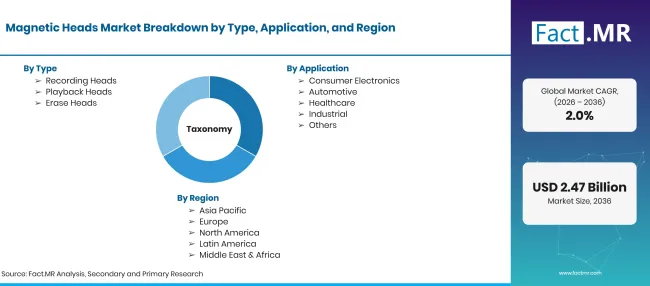
Magnetic Heads Market Taxonomy | Source: Fact.MR
| Items | Values |
|---|---|
| Quantitative Units (2026) | USD 2.03 Billion |
| Type | Recording Heads, Playback Heads, Erase Heads |
| Application | Consumer Electronics, Automotive, Healthcare, Industrial, Others |
| Technology | Digital, Analog |
| Material | Thin-Film, Ferrite, Metal-In-Gap |
| Regions Covered | North America, Latin America, Europe, East Asia, South Asia and Pacific, Middle East & Africa |
| Countries Covered | United States, Germany, Japan, United Kingdom, Brazil, and other countries |
| Key Companies Profiled | TDK Corporation; Seagate Technology Holdings plc; Western Digital Corporation; ICT Ltd.; AM Belgium NV; Brush Industries Inc.; International Electro-Magnetics, Inc. |
| Additional Attributes | Dollar revenue in the Magnetic Heads Market is segmented by type (recording heads, playback heads, erase heads); application (consumer electronics, automotive, healthcare, industrial); technology (digital, analog); material (thin-film, ferrite, metal-in-gap) and region. |
Source: Fact.MR analysis. Updated Nov 18, 2026
Source: Fact.MR analysis.
Magnetic Heads Market by Segments
-
Type
- Recording Heads
- Playback Heads
- Erase Heads
-
Application
- Consumer Electronics
- Automotive
- Healthcare
- Industrial
- Others
-
Technology
- Digital
- Analog
-
Material
- Thin-Film
- Ferrite
- Metal-In-Gap
-
Region:
- North America
- United States
- Canada
- Mexico
- Europe
- Germany
- United Kingdom
- France
- Italy
- Spain
- Rest of Europe
- Asia Pacific
- China
- India
- Japan
- South Korea
- Australia
- Rest of Asia Pacific
- Latin America
- Brazil
- Mexico
- Argentina
- Rest of Latin America
- Middle East & Africa
- GCC Countries
- South Africa
- Rest of Middle East & Africa
- North America
Frequently Asked Questions
How big is the global Magnetic Heads Market in 2026?
What will be the size of the Magnetic Heads Market by 2036?
How fast will the Magnetic Heads Market grow during the forecast period?
Which type segment holds the largest share of the Magnetic Heads Market?
Who worked on this report


Preview the report firsthand - request a free sample
Free SampleGet the brochure for pricing and purchase details
Download PDF