- Market Value (2025): USD 62.9 Mn
- Estimated Value (2026): USD 70.0 Mn
- Forecast Value (2036): USD 205.0 Mn
- CAGR (2026-2036): 11.3%
What is the Gas Hydrate Formation Systems Market forecast to be worth by 2036?
USD 70.0 million in 2026 to USD 205.0 million by 2036 at 11.3% CAGR.
- The gas hydrate formation systems market reached USD 62.9 million in 2025 as laboratory and pilot-rig demand stayed tied to hydrate formation studies.
- Demand is projected to increase from USD 70.0 million in 2026 to USD 205.0 million by 2036.
- The market is forecast to record 11.3% CAGR from 2026 to 2036 owing to flow assurance research and controlled hydrate gas storage testing.
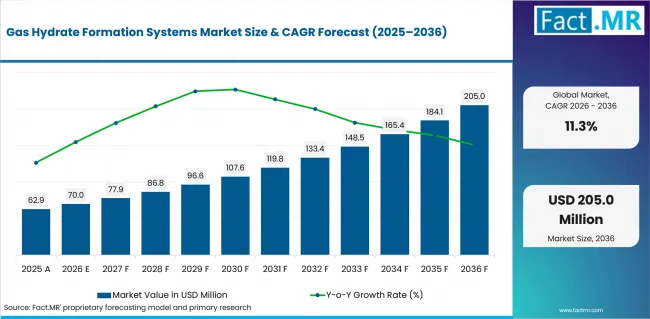
Gas Hydrate Formation Systems Market Value Analysis | Source: Fact.MR
What are the defining numbers behind Gas Hydrate Formation Systems Market growth?
USD 135.0 million absolute opportunity by 2036, led by stirred hydrate reactors and flow assurance research alongside bench/lab systems and oil & gas research users.
- Demand Drivers in the Market
- Flow-assurance teams commission hydrate tests when pipeline designs or operating envelopes must account for plug formation. That creates demand for systems that reproduce the pressure and temperature conditions behind the risk.
- Subsea projects face costly intervention if hydrate behavior is not understood before operations begin. This pushes operators and research partners toward dedicated test rigs instead of relying on generic laboratory vessels.
- CO2 transport and hydrate gas-storage programs require evidence on formation and dissociation cycles before pilots proceed. Those studies increase demand for cells that can observe the process under sustained high pressure.
- Research groups working across multiple fluids and inhibitors need results they can compare from one run to the next. This favors systems that maintain stable conditions and generate usable measurements.
- Key Segments Analyzed
- By System Type: Stirred hydrate reactors are expected to hold 43.0% share in 2026 because they support repeatable mixing and controlled hydrate growth.
- By Application: Flow assurance research is projected to account for 38.0% share in 2026 as pipeline and subsea testing remain core use cases.
- By Scale: Bench/lab is anticipated to capture 29.0% share in 2026 since most hydrate studies begin with controlled small-scale experiments.
- By End User: Oil & gas research is estimated to represent 37.0% share in 2026 due to its direct link with hydrate risk and reservoir studies.
- Analyst Opinion at Fact.MR
- Shambhu Nath Jha, Sr. Consultant at Fact.MR, states, “Gas hydrate formation systems must give researchers stable pressure control, reliable mixing, and repeatable temperature behavior. Purchase decisions are expected to depend on whether each system matches the required hydrate study rather than on vessel capacity alone.”
- Strategic Implications
- Laboratory teams should define the hydrate-testing workflow before equipment quotations move into purchasing discussions. The selected approach must align reactor geometry, pressure range, and test configuration with the intended flow-assurance study.
- Equipment providers should demonstrate pressure control, temperature stability, and safe sample handling within a single system. High-pressure vessel capability remains central because rated containment and dependable operating control influence laboratory approval.
- Investors should distinguish direct gas hydrate testing exposure from adjacent oilfield and general laboratory equipment. Market relevance becomes clearer when a company supplies hydrate autoclaves, rocking cells, or high-pressure view cells rather than broad pilot-scale systems.
The USA is expected to lead the Gas Hydrate Formation Systems Market with a 12.9% CAGR from 2026 to 2036, supported by flow assurance work and laboratory-scale hydrate research. Australia is projected to record a 12.6% CAGR as offshore energy studies require reliable pressure-temperature testing. Norway is anticipated to grow at 12.2% CAGR through subsea and cold-region research needs. Japan is estimated to post an 11.8% CAGR through hydrate resource studies and engineering capability. The UK is forecast at 11.5% CAGR as offshore research and specialist laboratory demand support system purchases.
How does the Gas Hydrate Formation Systems Market break down by segment?
Stirred hydrate reactors are expected to lead System Type at 43.0% share in 2026. Flow assurance research is projected to lead Application at 38.0% share in 2026.
Which system type dominates?
Stirred hydrate reactors are projected to account for 43.0% share in 2026.
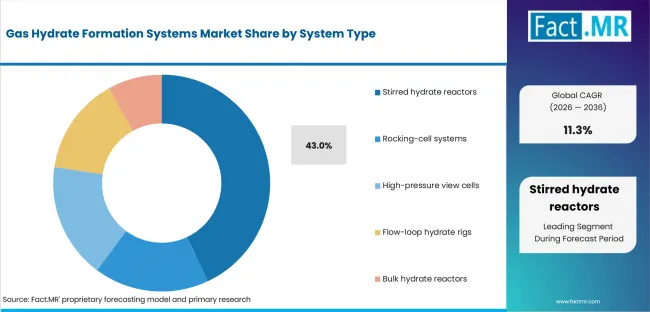
Gas Hydrate Formation Systems Market Analysis By System Type | Source: Fact.MR
Stirred hydrate reactors hold the leading position because they give researchers controlled mixing during hydrate nucleation and growth. Rocking-cell systems remain useful for screening hydrate behavior under simpler motion-based setups. High-pressure view cells support visual observation, while flow-loop hydrate rigs and bulk hydrate reactors serve larger test programs that require more complex operating conditions.
What leads the Application segment?
Flow assurance research is expected to hold 38.0% share in 2026.
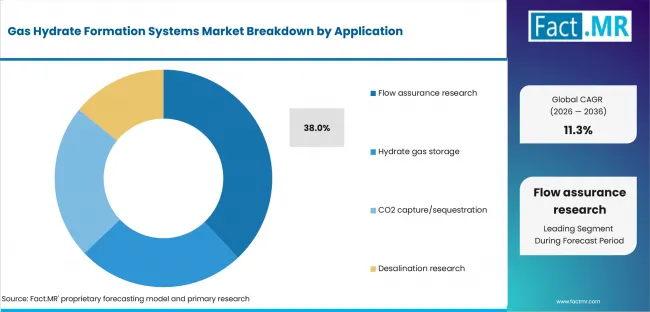
Gas Hydrate Formation Systems Market Analysis By Application | Source: Fact.MR
Flow assurance research leads because hydrate blockage risk remains a direct operational issue in offshore and subsea energy systems. Hydrate gas storage is a separate route where system stability and repeatable formation cycles matter. CO2 capture/sequestration and desalination research are expected to use similar pressure-temperature control, but their purchase timing depends more on project funding and test validation.
How does Scale shape demand?
Bench/lab is anticipated to lead with 29.0% share in 2026.
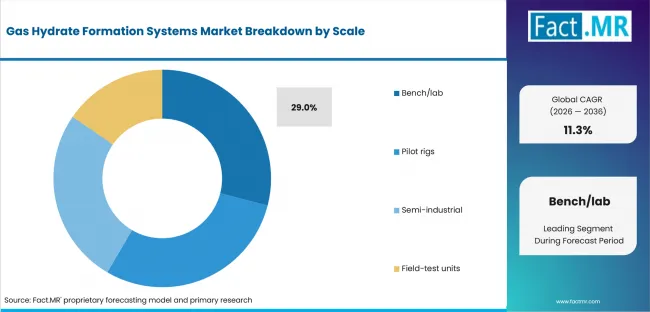
Gas Hydrate Formation Systems Market Analysis By Scale | Source: Fact.MR
Bench/lab systems lead because most hydrate studies begin with small samples and controlled experimental runs. Pilot rigs follow when researchers need stronger scale-up evidence before field testing. Semi-industrial and field-test units carry higher cost and longer approval cycles, so their demand is expected to be concentrated in larger research programs.
What supports oil & gas research within End User?
Oil & gas research is estimated to represent 37.0% share in 2026.
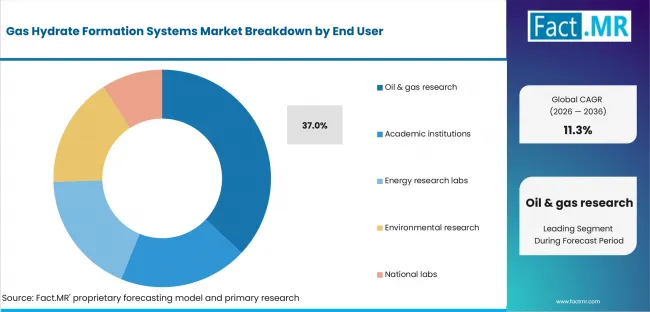
Gas Hydrate Formation Systems Market Analysis By End User | Source: Fact.MR
Oil & gas research users face direct hydrate risk in pipelines and reservoirs, which keeps controlled formation testing central to equipment selection. Academic institutions and energy research labs create steady demand for flexible systems. Environmental research and national labs use hydrate systems where gas storage, dissociation, or sequestration studies need tighter measurement control.
What is accelerating Gas Hydrate Formation Systems Market adoption, and what is holding it back?
Demand is expected to be driven by flow assurance testing and controlled hydrate gas storage research. Adoption is expected to be held back by custom configuration needs and strict pressure-safety requirements.
Drivers Impact Analysis
| DRIVER | (~) % IMPACT ON CAGR |
GEOGRAPHIC RELEVANCE | IMPACT TIMELINE |
|---|---|---|---|
| Flow assurance testing | +2.8% | USA, Norway, UK | Short term (<= 2 years) |
| Pressure-temperature control | +2.3% | USA, Japan, Australia | Short term (<= 2 years) |
| Hydrate gas storage research | +1.8% | Japan and energy research labs | Medium term (2-4 years) |
| Bench/lab replacement demand | +1.3% | Academic and national labs | Medium term (2-4 years) |
| Custom engineering services | +0.9% | Specialist equipment clusters | Long term (>= 4 years) |
Source: Fact.MR analysis. Updated Jul 24, 2026
- Flow assurance testing: Subsea and pipeline studies are expected to increase the value of systems that reproduce hydrate formation under controlled conditions.
- Pressure-temperature control: Researchers need stable operating windows before hydrate formation, inhibition, or dissociation results are accepted.
- Hydrate gas storage research: Gas storage and CO2 hydrate work are expected to support demand for precise cells and repeatable measurement setups.
- Bench/lab replacement demand: Small-scale systems are expected to remain the first purchase point for labs that test new hydrate methods.
- Custom engineering services: Complex studies are expected to favor providers that adapt vessels, sensors, software, and safety controls to the protocol.
Opportunity Impact Analysis
| OPPORTUNITY | (~) % IMPACT ON CAGR |
GEOGRAPHIC RELEVANCE | IMPACT TIMELINE |
|---|---|---|---|
| High-pressure visual cells | +1.2% | USA and Japan | Medium term (2-4 years) |
| Flow-loop hydrate rigs | +1.1% | Norway and UK | Medium term (2-4 years) |
| CO2 hydrate research | +0.9% | Australia and national labs | Long term (>= 4 years) |
| Pilot-scale progression | +0.7% | USA, Japan, Australia | Long term (>= 4 years) |
Source: Fact.MR analysis. Updated Jul 24, 2026
- High-pressure visual cells: Visual observation is expected to help researchers connect hydrate formation behavior with pressure and temperature changes.
- Flow-loop hydrate rigs: Larger loop systems are expected to gain attention where laboratories test hydrate control under moving-fluid conditions.
- CO2 hydrate research: Carbon capture and sequestration studies are expected to create demand for systems that support controlled CO2 hydrate experiments.
- Pilot-scale progression: Research programs moving beyond bench work are expected to require stronger scale-up evidence before field-test equipment is selected.
Restraints Impact Analysis
| RESTRAINT | (~) % IMPACT ON CAGR |
GEOGRAPHIC RELEVANCE | IMPACT TIMELINE |
|---|---|---|---|
| Custom design cost | -1.1% | Global | Short term (<= 2 years) |
| Pressure-safety approvals | -0.9% | Research labs and pilot sites | Short term (<= 2 years) |
| Limited repeat purchases | -0.7% | Academic institutions | Medium term (2-4 years) |
| Scale-up uncertainty | -0.5% | Field-test programs | Long term (>= 4 years) |
Source: Fact.MR analysis. Updated Jul 24, 2026
- Custom design cost: Each study can require different vessel size, mixing method, sensor layout, and pressure rating. This raises evaluation time before purchase.
- Pressure-safety approvals: Laboratories must review containment, shutdown controls, and operating procedures before high-pressure systems enter routine use.
- Limited repeat purchases: Many academic labs buy one system for several research cycles. This can slow replacement demand after installation.
- Scale-up uncertainty: Moving from bench studies to field-test units is expected to remain difficult when hydrate behavior changes with volume and flow conditions.
Which countries are scaling Gas Hydrate Formation Systems Market fastest?
The country comparison is shaped by offshore research exposure and laboratory capability rather than broad equipment volume alone. The total spread between the USA and the UK is 1.4 percentage points. The USA and Australia form the upper pair because both support energy research tied to offshore and hydrate studies. Norway follows through subsea expertise, while Japan keeps a strong position through hydrate resource work. The UK completes the set through offshore research and specialist laboratory demand.
- The USA shows the strongest listed position because research groups need controlled hydrate formation systems for flow assurance, storage, and dissociation studies.
- Australia remains close to the USA through offshore energy research and demand for test systems that support hydrate behavior studies.
- Norway ranks third as subsea production knowledge and cold-water operating conditions keep hydrate control relevant to research purchases.
- Japan holds the fourth position through hydrate resource studies and laboratory work that uses pressure-temperature control to assess formation behavior.
- The UK completes the listed outlook through offshore research links and specialist laboratories that support flow assurance and high-pressure testing work.
Similar CAGRs can create different purchase conditions across these countries. System choice depends on the study objective, operating pressure, and local technical support. The full report provides country-level CAGR analysis across North America, Latin America, Europe, East Asia, South Asia, Oceania and the Middle East and Africa.
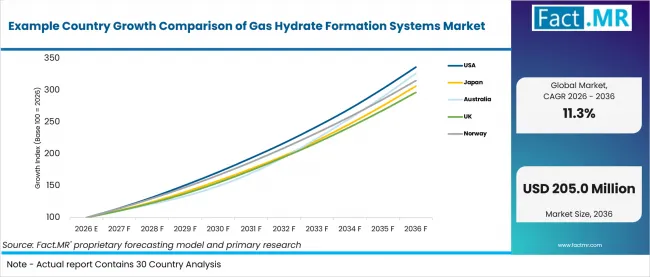
Example Country Growth Comparison Of Gas Hydrate Formation Systems Market | Source: Fact.MR
| Country | CAGR (2026-2036) |
|---|---|
| USA | 12.9% |
| Australia | 12.6% |
| Norway | 12.2% |
| Japan | 11.8% |
| UK | 11.5% |
Source: Fact.MR analysis. Updated Jul 24, 2026
What supports USA adoption?
12.9% CAGR, supported by flow assurance research and laboratory-scale hydrate studies.
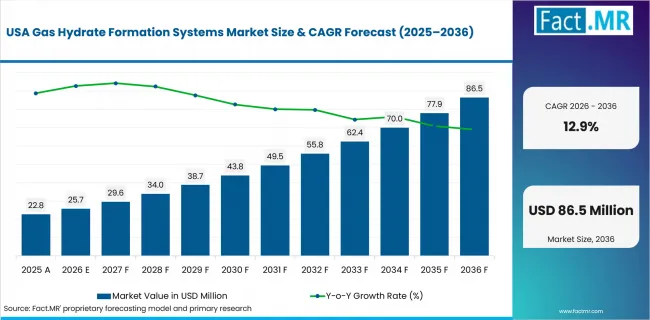
Gas Hydrate Formation Systems Market Country Value Analysis | Source: Fact.MR
The USA’s growth reflects a market where research labs require controlled systems for hydrate formation, dissociation, and flow assurance testing. Demand is expected to favor equipment that combines pressure control with accurate measurement. Lab groups are also expected to value service support when moving from bench studies toward larger experimental rigs.
What is driving Australia’s growth from 2026 to 2036?
12.6% CAGR, backed by offshore energy research and pilot-rig testing needs.
Australia’s growth is linked to offshore energy work and the need to test hydrate behavior under controlled lab conditions. Research programs are expected to prefer systems that handle pressure changes safely and deliver repeatable formation results. This favors equipment layouts that allow step-by-step movement from bench experiments into pilot trials.
What supports Norway’s growth?
12.2% CAGR, led by subsea research and flow assurance expertise.
Norway’s growth reflects a strong link between offshore production knowledge and hydrate control research. Laboratories are expected to use hydrate systems to study blockage risk, inhibitor testing, and pressure-temperature response. This creates demand for flow-loop rigs and visual cells that support applied subsea studies.
How does Japan perform?
11.8% CAGR, supported by hydrate resource studies and research equipment capability.
Japan’s growth is shaped by hydrate resource research and engineering work around controlled formation systems. Researchers are expected to value equipment that supports stable data collection across repeated test cycles. Local technical capability also helps laboratories adjust system design for gas storage and dissociation studies.
What supports the UK’s growth?
11.5% CAGR, backed by offshore research and specialist laboratory demand.
The UK’s growth reflects research demand linked to offshore energy systems and high-pressure laboratory testing. Customers are expected to compare system safety, measurement quality, and available support before choosing a provider. Demand is likely to remain selective because many purchases are tied to funded research programs rather than broad industrial rollout.
Who leads the Gas Hydrate Formation Systems Market?
Vinci Technologies shows the clearest direct relevance through gas hydrate autoclaves, hydrate study systems, and high-pressure visual cells.
Vinci Technologies supports direct hydrate formation studies through autoclave and visual-cell systems. PSL Systemtechnik adds rocking-cell and gas hydrate autoclave equipment for inhibitor and hydrate formation work. Sanchez Technologies under Core Laboratories, and Coretest Systems provide relevant high-pressure laboratory equipment exposure.
Which companies are the key providers?
Key companies include Vinci Technologies; Sanchez Technologies, a Core Laboratories company; PSL Systemtechnik; Coretest Systems.
- Vinci Technologies
- PSL Systemtechnik
- Coretest Systems
- Sanchez Technologies, a Core Laboratories company
Bibliography
- Agency for Natural Resources and Energy. (2026, January 16). Public call for contractors for the FY2026 methane hydrate research and development project. Ministry of Economy, Trade and Industry.
- Ministry of Economy, Trade and Industry. (2025, August 21). 46th Methane Hydrate Development Implementation Review Committee.
- U.S. Department of Energy. (2025, September 19). Advanced remediation technologies.
- SPL. (2025, June 5). SPL scientists publish groundbreaking research on natural gas hydrate transportability in Energy & Fuels journal.
This Report Addresses
- The report provides strategic intelligence on the Gas Hydrate Formation Systems Market across System Type and Application choices that shape hydrate gas research programs.
- Segment analysis covers stirred hydrate reactors and flow assurance research as the share leaders within the 2026 market, with links to oilfield chemicals where hydrate control remains relevant.
- Country outlook evaluates the USA and Australia alongside Norway and Japan. The UK completes the growth comparison across the profiled markets, including offshore links with subsea insulation use cases.
- Competitive analysis profiles Vinci Technologies and PSL Systemtechnik alongside Coretest Systems. Sanchez Technologies completes the provider set across high-pressure laboratory equipment and gas liquefaction adjacency.
- Application assessment covers flow assurance research and hydrate gas storage. CO2 capture/sequestration and desalination research complete the application view alongside adjacent metal-organic frameworks work in carbon capture studies.
What does the Gas Hydrate Formation Systems Market cover?
Gas hydrate formation systems are used to create and study hydrate formation under controlled pressure, temperature, and mixing conditions.
The Gas Hydrate Formation Systems Market covers equipment used for flow assurance research and hydrate gas storage studies. Coverage extends to CO2 capture/sequestration and desalination research. The market includes bench/lab systems, pilot rigs, semi-industrial systems, and field-test units. It also covers stirred hydrate reactors, rocking-cell systems, high-pressure view cells, flow-loop hydrate rigs, and bulk hydrate reactors used in controlled research settings.
The market differs from general laboratory reactors because commercial value comes from controlled hydrate formation and repeatable dissociation testing. General-purpose pressure vessels remain outside the boundary unless they are configured for hydrate studies. Hydrate inhibitors and standalone sensors are excluded unless the equipment performs or directly supports controlled formation work.
What is included in the scope?
Gas hydrate formation systems are used across oil & gas research and academic institutions. Energy research labs, environmental research users, and national labs are also included.
The scope includes System Type and Application alongside Scale and End User. Coverage spans stirred hydrate reactors and rocking-cell systems. High-pressure view cells, flow-loop hydrate rigs, and bulk hydrate reactors complete the system scope. It includes flow assurance research, hydrate gas storage, CO2 capture/sequestration, and desalination research. Bench/lab, pilot-rig, semi-industrial, and field-test scales follow the same controlled-formation rule.
What is excluded from the scope?
General laboratory reactors and unrelated oilfield equipment remain outside the scope of this market.
The scope excludes systems that do not create or support controlled gas hydrate formation studies. Standalone sensors, generic pressure vessels, and hydrate inhibitor chemicals are excluded. General gas processing equipment remains outside the scope unless it is configured for hydrate formation research. Company revenue without a clear connection to hydrate study systems or high-pressure research equipment is also excluded.
How Was the Analysis Built?
The analysis draws on 120+ sources, 35+ company portfolios, 25+ countries, and more than 20 industry interviews.
- Primary Research: Primary research includes discussions with manufacturers, service providers, technology developers, distributors, end users, procurement teams, and subject-matter experts. These conversations examine purchasing priorities, product adoption, operational challenges, approval requirements, competitive positioning, and the factors that influence wider market acceptance.
- Desk Research: Desk research covers government statistics, regulatory publications, company filings, trade data, technical studies, industry associations, standards, public policy, and other authoritative sources. Every source used in the analysis is documented in the bibliography.
- Market Sizing and Forecasting: Market estimates combine historical performance, demand indicators, pricing and volume trends, segment shares, company participation, country-level growth, adoption patterns, investment activity, and barriers to market expansion.
- Data Validation and Update Cycle: Findings are validated by comparing primary interviews with public data, company activity, regulatory changes, trade patterns, and industry developments. Regular updates review new product launches, capacity changes, partnerships, approvals, procurement trends, and shifts in commercial adoption.
Segmentation
What is the report’s scope and coverage?
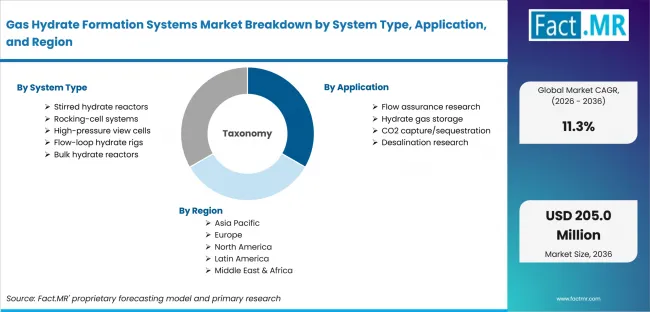
Gas Hydrate Formation Systems Market Breakdown By System Type, Application, And Region | Source: Fact.MR
| Attribute | Details |
|---|---|
| Quantitative Units | USD million |
| Market Definition | Gas hydrate formation systems represented by stirred hydrate reactors, rocking-cell systems, high-pressure view cells, flow-loop hydrate rigs, and bulk hydrate reactors. |
| System Type | Stirred hydrate reactors; Rocking-cell systems; High-pressure view cells; Flow-loop hydrate rigs; Bulk hydrate reactors |
| Application | Flow assurance research; Hydrate gas storage; CO2 capture/sequestration; Desalination research |
| Scale | Bench/lab; Pilot rigs; Semi-industrial; Field-test units |
| End User | Oil & gas research; Academic institutions; Energy research labs; Environmental research; National labs |
| Regions Covered | North America; Latin America; Europe; East Asia; South Asia and Pacific; Middle East and Africa |
| Countries Covered | USA; Japan; Australia; UK; Norway; South Korea |
| Key Companies Profiled | Vinci Technologies; Sanchez Technologies, a Core Laboratories company; PSL Systemtechnik; Coretest Systems |
| Forecast Period | 2026 to 2036 |
| Approach | Hybrid top-down and bottom-up approach using hydrate research demand; flow assurance testing; gas storage studies; CO2 hydrate work; system configuration; pressure-temperature control; scale progression; replacement demand; country adoption patterns; and company portfolio review |
Source: Fact.MR analysis. Updated Jul 24, 2026
How is the market segmented?
-
By System Type:
- Stirred hydrate reactors
- Rocking-cell systems
- High-pressure view cells
- Flow-loop hydrate rigs
- Bulk hydrate reactors
-
By Application:
- Flow assurance research
- Hydrate gas storage
- CO2 capture/sequestration
- Desalination research
-
By Scale:
- Bench/lab
- Pilot rigs
- Semi-industrial
- Field-test units
-
By End User:
- Oil & gas research
- Academic institutions
- Energy research labs
- Environmental research
- National labs
-
By Region:
- North America
- Europe
- East Asia
- South Asia & Oceania
Frequently Asked Questions
Which System Type leads the market?
Which Application leads the market?
Which Scale leads the market?
Which End User leads the market?
Which country records the highest listed CAGR?
What is the primary driver in this market?
What is the main restraint?
Who worked on this report


Preview the report firsthand - request a free sample
Free SampleGet the brochure for pricing and purchase details
Download PDF