- Market Value (2025): USD 19.0 Bn
- Estimated Value (2026): USD 20.3 Bn
- Forecast Value (2036): USD 37.9 Bn
- CAGR (2026-2036): 6.5%
What is the Gastroenterology Devices Market forecast to be worth by 2036?
USD 20.3 billion in 2026 to USD 37.9 billion by 2036 at a 6.5% CAGR.
- As per Fact.MR analysis, the Gastroenterology Devices Market was valued at USD 19.0 billion in 2025.
- Demand will grow from USD 20.3 billion in 2026 to USD 37.9 billion by 2036.
- The forecast projects a 6.5% CAGR from 2026 to 2036, driven by growing demand for advanced gastrointestinal diagnostics, minimally invasive procedures, and effective treatment of digestive disorders.
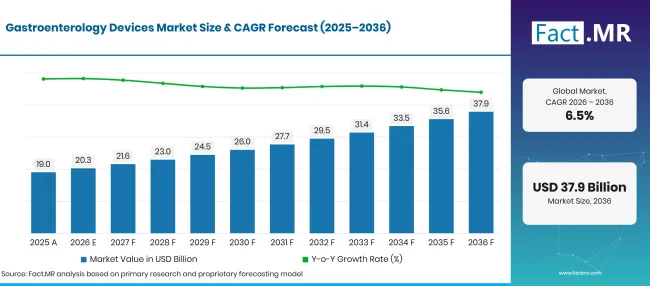
Factmr Gastroenterology Devices Market Forecast Global | Source: Fact.MR
| Year | Basis | Market Value (USD billion) |
|---|---|---|
| 2025 | Actual | 19.0 |
| 2026 | Estimate | 20.3 |
| 2036 | Forecast | 37.9 |
| CAGR 2026 to 2036 | Forecast period | 6.5% |
Source: Fact.MR analysis. Updated Oct 17, 2026
What are the defining numbers behind Gastroenterology Devices Market growth?
USD 17.6 billion absolute opportunity between 2026 and 2036.
- Demand Drivers in the Market
- Rising demand for minimally invasive diagnostic procedures is supporting the adoption of gastroenterology devices. The National Institute of Diabetes and Digestive and Kidney Diseases (NIDDK), in its historical review of gastrointestinal endoscopy, estimated that more than 20 million gastrointestinal endoscopies were performed annually in the United States [2].
- The growing burden of gastrointestinal disorders is increasing the need for accurate diagnosis and timely treatment. Hospitals and diagnostic centers require advanced imaging systems, biopsy devices, and endoscopic equipment to support the detection and evaluation of digestive tract conditions. NIDDK’s historical digestive disease statistics estimated that 60–70 million people in the United States were affected by digestive diseases. This substantial disease burden supports the need for diagnostic equipment, including endoscopes, imaging systems, and biopsy devices. [1].
- Healthcare providers are increasingly adopting therapeutic endoscopic procedures to manage gastrointestinal conditions while reducing the need for conventional surgery in suitable cases. Haemostasis devices and other specialized instruments support interventions such as controlling gastrointestinal bleeding and treating selected digestive tract abnormalities.
- Expanding access to healthcare facilities and the growing use of ambulatory surgical centers are creating opportunities for gastroenterology device manufacturers. The US Medicare Payment Advisory Commission (MedPAC), in its March 2026 report to Congress, reported that approximately 6,400 ambulatory surgical centers treated 3.4 million fee-for-service Medicare beneficiaries in 2024. It also reported that the number of centers grew by more than 2% annually on average between 2019 and 2024 [3].
- Key Segments Analyzed
- By Product Type: Endoscopes will account for 42.3% share in 2026, reflecting their central role in gastrointestinal examinations, disease detection, tissue sampling, and minimally invasive interventions.
- By Application: Diagnostics will represent 58.7% share in 2026, supported by demand for early disease detection, screening, and the assessment of gastrointestinal conditions.
- By End-User: Hospitals will hold 52.1% share in 2026, reflecting their access to specialized gastroenterology departments, trained medical professionals, and advanced diagnostic and therapeutic infrastructure.
- Analyst Opinion at Fact.MR
- Shambhu Nath Jha, Principal Consultant at Fact.MR, states, “Gastroenterology devices are likely to attract interest as healthcare providers seek effective tools for diagnosing and treating digestive system disorders. Hospitals and clinics still need procedure-specific guidance and a practical implementation plan before selecting suitable devices.”
- Strategic Implications
- Manufacturers can emphasize device capabilities, clinical applications, and operating efficiency to support informed purchasing decisions.
- Distributors play a key role in matching gastroenterology devices with diagnostic and therapeutic requirements across healthcare settings.
- Healthcare professionals can prioritize patient conditions and procedural objectives when selecting devices for diagnosis and treatment.
- Healthcare facilities can balance equipment costs with expected clinical outcomes, workflow improvements, and long-term patient care needs.
Germany is set to record a 4.9%CAGR through 2036. Brazil is set to post 5.7%, followed by the USA at 5.2%. The UK is estimated to advance at 8.0%, while Japan is forecast at 6.3%. Differences in healthcare infrastructure, diagnostic capabilities, and clinical demand create distinct pathways for gastroenterology device adoption across these markets.
How does the Gastroenterology Devices Market break down by segment?
Fact.MR finds that Endoscopes leads Product Type at 42.3%; Diagnostics leads Application at 58.7%; Hospitals leads End-User at 52.1%.
Which Product Type dominates?
Endoscopes hold 42.3% share in the Gastroenterology Devices Market in 2026.
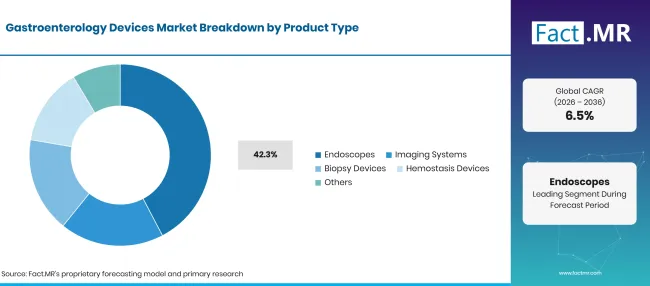
Factmr Gastroenterology Devices Market Breakdown Product Type | Source: Fact.MR
| Product Type | Share (2026) |
|---|---|
| Endoscopes (Leading segment) | 42.3% |
| Other segments combined | 57.7%* |
| Total | 100.0% |
Source: Fact.MR analysis. Updated Oct 17, 2026
Endoscopes account for the stated product-type share in the gastroenterology devices market, supported by their role in visualizing the digestive tract and enabling minimally invasive examinations. Imaging systems support the identification and assessment of gastrointestinal conditions, while biopsy devices facilitate tissue sampling for diagnostic evaluation. Hemostasis devices help control gastrointestinal bleeding, and other devices serve specialized procedural needs. The CDC updated its colorectal cancer screening guidance on June 17, 2026, explaining that the U.S. Preventive Services Task Force recommends routine screening for adults aged 45–75 [4].
What leads the Application segment?
Diagnostics lead with 58.7% share in the Gastroenterology Devices Market in 2026.
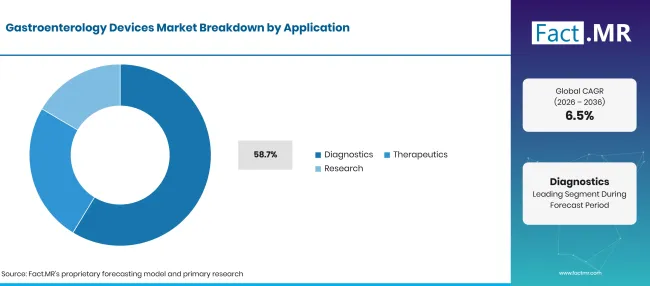
Factmr Gastroenterology Devices Market Breakdown Application | Source: Fact.MR
| Application | Share (2026) |
|---|---|
| Diagnostics (Leading segment) | 58.7% |
| Other segments combined | 41.3%* |
| Total | 100.0% |
Source: Fact.MR analysis. Updated Oct 17, 2026
Diagnostics represents dominant application share as gastroenterology devices are widely used to examine the digestive tract, identify abnormalities, and support disease evaluation. Endoscopic visualization, imaging systems, and biopsy procedures contribute to diagnostic assessments across gastrointestinal conditions. Therapeutic applications use these devices for interventions such as bleeding control and other minimally invasive procedures, while research applications support clinical investigations and the development of diagnostic and treatment approaches.
Which End-User dominates?
Hospitals account for 52.1% share in the Gastroenterology Devices Market in 2026.
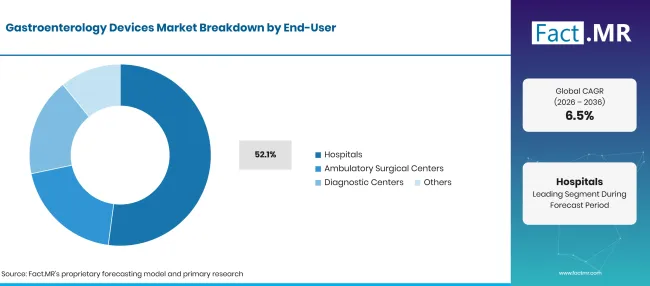
Factmr Gastroenterology Devices Market Breakdown End User | Source: Fact.MR
| End-User | Share (2026) |
|---|---|
| Hospitals (Leading segment) | 52.1% |
| Other segments combined | 47.9%* |
| Total | 100.0% |
Source: Fact.MR analysis. Updated Oct 17, 2026
Hospitals holds leading end-user share due to their capacity to provide comprehensive gastroenterology services, including diagnostic examinations, endoscopic interventions, and complex gastrointestinal procedures. Ambulatory surgical centers support outpatient interventions and procedures that do not require extended hospital stays. Diagnostic centers contribute through specialized examination and testing services, while other end-users serve additional clinical and procedural requirements.
What is accelerating Gastroenterology Devices Market adoption, and what is holding it back?
Growing demand for advanced digestive care boosts the gastroenterology devices market, but high equipment costs and limited access to specialized healthcare facilities slow adoption.
Drivers Impact Analysis
| DRIVER | (~) % IMPACT ON CAGR | GEOGRAPHIC RELEVANCE | IMPACT TIMELINE |
|---|---|---|---|
| Rising prevalence of gastrointestinal disorders | +1.0% | Global | Medium term (2–4 years) |
| Growing demand for minimally invasive procedures | +0.9% | Global | Short term (≤ 2 years) |
| Advancements in endoscopic imaging technologies | +0.7% | Europe, Americas, Asia | Medium term (2–4 years) |
| Expansion of hospital diagnostic capabilities | +0.5% | Global | Short term (≤ 2 years) |
| Increasing adoption of advanced therapeutic endoscopy | +0.4% | Global | Long term (≥ 4 years) |
Source: Fact.MR analysis. Updated Oct 17, 2026
Opportunity Impact Analysis
| OPPORTUNITY | (~) % IMPACT ON CAGR | GEOGRAPHIC RELEVANCE | IMPACT TIMELINE |
|---|---|---|---|
| Development of AI-assisted endoscopic systems | +0.8% | Global | Medium term (2–4 years) |
| Expansion of ambulatory surgical centers | +0.6% | Americas, Europe | Medium term (2–4 years) |
| Integration of high-resolution imaging technologies | +0.5% | Europe, Asia | Long term (≥ 4 years) |
| Growing demand for single-use endoscopic devices | +0.4% | Global | Short term (≤ 2 years) |
Source: Fact.MR analysis. Updated Oct 17, 2026
Restraints Impact Analysis
| RESTRAINT | (~) % IMPACT ON CAGR | GEOGRAPHIC RELEVANCE | IMPACT TIMELINE |
|---|---|---|---|
| High acquisition and maintenance costs of advanced devices | -0.8% | Global | Short term (≤ 2 years) |
| Risk of infection and cross-contamination | -0.6% | Global | Medium term (2–4 years) |
| Shortage of trained endoscopy professionals | -0.5% | Asia, emerging markets | Short term (≤ 2 years) |
| Complex regulatory requirements and reimbursement limitations | -0.4% | Global | Medium term (2–4 years) |
Source: Fact.MR analysis. Updated Oct 17, 2026
Which countries are scaling the Gastroenterology Devices Market through 2036?
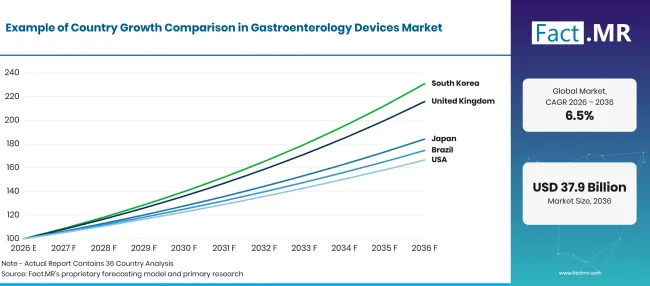
Factmr Gastroenterology Devices Market Growth Index | Source: Fact.MR
| Country | CAGR (2026-2036) |
|---|---|
| Germany | 4.9% |
| Brazil | 5.7% |
| USA | 5.2% |
| UK | 8.0% |
| Japan | 6.3% |
Source: Fact.MR analysis. Updated Oct 17, 2026
What supports Germany adoption?
4.9% CAGR, supported by advanced healthcare infrastructure and established endoscopy services.
Germany’s gastroenterology devices market benefits from its developed hospital network, diagnostic capabilities, and demand for minimally invasive procedures. Hospitals and specialized clinics use endoscopes, imaging systems, biopsy devices, and hemostasis equipment for gastrointestinal diagnosis and treatment. Continued investment in clinical technology and early disease detection can support demand for advanced devices.
How is Brazil developing adoption?
5.7% CAGR, driven by expanding diagnostic capabilities and growing access to gastrointestinal care.
Brazil’s market is supported by demand for diagnostic and therapeutic procedures across public and private healthcare facilities. Endoscopy equipment can help healthcare providers investigate digestive disorders, detect abnormalities, and perform minimally invasive interventions. Investment in medical infrastructure and wider access to specialized services may support adoption across hospitals, ambulatory surgical centers, and diagnostic centers.
What supports United States adoption?
5.2% CAGR, backed by established colorectal cancer screening and demand for advanced diagnostic procedures.
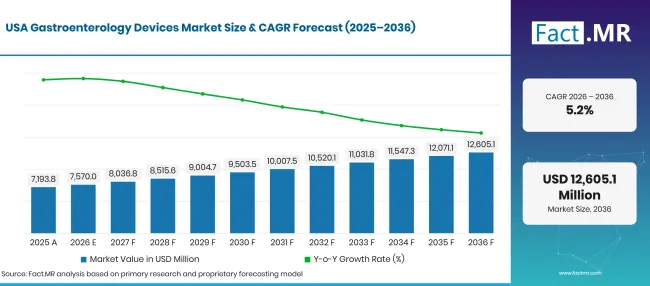
Factmr Gastroenterology Devices Market Forecast Usa | Source: Fact.MR
The U.S. market benefits from established gastrointestinal screening practices and the use of endoscopy for diagnosing digestive disorders and detecting colorectal abnormalities. The CDC reported in June 2025 that approximately seven in ten adults aged 50–75 were up to date with colorectal cancer screening. Colonoscopy can identify and remove precancerous polyps, supporting demand for endoscopes, imaging systems, and biopsy devices. [5]
How is the United Kingdom building adoption?
8.0% CAGR, driven by expanding bowel cancer screening and demand for diagnostic endoscopy.
The UK market is supported by the expansion of bowel cancer screening and the need for follow-up diagnostic procedures. NHS England reported that almost 7 million people participated in bowel screening during 2024/25, compared with approximately 4.7 million in 2014/15. Positive screening results and surveillance requirements can support demand for colonoscopes, biopsy devices, and related imaging technologies. [6]
What supports Japan adoption?
6.3% CAGR, shaped by gastrointestinal cancer detection and demand for precise endoscopic procedures.
Japan’s gastroenterology devices market benefits from the importance of early gastrointestinal cancer detection and established endoscopic diagnostic practices. Hospitals and specialized centers can use advanced endoscopes, imaging systems, and biopsy devices to examine gastrointestinal abnormalities and guide clinical decisions. Continued emphasis on early diagnosis and minimally invasive treatment may support demand for technologically advanced gastroenterology equipment.
Who leads the Gastroenterology Devices Market?
Fact.MR profiles FUJIFILM, Boston Scientific, Medtronic, Olympus, Cook Medical, CONMED, and PENTAX Medical (HOYA Group) across the gastroenterology devices market.
Olympus and FUJIFILM are prominent participants in endoscopy and gastrointestinal imaging technologies. Boston Scientific and Medtronic offer technologies used in therapeutic and minimally invasive procedures, while Cook Medical and CONMED provide specialized medical devices and procedural solutions. PENTAX Medical, part of HOYA Group, focuses on endoscopy systems and related technologies for gastrointestinal examinations.
Competition in the gastroenterology devices market depends on product performance, visualization capabilities, procedural efficiency, clinical usability, and compatibility with healthcare facilities' existing equipment. Hospitals and ambulatory surgical centers evaluate device reliability, maintenance requirements.
Which companies are the key providers?
Key companies in the gastroenterology devices market include FUJIFILM; Boston Scientific Corporation; Medtronic plc; Olympus Corporation; Cook Medical; CONMED Corporation; and PENTAX Medical (HOYA Group).
- FUJIFILM
- Boston Scientific Corporation
- Medtronic plc
- Olympus Corporation
- Cook Medical
- CONMED Corporation
- PENTAX Medical (HOYA Group)
Bibliography
- [1] National Institute of Diabetes and Digestive and Kidney Diseases. (2014, November). Digestive diseases statistics for the United States. National Institutes of Health.
- [2] Ruhl, C. E., & Everhart, J. E. (2008). Chapter 24: Indications & outcomes of gastrointestinal endoscopy. In The burden of digestive diseases in the United States. National Institute of Diabetes and Digestive and Kidney Diseases.
- [3] Medicare Payment Advisory Commission. (2026, March 12). Chapter 11: Ambulatory surgical center services: Status report. In March 2026 report to the Congress: Medicare payment policy.
- [4] Centers for Disease Control and Prevention. (2026, June 17). Talking with your doctor about colorectal cancer screening. https://www.cdc.gov/colorectal-cancer/talking-to-doctor/
- [5] Centers for Disease Control and Prevention. (2025, June 11). Use of colorectal cancer screening tests.
- [6] NHS England. (2026, April 20). NHS detects tens of thousands of bowel cancers thanks to screening programme.
This Report Answers
- The report describes how gastroenterology devices are used to diagnose, visualize, investigate, and treat gastrointestinal disorders.
- Segment analysis compares the specified product categories, including the stated 2026 share of endoscopes.
- Country analysis discusses Germany, Brazil, USA, UK, and Japan alongside relevant official healthcare statistics.
- The competitive overview profiles FUJIFILM, Boston Scientific, Medtronic, Olympus, Cook Medical, CONMED, and PENTAX Medical (HOYA Group).
- Application analysis separates diagnostic procedures from therapeutic interventions and research activities.
What does the Gastroenterology Devices Market cover?
The market covers medical devices used to examine, diagnose, and treat conditions affecting the gastrointestinal tract. It tracks the use of endoscopes, imaging systems, biopsy devices, haemostasis devices, and other specialized instruments. Application coverage distinguishes diagnostics, therapeutics, and research, while end-user segmentation includes hospitals, ambulatory surgical centers, diagnostic centers, and other healthcare facilities. Device purchasing decisions depend on clinical requirements, procedural capabilities, patient safety, and equipment costs.
What is included in the scope?
Included products comprise medical devices intended for gastrointestinal visualization, diagnostic investigation, tissue sampling, bleeding control, and therapeutic procedures. The market value boundary covers the specified product categories used in diagnostic and therapeutic applications and research. The analysis also includes device adoption across hospitals, ambulatory surgical centers, diagnostic centers, and other relevant healthcare settings.
What is excluded from the scope?
The analysis excludes medical devices used solely for unrelated medical specialties without a relevant gastroenterology application. Pharmaceutical products, diagnostic drugs, and treatments that do not constitute gastroenterology devices are outside the defined device revenue boundary. General hospital equipment without a specific gastroenterology application is also excluded. Revenue from unrelated medical services and standalone clinical procedures is not included in the market value unless explicitly covered by the underlying market research methodology.
How Was the Analysis Built?
The analysis draws on 120+ sources, 35+ company portfolios, 25+ countries, and more than 20 industry interviews.
- Primary Research: Primary research includes discussions with manufacturers, service providers, technology developers, distributors, end users, and subject-matter experts. These conversations examine purchasing priorities, product adoption, operational challenges, approval requirements, competitive positioning, and the factors that influence wider market acceptance.
- Desk Research: Desk research covers government statistics, regulatory publications, company filings, trade data, technical studies, industry associations, standards, public policy, and other authoritative sources. Every source used in the analysis is documented in the bibliography.
- Market Sizing and Forecasting: Market estimates combine historical performance, demand indicators, pricing and volume trends, segment shares, company participation, country-level growth, adoption patterns, investment activity, and barriers to market expansion.
- Data Validation and Update Cycle: Findings are validated by comparing primary interviews with public data, company activity, regulatory changes, trade patterns, and industry developments. Regular updates review new product launches, capacity changes, partnerships, approvals, and shifts in commercial adoption.
Segmentation
What is the report’s scope and coverage?
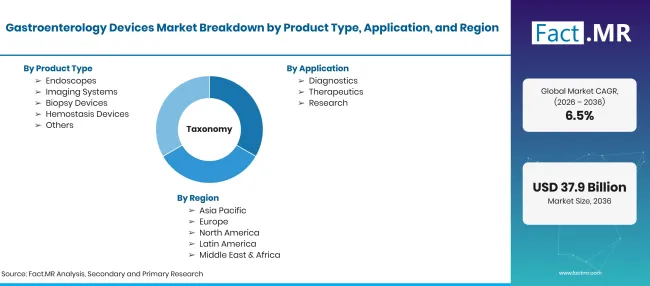
Factmr Gastroenterology Devices Market Taxonomy | Source: Fact.MR
| Attribute | Details |
|---|---|
| Quantitative Units | USD billion: 2026 valuation, 2036 forecast and CAGR |
| Market Definition | Medical devices used to diagnose, visualize, investigate, and treat gastrointestinal disorders through endoscopic, imaging, biopsy, hemostasis, and other specialized procedures. |
| Product Type | Endoscopes; Imaging Systems; Biopsy Devices; Hemostasis Devices; Others |
| Application | Diagnostics; Therapeutics; Research |
| End-User | Hospitals; Ambulatory Surgical Centers; Diagnostic Centers; Others |
| Regions Covered | North America; Latin America; Western Europe; Eastern Europe; East Asia; South Asia & Pacific; Middle East & Africa |
| Countries Covered | Germany; Brazil; USA; UK; Japan |
| Companies Profiled | FUJIFILM; Boston Scientific; Medtronic; Olympus; Cook Medical; CONMED; PENTAX Medical (HOYA Group) |
| Forecast Period | 2026 to 2036 |
| Approach | Market segmentation and scenario-based analysis supported by official healthcare statistics, regulatory information, disease-burden data, and medical device industry sources. |
Source: Fact.MR analysis. Updated Oct 17, 2026
How is the market segmented?
-
By Product Type
- Endoscopes
- Imaging Systems
- Biopsy Devices
- Hemostasis
- Others
-
By Application
- Diagnostics
- Therapeutics
- Research
-
By End-User
- Hospitals
- Ambulatory Surgical Centers
- Diagnostic Centers
- Others
-
By Region
- North America
- Latin America
- Western Europe
- Eastern Europe
- East Asia
- South Asia & Pacific
- Middle East & Africa
Frequently Asked Questions
How big is the Gastroenterology Devices Market in 2026?
What is the CAGR from 2026 to 2036?
Which Product Type has the largest stated share?
Which Application leads?
Which companies are covered?
Who worked on this report


Preview the report firsthand - request a free sample
Free SampleGet the brochure for pricing and purchase details
Download PDF