- Market Value (2025): USD 2.77 Bn
- Estimated Value (2026): USD 2.87 Bn
- Forecast Value (2036): USD 4.14 Bn
- CAGR (2026-2036): 3.7%
What is the Lumber Equipment Market forecast to be worth by 2036?
USD 2.9 billion in 2026 to USD 4.1 billion by 2036 at a 3.7% CAGR.
- As per Fact.MR analysis, the lumber equipment market was valued at USD 2.77 billion in 2025.
- Demand will grow from USD 2.87 billion in 2026 to USD 4.14 billion by 2036.
- The forecast records a 3.7% CAGR from 2026 to 2036 as demand for efficient lumber-processing equipment increases across sawmills and wood-processing facilities.
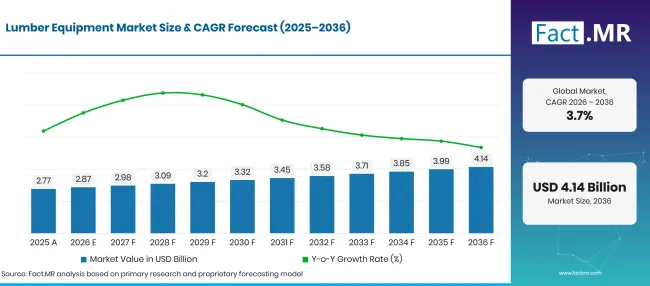
Factmr Lumber Equipment Market Forecast Global | Source: Fact.MR
| Year | Basis | Market Value (USD billion) |
|---|---|---|
| 2025 | Actual | 2.77 |
| 2026 | Estimate | 2.87 |
| 2036 | Forecast | 4.14 |
| CAGR 2026 to 2036 | Forecast period | 3.7% |
Source: Fact.MR analysis. Updated Oct 17, 2026
What are the defining numbers behind Lumber Equipment Market growth?
USD 1.2 billion absolute opportunity between 2026 and 2036.
- Demand Drivers in the Market
- Growing investment in construction and infrastructure supports demand for lumber-processing equipment used to produce timber for structural applications. The U.S. Census Bureau reported that construction spending reached a seasonally adjusted annual rate of USD 2,195.8 billion in February 2025, up 2.9% from February 2024 [1].
- Demand from furniture manufacturers creates opportunities for equipment that improves lumber sizing, surface finishing, and processing efficiency. According to Paraná's Institute of Economic and Social Development (IPARDES), based on Brazilian Institute of Geography and Statistics (IBGE) data, furniture manufacturing in Paraná increased by 13.4% during January–November 2024, while wood-product manufacturing rose by 12.8% [2].
- Lumber producers increasingly prioritize equipment productivity, material utilization, and consistent output. Statistics Canada reported that Canadian sawmills produced 2.905 million cubic metres of lumber in December 2025, down 12.8% from December 2024 [3].
- Key Segments Analyzed
- By Product Type: Sawmills will account for 32.4% share in 2026, reflecting their central role in converting logs into lumber for downstream applications.
- By Application: Construction leads with a 38.6% share in 2026, supported by demand for processed wood used in building structures and other construction projects.
- By Distribution Channel: Direct Sales will account for 52.1% share in 2026, highlighting the importance of direct manufacturer relationships for equipment selection, installation, and technical support.
- By End-User: Commercial users account for 44.2% share in 2026, reflecting demand from lumber-processing businesses and other commercial wood-production operations.
- Analyst Opinion at Fact.MR
- Shambhu Nath Jha, Principal Consultant at Fact.MR, states, “Demand for lumber equipment is influenced by the need for efficient wood processing, consistent product quality, and reliable production capacity. Manufacturers that improve equipment performance, simplify maintenance, and provide dependable technical support can better address the requirements of commercial and industrial lumber processors.”
- Strategic Implications
- Equipment manufacturers must prioritize cutting precision, operational reliability, and energy efficiency to meet the requirements of lumber-processing facilities.
- Distributors need to provide equipment-selection guidance, maintenance support, and access to replacement parts to reduce production interruptions.
- Lumber producers should evaluate equipment capacity, processing speed, and material recovery when investing in new machinery.
- Manufacturers are encouraged to develop solutions tailored to different wood-processing applications.
- Suppliers need to strengthen direct-sales capabilities while providing technical assistance throughout equipment installation and operation.
Germany is projected to register a 3.5% CAGR through 2036. Brazil is expected to record 4.2%, followed by the USA at 3.1%. The UK is forecast to advance at 3.9%, while Japan is projected to grow at 4.6%. Differences in construction activity, furniture production, industrial investment, and lumber-processing capacity may influence demand for equipment across these markets.
How does the Lumber Equipment Market break down by segment?
Fact.MR finds that Sawmills leads Product Type at 32.4%; Construction leads Application at 38.6%; Direct Sales leads Distribution Channel at 52.1%; Commercial leads End-User at 44.2%.
Which Product Type dominates?
Sawmills hold 32.4% share in 2026.
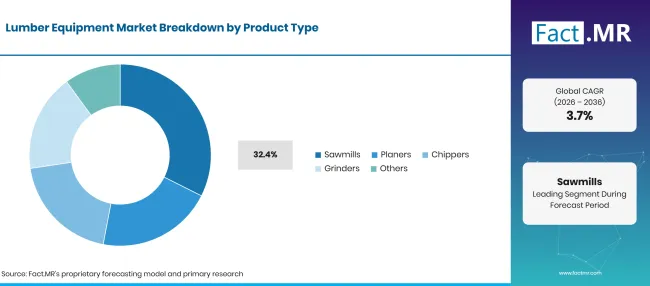
Factmr Lumber Equipment Market Breakdown Product Type | Source: Fact.MR
| Product Type | Share (2026) |
|---|---|
| Sawmills (Leading segment) | 32.4% |
| Other segments combined | 67.6%* |
| Total | 100.0% |
Source: Fact.MR analysis. Updated Oct 17, 2026
Sawmills account for the leading product-type share because they convert logs into lumber for construction, furniture manufacturing, and other wood-processing applications. Planers improve the thickness and surface finish of boards, while chippers process wood into smaller pieces for downstream uses. Grinders and other equipment support additional wood-processing and material-preparation requirements. Woodland Mills offers the HM126MAX portable sawmill for lumber-processing applications. On May 4, 2026, Comact announced a new-generation Miller Planer designed to improve dimensional accuracy, surface finish, reliability, and maintenance. These launches illustrate manufacturers’ focus on cutting capacity and lumber-processing quality [4] [5].
What leads the Application segment?
Construction accounts for 38.6% share in 2026.
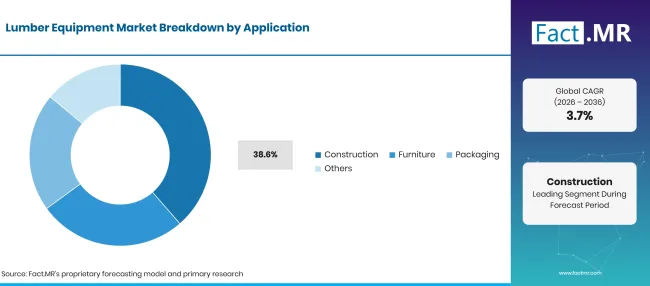
Factmr Lumber Equipment Market Breakdown Application | Source: Fact.MR
| Application | Share (2026) |
|---|---|
| Construction (Leading segment) | 38.6% |
| Other segments combined | 61.4%* |
| Total | 100.0% |
Source: Fact.MR analysis. Updated Oct 17, 2026
Construction segment presents the prominent application share because lumber is used in structural framing, flooring, roofing, and other building components. Furniture manufacturing requires equipment that delivers consistent dimensions and suitable surface finishes for wood components. Packaging applications create demand for machinery that processes lumber into pallets, crates, and other wooden packaging products. Other applications serve a range of wood-processing requirements.
How does Distribution Channel shape demand?
Direct Sales lead with 52.1% share in 2026.
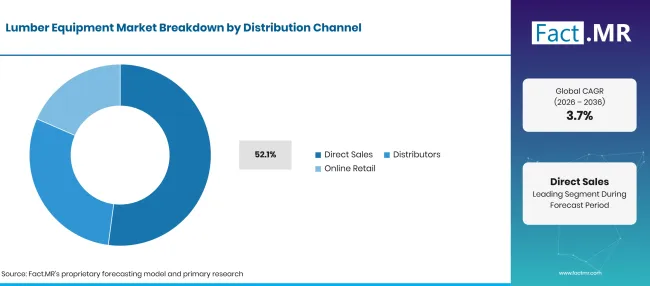
Factmr Lumber Equipment Market Breakdown Distribution Channel | Source: Fact.MR
| Distribution Channel Method | Share (2026) |
|---|---|
| Direct Sales (Leading segment) | 52.1% |
| Other segments combined | 47.9%* |
| Total | 100.0% |
Source: Fact.MR analysis. Updated Oct 17, 2026
Direct sales represent the leading distribution channel because lumber equipment purchases can require product customization, technical consultation, installation, and after-sales support. Distributors provide access to equipment, spare parts, and local service networks. Online retail can support equipment discovery and the purchase of smaller machinery and accessories, while other channels serve specialized purchasing requirements.
Which End-User dominates?
Commercial captures 44.2% share in 2026.
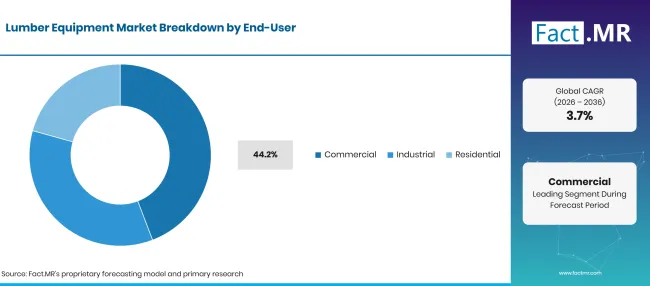
Factmr Lumber Equipment Market Breakdown End User | Source: Fact.MR
| End-User | Share (2026) |
|---|---|
| Commercial (Leading segment) | 44.2% |
| Other segments combined | 55.8%* |
| Total | 100.0% |
Source: Fact.MR analysis. Updated Oct 17, 2026
Commercial segment hold the leading end-user share as lumber-processing businesses require machinery to produce timber for construction, furniture, and packaging applications. Industrial users need higher-capacity equipment for large-scale production, automated processing, and consistent output. Residential users may purchase smaller sawmills and woodworking machinery for property maintenance, workshops, and small-scale wood processing.
What is accelerating Lumber Equipment Market adoption, and what is holding it back?
Growing demand for processed lumber in construction and furniture manufacturing boosts demand, but high equipment costs and maintenance requirements may slow adoption.
Drivers Impact Analysis
| DRIVER | (~) % IMPACT ON CAGR | GEOGRAPHIC RELEVANCE | IMPACT TIMELINE |
|---|---|---|---|
| Growing demand for processed lumber in construction | +1.0% | North America, Europe | Medium term (2–4 years) |
| Rising furniture manufacturing activity | +0.9% | Asia, Europe, Americas | Medium term (2–4 years) |
| Modernization of sawmills and lumber-processing facilities | +0.7% | Global | Long term (≥ 4 years) |
| Demand for improved production efficiency and material utilization | +0.5% | Global | Short term (≤ 2 years) |
| Expansion of automated wood-processing systems | +0.4% | North America, Europe, Asia | Long term (≥ 4 years) |
Source: Fact.MR analysis. Updated Oct 17, 2026
Opportunity Impact Analysis
| OPPORTUNITY | (~) % IMPACT ON CAGR | GEOGRAPHIC RELEVANCE | IMPACT TIMELINE |
|---|---|---|---|
| Adoption of automated and high-capacity sawmills | +0.8% | North America, Europe | Long term (≥ 4 years) |
| Development of energy-efficient lumber-processing machinery | +0.6% | Global | Medium term (2–4 years) |
| Integration of digital monitoring and process controls | +0.5% | North America, Europe, Asia | Long term (≥ 4 years) |
| Demand for compact and flexible equipment for smaller sawmills | +0.4% | Global | Medium term (2–4 years) |
Source: Fact.MR analysis. Updated Oct 17, 2026
Restraints Impact Analysis
| RESTRAINT | (~) % IMPACT ON CAGR | GEOGRAPHIC RELEVANCE | IMPACT TIMELINE |
|---|---|---|---|
| High initial equipment and installation costs | -0.8% | Global | Short term (≤ 2 years) |
| Maintenance expenses and spare-parts availability | -0.6% | Global | Medium term (2–4 years) |
| Shortages of skilled equipment operators and technicians | -0.5% | North America, Europe | Medium term (2–4 years) |
| Fluctuations in timber supply and lumber demand | -0.4% | Global | Short term (≤ 2 years) |
Source: Fact.MR analysis. Updated Oct 17, 2026
Which countries are scaling the Lumber Equipment Market through 2036?
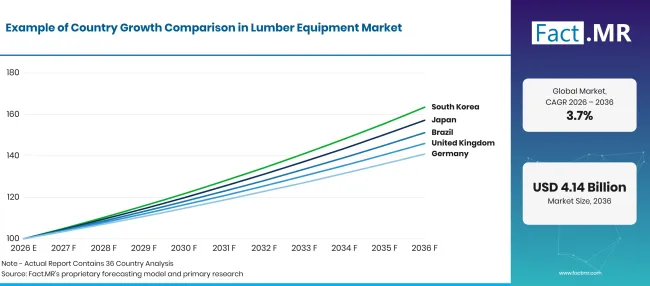
Factmr Lumber Equipment Market Growth Index | Source: Fact.MR
| Country | CAGR (2026-2036) |
|---|---|
| Germany | 3.5% |
| Brazil | 4.2% |
| USA | 3.1% |
| UK | 3.9% |
| Japn | 4.6% |
Source: Fact.MR analysis. Updated Oct 17, 2026
What supports Germany adoption?
3.5% CAGR, supported by construction activity and demand for precision lumber processing.
Germany’s lumber equipment market may benefit from demand for machinery used to process timber for construction, furniture manufacturing, and other wood-based applications. Equipment such as sawmills, planers, and chippers helps manufacturers produce lumber to required dimensions and quality standards. Investment in production efficiency and equipment modernization may support demand for lumber-processing machinery.
How is Brazil developing lumber equipment adoption?
4.2% CAGR, driven by wood processing, furniture production, and demand for lumber-processing machinery.
Brazil’s lumber equipment market may benefit from its wood-products and furniture manufacturing industries. Official Brazilian industrial production indicators cover wood-product and furniture manufacturing, providing context for equipment use in these industries. Equipment suppliers can target sawmills, planers, and chippers used to process timber for construction, furniture, and packaging applications [6].
What supports United States adoption?
3.1% CAGR, led by construction activity and demand for processed lumber.
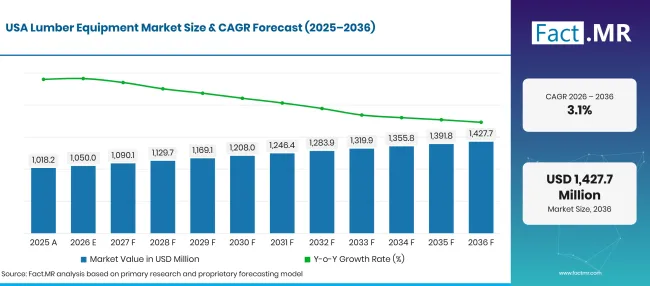
Factmr Lumber Equipment Market Forecast Usa | Source: Fact.MR
The U.S. market may benefit from demand for lumber used in residential construction, renovation, and commercial building projects. The U.S. Census Bureau publishes monthly construction spending and housing-start statistics that help track activity in important markets for processed wood. Sawmill operators and lumber producers may invest in machinery that improves cutting precision, production capacity, and material utilization as their processing requirements change [7].
How is the United Kingdom building adoption?
3.9% CAGR, shaped by timber production, wood-product manufacturing, and construction demand.
The UK market may benefit from demand for machinery used to process domestic timber into lumber and other wood products. Forest Research published provisional UK wood production and trade statistics for 2025 on May 28, 2026, covering timber production and trade activity. These official indicators help assess activity across the UK timber supply chain and the potential need for sawmills, planers, and related processing equipment [8].
What supports Japan adoption?
4.6% CAGR, backed by construction activity and established wood-processing industries.
Japan’s lumber equipment market may benefit from demand for timber used in residential construction, building components, and furniture production. Japan’s Statistics Bureau includes construction investment, construction orders, and housing starts in its Statistical Yearbook 2026. These indicators provide context for evaluating demand for processed lumber and machinery used to prepare wood for downstream applications [9].
Who leads the Lumber Equipment Market?
USNR and HMC Corporation serve the sawmill machinery and industrial wood-processing equipment segments. Wood-Mizer manufactures sawmills and wood-processing equipment for commercial and smaller-scale operations.
Pendu Manufacturing supplies machinery for sawmill operations and wood processing, while Laimet specializes in wood-processing equipment, including chipper technology. Product offerings should be checked for the specific equipment category and intended processing application before treating two portfolios as directly comparable.
Commercial competition depends on equipment performance, production capacity, reliability, and after-sales support. Manufacturers need machinery that delivers consistent processing quality and operational efficiency. Sawmill operators need equipment suited to their timber dimensions and production requirements. Dealers and service providers need reliable spare-parts availability and technical support to minimize downtime.
Which companies are the key providers?
Key companies include USNR; Wood-Mizer; HMC Corporation; Pendu Manufacturing, Ltd.; and Laimet.
- USNR
- Wood-Mizer
- HMC Corporation
- Pendu Manufacturing
- Laimet
Bibliography
- [1] U.S. Census Bureau. (2025, April 1). Monthly Construction Spending, February 2025.
- [2] Instituto Paranaense de Desenvolvimento Econômico e Social. (2025, February). Industrial production indicators for Paraná. https://www.ipardes.pr.gov.br/sites/ipardes/arquivos_restritos/files/documento/2025-02/VERSAO_COMPLETA.pdf
- [3] Statistics Canada. (2026, March 4). Sawmills, December 2025.
- [4] Woodland Mills. (n.d.). HM126MAX Portable Sawmill Trailer Mounted.
- [5] Comact. (2026, May 4). Comact Launches New Generation Miller Planer.
- [6] Instituto Brasileiro de Geografia e Estatística. (n.d.). Industry and construction statistics.
- [7] U.S. Census Bureau. (n.d.). Construction Spending: Historical data.
- [8] Forest Research. (2026, May 28). UK Wood Production and Trade: 2025 provisional figures.
- [9] Statistics Bureau of Japan. (2025, December 25). Japan Statistical Yearbook 2026: Chapter 10—Construction.
This Report Answers
- The report describes how lumber equipment is used across the specified wood-processing applications.
- Segment analysis compares the specified product categories and their 2026 shares.
- Country analysis discusses Germany, Brazil, USA, UK, and Japan alongside relevant construction, forestry, and timber production indicators.
- The competitive overview profiles USNR, Wood-Mizer, HMC Corporation, Pendu Manufacturing, and Laimet.
- Application analysis separates construction, furniture manufacturing, packaging, and other uses.
What does the Lumber Equipment Market cover?
The market covers lumber equipment intended for wood processing and lumber production. It tracks use in sawmills and in the production of wood products for construction, furniture, and packaging. Product coverage follows the specified equipment categories, while application coverage separates construction, furniture manufacturing, packaging, and other uses. Equipment purchasing decisions depend on processing requirements, production capacity, and the machinery's intended use.
What is included in the scope?
Included products comprise lumber-processing equipment sold for cutting, shaping, chipping, grinding, and preparing wood. The value boundary covers sawmills, planers, chippers, grinders, and other stated equipment categories. The segmentation also covers construction, furniture, packaging, and other applications, alongside direct sales, distributors, online retail, and commercial, industrial, and residential end-users.
What is excluded from the scope?
The analysis excludes wood products such as finished lumber, furniture, and packaging materials sold independently of the equipment used to manufacture them. Forestry machinery used solely for tree planting, felling, or log transportation is outside the defined lumber equipment category unless specifically included in the product classification. General construction equipment and unrelated industrial machinery are also excluded. Sales of raw timber and finished wood products are outside the equipment revenue boundary.
How Was the Analysis Built?
The analysis draws on 120+ sources, 35+ company portfolios, 25+ countries, and more than 20 industry interviews.
- Primary Research: Primary research includes discussions with manufacturers, service providers, technology developers, distributors, end users, and subject-matter experts. These conversations examine purchasing priorities, product adoption, operational challenges, approval requirements, competitive positioning, and the factors that influence wider market acceptance.
- Desk Research: Desk research covers government statistics, regulatory publications, company filings, trade data, technical studies, industry associations, standards, public policy, and other authoritative sources. Every source used in the analysis is documented in the bibliography.
- Market Sizing and Forecasting: Market estimates combine historical performance, demand indicators, pricing and volume trends, segment shares, company participation, country-level growth, adoption patterns, investment activity, and barriers to market expansion.
- Data Validation and Update Cycle: Findings are validated by comparing primary interviews with public data, company activity, regulatory changes, trade patterns, and industry developments. Regular updates review new product launches, capacity changes, partnerships, approvals, and shifts in commercial adoption.
Segmentation
What is the report’s scope and coverage?
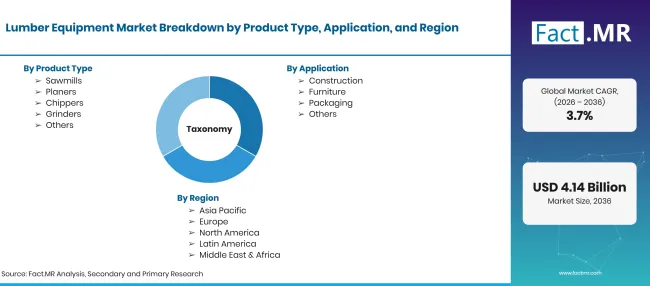
Factmr Lumber Equipment Market Taxonomy | Source: Fact.MR
| Attribute | Details |
|---|---|
| Quantitative Units | USD billion: 2026 valuation, 2036 forecast and CAGR |
| Market Definition | Lumber equipment used to process logs and wood into lumber, finished wood products, and other processed materials. |
| Product Type | Sawmills; Planers; Chippers; Grinders; Others |
| Application | Construction; Furniture; Packaging; Others |
| Distribution Channel | Direct Sales; Distributors; Online Retail |
| End-User | Commercial; Industrial; Residential |
| Regions Covered | North America; Latin America; Western Europe; Eastern Europe; East Asia; South Asia & Pacific; Middle East & Africa |
| Countries Covered | Germany; Brazil; USA; UK; Japan |
| Companies Profiled | USNR; Wood-Mizer; HMC Corporation; Pendu Manufacturing; Laimet |
| Forecast Period | 2026 to 2036 |
| Approach | Market segmentation and scenario-based analysis supported by official forestry statistics and timber production data to assess demand trends in the lumber equipment market. |
Source: Fact.MR analysis. Updated Oct 17, 2026
How is the market segmented?
-
By Product Type
- Sawmills
- Planers
- Chippers
- Grinders
- Others
-
By Application
- Construction
- Furniture
- Packaging
- Others
-
By Distribution Channel
- Direct Sales
- Distributors
- Online Retail
-
By End-User
- Commercial
- Industrial
- Residential
-
By Region
- North America
- Latin America
- Western Europe
- Eastern Europe
- East Asia
- South Asia & Pacific
- Middle East & Africa
Frequently Asked Questions
How big is the lumber equipment market in 2026?
What is the CAGR from 2026 to 2036?
Which product type has the largest stated share?
Which application leads?
Which companies are covered?
Who worked on this report


Preview the report firsthand - request a free sample
Free SampleGet the brochure for pricing and purchase details
Download PDF