- Market Value (2025): USD 96.0 Mn
- Estimated Value (2026): USD 100.0 Mn
- Forecast Value (2036): USD 150.0 Mn
- CAGR (2026-2036): 4.1%
What is the Gemological Microscopes Market forecast to be worth by 2036?
USD 100.0 million in 2026 to USD 150.0 million by 2036, at 4.1% CAGR.
- The Gemological Microscopes Market was valued at USD 96.0 million in 2025.
- Revenue is projected to grow from USD 100.0 million in 2026 to USD 150.0 million by 2036 as gemstone trading expands and more users add digital documentation to routine inspection.
- The market is forecast to record a 4.1% CAGR from 2026 to 2036 is supported by replacement of older optical stands and wider gemology training.
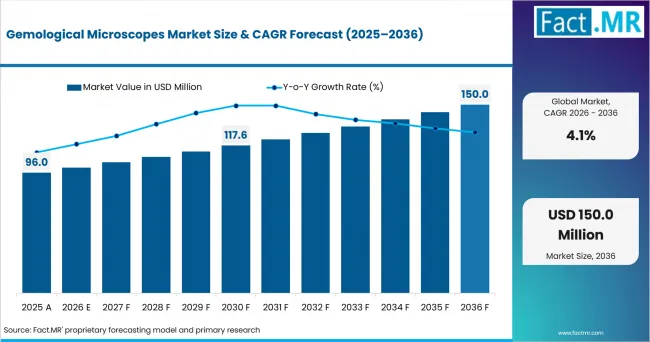
Gemological Microscopes Market Value Analysis | Source: Fact.MR
What are the defining numbers behind Gemological Microscopes Market growth?
USD 50.0 million absolute opportunity by 2036, led by Stereo darkfield microscopes and Darkfield within their respective segments.
- Demand Drivers in the Market
- Darkfield stereo microscopes are widely used because they make marks inside a gemstone easier to see against a dark background.
- Labs and gem experts use different lighting options since some details are clearer under reflected or polarized light.
- Camera mounts help users save images of internal marks, treatments, surface damage, and other features for reports or second opinions.
- Jewelry stores also use microscopes at the counter to show customers visible details and explain quality more clearly.
- Key Segments Analyzed
- By Optical Configuration: Stereo Darkfield Microscopes are expected to hold 40.0% share in 2026 supported by binocular depth perception and clear examination of inclusions and surface features.
- By Illumination Type: Darkfield is projected to account for 38.0% share in 2026 owing to its ability to make light-scattering inclusions visible against a dark background.
- By Magnification Range: 10x–45x is anticipated to capture 46.0% share in 2026 due to its practical coverage of broad stone orientation and detailed inclusion assessment within one zoom range.
- By User Group: Gem Labs are estimated to represent 32.0% share in 2026 attributable to routine use in gemstone identification, treatment assessment, grading, and report documentation.
- By Mounting System: Gem Clamp Stand is forecast to account for 36.0% share in 2026 driven by stable stone positioning and easier rotation across different lighting angles.
- Analyst Opinion at Fact.MR
- Shambhu Nath Jha, Senior Analyst at Fact.MR, states, "The microscope does not make the identification; it gives a trained observer a better set of visual evidence. Manufacturers that combine stable stereo optics with flexible illumination and secure stone handling are expected to serve both expert labs and commercial users. A straightforward image-capture path is expected to carry extra weight for users who need records for clients or reports."
- Strategic Implications
- Gem laboratories need to evaluate illumination range and camera workflow along with resolution and optical comfort.
- Retailers need a system that presents stones safely and clearly to a client without slowing ordinary counter service.
- Manufacturers differentiate through modular heads and adjustable stands. Clamps, cameras and lighting accessories let one platform serve several user levels without forcing a full system change.
- Training providers need to match classroom equipment to the lighting techniques and magnification practices students are expected to encounter in professional work.
The United States is projected to expand at a 4.5% CAGR from 2026 to 2036 because labs and retailers continue to add digital evidence to optical practice. Switzerland follows at 4.4% as its gem laboratories and watch houses keep instrumentation standards high. Belgium at 4.2% keeps microscopes in daily use across Antwerp's trading offices. Thailand is forecast at a 4.3% CAGR because trading and treatment services create concentrated inspection demand. The United Arab Emirates advances at 4.1% through high-value retail and international trading.
How does the Gemological Microscopes Market break down by segment?
The leading shares are Stereo darkfield microscopes at 40.0% by Optical Configuration and Darkfield at 38.0% by Illumination Type.
Which Optical Configuration dominates?
Stereo Darkfield Microscopes hold 40.0% share in 2026.
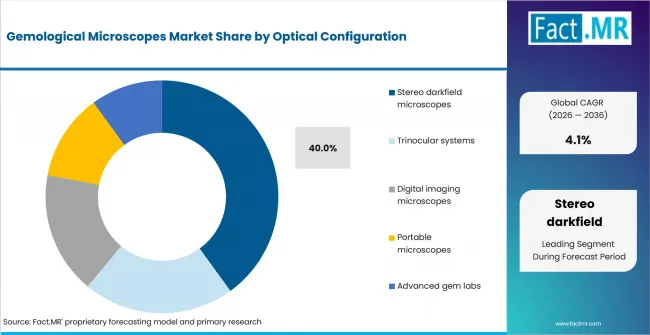
Gemological Microscopes Market Analysis By Optical Configuration | Source: Fact.MR
Binocular depth perception gives Stereo Darkfield Microscopes a practical advantage during routine gemstone examination. Users can assess the position and shape of inclusions while darkfield contrast improves visibility against the stone interior. This combination supports identification, treatment review, and surface inspection, helping the category secure the leading share in 2026.
What leads the Illumination Type segment?
Darkfield accounts for 38.0% share in 2026.
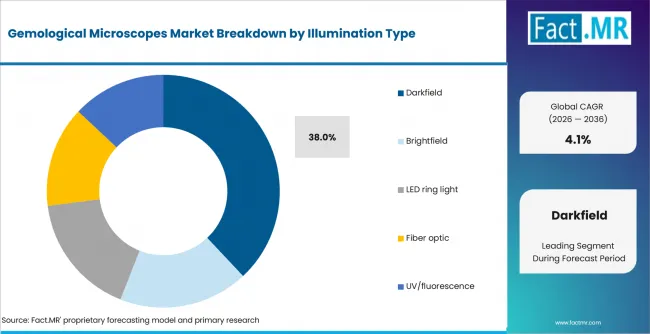
Gemological Microscopes Market Analysis By Illumination Type | Source: Fact.MR
Internal features often become easier to interpret when scattered light appears against a dark background. Darkfield illumination creates this viewing condition without distracting surface glare, making it useful for locating fractures, crystals, and other clarity characteristics. Its established role in daily laboratory and appraisal work supports its 38.0% share in 2026.
How does Magnification Range shape demand?
10x–45x leads with 46.0% share in 2026.
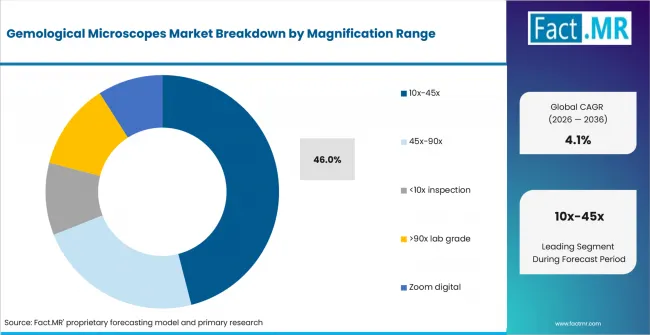
Gemological Microscopes Market Analysis By Magnification Range | Source: Fact.MR
A broad zoom range reduces the need to change equipment while examining the same gemstone. At lower magnification, users can orient the stone and review its overall structure, then move closer to inspect small inclusions or surface marks. This flexibility makes 10x–45x suitable for laboratories, retailers, appraisers, and teaching settings.
What supports Gem Labs within User Group?
Gem Labs are projected to hold 32.0% share in 2026.
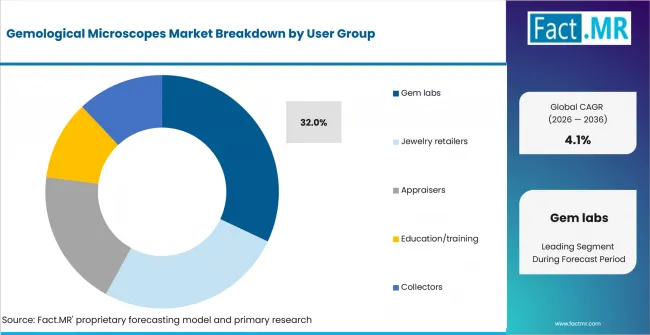
Gemological Microscopes Market Analysis By User Group | Source: Fact.MR
Microscopy forms part of several stages in a professional gem laboratory, from initial observation to treatment assessment and final report preparation. Trained gemologists use controlled lighting and magnification to compare internal features and document evidence. Regular use across this complete workflow gives Gem Labs the strongest position among user groups in 2026.
What leads the Mounting System segment?
Gem Clamp Stand accounts for 36.0% share in 2026.
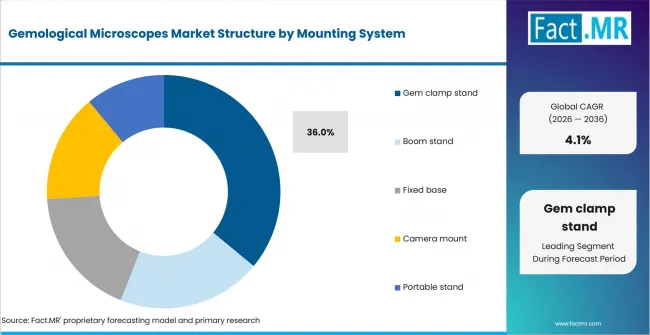
Gemological Microscopes Market Analysis By Mounting System | Source: Fact.MR
Loose gemstones need secure positioning without blocking the viewing area or limiting movement under the light source. A Gem Clamp Stand keeps the stone steady while allowing controlled rotation through different angles. This improves inspection consistency, reduces repeated handling, and supports photography, inclusion mapping, and treatment review, strengthening its lead within Mounting Systems.
What is accelerating Gemological Microscopes Market adoption, and what is holding it back?
Adoption is restrained by the skill required to interpret features correctly and by the cost jump from a basic stereo stand to a well-integrated imaging system.
Drivers Impact Analysis
| DRIVER | (~) % IMPACT ON CAGR | GEOGRAPHIC RELEVANCE | IMPACT TIMELINE |
|---|---|---|---|
| Gem-trade professionalization | +0.6% | Thailand and the United Arab Emirates | Medium term (2-4 years) |
| Digital documentation | +0.5% | United States and major gem hubs | Short term (<= 2 years) |
| Laboratory-grown and treated stones | +0.5% | Global | Medium term (2-4 years) |
| Gemology education | +0.4% | United States and Europe | Short term (<= 2 years) |
| Retail transparency | +0.3% | Jewelry retail centers | Long term (>= 4 years) |
Source: Fact.MR analysis. Updated Jul 17, 2026
- Gem-trade professionalization: More organized trading and laboratory services are expected to raise demand for repeatable inspection equipment. Retailers also need visible evidence when reports and client explanations depend on microscope findings.
- Digital documentation: Camera-ready systems allow users to archive a feature and share it with a colleague or customer. Adoption favors simple software and a calibrated imaging path that does not interrupt observation.
- Laboratory-grown and treated stones: A wider mix of natural and laboratory-grown material is expected to increase the need for careful microscopic examination. Treated stones add similar pressure because complex cases still require additional instruments or laboratory services.
Opportunity Impact Analysis
| OPPORTUNITY | (~) % IMPACT ON CAGR | GEOGRAPHIC RELEVANCE | IMPACT TIMELINE |
|---|---|---|---|
| Integrated live imaging | +0.3% | Global laboratories and retailers | Short term (<= 2 years) |
| Modular illumination kits | +0.3% | Education and appraisal channels | Medium term (2-4 years) |
| Remote second opinions | +0.2% | Distributed gem-trading networks | Long term (>= 4 years) |
| Mounted-jewelry ergonomics | +0.2% | Retailers and appraisers | Medium term (2-4 years) |
Source: Fact.MR analysis. Updated Jul 17, 2026
- Integrated live imaging: Trinocular and digital systems are expected to display the live field on a nearby screen while the gemologist works. Microscope manufacturers are expected to simplify adoption by delivering matched cameras and adapters. Capture software needs to fit the microscope workflow instead of interrupting observation.
- Modular illumination kits: Users benefit from adding fiber-optic or polarized capability to a common base. Brightfield and fluorescence accessories reduce the need to replace the microscope as skills and assignments expand.
- Remote second opinions: Live video and standardized still images are expected to support preliminary consultation across locations. The opportunity is concentrated where lighting and scale stay consistent. Focus stacking and image metadata also need enough discipline for the recipient to interpret.
Restraints Impact Analysis
| RESTRAINT | (~) % IMPACT ON CAGR | GEOGRAPHIC RELEVANCE | IMPACT TIMELINE |
|---|---|---|---|
| Interpretation dependence | -0.3% | Global | Short term (<= 2 years) |
| Imaging-system complexity | -0.2% | Small laboratories and retailers | Medium term (2-4 years) |
| Low-cost optical substitutes | -0.2% | Price-sensitive markets | Short term (<= 2 years) |
| Long replacement cycle | -0.1% | Established gem laboratories | Long term (>= 4 years) |
Source: Fact.MR analysis. Updated Jul 17, 2026
- Interpretation dependence: Magnification reveals features but does not automatically explain their origin or significance. Inexperienced users are expected to overstate conclusions when one lighting condition shows an inclusion without enough supporting evidence.
- Imaging-system complexity: Cameras and adapters add cost and setup time. Monitors, calibration and software create further friction for smaller users. Poorly matched components are expected to produce disappointing images when the optical microscope is sound but the capture path is weak.
- Low-cost optical substitutes: Generic stereo microscopes and handheld digital magnifiers compete for basic inspection budgets. Dedicated gemological systems must justify their premium through illumination and stone handling. Optical comfort and support complete the value case.
How does country demand for gemological microscopes compare?
United States 4.5%, Switzerland 4.4%, Belgium 4.2%, Thailand 4.3%, UAE 4.1%
The regional review begins with North America and Europe, where gem-testing laboratories and appraisal services are well established. It also covers Asia Pacific and the Middle East & Africa. The country analysis highlights the United States and Switzerland, with Belgium, Thailand, and the United Arab Emirates also included. The full report applies the same approach across more than 30+ countries.
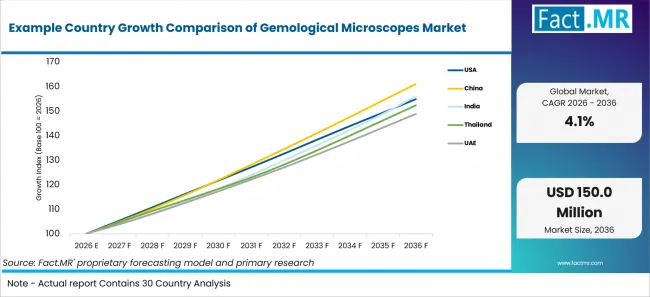
Example Country Growth Comparison Of Gemological Microscopes Market | Source: Fact.MR
| COUNTRY | CAGR |
|---|---|
| United States | 4.5% |
| Switzerland | 4.4% |
| Belgium | 4.2% |
| Thailand | 4.3% |
| United Arab Emirates | 4.1% |
Source: Fact.MR analysis. Updated Jul 17, 2026
How is the United States Gemological Microscopes Market expected to develop?
4.5% CAGR, supported by laboratory modernization and imaging-enabled gemstone examination.
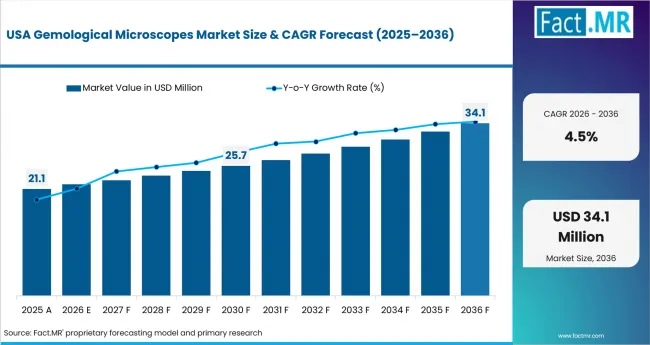
Gemological Microscopes Market Country Value Analysis | Source: Fact.MR
The United States has a broad network of gem laboratories, jewelry retailers, appraisers, and training centers that continue to update established darkfield workstations. The market is expected to record a 4.5% CAGR from 2026 to 2036 as professional users adopt ergonomic systems with improved optics, LED illumination, image capture, and digital display for grading, teaching, documentation, and customer review.
Why is Switzerland a benchmark buyer of Gemological Microscopes?
4.4% CAGR, driven by high-value gemstone testing and disciplined laboratory workflows.
Switzerland supports demand through independent gem laboratories that serve dealers, auction houses, watchmakers, jewelers, and luxury companies requiring consistent scientific documentation. The market is projected to expand at a 4.4% CAGR through 2036 as laboratories continue to favor precise darkfield systems that fit established gemstone identification, treatment assessment, training, and report-verification procedures.
What supports microscope demand in Belgium?
4.2% CAGR, tied to natural-diamond verification and Antwerp’s concentrated trading network.
Belgium benefits from Antwerp’s dense network of diamond traders, grading operations, and certification services where visual examination remains part of buying and resale decisions. Demand is anticipated to post a 4.2% CAGR by 2036 as professional users seek dependable stereo and darkfield microscopes that support natural-diamond verification, inclusion inspection, photographic records, and cross-border transaction documentation.
Why does Thailand stand out for Gemological Microscope growth?
4.3% CAGR, supported by colored-stone testing and treatment-identification expertise.
Thailand has an established gemstone trading, cutting, treatment, and laboratory base that handles natural, treated, synthetic, and imitation stones. The market is anticipated to grow at a 4.3% CAGR from 2026 to 2036 as laboratories and commercial users adopt versatile microscopes for inclusion review, treatment detection, teaching, quality checks, and documentation across varied colored-stone categories.
What supports Gemological Microscope adoption in the United Arab Emirates?
4.1% CAGR, driven by luxury jewelry trade and international gemstone transactions.
The United Arab Emirates supports microscope demand through Dubai’s expanding role in diamond trading, colored gemstones, auctions, luxury retail, and professional appraisal services. The market is forecast to record a 4.1% CAGR by 2036 as imaging-capable systems help users verify stones, present findings to clients, retain transaction records, and communicate examination results across international trading relationships.
Who leads the Gemological Microscopes Market?
Motic and Leica Microsystems hold strong positions through their well-known stereo microscopes. Meiji Techno adds gem-testing setups and a wide range of microscope parts.
Motic offers stereo microscopes that work with darkfield lighting, camera ports, three-viewing heads, and stands that hold gemstones during inspection. Leica Microsystems is known for clear optics, comfortable viewing, and digital imaging tools that help users study inclusions and save records. Meiji Techno supplies stereo microscopes and gem stands that support stone handling, darkfield checks, and everyday appraisal work. These companies compete on image clarity, lighting, viewing space, and camera support.
UNITRON and GIA Instruments also form part of the main company group. UNITRON offers flexible stereo microscopes with camera and lighting options for labs, classrooms, and jewelry professionals. GIA Instruments benefits from its close link with gem research, training, and laboratory work. Through 2036, competition is expected to depend on clear viewing, comfortable use, useful add-ons, image capture, technical help, and suitability for customer demonstrations.
Which companies are the key providers?
The company set includes Motic and Leica Microsystems. Meiji Techno, UNITRON and GIA Instruments complete the profiled group.
- Motic
- Leica Microsystems
- Meiji Techno
- UNITRON
- GIA Instruments
Bibliography
- Leica Microsystems. (2025, August 14). Leica Microsystems and Fisher Scientific partner to expand microscopy access across the EMEA region.
- Gemological Institute of America. (2025). GIA Gemolite NXT photomicroscope user guide.
- Shang, P. (2025, September 30). How GIA analyzes colored stones from start to finish. Gemological Institute of America.
- Wiggins, H., & Kiyak, E. (2025). Quartz assemblage imitating emerald. Gems & Gemology, 61(2).
This Report Addresses
- The report provides strategic intelligence on Gemological Microscopes across Optical Configuration and Illumination Type choices that shape gemstone inspection, grading, documentation, and training workflows.
- It compares the United States and Switzerland with Belgium, Thailand and the United Arab Emirates across coverage extending to 30+ countries.
- It assesses Motic and Leica Microsystems with Meiji Techno, UNITRON and GIA Instruments.
- It evaluates stereo darkfield and trinocular configurations within the optical scope. Digital, portable and advanced laboratory configurations complete the optical view.
- It examines laboratories and retailers as distinct user groups. Appraisers, educators and collectors complete the user view.
- It links forecast evidence to gemstone trade and training. Digital documentation, retail transparency and replacement cycles complete the demand view.
What does the Gemological Microscopes Market cover?
The study follows gemological microscope systems from professional laboratory benches to retail and appraisal use. Classroom and collector use are included where the equipment is configured for gem examination.
Revenue includes the optical body and gemological base. Integrated illumination and stands are counted when delivered as one system. Holders and bundled cameras are counted under the same condition.
Demand is segmented by optics and lighting before magnification is reviewed. User group and mounting system complete the segmentation view. Country estimates reflect jewelry and gemstone activity along with laboratory capacity. Education, professional training and equipment distribution are also considered.
What is included in the scope?
Included products must be configured for gemstone or jewelry examination instead of general microscopy alone.
Binocular and trinocular stereo systems are included with digital imaging microscopes and portable units. Higher-grade laboratory platforms are included when configured for gem examination. Integrated darkfield wells and brightfield plates fall within scope. Ring lights and fiber-optic sources are also counted. UV or fluorescence options and gem clamps remain within scope.
Bundled cameras and adapters are counted when they form part of the delivered microscope package. Displays and image software are included under the same condition. Replacement optical bodies are included if sold for a gemological stand.
What is excluded from the scope?
General microscopes and separate gem-testing instruments sit outside the market boundary.
The study excludes loupes and refractometers because they are separate gem-testing tools. Spectroscopes sold alone and polariscopes sold alone also sit outside the scope. Raman or infrared systems and elemental analyzers are excluded. Ordinary cameras are excluded unless they are bundled into a delivered gemological microscope system. General-purpose stereo microscopes are excluded unless the sale includes a gemological illumination and mounting configuration.
How was the analysis built?
The analysis draws on 120+ sources, 35+ company portfolios, 25+ countries, and more than 20 industry interviews.
- Primary Research: Primary research includes discussions with manufacturers, service providers, technology developers, distributors, end users, procurement teams, and subject-matter experts. These conversations examine purchasing priorities, product adoption, operational challenges, approval requirements, competitive positioning, and the factors that influence wider market acceptance.
- Desk Research: Desk research covers government statistics, regulatory publications, company filings, trade data, technical studies, industry associations, standards, public policy, and other authoritative sources. Every source used in the analysis is documented in the bibliography.
- Market Sizing and Forecasting: Market estimates combine historical performance, demand indicators, pricing and volume trends, segment shares, company participation, country-level growth, adoption patterns, investment activity, and barriers to market expansion.
- Data Validation and Update Cycle: Findings are validated by comparing primary interviews with public data, company activity, regulatory changes, trade patterns, and industry developments. Regular updates review new product launches, capacity changes, partnerships, approvals, procurement trends, and shifts in commercial adoption.
Segmentation
What is the report's scope and coverage?
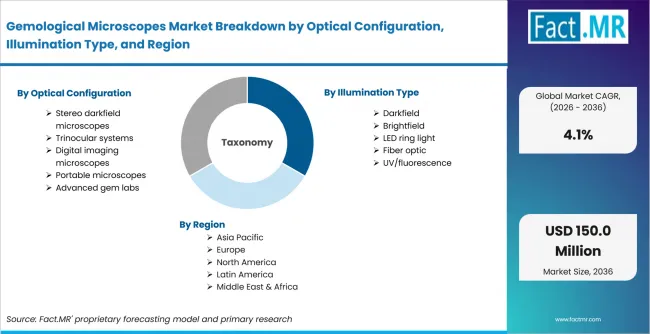
Gemological Microscopes Market Breakdown By Optical Configuration, Illumination Type, And Region | Source: Fact.MR
| ATTRIBUTE | DETAILS |
|---|---|
| Quantitative Units | USD million in 2026 to USD million by 2036 at a CAGR |
| Market Definition | The market covers microscopes configured for gem and jewelry examination. This includes stereo and trinocular systems along with digital, portable and advanced laboratory platforms with gem-holding and illumination features. |
| Optical Configuration | Stereo darkfield microscopes; Trinocular systems; Digital imaging microscopes; Portable microscopes; Advanced gem labs |
| Illumination Type | Darkfield; Brightfield; LED ring light; Fiber optic; UV/fluorescence |
| Magnification Range | 10x-45x; 45x-90x; <10x inspection; >90x lab grade; Zoom digital |
| User Group | Gem labs; Jewelry retailers; Appraisers; Education/training; Collectors |
| Mounting System | Gem clamp stand; Boom stand; Fixed base; Camera mount; Portable stand |
| Regions Covered | North America; Europe; Middle East & Africa; Asia Pacific |
| Countries Covered | United States; Switzerland; Belgium; Thailand; United Arab Emirates (30+ countries analyzed in the full report) |
| Key Companies Profiled | Motic; Leica Microsystems; Meiji Techno; UNITRON; GIA Instruments |
| Forecast Period | 2026 to 2036 |
| Approach | Sizing combines microscope-system shipments with realized prices by optical and imaging configuration. Replacement demand and training purchases are reviewed with laboratory expansion and retail adoption. |
Source: Fact.MR analysis. Updated Jul 17, 2026
How is the market segmented?
-
By Optical Configuration
- Stereo darkfield microscopes
- Trinocular systems
- Digital imaging microscopes
- Portable microscopes
- Advanced gem labs
-
By Illumination Type
- Darkfield
- Brightfield
- LED ring light
- Fiber optic
- UV/fluorescence
-
By Magnification Range
- 10x-45x
- 45x-90x
- <10x inspection
- >90x lab grade
- Zoom digital
-
By User Group
- Gem labs
- Jewelry retailers
- Appraisers
- Education/training
- Collectors
-
By Mounting System
- Gem clamp stand
- Boom stand
- Fixed base
- Camera mount
- Portable stand
-
By Region
- North America
- United States
- Europe
- Switzerland
- Belgium
- Middle East & Africa
- United Arab Emirates
- Asia Pacific
- Thailand
Frequently Asked Questions
Which Optical Configuration leads the Gemological Microscopes Market?
Which Illumination Type leads the Gemological Microscopes Market?
Which Magnification Range leads the Gemological Microscopes Market?
Which User Group leads the Gemological Microscopes Market?
Which Mounting System leads the Gemological Microscopes Market?
Which country records the highest CAGR in the Gemological Microscopes Market?
How does Switzerland perform in the Gemological Microscopes Market?
How does Thailand perform in the Gemological Microscopes Market?
How does Belgium perform in the Gemological Microscopes Market?
How does the United Arab Emirates perform in the Gemological Microscopes Market?
What is the primary driver in the Gemological Microscopes Market?
What is the main restraint in the Gemological Microscopes Market?
Why are Stereo Darkfield Microscopes important?
Why do Gem Labs dominate demand?
Who worked on this report


Preview the report firsthand - request a free sample
Free SampleGet the brochure for pricing and purchase details
Download PDF