- Market Value (2025): USD 113.9 Bn
- Estimated Value (2026): USD 126.4 Bn
- Forecast Value (2036): USD 358.7 Bn
- CAGR (2026-2036): 11.0%
What is the Automotive High Performance Electric Vehicles Market forecast to be worth by 2036?
USD 126.4 billion in 2026 to USD 358.7 billion by 2036 at 11.0% CAGR.
- The automotive high performance electric vehicles market was valued at USD 113.9 billion in 2025.
- Demand is projected to increase from USD 126.4 billion in 2026 to USD 358.7 billion by 2036.
- The market is forecast to record 11.0% CAGR from 2026 to 2036 as premium manufacturers extend electric performance into sedans and sport utility vehicles.
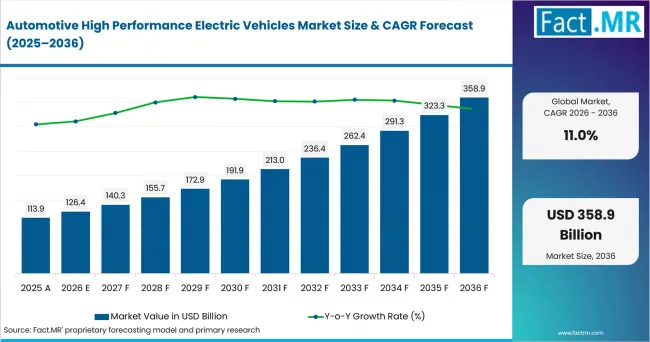
Automotive High Performance Electric Vehicles Market Value Analysis | Source: Fact.MR
What are the defining numbers behind Automotive High Performance Electric Vehicles Market growth?
USD 232.3 billion absolute opportunity by 2036 is led by high performance battery electric vehicles and performance passenger mobility.
- Demand Drivers in the Market
- Premium buyers favor electric cars that combine quick response, usable range and cabin comfort for regular driving.
- Manufacturers benefit from battery packages and battery-management controls that support repeated high-load use.
- Performance brands gain stronger driver appeal when steering feel and brake recovery translate clearly into electric controls.
- Key Segments Analyzed
- By Vehicle Category: High Performance Battery Electric Vehicles are expected to hold 47% share in 2026 supported by sports electric sedans and electric coupes.
- By Vehicle Application: Performance Passenger Mobility is projected to account for 42% share in 2026 owing to daily performance driving and grand touring use.
- By Performance Segment: Luxury Performance Cars are anticipated to capture 45% share in 2026 because sports sedans and grand tourers reach more buyers than limited-production hypercars.
- By End User: Individual Consumers are estimated to represent 74% share in 2026 as premium buyers retain control over specification and ownership choices.
- By Powertrain Technology: Dual Motor All-wheel Drive is forecast to account for 41% share in 2026 through scalable traction and axle-level torque control.
- Analyst Opinion at Fact.MR
- Shambhu Nath Jha, Principal Consultant at Fact.MR, states, "High-performance electric vehicles are becoming systems-engineering programs. Fact.MR opines that durable demand favors manufacturers that control thermal performance and charging behavior across repeated real-world use. A fast launch time attracts attention. Buyer confidence depends on predictable acceleration and service support after the first demonstration."
- Strategic Implications
- Vehicle manufacturers should test batteries, motors and cooling systems over repeated high-load cycles before using peak power as the release point.
- Performance brands can define which driving functions remain standard and which functions sit inside software packages without weakening buyer trust.
- Power-electronics suppliers need vehicle-level validation for silicon carbide power electronics before promising charging or track performance to automakers.
The USA follows at 11.7% as performance-car demand supports domestic electric specialists. Germany reaches 11.3% through premium engineering. South Korea records 10.8% through integrated battery supply chains. Japan posts 10.4%, while the UK reaches 9.9% and Canada 9.5%.
How does the Automotive High Performance Electric Vehicles Market break down by segment?
High Performance Battery Electric Vehicles lead at 47% in 2026. Performance Passenger Mobility leads at 42%.
Which Vehicle Category dominates?
High Performance Battery Electric Vehicles hold 47% share in 2026.
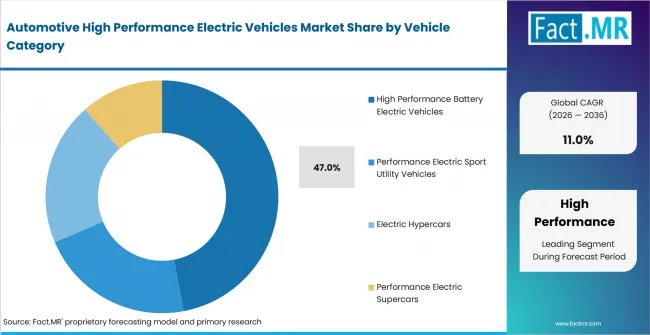
Automotive High Performance Electric Vehicles Market Analysis By Vehicle Category | Source: Fact.MR
High performance battery electric vehicles are expected to lead because sports electric sedans and electric coupes create the clearest bridge between premium daily use and enthusiast driving. These models can share platforms and dealer support while using stronger motors and cooling.
What leads the Vehicle Application segment?
Performance Passenger Mobility holds 42% share in 2026.
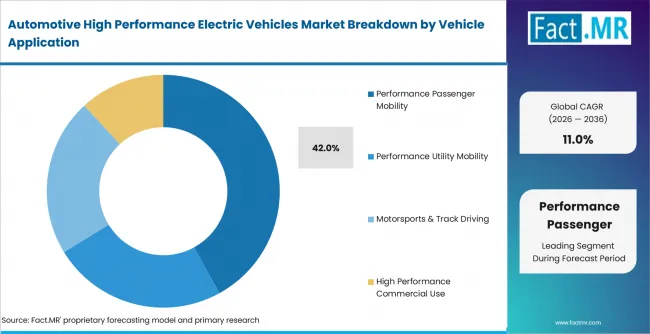
Automotive High Performance Electric Vehicles Market Analysis By Vehicle Application | Source: Fact.MR
Performance passenger mobility is projected to lead because daily driving and grand touring create repeat use beyond occasional track exposure. Buyers compare comfort and charging time with acceleration. Performance Utility Mobility serves customers who want added space.
Why do Luxury Performance Cars lead the Performance Segment?
Luxury Performance Cars hold 45% share in 2026.
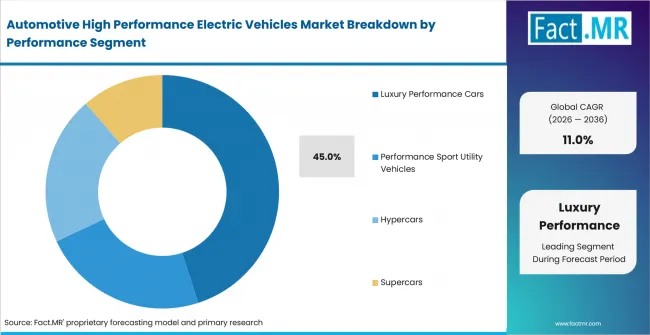
Automotive High Performance Electric Vehicles Market Analysis By Performance Segment | Source: Fact.MR
Luxury performance cars are anticipated to lead because sports sedans and grand tourers combine prestige with everyday usability. The luxury car gives them stronger retail visibility.
Which End User accounts for the largest share?
Individual Consumers hold 74% share in 2026.
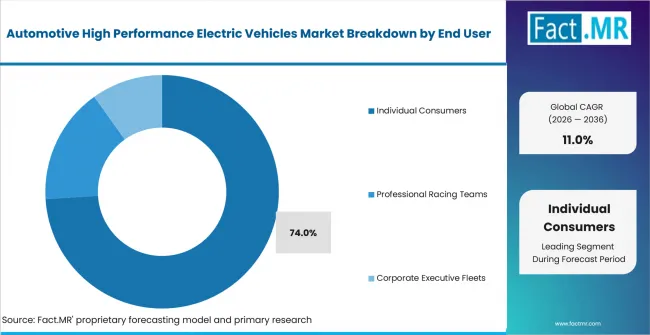
Automotive High Performance Electric Vehicles Market Analysis By End User | Source: Fact.MR
Individual consumers are estimated to lead because premium buyers make the final decision on body style and charging access. Luxury mobility providers and fleet operators use narrower purchase models where utilization carries more weight.
What supports Dual Motor All-wheel Drive within Powertrain Technology?
Dual Motor All-wheel Drive holds 41% share in 2026.
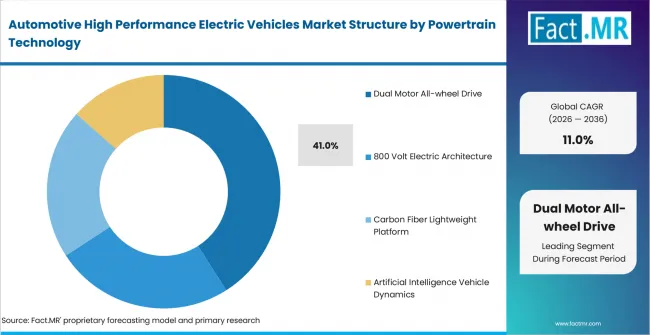
Automotive High Performance Electric Vehicles Market Analysis By Powertrain Technology | Source: Fact.MR
Dual Motor All-wheel Drive is forecast to lead because one motor at each axle gives buyers strong traction. The automotive powertrain case is reinforced by clearer validation.
What is accelerating Automotive High Performance Electric Vehicles Market adoption, and what is holding it back?
Premium electrification, high-voltage charging and software-controlled dynamics support adoption. Thermal limits and ownership cost restrain broader acceptance.
Drivers Impact Analysis
| DRIVER | COMMERCIAL EFFECT | GEOGRAPHIC RELEVANCE | IMPACT TIMELINE |
|---|---|---|---|
| Expansion of premium battery electric model lines | Creates more sedan, coupe, SUV and halo-vehicle purchase points | China, USA and Europe | Current forecast period |
| High-voltage charging and silicon carbide power electronics | Improves charging speed, power density and repeated output | Europe and Asia Pacific | Short to medium term |
| Software-controlled torque distribution and chassis integration | Allows manufacturers to differentiate handling and driver feedback | Global premium vehicle programs | Current forecast period |
| Battery thermal management for sustained performance | Reduces heat-related power loss during track and high-speed use | USA, Germany, South Korea and Japan | Medium term |
| Broader fast-charging coverage for touring use | Raises confidence that a performance EV can replace a premium combustion vehicle | North America, Europe and developed Asian markets | Medium to long term |
Source: Fact.MR analysis. Updated Aug 6, 2026
- Premium electric model expansion: More body styles are expected to give buyers a clearer path from interest to purchase.
- Thermal and charging integration: High-performance use makes charging speed and battery temperature part of the same buying decision.
- Vehicle-dynamics software: Automotive software is expected to help brands tune steering feel and torque delivery for each model line.
Opportunity Impact Analysis
| OPPORTUNITY | COMMERCIAL EFFECT | GEOGRAPHIC RELEVANCE | IMPACT TIMELINE |
|---|---|---|---|
| Performance electric sedans and coupes for daily use | Converts enthusiast demand into higher-volume premium passenger programs | China, USA, Germany and UK | Current forecast period |
| Dual-motor performance SUVs and crossovers | Adds utility, family use and higher-margin variants to electric platforms | North America, China and South Korea | Short to medium term |
| 800-volt charging and advanced thermal packages | Supports long-distance touring and repeated high-load operation | Europe, China, Japan and South Korea | Medium term |
| Integrated vehicle-dynamics software | Creates tunable handling, telemetry and over-the-air improvement routes | Global premium brands | Medium to long term |
Source: Fact.MR analysis. Updated Aug 6, 2026
- Broader performance body styles: Sedans and sport utility vehicles can reuse core electric platforms while adding stronger motors and suspension.
- High-voltage packages: Premium brands can use faster charging and battery cooling to improve touring confidence.
- Software-led differentiation: Integrated control of traction, steering and automotive sensor data is expected to support distinct handling feel.
Restraints Impact Analysis
| RESTRAINT | COMMERCIAL EFFECT | GEOGRAPHIC RELEVANCE | IMPACT TIMELINE |
|---|---|---|---|
| Battery mass and high-load thermal stress | Raises cooling, brake, tire and suspension requirements | All performance EV programs | Current forecast period |
| High component, validation and repair cost | Limits affordability and increases warranty and insurance exposure | Global premium and low-volume markets | Short to medium term |
| Charging speed varies by station and operating condition | Creates a gap between advertised and repeatable touring performance | North America and Europe | Current forecast period |
| Low volumes for hypercars and supercars | Concentrates tooling, homologation and service cost in few vehicles | UK, Germany, Italy and specialist markets | Medium to long term |
Source: Fact.MR analysis. Updated Aug 6, 2026
- Mass and thermal burden: High-capacity batteries improve range and power reserve but add weight that tires and brakes must manage.
- Ownership cost: Specialist tires and high-voltage repairs can slow adoption outside buyers who accept premium cost.
- Infrastructure mismatch: A high peak charging rating does not guarantee the same touring result at every station.
Which countries are scaling Automotive High Performance Electric Vehicles Market fastest?
- The country comparison spans 2.6 percentage points and separates China from Canada across the displayed forecast range.
- China remains 0.4 percentage point above the USA through electric vehicle manufacturing scale and fast premium model renewal.
- The USA stays 0.4 percentage point above Germany because domestic electric specialists and long-distance premium ownership support demand.
- Germany remains 0.5 percentage point above South Korea through premium engineering and performance-brand electrification.
- South Korea stays 0.4 percentage point above Japan as battery and power-electronics supply chains support export-focused performance models.
- Japan remains 0.5 percentage point above the UK through power-electronics expertise and disciplined validation.
- The UK remains 0.4 percentage point above Canada as specialist performance engineering supports premium electric model demand.
Comparable CAGRs can create different entry conditions because charging access and service coverage vary by country. Full report coverage includes five regions.
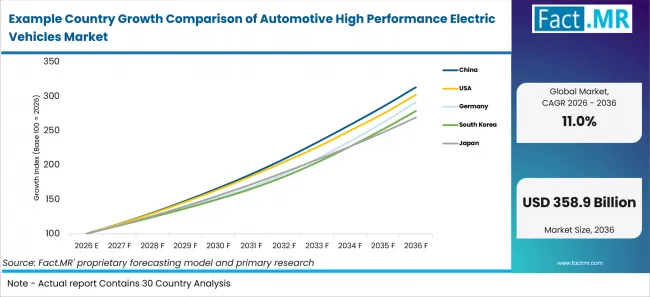
Example Country Growth Comparison Of Automotive High Performance Electric Vehicles Market | Source: Fact.MR
| COUNTRY | CAGR |
|---|---|
| USA | 11.7% |
| Germany | 11.3% |
| South Korea | 10.8% |
| Japan | 10.4% |
| UK | 9.9% |
| Canada | 9.5% |
Source: Fact.MR analysis. Updated Aug 6, 2026
How is the USA scaling Automotive High Performance Electric Vehicles demand?
11.7% CAGR, supported by established performance-car demand and domestic electric specialists.
American buyers have a deep culture of performance cars and long-distance road use. Touring range, service access and fast charging become part of the purchase decision.
What supports Germany's outlook?
11.3% CAGR, owing to premium engineering and performance-brand electrification.
German demand is shaped by premium engineering discipline and strong export-focused brands. Performance programs need stable braking, thermal control and high-speed durability.
How is South Korea developing the market?
10.8% CAGR, shaped by integrated vehicle and battery supply chains.
South Korea benefits from close coordination between vehicle assembly and battery suppliers. Export programs are expected to favor repeatable charging and thermal behavior across climates.
What underpins Japan's growth?
10.4% CAGR, attributable to power-electronics expertise and disciplined vehicle validation.
Japan brings careful validation habits and strength in motors, inverters and precision vehicle systems. Domestic adoption is expected to move steadily as charging convenience improves.
How is the UK market progressing?
9.9% CAGR, supported by rising battery electric registrations and premium-car demand.
The UK market is supported by premium buyers and a strong motorsport engineering base. Insurance cost and specialist repair capacity remain important checks before purchase.
What shapes the Canada outlook?
9.5% CAGR, driven by premium vehicle demand and cold-weather performance needs.
Canada is expected to develop through premium corridors where long trips and winter conditions shape expectations. Buyers place extra weight on battery preconditioning and all-wheel drive.
Who leads the Automotive High Performance Electric Vehicles Market?
Tesla and BMW anchor the field through high-output electric sedans and broader premium platforms. Porsche and Mercedes-Benz add performance engineering, chassis tuning and luxury positioning.
Lucid strengthens long-range acceleration, while Hyundai expands accessible performance EVs. Rimac, Ferrari, Lotus, Polestar and NIO widen competition through hypercars, lightweight design, software-led dynamics, premium mobility and distinct performance-focused electric vehicle portfolios worldwide for buyers.
Which companies are the key providers?
Key companies include Tesla, Inc.; Bayerische Motoren Werke AG; Porsche AG; Mercedes-Benz Group AG; Lucid Group, Inc.; Hyundai Motor Company; Rimac Group; Ferrari N.V.; Lotus Cars Limited; Polestar Automotive Holding UK PLC; NIO Inc.
- Tesla, Inc.
- Bayerische Motoren Werke AG
- Porsche AG
- Mercedes-Benz Group AG
- Lucid Group, Inc.
- Hyundai Motor Company
- Rimac Group
- Ferrari N.V.
- Lotus Cars Limited
- Polestar Automotive Holding UK PLC
- NIO Inc.
Bibliography
- U.S. Department of Energy. (2025, January 13). Vehicle grid integration assessment report.
- International Energy Agency. (2025, May 14). Global EV outlook 2025: Expanding sales in diverse markets.
- Department for Transport. (2025, July 11). Electric vehicle charging infrastructure on the strategic road network. GOV.UK.
This Report Answers
- The report provides strategic intelligence on Vehicle Category and Vehicle Application choices that shape premium electric programs.
- Segment analysis covers High Performance Battery Electric Vehicles and Performance Passenger Mobility as the share leaders within the 2026 market.
- Country outlook evaluates China and the USA alongside Germany and South Korea. Japan, the UK and Canada complete the growth comparison.
- Competitive analysis profiles Tesla, Inc. and Bayerische Motoren Werke AG alongside Porsche AG and Mercedes-Benz Group AG. Seven additional companies complete the provider set.
- Powertrain assessment covers Dual Motor All-wheel Drive and 800 Volt Electric Architecture. Carbon Fiber Lightweight Platform and Artificial Intelligence Vehicle Dynamics complete the technology view.
What does the Automotive High Performance Electric Vehicles Market cover?
High-performance battery electric sedans and coupes are included when they are sold for elevated road use. Sport utility vehicles and electric supercars are covered when performance defines the sale.
The Automotive High Performance Electric Vehicles Market covers finished battery electric passenger vehicles whose commercial position depends on stronger propulsion and driver engagement. Coverage extends to performance sedans and coupes. Sport utility vehicles and electric supercars are included when the vehicle is marketed around a clear performance purpose.
What is included in the scope?
Commercial high-performance battery electric vehicles and the vehicle-level technology value required to deliver their performance proposition are included.
The scope includes Vehicle Category and Vehicle Application alongside Performance Segment, End User and Powertrain Technology. Vehicle-level content is counted through the finished vehicle value.
What is excluded from the scope?
Mainstream electric vehicles without performance positioning remain outside the core boundary. Hybrid performance cars and standalone component revenue are excluded.
The scope excludes battery electric passenger vehicles built mainly for commuting or low-cost urban mobility. Hybrid performance vehicles and standalone charging-network revenue remain outside the boundary.
How Was the Analysis Built?
The analysis draws on 120+ sources, 35+ company portfolios, 25+ countries, and more than 20 industry interviews.
- Primary Research: Primary research includes discussions with manufacturers, service providers, technology developers, distributors, end users, procurement teams, and subject-matter experts. These conversations examine purchasing priorities, product adoption, operational challenges, approval requirements, competitive positioning, and the factors that influence wider market acceptance.
- Desk Research: Desk research covers government statistics, regulatory publications, company filings, trade data, technical studies, industry associations, standards, public policy, and other authoritative sources. Every source used in the analysis is documented in the bibliography.
- Market Sizing and Forecasting: Market estimates combine historical performance, demand indicators, pricing and volume trends, segment shares, company participation, country-level growth, adoption patterns, investment activity, and barriers to market expansion.
- Data Validation and Update Cycle: Findings are validated by comparing primary interviews with public data, company activity, regulatory changes, trade patterns, and industry developments. Regular updates review new product launches, capacity changes, partnerships, approvals, procurement trends, and shifts in commercial adoption.
Segmentation
What is the report’s scope and coverage?
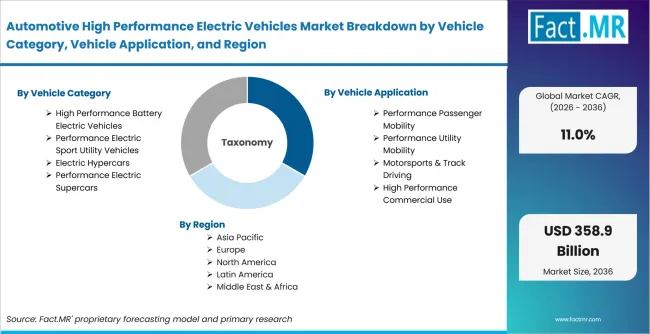
Automotive High Performance Electric Vehicles Market Breakdown By Vehicle Category, Vehicle Application, And Region | Source: Fact.MR
| Attribute | Details |
|---|---|
| Quantitative Units | USD billion |
| Market Definition | Revenue from commercially offered high-performance battery electric passenger vehicles, performance electric sport utility vehicles, electric hypercars and electric supercars whose market positioning depends on elevated propulsion, chassis, charging and driver engagement |
| Vehicle Category | High Performance Battery Electric Vehicles; Performance Electric Sport Utility Vehicles; Electric Hypercars; Performance Electric Supercars |
| Vehicle Application | Performance Passenger Mobility; Performance Utility Mobility; Motorsports & Track Driving; High Performance Commercial Use |
| Performance Segment | Luxury Performance Cars; Performance Sport Utility Vehicles; Hypercars; Supercars |
| End User | Individual Consumers; Luxury Mobility Providers; Professional Racing Teams; Corporate Executive Fleets |
| Powertrain Technology | Dual Motor All-wheel Drive; 800 Volt Electric Architecture; Carbon Fiber Lightweight Platform; Artificial Intelligence Vehicle Dynamics |
| Regions Covered | North America; Europe; Asia Pacific; Central & South America; Middle East & Africa |
| Countries Covered | China; USA; Germany; South Korea; Japan; UK; Canada |
| Key Companies Profiled | Tesla, Inc.; Bayerische Motoren Werke AG; Porsche AG; Mercedes-Benz Group AG; Lucid Group, Inc.; Hyundai Motor Company; Rimac Group; Ferrari N.V.; Lotus Cars Limited; Polestar Automotive Holding UK PLC; NIO Inc. |
| Forecast Period | 2026 to 2036 |
| Approach | Hybrid top-down and bottom-up approach using high-performance battery electric vehicle sales, vehicle pricing, model availability, platform and derivative mix, performance segment attachment, buyer category, charging and powertrain technology adoption, country growth rates and company portfolio validation |
Source: Fact.MR analysis. Updated Aug 6, 2026
How is the market segmented?
-
By Vehicle Category:
- High Performance Battery Electric Vehicles
- Sports Electric Sedans
- High Performance Electric Coupes
- Performance Electric Sport Utility Vehicles
- Dual Motor Performance SUVs
- Three Motor Hyper SUVs
- Electric Hypercars
- Dual Motor Hypercars
- Quad Motor Hypercars
- Performance Electric Supercars
- Two-seat Supercars
- Limited Edition Supercars
- High Performance Battery Electric Vehicles
-
By Vehicle Application:
- Performance Passenger Mobility
- Daily Performance Driving
- Grand Touring
- Performance Utility Mobility
- High-speed Touring
- Long-distance Performance Travel
- Motorsports & Track Driving
- Track Performance
- Endurance Racing
- High Performance Commercial Use
- Premium Mobility Services
- Exclusive Driving Experiences
- Performance Passenger Mobility
-
By Performance Segment:
- Luxury Performance Cars
- Sports Sedans
- Grand Tourers
- Performance Sport Utility Vehicles
- Performance Crossovers
- Electric Adventure Vehicles
- Hypercars
- Limited Production Hypercars
- Electric Race Cars
- Supercars
- Low-volume Performance Cars
- Bespoke Electric Vehicles
- Luxury Performance Cars
-
By End User:
- Individual Consumers
- Premium Vehicle Buyers
- Automotive Fleet Operators
- Luxury Mobility Providers
- Motorsport Teams
- Performance Driving Schools
- Professional Racing Teams
- High-performance Vehicle Collectors
- Specialty Vehicle Manufacturers
- Corporate Executive Fleets
- Luxury Rental Companies
- Exclusive Automotive Clubs
- Individual Consumers
-
By Powertrain Technology:
- Dual Motor All-wheel Drive
- Torque Vectoring Powertrain
- Silicon Carbide Power Electronics
- 800 Volt Electric Architecture
- High Energy Density Battery Systems
- Advanced Battery Thermal Management
- Carbon Fiber Lightweight Platform
- Lightweight Composite Chassis
- Active Torque Distribution
- Artificial Intelligence Vehicle Dynamics
- Predictive Traction Control
- Integrated Performance Software
- Dual Motor All-wheel Drive
-
By Region:
- North America
- Latin America
- Europe
- East Asia
- South Asia and Oceania
- Middle East and Africa
Frequently Asked Questions
How big is the automotive high performance electric vehicles market in 2026?
What is the CAGR of the automotive high performance electric vehicles market from 2026 to 2036?
Which vehicle category leads the automotive high performance electric vehicles market?
Which end-user segment leads the automotive high performance electric vehicles market?
Who are the leading companies in the automotive high performance electric vehicles market?
Who worked on this report


Preview the report firsthand - request a free sample
Free SampleGet the brochure for pricing and purchase details
Download PDF