- Market Value (2025): USD 207.7 Mn
- Estimated Value (2026): USD 223.0 Mn
- Forecast Value (2036): USD 454.0 Mn
- CAGR (2026-2036): 7.4%
What is the Giant Knotweed Rhizome Extract Market forecast to be worth by 2036?
USD 223.0 million in 2026 to USD 454.0 million by 2036, at a 7.4% CAGR.
- As per Fact.MR analysis, the giant knotweed rhizome market reached USD 207.7 million in 2025.
- Sales are projected to increase from USD 223.0 million in 2026 to USD 454.0 million in 2036.
- The market is forecast for record a 7.4% CAGR from 2026 to 2036.
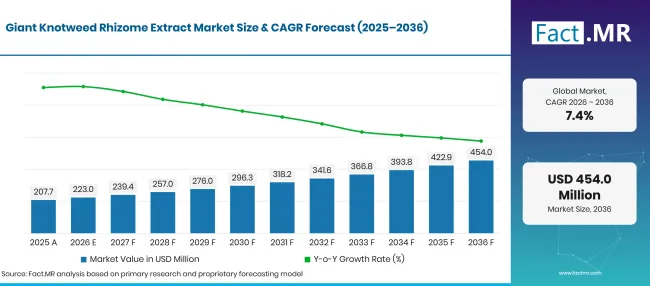
Factmr Giant Knotweed Rhizome Extract Market Forecast Global | Source: Fact.MR
| Year | Basis | Market Value (USD million) |
|---|---|---|
| 2025 | Historical estimate | 207.7 |
| 2026 | Estimate | 223.0 |
| 2036 | Forecast | 454.0 |
| CAGR 2026 to 2036 | Forecast period | 7.4% |
Source: Fact.MR analysis. Updated Oct 17, 2026
What are the defining numbers behind Giant Knotweed Rhizome Extract Market growth?
USD 231.0 million absolute opportunity between 2026 and 2036, with powder extracts and dietary supplements forming the main buying base.
- Demand Drivers in the Market
- Supplement manufacturers check the levels of key compounds before approving a giant knotweed extract. Clear test documents help ensure the same amount can be used in each capsule from one batch to the next.
- Ingredient suppliers need reliable records showing the plant identity and the part of the plant used. Products made from the rhizome should be clearly separated from ingredients marketed under broader knotweed or resveratrol labels.
- Cosmetic companies review color, appearance, and performance before adding the extract to creams or serums. Testing across different products helps determine whether the same extract can be used consistently.
- Online supplement brands pay close attention to accurate ingredient information. The UK government’s 2026 food supplement guidance advises caution when purchasing supplements through online marketplaces [1].
- Key Segments Analyzed
- By Product Type: Powder accounts for 42.4% share in 2026 because dry extracts are straightforward to weigh and blend.
- By Application: Dietary Supplements represent a 42.3% share in 2026 as capsule and tablet formulators buy botanical ingredients.
- By Distribution Channel: Online Stores capture a 34.8% share in 2026 as finished supplement brands sell directly to customers.
- Analyst Opinion at Fact.MR
- Shambhu Nath Jha, Principal Consultant at Fact.MR, states, “Consistency is a major factor when purchasing giant knotweed rhizome extract. Repeat buyers tend to rely on documented test results rather than broad statements about plant origin. Suppliers that clearly describe their production process and quality controls are often viewed more favorably for regulated applications.”
- Strategic Implications
- Extract manufacturers should clearly identify whether the material comes from the rhizome, leaf, or stem. Clear product information makes it easier for formulators to compare products on an equal basis.
- Supplement manufacturers should agree on quality requirements and testing needs before selecting an ingredient. Having clear standards helps teams manage differences between shipments.
- Personal care companies should review color and mixing properties before using giant knotweed extract in creams or serums. Testing in the final product can help identify any changes in appearance.
- Sellers should keep supplier documents connected to each production batch. Records on ingredient source and product details become especially important when online listings include broad health-related claims.
Japan is projected to record 8.6% CAGR through 2036, while the United Kingdom reaches 7.7%. The United States follows at 7.3%, Germany records 6.8%, and Brazil is forecast at 6.3%. These country forecasts reflect distinct review needs and ingredient-buying practices rather than a single worldwide purchasing model.
How does the Giant Knotweed Rhizome Extract Market break down by segment?
Powder 42.4%; Dietary Supplements 42.3%; Online Stores 34.8% share in 2026.
Which Product Type holds the main share?
Powder holds 42.4% share in 2026.
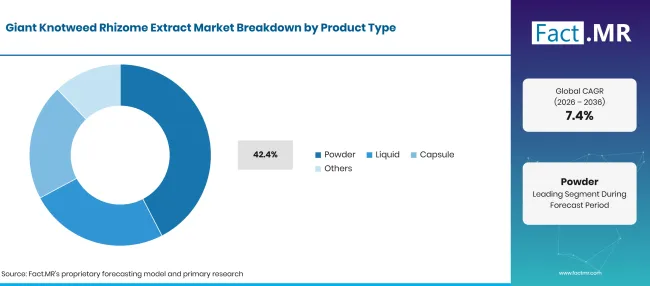
Factmr Giant Knotweed Rhizome Extract Market Breakdown Product Type | Source: Fact.MR
| Product Type | Share (2026) |
|---|---|
| Powder (Leading segment) | 42.4% |
| Other segments combined | 57.6% |
| Total | 100.0% |
Source: Fact.MR analysis. Updated Oct 17, 2026
Powder extract is easier for contract manufacturers to weigh into capsule blends. Liquid products serve developers working with fluid products. Capsules provide a finished-use format when the ingredient has suitable regulatory status. Botanically similar products require species-level checks before a formulator treats one extract as a substitute for another.
What leads the Application segment?
Dietary Supplements account for 42.3% share in 2026.
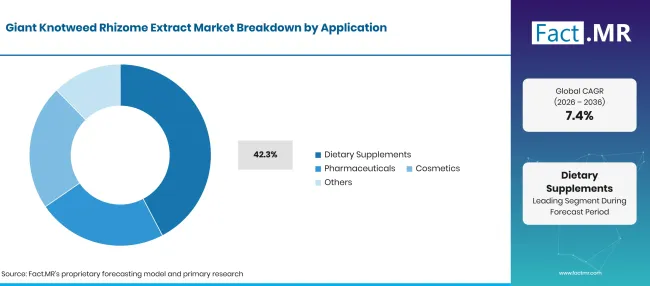
Factmr Giant Knotweed Rhizome Extract Market Breakdown Application | Source: Fact.MR
| Application | Share (2026) |
|---|---|
| Dietary Supplements (Leading segment) | 42.3% |
| Other segments combined | 57.7% |
| Total | 100.0% |
Source: Fact.MR analysis. Updated Oct 17, 2026
Dietary supplement manufacturers assess giant knotweed rhizome extract for formulas requiring documented botanical identity. Pharmaceutical developers need separate evidence for each intended medical use. Cosmetics teams test plant-derived samples for color and formulation stability before commercial selection.
Which Distribution Channel captures the main share?
Online Stores represent a 34.8% share in 2026.
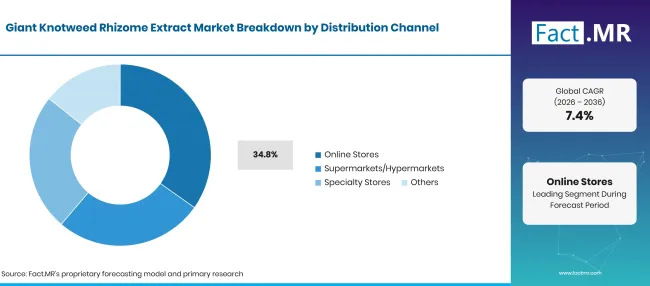
Factmr Giant Knotweed Rhizome Extract Market Breakdown Distribution Channel | Source: Fact.MR
| Distribution Channel | Share (2026) |
|---|---|
| Online Stores (Leading segment) | 34.8% |
| Other segments combined | 65.2% |
| Total | 100.0% |
Source: Fact.MR analysis. Updated Oct 17, 2026
Online sales allow supplement brands to explain ingredient identity and serving instructions at the point of purchase. Specialist stores serve customers who want help understanding botanical product descriptions. Supermarkets and hypermarkets carry buyer supplements when their product range and labeling meet the retailer’s needs.
What is accelerating Giant Knotweed Rhizome Extract Market adoption, and what is holding it back?
Ingredient traceability supports purchasing; approval requirements and variable extract quality can slow sales.
Drivers Impact Analysis
| DRIVER | (~) % IMPACT ON CAGR | GEOGRAPHIC RELEVANCE | IMPACT TIMELINE |
|---|---|---|---|
| Verified phytochemical profiles | +1.0% | Global | Medium term (2–4 years) |
| Repeat formulation purchases | +0.8% | USA, Japan | Medium term (2–4 years) |
| Online finished-product reach | +0.7% | USA, UK | Short term (<= 2 years) |
| Cosmetic formulation trials | +0.5% | Germany, Japan | Medium term (2–4 years) |
| Supplier testing records | +0.4% | Global | Long term (>= 4 years) |
Source: Fact.MR analysis. Updated Oct 17, 2026
Opportunity Impact Analysis
| OPPORTUNITY | (~) % IMPACT ON CAGR | GEOGRAPHIC RELEVANCE | IMPACT TIMELINE |
|---|---|---|---|
| Standardized powder specifications | +0.8% | Global | Medium term (2–4 years) |
| Traceable rhizome sourcing | +0.6% | UK, Germany | Short term (<= 2 years) |
| Finished-product ingredient clarity | +0.5% | USA, Brazil | Medium term (2–4 years) |
| Formulation support for skin care | +0.4% | Japan, Germany | Long term (>= 4 years) |
Source: Fact.MR analysis. Updated Oct 17, 2026
Restraints Impact Analysis
| RESTRAINT | (~) % IMPACT ON CAGR | GEOGRAPHIC RELEVANCE | IMPACT TIMELINE |
|---|---|---|---|
| Variable constituent levels | -0.8% | Global | Short term (<= 2 years) |
| Limits on product claims | -0.6% | EU, Brazil | Medium term (2–4 years) |
| Botanical safety review | -0.5% | Global | Medium term (2–4 years) |
| Invasive-plant handling controls | -0.4% | UK | Long term (>= 4 years) |
Source: Fact.MR analysis. Updated Oct 17, 2026
Which countries are scaling Giant Knotweed Rhizome Extract Market through 2036?
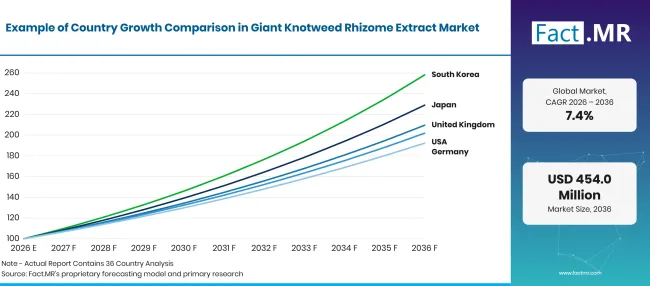
Factmr Giant Knotweed Rhizome Extract Market Growth Index | Source: Fact.MR
| Country | CAGR (2026–2036) |
|---|---|
| Japan | 8.6% |
| United Kingdom | 7.7% |
| United States | 7.3% |
| Germany | 6.8% |
| Brazil | 6.3% |
Source: Fact.MR analysis. Updated Oct 17, 2026
What shapes the Japan extract outlook?
8.6% CAGR, driven by ingredient identity, quality review, and clear supplement information.
Japanese supplement companies pay close attention to plant identification, testing results, and consistent quality from one batch to the next when selecting giant knotweed rhizome extract. The Consumer Affairs Agency reported 24,715 subscription-related consultations concerning other health foods in 2024 [4]. Suppliers can strengthen their position by providing clear product information, reliable quality records, and extracts that perform consistently in supplement and personal care products.
How is the United Kingdom handling extract sales?
7.7% CAGR, shaped by online product descriptions, ingredient review, and controlled botanical sourcing.
UK supplement businesses look for clear information on the plant species, rhizome source, and key compound levels before listing botanical extracts online. The Food Standards Agency reported in June 2026 that its 2025/26 incident response covered growing complexity associated with online marketplaces [5]. As a result, retailers and importers place greater value on accurate ingredient details, safety checks, and reliable sourcing practices.
What supports United States purchasing?
7.3% CAGR, supported by extract quality standards, supplement formulation, and species-level testing.
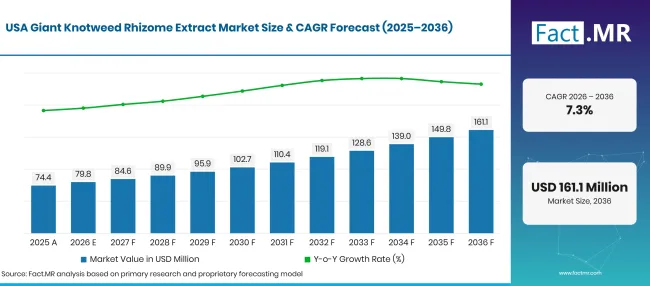
Factmr Giant Knotweed Rhizome Extract Market Forecast Usa | Source: Fact.MR
U.S. contract manufacturers usually ask for ingredient specifications before they approve giant knotweed rhizome extract for use in supplements. The FDA updated its information on new dietary supplement ingredients in March 2026 [3]. Manufacturers also check marker levels and confirm the plant’s identity so each batch stays consistent. Online sellers explain the extract and its resveratrol content in clear ingredient descriptions.
Why does Germany favor documented ingredients?
6.8% CAGR, influenced by traceable botanical materials, online supplement purchasing, and formulation checks.
German supplement brands check the plant’s identity, ingredients, and intended use before adding giant knotweed rhizome extract to their products. Destatis reported that 21% of Germans aged 16 to 74 bought medicines or dietary supplements online in 2024 [6]. Clear ingredient names, traceable batches, and stability details help suppliers meet the needs of both supplement and cosmetic buyers.
How are Brazilian supplement rules affecting sales?
6.3% CAGR, shaped by supplement safety review, ingredient records, and traceable botanical supply.
Brazilian supplement companies review ingredient approval, supplier records, and product ingredients before using giant knotweed rhizome extract in their formulas. Anvisa ordered the recall of 12 supplements in November 2025 after finding production compliance issues [2]. Because of these checks, manufacturers need accurate plant identification, batch records, and clear product descriptions for both local and imported ingredients.
Who leads the Giant Knotweed Rhizome Extract Market?
Specialized botanical extract suppliers compete on ingredient specifications and customer support.
Sabinsa Corporation work in the wider botanical-ingredient field. Their processing capabilities provide a comparison point for manufacturers assessing records and repeat supply. Giant knotweed customers need exact species identification and plant-part records for each batch.
Xi’an Sost Biotech, Hunan Nutramax and Changsha Huir Biological-Tech participate in botanical-extract supply. For giant knotweed rhizome extract, comparisons turn on clear product specifications and repeatable composition. Ingredient teams compare extraction methods and batch test results when plant names appear similar.
Which companies are the key providers?
Key companies include Sabinsa Corporation; Xi’an Sost Biotech; Hunan Nutramax; and Changsha Huir Biological-Tech.
- Sabinsa Corporation
- Xi’an Sost Biotech
- Hunan Nutramax
- Changsha Huir Biological-Tech
Bibliography
- [1] Food Standards Agency. (2026, June 25). Food supplements guidance. GOV.UK.
- [2] Agência Nacional de Vigilância Sanitária. (2025, November 19). Proibidos suplementos alimentares das marcas Lirius e Natufab.
- [3] U.S. Food and Drug Administration. (n.d.). What’s new in dietary supplements.
- [4] Consumer Affairs Agency, Government of Japan. (2025). White Paper on Consumer Affairs 2025: Summary.
- [5] Food Standards Agency. (2026, June 25). Incidents & Resilience Annual Report 2025/26. GOV.UK.
- [6] Statistisches Bundesamt (Destatis). (2025, March 11). 21 % der 16- bis 74-Jährigen kaufen Arzneimittel oder Nahrungsergänzungsmittel online.
This Report Answers
- The report compares powder, liquid, capsule, and other giant knotweed rhizome extract formats used across supplement and formulation applications.
- Application analysis explains why dietary supplements account for the larger specified share, while pharmaceuticals and cosmetics require separate ingredient and formulation checks.
- Country analysis examines how botanical identity, supplement rules, online product information, and traceable sourcing influence purchasing across Japan, the United Kingdom, the United States, Germany, and Brazil.
- Competitive analysis compares botanical extract suppliers on species identification, rhizome sourcing, batch consistency, testing records, and formulation support.
- Distribution analysis shows how online stores, specialty retailers, supermarkets, and other channels differ in the way buyers review ingredient descriptions and product specifications.
What does the Giant Knotweed Rhizome Extract Market cover?
The market covers products identified as giant knotweed, Reynoutria sachalinensis, rhizome extract. Species identity requires careful attention because Japanese knotweed, Reynoutria japonica, is chemically different.
Related ingredient categories include botanical extracts and other standardized plant materials assessed by formulation teams.
What is included in the scope?
The scope covers powders and liquids produced from giant knotweed rhizomes when their identity and intended use can be stated. Capsules are included where they contain the stated extract. Dietary supplements form the central use, subject to suitable ingredient approval. Cosmetics enter when the ingredient is suitable for a finished formula. Distribution analysis distinguishes consumer online stores from retail outlets and specialist channels.
The distinct ingredient category of trans-resveratrol ingredients helps illustrate why buyers must tell apart plant extracts from materials made by other production routes.
What is excluded from the scope?
The scope excludes unprocessed invasive-plant waste and loose rhizome material sold without conversion into an extract. It also excludes unrelated knotweed species or above-ground plant material when the product cannot be identified as the stated rhizome extract. Resveratrol derived from Japanese knotweed and synthetic or fermented resveratrol belong to distinct product categories. Pharmaceutical efficacy is not inferred from laboratory studies alone.
How Was the Analysis Built?
The analysis draws on 120+ sources, 35+ company portfolios, 25+ countries, and more than 20 industry interviews.
- Primary Research: Primary research includes discussions with manufacturers, service providers, technology developers, distributors, end users, and subject-matter experts. These conversations examine purchasing priorities, product adoption, operational challenges, approval requirements, competitive positioning, and the factors that influence wider market acceptance.
- Desk Research: Desk research covers government statistics, regulatory publications, company filings, trade data, technical studies, industry associations, standards, public policy, and other authoritative sources. Every source used in the analysis is documented in the bibliography.
- Market Sizing and Forecasting: Market estimates combine historical performance, demand indicators, pricing and volume trends, segment shares, company participation, country-level growth, adoption patterns, investment activity, and barriers to market expansion.
- Data Validation and Update Cycle: Findings are validated by comparing primary interviews with public data, company activity, regulatory changes, trade patterns, and industry developments. Regular updates review new product launches, capacity changes, partnerships, approvals, and shifts in commercial adoption.
Segmentation
What is the report’s scope and coverage?
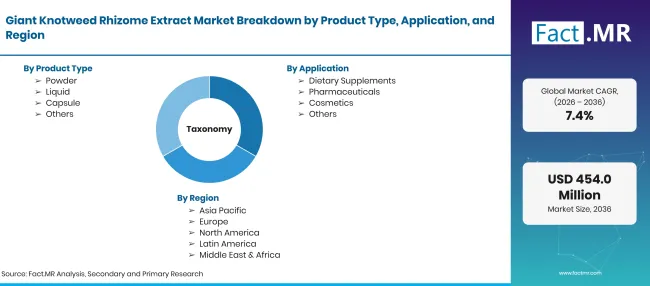
Factmr Giant Knotweed Rhizome Extract Market Taxonomy 1 | Source: Fact.MR
| Attribute | Details |
|---|---|
| Quantitative Units | USD million in 2026 to USD million by 2036 at CAGR |
| Market Definition | Extract sold from identified knotweed rhizome material for assessed formulation uses |
| Product Type | Powder; Liquid; Capsule; Others |
| Application | Dietary Supplements; Pharmaceuticals; Cosmetics; Others |
| Distribution Channel | Online Stores; Supermarkets/Hypermarkets; Specialty Stores; Others |
| Countries Covered | Japan; United Kingdom; United States; Germany; Brazil |
| Companies Profiled | Sabinsa; Xi’an Sost; Hunan Nutramax; Changsha Huir |
| Forecast Period | 2026 to 2036 |
| Approach | Country outlook, ingredient use, market forecast and publicly documented regulation |
Source: Fact.MR analysis. Updated Oct 17, 2026
How is the market segmented?
-
By Product Type
- Powder
- Liquid
- Capsule
- Others
-
By Application
- Dietary Supplements
- Pharmaceuticals
- Cosmetics
- Others
-
By Distribution Channel
- Online Stores
- Supermarkets/Hypermarkets
- Specialty Stores
- Others
-
By Region
- North America
- Latin America
- Western Europe
- Eastern Europe
- East Asia
- South Asia & Pacific
- Middle East & Africa
Frequently Asked Questions
How big is the market in 2026?
What is the expected growth rate?
Which product type leads?
Which application leads?
Who are the main companies in the giant knotweed rhizome market?
Who worked on this report


Preview the report firsthand - request a free sample
Free SampleGet the brochure for pricing and purchase details
Download PDF