- Market Value (2025): USD 1.1 Bn
- Estimated Value (2026): USD 1.17 Bn
- Forecast Value (2036): USD 2.24 Bn
- CAGR (2026-2036): 6.7%
What is the Sterols Market forecast to be worth by 2036?
USD 1.2 billion in 2026 to USD 2.2 billion by 2036 at a 6.7% CAGR.
- Fact.MR estimates that the sterols market reached USD 1.1 billion in 2025, built mainly on spreads, dairy drinks and supplements.
- Sales are set to climb from USD 1.17 billion in 2026 to USD 2.24 billion by 2036 as supplement and drug synthesis uses widen.
- Growth will compound at 6.7% CAGR from 2026 to 2036, since dispersible grades open new beverage and dairy formats.
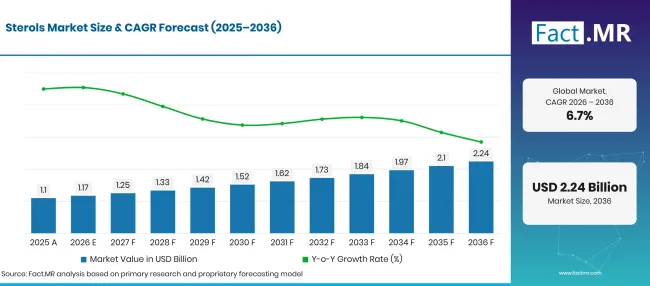
Factmr Sterols Market Forecast Global | Source: Fact.MR
| Year | Basis | Market Value (USD billion) |
|---|---|---|
| 2025 | Actual | 1.1 |
| 2026 | Estimate | 1.17 |
| 2036 | Forecast | 2.24 |
| CAGR 2026 to 2036 | Forecast period | 6.7% |
Source: Fact.MR analysis. Updated Oct 16, 2026
What are the defining numbers behind Sterols Market growth?
New value of USD 1.0 billion will accrue between 2026 and 2036, mostly from food and supplement uses.
- Demand Drivers in the Market
- Cardiovascular risk keeps cholesterol control on the consumer agenda. The World Health Organization reported that an estimated 19.8 million people died from cardiovascular diseases in 2022, about 32% of all global deaths [1]. Food brands use plant sterols to offer a diet-based option for lowering LDL cholesterol.
- European rules give plant sterols a clear legal route into foods. In July 2025, the European Commission adopted Implementing Regulation (EU) 2025/1509, which amended the novel food specifications for phytosterols and phytostanols [2]. Wider specifications let suppliers qualify sterols from more oilseed sources, such as sunflower.
- Supplement makers are moving sterols into tablets, softgels and chews. Shoppers who avoid daily spreads or dairy drinks can still reach an effective intake through a capsule.
- Pharmaceutical synthesis creates a second sales stream. Drug makers convert stigmasterol and sitosterol into steroid intermediates, while cholesterol from wool grease feeds vitamin D3 production.
- Personal care brands use sterols to support the skin barrier. Formulators add them to creams and lotions for dry or aging skin, often in place of synthetic emollients.
- Key Segments Analyzed
- By Product Type: Plant Sterols will command 62.5% share in 2026, as oil refiners and pulp mills turn out sterol-rich side streams in steady volume.
- By Application: Food and Beverages will take 48.3% share in 2026 on the strength of cholesterol-lowering spreads, yogurt drinks and fortified dairy.
- By Form: Powder will capture 43.2% share in 2026, given that it doses easily into dry blends, tablets and beverage premixes.
- By End-User: Food Industry will hold 46.5% share in 2026 through annual bulk contracts placed by spread, dairy and bakery manufacturers.
- Analyst Opinion at Fact.MR
- Shambhu Nath Jha, Principal Consultant at Fact.MR, states, “Cholesterol control is a daily routine for millions of consumers, and that habit keeps plant sterols in front. Because supply tracks vegetable oil refining, producers with access to deodorizer distillate and tall oil will hold a cost edge. New growth will come from supplements and food formats that do not depend on spreads.”
- Strategic Implications
- Sterol producers should secure long-term distillate supply from oilseed crushers, given that feedstock volume sets output more than plant capacity does.
- Food manufacturers should design products that deliver an effective daily sterol intake in one or two servings, since consumers rarely eat several fortified items each day.
- Supplement brands should invest in water-dispersible and micronized grades that fit chewables and drink mixes.
- Pharmaceutical buyers should qualify more than one source of stigmasterol and cholesterol to reduce exposure to crop and wool supply swings.
At 7.8% CAGR, Germany will stay ahead, where spread and dairy makers buy sterols at scale for a heart-aware public. Brazil comes next at 7.1% as hypertension and obesity push shoppers toward heart-health foods. Growth in the United States will reach 6.5% with strong supplement retail and heart disease as the top cause of death. For the United Kingdom, a 5.8% pace rests on widespread raised cholesterol among adults. Japan closes the group at 5.1%, with Foods with Function Claims feeding steady product launches.
How does the Sterols Market break down by segment?
Plant Sterols will lead Product Type at 62.5%; Food and Beverages will top Application at 48.3%; Powder will head Form at 43.2%; Food Industry will hold first place in End-User at 46.5%.
Which Product Type dominates?
Plant Sterols represent 62.5% of 2026 sales.
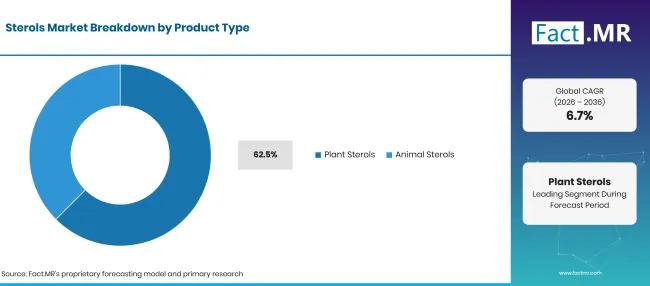
Factmr Sterols Market Breakdown Product Type | Source: Fact.MR
| Product Type | Share (2026) |
|---|---|
| Plant Sterols (Leading segment) | 62.5% |
| Other segments combined | 37.5%* |
| Total | 100.0% |
Source: Fact.MR analysis. Updated Oct 16, 2026
Edible oil refiners recover plant sterols as a co-product, which keeps unit costs low and output steady. Deodorizer distillate from soybean, rapeseed and sunflower oil supplies most volume. Pine-based sterols come from crude tall oil produced by kraft pulp mills. Supply grows with vegetable oil output. The U.S. Department of Agriculture forecast global vegetable oil production at 243.16 million metric tons for 2026/27 in its October 2026 outlook [3]. Animal sterols serve narrower uses, with cholesterol extracted from lanolin and wool grease for vitamin D3 and pharmaceutical synthesis.
What leads the Application segment?
Food and Beverages take 48.3% of 2026 sales.
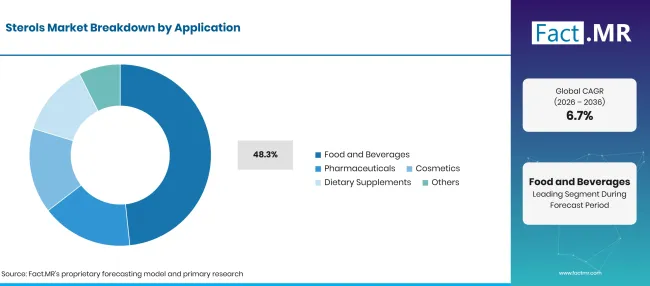
Factmr Sterols Market Breakdown Application | Source: Fact.MR
| Application | Share (2026) |
|---|---|
| Food and Beverages (Leading segment) | 48.3% |
| Other segments combined | 51.7%* |
| Total | 100.0% |
Source: Fact.MR analysis. Updated Oct 16, 2026
Consumers reach a daily sterol intake most easily through everyday foods they already buy. Cholesterol-lowering margarine and spreads were the first mass carriers, and yogurt drinks and milk followed. Pharmaceuticals use sterols as raw materials for steroid hormones and vitamin D. Cosmetics apply them in barrier creams and hair care. Dietary supplements carry sterols in softgels and tablets, which suit consumers who prefer a measured daily dose.
How does Form shape demand?
Powder makes up 43.2% of 2026 sales.
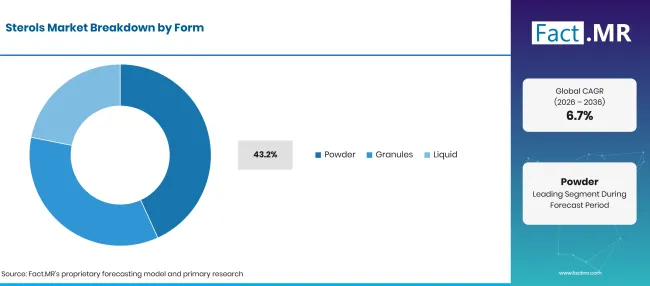
Factmr Sterols Market Breakdown Form | Source: Fact.MR
| Form | Share (2026) |
|---|---|
| Powder (Leading segment) | 43.2% |
| Other segments combined | 56.8%* |
| Total | 100.0% |
Source: Fact.MR analysis. Updated Oct 16, 2026
Tablet pressers and dry-mix blenders need an ingredient that spreads evenly through a batch of drink powder or tablets. Micronized and water-dispersible grades now allow sterols in clear beverages and dairy products. Granules improve flow on high-speed tableting lines. Liquid forms, often sterol esters, dissolve into fats and oils for spreads. Soybean oil is a main feedstock for esterified sterols, and USDA forecast global soybean oil production at 75.24 million metric tons for 2026/27 [3].
What supports Food Industry within End-User?
Food Industry buyers account for 46.5% of 2026 sales.
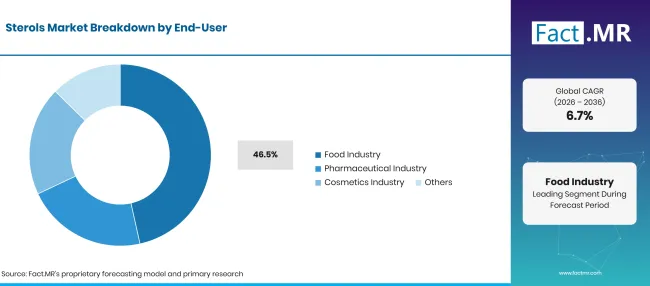
Factmr Sterols Market Breakdown End User | Source: Fact.MR
| End-User | Share (2026) |
|---|---|
| Food Industry (Leading segment) | 46.5% |
| Other segments combined | 53.5%* |
| Total | 100.0% |
Source: Fact.MR analysis. Updated Oct 16, 2026
Spread, dairy and bakery producers buy sterols by the tonne and fold them into products sold every week. Formulators must meet health claim dose rules and keep taste and texture unchanged. The pharmaceutical industry buys high-purity sterols for steroid synthesis and checks each lot against pharmacopeia specifications. Cosmetics makers use smaller volumes but pay more per kilogram for refined grades. Makers of fortified dairy products remain steady buyers of dispersible sterol grades.
What is accelerating Sterols Market adoption, and what is holding it back?
Adoption will rise through cholesterol awareness, clear health claim rules and wider use in supplements and skin care. Growth is constrained by feedstock links to oilseed crushing and by the need for daily intake to reach a measurable effect.
Drivers Impact Analysis
| DRIVER | (~) % IMPACT ON CAGR | GEOGRAPHIC RELEVANCE | IMPACT TIMELINE |
|---|---|---|---|
| Consumer focus on LDL cholesterol control and heart health | +1.4% | North America, Western Europe, East Asia | Short term (<= 2 years) |
| Authorised health claims and novel food rules for plant sterols | +1.1% | Western Europe, Latin America | Medium term (2-4 years) |
| Growth of sterol supplements in softgels, tablets and chews | +1.0% | North America, East Asia | Short term (<= 2 years) |
| Steroid and vitamin D3 synthesis from stigmasterol and cholesterol | +0.7% | East Asia, South Asia & Pacific | Long term (>= 4 years) |
| Skin barrier creams using sterols in personal care | +0.5% | Western Europe, East Asia | Medium term (2-4 years) |
Source: Fact.MR analysis. Updated Oct 16, 2026
Opportunity Impact Analysis
| OPPORTUNITY | (~) % IMPACT ON CAGR | GEOGRAPHIC RELEVANCE | IMPACT TIMELINE |
|---|---|---|---|
| Water-dispersible sterol grades for beverages and dairy | +0.9% | Global | Medium term (2-4 years) |
| Sunflower and rapeseed sterols for non-GMO and allergen-free labels | +0.7% | Western Europe, Latin America | Medium term (2-4 years) |
| Sterols in plant-based dairy alternatives | +0.5% | Western Europe, North America | Long term (>= 4 years) |
Source: Fact.MR analysis. Updated Oct 16, 2026
Restraints Impact Analysis
| RESTRAINT | (~) % IMPACT ON CAGR | GEOGRAPHIC RELEVANCE | IMPACT TIMELINE |
|---|---|---|---|
| Feedstock dependence on oilseed crushing and pulp mill output | -0.6% | Global | Short term (<= 2 years) |
| Daily intake needs that limit repeat purchase of fortified foods | -0.5% | Western Europe, North America | Medium term (2-4 years) |
| Competition from statins and other prescription lipid therapies | -0.4% | Global | Long term (>= 4 years) |
Source: Fact.MR analysis. Updated Oct 16, 2026
Which countries are scaling the Sterols Market through 2036?
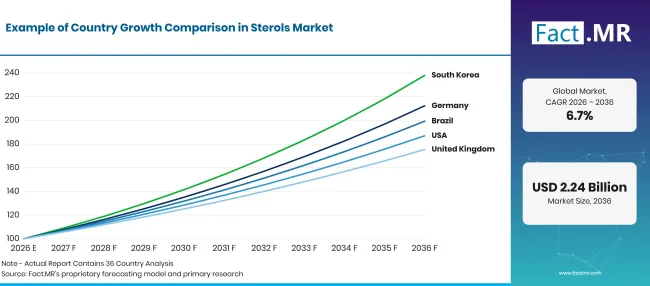
Factmr Sterols Market Growth Index | Source: Fact.MR
| Country | CAGR (2026–2036) |
|---|---|
| Germany | 7.8% |
| Brazil | 7.1% |
| United States | 6.5% |
| United Kingdom | 5.8% |
| Japan | 5.1% |
Source: Fact.MR analysis. Updated Oct 16, 2026
What supports Germany’s adoption?
7.8% CAGR, reflecting a large spreads and dairy industry and high cardiovascular awareness.
Heart disease remains the main health concern behind sterol-enriched foods in Germany. Destatis reported that 334,100 people died of cardiovascular diseases in 2025, which kept it the leading cause of death despite a 1.5% decline from 2024 [4]. German retailers stock sterol spreads, yogurt drinks and supplements under EU health claim rules. Domestic dairy and margarine producers source sterols from European oilseed refiners.
How is Brazil scaling demand?
7.1% CAGR, driven by rising hypertension and obesity that draw shoppers toward heart-health foods.
Brazil’s Ministry of Health reported in its Vigitel 2025 results that medically diagnosed hypertension among adults rose from 22.6% in 2006 to 29.7% in 2024 [5]. Obesity prevalence reached 25.7% in 2024 [5]. These trends push consumers toward cholesterol-lowering foods and supplements. Brazil’s large soybean crushing industry also gives local refiners access to sterol-rich distillate.
What supports United States adoption?
6.5% CAGR, backed by strong supplement retail and heart disease mortality.
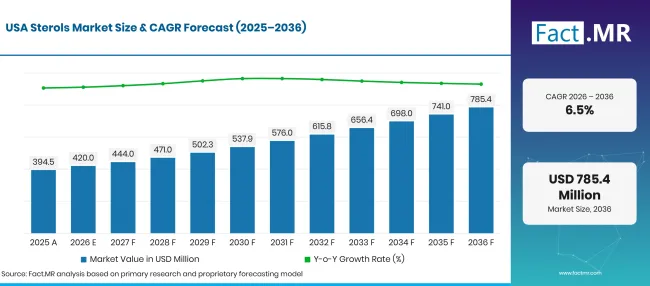
Factmr Sterols Market Forecast Usa | Source: Fact.MR
The National Center for Health Statistics reported that heart disease was the top cause of death in the United States in 2024, with 683,491 deaths [6]. A separate NCHS brief found that 28.7% of U.S. adults had two or more cardiovascular risk factors during August 2021 to August 2023 [7]. Sterol supplements and fortified juices reach these consumers through pharmacy and online channels.
How is the United Kingdom developing demand?
5.8% CAGR, on the back of high rates of raised cholesterol among adults.
NHS England reported in the Health Survey for England 2024 that 48% of adults had raised cholesterol [8]. The Office for National Statistics reported that ischaemic heart diseases were the leading cause of death among males in England and Wales in 2025, at 12.2% of registered deaths [9]. Plant stanol and sterol spreads and yogurt drinks are widely sold in UK supermarkets.
How does Japan perform?
5.1% CAGR, helped by Foods with Function Claims and an aging population.
Japan offers two regulated routes for cholesterol claims on foods. The Consumer Affairs Agency counted 6,703 notified Foods with Function Claims products and 1,030 FOSHU products as of March 2025 [10]. In its 2025 abridged life table, the Ministry of Health, Labour and Welfare reported that heart disease ranked second among causes of death for males [11]. Older consumers favor drinks and supplements with approved labels.
Who leads the Sterols Market?
Competition runs across three groups. Agribusiness processors such as ADM and Cargill market plant sterols under the CardioAid and CoroWise brands, and ADM offers powder and ester paste grades for food use.
Louis Dreyfus Company supplies plant sterol esters for food and supplement use. Ingredient specialists compete on source and purity. Kensing produces sunflower and other plant-derived phytosterols. In November 2025, it announced exclusive EU authorization for Sunvasterol, a sunflower-derived phytosterol made in Spain [12]. Xi’an Healthful Biotechnology and Matrix Life Science supply sterol powders and granules from China and India. Raisio competes downstream through Benecol, a consumer brand built on plant stanol ester. Feedstock access, dispersible grades and health claim approvals across regions will separate the stronger suppliers from the rest.
Which companies are the key providers?
Key companies include Archer Daniels Midland Company; Cargill, Incorporated; Louis Dreyfus Company; Kensing; Raisio plc (Benecol); Xi’an Healthful Biotechnology Co., Ltd.; and Matrix Life Science.
- Archer Daniels Midland Company
- Cargill, Incorporated
- Louis Dreyfus Company
- Kensing
- Raisio plc (Benecol)
- Xi’an Healthful Biotechnology Co., Ltd.
- Matrix Life Science
Bibliography
- [1] World Health Organization. (2025, July 31). Cardiovascular diseases (CVDs).
- [2] European Commission. (2025, July 25). Commission Implementing Regulation (EU) 2025/1509 amending Implementing Regulation (EU) 2017/2470 as regards the specifications of the novel food phytosterols/phytostanols.
- [3] U.S. Department of Agriculture, Foreign Agricultural Service. (2026, October). Oilseeds: World Markets and Trade.
- [4] Statistisches Bundesamt (Destatis). (2026, October 9). Todesursachen 2025: Weniger Verstorbene aufgrund von Herz-Kreislauf-Erkrankungen [Causes of death 2025: Fewer deaths from cardiovascular diseases].
- [5] Ministério da Saúde, Brazil. (2026). Para o povo brasileiro viver mais e viver melhor: Resultados Vigitel 2025 [For Brazilians to live longer and better: Vigitel 2025 results].
- [6] National Center for Health Statistics. (2026, January 29). Mortality in the United States, 2024 (NCHS Data Brief No. 548).
- [7] National Center for Health Statistics. (2025, September 16). Prevalence of Cardiovascular Disease Risk Factors in Adults: United States, August 2021 to August 2023 (NCHS Data Brief No. 540).
- [8] NHS England. (2026, January 27). Health Survey for England, 2024: Adults’ health.
- [9] Office for National Statistics. (2026, September 25). Deaths registered in England and Wales: 2025.
- [10] Consumer Affairs Agency, Japan. (2025, July). 機能性表示食品制度の令和6年度の見直しについて [Review of the Foods with Function Claims system in fiscal 2024].
- [11] Ministry of Health, Labour and Welfare, Japan. (2026, July 24). 令和7(2025)年簡易生命表の概要 [Summary of the 2025 abridged life table].
- [12] Kensing. (2025, November 11). Kensing Gains Exclusive EFSA Approval for its Naturally Derived Sunflower Phytosterols.
This Report Answers
- Sterol sales are broken down by product type, application, form and end-user.
- For each segment, readers see which subsegment leads and the operating factors behind its 2026 share.
- Health claim rules, diet habits and cardiovascular risk frame the comparison of the five listed countries.
- Profiles cover active sterol producers and consumer brands, grouped by their role in the supply chain.
- Vegetable oil refining and tall oil output are traced to show what limits sterol availability.
What does the Sterols Market cover?
Plant sterols, plant stanols and their esters fall within the Sterols Market, along with animal sterols such as cholesterol. These ingredients are sold in powder, granule and liquid forms.
The assessment tracks demand across food and beverages, pharmaceuticals, cosmetics and dietary supplements. Revenue is measured at the ingredient level, before sterols are blended into finished products.
What is included in the scope?
Sterols recovered from vegetable oil deodorizer distillate, tall oil and wool grease are in scope. Sterol esters made by reacting sterols with fatty acids are included at the value of the ester.
Sterols sold to makers of dietary supplements are counted when sold as bulk ingredients. Those used as raw materials for steroid and vitamin D3 synthesis are also included.
What is excluded from the scope?
Finished foods, supplements and cosmetics that contain sterols count only at the ingredient value. Prescription lipid-lowering drugs such as statins fall outside the revenue boundary.
Tocopherols and fatty acids recovered from the same distillate streams are excluded. Crude tall oil and wool grease sold before sterol extraction are also excluded.
How Was the Analysis Built?
The analysis draws on 120+ sources, 35+ company portfolios, 25+ countries, and more than 20 industry interviews.
- Primary Research: Primary research includes discussions with manufacturers, service providers, technology developers, distributors, end users, and subject-matter experts. These conversations examine purchasing priorities, product adoption, operational challenges, approval requirements, competitive positioning, and the factors that influence wider market acceptance.
- Desk Research: Desk research covers government statistics, regulatory publications, company filings, trade data, technical studies, industry associations, standards, public policy, and other authoritative sources. Every source used in the analysis is documented in the bibliography.
- Market Sizing and Forecasting: Market estimates combine historical performance, demand indicators, pricing and volume trends, segment shares, company participation, country-level growth, adoption patterns, investment activity, and barriers to market expansion.
- Data Validation and Update Cycle: Findings are validated by comparing primary interviews with public data, company activity, regulatory changes, trade patterns, and industry developments. Regular updates review new product launches, capacity changes, partnerships, approvals, and shifts in commercial adoption.
Segmentation
What is the report’s scope and coverage?
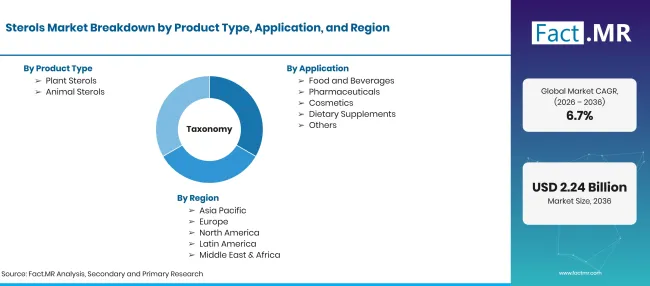
Factmr Sterols Market Taxonomy | Source: Fact.MR
| Attribute | Details |
|---|---|
| Quantitative Units | USD billion in 2026 to USD billion by 2036 at CAGR |
| Market Definition | Plant and animal sterols sold as ingredients, including free sterols, stanols and sterol esters. The scope covers sales to food, pharmaceutical, cosmetics and supplement manufacturers. |
| Product Type | Plant Sterols; Animal Sterols |
| Application | Food and Beverages; Pharmaceuticals; Cosmetics; Dietary Supplements; Others |
| Form | Powder; Granules; Liquid; Others |
| End-User | Food Industry; Pharmaceutical Industry; Cosmetics Industry |
| Regions Covered | North America; Latin America; Western Europe; Eastern Europe; East Asia; South Asia & Pacific; Middle East & Africa |
| Countries Covered | Germany; Brazil; United States; United Kingdom; Japan |
| Companies Profiled | Archer Daniels Midland Company; Cargill, Incorporated; Louis Dreyfus Company; Kensing; Raisio plc (Benecol); Xi’an Healthful Biotechnology Co., Ltd.; Matrix Life Science |
| Forecast Period | 2026 to 2036 |
| Approach | Hybrid top-down and bottom-up approach using vegetable oil refining and tall oil volumes; sterol yield per tonne of feedstock; application and form split; health claim rules by country; and supplier portfolio review. |
Source: Fact.MR analysis. Updated Oct 16, 2026
How is the market segmented?
-
By Product Type
- Plant Sterols
- Animal Sterols
-
By Application
- Food and Beverages
- Pharmaceuticals
- Cosmetics
- Dietary Supplements
- Others
-
By Form
- Powder
- Granules
- Liquid
- Others
-
By End-User
- Food Industry
- Pharmaceutical Industry
- Cosmetics Industry
-
By Region
- North America
- Latin America
- Western Europe
- Eastern Europe
- East Asia
- South Asia & Pacific
- Middle East & Africa
Frequently Asked Questions
How big is the sterols market in 2026?
What is the CAGR of the sterols market from 2026 to 2036?
Which product type leads the sterols market?
Which application leads the sterols market?
Which form leads the sterols market?
Which end-user leads the sterols market?
Which country will grow the most in the sterols market?
Who are the main companies in the sterols market?
Who worked on this report


Preview the report firsthand - request a free sample
Free SampleGet the brochure for pricing and purchase details
Download PDF