- Market Value (2025): USD 167.3 Bn
- Estimated Value (2026): USD 175.1 Bn
- Forecast Value (2036): USD 275.8 Bn
- CAGR (2026-2036): 4.6%
What is the Glazing Market forecast to be worth by 2036?
USD 175.1 billion in 2026 to USD 275.8 billion by 2036 at a 4.6% CAGR.
- According to Fact.MR analysis, the glazing market was valued at USD 167.3 billion in 2025.
- Glazing sales are projected to reach from USD 175.1 billion in 2026 to USD 275.8 billion by 2036 as insulating units and safety glass secure a larger share of specification work.
- The forecast 4.6% CAGR between 2026 and 2036 reflects ongoing demand from construction and automotive customers, whose testing and delivery requirements differ substantially.
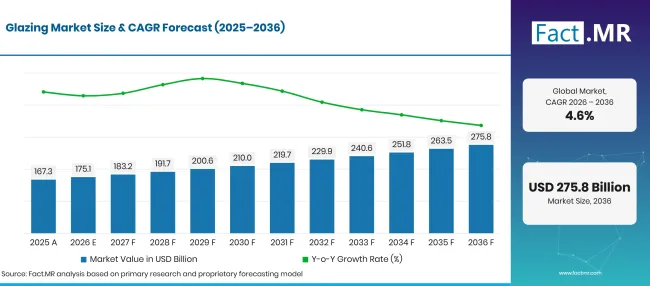
Glazing Market Forecast Global | Source: Fact.MR
| Year | Basis | Market Value (USD billion) |
|---|---|---|
| 2025 | Actual | 167.3 |
| 2026 | Estimate | 175.1 |
| 2036 | Forecast | 275.8 |
| CAGR 2026 to 2036 | Forecast period | 4.6% |
Source: Fact.MR analysis. Updated Nov 10, 2026
What are the defining numbers behind Glazing Market growth?
USD 100.7 billion absolute opportunity by 2036; insulating glazing, residential applications and construction end use shape demand.
- Demand Drivers in the Market
- Building owners consider glazing performance when trying to maintain comfortable indoor temperatures without giving up natural light. Insulating units can reduce heat transfer through windows, while the complete frame and installation details determine how well that performance is achieved in practice.
- Architectural teams increasingly specify combinations of coatings and glazing assemblies against project performance targets.
- Vehicle manufacturers need glass that fits a defined opening and meets optical and safety requirements. Windshields rely on laminated construction while side and rear positions often use tempered products.
- Replacement glazing creates demand that is separate from new-building work. Installers must first assess the frame, measure the opening and identify the existing glass specification so the replacement unit can be fitted without avoidable rework.
- Key Segments Analyzed
- By Product Type: Insulating Glazing accounts for 35.2% of 2026 value, reflecting its use in window and façade assemblies where heat transfer is a purchasing consideration.
- By Application: Residential applications represent 45.3% of 2026 value, supported by window installation and replacement across homes.
- By End-User: Construction represents 62.4% of 2026 demand, covering glazing installed by building contractors and specialist fabricators.
- Analyst Opinion at Fact.MR
- Shambhu Nath Jha, Principal Consultant at Fact.MR, states, “Glazing buyers often compare the performance of the finished unit with its installed cost. Window installers assess sealing reliability and thermal characteristics because both influence long-term service. Automotive customers also require consistent optical quality and vehicle-specific approval.”
- Strategic Implications
- Glazing suppliers should publish specifications for the finished unit, including thermal performance and edge-seal requirements. Vehicle-glass suppliers should document optical consistency and model-specific approvals.
- Window fabricators need consistent spacer placement and sealed-unit quality so installers can meet specified thermal performance after fitting.
- Glass processors should plan coating and tempering capacity around the actual demand from window fabricators, commercial façades and vehicle programs.
Germany is projected to lead glazing market growth at 5.5% CAGR, as insulating-glass demand is supported by renovation activity and new housing permits. Brazil follows at 5.0%, with construction activity and regional processing capacity shaping orders. The United States will grow at 4.6% as replacement windows and differentiated façade glazing sustain demand. The United Kingdom records 4.1%, supported by replacement units and commercial construction. Japan completes the list at 3.6%, where renovation demand and precise automotive-glass manufacturing offset slower new construction.
How does the Glazing Market break down by segment?
Insulating Glazing represents 35.2% of Product Type; Residential represents 45.3% of Application; Construction accounts for 62.4% of End-User demand.
Which Product Type dominates?
Insulating Glazing accounts for 35.2% in 2026.
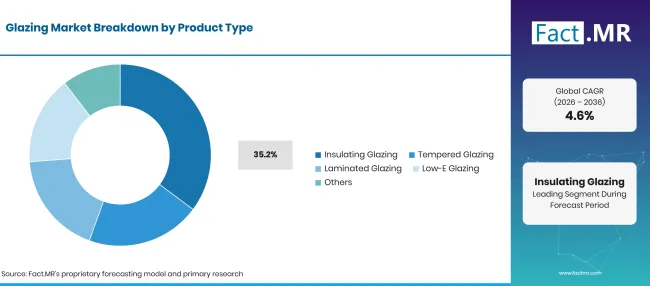
Glazing Market Breakdown Product Type | Source: Fact.MR
| Product Type | Share (2026) |
|---|---|
| Insulating Glazing (Leading segment) | 35.2% |
| Other segments combined | 64.8% |
| Total | 100.0% |
Source: Fact.MR analysis. Updated Nov 10, 2026
Insulating glazing leads because sealed multi-pane units help reduce heat transfer while maintaining daylight and visibility. Demand comes from both new construction and replacement windows, where installers must match the unit to frame dimensions and thermal requirements. Buyers also consider coating performance, cavity design and edge-seal quality when comparing available glazing options.
What leads the Application segment?
Residential captures 45.3% share in 2026.
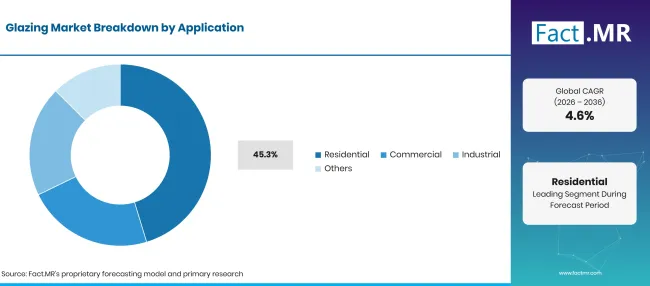
Glazing Market Breakdown Application | Source: Fact.MR
| Application | Share (2026) |
|---|---|
| Residential (Leading segment) | 45.3% |
| Other segments combined | 54.7% |
| Total | 100.0% |
Source: Fact.MR analysis. Updated Nov 10, 2026
Residential glazing demand is shaped by two purchase routes: windows installed in new homes and replacement units fitted in occupied properties. Homeowners and fabricators compare insulation performance, opening dimensions and compatibility with existing frames. Local installation networks, renovation cycles and the need for correctly sized sealed units all influence residential order volumes.
How does End-User shape demand?
Construction holds 62.4% share in 2026.
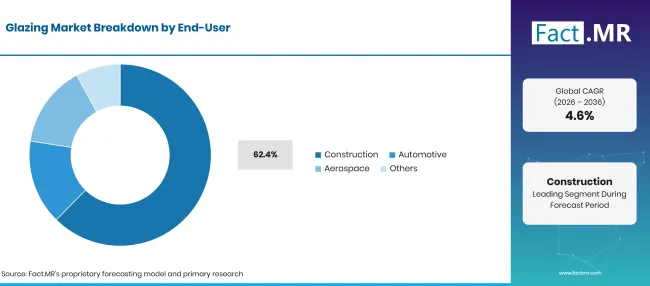
Glazing Market Breakdown End User | Source: Fact.MR
| End-User | Share (2026) |
|---|---|
| Construction (Leading segment) | 62.4% |
| Other segments combined | 37.6% |
| Total | 100.0% |
Source: Fact.MR analysis. Updated Nov 10, 2026
Construction users include developers, façade contractors, window fabricators and specialist glazing installers working to project-specific dimensions and schedules. Their purchasing depends on building specifications, delivery timing and installation requirements rather than glass type alone. Demand spans residential and commercial projects, with additional attention to thermal performance, safety requirements and reliable handling of finished glazing units.
What is accelerating Glazing Market adoption, and what is holding it back?
Demand for insulating glass reflects new-building requirements and replacement projects. Energy performance and glass safety specifications guide product selection, while fabrication costs and installation constraints affect order timing.
Drivers Impact Analysis
| DRIVER | (~) % IMPACT ON CAGR | GEOGRAPHIC RELEVANCE | IMPACT TIMELINE |
|---|---|---|---|
| Demand for insulating window systems | +0.9% | Europe, North America | Medium term (2–4 years) |
| Residential glazing replacement | +0.7% | Europe, North America, Japan | Short term (≤ 2 years) |
| Safety glass in vehicle assembly | +0.5% | East Asia, Europe, Americas | Medium term (2–4 years) |
| Higher-performance façade specification | +0.4% | Europe, North America | Long term (≥ 4 years) |
| Commercial coating and fabrication improvements | +0.3% | Global | Long term (≥ 4 years) |
Source: Fact.MR analysis. Updated Nov 10, 2026
Opportunity Impact Analysis
| OPPORTUNITY | (~) % IMPACT ON CAGR | GEOGRAPHIC RELEVANCE | IMPACT TIMELINE |
|---|---|---|---|
| Renovation-friendly high-insulation glazing | +0.6% | Western Europe, Japan | Medium term (2–4 years) |
| Bird-safe architectural glass | +0.4% | North America, Europe | Medium term (2–4 years) |
| Higher-value coated façade units | +0.3% | Global urban markets | Long term (≥ 4 years) |
| Replacement networks for shaped automotive glass | +0.2% | North America, Europe | Short term (≤ 2 years) |
Source: Fact.MR analysis. Updated Nov 10, 2026
Restraints Impact Analysis
| RESTRAINT | (~) % IMPACT ON CAGR | GEOGRAPHIC RELEVANCE | IMPACT TIMELINE |
|---|---|---|---|
| Weak new-building starts in some markets | −0.6% | Germany, Japan | Short term (≤ 2 years) |
| Furnace energy and processing costs | −0.5% | Global | Short term (≤ 2 years) |
| Project installation and breakage exposure | −0.3% | Global | Medium term (2–4 years) |
| Long vehicle-product qualification | −0.2% | Automotive manufacturing regions | Long term (≥ 4 years) |
Source: Fact.MR analysis. Updated Nov 10, 2026
Which countries are scaling the Glazing Market through 2036?
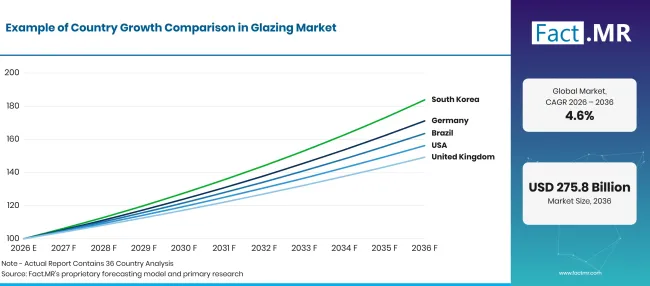
Glazing Market Growth Index | Source: Fact.MR
| Country | CAGR (2026 to 2036) |
|---|---|
| Germany | 5.5% |
| Brazil | 5.0% |
| United States | 4.6% |
| United Kingdom | 4.1% |
| Japan | 3.6% |
Source: Fact.MR analysis. Updated Nov 10, 2026
What supports Germany’s glazing outlook?
5.5% CAGR, with efficient glazing and replacement specifications shaping demand.
German glazing orders depend on renovation decisions and the pace of new housing work. In February 2026, the Federal Statistical Office reported that Germany issued permits for 238,500 dwellings during 2025, an increase of 10.8% from the previous year [3]. Renovation has a different buying pattern because installers must fit the glass to an existing frame and preserve the finished window’s thermal performance.
How is Brazil developing glazing demand?
5.0% CAGR, shaped by construction activity and the mix of standard and specialized glass.
Brazilian glazing sales are closely tied to building work and the availability of regional glass processors. In January 2026, the Brazilian Institute of Geography and Statistics reported that its national construction-cost index rose 5.63% over 2025 [4]. Tempered glazing suits doors and internal partitions where safety requirements shape the product selection, while insulated products serve projects with stated heat-control targets.
What shapes United States glazing purchases?
4.6% CAGR, reflecting replacement windows and differentiated façade glass.
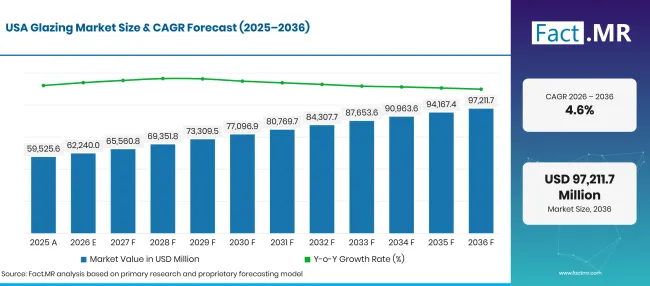
Glazing Market Forecast Usa | Source: Fact.MR
In the United States, replacement windows remain a different commercial channel from the glazing installed in new construction. The U.S. Census Bureau reported in October 2026 that private residential construction spending reached a seasonally adjusted annual rate of USD 882.3 billion in August 2026 [5]. Homeowners replacing failed sealed units usually compare the finished window’s insulation performance and whether it fits the existing opening.
How is United Kingdom glazing demand changing?
4.1% CAGR, tied to non-residential work and the replacement of existing units.
The United Kingdom has a large installed stock of windows that creates repeat work for fabricators supplying replacement insulated glazing. In October 2026, the Office for National Statistics reported that the value of new construction work in Great Britain increased by 1.9% during 2025 to GBP 139,106 million [1]. Project teams assess solar-control and thermal performance alongside appearance when choosing coated units.
How does Japan compare in glazing demand?
3.6% CAGR, with renovation and precise manufacturing offsetting slower new construction.
Japan combines exacting automotive-glass manufacture with building replacement work that often involves restricted frame dimensions. The Ministry of Land, Infrastructure, Transport and Tourism reported in January 2026 that housing starts declined during 2025 [2]. Small installation spaces can influence whether a thick double-glazed assembly is suitable or whether another configuration is required.
Who leads the Glazing Market?
Saint-Gobain, AGC, NSG and Guardian Glass supply architectural glazing; Fuyao specializes in vehicle glass.
Fact.MR analysis compares manufacturers that produce high-volume glass with firms that fabricate products close to end users. Saint-Gobain Glass and AGC supply coated architectural products alongside conventional flat glass.
Fuyao Glass Industry Group focuses on automotive glass, while Vitro Architectural Glass markets coated building glass. Xinyi Glass participates in the flat-glass and processed-glass supply chain.
Which companies are the key providers?
Key companies include Fuyao Glass Industry Group Co., Ltd., Saint-Gobain S.A., AGC Inc., Nippon Sheet Glass Co., Ltd. (Pilkington), Guardian Industries Corp. (Guardian Glass), Vitro S.A.B. de C.V. / Vitro Architectural Glass, Corning Incorporated, and Xinyi Glass Holdings Limited.
- Fuyao Glass Industry Group Co., Ltd.
- Saint-Gobain S.A.
- AGC Inc.
- Nippon Sheet Glass Co., Ltd. (Pilkington)
- Guardian Industries Corp. (Guardian Glass)
- Vitro S.A.B. de C.V. / Vitro Architectural Glass
- Corning Incorporated
- Xinyi Glass Holdings Limited
Bibliography
- [1] Office for National Statistics. (2026, October 23). Construction statistics, Great Britain: 2025.
- [2] Ministry of Land, Infrastructure, Transport and Tourism. (2026, January 30). [Building Starts Statistics Survey Report: 2025 annual results].
- [3] Statistisches Bundesamt (Destatis). (2026, February 18). 10,8 % mehr Baugenehmigungen für Wohnungen im Jahr 2025.
- [4] Instituto Brasileiro de Geografia e Estatística. (2026, January 9). Índice Nacional da Construção Civil varia 0,51% em dezembro.
- [5] U.S. Census Bureau. (2026, October 1). Monthly Construction Spending, August 2026.
This Report Answers
- The analysis describes how insulating, tempered and laminated glazing differ by use and required product performance.
- Application coverage compares residential replacement windows with commercial façade projects and industrial installations.
- End-user analysis distinguishes glass sold to construction fabricators from vehicle glazing requiring program qualification.
- Country outlooks compare Germany, Brazil, the United States, the United Kingdom and Japan over 2026 to 2036.
- Competitive coverage profiles eight suppliers with differing architectural and automotive portfolios.
What does the Glazing Market cover?
The glazing market covers finished glass products used to close windows and other building openings, plus relevant transport glazing. Architectural products include sealed insulating units and processed sheets prepared for specific openings.
What is included in the scope?
Insulating glazing units, tempered glass panels and laminated safety glass are included when sold as glazing products. Low-emissivity coated glazing and related specialty products are covered in the relevant product category.
Vehicle windshields and other finished automotive glazing are included under the automotive end user. Aerospace transparencies are covered where they are sold as glazing rather than as complete aircraft systems.
What is excluded from the scope?
Unprocessed glass sold solely as raw manufacturing input is excluded where it would duplicate subsequent processed-glazing revenue. Window frames and standalone hardware are outside the product boundary.
Optical fibers, display panels and semiconductor glass do not belong to architectural or vehicle glazing revenue. Decorative mirrors are excluded when they do not serve an opening or transparency function.
How Was the Analysis Built?
The analysis draws on 120+ sources, 35+ company portfolios, 25+ countries, and more than 20 industry interviews.
- Primary Research: Primary research includes discussions with manufacturers, service providers, technology developers, distributors, end users, and subject-matter experts. These conversations examine purchasing priorities, product adoption, operational challenges, approval requirements, competitive positioning, and the factors that influence wider market acceptance.
- Desk Research: Desk research covers government statistics, regulatory publications, company filings, trade data, technical studies, industry associations, standards, public policy, and other authoritative sources. Every source used in the analysis is documented in the bibliography.
- Market Sizing and Forecasting: Market estimates combine historical performance, demand indicators, pricing and volume trends, segment shares, company participation, country-level growth, adoption patterns, investment activity, and barriers to market expansion.
- Data Validation and Update Cycle: Findings are validated by comparing primary interviews with public data, company activity, regulatory changes, trade patterns, and industry developments. Regular updates review new product launches, capacity changes, partnerships, approvals, and shifts in commercial adoption.
Segmentation
What is the report’s scope and coverage?
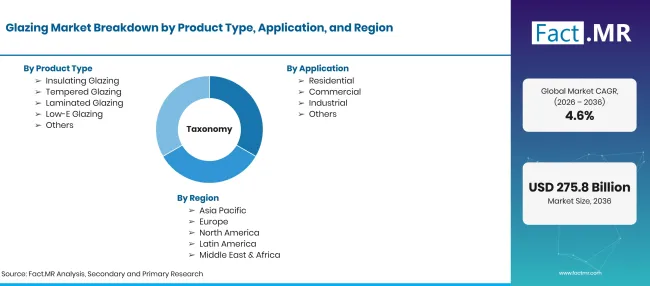
Glazing Market Taxonomy | Source: Fact.MR
| Attribute | Details |
|---|---|
| Quantitative Units | USD billion |
| Market Definition | Finished glass and glazing assemblies sold for architectural and transportation applications. |
| Product Type | Insulating Glazing; Tempered Glazing; Laminated Glazing; Low-E Glazing; Others |
| Application | Residential; Commercial; Industrial; Others |
| End-User | Construction; Automotive; Aerospace; Others |
| Regions Covered | North America; Latin America; Western Europe; Eastern Europe; East Asia; South Asia & Pacific; Middle East & Africa |
| Countries Covered | Germany; Brazil; United States; United Kingdom; Japan |
| Companies Profiled | Fuyao Glass Industry Group Co., Ltd., Saint-Gobain S.A., AGC Inc., Nippon Sheet Glass Co., Ltd. (Pilkington), Guardian Industries Corp. (Guardian Glass), Vitro S.A.B. de C.V. / Vitro Architectural Glass, Corning Incorporated, and Xinyi Glass Holdings Limited |
| Forecast Period | 2026 to 2036 |
| Approach | Review of glazing products, construction indicators, application specifications, supplier activity and country market conditions |
Source: Fact.MR analysis. Updated Nov 10, 2026
How is the market segmented?
-
By Product Type
- Insulating Glazing
- Tempered Glazing
- Laminated Glazing
- Low-E Glazing
- Others
-
By Application
- Residential
- Commercial
- Industrial
- Others
-
By End-User
- Construction
- Automotive
- Aerospace
- Others
-
By Region
- North America
- Latin America
- Western Europe
- Eastern Europe
- East Asia
- South Asia & Pacific
- Middle East & Africa
Frequently Asked Questions
How big is the Glazing Market in 2026?
What is the CAGR of the Glazing Market from 2026 to 2036?
Which product type leads the Glazing Market?
Which application leads the Glazing Market?
Who are the leading companies in the Glazing Market?
Who worked on this report


Preview the report firsthand - request a free sample
Free SampleGet the brochure for pricing and purchase details
Download PDF