- Market Value (2025): USD 165.0 Mn
- Estimated Value (2026): USD 180.0 Mn
- Forecast Value (2036): USD 430.1 Mn
- CAGR (2026-2036): 9.1%
Gluten-Free Cellulosic Hydrocolloids Market Forecast and Outlook 2026 to 2036
As per the Fact.MR analysis, the gluten-free cellulosic hydrocolloids market was valued at USD 165.0 million in 2025 and is projected to grow from USD 180.0 million in 2026 to USD 430.1 million by 2036. Demand for gluten-free cellulosic hydrocolloids is likely to grow at a CAGR of 9.1% over the forecast period.
Demand for gluten-free cellulosic hydrocolloids is rising as bakers and food makers replace the gas-holding, binding and moisture-retaining role of gluten in bread, pasta, coatings and nutrition products. Manufacturers of gluten-free cellulosic hydrocolloids are offering hydroxypropyl methylcellulose, methylcellulose, cellulose gum and hydroxyethyl cellulose grades that gel on heating, hold water and give dough structure without wheat protein. For example, in January 2026, the U.S. Food and Drug Administration issued a request for information on labeling and preventing cross-contact of gluten in packaged foods. Similar regulatory attention is projected to drive sales of gluten-free cellulosic hydrocolloids.
Key Takeaways from the Gluten-Free Cellulosic Hydrocolloids Market
- Gluten-Free Cellulosic Hydrocolloids Market Value (2025): USD 165.0 million
- Gluten-Free Cellulosic Hydrocolloids Market Value (2026): USD 180.0 million
- Gluten-Free Cellulosic Hydrocolloids Market Forecast Value (2036): USD 430.1 million
- Gluten-Free Cellulosic Hydrocolloids Market Forecast CAGR (2026-2036): 9.1%
- Leading Product Type: Hydroxyethyl cellulose (28.7%)
- Key Market Participants: Dow, IFF, Ashland, Shin-Etsu Chemical, Lotte Fine Chemical, CP Kelco
- Key Growth Regions: United States, Germany, France, Japan, United Kingdom
In August 2026, the first major update to UK coeliac disease guidelines in more than a decade was published, drawing new attention to diagnosis and diet management. Demand for gluten-free cellulosic hydrocolloids is growing as more people are diagnosed and expect gluten-free bread and snacks that match conventional texture. Manufacturers of gluten-free cellulosic hydrocolloids are refining viscosity grades for softer crumb and longer freshness. Similar awareness is projected to drive sales of gluten-free cellulosic hydrocolloids across North America, Europe and Japan.
Gluten-Free Cellulosic Hydrocolloids Market
| Metric | Value |
|---|---|
| Estimated Value in (2026) | USD 180.0 million |
| Forecast Value in (2036) | USD 430.1 million |
| Forecast CAGR (2026 to 2036) | 9.1% |
Source: Fact.MR analysis. Updated Nov 21, 2026
Source: Fact.MR analysis.
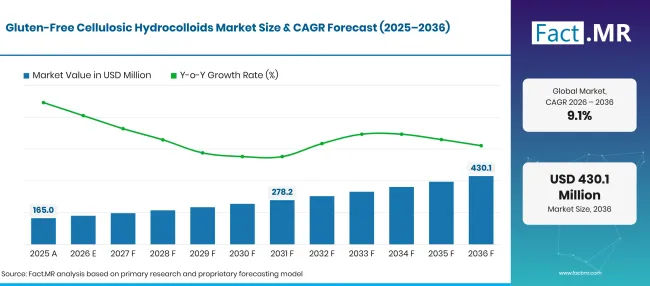
Gluten Free Cellulosic Hydrocolloids Forecast Global | Source: Fact.MR
Category
| Category | Segments |
|---|---|
| Product Type | Hydroxyethyl cellulose, Cellulose gum CMC, Blended cellulosic system, Hydroxypropyl methylcellulose, Methylcellulose |
| Product Form | Granule and agglomerate, Dry powder, Encapsulated, Custom premix, Liquid concentrate |
| Application | Nutrition and supplements, Bakery and confectionery, Dairy and alternatives, Beverages, Savory and other |
| Buyer Type | Ingredient blender, Food manufacturer, Nutrition brand, Beverage producer, Contract formulator |
| Region | United States; Germany; France; Japan; United Kingdom |
Source: Fact.MR analysis. Updated Nov 21, 2026
Source: Fact.MR analysis.
Segmental Analysis
Why does hydroxyethyl cellulose lead product demand in the Gluten-Free Cellulosic Hydrocolloids Market?
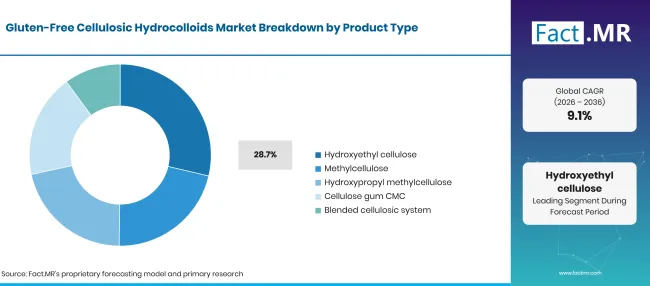
Gluten Free Cellulosic Hydrocolloids Breakdown Product Type | Source: Fact.MR
Demand for Hydroxyethyl cellulose accounts for 28.7% of the gluten-free cellulosic hydrocolloids market in 2026, about USD 51.7 million, because it thickens and holds water across a wide pH and salt range, which suits nutrition powders, coatings and batter systems where permitted. It gives smooth viscosity without gelling. Manufacturers of gluten-free cellulosic hydrocolloids are supplying controlled-viscosity grades for specific uses. Similar thickening performance is projected to keep hydroxyethyl cellulose the leading product type.
How are granules and agglomerates leading form demand in the Gluten-Free Cellulosic Hydrocolloids Market?
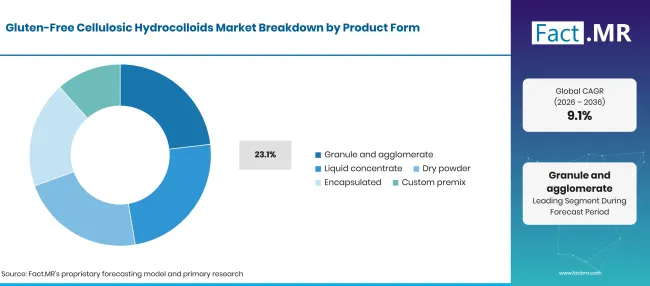
Gluten Free Cellulosic Hydrocolloids Breakdown Product Form | Source: Fact.MR
Sales of Granule and agglomerate formats leads with 23.1% of gluten-free cellulosic hydrocolloids revenue in 2026, about USD 41.6 million, because agglomerated cellulose ethers wet out without forming lumps and blend evenly with rice, corn and tapioca flours. Dust control is also better. Manufacturers of gluten-free cellulosic hydrocolloids are offering fast-hydrating granules for dry mixes. Similar ease of use is projected to keep granules and agglomerates the leading product form.
Why do nutrition and supplements lead application demand in the Gluten-Free Cellulosic Hydrocolloids Market?
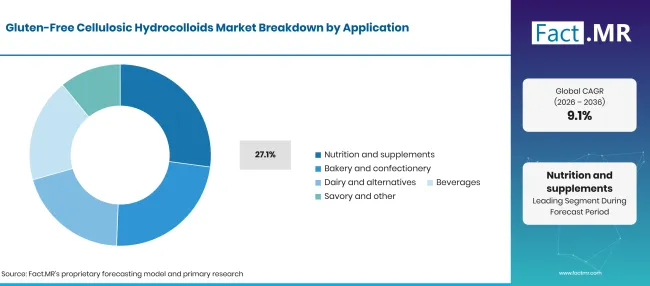
Gluten Free Cellulosic Hydrocolloids Breakdown Application | Source: Fact.MR
Demand for the Nutrition and supplements to represent 27.1% of gluten-free cellulosic hydrocolloids revenue in 2026, about USD 48.8 million, as gluten-free protein bars, shakes, capsules and fiber products use cellulose ethers for binding, suspension and vegetarian capsule shells. Many consumers who avoid gluten buy these products. Manufacturers of gluten-free cellulosic hydrocolloids are serving supplement makers that also use cellulose derivative excipients. Similar health positioning is projected to keep nutrition and supplements the leading application.
How are ingredient blenders leading buyer demand in the Gluten-Free Cellulosic Hydrocolloids Market?
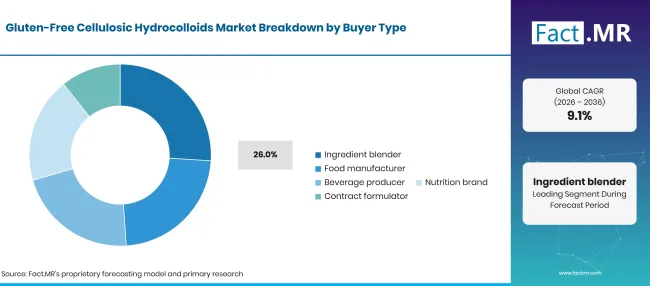
Gluten Free Cellulosic Hydrocolloids Breakdown Buyer Type | Source: Fact.MR
Sales of ingredient blenders account for 26.0% of gluten-free cellulosic hydrocolloids revenue in 2026, about USD 46.8 million, because gluten-free flour mixes and bakery premixes are built by specialist blenders who combine cellulose ethers with starches, fibers and proteins. Bakers then buy one tested mix. Manufacturers of gluten-free cellulosic hydrocolloids are supporting blenders with baking trials, as covered in the wider food grade cellulose market. Similar reliance on premixes is projected to keep ingredient blenders the leading buyer type.
Gluten-Free Cellulosic Hydrocolloids Market-Drivers, Restraints & Trends
Drivers:
Demand for gluten-free cellulosic hydrocolloids is rising as regulators tighten gluten labeling. For example, the FDA's January 2026 request for information, issued in response to a citizen petition from Celiac Journey, sought data on rye, barley and oats and on cross-contact, and the comment period was later extended. Manufacturers of gluten-free cellulosic hydrocolloids are supporting manufacturers that move to dedicated gluten-free recipes. Similar regulatory action is projected to drive sales of gluten-free cellulosic hydrocolloids.
Restraints:
Demand for gluten-free cellulosic hydrocolloids is constrained by clean-label concerns about chemically modified cellulose and by policy scrutiny of processed foods. For example, in August 2026, U.S. agencies advanced a proposed federal definition of ultra-processed foods. Similar scrutiny is projected to push some brands toward psyllium, citrus fiber and other natural binders. Manufacturers of gluten-free cellulosic hydrocolloids must explain the plant origin and safety record of cellulose ethers.
Trend: Better Gluten-Free Bread Texture
Demand for cellulose ethers that give open crumb and soft bite in gluten-free bread is rising as consumers compare products with wheat bread. Manufacturers are combining HPMC with enzymes and fibers. Novonesis reported 9% organic growth in Food & Health Biosolutions for the first nine months of 2026, reflecting demand for such processing aids. Similar development is projected to drive sales of gluten-free cellulosic hydrocolloids in bakery.
Trend: Plant-Based Binding Systems
In November 2026, Fi Europe in Frankfurt brought ingredient suppliers together from 17 to 19 November, with texture and health ingredients prominent. Demand for methylcellulose as a heat-setting binder in plant-based and gluten-free foods is rising. Similar product launches are projected to drive sales of gluten-free cellulosic hydrocolloids. Manufacturers of gluten-free cellulosic hydrocolloids are promoting systems that compete with chemically modified hydrocolloids from other sources.
Gluten-Free Cellulosic Hydrocolloids Market by Analysis by Key Country
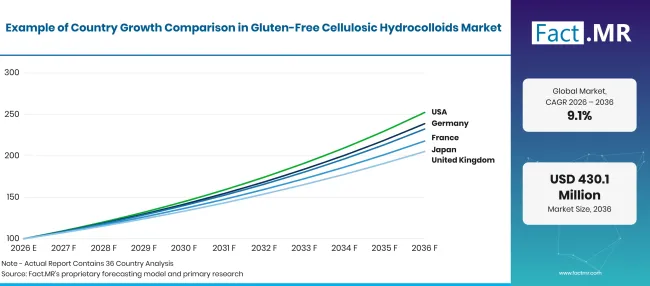
Gluten Free Cellulosic Hydrocolloids Growth Index | Source: Fact.MR
| Country | CAGR (2026-2036) |
|---|---|
| United States | 9.7% |
| Germany | 9.1% |
| France | 8.8% |
| Japan | 8.1% |
| United Kingdom | 7.5% |
Source: Fact.MR analysis. Updated Nov 21, 2026
Source: Fact.MR analysis.
What is driving gluten-free cellulosic hydrocolloids demand in the United States?
In January 2026, the FDA published a request for information on gluten labeling and cross-contact, and in March 2026 it extended the comment period.
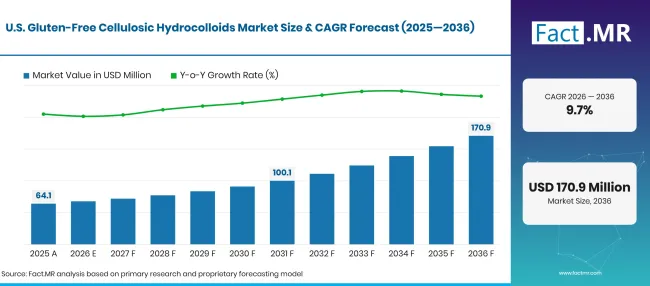
Gluten Free Cellulosic Hydrocolloids Forecast Usa | Source: Fact.MR
Demand for gluten-free cellulosic hydrocolloids in the United States is projected to grow at a 9.7% CAGR, the fastest among the five key countries, as gluten-free bakery, snack and supplement makers expand ranges and tighten controls. Manufacturers of gluten-free cellulosic hydrocolloids, including Dow, Ashland, IFF and CP Kelco, are serving U.S. producers. Similar regulatory focus is projected to drive sales in the United States.
How is the bakery sector supporting gluten-free cellulosic hydrocolloids sales in Germany?
Sales of gluten-free cellulosic hydrocolloids in Germany are estimated to record a 9.1% CAGR as free-from bread and rolls gain shelf space despite a weak food market.
The BVE reported in October 2026 that German food industry revenue fell 2.3% in the first half of 2026, increasing interest in premium niches. Manufacturers of gluten-free cellulosic hydrocolloids are serving German gluten-free bakers and mix producers. Similar premium demand is projected to drive sales in Germany.
What is shaping gluten-free cellulosic hydrocolloids demand in France?
Demand for gluten-free cellulosic hydrocolloids in France is projected to increase at an 8.8% CAGR as industrial bakers invest in new lines.
French trade press reported in April 2026 that investment and concentration were the leading trends in bakery and pastry, and the Choose France summit in June 2026 brought new food-sector investment. Manufacturers of gluten-free cellulosic hydrocolloids are serving gluten-free bread and pastry producers. Similar investment is projected to drive sales in France.
How is product innovation shaping gluten-free cellulosic hydrocolloids sales in Japan?
Sales of gluten-free cellulosic hydrocolloids in Japan are estimated to grow at an 8.1% CAGR as rice-flour bread and noodles gain popularity and local cellulose ether makers supply food grades.
Shin-Etsu Chemical is among the main producers of methylcellulose and HPMC. Teikoku Databank's September 2026 survey counted 20,187 food price increases in 2026, encouraging makers to use domestic rice flour. Similar product development is projected to support sales in Japan.
Why is growth slower for gluten-free cellulosic hydrocolloids in the United Kingdom?
Demand for gluten-free cellulosic hydrocolloids in the United Kingdom is projected to capture a 7.5% CAGR, the slowest among the five countries, as the gluten-free category is already well developed and public support is limited.
In England, only gluten-free bread and flour mixes can be prescribed, and many local health bodies have withdrawn prescriptions. Manufacturers of gluten-free cellulosic hydrocolloids are serving established free-from brands. Similar maturity is projected to moderate sales growth in the United Kingdom.
Competitive Landscape for Gluten-Free Cellulosic Hydrocolloids Market
Competition in the gluten-free cellulosic hydrocolloids market is led by cellulose ether producers. Dow, Ashland, Shin-Etsu Chemical and Lotte Fine Chemical compete through methylcellulose and HPMC grades with defined gel strength, and IFF and CP Kelco compete through cellulose gum and broader hydrocolloid portfolios. Buyers select gluten-free cellulosic hydrocolloids on viscosity grade, thermal gelation, hydration speed, purity and regulatory status.
From 2025 onward, competition shifted toward bakery performance and regulatory support. The FDA opened a review of gluten labeling, the UK updated coeliac guidelines, U.S. agencies examined ultra-processed foods, and ingredient suppliers presented new texture systems at Fi Europe 2026. Manufacturers that pair consistent cellulose ethers with gluten-free baking expertise are best placed to grow.
Recent Developments
- In November 2026, Fi Europe 2026 was held in Frankfurt from 17 to 19 November.
- In August 2026, updated UK coeliac disease guidelines were published.
- In March 2026, the FDA extended the comment period on its gluten labeling request for information.
- In January 2026, the FDA issued a request for information on labeling and cross-contact of gluten.
Key Players in Gluten-Free Cellulosic Hydrocolloids Market
Key companies operating in the market include Dow, IFF, Ashland, Shin-Etsu Chemical, Lotte Fine Chemical, and CP Kelco.
- Dow
- IFF
- Ashland
- Shin-Etsu Chemical
- Lotte Fine Chemical
- CP Kelco
Bibliography
- British Society of Gastroenterology. (2026). The 2026 British Society of Gastroenterology guidelines on the diagnosis and management of adult coeliac disease.
- Bundesvereinigung der Deutschen Ernährungsindustrie. (2026, October 28). Halbjahresbilanz der Ernährungsindustrie 1/2026.
- Coeliac UK. (2026, July 13). New guidelines released.
- Coeliac UK. (2026, February). Prescribable products list.
- Fi Europe. (2026). Fi Europe 2026: Food ingredients trade show.
- Novonesis. (2026, November 5). 9M 2026: Novonesis delivered 7% organic sales growth, confirming full-year outlook.
- Teikoku Databank. (2026, September 30). 食品主要195社 価格改定動向調査―2026年10月 [Price revision trends among 195 major food companies—October 2026].
- U.S. Food and Drug Administration. (2026, January 21). FDA takes steps to improve gluten ingredient disclosure in foods.
- U.S. Food and Drug Administration. (2026, March 18). Labeling and preventing cross-contact of gluten for packaged foods; Request for information; Extension of comment period. Federal Register.
- UK Department of Health and Social Care. (2025, June 4). Restricting advertising of less healthy food or drink on TV and online: Products in scope. GOV.UK.
- UK Department of Health and Social Care. (2026, March 25). Less healthy food or drink: Advertising and promotions restrictions. GOV.UK.
- UK Parliament. (2025). The Communications Act 2003 (Restrictions on the Advertising of Less Healthy Food) (Effective Date) (Amendment) Regulations 2025.
Segmentation
Scope of Report
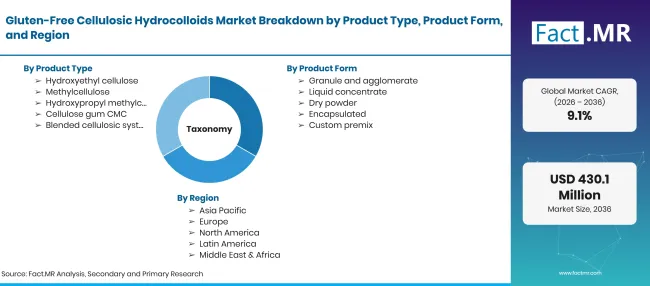
Gluten Free Cellulosic Hydrocolloids Taxonomy | Source: Fact.MR
| Items | Values |
|---|---|
| Quantitative Units (2026) | USD 180.0 Million |
| Product Type | Hydroxyethyl cellulose, Cellulose gum CMC, Blended cellulosic system, Hydroxypropyl methylcellulose, Methylcellulose |
| Product Form | Granule and agglomerate, Dry powder, Encapsulated, Custom premix, Liquid concentrate |
| Application | Nutrition and supplements, Bakery and confectionery, Dairy and alternatives, Beverages, Savory and other |
| Buyer Type | Ingredient blender, Food manufacturer, Nutrition brand, Beverage producer, Contract formulator |
| Regions Covered | North America, Latin America, Europe, Asia Pacific, Middle East & Africa |
| Countries Covered | United States, Germany, France, Japan, United Kingdom, and other countries |
| Key Companies Profiled | Dow, IFF, Ashland, Shin-Etsu Chemical, Lotte Fine Chemical, CP Kelco |
| Additional Attributes | Dollar revenue in the Gluten-Free Cellulosic Hydrocolloids Market is segmented by product type (hydroxyethyl cellulose, cellulose gum, HPMC, methylcellulose, blends), product form, application, buyer type and region. |
Source: Fact.MR analysis. Updated Nov 21, 2026
Source: Fact.MR analysis.
Gluten-Free Cellulosic Hydrocolloids Market by Segments
-
Product Type
- Hydroxyethyl cellulose
- Cellulose gum CMC
- Blended cellulosic system
- Hydroxypropyl methylcellulose
- Methylcellulose
-
Product Form
- Granule and agglomerate
- Dry powder
- Encapsulated
- Custom premix
- Liquid concentrate
-
Application
- Nutrition and supplements
- Bakery and confectionery
- Dairy and alternatives
- Beverages
- Savory and other
-
Buyer Type
- Ingredient blender
- Food manufacturer
- Nutrition brand
- Beverage producer
- Contract formulator
-
Region:
- North America
- United States
- Canada
- Mexico
- Europe
- Germany
- United Kingdom
- France
- Italy
- Spain
- Rest of Europe
- Asia Pacific
- China
- India
- Japan
- South Korea
- Australia
- Rest of Asia Pacific
- Latin America
- Brazil
- Argentina
- Rest of Latin America
- Middle East & Africa
- GCC Countries
- South Africa
- Rest of Middle East & Africa
- North America
Frequently Asked Questions
How big is the global Gluten-Free Cellulosic Hydrocolloids Market in 2026?
What will be the size of the Gluten-Free Cellulosic Hydrocolloids Market by 2036?
How fast will the Gluten-Free Cellulosic Hydrocolloids Market grow during the forecast period?
Which product type segment holds the largest share of the Gluten-Free Cellulosic Hydrocolloids Market?
Who worked on this report


Preview the report firsthand - request a free sample
Free SampleGet the brochure for pricing and purchase details
Download PDF