- Market Value (2025): USD 37.2 Mn
- Estimated Value (2026): USD 40.0 Mn
- Forecast Value (2036): USD 83.2 Mn
- CAGR (2026-2036): 7.6%
Dairy-Analogue Soy Proteins Market Forecast and Outlook 2026 to 2036
The dairy-analogue soy proteins market is projected to grow from USD 40.0 million in 2026 to USD 83.2 million by 2036. Demand for dairy-analogue soy proteins is likely to grow at a CAGR of 7.6% over the forecast period.
Orders for dairy-analogue soy proteins are increasing as producers of plant-based milk, yogurt, cheese and cream need proteins that gel, emulsify and ferment like milk proteins while matching dairy on protein content. Specialist producers are offering deflavored soy bases, fermentable proteins for yogurt and cheese cultures, and creaming proteins with high emulsifying power. For example, in October 2026, Danone reported that its dairy and plant-based business grew 3.6% like-for-like in the third quarter, with strong performance from brands including Alpro.
Market figures and highlights for the Dairy-Analogue Soy Proteins Market
- Sales of dairy-analogue soy proteins stood at USD 37.2 million in 2025
- Dairy-Analogue Soy Proteins Market Value (2026): USD 40.0 million
- Dairy-Analogue Soy Proteins Market Forecast Value (2036): USD 83.2 million
- Dairy-Analogue Soy Proteins Market Forecast CAGR (2026-2036): 7.6%
- Leading Product Type: Fermented soy dairy analog (24.9%)
- Companies profiled: ADM, Cargill, Bunge, Wilmar, Fuji Oil
- Countries covered by growth analysis: United Kingdom, France, United States, Germany, Italy
In May 2026, the Good Food Institute reported that global retail sales of plant-based meat, seafood, milk, yogurt, ice cream and cheese totaled an estimated USD 28.9 billion in 2025, up 3% from 2024. More businesses are purchasing dairy-analogue soy proteins as dairy alternatives remain the largest part of that market and brands seek better nutrition than oat or almond bases provide. Specialist producers are stressing protein quality and neutral taste.
Dairy-Analogue Soy Proteins Market
| Metric | Value |
|---|---|
| Estimated Value in (2026) | USD 40.0 million |
| Forecast Value in (2036) | USD 83.2 million |
| Forecast CAGR (2026 to 2036) | 7.6% |
Source: Fact.MR analysis. Updated Nov 21, 2026
Source: Fact.MR analysis.
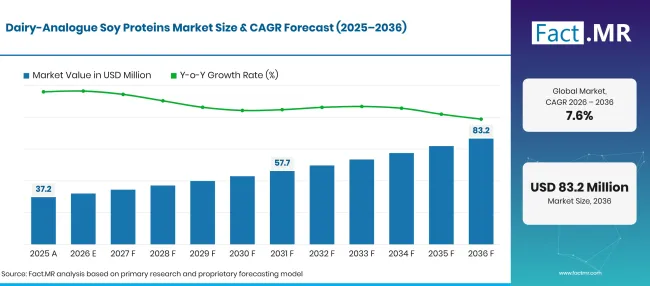
Dairy Analogue Soy Proteins Forecast Global | Source: Fact.MR
Category
| Category | Segments |
|---|---|
| Product Type | Fermented soy dairy analog, Soy cream protein, Soy cheese protein, Soy yogurt protein, Soy milk protein base |
| Product Form | Granule and agglomerate, Liquid concentrate, Dry powder, Encapsulated, Custom premix |
| Application | Beverages, Nutrition and supplements, Bakery and confectionery, Dairy and alternatives, Savory and other |
| Buyer Type | Contract formulator, Food manufacturer, Beverage producer, Nutrition brand, Ingredient blender |
| Region | United Kingdom; France; United States; Germany; Italy |
Source: Fact.MR analysis. Updated Nov 21, 2026
Segmental Analysis
Why do fermented soy dairy analogs lead product demand in the Dairy-Analogue Soy Proteins Market?
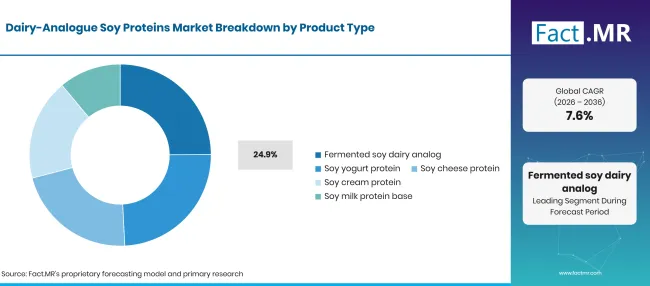
Dairy Analogue Soy Proteins Breakdown Product Type | Source: Fact.MR
Fermented soy dairy analog proteins hold 24.9% of the dairy-analogue soy proteins market in 2026, valued at USD 10.0 million, as lactic cultures help reduce beany flavors and develop the acidity and texture associated with yogurt and fresh cheese. A 2025 study on probiotic lactic acid bacteria examined how different cultures affect soy yogurt fermentation, gel formation and sensory properties. Acidification helps soy proteins form a gel structure.
How are granules and agglomerates leading form demand in the Dairy-Analogue Soy Proteins Market?
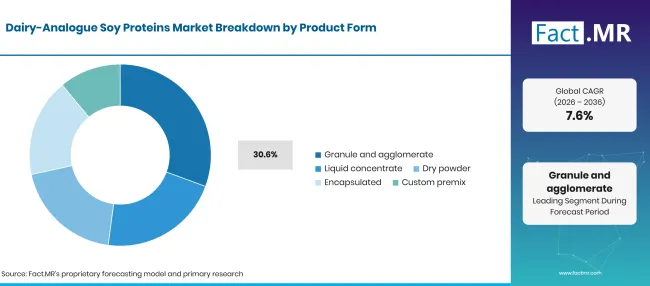
Dairy Analogue Soy Proteins Breakdown Product Form | Source: Fact.MR
Granules and agglomerates account for 30.6% of dairy-analogue soy proteins revenue in 2026, generating USD 12.2 million, because improved wettability supports faster hydration during plant-based beverage production. Research published in October 2026 examined soy protein isolate granules developed for rapid wetting and dispersion, highlighting the role of particle structure in powder performance. Specialist producers are refining granulation methods to improve handling and mixing efficiency.
Why do beverages lead application demand in the Dairy-Analogue Soy Proteins Market?
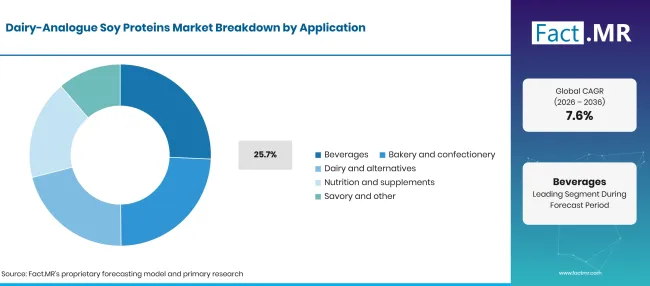
Dairy Analogue Soy Proteins Breakdown Application | Source: Fact.MR
Beverages contribute 25.7% of dairy-analogue soy proteins revenue in 2026, equivalent to approximately USD 10.3 million, supported by demand for soy drinks, barista-style milks, and protein-fortified plant beverages. Soy proteins help manufacturers achieve dairy-like protein content while supporting functional performance. Heat stability remains important in coffee applications. Manufacturers are refining protein formulations for UHT processing and foaming, with future ingredient selection reflecting flavor, nutritional content, and beverage stability.
How are contract formulators leading buyer demand in the Dairy-Analogue Soy Proteins Market?
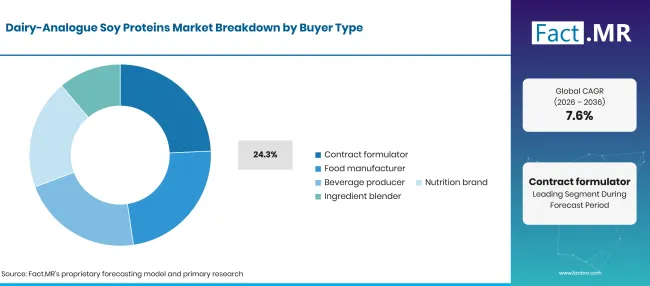
Dairy Analogue Soy Proteins Breakdown Buyer Type | Source: Fact.MR
Contract formulators capture 24.3% of dairy-analogue soy proteins revenue in 2026, valued at about USD 9.7 million, as plant-based brands increasingly outsource product development and manufacturing to specialist partners. Co-manufacturers with aseptic filling and fermentation capabilities influence protein selection during recipe development. Soy protein suppliers are offering functional concentrates and tailored formulations to these businesses. Continued outsourcing will support demand from contract formulators seeking consistent product quality and efficient production.
Dairy-Analogue Soy Proteins Market-Drivers, Restraints & Trends
Drivers
Orders for dairy-analogue soy proteins are increasing as plant-based dairy becomes more affordable and widely stocked. For example, in June 2026, GFI Europe reported that Europe's plant-based food retail market grew as prices became more competitive, and that Germany remained the region's largest market. Specialist producers are supporting private-label ranges that need cost-efficient, high-protein bases.
Restraints
European soybean supply conditions are influencing raw material availability and production costs for soy protein manufacturers. In November 2026, Donau Soja estimated that the EU-27 soybean harvest would decline by around 20% to approximately 2.36 million tonnes in 2026, reflecting lower output across several producing countries. Ingredient suppliers will assess sourcing costs and supply stability when planning dairy-alternative formulations.
Trend
Protein-Rich Plant-Based Dairy Orders for plant-based yogurts and drinks with dairy-level protein are increasing as consumers follow high-protein diets. Suppliers are increasing protein load without chalkiness. Danone said in October 2026 that High Protein brands contributed to growth in its dairy and plant-based division.
Trend
Investment Shift toward Europe In May 2026, the Good Food Institute reported that investment in Europe-headquartered plant-based companies reached USD 216 million, exceeding North America's USD 181 million for the fourth consecutive year. Demand for specialized ingredients is rising as European brands scale.
Dairy-Analogue Soy Proteins Market by Analysis by Key Country
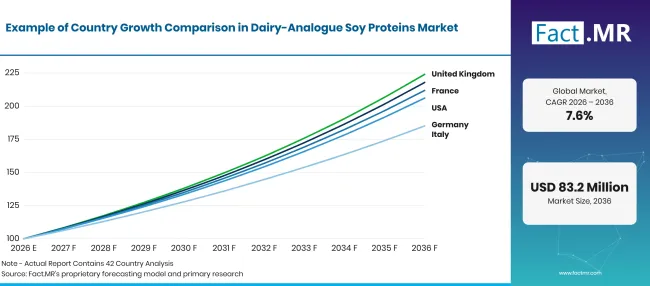
Dairy Analogue Soy Proteins Growth Index | Source: Fact.MR
| Country | CAGR (2026-2036) |
|---|---|
| United Kingdom | 8.4% |
| France | 8.1% |
| United States | 7.8% |
| Germany | 7.5% |
| Italy | 6.4% |
Source: Fact.MR analysis. Updated Nov 21, 2026
Source: Fact.MR analysis.
What is driving dairy-analogue soy proteins demand in the United Kingdom?
In October 2026, Danone reported strong performance in its dairy and plant-based business in the United Kingdom, supported by Alpro.
Demand for dairy-analogue soy proteins in the United Kingdom is projected to grow at an 8.4% CAGR, the fastest among the five key countries. According to GFI Europe's 2026 retail analysis, 31.3% of UK households purchased plant-based milk at least once in 2025. This figure covers the broader plant-based milk category, including soy, oat and other alternatives. Soy protein suppliers are supporting manufacturers developing protein-rich dairy alternatives.
How is category growth supporting dairy-analogue soy proteins sales in France?
Sales of dairy-analogue soy proteins in France are projected to grow at an 8.1% CAGR as plant-based dairy gains shoppers.
Danone cited France among its best-performing markets for dairy and plant-based products in the third quarter of 2026, and GFI Europe reported rising French plant-based volumes. Specialist producers are serving French soy dessert and drink makers.
What is shaping dairy-analogue soy proteins demand in the United States?
Demand for dairy-analogue soy proteins in the United States is projected to grow at a 7.8% CAGR as protein-focused consumers return to soy milk and high-protein plant yogurts.
ADM reported in November 2026 that the recovery of its Decatur East protein plant supported Human Nutrition results. Suppliers of dairy-analogue soy proteins, including ADM, Cargill, are supplying U.S. plant-based dairy brands.
How is retail support shaping dairy-analogue soy proteins sales in Germany?
Sales of dairy-analogue soy proteins in Germany are projected to grow at a 7.5% CAGR as discounters widen plant-based dairy lines.
GFI Europe reported in June 2026 that German retailers were pushing to increase the share of plant-based protein sales through range expansion and investment. Material suppliers are serving German private-label manufacturers.
Why is growth slower for dairy-analogue soy proteins in Italy?
Demand for dairy-analogue soy proteins in Italy is projected to grow at a 6.4% CAGR, the slowest among the five countries, as the plant-based dairy category is smaller and traditional dairy culture is strong.
Italy’s plant-based milk and drinks retail sales reached EUR 342 million in 2025, according to GFI Europe, while Valsoia reported higher nine-month revenue in November 2026. Specialist producers are serving Italian soy drink and gelato producers.
Competitive Landscape for Dairy-Analogue Soy Proteins Market
The dairy-analogue soy proteins market includes global ingredient manufacturers and companies specializing in soy processing. ADM has developed protein isolates and concentrates for dairy-free beverages, while Cargill supplies plant-based ingredients for food formulations. Fuji Oil uses its Ultra Soy Separation technology to produce soy cream and cheese-like ingredients. Bunge and Wilmar contribute through soybean processing and ingredient supply operations. Differences in taste, gel formation, protein concentration and heat stability influence how manufacturers choose suppliers for dairy alternatives.
In May 2026, ADM launched ProFam 883, a soy protein isolate developed for protein-rich beverages with clean taste and high solubility. Fuji Oil's 2025 corporate materials also highlighted its patented soy separation technology, which produces soy cream and low-fat soy milk with distinct functional properties. In July 2026, the European Commission confirmed preparations for the EU Deforestation Regulation, scheduled to apply to large and medium-sized operators from December 30, 2026.
Recent Developments
- In May 2026, ADM launched ProFam 894 soy protein isolate, offering clean taste, light color and medium viscosity for Greek-style yogurt alternatives, yogurt drinks and other dairy-free products requiring smooth texture.
- In March 2026, Bunge completed its acquisition of IFF's soy protein concentrate, lecithin and soy crushing businesses, expanding its ingredient portfolio for plant-based foods, protein enrichment and food processing applications.
Key Players in Dairy-Analogue Soy Proteins Market
Key companies profiled include ADM; Cargill; Bunge; Wilmar; and Fuji Oil.
- ADM
- Cargill
- Bunge
- Wilmar
- Fuji Oil
Bibliography
- ADM. (2026, May 20). ADM advances protein innovation with new ingredient solutions. Official press release
- Archer-Daniels-Midland Company. (2026, November 3). ADM reports third quarter 2026 results.
- Bunge. (2026, March 2). Bunge completes acquisition of IFF's soy protein concentrate, lecithin, and crush business. Official acquisition announcement
- Danone S.A. (2026, October 28). 2026 third quarter sales: Solid performance in Q3; broad-based growth across categories and geographies.
- European Commission, Directorate-General for Agriculture and Rural Development. (2026, July 7). Action plan for resilience, strategic autonomy and sustainability of the EU protein system.
- European Environment Agency. (2026, June 22). Protein diversification—Strategic risks and opportunities for sustainable food systems (EEA Report No. 05/2026).
- GFI Europe. (2026, June 9). Germany remains Europe’s leading market for plant-based foods with 3.1% growth in sales value.
- The Good Food Institute. (2026). 2026 state of the industry report: Plant-based meat, seafood, eggs, dairy, and ingredients.
- Organisation for Economic Co-operation and Development, & Food and Agriculture Organization of the United Nations. (2026). OECD-FAO agricultural outlook 2026–2035. OECD Publishing.
- U.S. Department of Agriculture, Foreign Agricultural Service. (2026, April 10). Oilseeds and products annual: European Union (Report No. E42026-0029).
- Valsoia S.p.A. (2026, November 9). The Board of Directors approves the additional periodic information referred to the first nine months of 2026.
Segmentation
Scope of Report
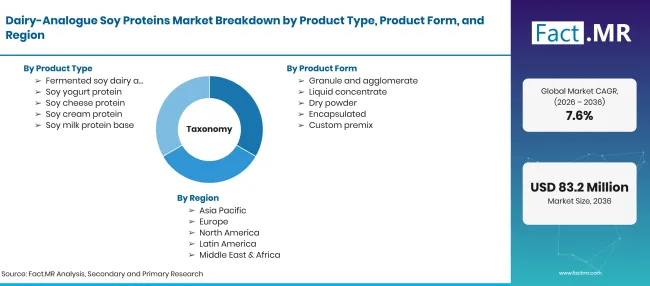
Dairy Analogue Soy Proteins Taxonomy | Source: Fact.MR
| Items | Values |
|---|---|
| Quantitative Units (2026) | USD 40.0 Million |
| Product Type | Fermented soy dairy analog, Soy cream protein, Soy cheese protein, Soy yogurt protein, Soy milk protein base |
| Product Form | Granule and agglomerate, Liquid concentrate, Dry powder, Encapsulated, Custom premix |
| Application | Beverages, Nutrition and supplements, Bakery and confectionery, Dairy and alternatives, Savory and other |
| Buyer Type | Contract formulator, Food manufacturer, Beverage producer, Nutrition brand, Ingredient blender |
| Regions Covered | North America, Latin America, Europe, East Asia, South Asia and Pacific, Middle East & Africa |
| Countries Covered | United Kingdom, France, United States, Germany, Italy, and other countries |
| Key Companies Profiled | ADM, Cargill, Bunge, Wilmar, Fuji Oil |
| Additional Attributes | Dollar revenue in the Dairy-Analogue Soy Proteins Market is segmented by product type (fermented soy analog, soy cream, soy cheese, soy yogurt, soy milk base proteins), product form, application, buyer type and region. |
Source: Fact.MR analysis. Updated Nov 21, 2026
Dairy-Analogue Soy Proteins Market by Segments
-
Product Type
- Fermented soy dairy analog
- Soy cream protein
- Soy cheese protein
- Soy yogurt protein
- Soy milk protein base
-
Product Form
- Granule and agglomerate
- Liquid concentrate
- Dry powder
- Encapsulated
- Custom premix
-
Application
- Beverages
- Nutrition and supplements
- Bakery and confectionery
- Dairy and alternatives
- Savory and other
-
Buyer Type
- Contract formulator
- Food manufacturer
- Beverage producer
- Nutrition brand
- Ingredient blender
-
Region:
- North America
- United States
- Canada
- Mexico
- Europe
- Germany
- United Kingdom
- France
- Italy
- Spain
- Rest of Europe
- Asia Pacific
- China
- India
- Japan
- South Korea
- Australia
- Rest of Asia Pacific
- Latin America
- Brazil
- Mexico
- Argentina
- Rest of Latin America
- Middle East & Africa
- GCC Countries
- South Africa
- Rest of Middle East & Africa
- North America
Frequently Asked Questions
How big is the global Dairy-Analogue Soy Proteins Market in 2026?
What will be the size of the Dairy-Analogue Soy Proteins Market by 2036?
How fast will the Dairy-Analogue Soy Proteins Market grow during the forecast period?
Which product type segment holds the largest share of the Dairy-Analogue Soy Proteins Market?
Who worked on this report


Preview the report firsthand - request a free sample
Free SampleGet the brochure for pricing and purchase details
Download PDF