- Market Value (2025): USD 13.7 Bn
- Estimated Value (2026): USD 14.9 Bn
- Forecast Value (2036): USD 33.5 Bn
- CAGR (2026-2036): 8.5%
What is the GPON Equipment Market forecast to be worth by 2036?
USD 14.9 billion in 2026 to USD 33.5 billion by 2036 at an 8.5% CAGR.
- According to Fact.MR estimates, the GPON equipment market was valued at USD 13.7 billion in 2025.
- Market value is projected to rise from USD 14.9 billion in 2026 to USD 33.5 billion by 2036.
- The market is forecast to expand at an 8.5% CAGR from 2026 to 2036 as telecom operators extend fiber-based broadband coverage and upgrade existing access networks.
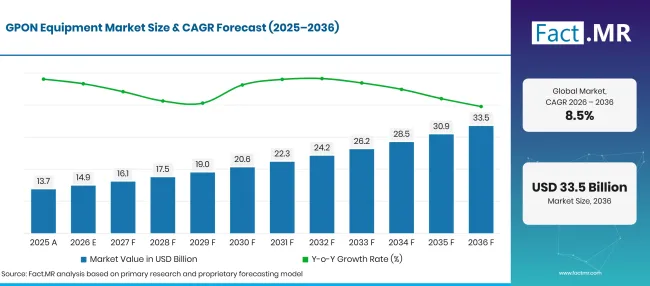
Gpon Equipment Market Forecast Global | Source: Fact.MR
| Year | Basis | Market Value (USD billion) |
|---|---|---|
| 2025 | Actual | 13.7 |
| 2026 | Estimate | 14.9 |
| 2036 | Forecast | 33.5 |
| CAGR 2026 to 2036 | Forecast period | 8.5% |
Source: Fact.MR analysis. Updated Oct 31, 2026
What are the defining numbers behind GPON Equipment Market growth?
USD 18.6 billion absolute opportunity between 2026 and 2036.
- Demand Drivers in the Market
- Telecommunications operators are expanding fiber-based broadband infrastructure to accommodate rising household data consumption and demand for higher-speed internet subscriptions. This expansion is supporting purchases of Optical Line Terminals (OLTs) and Optical Network Terminals (ONTs) across new Fiber-to-the-Home (FTTH) deployments.
- Broadband providers are upgrading existing fiber networks to deliver higher bandwidth and improve network management efficiency. Multi-PON equipment enables operators to introduce newer access technologies while retaining existing fiber infrastructure and reducing the need for extensive network replacement.
- Residential broadband expansion is increasing demand for subscriber-side optical equipment. ONTs with integrated Wi-Fi capabilities and multiple Ethernet interfaces help service providers address growing household requirements for reliable connectivity and support multiple connected devices.
- Government-backed broadband programmes and private telecommunications investments are accelerating fiber deployment in underserved and semi-urban locations. Compact OLT equipment enables operators to extend network coverage while supporting efficient infrastructure installation across areas with varying connectivity requirements.
- Key Segments Analyzed
- By Component: ONT equipment holds a 52.3% market share in 2026, supported by increasing fiber subscriber connections and the need for customer-premises optical termination devices.
- By Technology: 2.5G PON captures a 48.6% share in 2026, reflecting its established deployment base and suitability for gigabit broadband access.
- By Application: FTTH leads with a 58.7% share in 2026 as fiber connections increasingly reach residential premises.
- By End-User: Residential customers represent 62.1% of the market in 2026, reflecting demand for high-speed household broadband services.
- Analyst Opinion at Fact.MR
- Shambhu Nath Jha, Principal Consultant at Fact.MR, states, “GPON equipment suppliers will need to balance affordable fiber deployment with the growing requirement for higher bandwidth. Vendors offering interoperable OLT and ONT platforms with flexible upgrade paths are likely to remain relevant as operators expand FTTH networks and introduce newer PON technologies.”
- Strategic Implications
- Equipment manufacturers should develop flexible OLT platforms that support GPON alongside higher-speed PON technologies to reduce network replacement requirements.
- Telecommunications operators need to prioritize ONT interoperability, network reliability and subscriber management when selecting equipment for large-scale FTTH deployments.
- Broadband service providers must consider compact and scalable OLT configurations when extending fiber coverage into smaller cities and underserved locations.
- Equipment suppliers can strengthen product portfolios with advanced ONTs that support higher-speed broadband, Wi-Fi connectivity and multiple residential applications.
- Vendors should demonstrate compatibility with existing optical distribution networks to reduce the cost and complexity of network upgrades.
Germany is set to record a 10.2% CAGR through 2036. Brazil is forecast to advance at 9.4%, followed by the USA at 8.5%. The UK is estimated to expand at 7.6%, while Japan is projected to record a 6.7% CAGR.
How does the GPON Equipment Market break down by segment?
In Fact.MR’s segmentation, ONT leads Component at 52.3%; 2.5G PON leads Technology at 48.6%; FTTH leads Application at 58.7%; and Residential leads End-User at 62.1%.
Which Component dominates?
ONT is projected to account for 52.3% of the market in 2026.
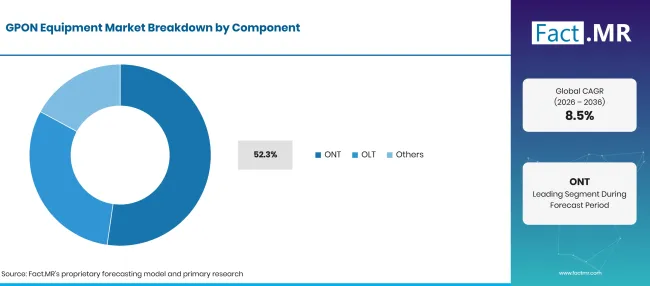
Gpon Equipment Market Breakdown Component | Source: Fact.MR
| Component | Share (2026) |
|---|---|
| ONT (Leading segment) | 52.3% |
| Other segments combined | 47.7%* |
| Total | 100.0% |
Source: Fact.MR analysis. Updated Oct 31, 2026
ONT equipment provides the optical interface between the fiber network and subscriber premises. Increasing FTTH connections create demand for ONTs that can support reliable broadband access and multiple connected devices. Equipment selection also depends on Ethernet interfaces, Wi-Fi capabilities, power efficiency and compatibility with service-provider infrastructure. OLT equipment remains essential for aggregating subscriber connections and managing optical access networks.
What leads the Technology segment?
2.5G PON is projected to account for 48.6% of the market in 2026.
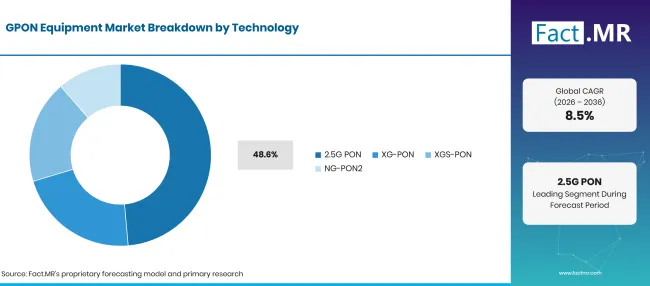
Gpon Equipment Market Breakdown Technology | Source: Fact.MR
| Technology | Share (2026) |
|---|---|
| 2.5G PON (Leading segment) | 48.6% |
| Other segments combined | 51.4%* |
| Total | 100.0% |
Source: Fact.MR analysis. Updated Oct 31, 2026
GPON operating at a nominal downstream rate of approximately 2.5 Gbit/s maintains a significant position because of its suitability for established fiber broadband infrastructure and residential connectivity requirements. XG-PON and XGS-PON support higher bandwidth requirements and provide upgrade options for operators serving customers with increasing data consumption. NG-PON2 offers additional network flexibility through wavelength-based capacity allocation. Technology selection depends on subscriber requirements, network investment and compatibility with deployed infrastructure.
How does Application shape demand?
FTTH is likely to account for a 58.7% share in 2026.
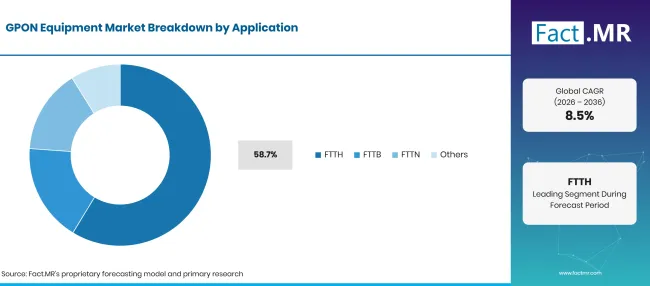
Gpon Equipment Market Breakdown Application | Source: Fact.MR
| Application | Share (2026) |
|---|---|
| FTTH (Leading segment) | 58.7% |
| Other segments combined | 41.3%* |
| Total | 100.0% |
Source: Fact.MR analysis. Updated Oct 31, 2026
FTTH connects optical fiber directly to residential or commercial premises, supporting higher broadband speeds and more reliable connectivity. Telecommunications providers deploy GPON equipment to expand subscriber coverage and replace older access infrastructure. FTTB serves multi-dwelling buildings and commercial properties, while FTTN uses fiber connections to neighborhood nodes before the final connection to subscribers. Other applications address specialized network deployment requirements.
Which End-User category leads?
Residential customers are set to represent a 62.1% share in 2026.
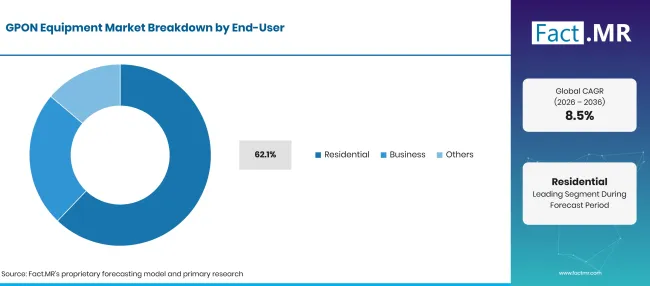
Gpon Equipment Market Breakdown End User | Source: Fact.MR
| End-User | Share (2026) |
|---|---|
| Residential (Leading segment) | 62.1% |
| Other segments combined | 37.9%* |
| Total | 100.0% |
Source: Fact.MR analysis. Updated Oct 31, 2026
Residential demand is supported by increasing dependence on high-speed internet for entertainment, remote working, online education and connected household devices. Broadband providers require scalable ONT installations to connect new subscribers and maintain service quality. Business customers require optical access equipment that can support higher availability, enterprise connectivity and consistent network performance.
What is accelerating GPON Equipment Market adoption, and what is holding it back?
FTTH expansion and higher broadband requirements support equipment demand, while infrastructure costs and technology transitions create deployment challenges.
Drivers Impact Analysis
| DRIVER | (~) % IMPACT ON CAGR | GEOGRAPHIC RELEVANCE | IMPACT TIMELINE |
|---|---|---|---|
| Expansion of FTTH infrastructure | +1.1% | Global | Medium term (2–4 years) |
| Rising residential broadband consumption | +0.9% | Global | Short term (≤ 2 years) |
| Migration toward higher-capacity PON | +0.8% | Asia, Europe, Americas | Medium term (2–4 years) |
| Broadband infrastructure investment | +0.7% | Europe, Asia, Americas | Long term (≥ 4 years) |
| Demand for scalable optical access equipment | +0.5% | Global | Medium term (2–4 years) |
Source: Fact.MR analysis. Updated Oct 31, 2026
Opportunity Impact Analysis
| OPPORTUNITY | (~) % IMPACT ON CAGR | GEOGRAPHIC RELEVANCE | IMPACT TIMELINE |
|---|---|---|---|
| Multi-PON equipment deployment | +0.9% | Global | Medium term (2–4 years) |
| Fiber expansion in underserved areas | +0.7% | Asia, Latin America | Long term (≥ 4 years) |
| Advanced residential ONTs | +0.6% | Global | Short term (≤ 2 years) |
| Compact and outdoor OLT systems | +0.5% | Emerging markets | Medium term (2–4 years) |
| Migration to XGS-PON and 50G PON | +0.8% | Europe, Asia, North America | Long term (≥ 4 years) |
Source: Fact.MR analysis. Updated Oct 31, 2026
Restraints Impact Analysis
| RESTRAINT | (~) % IMPACT ON CAGR | GEOGRAPHIC RELEVANCE | IMPACT TIMELINE |
|---|---|---|---|
| High fiber deployment expenditure | -0.9% | Global | Short term (≤ 2 years) |
| Network upgrade and replacement costs | -0.7% | Global | Medium term (2–4 years) |
| Equipment interoperability challenges | -0.6% | Global | Short term (≤ 2 years) |
| Uneven fiber infrastructure availability | -0.5% | Emerging markets | Long term (≥ 4 years) |
| Price competition among equipment suppliers | -0.4% | Global | Medium term (2–4 years) |
Source: Fact.MR analysis. Updated Oct 31, 2026
Which countries are scaling the GPON Equipment Market through 2036?
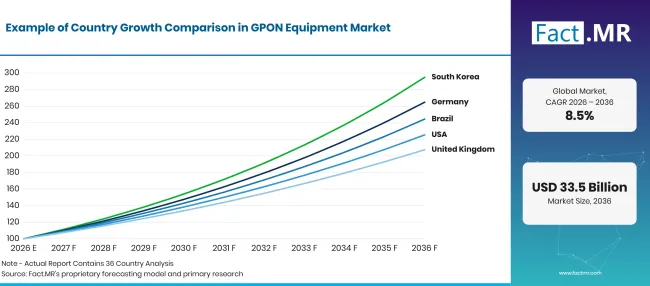
Gpon Equipment Market Growth Index | Source: Fact.MR
| Country | CAGR (2026–2036) |
|---|---|
| Germany | 10.2% |
| Brazil | 9.4% |
| USA | 8.5% |
| UK | 7.6% |
| Japan | 6.7% |
Source: Fact.MR analysis. Updated Oct 31, 2026
What supports Germany adoption?
10.2% CAGR, driven by continued fibre network expansion and rising demand for high-speed broadband connections.
Germany's GPON equipment market is supported by continued investment in fiber broadband infrastructure and efforts to extend fiber connectivity beyond major urban areas. Telecommunications providers require scalable optical access equipment to connect residential customers and support higher broadband speeds. Deployment of modern OLTs and ONTs can help operators expand FTTH coverage and improve network capacity.
Germany's GPON equipment market is supported by continued investment in fibre broadband infrastructure and efforts to extend connectivity beyond major urban areas. According to the Federal Network Agency's 2026 Telecoms Annual Report, active FTTH and FTTB connections increased from 5.3 million at the end of 2024 to 6.4 million at the end of 2025. Fibre's share of active fixed broadband connections also increased from 13.7% to 16.5%. This expansion supports demand for OLTs and ONTs as operators connect additional subscribers and increase network capacity. [8]
How is Brazil developing GPON equipment adoption?
9.4% CAGR, supported by expanding fibre broadband connections and infrastructure development across underserved locations.
Brazil's market growth is supported by expanding broadband infrastructure and increasing fiber deployment across residential and business locations. Internet service providers require cost-effective OLT and ONT equipment to extend coverage into smaller cities and underserved communities. Compact optical access solutions can support network expansion where subscriber density and infrastructure conditions vary.
Brazil's market growth is supported by expanding broadband infrastructure and increasing fibre deployment across residential and business locations. According to Brazil's telecommunications regulator Anatel, the country recorded 55.4 million fixed broadband connections in the second quarter of 2026, including 44.7 million connections delivered through optical fibre. Fibre therefore accounted for more than 80% of fixed broadband connections. This growing subscriber base creates demand for cost-effective OLT and ONT equipment as internet service providers extend coverage into smaller cities and underserved communities. [9]
What supports United States adoption?
8.5% CAGR, driven by federal broadband funding and continued fibre network deployment in underserved communities.
The US market is supported by fiber broadband investment and the modernization of existing telecommunications infrastructure. Broadband providers are expanding FTTH services and upgrading access networks to accommodate growing residential and business bandwidth requirements. Multi-PON equipment offers an upgrade path for operators seeking to introduce higher-speed services without replacing their entire fiber infrastructure.
The US market is supported by fibre broadband investment and the modernization of existing telecommunications infrastructure. In May 2026, the National Telecommunications and Information Administration reported that 54 of 56 states and territories had received approval for their final Broadband Equity, Access, and Deployment (BEAD) proposals. The programme provides USD 42.45 billion in federal funding for broadband deployment. These investments create opportunities for GPON equipment suppliers as providers extend fibre networks and upgrade access infrastructure. [10]
How is the United Kingdom building adoption?
7.6% CAGR, shaped by rising full-fibre broadband availability and continued investment in nationwide network coverage.
The UK market benefits from continued fiber network deployment and competition among broadband providers. Network operators require scalable optical equipment to connect residential subscribers and extend full-fiber coverage. Adoption of advanced OLT platforms and compatible ONTs can support higher subscriber capacity and improve network deployment flexibility.
The UK market benefits from continued fibre network deployment and competition among broadband providers. According to Ofcom's May 2026 update, full-fibre broadband was available to 24.9 million residential premises in January 2026, representing 82% of UK homes. Full-fibre connections across residential and commercial premises reached 12.4 million. This expanding network footprint supports demand for scalable OLT platforms and compatible ONTs to connect additional subscribers and improve broadband capacity. [11]
What supports Japan adoption?
6.7% CAGR, supported by extensive fibre broadband coverage and ongoing demand for reliable high-speed connectivity.
Japan's GPON equipment market is supported by an established fiber broadband infrastructure and demand for reliable high-speed connectivity. Telecommunications operators continue to improve optical access networks to accommodate changing residential and enterprise requirements. Equipment upgrades and higher-capacity PON technologies provide opportunities for suppliers offering flexible network solutions. Japan's GPON equipment market is supported by an established fibre broadband infrastructure and continued demand for high-speed connectivity.
Who leads the GPON Equipment Market?
Fact.MR identifies Huawei Technologies, Nokia Corporation, ZTE Corporation, FiberHome Technologies, Calix Inc., ADTRAN Inc. as the selected companies with verifiable activity in the wider PON equipment market and recent optical-access product developments.
Huawei, Nokia, ZTE and FiberHome maintain significant product activity across optical access infrastructure and next-generation PON solutions. Huawei Technologies published its announcement on next-generation optical network products in March 2026 [1]. Nokia unveiled mass-market 25G PON residential ONTs in March 2025 [2]. Nokia announced its flexible 50G/25G/10G PON solution on October 12, 2026 [3]. ZTE presented its FTTx portfolio at Network X 2025 in October 2025, specifically on October 14, 2025 [4]. FiberHome showcased AI-enabled 10-gigabit all-optical network technologies at PTEXPO 2025 in September 2025 [5].
Calix and ADTRAN participate in fiber access equipment through OLT platforms and subscriber-side optical products. Cisco offers routed PON ONTs for high-speed optical access applications. In May 2026, Calix introduced its 50G-PON capabilities [6]. ADTRAN discussed its SDX 6400 Series and 50G PON technology in January 2025 [7].
Competition is shaped by OLT capacity, ONT functionality, multi-generation PON compatibility, network management capabilities and equipment interoperability. Vendors are increasingly developing platforms that allow operators to migrate from established GPON infrastructure toward XGS-PON, 25G PON and 50G PON without requiring complete network replacement.
Which companies are the key providers?
Key companies profiled include Huawei Technologies; Nokia Corporation; ZTE Corporation; FiberHome Technologies; Calix Inc.; and ADTRAN Inc.
- Huawei Technologies
- Nokia Corporation
- ZTE Corporation
- FiberHome Technologies
- Calix Inc.
- ADTRAN Inc.
Bibliography
- [1] Huawei Technologies. (2026, March 2). Huawei launches next generation optical network products and solutions to drive new growth in the AI era.
- [2] Nokia Corporation. (2025, March 18). Nokia unveils two mass-market 25G PON residential fiber ONTs, making large-scale multi-gig and 10G+ viable and affordable
- [3] Nokia Corporation. (2026, October 12). Nokia launches flexible 50G/25G/10GPON solution to accelerate AI-ready fiber broadband.
- [4] ZTE Corporation. (2025, October 14). ZTE unveils comprehensive portfolio at Network X to accelerate FTTx rollout and smart home evolution.
- [5] FiberHome Technologies. (2025, September 25). PTEXPO 2025[PTEXPO 2025: AI-powered 10-gigabit all-optical network].
- [6] Calix, Inc. (2026, May 12). Calix 50G-PON extends platform advantage to scale services without rebuilding networks.
- [8] Bundesnetzagentur. (2026, June 5). Telecoms Annual Report 2025.
- [9] Agência Nacional de Telecomunicações. (2026, July 15). Anatel divulga Relatório de Monitoramento da Competição do segundo trimestre de 2026.
- [10] National Telecommunications and Information Administration. (2026, May 4). BEAD Progress Dashboard
- [11] Ofcom. (2026, May 13). Connected Nations update: Spring 2026.
This Report Answers
- The report examines GPON equipment demand across ONT and OLT components.
- Technology analysis compares 2.5G PON, XG-PON, XGS-PON and NG-PON2.
- Application analysis evaluates FTTH, FTTB and FTTN deployment.
- Country analysis covers Germany, Brazil, USA, UK and Japan.
- Competitive analysis profiles seven companies with verified optical-access product activity.
- The report examines the transition toward higher-capacity PON infrastructure and its implications for equipment suppliers.
What does the GPON Equipment Market cover?
The market covers optical access equipment used to transmit broadband services through passive optical fiber networks. It includes subscriber-side ONTs, network-side OLTs and other associated optical access equipment. The analysis considers equipment deployed across FTTH, FTTB and FTTN applications and examines technology adoption across the specified PON categories.
What is included in the scope?
Included products comprise optical line terminals, optical network terminals and other equipment directly associated with passive optical network access infrastructure.
The market covers equipment used by telecommunications operators and internet service providers for residential and business broadband connectivity. Products supporting the evolution of GPON networks toward higher-capacity PON technologies are considered where they serve the defined optical access equipment market.
What is excluded from the scope?
The analysis excludes standalone fiber-optic cables, civil construction and fiber installation services.
General telecommunications routers and switches without a direct PON equipment function are excluded. Optical transmission equipment used exclusively in long-haul backbone networks is also outside the defined market boundary. Broadband subscription revenue and telecommunications service charges are not included.
How Was the Analysis Built?
The analysis draws on 120+ sources, 35+ company portfolios, 25+ countries and more than 20 industry interviews.
- Primary Research: Primary research includes discussions with optical equipment manufacturers, telecommunications operators, broadband service providers, distributors, network integrators and industry experts. These discussions examine equipment purchasing priorities, deployment requirements, technology upgrades, interoperability and competitive positioning.
- Desk Research: Desk research covers company product announcements, official product specifications, telecommunications infrastructure statistics, regulatory publications, industry associations, technical standards and broadband investment developments.
- Market Sizing and Forecasting: Market estimates combine historical performance, equipment demand, pricing and shipment trends, subscriber growth, fiber deployment, technology adoption, company participation and country-level growth indicators.
- Data Validation and Update Cycle: Findings are validated by comparing primary interviews with company announcements, product portfolio developments, network deployment activity, partnerships and changes in optical access technologies.
Segmentation
What is the report's scope and coverage?
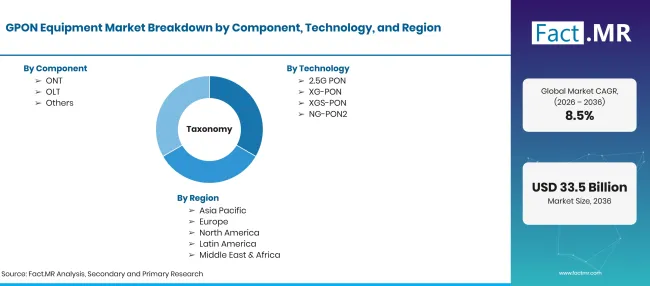
Gpon Equipment Market Taxonomy | Source: Fact.MR
| Attribute | Details |
|---|---|
| Quantitative Units | USD billion |
| Market Definition | The GPON equipment market covers optical line terminals (OLTs), optical network terminals (ONTs), and associated components used in Gigabit Passive Optical Network infrastructure to deliver high-speed fibre broadband connectivity across residential and commercial applications. |
| Component | ONT; OLT; Others |
| Technology | 2.5G PON; XG-PON; XGS-PON; NG-PON2 |
| Application | FTTH; FTTB; FTTN; Others |
| End-User | Residential; Business; Others |
| Regions Covered | North America; Latin America; Western Europe; Eastern Europe; East Asia; South Asia & Pacific; Middle East & Africa |
| Countries Covered | Germany; Brazil; USA; UK; Japan |
| Companies Profiled | Huawei; Nokia; ZTE; FiberHome; Calix; ADTRAN; Cisco |
| Forecast Period | 2026 to 2036 |
| Approach | Market segmentation and scenario-based analysis supported by company product developments and broadband infrastructure indicators |
Source: Fact.MR analysis. Updated Oct 31, 2026
How is the market segmented?
-
By Component
- ONT
- OLT
- Others
-
By Technology
- 2.5G PON
- XG-PON
- XGS-PON
- NG-PON2
-
By Application
- FTTH
- FTTB
- FTTN
- Others
-
By End-User
- Residential
- Business
- Others
-
By Region
- North America
- Latin America
- Western Europe
- Eastern Europe
- East Asia
- South Asia & Pacific
- Middle East & Africa
Frequently Asked Questions
How big is the GPON Equipment Market in 2026?
What is the CAGR from 2026 to 2036?
Which component has the largest market share?
Which technology leads the market?
Which application dominates the market?
Which end-user category leads?
Which country has the highest projected CAGR?
Which companies are covered?
Who worked on this report


Preview the report firsthand - request a free sample
Free SampleGet the brochure for pricing and purchase details
Download PDF