- Market Value (2025): USD 103.0 Mn
- Estimated Value (2026): USD 108.0 Mn
- Forecast Value (2036): USD 173.1 Mn
- CAGR (2026-2036): 4.8%
What is the Omnidirectional Sonobuoy Market forecast to be worth by 2036?
USD 108.0 million in 2026 to USD 173.1 million by 2036 at a 4.8% CAGR.
- According to Fact.MR, the omnidirectional sonobuoy market was valued at USD 103.0 million in 2025.
- Market value is projected to rise from USD 108.0 million in 2026 to USD 173.1 million by 2036.
- The market is forecast to grow at a 4.8% CAGR from 2026 to 2036, supported by requirements for underwater acoustic detection and maritime surveillance.
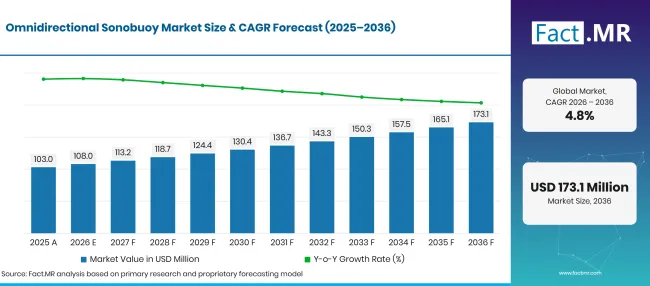
Omnidirectional Sonobuoy Market Forecast Global | Source: Fact.MR
| Year | Basis | Market Value (USD million) |
|---|---|---|
| 2025 | Actual | 103.0 |
| 2026 | Estimate | 108.0 |
| 2036 | Forecast | 173.1 |
| CAGR 2026 to 2036 | Forecast period | 4.8% |
Source: Fact.MR analysis. Updated Oct 31, 2026
What are the defining numbers behind Omnidirectional Sonobuoy Market growth?
USD 65.1 million absolute opportunity between 2026 and 2036.
- Demand Drivers in the Market
- Naval forces require underwater acoustic sensors to support submarine detection, maritime patrol, and anti-submarine warfare.
- Modernization of maritime patrol aircraft and unmanned platforms creates opportunities for sonobuoy deployment. On January 12, 2026, Germany's Bundeswehr announced an order for eight MQ-9B unmanned aircraft for maritime surveillance and anti-submarine warfare missions. The aircraft can carry sonobuoy deployment canisters, with initial deliveries expected from 2028 [1][1]
- Defense agencies need reliable acoustic sensing equipment that can operate at specified depths and transmit usable signals to receiving platforms.
- Key Segments Analyzed
- By Product Type, Passive Sonobuoys account for 48.2% of the market in 2026, reflecting demand for underwater acoustic listening and detection.
- By Application, Defense is projected to account for 64.3% of the market in 2026, supported by anti-submarine warfare and maritime surveillance requirements.
- By Deployment, Airborne deployment is estimated to represent 71.5% of the market in 2026, driven by the use of maritime patrol aircraft and other suitable airborne platforms.
- Analyst Opinion at Fact.MR
- Shambhu Nath Jha, Principal Consultant at Fact.MR, states, “Omnidirectional sonobuoy demand is closely linked to the need for dependable underwater acoustic information across maritime operations. Manufacturers that demonstrate consistent sensing performance, compatibility with deployment platforms, and reliable production capabilities are likely to remain well positioned as defense users modernize their detection systems.”
- Strategic Implications
- Manufacturers should document the acoustic coverage, operating depth, service life, and deployment requirements of each sonobuoy model.
- Suppliers can distinguish omnidirectional passive products from directional sonobuoys and combined active/passive systems when presenting their product portfolios.
- Research institutions and commercial operators must evaluate expendable sensor costs, environmental suitability, and data quality before adopting sonobuoys for nonmilitary applications.
Germany is forecast to record a 4.9% CAGR through 2036. Brazil is forecast to post 5.9%, followed by the USA at 5.6%. The UK is estimated to advance at 4.4%, while Japan is projected to record 3.4%.
How does the Omnidirectional Sonobuoy Market break down by segment?
Fact.MR estimates that Passive Sonobuoys lead Product Type at 48.2%, Defense leads Application at 64.3%, and Airborne deployment leads Deployment at 71.5% in 2026.
Which Product Type dominates?
Passive Sonobuoys are set to hold a 48.2% share in 2026.
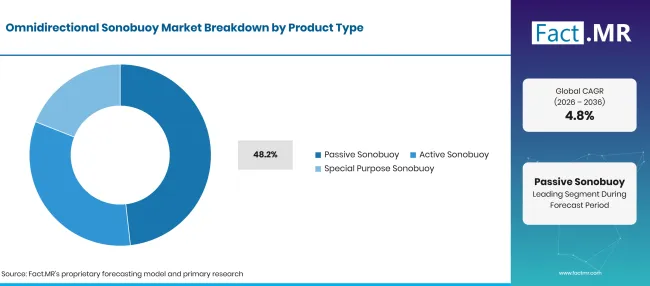
Omnidirectional Sonobuoy Market Breakdown Product Type | Source: Fact.MR
| Product Type | Share (2026) |
|---|---|
| Passive Sonobuoy (Leading segment) | 48.2% |
| Other segments combined | 51.8%* |
| Total | 100.0% |
Source: Fact.MR analysis. Updated Oct 31, 2026
Passive sonobuoys receive underwater acoustic signals without actively transmitting an interrogation pulse. Their role in submarine detection and maritime surveillance makes them relevant to defense users that need persistent acoustic monitoring. Product selection depends on the intended detection mission, operating depth, frequency range, and receiving-system compatibility. Omnidirectional reception should be verified against the technical specifications of the individual model.
What leads the Application segment?
Defense is set to represent a 64.3% share in 2026.
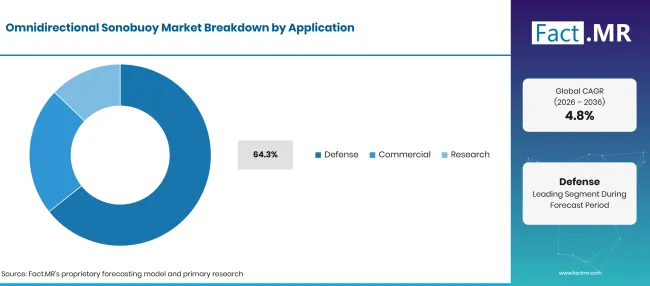
Omnidirectional Sonobuoy Market Breakdown Application | Source: Fact.MR
| Application | Share (2026) |
|---|---|
| Defense (Leading segment) | 64.3% |
| Other segments combined | 35.7%* |
| Total | 100.0% |
Source: Fact.MR analysis. Updated Oct 31, 2026
Defense applications include anti-submarine warfare, maritime patrol, and underwater surveillance. Decisions depend on the operational requirements of naval forces, the performance of acoustic sensors, and compatibility with aircraft and other deployment platforms. Commercial and research applications have different requirements, including environmental monitoring, underwater sound measurement, and data collection.
How does Deployment shape demand?
Airborne deployment is likely to account for 71.5% of the market in 2026.
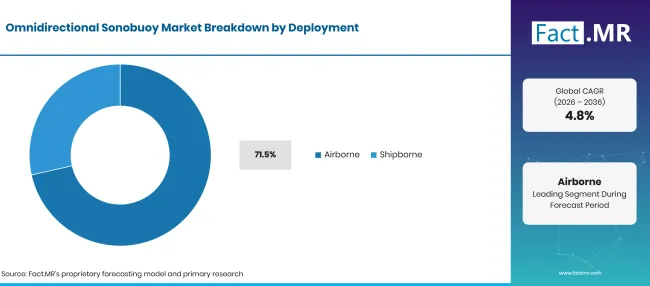
Omnidirectional Sonobuoy Market Breakdown Deployment | Source: Fact.MR
| Deployment | Share (2026) |
|---|---|
| Airborne (Leading segment) | 71.5% |
| Other segments combined | 28.5%* |
| Total | 100.0% |
Source: Fact.MR analysis. Updated Oct 31, 2026
Airborne deployment allows sonobuoys to be placed across large maritime search areas by aircraft and other suitable platforms. Shipborne deployment can support selected surveillance and research activities where the vessel's operating requirements permit the use of sonobuoys. Deployment decisions depend on the launch mechanism, mission duration, operating environment, and communication links between the buoy and the receiving platform.
What is accelerating Omnidirectional Sonobuoy Market adoption, and what is holding it back?
Underwater surveillance needs and maritime platform modernization support demand. However, high costs and technical qualification requirements can limit adoption, while restricted defense purchasing channels create additional barriers.
Drivers Impact Analysis
| DRIVER | (~) % IMPACT ON CAGR | Geographic relevance | Impact timeline |
|---|---|---|---|
| Anti-submarine warfare modernization | +1.0% | North America, Europe, Asia Pacific | Medium term (2–4 years) |
| Maritime patrol aircraft modernization | +0.9% | Europe, North America, Asia Pacific | Medium term (2–4 years) |
| Unmanned maritime surveillance platforms | +0.7% | Global | Long term (4+ years) |
| Demand for underwater acoustic sensing | +0.6% | Global | Medium term (2–4 years) |
| Indigenous defense manufacturing programs | +0.5% | Asia Pacific, Europe | Long term (4+ years) |
Source: Fact.MR analysis. Updated Oct 31, 2026
Opportunity Impact Analysis
| OPPORTUNITY | (~) % IMPACT ON CAGR | Geographic relevance | Impact timeline |
|---|---|---|---|
| Integration with unmanned aircraft | +0.8% | Europe, Asia Pacific | Medium term (2–4 years) |
| Improved acoustic sensor performance | +0.7% | Global | Long term (4+ years) |
| Domestic sonobuoy production capacity | +0.6% | Asia Pacific, Europe | Long term (4+ years) |
| Modular deployment and receiving systems | +0.5% | Global | Medium term (2–4 years) |
| Oceanographic and research applications | +0.3% | Global | Long term (4+ years) |
Source: Fact.MR analysis. Updated Oct 31, 2026
Restraints Impact Analysis
| RESTRAINT | (~) % IMPACT ON CAGR | Geographic relevance | Impact timeline |
|---|---|---|---|
| High development and procurement costs | -0.8% | Global | Short term (up to 2 years) |
| Stringent military qualification requirements | -0.7% | Global | Medium term (2–4 years) |
| Restricted defense procurement channels | -0.6% | Global | Medium term (2–4 years) |
| Complex platform integration | -0.5% | Global | Medium term (2–4 years) |
| Limited public information on product specifications | -0.3% | Global | Short term (up to 2 years) |
Source: Fact.MR analysis. Updated Oct 31, 2026
Which countries are scaling the Omnidirectional Sonobuoy Market through 2036?
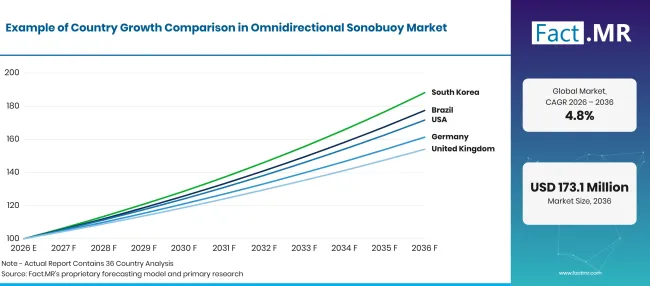
Omnidirectional Sonobuoy Market Growth Index | Source: Fact.MR
| Country | CAGR (2026–2036) |
|---|---|
| Germany | 4.9% |
| Brazil | 5.9% |
| USA | 5.6% |
| UK | 4.4% |
| Japan | 3.4% |
Source: Fact.MR analysis. Updated Oct 31, 2026
What supports adoption in Germany?
4.9% CAGR, with maritime surveillance upgrades and new airborne platforms widening the role for acoustic sensing.
Germany’s demand for omnidirectional sonobuoys may be supported by efforts to strengthen maritime surveillance and anti-submarine warfare capabilities. Naval modernization can create opportunities for underwater acoustic monitoring systems, while cooperation with NATO allies can reinforce the need for compatible maritime surveillance technologies.
How is Brazil developing sonobuoy adoption?
5.9% CAGR, as naval modernization creates more need for underwater monitoring across coastal and defense missions.
Brazil’s omnidirectional sonobuoy market may benefit from naval modernization and efforts to strengthen maritime surveillance. Submarine development and anti-submarine warfare initiatives can increase interest in underwater acoustic detection technologies. Improvements in naval aviation and coastal security capabilities may further support sonobuoy adoption, while international defense cooperation can facilitate access to advanced underwater surveillance systems.
What supports United States adoption?
5.6% CAGR, with an established production base and recurring anti-submarine warfare requirements sustaining demand.
The United States has an established sonobuoy production base. Department of Defense contract records document sonobuoy production activity involving Sparton De Leon Springs [2]. Demand for omnidirectional products specifically depends on model-level requirements, rather than total sonobuoy types. [2][2]
How is the United Kingdom building adoption?
4.4% CAGR, supported by maritime surveillance requirements and the use of compatible underwater acoustic sensing systems.
The UK market is associated with the need to maintain maritime surveillance capabilities and compatible acoustic sensing systems. Ultra Maritime identifies its SSQ-906G as a wideband omnidirectional passive sonobuoy, with operating-depth settings of 30 m, 140 m, and 300 m [3][3]
What supports adoption in Japan?
3.4% CAGR, with maritime security priorities keeping underwater detection capabilities relevant to future fleet planning.
Japan's maritime security requirements make underwater acoustic sensing relevant to naval surveillance and anti-submarine warfare. Adoption of omnidirectional sonobuoys will depend on procurement priorities, compatible maritime patrol platforms, and the specifications selected by defense agencies.
Who leads the Omnidirectional Sonobuoy Market?
Fact.MR identifies a competitive landscape involving established sonobuoy manufacturers, defense electronics companies, and firms developing domestic production capabilities. Public product documentation provides the clearest evidence for Ultra Maritime and Twenty-Six Defense Maritime, while Lockheed Martin and Thales have documented sonobuoy production activity.
Ultra Maritime offers the SSQ-906G wideband omnidirectional passive sonobuoy. Twenty-Six Defense Maritime, formerly Sparton, manufactures multiple sonobuoy variants, including the AN/SSQ-62E with an omnidirectional transmitting element and the AN/SSQ-53F with wideband omnidirectional performance.
Lockheed Martin participates in U.S. Navy sonobuoy production programs. Thales is associated with the SonoFlash combined active/passive sonobuoy, a product class that must be distinguished from dedicated omnidirectional passive models. These distinctions matter when identifying direct competitors in a narrowly defined omnidirectional market.
ASELSAN has developed the ASELBUOY passive directional sonobuoy. On February 11, 2025, Ultra Maritime announced a production-planning agreement with Bharat Dynamics Limited for proposed co-production of US-specification sonobuoys in India, with production anticipated from 2027 [4]. SeaLandAire Technologies has experience in underwater acoustics and sonobuoy research and development. [4]
Which companies are the key providers?
The company set for the broader sonobuoy market includes Ultra Maritime, Twenty-Six Defense Maritime, ASELSAN A.Ş., Bharat Dynamics Limited, SeaLandAire Technologies, Inc.
- Ultra Maritime
- Twenty-Six Defense Maritime (formerly Sparton)
- ASELSAN A.Ş.
- Bharat Dynamics Limited (BDL)
- SeaLandAire Technologies, Inc.
Bibliography
- [1] Henckel, O. (2026, January 12). Bundeswehr bestellt Drohnen zur Seefernaufklärung und U-Boot-Jagd. Bundeswehr.
- [2] U.S. Department of Defense. (2024, March). Contracts: Sparton De Leon Springs LLC—AN/SSQ-125 Modified High Duty Cycle Sonobuoys.
- [3] Ultra Maritime. (2026). Wideband omni-directional passive: SSQ-906G/SSQ-906H.
- [4] Ultra Maritime. (2025, February 11). Ultra Maritime signs contract for co-production of U.S. sonobuoys in India.
This Report Answers
- The report describes demand for omnidirectional sonobuoys across defense, commercial, and research applications.
- Segment analysis compares passive, active, and special-purpose sonobuoys using the market shares.
- Country analysis discusses Germany, Brazil, the USA, the UK, and Japan alongside the growth estimates.
- The competitive overview identifies established manufacturers, emerging domestic production initiatives, and companies whose direct participation requires further verification.
- Deployment analysis separates airborne and shipborne use cases.
What does the Omnidirectional Sonobuoy Market cover?
The market covers expendable underwater acoustic sensors designed to receive or transmit acoustic signals as part of underwater detection and monitoring operations. The scope focuses on sonobuoys with documented omnidirectional sensing or transmission characteristics, depending on the product configuration. It distinguishes these products from directional-only sonobuoys, sonobuoy receiving equipment, launchers, and broader anti-submarine warfare systems.
What is included in the scope?
Included products are sonobuoys with documented omnidirectional acoustic performance and applications within the stated product categories.
The market covers defense-oriented acoustic detection as well as qualifying commercial and research uses. Product inclusion depends on technical documentation that establishes the relevant sensing characteristics.
What is excluded from the scope?
The analysis excludes sonar systems installed permanently on ships or submarines, standalone sonobuoy receivers, aircraft launchers, acoustic processing equipment, and other defense systems sold independently of the buoy. Directional-only sonobuoys are excluded unless they also provide a qualifying omnidirectional function.
The analysis excludes non-expendable underwater acoustic systems and reusable sonar equipment that do not fall within the defined sonobuoy category. Fixed seabed surveillance systems and ship-mounted sonar systems are also excluded. The market scope excludes general maritime surveillance equipment unrelated to sonobuoys, along with deployment platforms, aircraft, processing software and other associated equipment sold separately.
How Was the Analysis Built?
The analysis draws on 120+ sources, 35+ company portfolios, 25+ countries, and more than 20 industry interviews.
- Primary Research: Primary research includes discussions with manufacturers, service providers, technology developers, distributors, end users, and subject-matter experts. These conversations examine purchasing priorities, product adoption, operational challenges, approval requirements, competitive positioning, and the factors that influence wider market acceptance.
- Desk Research: Desk research covers government statistics, regulatory publications, company filings, trade data, technical studies, industry associations, standards, public policy, and other authoritative sources. Every source used in the analysis is documented in the bibliography.
- Market Sizing and Forecasting: Market estimates combine historical performance, demand indicators, pricing and volume trends, segment shares, company participation, country-level growth, adoption patterns, investment activity, and barriers to market expansion.
- Data Validation and Update Cycle: Findings are validated by comparing primary interviews with public data, company activity, regulatory changes, trade patterns, and industry developments. Regular updates review new product launches, capacity changes, partnerships, approvals, and shifts in commercial adoption.
Segmentation
What is the report's scope and coverage?
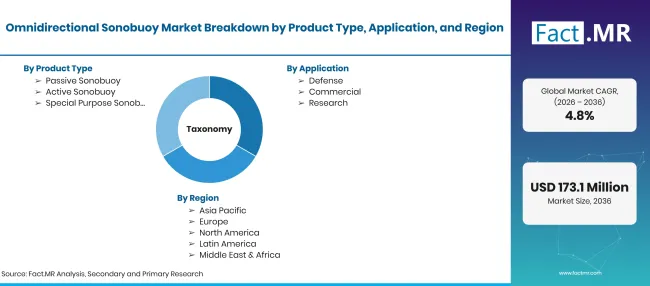
Omnidirectional Sonobuoy Market Taxonomy | Source: Fact.MR
| Attribute | Details |
|---|---|
| Quantitative Units | USD million |
| Market Definition | The omnidirectional sonobuoy market comprises expendable underwater acoustic devices designed to detect and monitor underwater sounds from multiple directions. These systems support anti-submarine warfare and maritime surveillance by collecting acoustic signals to help identify and track underwater threats. Demand is influenced by naval modernization and the need for enhanced underwater detection capabilities. |
| Product Type | Passive Sonobuoy; Active Sonobuoy; Special Purpose Sonobuoy |
| Application | Defense; Commercial; Research |
| Deployment | Airborne; Shipborne |
| End-User | Maritime Patrol; Naval Forces; Oceanographic Research Institutions |
| Regions Covered | North America; Latin America; Western Europe; Eastern Europe; East Asia; South Asia & Pacific; Middle East & Africa |
| Countries Covered | Germany; Brazil; USA; UK; Japan |
| Companies Profiled | Ultra Maritime; Twenty-Six Defense Maritime; ASELSAN A.Ş.; Bharat Dynamics Limited; SeaLandAire Technologies, Inc. |
| Forecast Period | 2026 to 2036 |
| Approach | Segment-based analysis supported by company product documentation, defense information, and market assumptions |
Source: Fact.MR analysis. Updated Oct 31, 2026
How is the market segmented?
-
By Product Type
- Passive Sonobuoy
- Active Sonobuoy
- Special Purpose Sonobuoy
-
By Application
- Defense
- Commercial
- Research
-
By Deployment
- Airborne
- Shipborne
-
By End-User
- Maritime Patrol
- Naval Forces
- Oceanographic Research Institutions
-
By Region
- North America
- Latin America
- Western Europe
- Eastern Europe
- East Asia
- South Asia & Pacific
- Middle East & Africa
Frequently Asked Questions
How big is the Omnidirectional Sonobuoy Market in 2026?
What is the CAGR from 2026 to 2036?
Which application leads the market?
Which deployment type has the largest share?
Which companies are covered?
Who worked on this report


Preview the report firsthand - request a free sample
Free SampleGet the brochure for pricing and purchase details
Download PDF