- Market Value (2025): USD 4.0 Bn
- Estimated Value (2026): USD 4.6 Bn
- Forecast Value (2036): USD 16.8 Bn
- CAGR (2026-2036): 13.8%
What is the GPU in Healthcare and Medical Imaging Market forecast to be worth by 2036?
USD 4.6 billion in 2026 to USD 16.8 billion by 2036 at 13.8% CAGR.
- The GPU in Healthcare and Medical Imaging market was valued at USD 4.0 billion in 2025 as hospitals and imaging vendors expanded AI-enabled reconstruction and model testing.
- Demand is projected to increase from USD 4.6 billion in 2026 to USD 16.8 billion by 2036.
- The market is forecast to record 13.8% CAGR from 2026 to 2036.
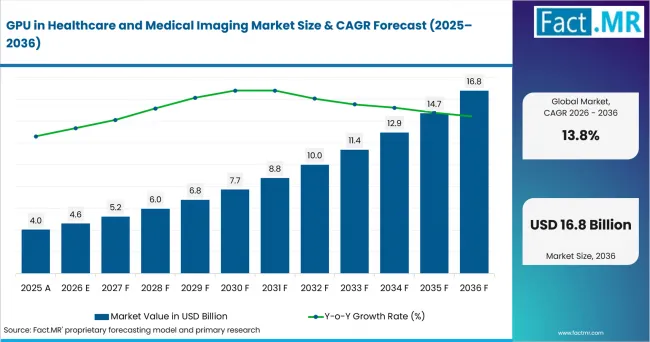
Gpu In Healthcare And Medical Imaging Market Value Analysis | Source: Fact.MR
What are the defining numbers behind GPU in Healthcare and Medical Imaging Market growth?
USD 12.2 billion absolute opportunity by 2036, led by data center GPUs and diagnostic imaging.
- Demand Drivers in the Market
- Medical image files are large and time sensitive. GPU acceleration is expected to help care teams process CT and MRI images faster.
- Hospitals prefer local or controlled GPU systems when AI reconstruction must work inside daily radiology workflows.
- Cloud and on-premises choices are anticipated to expand as buyers balance protected health data with scalable model training.
- Imaging software vendors are expected to use GPUs to support faster visualization and more stable clinical AI outputs.
- Key Segments Analyzed
- By GPU Solution: Data Center GPUs are expected to hold 46.0% share in 2026 because training and inference workloads need high memory bandwidth.
- By Clinical Application: Diagnostic Imaging is projected to account for 39.0% share in 2026 as radiology remains the largest clinical use case for GPU-backed AI.
- By End-use Facility: Hospitals are anticipated to capture 42.0% share in 2026 since acute-care networks need secure imaging review and internal AI deployment.
- By Deployment Model: On-premises Infrastructure is estimated to represent 51.0% share in 2026 due to data governance and latency-sensitive imaging workflows.
- By Compute Platform: Artificial Intelligence GPU Computing is forecast to hold 48.0% share in 2026 as model training and inference become core imaging requirements.
- Analyst Opinion at Fact.MR
- Shambhu Nath Jha, Senior Consultant at Fact.MR, states, "GPU adoption in healthcare is moving from research clusters into daily imaging operations. Hospitals and imaging vendors are expected to favor platforms that support AI inference and image reconstruction without slowing radiology workflows."
- Strategic Implications
- Healthcare IT teams should match GPU selection with image volume and model type before expanding infrastructure.
- Imaging software vendors can improve adoption by proving that accelerated tools reduce review friction without adding compliance risk.
- Cloud and infrastructure providers should support hybrid deployment when hospitals keep sensitive image data close to clinical systems.
- GPU suppliers can strengthen buyer confidence by showing validated performance for radiology and three-dimensional reconstruction workloads.
The USA leads at 14.9% CAGR through hospital AI investment and secure imaging infrastructure. China follows at 14.3% as domestic imaging AI platforms expand. Germany reaches 13.7% through radiology modernization. Japan posts 13.1% as advanced imaging equipment supports accelerated processing. South Korea records 12.5% through digital hospitals. Canada reaches 11.9% through AI research. Singapore records 11.2% through connected care infrastructure.
How does the GPU in Healthcare and Medical Imaging Market break down by segment?
Data Center GPUs are expected to lead GPU Solution at 46.0% share in 2026. Diagnostic Imaging is projected to lead Clinical Application at 39.0% share in 2026.
Which GPU Solution dominates?
Data Center GPUs are projected to account for 46.0% share in 2026.
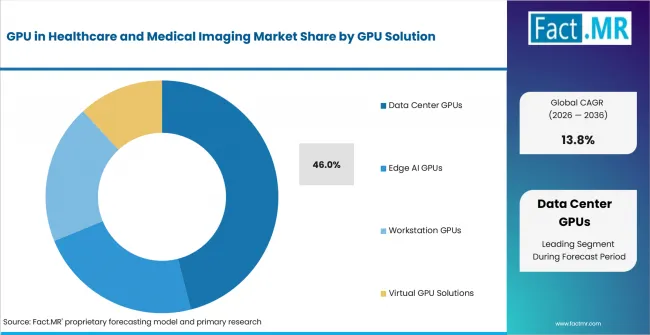
Gpu In Healthcare And Medical Imaging Market Analysis By Gpu Solution | Source: Fact.MR
Their dominance comes from the dense compute required for medical imaging model training and inference. Hospitals and cloud providers use these systems when large image must be processed quickly and reliably. Workstation GPUs continue to support research and local review, while embedded GPUs serve scanner-side processing where real-time performance matters.
What leads the Clinical Application segment?
Diagnostic Imaging is expected to hold 39.0% share in 2026.
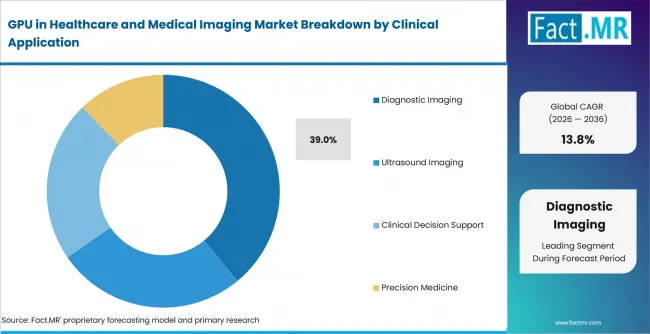
Gpu In Healthcare And Medical Imaging Market Analysis By Clinical Application | Source: Fact.MR
Radiology workflows give this segment its strongest demand base, as CT and MRI imaging depend on fast reconstruction and clear visual review. GPUs help improve image-processing speed and clinical throughput. Surgical imaging and radiation therapy planning add further demand where precision visualization is important for treatment decisions.
How do Hospitals shape end-use demand?
Hospitals are anticipated to lead End-use Facility with 42.0% share in 2026.
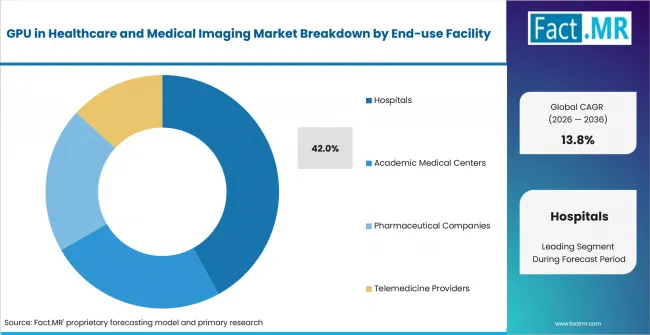
Gpu In Healthcare And Medical Imaging Market Analysis By End Use Facility | Source: Fact.MR
High scan volumes, multiple departments and strict data-governance needs place hospitals at the center of adoption. Large care networks often require GPU systems that can support radiology, diagnostics and research workflows together. Diagnostic imaging centers remain important, especially where outpatient volumes create pressure for faster turnaround.
Why does On-premises Infrastructure lead Deployment Model?
On-premises Infrastructure is estimated to represent 51.0% share in 2026.
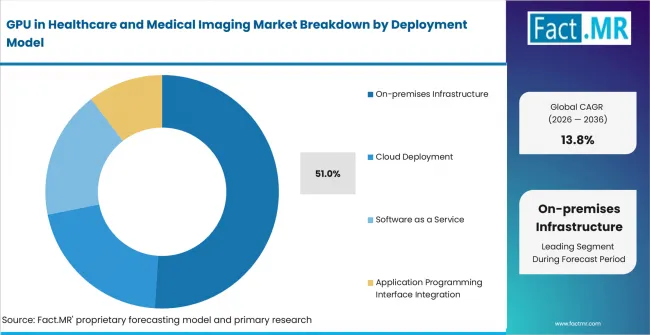
Gpu In Healthcare And Medical Imaging Market Analysis By Deployment Model | Source: Fact.MR
Healthcare buyers often prefer local infrastructure when image data control, latency and clinical access are critical. On-premises systems allow hospitals to keep sensitive imaging workflows closer to internal governance rules. Cloud deployment is likely to grow for research and training capacity, while hybrid models fit buyers that separate clinical inference from broader collaboration.
What supports Artificial Intelligence GPU Computing?
Artificial Intelligence GPU Computing is forecast to hold 48.0% share in 2026.
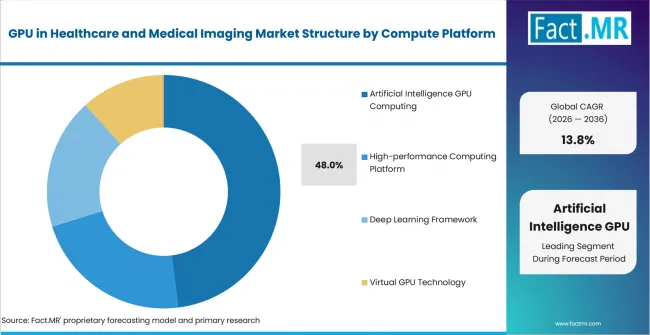
Gpu In Healthcare And Medical Imaging Market Analysis By Compute Platform | Source: Fact.MR
AI imaging workloads rely on parallel processing for segmentation, detection, classification and reconstruction. This makes GPU computing central to model performance across diagnostic and procedural use cases. Visualization adds another demand layer for complex scans, while edge AI platforms support local processing in procedure rooms and specialized care settings.
What is accelerating GPU in Healthcare and Medical Imaging Market adoption, and what is holding it back?
Demand is expected to rise through imaging AI and secure infrastructure. Higher clinical data volumes add further pressure. Growth may be limited by infrastructure cost and validation work. Integration complexity remains a restraint.
Drivers Impact Analysis
| DRIVER | (~) % IMPACT ON CAGR | GEOGRAPHIC RELEVANCE | IMPACT TIMELINE |
|---|---|---|---|
| Diagnostic imaging AI adoption | +3.5% | USA, China, Germany | Short term (<= 2 years) |
| Hospital GPU infrastructure upgrades | +2.8% | North America, East Asia, Europe | Short term (<= 2 years) |
| Three-dimensional visualization workloads | +2.1% | USA, Japan, South Korea | Medium term (2-4 years) |
| Hybrid cloud deployment for medical data | +1.6% | Canada, Singapore, Europe | Medium term (2-4 years) |
| Clinical model validation needs | +1.1% | Regulated healthcare markets | Long term (>= 4 years) |
Source: Fact.MR analysis. Updated Aug 7, 2026
- Diagnostic imaging AI adoption: Radiology teams are expected to use GPU acceleration when image reconstruction and triage tools require stable performance.
- Hospital GPU infrastructure upgrades: Care providers are anticipated to invest when older servers cannot handle AI inference and visualization workloads.
- Three-dimensional visualization workloads: CT and MRI use cases are expected to raise demand for high-resolution rendering. Surgical planning and pathology add smaller but useful demand.
Opportunity Impact Analysis
| OPPORTUNITY | (~) % IMPACT ON CAGR | GEOGRAPHIC RELEVANCE | IMPACT TIMELINE |
|---|---|---|---|
| Hybrid GPU deployment models | +1.4% | USA, Canada, Singapore | Medium term (2-4 years) |
| Medical imaging foundation models | +1.2% | USA, Germany, Japan | Medium term (2-4 years) |
| Edge inference near scanners | +0.9% | China, South Korea, Japan | Long term (>= 4 years) |
| GPU-enabled clinical research platforms | +0.7% | North America and Europe | Long term (>= 4 years) |
Source: Fact.MR analysis. Updated Aug 7, 2026
- Hybrid GPU deployment models: Providers that combine local inference with scalable cloud training are expected to appeal to hospitals with strict data rules.
- Medical imaging foundation models: Vendors that support tuning and validation are expected to gain attention from radiology AI developers.
- Edge inference near scanners: GPU modules inside or near imaging systems are anticipated to support faster processing in diagnostic suites.
Restraints Impact Analysis
| RESTRAINT | (~) % IMPACT ON CAGR | GEOGRAPHIC RELEVANCE | IMPACT TIMELINE |
|---|---|---|---|
| High infrastructure cost | -1.5% | Hospitals and smaller imaging networks | Short term (<= 2 years) |
| Clinical validation burden | -1.1% | Regulated healthcare markets | Short term (<= 2 years) |
| Data integration complexity | -0.8% | Global | Medium term (2-4 years) |
| Specialized workforce needs | -0.6% | Developing and smaller markets | Long term (>= 4 years) |
Source: Fact.MR analysis. Updated Aug 7, 2026
- High infrastructure cost: GPU clusters and storage can raise ownership cost for hospitals with limited AI imaging budgets. Cooling and software add further spending.
- Clinical validation burden: Imaging AI workflows require evidence and governance before hospitals can rely on accelerated outputs in care settings.
- Data integration complexity: Legacy PACS and EHR systems can slow deployment. Image archives add more work when several clinical systems must connect.
Which countries are scaling GPU in Healthcare and Medical Imaging Market fastest?
- The country comparison spans 3.7 percentage points and forms three practical growth bands across the forecast period.
- The USA remains 0.6 percentage point above China through hospital AI investment and secure imaging infrastructure.
- Germany holds a 0.6 percentage point edge over Japan through radiology modernization and medical technology demand.
- Japan remains 0.6 percentage point above South Korea because advanced imaging equipment sustains GPU use.
- South Korea stays 0.6 percentage point above Canada as digital hospitals and semiconductor capability support local adoption.
- Canada remains 0.7 percentage point above Singapore through AI research and hospital network adoption.
Comparable CAGRs can create different entry conditions because healthcare data rules and hospital budgets vary by country.
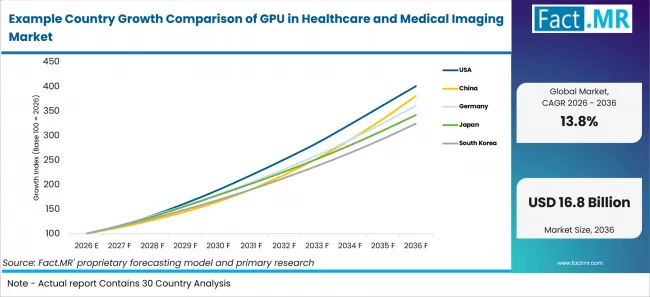
Example Country Growth Comparison Of Gpu In Healthcare And Medical Imaging Market | Source: Fact.MR
| Country | CAGR (2026-2036) |
|---|---|
| USA | 14.9% |
| Germany | 13.7% |
| Japan | 13.1% |
| South Korea | 12.5% |
| Canada | 11.9% |
| Singapore | 11.2% |
Source: Fact.MR analysis. Updated Aug 7, 2026
What supports USA adoption?
14.9% CAGR, supported by hospital AI investment and secure imaging infrastructure.
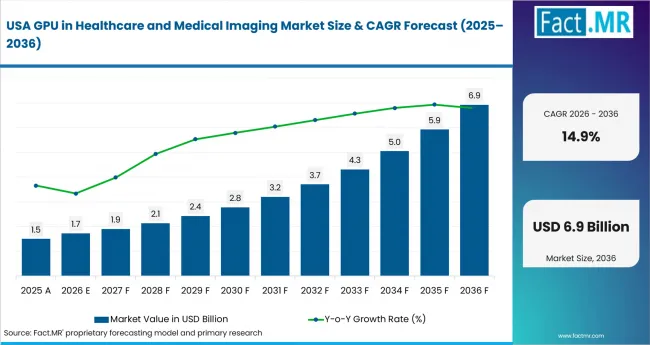
Gpu In Healthcare And Medical Imaging Market Country Value Analysis | Source: Fact.MR
Large hospital systems in the USA are expected to evaluate GPU platforms through workflow fit first. Radiology and research teams often need separate compute environments. Secure deployment remains an important purchase filter.
What is driving Germany's growth from 2026 to 2036?
13.7% CAGR, backed by medical technology demand and secure radiology modernization.
Germany's position reflects a healthcare environment where reliability and governance shape approval. Imaging teams are expected to favor GPU systems that improve visualization without weakening data control.
How is Japan developing demand?
13.1% CAGR, led by advanced imaging equipment and clinical workflow pressure.
Japan's demand is shaped by advanced imaging equipment and efficient review needs. Hospitals are anticipated to use GPUs where reconstruction speed supports busy departments.
How does South Korea perform?
12.5% CAGR, supported by digital hospitals and local semiconductor capability.
South Korea is expected to benefit from advanced hospitals and strong hardware expertise. Adoption is likely to depend on proof that accelerated systems fit clinical routines.
What supports Canada's growth?
11.9% CAGR, backed by AI research and hospital network adoption.
Canada's growth reflects research hospitals and academic AI activity. Health systems are expected to adopt GPU infrastructure when models can be tested across imaging programs.
How is Singapore scaling demand?
11.2% CAGR, supported by connected care infrastructure and regional medtech activity.
Singapore's compact healthcare system is expected to support focused imaging AI deployment. Hospitals and medtech suppliers operate close to research and digital infrastructure.
Who leads the GPU in Healthcare and Medical Imaging Market?
NVIDIA Corporation and Advanced Micro Devices, Inc. show direct relevance through GPU hardware. Intel Corporation supports the same compute layer. Microsoft Corporation supports cloud and software activity. Google LLC adds platform depth. Dell Technologies Inc. and Hewlett Packard Enterprise Company add server depth. Lenovo Group Limited extends the provider base.
Healthcare buyers usually assess performance and security together. GPU suppliers compete on accelerator capability and software support. Infrastructure providers compete on deployment reliability and hospital integration.
Which companies are the key providers?
Key companies profiled NVIDIA Corporation, Advanced Micro Devices, Inc., Intel Corporation, Microsoft Corporation, Google LLC, Dell Technologies Inc., Hewlett Packard Enterprise Company, and Lenovo Group Limited.
- NVIDIA Corporation
- Advanced Micro Devices, Inc.
- Intel Corporation
- Microsoft Corporation
- Google LLC
- Dell Technologies Inc.
- Hewlett Packard Enterprise Company
- Lenovo Group Limited
Bibliography
- U.S. Food and Drug Administration. (2025, January). Artificial intelligence-enabled device software functions: Lifecycle management and marketing submission recommendations.
- National Institutes of Health Common Fund. (2025, May 12). The NIH Common Fund PRIMED-AI program gets underway!
- Health Canada. (2026, April 1). Pre-market guidance for machine learning-enabled medical devices.
- NVIDIA Corporation. (2025, March 18). NVIDIA and GE HealthCare collaborate to advance the development of autonomous diagnostic imaging with physical AI.
This Report Answers
- The report provides strategic intelligence on the GPU in Healthcare and Medical Imaging Market across GPU Solution and Clinical Application choices.
- Segment analysis covers Data Center GPUs and Diagnostic Imaging as the share leaders within the 2026 market.
- Country outlook evaluates the USA and China alongside Germany and Japan. South Korea and Canada appear before Singapore in the growth comparison.
- Competitive analysis profiles the full provider set listed in the company section. GPU suppliers and cloud providers form one group. Server vendors and networking specialists complete it.
- Deployment assessment covers on-premises and cloud-based infrastructure. Hybrid infrastructure and edge inference complete the compute view.
What does the GPU in Healthcare and Medical Imaging Market cover?
GPU platforms process medical images and run clinical AI workloads.
The market covers accelerated computing used in diagnostic imaging and related clinical applications. Coverage extends to servers and workstations. Embedded platforms, virtualized GPU instances, and cloud infrastructure are included when the GPU function supports medical imaging workloads.
What is included in the scope?
The scope includes GPU hardware used by hospitals, imaging centers, research institutes, and cloud-connected healthcare platforms.
Coverage includes GPU Solution and Clinical Application. End-use Facility, Deployment Model, and Compute Platform are included. It covers data center and workstation GPUs. Embedded and virtualized formats are included. Clinical coverage spans Diagnostic Imaging and related applications.
What is excluded from the scope?
General enterprise GPU use without a healthcare or medical imaging connection remains outside the scope of this market.
The scope excludes gaming GPUs and consumer graphics cards. It excludes imaging equipment revenue where GPU use cannot be separated from the broader device. Company revenue is included only when the activity clearly relates to healthcare GPU infrastructure.
How Was the Analysis Built?
The analysis uses 120+ sources, 35+ company portfolios, 25+ countries, and 20+ industry interviews.
- Primary Research: Primary research includes discussions with manufacturers and service providers. Developers and distributors are included. End users and procurement teams are reviewed with subject-matter experts.
- Desk Research: Desk research covers government statistics and regulatory publications. Company filings and technical studies are reviewed with standards and other authoritative sources.
- Market Sizing and Forecasting: Market estimates combine historical performance and demand indicators. Pricing trends, segment shares, country growth, adoption patterns, and barriers are reviewed.
- Data Validation and Update Cycle: Findings are validated by comparing interviews with public data. Company activity and regulatory changes are reviewed with commercial adoption shifts.
Segmentation
What is the report's scope and coverage?
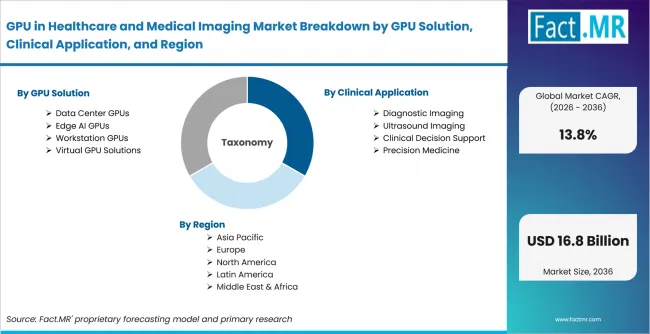
Gpu In Healthcare And Medical Imaging Market Breakdown By Gpu Solution, Clinical Application, And Region | Source: Fact.MR
| Attribute | Details |
|---|---|
| Quantitative Units | USD billion in 2026 to USD billion by 2036 at CAGR |
| Market Definition | Graphics processing unit hardware and accelerated computing infrastructure used in healthcare imaging workflows where image processing, AI inference, visualization, and secure deployment determine adoption |
| GPU Solution | Data Center GPUs; Workstation GPUs; Embedded GPUs; Edge GPUs; Virtualized GPU instances |
| Clinical Application | Diagnostic Imaging; Surgical Imaging; Radiation Therapy Planning; Pathology Imaging; Research Imaging |
| End-use Facility | Hospitals; Diagnostic Imaging Centers; Academic and Research Institutes; Ambulatory Care Centers; Telehealth and Cloud Imaging Providers |
| Deployment Model | On-premises Infrastructure; Cloud-based Infrastructure; Hybrid Infrastructure |
| Compute Platform | Artificial Intelligence GPU Computing; Visualization and Rendering; Edge AI Computing; High Performance Computing; Data Processing Pipelines |
| Regions Covered | North America; Latin America; Europe; East Asia; South Asia and Pacific; Middle East and Africa |
| Countries Covered | USA; China; Germany; Japan; South Korea; Canada; Singapore |
| Key Companies Profiled | NVIDIA Corporation; Advanced Micro Devices, Inc.; Intel Corporation; Microsoft Corporation; Google LLC; Dell Technologies Inc.; Hewlett Packard Enterprise Company; Lenovo Group Limited |
| Forecast Period | 2026 to 2036 |
| Approach | Hybrid top-down and bottom-up approach using healthcare imaging demand; GPU infrastructure requirements; clinical AI adoption; hospital procurement patterns; imaging software deployment; cloud and on-premises infrastructure; country growth trends; regulatory context; company portfolio review; and interviews with market participants |
Source: Fact.MR analysis. Updated Aug 7, 2026
How is the market segmented?
-
By GPU Solution
- Data Center GPUs
- Training GPUs
- Inference GPUs
- Edge AI GPUs
- Embedded AI GPUs
- Mobile AI Accelerators
- Workstation GPUs
- Professional Visualization GPUs
- Remote Visualization GPUs
- Virtual GPU Solutions
- GPU Virtualization
- Multi-user GPU Sharing
- Data Center GPUs
-
By Clinical Application
- Diagnostic Imaging
- MRI Image Reconstruction
- CT Image Processing
- Ultrasound Imaging
- Real-time Image Enhancement
- Point-of-care Imaging
- Clinical Decision Support
- AI-assisted Diagnosis
- Digital Pathology
- Precision Medicine
- Genomics Analysis
- Predictive Healthcare Analytics
- Diagnostic Imaging
-
By End-use Facility
- Hospitals
- Tertiary Care Hospitals
- Diagnostic Imaging Centers
- Academic Medical Centers
- Research Institutes
- Specialty Clinics
- Pharmaceutical Companies
- Biotechnology Companies
- Clinical Research Organizations
- Telemedicine Providers
- Remote Diagnostic Networks
- Public Health Agencies
- Hospitals
-
By Deployment Model
- On-premises Infrastructure
- Local GPU Clusters
- Private Data Centers
- Cloud Deployment
- Hybrid Cloud
- Edge Computing
- Software as a Service
- Managed GPU Services
- Multi-cloud Platform
- Application Programming Interface Integration
- Containerized Deployment
- Kubernetes Orchestration
- On-premises Infrastructure
-
By Compute Platform
- Artificial Intelligence GPU Computing
- CUDA Computing Platform
- Parallel Processing Architecture
- High-performance Computing Platform
- Distributed GPU Computing
- Multi-GPU Framework
- Deep Learning Framework
- Tensor Processing Framework
- Open Compute Framework
- Virtual GPU Technology
- GPU Virtualization Layer
- Hardware-assisted Virtualization
- Artificial Intelligence GPU Computing
-
By Region
- North America
- Latin America
- Western Europe
- Eastern Europe
- East Asia
- South Asia and Pacific
- Middle East & Africa
Frequently Asked Questions
How big is the GPU in healthcare and medical imaging market in 2026?
What is the CAGR of the GPU in healthcare and medical imaging market from 2026 to 2036?
Which GPU solution leads the GPU in healthcare and medical imaging market?
Which clinical application leads the GPU in healthcare and medical imaging market?
Who are the leading companies in the GPU in healthcare and medical imaging market?
Who worked on this report


Preview the report firsthand - request a free sample
Free SampleGet the brochure for pricing and purchase details
Download PDF