Green Grinding Aids for Cement Mills Market
Green Grinding Aids for Cement Mills Market Size and Share Forecast Outlook 2026 to 2036
Green grinding aids for cement mills market is projected to grow from USD 283.0 million in 2026 to USD 789.2 million by 2036, at a CAGR of 10.8%. Bio-based & biodegradable glycols & esters will dominate with a 28.0% market share, while energy reduction & throughput improvement (primary roi driver) will lead the functional benefit segment with a 36.0% share.
Green Grinding Aids for Cement Mills Market Forecast and Outlook 2026 to 2036
The global green grinding aids for cement mills market is projected to reach USD 789.19 million by 2036. The market is valued at USD 283.00 million in 2026 and is set to rise at a CAGR of 10.8% during the assessment period.
By product type, bio-based & biodegradable glycols & esters hold a leading 28% share. Energy reduction & throughput improvement represents the dominant functional benefit at 36%, while the supply model of chemical suppliers & formulators is primary at 48.0%.
Key Takeaways from the Green Grinding Aids for Cement Mills Market
- Market Value for 2026: USD 283.00 Million
- Market Value for 2036: USD 789.19 Million
- Forecast CAGR (2026-2036): 10.8%
- Leading Product Segment Share (2026): Bio-based & biodegradable glycols & esters (28%)
- Leading Functional Benefit Share (2026): Energy reduction & throughput improvement (36%)
- Leading Supply Model Share (2026): Chemical suppliers & formulators (48.0%)
- Key Players in the Market: MBCC Group, BASF SE, Evonik Industries AG, GCP Applied Technologies, Clariant AG, W. R. Grace and Company
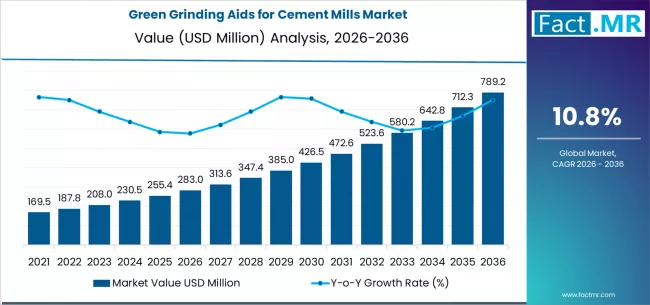
Defining trends involve the development of proprietary hybrid eco-packs engineered for performance in modern blended cement formulations. Innovation is focused on enhancing dispersion efficiency and strength contribution while reducing volatile organic compound (VOC) content and environmental impact. Integration of these advanced additives into closed-loop and reclaim-compatible systems is becoming a key competitive strategy.
Regulatory frameworks enforcing stricter air quality standards and workplace safety limits on VOC and amine emissions are primary market drivers. The global cement industry’s sustainability commitments to reduce carbon footprint and energy consumption per ton of cement act as significant catalysts, creating sustained demand for high-performance, environmentally preferable grinding aids.
Green Grinding Aids for Cement Mills Market
| Metric | Value |
|---|---|
| Market Value (2026) | USD 283.00 Million |
| Market Forecast Value (2036) | USD 789.19 Million |
| Forecast CAGR (2026-2036) | 10.8% |
Category
| Category | Segments |
|---|---|
| Product | Bio-based & biodegradable glycols & esters, Low-amine & reduced-amine amine blends, Polycarboxylate-based dispersion enhancers, Reclaimed & re-refined recycled solvent packages, Specialty eco-frothers & surfactants (biobased), Proprietary hybrid eco-packs (vendor engineered) |
| Functional Benefit | Energy reduction & throughput improvement (primary ROI driver), Lower VOC & regulatory & worker-safety specification compliance, Reduced clinker interference (performance for blended cements), Improved early strength with low residuals, Reclaimer & closed-loop compatibility |
| Supply Model | Chemical suppliers & formulators, Integrated OEM & cement-producer in-house formulations, Toll, reclaim & on-site reblend services |
| Region | North America, Latin America, Western Europe, Eastern Europe, East Asia, South Asia & Pacific, MEA |
Segmental Analysis
By Product, Which Chemistry is Fundamental for Sustainable Performance?
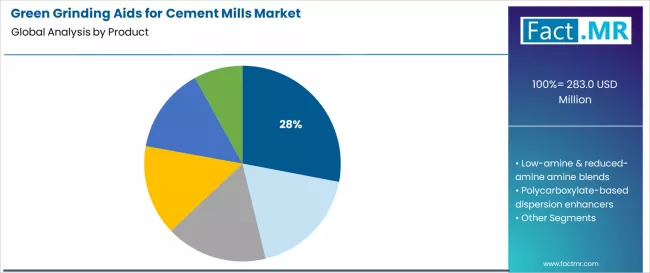
Bio-based & biodegradable glycols & esters lead the segment with a 28% share. This dominance is due to their effectiveness in reducing grinding energy, their renewable origin aligning with sustainability goals, and their favorable environmental and toxicological profile. They serve as direct replacements for conventional petroleum-derived glycols, offering cement producers a tangible step towards reducing the carbon footprint of the grinding process.
By Functional Benefit, Which Driver is Primary for Adoption?
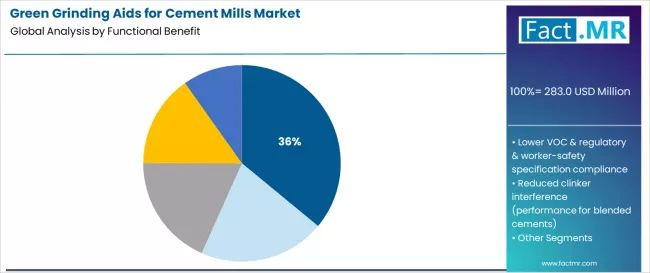
Energy reduction & throughput improvement commands the largest functional benefit share at 36%. This represents the core economic return on investment for cement producers, directly lowering operational costs and increasing mill capacity. In an energy-intensive industry, grinding aids that deliver measurable kWh/ton savings and higher output are critical for profitability, making this benefit the primary adoption driver.
By Supply Model, Which Channel Dominates the Market?
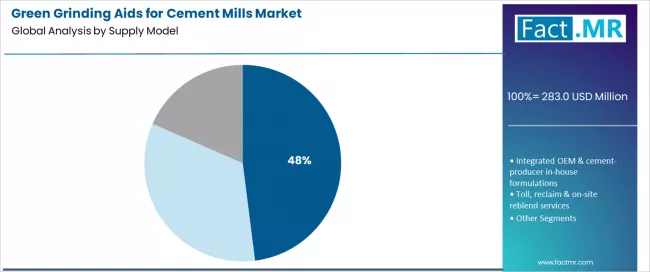
The chemical suppliers & formulators model is the leading supply model at 48.0%. Its dominance is attributed to the specialized R&D, formulation expertise, and consistent quality control required to produce high-performance grinding aids. This model provides cement producers with access to advanced, tailored chemistries without the capital investment and technical overhead of in-house production.
What are the Drivers, Restraints, and Key Trends of the Green Grinding Aids for Cement Mills Market?
The global cement industry’s push for decarbonization and energy efficiency drives market growth. Tightening regulations on VOC emissions and worker exposure to amine-based products compel a shift to greener alternatives. The rising use of supplementary cementitious materials, which are harder to grind, increases the need for high-performance dispersants.
A significant restraint is the higher upfront cost of some advanced green formulations compared to traditional commodities. Performance validation in diverse cement blends and mill types requires extensive testing, potentially slowing adoption. The fragmentation of the global cement industry means penetration rates vary significantly by region and company size.
Key trends include the design of multifunctional additives that combine grinding aid properties with strength enhancers for blended cements. The development of reclaim-compatible products supports circular economy initiatives within cement plants. The market is also seeing a strategic shift towards service-oriented models, including toll manufacturing and on-site blend optimization, to deepen customer integration.
Analysis of the Green Grinding Aids for Cement Mills Market by Key Countries

| Country | CAGR (2026-2036) |
|---|---|
| India | 13.50% |
| China | 12.00% |
| USA | 9.00% |
| Germany | 8.00% |
How does India’s Cement Industry Expansion and Sustainability Push Drive Market Leadership?
India leads with a 13.50% CAGR, driven by its massive and growing cement production capacity and stringent new environmental norms. The industry’s focus on lowering power consumption, a major cost component, and reducing the clinker factor in cement creates robust demand for high-efficiency, green grinding aids tailored for blended cements and harsh grinding conditions.
Why is China’s Focus on Industrial Eco-Efficiency a Key Driver?
China’s 12.00% growth is fueled by its dual goals of cement industry consolidation and mandatory reductions in energy consumption per unit of output. National policies promoting green building materials and the use of industrial waste in cement blends propel the adoption of advanced polycarboxylate-based and bio-based grinding aids to maintain productivity in more challenging raw mixes.
What Role does the USA’s Regulatory Landscape and Focus on Blended Cements Play?
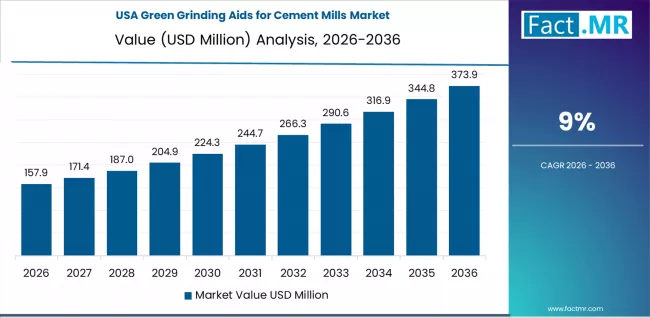
The USA's 9.00% growth is underpinned by environmental regulations targeting VOC emissions and a strong market for Portland-limestone and other blended cements. Demand is driven by the need for grinding aids that deliver energy savings while complying with air quality standards and enhancing the grindability of limestone and supplementary materials.
How does Germany’s Engineering Leadership and Circular Economy Focus Influence the Market?
Germany’s 8.00% growth reflects its leadership in high-performance chemical additives and a strong regulatory framework for industrial emissions and product sustainability. The focus on closed-loop systems, use of alternative raw materials, and premium cement products creates a sophisticated market for proprietary, low-residual, and reclaim-compatible grinding aid technologies.
Competitive Landscape of the Green Grinding Aids for Cement Mills Market
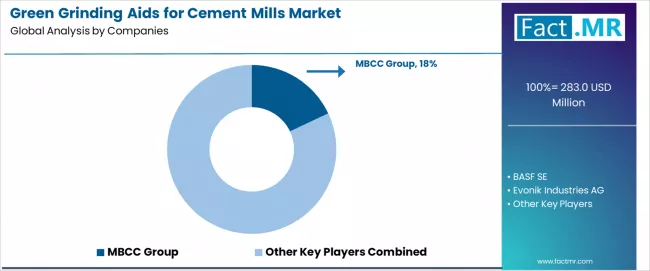
The competitive landscape features global construction chemical specialists and diversified chemical majors. Leading players like MBCC Group and BASF SE compete on the strength of their extensive application expertise, broad portfolios spanning conventional and green alternatives, and global technical service networks capable of supporting multinational cement producers.
Specialty chemical companies like Evonik Industries AG and Clariant AG compete through targeted innovations in surfactant and dispersion chemistry. Firms like GCP Applied Technologies and W. R. Grace and Company leverage deep knowledge of cement performance and the shift towards multifunctional additives. Competition centers on proven performance data, the ability to formulate for specific regional materials and regulations, and providing holistic technical and supply chain solutions.
Key Players in the Green Grinding Aids for Cement Mills Market
- MBCC Group
- BASF SE
- Evonik Industries AG
- GCP Applied Technologies
- Clariant AG
- W. R. Grace and Company
Scope of Report
| Items | Values |
|---|---|
| Quantitative Units | USD Million |
| Product | Bio-based & biodegradable glycols & esters, Low-amine & reduced-amine amine blends, Polycarboxylate-based dispersion enhancers, Reclaimed & re-refined recycled solvent packages, Specialty eco-frothers & surfactants (biobased), Proprietary hybrid eco-packs (vendor engineered) |
| Functional Benefit | Energy reduction & throughput improvement (primary ROI driver), Lower VOC & regulatory & worker-safety specification compliance, Reduced clinker interference (performance for blended cements), Improved early strength with low residuals, Reclaimer & closed-loop compatibility |
| Supply Model | Chemical suppliers & formulators, Integrated OEM & cement-producer in-house formulations, Toll, reclaim & on-site reblend services |
| Key Countries | India, China, USA, Germany |
| Key Companies | MBCC Group, BASF SE, Evonik Industries AG, GCP Applied Technologies, Clariant AG, W. R. Grace and Company |
| Additional Analysis | Analysis of dosage optimization models, impact on cement particle size distribution and strength development, total cost of ownership (TCO) versus energy savings, competitive assessment versus traditional triethanolamine (TEA) based products, and sustainability lifecycle assessment. |
Green Grinding Aids for Cement Mills Market by Segments
-
Product :
- Bio-based & biodegradable glycols & esters
- Low-amine & reduced-amine amine blends
- Polycarboxylate-based dispersion enhancers
- Reclaimed & re-refined recycled solvent packages
- Specialty eco-frothers & surfactants (biobased)
- Proprietary hybrid eco-packs (vendor engineered)
-
Functional Benefit :
- Energy reduction & throughput improvement (primary ROI driver)
- Lower VOC & regulatory & worker-safety specification compliance
- Reduced clinker interference (performance for blended cements)
- Improved early strength with low residuals
- Reclaimer & closed-loop compatibility
-
Supply Model :
- Chemical suppliers & formulators
- Integrated OEM & cement-producer in-house formulations
- Toll, reclaim & on-site reblend services
-
Region :
-
North America
- USA
- Canada
-
Latin America
- Brazil
- Mexico
- Argentina
- Rest of Latin America
-
Western Europe
- Germany
- UK
- France
- Spain
- Italy
- BENELUX
- Rest of Western Europe
-
Eastern Europe
- Russia
- Poland
- Czech Republic
- Rest of Eastern Europe
-
East Asia
- China
- Japan
- South Korea
- Rest of East Asia
-
South Asia & Pacific
- India
- ASEAN
- Australia
- Rest of South Asia & Pacific
-
MEA
- Saudi Arabia
- UAE
- Turkiye
- Rest of MEA
-
Table of Content
- Executive Summary
- Global Market Outlook
- Demand to side Trends
- Supply to side Trends
- Technology Roadmap Analysis
- Analysis and Recommendations
- Market Overview
- Market Coverage / Taxonomy
- Market Definition / Scope / Limitations
- Market Background
- Market Dynamics
- Drivers
- Restraints
- Opportunity
- Trends
- Scenario Forecast
- Demand in Optimistic Scenario
- Demand in Likely Scenario
- Demand in Conservative Scenario
- Opportunity Map Analysis
- Product Life Cycle Analysis
- Supply Chain Analysis
- Investment Feasibility Matrix
- Value Chain Analysis
- PESTLE and Porter’s Analysis
- Regulatory Landscape
- Regional Parent Market Outlook
- Production and Consumption Statistics
- Import and Export Statistics
- Market Dynamics
- Global Market Analysis 2021 to 2025 and Forecast, 2026 to 2036
- Historical Market Size Value (USD Million) Analysis, 2021 to 2025
- Current and Future Market Size Value (USD Million) Projections, 2026 to 2036
- Y to o to Y Growth Trend Analysis
- Absolute $ Opportunity Analysis
- Global Market Pricing Analysis 2021 to 2025 and Forecast 2026 to 2036
- Global Market Analysis 2021 to 2025 and Forecast 2026 to 2036, By Product
- Introduction / Key Findings
- Historical Market Size Value (USD Million) Analysis By Product, 2021 to 2025
- Current and Future Market Size Value (USD Million) Analysis and Forecast By Product, 2026 to 2036
- Bio-based & biodegradable glycols & esters
- Low-amine & reduced-amine amine blends
- Polycarboxylate-based dispersion enhancers
- Reclaimed&re-refined recycled solvent packages
- Specialty eco-frothers & surfactants (biobased)
- Proprietary hybrid eco-packs (vendor engineered)
- Bio-based & biodegradable glycols & esters
- Y to o to Y Growth Trend Analysis By Product, 2021 to 2025
- Absolute $ Opportunity Analysis By Product, 2026 to 2036
- Global Market Analysis 2021 to 2025 and Forecast 2026 to 2036, By Functional Benefit
- Introduction / Key Findings
- Historical Market Size Value (USD Million) Analysis By Functional Benefit, 2021 to 2025
- Current and Future Market Size Value (USD Million) Analysis and Forecast By Functional Benefit, 2026 to 2036
- Energy reduction & throughput improvement (primary ROI driver)
- Lower VOC & regulatory & worker-safety specification compliance
- Reduced clinker interference (performance for blended cements)
- Improved early strength with low residuals
- Reclaimer & closed-loop compatibility
- Energy reduction & throughput improvement (primary ROI driver)
- Y to o to Y Growth Trend Analysis By Functional Benefit, 2021 to 2025
- Absolute $ Opportunity Analysis By Functional Benefit, 2026 to 2036
- Global Market Analysis 2021 to 2025 and Forecast 2026 to 2036, By Supply Model
- Introduction / Key Findings
- Historical Market Size Value (USD Million) Analysis By Supply Model, 2021 to 2025
- Current and Future Market Size Value (USD Million) Analysis and Forecast By Supply Model, 2026 to 2036
- Chemical suppliers & formulators
- Integrated OEM & cement-producer in-house formulations
- Toll, reclaim & on-site reblend services
- Chemical suppliers & formulators
- Y to o to Y Growth Trend Analysis By Supply Model, 2021 to 2025
- Absolute $ Opportunity Analysis By Supply Model, 2026 to 2036
- Global Market Analysis 2021 to 2025 and Forecast 2026 to 2036, By Region
- Introduction
- Historical Market Size Value (USD Million) Analysis By Region, 2021 to 2025
- Current Market Size Value (USD Million) Analysis and Forecast By Region, 2026 to 2036
- North America
- Latin America
- Western Europe
- Eastern Europe
- East Asia
- South Asia and Pacific
- Middle East & Africa
- Market Attractiveness Analysis By Region
- North America Market Analysis 2021 to 2025 and Forecast 2026 to 2036, By Country
- Historical Market Size Value (USD Million) Trend Analysis By Market Taxonomy, 2021 to 2025
- Market Size Value (USD Million) Forecast By Market Taxonomy, 2026 to 2036
- By Country
- USA
- Canada
- Mexico
- By Product
- By Functional Benefit
- By Supply Model
- By Country
- Market Attractiveness Analysis
- By Country
- By Product
- By Functional Benefit
- By Supply Model
- Key Takeaways
- Latin America Market Analysis 2021 to 2025 and Forecast 2026 to 2036, By Country
- Historical Market Size Value (USD Million) Trend Analysis By Market Taxonomy, 2021 to 2025
- Market Size Value (USD Million) Forecast By Market Taxonomy, 2026 to 2036
- By Country
- Brazil
- Chile
- Rest of Latin America
- By Product
- By Functional Benefit
- By Supply Model
- By Country
- Market Attractiveness Analysis
- By Country
- By Product
- By Functional Benefit
- By Supply Model
- Key Takeaways
- Western Europe Market Analysis 2021 to 2025 and Forecast 2026 to 2036, By Country
- Historical Market Size Value (USD Million) Trend Analysis By Market Taxonomy, 2021 to 2025
- Market Size Value (USD Million) Forecast By Market Taxonomy, 2026 to 2036
- By Country
- Germany
- UK
- Italy
- Spain
- France
- Nordic
- BENELUX
- Rest of Western Europe
- By Product
- By Functional Benefit
- By Supply Model
- By Country
- Market Attractiveness Analysis
- By Country
- By Product
- By Functional Benefit
- By Supply Model
- Key Takeaways
- Eastern Europe Market Analysis 2021 to 2025 and Forecast 2026 to 2036, By Country
- Historical Market Size Value (USD Million) Trend Analysis By Market Taxonomy, 2021 to 2025
- Market Size Value (USD Million) Forecast By Market Taxonomy, 2026 to 2036
- By Country
- Russia
- Poland
- Hungary
- Balkan & Baltic
- Rest of Eastern Europe
- By Product
- By Functional Benefit
- By Supply Model
- By Country
- Market Attractiveness Analysis
- By Country
- By Product
- By Functional Benefit
- By Supply Model
- Key Takeaways
- East Asia Market Analysis 2021 to 2025 and Forecast 2026 to 2036, By Country
- Historical Market Size Value (USD Million) Trend Analysis By Market Taxonomy, 2021 to 2025
- Market Size Value (USD Million) Forecast By Market Taxonomy, 2026 to 2036
- By Country
- China
- Japan
- South Korea
- By Product
- By Functional Benefit
- By Supply Model
- By Country
- Market Attractiveness Analysis
- By Country
- By Product
- By Functional Benefit
- By Supply Model
- Key Takeaways
- South Asia and Pacific Market Analysis 2021 to 2025 and Forecast 2026 to 2036, By Country
- Historical Market Size Value (USD Million) Trend Analysis By Market Taxonomy, 2021 to 2025
- Market Size Value (USD Million) Forecast By Market Taxonomy, 2026 to 2036
- By Country
- India
- ASEAN
- Australia & New Zealand
- Rest of South Asia and Pacific
- By Product
- By Functional Benefit
- By Supply Model
- By Country
- Market Attractiveness Analysis
- By Country
- By Product
- By Functional Benefit
- By Supply Model
- Key Takeaways
- Middle East & Africa Market Analysis 2021 to 2025 and Forecast 2026 to 2036, By Country
- Historical Market Size Value (USD Million) Trend Analysis By Market Taxonomy, 2021 to 2025
- Market Size Value (USD Million) Forecast By Market Taxonomy, 2026 to 2036
- By Country
- Kingdom of Saudi Arabia
- Other GCC Countries
- Turkiye
- South Africa
- Other African Union
- Rest of Middle East & Africa
- By Product
- By Functional Benefit
- By Supply Model
- By Country
- Market Attractiveness Analysis
- By Country
- By Product
- By Functional Benefit
- By Supply Model
- Key Takeaways
- Key Countries Market Analysis
- USA
- Pricing Analysis
- Market Share Analysis, 2025
- By Product
- By Functional Benefit
- By Supply Model
- Canada
- Pricing Analysis
- Market Share Analysis, 2025
- By Product
- By Functional Benefit
- By Supply Model
- Mexico
- Pricing Analysis
- Market Share Analysis, 2025
- By Product
- By Functional Benefit
- By Supply Model
- Brazil
- Pricing Analysis
- Market Share Analysis, 2025
- By Product
- By Functional Benefit
- By Supply Model
- Chile
- Pricing Analysis
- Market Share Analysis, 2025
- By Product
- By Functional Benefit
- By Supply Model
- Germany
- Pricing Analysis
- Market Share Analysis, 2025
- By Product
- By Functional Benefit
- By Supply Model
- UK
- Pricing Analysis
- Market Share Analysis, 2025
- By Product
- By Functional Benefit
- By Supply Model
- Italy
- Pricing Analysis
- Market Share Analysis, 2025
- By Product
- By Functional Benefit
- By Supply Model
- Spain
- Pricing Analysis
- Market Share Analysis, 2025
- By Product
- By Functional Benefit
- By Supply Model
- France
- Pricing Analysis
- Market Share Analysis, 2025
- By Product
- By Functional Benefit
- By Supply Model
- India
- Pricing Analysis
- Market Share Analysis, 2025
- By Product
- By Functional Benefit
- By Supply Model
- ASEAN
- Pricing Analysis
- Market Share Analysis, 2025
- By Product
- By Functional Benefit
- By Supply Model
- Australia & New Zealand
- Pricing Analysis
- Market Share Analysis, 2025
- By Product
- By Functional Benefit
- By Supply Model
- China
- Pricing Analysis
- Market Share Analysis, 2025
- By Product
- By Functional Benefit
- By Supply Model
- Japan
- Pricing Analysis
- Market Share Analysis, 2025
- By Product
- By Functional Benefit
- By Supply Model
- South Korea
- Pricing Analysis
- Market Share Analysis, 2025
- By Product
- By Functional Benefit
- By Supply Model
- Russia
- Pricing Analysis
- Market Share Analysis, 2025
- By Product
- By Functional Benefit
- By Supply Model
- Poland
- Pricing Analysis
- Market Share Analysis, 2025
- By Product
- By Functional Benefit
- By Supply Model
- Hungary
- Pricing Analysis
- Market Share Analysis, 2025
- By Product
- By Functional Benefit
- By Supply Model
- Kingdom of Saudi Arabia
- Pricing Analysis
- Market Share Analysis, 2025
- By Product
- By Functional Benefit
- By Supply Model
- Turkiye
- Pricing Analysis
- Market Share Analysis, 2025
- By Product
- By Functional Benefit
- By Supply Model
- South Africa
- Pricing Analysis
- Market Share Analysis, 2025
- By Product
- By Functional Benefit
- By Supply Model
- USA
- Market Structure Analysis
- Competition Dashboard
- Competition Benchmarking
- Market Share Analysis of Top Players
- By Regional
- By Product
- By Functional Benefit
- By Supply Model
- Competition Analysis
- Competition Deep Dive
- MBCC Group
- Overview
- Product Portfolio
- Profitability by Market Segments (Product/Age /Sales Channel/Region)
- Sales Footprint
- Strategy Overview
- Marketing Strategy
- Product Strategy
- Channel Strategy
- BASF SE
- Evonik Industries AG
- GCP Applied Technologies
- Clariant AG
- W. R. Grace and Companies
- MBCC Group
- Competition Deep Dive
- Assumptions & Acronyms Used
- Research Methodology
List Of Table
- Table 1: Global Market Value (USD Million) Forecast by Region, 2021 to 2036
- Table 2: Global Market Value (USD Million) Forecast by Product, 2021 to 2036
- Table 3: Global Market Value (USD Million) Forecast by Functional Benefit, 2021 to 2036
- Table 4: Global Market Value (USD Million) Forecast by Supply Model, 2021 to 2036
- Table 5: North America Market Value (USD Million) Forecast by Country, 2021 to 2036
- Table 6: North America Market Value (USD Million) Forecast by Product, 2021 to 2036
- Table 7: North America Market Value (USD Million) Forecast by Functional Benefit, 2021 to 2036
- Table 8: North America Market Value (USD Million) Forecast by Supply Model, 2021 to 2036
- Table 9: Latin America Market Value (USD Million) Forecast by Country, 2021 to 2036
- Table 10: Latin America Market Value (USD Million) Forecast by Product, 2021 to 2036
- Table 11: Latin America Market Value (USD Million) Forecast by Functional Benefit, 2021 to 2036
- Table 12: Latin America Market Value (USD Million) Forecast by Supply Model, 2021 to 2036
- Table 13: Western Europe Market Value (USD Million) Forecast by Country, 2021 to 2036
- Table 14: Western Europe Market Value (USD Million) Forecast by Product, 2021 to 2036
- Table 15: Western Europe Market Value (USD Million) Forecast by Functional Benefit, 2021 to 2036
- Table 16: Western Europe Market Value (USD Million) Forecast by Supply Model, 2021 to 2036
- Table 17: Eastern Europe Market Value (USD Million) Forecast by Country, 2021 to 2036
- Table 18: Eastern Europe Market Value (USD Million) Forecast by Product, 2021 to 2036
- Table 19: Eastern Europe Market Value (USD Million) Forecast by Functional Benefit, 2021 to 2036
- Table 20: Eastern Europe Market Value (USD Million) Forecast by Supply Model, 2021 to 2036
- Table 21: East Asia Market Value (USD Million) Forecast by Country, 2021 to 2036
- Table 22: East Asia Market Value (USD Million) Forecast by Product, 2021 to 2036
- Table 23: East Asia Market Value (USD Million) Forecast by Functional Benefit, 2021 to 2036
- Table 24: East Asia Market Value (USD Million) Forecast by Supply Model, 2021 to 2036
- Table 25: South Asia and Pacific Market Value (USD Million) Forecast by Country, 2021 to 2036
- Table 26: South Asia and Pacific Market Value (USD Million) Forecast by Product, 2021 to 2036
- Table 27: South Asia and Pacific Market Value (USD Million) Forecast by Functional Benefit, 2021 to 2036
- Table 28: South Asia and Pacific Market Value (USD Million) Forecast by Supply Model, 2021 to 2036
- Table 29: Middle East & Africa Market Value (USD Million) Forecast by Country, 2021 to 2036
- Table 30: Middle East & Africa Market Value (USD Million) Forecast by Product, 2021 to 2036
- Table 31: Middle East & Africa Market Value (USD Million) Forecast by Functional Benefit, 2021 to 2036
- Table 32: Middle East & Africa Market Value (USD Million) Forecast by Supply Model, 2021 to 2036
List Of Figures
- Figure 1: Global Market Pricing Analysis
- Figure 2: Global Market Value (USD Million) Forecast 2021 to 2036
- Figure 3: Global Market Value Share and BPS Analysis by Product, 2026 and 2036
- Figure 4: Global Market Y to o to Y Growth Comparison by Product, 2026 to 2036
- Figure 5: Global Market Attractiveness Analysis by Product
- Figure 6: Global Market Value Share and BPS Analysis by Functional Benefit, 2026 and 2036
- Figure 7: Global Market Y to o to Y Growth Comparison by Functional Benefit, 2026 to 2036
- Figure 8: Global Market Attractiveness Analysis by Functional Benefit
- Figure 9: Global Market Value Share and BPS Analysis by Supply Model, 2026 and 2036
- Figure 10: Global Market Y to o to Y Growth Comparison by Supply Model, 2026 to 2036
- Figure 11: Global Market Attractiveness Analysis by Supply Model
- Figure 12: Global Market Value (USD Million) Share and BPS Analysis by Region, 2026 and 2036
- Figure 13: Global Market Y to o to Y Growth Comparison by Region, 2026 to 2036
- Figure 14: Global Market Attractiveness Analysis by Region
- Figure 15: North America Market Incremental Dollar Opportunity, 2026 to 2036
- Figure 16: Latin America Market Incremental Dollar Opportunity, 2026 to 2036
- Figure 17: Western Europe Market Incremental Dollar Opportunity, 2026 to 2036
- Figure 18: Eastern Europe Market Incremental Dollar Opportunity, 2026 to 2036
- Figure 19: East Asia Market Incremental Dollar Opportunity, 2026 to 2036
- Figure 20: South Asia and Pacific Market Incremental Dollar Opportunity, 2026 to 2036
- Figure 21: Middle East & Africa Market Incremental Dollar Opportunity, 2026 to 2036
- Figure 22: North America Market Value Share and BPS Analysis by Country, 2026 and 2036
- Figure 23: North America Market Value Share and BPS Analysis by Product, 2026 and 2036
- Figure 24: North America Market Y to o to Y Growth Comparison by Product, 2026 to 2036
- Figure 25: North America Market Attractiveness Analysis by Product
- Figure 26: North America Market Value Share and BPS Analysis by Functional Benefit, 2026 and 2036
- Figure 27: North America Market Y to o to Y Growth Comparison by Functional Benefit, 2026 to 2036
- Figure 28: North America Market Attractiveness Analysis by Functional Benefit
- Figure 29: North America Market Value Share and BPS Analysis by Supply Model, 2026 and 2036
- Figure 30: North America Market Y to o to Y Growth Comparison by Supply Model, 2026 to 2036
- Figure 31: North America Market Attractiveness Analysis by Supply Model
- Figure 32: Latin America Market Value Share and BPS Analysis by Country, 2026 and 2036
- Figure 33: Latin America Market Value Share and BPS Analysis by Product, 2026 and 2036
- Figure 34: Latin America Market Y to o to Y Growth Comparison by Product, 2026 to 2036
- Figure 35: Latin America Market Attractiveness Analysis by Product
- Figure 36: Latin America Market Value Share and BPS Analysis by Functional Benefit, 2026 and 2036
- Figure 37: Latin America Market Y to o to Y Growth Comparison by Functional Benefit, 2026 to 2036
- Figure 38: Latin America Market Attractiveness Analysis by Functional Benefit
- Figure 39: Latin America Market Value Share and BPS Analysis by Supply Model, 2026 and 2036
- Figure 40: Latin America Market Y to o to Y Growth Comparison by Supply Model, 2026 to 2036
- Figure 41: Latin America Market Attractiveness Analysis by Supply Model
- Figure 42: Western Europe Market Value Share and BPS Analysis by Country, 2026 and 2036
- Figure 43: Western Europe Market Value Share and BPS Analysis by Product, 2026 and 2036
- Figure 44: Western Europe Market Y to o to Y Growth Comparison by Product, 2026 to 2036
- Figure 45: Western Europe Market Attractiveness Analysis by Product
- Figure 46: Western Europe Market Value Share and BPS Analysis by Functional Benefit, 2026 and 2036
- Figure 47: Western Europe Market Y to o to Y Growth Comparison by Functional Benefit, 2026 to 2036
- Figure 48: Western Europe Market Attractiveness Analysis by Functional Benefit
- Figure 49: Western Europe Market Value Share and BPS Analysis by Supply Model, 2026 and 2036
- Figure 50: Western Europe Market Y to o to Y Growth Comparison by Supply Model, 2026 to 2036
- Figure 51: Western Europe Market Attractiveness Analysis by Supply Model
- Figure 52: Eastern Europe Market Value Share and BPS Analysis by Country, 2026 and 2036
- Figure 53: Eastern Europe Market Value Share and BPS Analysis by Product, 2026 and 2036
- Figure 54: Eastern Europe Market Y to o to Y Growth Comparison by Product, 2026 to 2036
- Figure 55: Eastern Europe Market Attractiveness Analysis by Product
- Figure 56: Eastern Europe Market Value Share and BPS Analysis by Functional Benefit, 2026 and 2036
- Figure 57: Eastern Europe Market Y to o to Y Growth Comparison by Functional Benefit, 2026 to 2036
- Figure 58: Eastern Europe Market Attractiveness Analysis by Functional Benefit
- Figure 59: Eastern Europe Market Value Share and BPS Analysis by Supply Model, 2026 and 2036
- Figure 60: Eastern Europe Market Y to o to Y Growth Comparison by Supply Model, 2026 to 2036
- Figure 61: Eastern Europe Market Attractiveness Analysis by Supply Model
- Figure 62: East Asia Market Value Share and BPS Analysis by Country, 2026 and 2036
- Figure 63: East Asia Market Value Share and BPS Analysis by Product, 2026 and 2036
- Figure 64: East Asia Market Y to o to Y Growth Comparison by Product, 2026 to 2036
- Figure 65: East Asia Market Attractiveness Analysis by Product
- Figure 66: East Asia Market Value Share and BPS Analysis by Functional Benefit, 2026 and 2036
- Figure 67: East Asia Market Y to o to Y Growth Comparison by Functional Benefit, 2026 to 2036
- Figure 68: East Asia Market Attractiveness Analysis by Functional Benefit
- Figure 69: East Asia Market Value Share and BPS Analysis by Supply Model, 2026 and 2036
- Figure 70: East Asia Market Y to o to Y Growth Comparison by Supply Model, 2026 to 2036
- Figure 71: East Asia Market Attractiveness Analysis by Supply Model
- Figure 72: South Asia and Pacific Market Value Share and BPS Analysis by Country, 2026 and 2036
- Figure 73: South Asia and Pacific Market Value Share and BPS Analysis by Product, 2026 and 2036
- Figure 74: South Asia and Pacific Market Y to o to Y Growth Comparison by Product, 2026 to 2036
- Figure 75: South Asia and Pacific Market Attractiveness Analysis by Product
- Figure 76: South Asia and Pacific Market Value Share and BPS Analysis by Functional Benefit, 2026 and 2036
- Figure 77: South Asia and Pacific Market Y to o to Y Growth Comparison by Functional Benefit, 2026 to 2036
- Figure 78: South Asia and Pacific Market Attractiveness Analysis by Functional Benefit
- Figure 79: South Asia and Pacific Market Value Share and BPS Analysis by Supply Model, 2026 and 2036
- Figure 80: South Asia and Pacific Market Y to o to Y Growth Comparison by Supply Model, 2026 to 2036
- Figure 81: South Asia and Pacific Market Attractiveness Analysis by Supply Model
- Figure 82: Middle East & Africa Market Value Share and BPS Analysis by Country, 2026 and 2036
- Figure 83: Middle East & Africa Market Value Share and BPS Analysis by Product, 2026 and 2036
- Figure 84: Middle East & Africa Market Y to o to Y Growth Comparison by Product, 2026 to 2036
- Figure 85: Middle East & Africa Market Attractiveness Analysis by Product
- Figure 86: Middle East & Africa Market Value Share and BPS Analysis by Functional Benefit, 2026 and 2036
- Figure 87: Middle East & Africa Market Y to o to Y Growth Comparison by Functional Benefit, 2026 to 2036
- Figure 88: Middle East & Africa Market Attractiveness Analysis by Functional Benefit
- Figure 89: Middle East & Africa Market Value Share and BPS Analysis by Supply Model, 2026 and 2036
- Figure 90: Middle East & Africa Market Y to o to Y Growth Comparison by Supply Model, 2026 to 2036
- Figure 91: Middle East & Africa Market Attractiveness Analysis by Supply Model
- Figure 92: Global Market - Tier Structure Analysis
- Figure 93: Global Market - Company Share Analysis
- FAQs -
How big is the green grinding aids for cement mills market in 2026?
The global green grinding aids for cement mills market is estimated to be valued at USD 283.0 million in 2026.
What will be the size of green grinding aids for cement mills market in 2036?
The market size for the heat-stress mitigation foliar protectant market is projected to reach USD 719.1 million by 2036.
How much will be the green grinding aids for cement mills market growth between 2026 and 2036?
The heat-stress mitigation foliar protectant market is expected to grow at a 8.4% CAGR between 2026 and 2036.
What are the key product types in the green grinding aids for cement mills market?
The key product types in heat-stress mitigation foliar protectant market are anti-transpirants (film-forming&stomatal regulation), osmoprotectant sprays (glycine betaine, proline blends), biostimulants (seaweed extracts, humic&fulvic blends), reflective kaolin & mineral particle films, amino-acid foliar protectants and microbial&biological foliar stress reducers.
Which functional benefit segment to contribute significant share in the green grinding aids for cement mills market in 2026?
In terms of crop type, fruits & vegetables segment to command 30.0% share in the heat-stress mitigation foliar protectant market in 2026.