Positive Displacement Blowers Market Size, Share, Growth and Forecast (2026 - 2036)
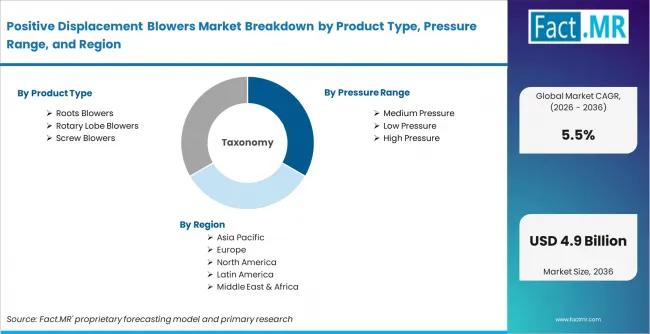
Positive Displacement Blowers Market is segmented by Product Type (Roots Blowers, Rotary Lobe Blowers, Screw Blowers), Pressure Range (Medium Pressure, Low Pressure, High Pressure), Application (Wastewater Treatment, Pneumatic Conveying, Industrial Processing, Aquaculture, Food and Beverage), and Region, with forecasts covering the period from 2026 to 2036.
Positive Displacement Blowers Market Analysis and Forecast by Fact.MR
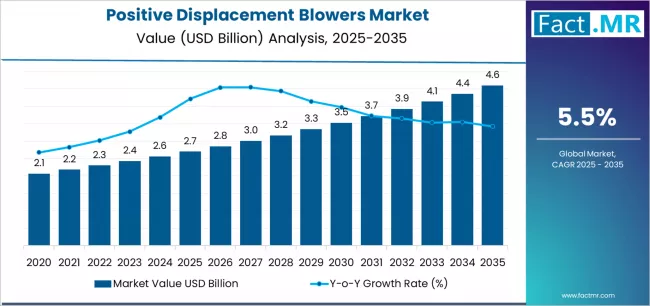
- The global positive displacement blowers market is estimated at USD 2.85 billion in 2026 and is forecast to expand at a CAGR of 5.5% to reach USD 4.87 billion by 2036.
- Positive displacement blowers encompass roots blowers, rotary lobe blowers, and screw blowers that deliver consistent volumetric airflow regardless of system pressure for wastewater treatment aeration, pneumatic conveying, industrial processing, aquaculture, and food and beverage applications.
- The market is driven by expanding wastewater treatment infrastructure, tightening environmental discharge standards, growing pneumatic conveying requirements in cement and bulk material handling, aquaculture expansion, and the emergence of energy-efficient screw blower technologies that deliver 20 to 37% energy savings compared to conventional roots blowers.
Summary of Positive Displacement Blowers Market
- Market Snapshot
- In 2025, the global Positive Displacement Blowers Market was valued at approximately USD 2.7 billion.
- The market is estimated to reach USD 2.85 billion in 2026 and is projected to attain USD 4.87 billion by 2036.
- The positive displacement blowers market is likely to expand at a CAGR of 5.5% during the forecast period.
- The market is anticipated to create an absolute dollar opportunity of USD 2.02 billion between 2026 and 2036.
- Electric motor driven accounts for 70% of drive type share in 2026.
- India (6.4%) and China (6.2%) are the key growth markets during the forecast period.
- Demand and Growth Drivers
- Expanding municipal and industrial wastewater treatment infrastructure is the primary demand driver, with positive displacement blowers providing consistent oil-free air delivery essential for biological aeration processes.
- Tightening environmental discharge standards in both developed and emerging economies are requiring treatment plant upgrades that include modern, energy-efficient blower systems.
- Growing pneumatic conveying requirements in cement, bulk material handling, and food processing are driving demand for reliable positive displacement airflow at medium pressures.
- Aquaculture expansion, particularly shrimp and fish farming in Asia Pacific, is creating demand for aeration blowers that maintain dissolved oxygen levels critical to aquatic health.
- Energy efficiency mandates and rising electricity costs are accelerating adoption of screw blowers and variable-frequency-drive-equipped systems that reduce energy consumption by 20 to 37%.
- Product and Segment View
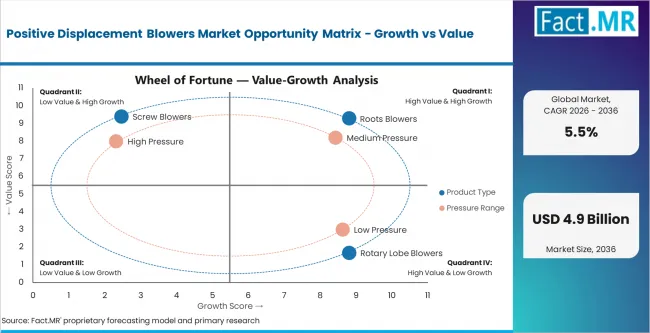
- Roots blowers account for 45% of the product type segment in 2026, sustained by proven reliability, established installed base, and broad application across wastewater treatment, pneumatic conveying, and industrial processing.
- Medium pressure (1.5 to 3.5 bar) holds 45% of the pressure range segment, serving the broadest range of industrial processes, wastewater aeration, and material handling applications.
- Electric motor driven accounts for 70% of the drive type segment, reflecting the dominance of electric power in permanent installations where VFD integration enables energy optimization.
- Key segmentation includes:
- Product Type: Roots blowers (two-lobe, three-lobe), Rotary lobe blowers (dry running, oil-lubricated), Screw blowers (single-stage, two-stage)
- Pressure Range: Low pressure, Medium pressure, High pressure
- Application: Wastewater treatment, Pneumatic conveying, Industrial processing, Aquaculture, Food and beverage
- End Use Industry: Water and wastewater, Manufacturing, Food and beverage, Energy and power, Aquaculture
- Drive Type: Electric motor driven, Engine driven, Direct drive systems
- Cooling Type: Air-cooled blowers, Water-cooled blowers
- These systems enable:
- Consistent volumetric airflow delivery independent of system pressure variations, essential for biological aeration in wastewater treatment
- Oil-free air supply for food processing, pharmaceutical, and sensitive industrial applications where air purity is critical
- Reliable medium-pressure air delivery for pneumatic conveying of bulk materials including cement, powder, and grain
- Geography and Competitive Outlook
- Asia Pacific leads growth through India and China, driven by wastewater treatment infrastructure expansion, industrial growth, aquaculture development, and cement industry requirements.
- North America sustains demand through the USA, supported by aging wastewater plant upgrades, environmental compliance requirements, and industrial process air needs.
- Europe maintains growth through Germany, driven by energy efficiency leadership, environmental standards, and AERZEN's home market technology development.
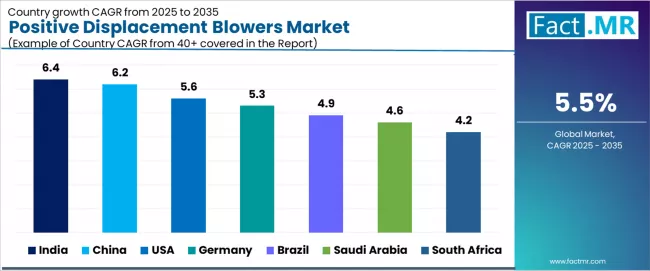
- India (6.4%) and China (6.2%) lead growth, while the USA (5.6%), Germany (5.3%), Brazil (4.9%), Saudi Arabia (4.6%), and South Africa (4.2%) sustain demand.
- Major players include Roots Blower Co., Ingersoll Rand, Aerzener Maschinenfabrik, Atlas Copco, Busch Group, and Kaeser Kompressoren.
- Analyst Opinion
- Shambhu Nath Jha, Principal Consultant at Fact.MR, says 'The positive displacement blower market is undergoing a technology transition as energy-efficient screw blowers challenge the established dominance of traditional roots blowers. AERZEN's Delta Hybrid 2.0 screw blowers, premiering at IFAT 2026, achieve energy savings of up to 37% compared to conventional positive displacement blowers while delivering significantly lower noise levels. This performance gap is creating a bifurcation where new installations increasingly specify screw blower technology for energy-sensitive applications, while the massive installed base of roots blowers sustains replacement and maintenance demand. Companies offering integrated technology solutions combining roots, screw, and turbo blower configurations within single system designs are capturing specification advantages in complex wastewater and industrial projects.'
Key Growth Drivers, Constraints, and Opportunities
Key Factors Driving Growth
- Wastewater treatment infrastructure expansion across India, China, the Middle East, and Latin America is creating sustained multi-year demand for aeration blower systems.
- Energy efficiency mandates and rising electricity costs are driving specification of screw blowers and VFD-equipped systems delivering 20 to 37% savings over conventional roots blowers.
- Aquaculture expansion, particularly in Asia Pacific, is creating growing demand for reliable aeration systems maintaining dissolved oxygen levels in fish and shrimp farming operations.
Key Market Constraints
- High energy consumption of conventional roots blowers, which can represent 50 to 70% of wastewater treatment plant electricity costs, creates operating cost pressure driving technology transitions.
- Long replacement cycles of 15 to 20 years for industrial blower installations limit the pace of installed base modernization and technology adoption.
- Price sensitivity in municipal wastewater projects, particularly in emerging economies, creates procurement resistance to premium-priced screw and turbo blower technologies.
Key Opportunity Areas
- Screw blower technology offering 20 to 37% energy savings is displacing conventional roots blowers in new installations and major upgrade projects.
- Digital monitoring and predictive maintenance integration into blower systems creates service revenue opportunities beyond equipment sales.
- Municipal wastewater treatment expansion in India, Southeast Asia, and Africa represents large-scale greenfield demand for aeration blower systems.
Segment-wise Analysis of the Positive Displacement Blowers Market
- Roots blowers hold 45% of the product type segment in 2026, sustained by proven reliability, broad application compatibility, and the massive global installed base driving replacement demand.
- Water and wastewater industry accounts for 40% of the end use industry segment in 2026, reflecting the fundamental role of blowers in biological aeration at municipal and industrial treatment plants.
- Air-cooled blowers account for 60% of the cooling type segment, driven by installation simplicity, lower maintenance, and suitability for the majority of standard-pressure industrial applications.
The market is segmented by product type, pressure range, application, end use industry, drive type, cooling type, and region. Roots blowers lead by product type. Medium pressure leads by pressure range. Wastewater treatment leads by application, and electric motor drives dominate by drive type.
Which Product Type Segment Dominates the Positive Displacement Blowers Market?
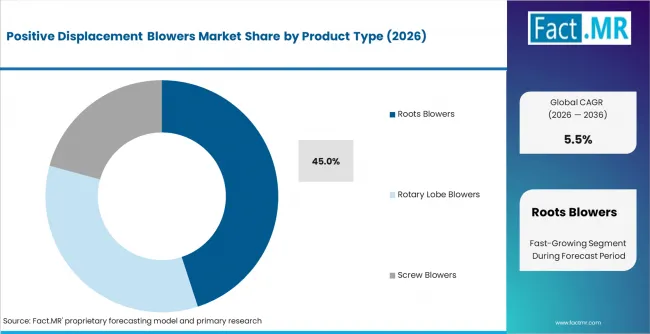
Roots blowers account for 45% of the product type segment in 2026. Two-lobe and three-lobe roots blowers remain the workhorse of wastewater aeration, pneumatic conveying, and industrial process air applications through their proven reliability, simple maintenance, and tolerance of process variations. Three-lobe designs are gaining share over two-lobe configurations through improved efficiency, reduced pulsation, and lower noise.
Screw blowers are the fastest-growing product type, driven by energy savings of 20 to 37% compared to conventional roots blowers. AERZEN's Delta Hybrid 2.0, premiering at IFAT 2026, exemplifies this trend with improved thermal stability and advanced AERtronic control. Rotary lobe blowers serve applications requiring oil-free operation in food, pharmaceutical, and sensitive industrial environments.
Which Application Segment Dominates the Positive Displacement Blowers Market?
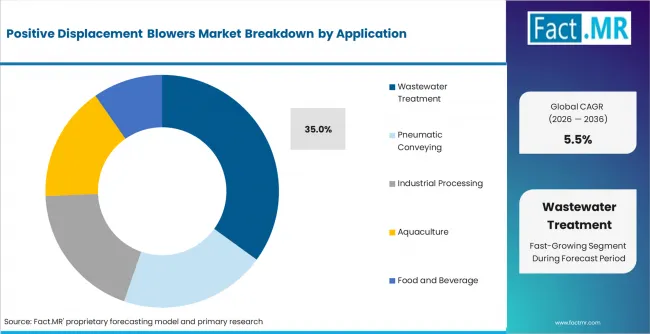
Wastewater treatment accounts for 35% of the application segment in 2026. Biological aeration in activated sludge processes requires consistent, oil-free airflow that positive displacement blowers deliver reliably. Municipal sewage treatment and industrial effluent treatment plants form the core demand base, with aeration typically consuming 50 to 70% of total plant energy.
Pneumatic conveying is the second-largest application, serving cement, flour, grain, plastic pellet, and chemical powder transport. Industrial processing applications include chemical reactor air supply, combustion air delivery, and flue gas treatment. Aquaculture is the fastest-growing segment through shrimp and fish farming aeration expansion in Asia Pacific.
Which Drive Type Segment Dominates the Positive Displacement Blowers Market?
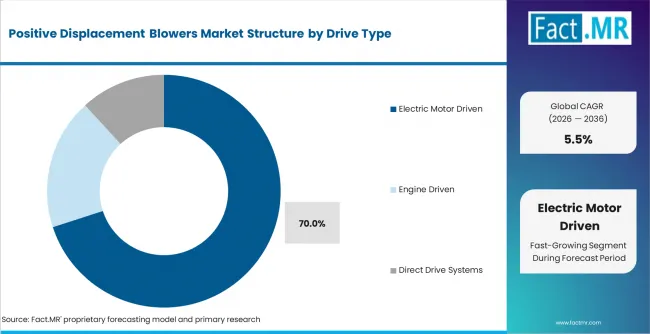
Electric motor driven accounts for 70% of the drive type segment in 2026. Standard and variable frequency drive (VFD) electric motors serve the vast majority of permanent blower installations in wastewater treatment, manufacturing, and food processing. VFD-equipped systems are the fastest-growing sub-segment, enabling energy optimization through speed control that matches airflow delivery to actual process demand.
Engine driven blowers serve remote locations, off-grid applications, and emergency backup installations. Direct drive systems, including coupled and belt drive configurations, serve specific applications where mechanical simplicity or flexible speed matching is prioritized.
Which Product Trend is Shaping the Next Phase of Growth in the Positive Displacement Blowers Market?
Energy-efficient screw blowers with integrated digital monitoring are the defining product trend. At IFAT 2026 in Munich, AERZEN premiered new sizes of its Delta Hybrid 2.0 screw blowers and Aerzen Turbo blowers under the slogan 'Efficient by Nature - Sustainable by Design.' The Delta Hybrid screw blowers achieve energy savings of up to 37% compared to conventional positive displacement blowers while delivering extremely low sound pressure levels, improved thermal stability through modified process air flows, and advanced AERtronic control systems as standard.
This energy-efficiency transition is being complemented by integrated system solutions that combine rotary piston, screw, and turbo blower technologies within optimized configurations for specific applications. AERZEN's acquisition of ACI extends its portfolio into compressed air solutions, while Atlas Copco's ZS series gear-box driven screw blowers and Kaeser Kompressoren's sigma profile rotary blowers continue to push efficiency boundaries. The shift toward holistic system design rather than individual blower specification represents a fundamental change in how wastewater treatment plants and industrial facilities approach aeration and process air procurement.
Regional Outlook Across Key Markets
.webp)
| Country | CAGR (%) |
|---|---|
| India | 6.4% |
| China | 6.2% |
| USA | 5.6% |
| Germany | 5.3% |
| Brazil | 4.9% |
| Saudi Arabia | 4.6% |
| South Africa | 4.2% |
- India leads growth at 6.4%, driven by massive wastewater treatment infrastructure expansion, industrial growth, and aquaculture development.
- China follows at 6.2%, supported by environmental compliance enforcement, industrial production expansion, and growing adoption of energy-efficient blower technologies.
- The USA grows at 5.6%, driven by aging wastewater plant upgrades, environmental compliance, and industrial process air requirements.
- Germany sustains growth at 5.3%, supported by AERZEN's technology leadership, energy efficiency standards, and environmental engineering excellence.
Source: Fact MR (FMR) analysis, based on proprietary forecasting model and primary research.
Market Outlook for Positive Displacement Blowers in India
The India market is projected to grow at a CAGR of 6.4% through 2036. Demand is driven by massive wastewater treatment infrastructure expansion under government sanitation programs, industrial growth, cement industry requirements, and aquaculture development.
- Wastewater treatment expansion creates multi-year aeration blower procurement.
- Industrial growth drives process air and pneumatic conveying demand.
- Aquaculture development expands aeration equipment requirements.
Positive Displacement Blower Demand Trends in China
The China market is projected to grow at a CAGR of 6.2% through 2036. Growth is supported by environmental compliance enforcement, industrial production expansion, cement industry requirements, and adoption of energy-efficient screw blower technologies.
- Environmental compliance enforcement drives treatment plant blower upgrades.
- Industrial production expansion creates process air demand.
- Energy efficiency focus accelerates screw blower technology adoption.
United States Positive Displacement Blower Market Growth Assessment
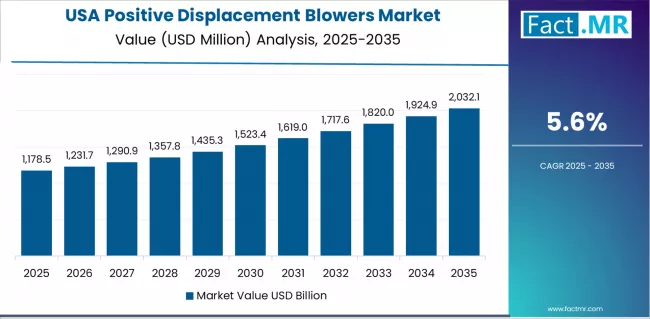
The U.S. market is projected to grow at a CAGR of 5.6% through 2036. Demand is driven by aging wastewater treatment plant upgrades, environmental discharge compliance, industrial process requirements, and energy efficiency optimization.
- Aging treatment plant infrastructure drives blower replacement demand.
- Environmental compliance sustains aeration system procurement.
- Energy efficiency focus drives adoption of VFD-equipped and screw blower systems.
Germany Positive Displacement Blower Market Demand Analysis
The Germany market is projected to grow at a CAGR of 5.3% through 2036. Demand is shaped by AERZEN's technology development, strict environmental standards, energy efficiency leadership, and export-oriented manufacturing for global markets.
- AERZEN's home market drives technology innovation and first-adoption.
- Environmental standards sustain demand for high-efficiency aeration systems.
- Export manufacturing supports global market supply from German production.
Brazil Positive Displacement Blower Market Opportunity Outlook
The Brazil market is projected to grow at a CAGR of 4.9% through 2036. Demand is supported by wastewater treatment infrastructure expansion, industrial growth, and agricultural processing requirements.
- Wastewater treatment expansion creates aeration blower demand.
- Industrial growth drives process air and conveying requirements.
- Agricultural processing sustains food industry blower demand.
Competitive Benchmarking and Company Positioning
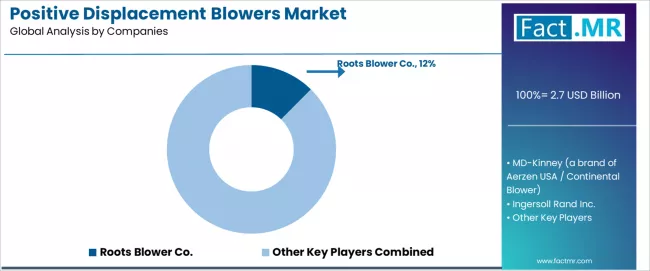
Positive Displacement Blowers Market Analysis By Company
- Roots Blower Co. holds approximately 12% market share through brand heritage, broad product range, and deep installed base across wastewater and industrial applications.
- Ingersoll Rand, Aerzener Maschinenfabrik, Atlas Copco, and Kaeser Kompressoren compete through technology innovation, energy efficiency leadership, and global service networks.
- Energy efficiency performance, product technology breadth, service infrastructure, and application engineering capability are primary differentiators.
The competitive landscape is moderately fragmented. Roots Blower Co. holds approximately 12% market share through its founding heritage in positive displacement blower technology and deep installed base. Ingersoll Rand maintains a broad industrial air portfolio spanning blowers, compressors, and vacuum systems with global manufacturing and service infrastructure.
Aerzener Maschinenfabrik (AERZEN) is the technology leader in energy-efficient screw blowers, with its Delta Hybrid 2.0 platform delivering up to 37% energy savings. AERZEN's acquisition of ACI expands its compressed air portfolio. Atlas Copco competes through its ZS series screw blowers, while Kaeser Kompressoren offers sigma profile rotary blowers with advanced controls.
Busch Group serves vacuum and blower applications, EBARA Corporation serves Asian municipal infrastructure, and MAPRO serves specialized Italian and European industrial markets. GREATECH, BLOWTAC, and Shandong Dacheng serve Asian markets with competitive pricing and expanding product ranges. Republic Manufacturing and Eurus Blower serve North American niche applications.
Strategic priorities include expanding screw blower technology adoption, integrating digital monitoring platforms, developing energy-efficient hybrid system solutions, and strengthening service infrastructure in high-growth emerging markets.
Key Companies in the Positive Displacement Blowers Market
- Roots Blower Co., Ingersoll Rand Inc., and Aerzener Maschinenfabrik GmbH lead through technology heritage, product breadth, and global market presence.
- Atlas Copco AB, Busch Group, and Kaeser Kompressoren SE hold established positions through diversified compressed air portfolios and energy efficiency leadership.
- Eurus Blower, Republic Manufacturing, MAPRO, EBARA, GREATECH, BLOWTAC, and Shandong Dacheng compete through regional strength, application specialization, and competitive pricing.
Recent Industry Developments
- Aerzener Maschinenfabrik GmbH - Product Premiere / Delta Hybrid 2.0 Screw Blowers at IFAT 2026 (May 2026)
- AERZEN premiered new sizes of its Delta Hybrid 2.0 screw blowers and Aerzen Turbo blowers at IFAT 2026 in Munich, achieving energy savings of up to 37% compared to conventional positive displacement blowers with improved thermal stability and advanced AERtronic control.
- Aerzener Maschinenfabrik GmbH - Strategic Acquisition / ACI Compressor Solutions (2025)
- AERZEN acquired ACI, expanding its portfolio to include highly efficient compressor solutions for industrial compressed air applications, broadening its technology platform beyond blower systems.
- Atlas Copco AB - Technology Development / ZS Series Gear-Box Driven Screw Blowers (2025)
- Atlas Copco continued expanding its ZS series gear-box driven rotary screw blowers for industrial and wastewater aeration applications, delivering flow ranges from 160 to 5,300 cfm at pressures from 4.4 to 22 psig with improved energy efficiency.
Leading Companies Shaping the Positive Displacement Blowers Market
- Roots Blower Co.
- MD-Kinney
- Ingersoll Rand Inc.
- Aerzener Maschinenfabrik GmbH
- Busch Group (Busch SE)
- Atlas Copco AB
- Kaeser Kompressoren SE
- Eurus Blower, Inc.
- Republic Manufacturing
- MAPRO S.p.A.
- EBARA Corporation
- GREATECH (Greatech Blower & Vacuum Co., Ltd.)
- BLOWTAC (Taiwan Blower Co., Ltd.)
- Shandong Dacheng Machinery Technology Co., Ltd
Sources and Research References
- Aerzener Maschinenfabrik GmbH. IFAT 2026 Delta Hybrid 2.0 and Aerzen Turbo premiere documentation.
- Atlas Copco AB. ZS series screw blower technology documentation.
- Ingersoll Rand. Industrial blower and compressor portfolio documentation.
- Wastewater treatment capacity databases, industrial production statistics, and aquaculture growth analysis.
- Primary interviews with blower manufacturers, system integrators, wastewater utilities, and industrial end users.
This bibliography is provided for reader reference and is not exhaustive. The full report contains the complete reference list and detailed citations.
Key Questions This Report Addresses
- What is the current and future size of the Positive Displacement Blowers market?
- How fast is the market expected to grow between 2026 and 2036?
- Which product type leads in 2026?
- Which application holds highest share?
- What drives demand?
- How is screw blower technology influencing the market?
- Why is India the fastest-growing market?
- How are energy efficiency requirements shaping demand?
- Which countries show fastest growth?
- Who are the key companies?
- How does Fact.MR validate the forecast?
Positive Displacement Blowers Market Definition
The positive displacement blowers market covers roots blowers, rotary lobe blowers, and screw blowers providing consistent volumetric airflow for wastewater treatment, pneumatic conveying, industrial processing, aquaculture, and food and beverage applications.
Positive Displacement Blowers Market Inclusions
- The scope covers global and regional market size and forecasts for 2026 to 2036 across product type, pressure range, application, end use industry, drive type, cooling type, and region.
- It includes analysis of wastewater treatment infrastructure investment, environmental discharge standards, pneumatic conveying requirements, and aquaculture expansion trends.
- The report covers pricing and cost analysis across blower categories including capital costs, energy consumption economics, and lifecycle total cost of ownership.
- It covers technology trends, market drivers, and competitive landscape including product portfolios and energy efficiency performance of leading manufacturers.
Positive Displacement Blowers Market Exclusions
- The scope excludes centrifugal blowers, high-speed turbo blowers, and regenerative blowers operating on different aerodynamic principles.
- It excludes air compressors operating above 4 bar that serve compressed air rather than blower applications.
- The report excludes blower-related accessories, ducting, and diffuser systems sold independently.
- It also excludes vacuum pump applications where positive displacement machines operate in suction rather than pressure mode.
Positive Displacement Blowers Market Research Methodology
- The methodology combines secondary research, primary interviews, and forecast modelling.
- It draws on 60+ secondary sources and benchmarks 20+ manufacturer product portfolios.
- Market sizing covers 25+ countries through a demand-side model, supported by top-down validation.
- Key inputs include wastewater treatment capacity expansion, industrial production output, aquaculture growth rates, and blower energy consumption analysis.
- The model cross-checks demand with manufacturing capacity, pricing data, and installation volumes.
- Primary validation includes 15+ interviews across blower manufacturers, system integrators, wastewater utilities, and industrial end users.
- Final estimates go through capacity-expansion checks, energy-savings analysis, and sensitivity testing.
Scope of Analysis

| Parameter | Details |
|---|---|
| Quantitative Units | USD 2.85 billion to USD 4.87 billion, at a CAGR of 5.5% |
| Market Definition | The market covers roots blowers, rotary lobe blowers, and screw blowers providing consistent volumetric airflow for wastewater treatment, pneumatic conveying, industrial processing, and aquaculture. |
| Regions Covered | North America, Latin America, Europe, East Asia, South Asia and Pacific, Middle East and Africa |
| Countries Covered | India, China, USA, Germany, Brazil, Saudi Arabia, South Africa, 25 plus countries |
| Key Companies | Roots Blower, MD-Kinney, Ingersoll Rand, AERZEN, Busch Group, Atlas Copco, Kaeser, Eurus Blower, Republic Manufacturing, MAPRO, EBARA |
| Forecast Period | 2026 to 2036 |
| Approach | Hybrid demand-side and top-down methodology built on wastewater treatment capacity, industrial production output, aquaculture growth, and primary interviews across manufacturers, utilities, and end users |
Positive Displacement Blowers Market Segmentation
-
Positive Displacement Blowers Market Segmented by Product Type:
- Roots Blowers
- Two-lobe Blowers
- Standard Design
- General Industrial Use
- Three-lobe Blowers
- Low Noise
- Improved Efficiency
- Two-lobe Blowers
- Rotary Lobe Blowers
- Dry Running Blowers
- Oil-free Operation
- Food and Beverage Use
- Oil-lubricated Blowers
- High Durability
- Heavy-duty Applications
- Dry Running Blowers
- Screw Blowers
- Single-stage Screw Blowers
- Energy Efficient
- Continuous Operation
- Two-stage Screw Blowers
- High Pressure Output
- Industrial Applications
- Single-stage Screw Blowers
- Roots Blowers
-
Positive Displacement Blowers Market Segmented by Pressure Range:
- Medium Pressure
- 1.5–2.5 bar
- Industrial Processes
- Air Supply
- 2.5–3.5 bar
- Material Handling
- Combustion Air
- 1.5–2.5 bar
- Low Pressure
- Below 1 bar
- Aeration
- Ventilation
- 1–1.5 bar
- Wastewater Treatment
- Pneumatic Conveying
- Below 1 bar
- High Pressure
- Above 3.5 bar
- Special Applications
- Chemical Processing
- Ultra-high Pressure
- Advanced Systems
- Critical Operations
- Above 3.5 bar
- Medium Pressure
-
Positive Displacement Blowers Market Segmented by Application:
- Wastewater Treatment
- Aeration Systems
- Biological Treatment
- Activated Sludge Process
- Sludge Handling
- Dewatering
- Mixing
- Aeration Systems
- Pneumatic Conveying
- Dense Phase Conveying
- Bulk Materials
- Cement Industry
- Dilute Phase Conveying
- Powder Transport
- Food Processing
- Dense Phase Conveying
- Industrial Processing
- Chemical Processing
- Reactor Air Supply
- Gas Handling
- Power Plants
- Combustion Air
- Flue Gas Treatment
- Chemical Processing
- Aquaculture
- Fish Farming
- Oxygen Supply
- Water Circulation
- Shrimp Farming
- Aeration
- Water Quality Control
- Fish Farming
- Food and Beverage
- Food Processing
- Packaging
- Drying
- Beverage Production
- Fermentation
- Bottling
- Food Processing
- Wastewater Treatment
-
Positive Displacement Blowers Market Segmented by End Use Industry:
- Water and Wastewater Industry
- Municipal Treatment
- Sewage Plants
- Water Treatment
- Industrial Treatment
- Effluent Treatment
- Recycling Plants
- Municipal Treatment
- Manufacturing Industry
- Cement Industry
- Material Handling
- Clinker Cooling
- Chemical Industry
- Process Air
- Gas Transfer
- Cement Industry
- Food and Beverage Industry
- Food Processing
- Drying
- Mixing
- Beverage Industry
- Fermentation
- Packaging
- Food Processing
- Energy and Power
- Power Plants
- Thermal
- Renewable
- Oil and Gas
- Refineries
- Gas Processing
- Power Plants
- Aquaculture Industry
- Fish Farms
- Oxygenation
- Water Circulation
- Shrimp Farms
- Aeration
- Quality Control
- Fish Farms
- Water and Wastewater Industry
-
Positive Displacement Blowers Market Segmented by Drive Type:
- Electric Motor Driven
- Standard Motors
- Industrial Use
- Continuous Operation
- Variable Frequency Drive (VFD)
- Energy Efficiency
- Speed Control
- Standard Motors
- Engine Driven
- Diesel Engine
- Remote Locations
- Off-grid Applications
- Gas Engine
- Industrial Use
- Continuous Operation
- Diesel Engine
- Direct Drive Systems
- Coupled Systems
- High Efficiency
- Low Maintenance
- Belt Drive Systems
- Flexible Operation
- Cost-effective
- Coupled Systems
- Electric Motor Driven
-
Positive Displacement Blowers Market Segmented by Cooling Type:
- Air-cooled Blowers
- Natural Air Cooling
- Small Systems
- Low Maintenance
- Forced Air Cooling
- High Performance
- Industrial Use
- Natural Air Cooling
- Water-cooled Blowers
- Closed-loop Cooling
- Efficient Heat Removal
- Continuous Operation
- Open-loop Cooling
- Industrial Applications
- High Load Systems
- Closed-loop Cooling
- Air-cooled Blowers
-
Positive Displacement Blowers Market by Region:
- North America
- USA
- Canada
- Mexico
- Latin America
- Brazil
- Chile
- Rest of Latin America
- Western Europe
- Germany
- UK
- Italy
- Spain
- France
- Nordic
- BENELUX
- Rest of Western Europe
- Eastern Europe
- Russia
- Poland
- Hungary
- Balkan & Baltic
- Rest of Eastern Europe
- East Asia
- China
- Japan
- South Korea
- South Asia and Pacific
- India
- ASEAN
- Australia & New Zealand
- Rest of South Asia and Pacific
- Middle East & Africa
- Kingdom of Saudi Arabia
- Other GCC Countries
- Turkiye
- South Africa
- Other African Union
- Rest of Middle East & Africa
- North America
- Frequently Asked Questions -
How big is the positive displacement blowers market in 2025?
The global market is estimated at USD 2.7 billion in 2025.
What are the key material types in the Aerospace Insulation Market?
The key material types are thermal insulation (ceramic, fiberglass, aerogel), foam insulation (PU, polyimide), and reflective insulation (aluminum foil, MLI).
Which application holds the highest share in the Aerospace Insulation Market in 2026?
Aircraft is expected to account for 55% share in 2026 in the Aerospace Insulation Market.
Which are the fastest-growing countries in the Aerospace Insulation Market?
India (6.4%) and China (6.1%) are the fastest-growing countries during the forecast period.
Which application holds highest share in 2026?
Wastewater treatment is expected to account for 35% share in 2026.
Which are the fastest-growing countries?
India (6.4%) and China (6.2%) are the fastest-growing countries during the forecast period.
Table of Content
- Executive Summary
- Global Market Outlook
- Demand to side Trends
- Supply to side Trends
- Technology Roadmap Analysis
- Analysis and Recommendations
- Market Overview
- Market Coverage / Taxonomy
- Market Definition / Scope / Limitations
- Research Methodology
- Chapter Orientation
- Analytical Lens and Working Hypotheses
- Market Structure, Signals, and Trend Drivers
- Benchmarking and Cross-market Comparability
- Market Sizing, Forecasting, and Opportunity Mapping
- Research Design and Evidence Framework
- Desk Research Programme (Secondary Evidence)
- Company Annual and Sustainability Reports
- Peer-reviewed Journals and Academic Literature
- Corporate Websites, Product Literature, and Technical Notes
- Earnings Decks and Investor Briefings
- Statutory Filings and Regulatory Disclosures
- Technical White Papers and Standards Notes
- Trade Journals, Industry Magazines, and Analyst Briefs
- Conference Proceedings, Webinars, and Seminar Materials
- Government Statistics Portals and Public Data Releases
- Press Releases and Reputable Media Coverage
- Specialist Newsletters and Curated Briefings
- Sector Databases and Reference Repositories
- Fact.MR Internal Proprietary Databases and Historical Market Datasets
- Subscription Datasets and Paid Sources
- Social Channels, Communities, and Digital Listening Inputs
- Additional Desk Sources
- Expert Input and Fieldwork (Primary Evidence)
- Primary Modes
- Qualitative Interviews and Expert Elicitation
- Quantitative Surveys and Structured Data Capture
- Blended Approach
- Why Primary Evidence is Used
- Field Techniques
- Interviews
- Surveys
- Focus Groups
- Observational and In-context Research
- Social and Community Interactions
- Stakeholder Universe Engaged
- C-suite Leaders
- Board Members
- Presidents and Vice Presidents
- R&D and Innovation Heads
- Technical Specialists
- Domain Subject-matter Experts
- Scientists
- Physicians and Other Healthcare Professionals
- Governance, Ethics, and Data Stewardship
- Research Ethics
- Data Integrity and Handling
- Primary Modes
- Tooling, Models, and Reference Databases
- Desk Research Programme (Secondary Evidence)
- Data Engineering and Model Build
- Data Acquisition and Ingestion
- Cleaning, Normalisation, and Verification
- Synthesis, Triangulation, and Analysis
- Quality Assurance and Audit Trail
- Market Background
- Market Dynamics
- Drivers
- Restraints
- Opportunity
- Trends
- Scenario Forecast
- Demand in Optimistic Scenario
- Demand in Likely Scenario
- Demand in Conservative Scenario
- Opportunity Map Analysis
- Product Life Cycle Analysis
- Supply Chain Analysis
- Investment Feasibility Matrix
- Value Chain Analysis
- PESTLE and Porter’s Analysis
- Regulatory Landscape
- Regional Parent Market Outlook
- Production and Consumption Statistics
- Import and Export Statistics
- Market Dynamics
- Global Market Analysis 2021 to 2025 and Forecast, 2026 to 2036
- Historical Market Size Value (USD Million) Analysis, 2021 to 2025
- Current and Future Market Size Value (USD Million) Projections, 2026 to 2036
- Y to o to Y Growth Trend Analysis
- Absolute $ Opportunity Analysis
- Global Market Pricing Analysis 2021 to 2025 and Forecast 2026 to 2036
- Global Market Analysis 2021 to 2025 and Forecast 2026 to 2036, By Product Type
- Introduction / Key Findings
- Historical Market Size Value (USD Million) Analysis By Product Type, 2021 to 2025
- Current and Future Market Size Value (USD Million) Analysis and Forecast By Product Type, 2026 to 2036
- Roots Blowers
- Two-lobe Blowers
- Standard Design
- General Industrial Use
- Three-lobe Blowers
- Low Noise
- Improved Efficiency
- Rotary Lobe Blowers
- Dry Running Blowers
- Oil-free Operation
- Food and Beverage Use
- Oil-lubricated Blowers
- High Durability
- Screw Blowers
- Single-stage Screw Blowers
- Energy Efficient
- Continuous Operation
- Two-stage Screw Blowers
- High Pressure Output
- Roots Blowers
- Y to o to Y Growth Trend Analysis By Product Type, 2021 to 2025
- Absolute $ Opportunity Analysis By Product Type, 2026 to 2036
- Global Market Analysis 2021 to 2025 and Forecast 2026 to 2036, By Pressure Range
- Introduction / Key Findings
- Historical Market Size Value (USD Million) Analysis By Pressure Range, 2021 to 2025
- Current and Future Market Size Value (USD Million) Analysis and Forecast By Pressure Range, 2026 to 2036
- Medium Pressure
- 1.5–2.5 bar
- Industrial Processes
- Air Supply
- 2.5–3.5 bar
- Material Handling
- Combustion Air
- Low Pressure
- Below 1 bar
- Aeration
- Ventilation
- 1–1.5 bar
- Wastewater Treatment
- High Pressure
- Above 3.5 bar
- Special Applications
- Chemical Processing
- Ultra-high Pressure
- Advanced Systems
- Medium Pressure
- Y to o to Y Growth Trend Analysis By Pressure Range, 2021 to 2025
- Absolute $ Opportunity Analysis By Pressure Range, 2026 to 2036
- Global Market Analysis 2021 to 2025 and Forecast 2026 to 2036, By Application
- Introduction / Key Findings
- Historical Market Size Value (USD Million) Analysis By Application, 2021 to 2025
- Current and Future Market Size Value (USD Million) Analysis and Forecast By Application, 2026 to 2036
- Wastewater Treatment
- Aeration Systems
- Biological Treatment
- Activated Sludge Process
- Sludge Handling
- Dewatering
- Mixing
- Pneumatic Conveying
- Dense Phase Conveying
- Bulk Materials
- Cement Industry
- Dilute Phase Conveying
- Powder Transport
- Industrial Processing
- Chemical Processing
- Reactor Air Supply
- Gas Handling
- Power Plants
- Combustion Air
- Aquaculture
- Fish Farming
- Oxygen Supply
- Water Circulation
- Shrimp Farming
- Aeration
- Food and Beverage
- Food Processing
- Packaging
- Drying
- Beverage Production
- Fermentation
- Wastewater Treatment
- Y to o to Y Growth Trend Analysis By Application, 2021 to 2025
- Absolute $ Opportunity Analysis By Application, 2026 to 2036
- Global Market Analysis 2021 to 2025 and Forecast 2026 to 2036, By End Use Industry
- Introduction / Key Findings
- Historical Market Size Value (USD Million) Analysis By End Use Industry, 2021 to 2025
- Current and Future Market Size Value (USD Million) Analysis and Forecast By End Use Industry, 2026 to 2036
- Water and Wastewater Industry
- Municipal Treatment
- Sewage Plants
- Water Treatment
- Industrial Treatment
- Effluent Treatment
- Recycling Plants
- Manufacturing Industry
- Cement Industry
- Material Handling
- Clinker Cooling
- Chemical Industry
- Process Air
- Food and Beverage Industry
- Food Processing
- Drying
- Mixing
- Beverage Industry
- Fermentation
- Energy and Power
- Power Plants
- Thermal
- Renewable
- Oil and Gas
- Refineries
- Aquaculture Industry
- Fish Farms
- Oxygenation
- Water Circulation
- Shrimp Farms
- Aeration
- Water and Wastewater Industry
- Y to o to Y Growth Trend Analysis By End Use Industry, 2021 to 2025
- Absolute $ Opportunity Analysis By End Use Industry, 2026 to 2036
- Global Market Analysis 2021 to 2025 and Forecast 2026 to 2036, By Drive Type
- Introduction / Key Findings
- Historical Market Size Value (USD Million) Analysis By Drive Type, 2021 to 2025
- Current and Future Market Size Value (USD Million) Analysis and Forecast By Drive Type, 2026 to 2036
- Electric Motor Driven
- Standard Motors
- Industrial Use
- Continuous Operation
- Variable Frequency Drive (VFD)
- Energy Efficiency
- Speed Control
- Engine Driven
- Diesel Engine
- Remote Locations
- Off-grid Applications
- Gas Engine
- Industrial Use
- Direct Drive Systems
- Coupled Systems
- High Efficiency
- Low Maintenance
- Belt Drive Systems
- Flexible Operation
- Electric Motor Driven
- Y to o to Y Growth Trend Analysis By Drive Type, 2021 to 2025
- Absolute $ Opportunity Analysis By Drive Type, 2026 to 2036
- Global Market Analysis 2021 to 2025 and Forecast 2026 to 2036, By Cooling Type
- Introduction / Key Findings
- Historical Market Size Value (USD Million) Analysis By Cooling Type, 2021 to 2025
- Current and Future Market Size Value (USD Million) Analysis and Forecast By Cooling Type, 2026 to 2036
- Air-cooled Blowers
- Natural Air Cooling
- Small Systems
- Low Maintenance
- Forced Air Cooling
- High Performance
- Industrial Use
- Water-cooled Blowers
- Closed-loop Cooling
- Efficient Heat Removal
- Continuous Operation
- Open-loop Cooling
- Industrial Applications
- Air-cooled Blowers
- Y to o to Y Growth Trend Analysis By Cooling Type, 2021 to 2025
- Absolute $ Opportunity Analysis By Cooling Type, 2026 to 2036
- Global Market Analysis 2021 to 2025 and Forecast 2026 to 2036, By Region
- Introduction
- Historical Market Size Value (USD Million) Analysis By Region, 2021 to 2025
- Current Market Size Value (USD Million) Analysis and Forecast By Region, 2026 to 2036
- North America
- Latin America
- Western Europe
- Eastern Europe
- East Asia
- South Asia and Pacific
- Middle East & Africa
- Market Attractiveness Analysis By Region
- North America Market Analysis 2021 to 2025 and Forecast 2026 to 2036, By Country
- Historical Market Size Value (USD Million) Trend Analysis By Market Taxonomy, 2021 to 2025
- Market Size Value (USD Million) Forecast By Market Taxonomy, 2026 to 2036
- By Country
- USA
- Canada
- Mexico
- By Product Type
- By Pressure Range
- By Application
- By End Use Industry
- By Drive Type
- By Cooling Type
- By Country
- Market Attractiveness Analysis
- By Country
- By Product Type
- By Pressure Range
- By Application
- By End Use Industry
- By Drive Type
- By Cooling Type
- Key Takeaways
- Latin America Market Analysis 2021 to 2025 and Forecast 2026 to 2036, By Country
- Historical Market Size Value (USD Million) Trend Analysis By Market Taxonomy, 2021 to 2025
- Market Size Value (USD Million) Forecast By Market Taxonomy, 2026 to 2036
- By Country
- Brazil
- Chile
- Rest of Latin America
- By Product Type
- By Pressure Range
- By Application
- By End Use Industry
- By Drive Type
- By Cooling Type
- By Country
- Market Attractiveness Analysis
- By Country
- By Product Type
- By Pressure Range
- By Application
- By End Use Industry
- By Drive Type
- By Cooling Type
- Key Takeaways
- Western Europe Market Analysis 2021 to 2025 and Forecast 2026 to 2036, By Country
- Historical Market Size Value (USD Million) Trend Analysis By Market Taxonomy, 2021 to 2025
- Market Size Value (USD Million) Forecast By Market Taxonomy, 2026 to 2036
- By Country
- Germany
- UK
- Italy
- Spain
- France
- Nordic
- BENELUX
- Rest of Western Europe
- By Product Type
- By Pressure Range
- By Application
- By End Use Industry
- By Drive Type
- By Cooling Type
- By Country
- Market Attractiveness Analysis
- By Country
- By Product Type
- By Pressure Range
- By Application
- By End Use Industry
- By Drive Type
- By Cooling Type
- Key Takeaways
- Eastern Europe Market Analysis 2021 to 2025 and Forecast 2026 to 2036, By Country
- Historical Market Size Value (USD Million) Trend Analysis By Market Taxonomy, 2021 to 2025
- Market Size Value (USD Million) Forecast By Market Taxonomy, 2026 to 2036
- By Country
- Russia
- Poland
- Hungary
- Balkan & Baltic
- Rest of Eastern Europe
- By Product Type
- By Pressure Range
- By Application
- By End Use Industry
- By Drive Type
- By Cooling Type
- By Country
- Market Attractiveness Analysis
- By Country
- By Product Type
- By Pressure Range
- By Application
- By End Use Industry
- By Drive Type
- By Cooling Type
- Key Takeaways
- East Asia Market Analysis 2021 to 2025 and Forecast 2026 to 2036, By Country
- Historical Market Size Value (USD Million) Trend Analysis By Market Taxonomy, 2021 to 2025
- Market Size Value (USD Million) Forecast By Market Taxonomy, 2026 to 2036
- By Country
- China
- Japan
- South Korea
- By Product Type
- By Pressure Range
- By Application
- By End Use Industry
- By Drive Type
- By Cooling Type
- By Country
- Market Attractiveness Analysis
- By Country
- By Product Type
- By Pressure Range
- By Application
- By End Use Industry
- By Drive Type
- By Cooling Type
- Key Takeaways
- South Asia and Pacific Market Analysis 2021 to 2025 and Forecast 2026 to 2036, By Country
- Historical Market Size Value (USD Million) Trend Analysis By Market Taxonomy, 2021 to 2025
- Market Size Value (USD Million) Forecast By Market Taxonomy, 2026 to 2036
- By Country
- India
- ASEAN
- Australia & New Zealand
- Rest of South Asia and Pacific
- By Product Type
- By Pressure Range
- By Application
- By End Use Industry
- By Drive Type
- By Cooling Type
- By Country
- Market Attractiveness Analysis
- By Country
- By Product Type
- By Pressure Range
- By Application
- By End Use Industry
- By Drive Type
- By Cooling Type
- Key Takeaways
- Middle East & Africa Market Analysis 2021 to 2025 and Forecast 2026 to 2036, By Country
- Historical Market Size Value (USD Million) Trend Analysis By Market Taxonomy, 2021 to 2025
- Market Size Value (USD Million) Forecast By Market Taxonomy, 2026 to 2036
- By Country
- Kingdom of Saudi Arabia
- Other GCC Countries
- Turkiye
- South Africa
- Other African Union
- Rest of Middle East & Africa
- By Product Type
- By Pressure Range
- By Application
- By End Use Industry
- By Drive Type
- By Cooling Type
- By Country
- Market Attractiveness Analysis
- By Country
- By Product Type
- By Pressure Range
- By Application
- By End Use Industry
- By Drive Type
- By Cooling Type
- Key Takeaways
- Key Countries Market Analysis
- USA
- Pricing Analysis
- Market Share Analysis, 2025
- By Product Type
- By Pressure Range
- By Application
- By End Use Industry
- By Drive Type
- By Cooling Type
- Canada
- Pricing Analysis
- Market Share Analysis, 2025
- By Product Type
- By Pressure Range
- By Application
- By End Use Industry
- By Drive Type
- By Cooling Type
- Mexico
- Pricing Analysis
- Market Share Analysis, 2025
- By Product Type
- By Pressure Range
- By Application
- By End Use Industry
- By Drive Type
- By Cooling Type
- Brazil
- Pricing Analysis
- Market Share Analysis, 2025
- By Product Type
- By Pressure Range
- By Application
- By End Use Industry
- By Drive Type
- By Cooling Type
- Chile
- Pricing Analysis
- Market Share Analysis, 2025
- By Product Type
- By Pressure Range
- By Application
- By End Use Industry
- By Drive Type
- By Cooling Type
- Germany
- Pricing Analysis
- Market Share Analysis, 2025
- By Product Type
- By Pressure Range
- By Application
- By End Use Industry
- By Drive Type
- By Cooling Type
- UK
- Pricing Analysis
- Market Share Analysis, 2025
- By Product Type
- By Pressure Range
- By Application
- By End Use Industry
- By Drive Type
- By Cooling Type
- Italy
- Pricing Analysis
- Market Share Analysis, 2025
- By Product Type
- By Pressure Range
- By Application
- By End Use Industry
- By Drive Type
- By Cooling Type
- Spain
- Pricing Analysis
- Market Share Analysis, 2025
- By Product Type
- By Pressure Range
- By Application
- By End Use Industry
- By Drive Type
- By Cooling Type
- France
- Pricing Analysis
- Market Share Analysis, 2025
- By Product Type
- By Pressure Range
- By Application
- By End Use Industry
- By Drive Type
- By Cooling Type
- India
- Pricing Analysis
- Market Share Analysis, 2025
- By Product Type
- By Pressure Range
- By Application
- By End Use Industry
- By Drive Type
- By Cooling Type
- ASEAN
- Pricing Analysis
- Market Share Analysis, 2025
- By Product Type
- By Pressure Range
- By Application
- By End Use Industry
- By Drive Type
- By Cooling Type
- Australia & New Zealand
- Pricing Analysis
- Market Share Analysis, 2025
- By Product Type
- By Pressure Range
- By Application
- By End Use Industry
- By Drive Type
- By Cooling Type
- China
- Pricing Analysis
- Market Share Analysis, 2025
- By Product Type
- By Pressure Range
- By Application
- By End Use Industry
- By Drive Type
- By Cooling Type
- Japan
- Pricing Analysis
- Market Share Analysis, 2025
- By Product Type
- By Pressure Range
- By Application
- By End Use Industry
- By Drive Type
- By Cooling Type
- South Korea
- Pricing Analysis
- Market Share Analysis, 2025
- By Product Type
- By Pressure Range
- By Application
- By End Use Industry
- By Drive Type
- By Cooling Type
- Russia
- Pricing Analysis
- Market Share Analysis, 2025
- By Product Type
- By Pressure Range
- By Application
- By End Use Industry
- By Drive Type
- By Cooling Type
- Poland
- Pricing Analysis
- Market Share Analysis, 2025
- By Product Type
- By Pressure Range
- By Application
- By End Use Industry
- By Drive Type
- By Cooling Type
- Hungary
- Pricing Analysis
- Market Share Analysis, 2025
- By Product Type
- By Pressure Range
- By Application
- By End Use Industry
- By Drive Type
- By Cooling Type
- Kingdom of Saudi Arabia
- Pricing Analysis
- Market Share Analysis, 2025
- By Product Type
- By Pressure Range
- By Application
- By End Use Industry
- By Drive Type
- By Cooling Type
- Turkiye
- Pricing Analysis
- Market Share Analysis, 2025
- By Product Type
- By Pressure Range
- By Application
- By End Use Industry
- By Drive Type
- By Cooling Type
- South Africa
- Pricing Analysis
- Market Share Analysis, 2025
- By Product Type
- By Pressure Range
- By Application
- By End Use Industry
- By Drive Type
- By Cooling Type
- USA
- Market Structure Analysis
- Competition Dashboard
- Competition Benchmarking
- Market Share Analysis of Top Players
- By Regional
- By Product Type
- By Pressure Range
- By Application
- By End Use Industry
- By Drive Type
- By Cooling Type
- Competition Analysis
- Competition Deep Dive
- Roots Blower Co.
- Overview
- Product Portfolio
- Profitability by Market Segments (Product/Age /Sales Channel/Region)
- Sales Footprint
- Strategy Overview
- Marketing Strategy
- Product Strategy
- Channel Strategy
- MD-Kinney (a brand of Aerzen USA / Continental Blower)
- Ingersoll Rand Inc.
- Aerzener Maschinenfabrik GmbH
- Busch Group (Busch SE)
- Atlas Copco AB
- Kaeser Kompressoren SE
- Eurus Blower, Inc.
- Republic Manufacturing
- MAPRO S.p.A.
- EBARA Corporation
- GREATECH (Greatech Blower & Vacuum Co., Ltd.)
- BLOWTAC (Taiwan Blower Co., Ltd.)
- Shandong Dacheng Machinery Technology Co., Ltd
- Roots Blower Co.
- Competition Deep Dive
- Assumptions & Acronyms Used
List Of Table
- Table 1: Global Market Value (USD Million) Forecast by Region, 2021 to 2036
- Table 2: Global Market Value (USD Million) Forecast by Product Type, 2021 to 2036
- Table 3: Global Market Value (USD Million) Forecast by Pressure Range, 2021 to 2036
- Table 4: Global Market Value (USD Million) Forecast by Application, 2021 to 2036
- Table 5: Global Market Value (USD Million) Forecast by End Use Industry, 2021 to 2036
- Table 6: Global Market Value (USD Million) Forecast by Drive Type, 2021 to 2036
- Table 7: Global Market Value (USD Million) Forecast by Cooling Type, 2021 to 2036
- Table 8: North America Market Value (USD Million) Forecast by Country, 2021 to 2036
- Table 9: North America Market Value (USD Million) Forecast by Product Type, 2021 to 2036
- Table 10: North America Market Value (USD Million) Forecast by Pressure Range, 2021 to 2036
- Table 11: North America Market Value (USD Million) Forecast by Application, 2021 to 2036
- Table 12: North America Market Value (USD Million) Forecast by End Use Industry, 2021 to 2036
- Table 13: North America Market Value (USD Million) Forecast by Drive Type, 2021 to 2036
- Table 14: North America Market Value (USD Million) Forecast by Cooling Type, 2021 to 2036
- Table 15: Latin America Market Value (USD Million) Forecast by Country, 2021 to 2036
- Table 16: Latin America Market Value (USD Million) Forecast by Product Type, 2021 to 2036
- Table 17: Latin America Market Value (USD Million) Forecast by Pressure Range, 2021 to 2036
- Table 18: Latin America Market Value (USD Million) Forecast by Application, 2021 to 2036
- Table 19: Latin America Market Value (USD Million) Forecast by End Use Industry, 2021 to 2036
- Table 20: Latin America Market Value (USD Million) Forecast by Drive Type, 2021 to 2036
- Table 21: Latin America Market Value (USD Million) Forecast by Cooling Type, 2021 to 2036
- Table 22: Western Europe Market Value (USD Million) Forecast by Country, 2021 to 2036
- Table 23: Western Europe Market Value (USD Million) Forecast by Product Type, 2021 to 2036
- Table 24: Western Europe Market Value (USD Million) Forecast by Pressure Range, 2021 to 2036
- Table 25: Western Europe Market Value (USD Million) Forecast by Application, 2021 to 2036
- Table 26: Western Europe Market Value (USD Million) Forecast by End Use Industry, 2021 to 2036
- Table 27: Western Europe Market Value (USD Million) Forecast by Drive Type, 2021 to 2036
- Table 28: Western Europe Market Value (USD Million) Forecast by Cooling Type, 2021 to 2036
- Table 29: Eastern Europe Market Value (USD Million) Forecast by Country, 2021 to 2036
- Table 30: Eastern Europe Market Value (USD Million) Forecast by Product Type, 2021 to 2036
- Table 31: Eastern Europe Market Value (USD Million) Forecast by Pressure Range, 2021 to 2036
- Table 32: Eastern Europe Market Value (USD Million) Forecast by Application, 2021 to 2036
- Table 33: Eastern Europe Market Value (USD Million) Forecast by End Use Industry, 2021 to 2036
- Table 34: Eastern Europe Market Value (USD Million) Forecast by Drive Type, 2021 to 2036
- Table 35: Eastern Europe Market Value (USD Million) Forecast by Cooling Type, 2021 to 2036
- Table 36: East Asia Market Value (USD Million) Forecast by Country, 2021 to 2036
- Table 37: East Asia Market Value (USD Million) Forecast by Product Type, 2021 to 2036
- Table 38: East Asia Market Value (USD Million) Forecast by Pressure Range, 2021 to 2036
- Table 39: East Asia Market Value (USD Million) Forecast by Application, 2021 to 2036
- Table 40: East Asia Market Value (USD Million) Forecast by End Use Industry, 2021 to 2036
- Table 41: East Asia Market Value (USD Million) Forecast by Drive Type, 2021 to 2036
- Table 42: East Asia Market Value (USD Million) Forecast by Cooling Type, 2021 to 2036
- Table 43: South Asia and Pacific Market Value (USD Million) Forecast by Country, 2021 to 2036
- Table 44: South Asia and Pacific Market Value (USD Million) Forecast by Product Type, 2021 to 2036
- Table 45: South Asia and Pacific Market Value (USD Million) Forecast by Pressure Range, 2021 to 2036
- Table 46: South Asia and Pacific Market Value (USD Million) Forecast by Application, 2021 to 2036
- Table 47: South Asia and Pacific Market Value (USD Million) Forecast by End Use Industry, 2021 to 2036
- Table 48: South Asia and Pacific Market Value (USD Million) Forecast by Drive Type, 2021 to 2036
- Table 49: South Asia and Pacific Market Value (USD Million) Forecast by Cooling Type, 2021 to 2036
- Table 50: Middle East & Africa Market Value (USD Million) Forecast by Country, 2021 to 2036
- Table 51: Middle East & Africa Market Value (USD Million) Forecast by Product Type, 2021 to 2036
- Table 52: Middle East & Africa Market Value (USD Million) Forecast by Pressure Range, 2021 to 2036
- Table 53: Middle East & Africa Market Value (USD Million) Forecast by Application, 2021 to 2036
- Table 54: Middle East & Africa Market Value (USD Million) Forecast by End Use Industry, 2021 to 2036
- Table 55: Middle East & Africa Market Value (USD Million) Forecast by Drive Type, 2021 to 2036
- Table 56: Middle East & Africa Market Value (USD Million) Forecast by Cooling Type, 2021 to 2036
List Of Figures
- Figure 1: Global Market Pricing Analysis
- Figure 2: Global Market Value (USD Million) Forecast 2021 to 2036
- Figure 3: Global Market Value Share and BPS Analysis by Product Type, 2026 and 2036
- Figure 4: Global Market Y-o-Y Growth Comparison by Product Type, 2026 to 2036
- Figure 5: Global Market Attractiveness Analysis by Product Type
- Figure 6: Global Market Value Share and BPS Analysis by Pressure Range, 2026 and 2036
- Figure 7: Global Market Y-o-Y Growth Comparison by Pressure Range, 2026 to 2036
- Figure 8: Global Market Attractiveness Analysis by Pressure Range
- Figure 9: Global Market Value Share and BPS Analysis by Application, 2026 and 2036
- Figure 10: Global Market Y-o-Y Growth Comparison by Application, 2026 to 2036
- Figure 11: Global Market Attractiveness Analysis by Application
- Figure 12: Global Market Value Share and BPS Analysis by End Use Industry, 2026 and 2036
- Figure 13: Global Market Y-o-Y Growth Comparison by End Use Industry, 2026 to 2036
- Figure 14: Global Market Attractiveness Analysis by End Use Industry
- Figure 15: Global Market Value Share and BPS Analysis by Drive Type, 2026 and 2036
- Figure 16: Global Market Y-o-Y Growth Comparison by Drive Type, 2026 to 2036
- Figure 17: Global Market Attractiveness Analysis by Drive Type
- Figure 18: Global Market Value Share and BPS Analysis by Cooling Type, 2026 and 2036
- Figure 19: Global Market Y-o-Y Growth Comparison by Cooling Type, 2026 to 2036
- Figure 20: Global Market Attractiveness Analysis by Cooling Type
- Figure 21: Global Market Value (USD Million) Share and BPS Analysis by Region, 2026 and 2036
- Figure 22: Global Market Y-o-Y Growth Comparison by Region, 2026 to 2036
- Figure 23: Global Market Attractiveness Analysis by Region
- Figure 24: North America Market Incremental Dollar Opportunity, 2026 to 2036
- Figure 25: Latin America Market Incremental Dollar Opportunity, 2026 to 2036
- Figure 26: Western Europe Market Incremental Dollar Opportunity, 2026 to 2036
- Figure 27: Eastern Europe Market Incremental Dollar Opportunity, 2026 to 2036
- Figure 28: East Asia Market Incremental Dollar Opportunity, 2026 to 2036
- Figure 29: South Asia and Pacific Market Incremental Dollar Opportunity, 2026 to 2036
- Figure 30: Middle East & Africa Market Incremental Dollar Opportunity, 2026 to 2036
- Figure 31: North America Market Value Share and BPS Analysis by Country, 2026 and 2036
- Figure 32: North America Market Value Share and BPS Analysis by Product Type, 2026 and 2036
- Figure 33: North America Market Y-o-Y Growth Comparison by Product Type, 2026 to 2036
- Figure 34: North America Market Attractiveness Analysis by Product Type
- Figure 35: North America Market Value Share and BPS Analysis by Pressure Range, 2026 and 2036
- Figure 36: North America Market Y-o-Y Growth Comparison by Pressure Range, 2026 to 2036
- Figure 37: North America Market Attractiveness Analysis by Pressure Range
- Figure 38: North America Market Value Share and BPS Analysis by Application, 2026 and 2036
- Figure 39: North America Market Y-o-Y Growth Comparison by Application, 2026 to 2036
- Figure 40: North America Market Attractiveness Analysis by Application
- Figure 41: North America Market Value Share and BPS Analysis by End Use Industry, 2026 and 2036
- Figure 42: North America Market Y-o-Y Growth Comparison by End Use Industry, 2026 to 2036
- Figure 43: North America Market Attractiveness Analysis by End Use Industry
- Figure 44: North America Market Value Share and BPS Analysis by Drive Type, 2026 and 2036
- Figure 45: North America Market Y-o-Y Growth Comparison by Drive Type, 2026 to 2036
- Figure 46: North America Market Attractiveness Analysis by Drive Type
- Figure 47: North America Market Value Share and BPS Analysis by Cooling Type, 2026 and 2036
- Figure 48: North America Market Y-o-Y Growth Comparison by Cooling Type, 2026 to 2036
- Figure 49: North America Market Attractiveness Analysis by Cooling Type
- Figure 50: Latin America Market Value Share and BPS Analysis by Country, 2026 and 2036
- Figure 51: Latin America Market Value Share and BPS Analysis by Product Type, 2026 and 2036
- Figure 52: Latin America Market Y-o-Y Growth Comparison by Product Type, 2026 to 2036
- Figure 53: Latin America Market Attractiveness Analysis by Product Type
- Figure 54: Latin America Market Value Share and BPS Analysis by Pressure Range, 2026 and 2036
- Figure 55: Latin America Market Y-o-Y Growth Comparison by Pressure Range, 2026 to 2036
- Figure 56: Latin America Market Attractiveness Analysis by Pressure Range
- Figure 57: Latin America Market Value Share and BPS Analysis by Application, 2026 and 2036
- Figure 58: Latin America Market Y-o-Y Growth Comparison by Application, 2026 to 2036
- Figure 59: Latin America Market Attractiveness Analysis by Application
- Figure 60: Latin America Market Value Share and BPS Analysis by End Use Industry, 2026 and 2036
- Figure 61: Latin America Market Y-o-Y Growth Comparison by End Use Industry, 2026 to 2036
- Figure 62: Latin America Market Attractiveness Analysis by End Use Industry
- Figure 63: Latin America Market Value Share and BPS Analysis by Drive Type, 2026 and 2036
- Figure 64: Latin America Market Y-o-Y Growth Comparison by Drive Type, 2026 to 2036
- Figure 65: Latin America Market Attractiveness Analysis by Drive Type
- Figure 66: Latin America Market Value Share and BPS Analysis by Cooling Type, 2026 and 2036
- Figure 67: Latin America Market Y-o-Y Growth Comparison by Cooling Type, 2026 to 2036
- Figure 68: Latin America Market Attractiveness Analysis by Cooling Type
- Figure 69: Western Europe Market Value Share and BPS Analysis by Country, 2026 and 2036
- Figure 70: Western Europe Market Value Share and BPS Analysis by Product Type, 2026 and 2036
- Figure 71: Western Europe Market Y-o-Y Growth Comparison by Product Type, 2026 to 2036
- Figure 72: Western Europe Market Attractiveness Analysis by Product Type
- Figure 73: Western Europe Market Value Share and BPS Analysis by Pressure Range, 2026 and 2036
- Figure 74: Western Europe Market Y-o-Y Growth Comparison by Pressure Range, 2026 to 2036
- Figure 75: Western Europe Market Attractiveness Analysis by Pressure Range
- Figure 76: Western Europe Market Value Share and BPS Analysis by Application, 2026 and 2036
- Figure 77: Western Europe Market Y-o-Y Growth Comparison by Application, 2026 to 2036
- Figure 78: Western Europe Market Attractiveness Analysis by Application
- Figure 79: Western Europe Market Value Share and BPS Analysis by End Use Industry, 2026 and 2036
- Figure 80: Western Europe Market Y-o-Y Growth Comparison by End Use Industry, 2026 to 2036
- Figure 81: Western Europe Market Attractiveness Analysis by End Use Industry
- Figure 82: Western Europe Market Value Share and BPS Analysis by Drive Type, 2026 and 2036
- Figure 83: Western Europe Market Y-o-Y Growth Comparison by Drive Type, 2026 to 2036
- Figure 84: Western Europe Market Attractiveness Analysis by Drive Type
- Figure 85: Western Europe Market Value Share and BPS Analysis by Cooling Type, 2026 and 2036
- Figure 86: Western Europe Market Y-o-Y Growth Comparison by Cooling Type, 2026 to 2036
- Figure 87: Western Europe Market Attractiveness Analysis by Cooling Type
- Figure 88: Eastern Europe Market Value Share and BPS Analysis by Country, 2026 and 2036
- Figure 89: Eastern Europe Market Value Share and BPS Analysis by Product Type, 2026 and 2036
- Figure 90: Eastern Europe Market Y-o-Y Growth Comparison by Product Type, 2026 to 2036
- Figure 91: Eastern Europe Market Attractiveness Analysis by Product Type
- Figure 92: Eastern Europe Market Value Share and BPS Analysis by Pressure Range, 2026 and 2036
- Figure 93: Eastern Europe Market Y-o-Y Growth Comparison by Pressure Range, 2026 to 2036
- Figure 94: Eastern Europe Market Attractiveness Analysis by Pressure Range
- Figure 95: Eastern Europe Market Value Share and BPS Analysis by Application, 2026 and 2036
- Figure 96: Eastern Europe Market Y-o-Y Growth Comparison by Application, 2026 to 2036
- Figure 97: Eastern Europe Market Attractiveness Analysis by Application
- Figure 98: Eastern Europe Market Value Share and BPS Analysis by End Use Industry, 2026 and 2036
- Figure 99: Eastern Europe Market Y-o-Y Growth Comparison by End Use Industry, 2026 to 2036
- Figure 100: Eastern Europe Market Attractiveness Analysis by End Use Industry
- Figure 101: Eastern Europe Market Value Share and BPS Analysis by Drive Type, 2026 and 2036
- Figure 102: Eastern Europe Market Y-o-Y Growth Comparison by Drive Type, 2026 to 2036
- Figure 103: Eastern Europe Market Attractiveness Analysis by Drive Type
- Figure 104: Eastern Europe Market Value Share and BPS Analysis by Cooling Type, 2026 and 2036
- Figure 105: Eastern Europe Market Y-o-Y Growth Comparison by Cooling Type, 2026 to 2036
- Figure 106: Eastern Europe Market Attractiveness Analysis by Cooling Type
- Figure 107: East Asia Market Value Share and BPS Analysis by Country, 2026 and 2036
- Figure 108: East Asia Market Value Share and BPS Analysis by Product Type, 2026 and 2036
- Figure 109: East Asia Market Y-o-Y Growth Comparison by Product Type, 2026 to 2036
- Figure 110: East Asia Market Attractiveness Analysis by Product Type
- Figure 111: East Asia Market Value Share and BPS Analysis by Pressure Range, 2026 and 2036
- Figure 112: East Asia Market Y-o-Y Growth Comparison by Pressure Range, 2026 to 2036
- Figure 113: East Asia Market Attractiveness Analysis by Pressure Range
- Figure 114: East Asia Market Value Share and BPS Analysis by Application, 2026 and 2036
- Figure 115: East Asia Market Y-o-Y Growth Comparison by Application, 2026 to 2036
- Figure 116: East Asia Market Attractiveness Analysis by Application
- Figure 117: East Asia Market Value Share and BPS Analysis by End Use Industry, 2026 and 2036
- Figure 118: East Asia Market Y-o-Y Growth Comparison by End Use Industry, 2026 to 2036
- Figure 119: East Asia Market Attractiveness Analysis by End Use Industry
- Figure 120: East Asia Market Value Share and BPS Analysis by Drive Type, 2026 and 2036
- Figure 121: East Asia Market Y-o-Y Growth Comparison by Drive Type, 2026 to 2036
- Figure 122: East Asia Market Attractiveness Analysis by Drive Type
- Figure 123: East Asia Market Value Share and BPS Analysis by Cooling Type, 2026 and 2036
- Figure 124: East Asia Market Y-o-Y Growth Comparison by Cooling Type, 2026 to 2036
- Figure 125: East Asia Market Attractiveness Analysis by Cooling Type
- Figure 126: South Asia and Pacific Market Value Share and BPS Analysis by Country, 2026 and 2036
- Figure 127: South Asia and Pacific Market Value Share and BPS Analysis by Product Type, 2026 and 2036
- Figure 128: South Asia and Pacific Market Y-o-Y Growth Comparison by Product Type, 2026 to 2036
- Figure 129: South Asia and Pacific Market Attractiveness Analysis by Product Type
- Figure 130: South Asia and Pacific Market Value Share and BPS Analysis by Pressure Range, 2026 and 2036
- Figure 131: South Asia and Pacific Market Y-o-Y Growth Comparison by Pressure Range, 2026 to 2036
- Figure 132: South Asia and Pacific Market Attractiveness Analysis by Pressure Range
- Figure 133: South Asia and Pacific Market Value Share and BPS Analysis by Application, 2026 and 2036
- Figure 134: South Asia and Pacific Market Y-o-Y Growth Comparison by Application, 2026 to 2036
- Figure 135: South Asia and Pacific Market Attractiveness Analysis by Application
- Figure 136: South Asia and Pacific Market Value Share and BPS Analysis by End Use Industry, 2026 and 2036
- Figure 137: South Asia and Pacific Market Y-o-Y Growth Comparison by End Use Industry, 2026 to 2036
- Figure 138: South Asia and Pacific Market Attractiveness Analysis by End Use Industry
- Figure 139: South Asia and Pacific Market Value Share and BPS Analysis by Drive Type, 2026 and 2036
- Figure 140: South Asia and Pacific Market Y-o-Y Growth Comparison by Drive Type, 2026 to 2036
- Figure 141: South Asia and Pacific Market Attractiveness Analysis by Drive Type
- Figure 142: South Asia and Pacific Market Value Share and BPS Analysis by Cooling Type, 2026 and 2036
- Figure 143: South Asia and Pacific Market Y-o-Y Growth Comparison by Cooling Type, 2026 to 2036
- Figure 144: South Asia and Pacific Market Attractiveness Analysis by Cooling Type
- Figure 145: Middle East & Africa Market Value Share and BPS Analysis by Country, 2026 and 2036
- Figure 146: Middle East & Africa Market Value Share and BPS Analysis by Product Type, 2026 and 2036
- Figure 147: Middle East & Africa Market Y-o-Y Growth Comparison by Product Type, 2026 to 2036
- Figure 148: Middle East & Africa Market Attractiveness Analysis by Product Type
- Figure 149: Middle East & Africa Market Value Share and BPS Analysis by Pressure Range, 2026 and 2036
- Figure 150: Middle East & Africa Market Y-o-Y Growth Comparison by Pressure Range, 2026 to 2036
- Figure 151: Middle East & Africa Market Attractiveness Analysis by Pressure Range
- Figure 152: Middle East & Africa Market Value Share and BPS Analysis by Application, 2026 and 2036
- Figure 153: Middle East & Africa Market Y-o-Y Growth Comparison by Application, 2026 to 2036
- Figure 154: Middle East & Africa Market Attractiveness Analysis by Application
- Figure 155: Middle East & Africa Market Value Share and BPS Analysis by End Use Industry, 2026 and 2036
- Figure 156: Middle East & Africa Market Y-o-Y Growth Comparison by End Use Industry, 2026 to 2036
- Figure 157: Middle East & Africa Market Attractiveness Analysis by End Use Industry
- Figure 158: Middle East & Africa Market Value Share and BPS Analysis by Drive Type, 2026 and 2036
- Figure 159: Middle East & Africa Market Y-o-Y Growth Comparison by Drive Type, 2026 to 2036
- Figure 160: Middle East & Africa Market Attractiveness Analysis by Drive Type
- Figure 161: Middle East & Africa Market Value Share and BPS Analysis by Cooling Type, 2026 and 2036
- Figure 162: Middle East & Africa Market Y-o-Y Growth Comparison by Cooling Type, 2026 to 2036
- Figure 163: Middle East & Africa Market Attractiveness Analysis by Cooling Type
- Figure 164: Global Market - Tier Structure Analysis
- Figure 165: Global Market - Company Share Analysis