- Base Value(2025): 4.7 Bn
- Estimated Value(2026): 4.9 Bn
- Forecast Value (2036): 7.4 Bn
- CAGR (2026 - 2036): 4.2%
Cement Packaging Market Analysis and Forecast by Fact.MR
- The global cement packaging market is estimated at USD 4.90 billion in 2026 and is forecast to expand at a CAGR of 4.2% to reach USD 7.39 billion by 2036.
- Cement packaging encompasses paper bags, plastic bags, and bulk packaging including FIBCs and tanker systems designed to protect, transport, and dispense cement products from manufacturing plants to construction sites.
- The market is driven by construction sector expansion in emerging economies, infrastructure investment programs, the shift from multi-wall paper bags to plastic and composite alternatives offering improved moisture protection, and growing demand for valve bag systems that enable automated filling, reduce dust emission, and improve packaging line efficiency.
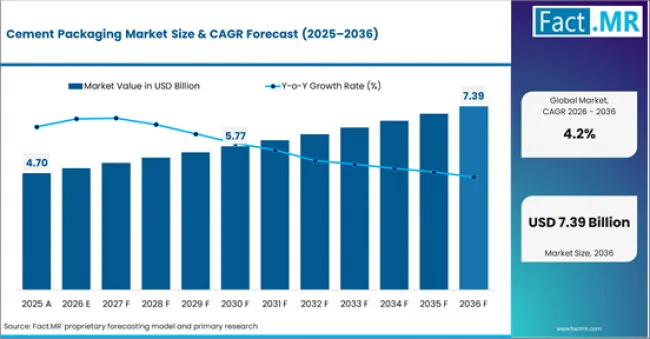
Cement Packaging Market Value Analysis | Source: Fact.MR
Summary of Cement Packaging Market
- Market Snapshot
- In 2025, the global Cement Packaging Market was valued at approximately USD 4.70 billion.
- The market is estimated to reach USD 4.90 billion in 2026 and is projected to attain USD 7.39 billion by 2036.
- The cement packaging market is likely to expand at a CAGR of 4.2% during the forecast period.
- The market is anticipated to create an absolute dollar opportunity of USD 2.49 billion between 2026 and 2036.
- Valve bags account for 60% of closure type share in 2026.
- India (5.0%) and China (4.8%) are the key growth markets during the forecast period.
- Demand and Growth Drivers
- Construction sector expansion across India, China, Indonesia, the Middle East, and Africa is driving cement production growth that directly translates into packaging volume demand.
- Infrastructure investment programs including highways, railways, bridges, and urban development are creating sustained cement consumption supporting packaging market growth.
- The shift from multi-wall paper bags to woven polypropylene and composite laminate bags is driven by improved moisture protection, lower packaging weight, and better stacking performance.
- Valve bag adoption for automated filling lines is increasing as cement producers invest in high-speed packaging equipment that reduces dust emission and labor requirements.
- Growing cement retail distribution through branded packaging to individual consumers and small contractors creates demand for improved bag aesthetics, printability, and durability.
- Product and Segment View
- Bags account for 75% of the packaging type segment in 2026, with paper and plastic bags serving retail, commercial, and small-scale construction distribution channels worldwide.
- Plastic accounts for 50% of the material type segment in 2026, driven by woven polypropylene sacks offering moisture resistance, high strength-to-weight ratio, and competitive pricing.
- Valve bags hold 60% of the closure type segment in 2026, driven by automated filling compatibility, dust reduction, and improved sealing performance versus open-mouth alternatives.
- Key segmentation includes:
- Packaging Type: Bags (paper, plastic), Bulk packaging (FIBC, tankers)
- Material Type: Plastic (PP, PE), Paper (kraft, bleached), Composite materials
- Capacity: Small (up to 40 kg), Medium (40-100 kg), Large (above 100 kg)
- Closure Type: Valve bags (paper, plastic), Open mouth bags (sewn, heat sealed)
- Application: Commercial construction, Residential construction, Industrial construction
- These systems enable:
- Moisture protection preserving cement quality during transport, storage, and retail display across humid and variable climate conditions
- Automated high-speed filling through valve bag systems that reduce dust emission, labor costs, and packaging line downtime
- Branded retail presentation supporting cement company marketing, product differentiation, and retail distribution expansion
- Geography and Competitive Outlook
- Asia Pacific dominates through India, China, and Indonesia, driven by the largest cement production volumes, construction activity, and bag consumption worldwide.
- The Middle East sustains demand through Saudi Arabia, driven by Vision 2030 construction programs, infrastructure development, and hot-climate moisture protection requirements.
- Latin America maintains growth through Brazil, supported by construction activity, infrastructure spending, and cement retail distribution expansion.
- India (5.0%) and China (4.8%) lead growth, while Indonesia (4.5%), Saudi Arabia (3.6%), Brazil (3.2%), the USA (3.0%), and Germany (2.8%) sustain demand.
- Major players include Mondi plc, WestRock Company, Stora Enso Oyj, Billerud AB, and UltraTech Cement Limited.
- Analyst Opinion
- Shambhu Nath Jha, Principal Consultant at Fact.MR, says 'The cement packaging market reflects a structural transition from paper to plastic and composite materials driven by moisture performance, weight reduction, and automated filling compatibility. Woven polypropylene bags are displacing multi-wall paper bags in tropical and high-humidity markets where moisture ingress degrades cement quality during extended storage and retail display. Valve bag systems are becoming the default specification for new cement filling lines, creating equipment-driven packaging format lock-in. Companies offering integrated solutions combining bag design, filling equipment compatibility, and printing quality for retail branding are capturing specification advantages, while commodity bag producers face margin compression from import competition.'
Key Growth Drivers, Constraints, and Opportunities
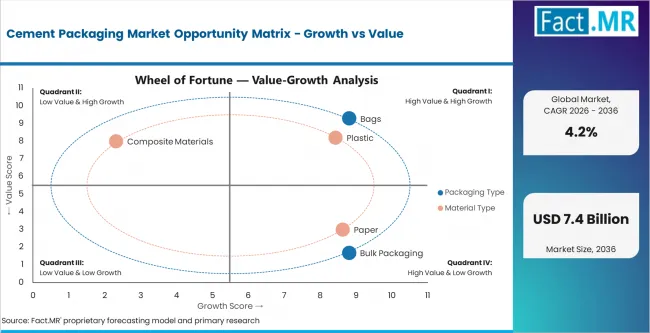
Cement Packaging Market Opportunity Matrix Growth Vs Value | Source: Fact.MR
Key Factors Driving Growth
- Construction sector expansion in India, China, Indonesia, and the Middle East drives cement production growth that directly increases packaging demand.
- Valve bag adoption for automated filling is creating equipment-driven demand as cement producers modernize packaging lines.
- Retail cement distribution growth through branded bags is creating demand for high-print-quality packaging supporting brand differentiation.
Key Market Constraints
- Bulk cement delivery by tanker for large construction projects reduces bagged cement demand in developed markets where ready-mix concrete is dominant.
- Raw material cost volatility for polypropylene and kraft paper creates procurement cost uncertainty for bag manufacturers.
- Sustainability pressure on plastic packaging creates regulatory risk in markets implementing single-use plastic restrictions that may apply to cement bags.
Key Opportunity Areas
- Composite paper-plastic laminate bags offering both moisture protection and recyclability create a sustainability-compliant premium segment.
- Smart packaging with QR codes linking to product specifications, mixing guides, and authenticity verification creates brand engagement opportunities.
- Growing small-bag retail distribution in emerging markets expands the addressable market as individual consumers and small contractors purchase 25 to 50 kg bags.
Segment-wise Analysis of the Cement Packaging Market
- Bags hold 75% of the packaging type segment in 2026, sustained by retail distribution dominance where bagged cement serves individual consumers and small contractors.
- Commercial construction accounts for 40% of the application segment in 2026, driven by high-rise buildings, office complexes, and commercial infrastructure projects.
- Medium capacity (40 to 100 kg) holds 50% of the capacity segment, reflecting the dominant 50 kg bag standard used across construction markets worldwide.
The market is segmented by packaging type, material type, capacity, closure type, application, and region. Bags lead by packaging type. Plastic leads by material. Valve bags lead by closure type, and commercial construction leads by application.
Which Packaging Type Segment Dominates the Cement Packaging Market?
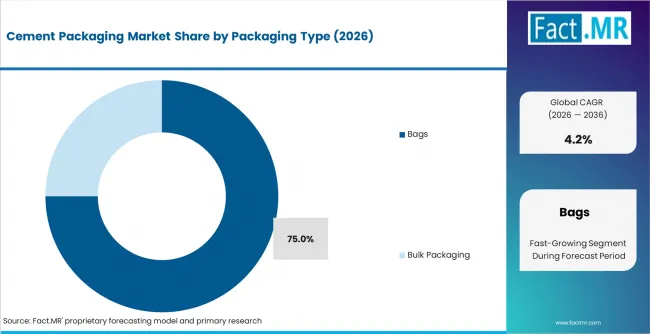
Cement Packaging Market Analysis By Packaging Type | Source: Fact.MR
Bags account for 75% of the packaging type segment in 2026. Paper bags, including multi-wall kraft and bleached paper bags, continue to serve markets where biodegradability and recyclability are priorities. Plastic bags, primarily woven polypropylene, are gaining share through superior moisture protection, lower weight, and competitive cost-per-bag economics. The choice between paper and plastic often depends on regional climate, regulatory environment, and filling equipment compatibility.
Bulk packaging, including FIBCs (jumbo bags) and tanker systems, serves large-scale construction projects and ready-mix concrete operations where bagged distribution is inefficient. FIBC demand is growing through large infrastructure projects that consume cement in quantities exceeding individual bag-handling capacity.
Which Closure Type Segment Dominates the Cement Packaging Market?
Valve bags account for 60% of the closure type segment in 2026. Paper and plastic valve bags enable automated high-speed filling that reduces dust emission, improves fill weight accuracy, and requires less labor than open-mouth bag filling. Valve bags self-seal after filling, eliminating the stitching or heat-sealing step required for open-mouth bags, simplifying packaging line operations.
Open-mouth bags remain relevant in markets where manual filling is standard and bag-stitching equipment is already installed. The transition to valve bags is driven by filling equipment investment rather than bag cost alone, creating format lock-in as producers invest in valve-compatible filling lines.
Which Material Type Segment Dominates the Cement Packaging Market?
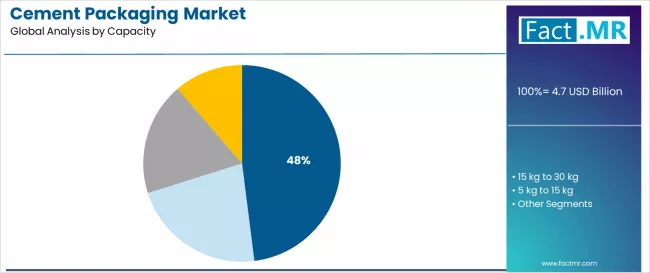
Cement Packaging Market Analysis By Capacity | Source: Fact.MR
Plastic accounts for 50% of the material type segment in 2026. Woven polypropylene bags provide moisture resistance, high tensile strength, and lightweight construction that reduces packaging material cost per tonne of cement. PP woven sacks dominate in Asia Pacific and the Middle East where humidity and temperature conditions require enhanced moisture protection.
Paper remains the preferred material in Europe and parts of the Americas where kraft paper bags offer recyclability, biodegradability, and compliance with packaging waste regulations. Composite paper-plastic laminates are growing as a middle-ground solution offering paper's recyclability with plastic's moisture performance.
Which Product Trend is Shaping the Next Phase of Growth in the Cement Packaging Market?
Composite paper-plastic laminate bags with enhanced printability for retail branding are the defining trend. As cement companies expand retail distribution through hardware stores, home improvement centers, and small-contractor supply chains, packaging becomes a marketing tool requiring high-quality graphics, color consistency, and brand visibility. Laminate bags combining kraft paper's printable surface with polyethylene or polypropylene moisture barriers deliver both brand presentation and product protection.
Automated valve bag filling systems operating at 2,000 to 4,000 bags per hour are simultaneously driving packaging format standardization. Cement producers investing in new filling lines specify valve bag compatibility, creating format lock-in that influences bag material choice, dimension standards, and supplier qualification. This equipment-driven packaging transition is most active in India, Southeast Asia, and the Middle East where cement production capacity additions are concentrated.
Regional Outlook Across Key Markets
.webp "Top Country Growth Comparison Cement Packaging Market Cagr (2026 2036)")
Top Country Growth Comparison Cement Packaging Market Cagr (2026 2036) | Source: Fact.MR
- India leads growth at 5.0%, driven by the world's second-largest cement production, construction expansion, and retail distribution growth.
- China follows at 4.8%, supported by the world's largest cement production base, infrastructure investment, and packaging modernization.
- Indonesia grows at 4.5%, driven by construction activity, cement capacity additions, and growing adoption of moisture-resistant plastic bags.
- Saudi Arabia sustains growth at 3.6% through Vision 2030 construction programs and infrastructure development.
| Country | CAGR (%) |
|---|---|
| India | 5.0% |
| China | 4.8% |
| Indonesia | 4.5% |
| Saudi Arabia | 3.6% |
| Brazil | 3.2% |
| USA | 3.0% |
| Germany | 2.8% |
Source: Fact.MR analysis. Updated May 25, 2026
Source: Fact MR (FMR) analysis, based on proprietary forecasting model and primary research.
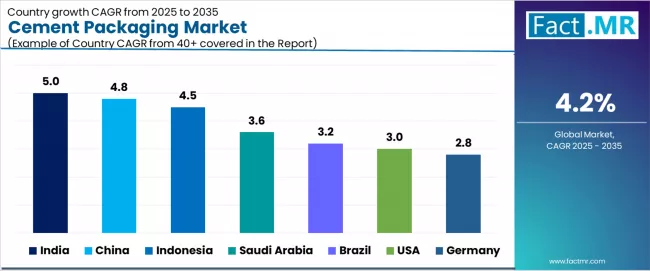
Cement Packaging Market Cagr Analysis By Country | Source: Fact.MR
Market Outlook for Cement Packaging in India
The India cement packaging market is projected to grow at a CAGR of 5.0% through 2036. Demand is driven by the world's second-largest cement production, construction expansion, retail distribution growth, and growing adoption of valve bag filling systems.
- Construction expansion drives cement production and packaging volume.
- Retail distribution growth supports branded bag demand.
- Valve bag adoption modernizes packaging line operations.
Cement Packaging Demand Trends in China
The China market is projected to grow at a CAGR of 4.8% through 2036. Growth is supported by the world's largest cement production, infrastructure investment, and packaging format modernization from open-mouth to valve bag systems.
- World's largest cement production sustains packaging volume.
- Infrastructure investment maintains construction-driven demand.
- Format modernization drives valve bag adoption.
Indonesia Cement Packaging Market Growth Assessment
The Indonesia market is projected to grow at a CAGR of 4.5% through 2036. Demand is driven by construction activity, cement capacity expansion, and adoption of moisture-resistant plastic packaging suited to tropical climate conditions.
- Construction activity drives cement packaging demand.
- Tropical climate drives moisture-resistant packaging specification.
- Cement capacity additions create new packaging line procurement.
Saudi Arabia Cement Packaging Market Demand Analysis
The Saudi Arabia market is projected to grow at a CAGR of 3.6% through 2036. Demand is shaped by Vision 2030 construction, infrastructure development, and hot-climate requirements for enhanced moisture and heat protection.
- Vision 2030 programs drive construction and cement demand.
- Hot climate requires enhanced moisture and heat protection.
- Infrastructure development sustains bagged cement distribution.
Germany Cement Packaging Market Opportunity Outlook
The Germany market is projected to grow at a CAGR of 2.8% through 2036. Demand is supported by construction activity, packaging sustainability regulations, and preference for recyclable paper-based cement bags.
- Construction activity sustains steady packaging demand.
- Sustainability regulations favor recyclable paper bags.
- Retail DIY market supports small-bag distribution.
Competitive Benchmarking and Company Positioning
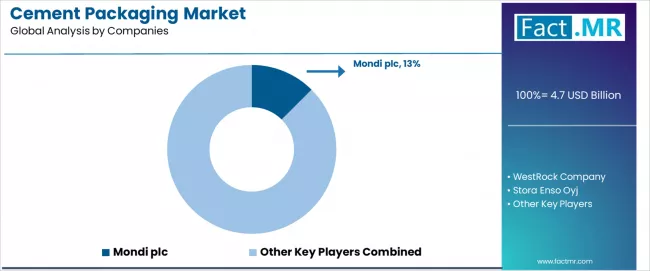
Cement Packaging Market Analysis By Company | Source: Fact.MR
Cement Packaging Market Analysis By Company
- Mondi plc holds approximately 13% market share through its broad industrial bag portfolio, kraft paper manufacturing, and integrated bag converting operations.
- WestRock Company, Stora Enso, and Billerud compete through paper-based packaging expertise, sustainability credentials, and European market leadership.
- Bag material technology, valve bag design capability, filling equipment compatibility, and regional manufacturing presence are primary differentiators.
The competitive landscape is moderately fragmented with regional concentration. Mondi plc holds approximately 13% market share through its integrated kraft paper and industrial bag operations. Mondi's position is built on vertical integration from paper production through bag converting, strong European and emerging market presence, and established cement producer relationships.
WestRock Company, Stora Enso, and Billerud serve paper-based cement packaging markets with sustainability-focused kraft paper and laminate solutions. NNZ Inc. and ARODO BV provide specialized industrial packaging solutions across European and Asian markets.
Indian manufacturers including Formosa Synthetics, Shalimar Tar Products, and Umasree Texplast serve the large domestic market with woven polypropylene bags, competing through cost-effective manufacturing and proximity to cement production facilities. UltraTech Cement represents the growing trend of cement producers influencing packaging specification and procurement.
Strategic priorities include developing sustainable composite bags, expanding valve bag converting capacity, improving print quality for retail branding, and building manufacturing presence in high-growth construction markets.
Key Companies in the Cement Packaging Market
Mondi plc, WestRock Company, and Stora Enso Oyj lead through integrated paper-to-bag operations, sustainability credentials, and global distribution.
Billerud AB, NNZ Inc., and ARODO BV hold established positions through industrial packaging expertise and European market focus.
UltraTech Cement Limited, Formosa Synthetics Pvt. Ltd., Shalimar Tar Products Ltd., and Umasree Texplast Pvt. Ltd. compete through regional manufacturing, cost efficiency, and proximity to cement producers.
Recent Industry Developments
- Mondi plc - Product Innovation / Moisture-Resistant Composite Cement Bag (2025)
- Mondi continued expanding its composite paper-plastic laminate cement bag portfolio, addressing growing demand for bags combining kraft paper printability with enhanced moisture protection for tropical and high-humidity markets.
- Stora Enso Oyj - Sustainability Initiative / Recyclable Cement Packaging Solutions (2025)
- Stora Enso advanced its recyclable cement packaging development using renewable fiber-based materials designed to meet EU packaging waste regulation requirements while maintaining bag strength and filling line compatibility.
- UltraTech Cement Limited - Packaging Modernization / Valve Bag Filling Line Expansion (2025)
- UltraTech Cement continued modernizing its packaging operations with valve bag filling systems, improving fill accuracy, reducing dust emission, and enhancing retail bag presentation across its distribution network.
Leading Companies Shaping the Cement Packaging Market
- Mondi plc
- WestRock Company
- Stora Enso Oyj
- Billerud AB
- UltraTech Cement Limited
- NNZ Inc.
- ARODO BV
- Formosa Synthetics Pvt. Ltd.
- Shalimar Tar Products Ltd.
- Umasree Texplast Pvt. Ltd.
Sources and Research References
- Mondi plc. Industrial bag portfolio and composite packaging development documentation.
- Stora Enso Oyj. Renewable fiber packaging and sustainability program documentation.
- Global cement production databases, construction output statistics, and packaging material pricing data.
- EU packaging waste regulation databases and regional packaging format analysis.
- Primary interviews with bag manufacturers, cement producers, filling equipment suppliers, and distributors.
This bibliography is provided for reader reference and is not exhaustive. The full report contains the complete reference list and detailed citations.
Key Questions This Report Addresses
- What is the current and future size of the Cement Packaging market?
- How fast is the market expected to grow between 2026 and 2036?
- Which packaging type leads in 2026?
- Which application holds highest share?
- What drives demand?
- How is the shift to valve bags influencing the market?
- Why is India the fastest-growing market?
- How are sustainable materials shaping demand?
- Which countries show fastest growth?
- Who are the key companies?
- How does Fact.MR validate the forecast?
Cement Packaging Market Definition
The cement packaging market covers paper bags, plastic bags, FIBCs, and bulk tanker systems used to package, transport, and distribute cement products from manufacturing plants to construction sites and retail distribution points.
Cement Packaging Market Inclusions
- The scope covers global and regional market size and forecasts for 2026 to 2036 across packaging type, material type, capacity, closure type, application, and region.
- It includes analysis of cement production volumes, construction sector expansion, packaging format transitions, and filling equipment investment trends.
- The report covers pricing and cost analysis across bag categories including material costs, conversion costs, and total packaging cost per tonne of cement.
- It covers technology trends, market drivers, and competitive landscape including product portfolios and manufacturing capabilities of leading packaging suppliers.
Cement Packaging Market Exclusions
- The scope excludes cement manufacturing equipment, kilns, and grinding systems not related to packaging.
- It excludes packaging for non-cement construction materials including gypsum, lime, and premixed concrete.
- The report excludes transport pallets, shrink wrap, and secondary packaging used for bag stabilization during transport.
- It also excludes packaging ink, adhesive, and closure materials sold separately from finished bags.
Cement Packaging Market Research Methodology
- The methodology combines secondary research, primary interviews, and forecast modelling.
- It draws on 50+ secondary sources and benchmarks 20+ packaging supplier portfolios.
- Market sizing covers 20+ countries through a demand-side model, supported by top-down validation.
- Key inputs include cement production volumes, construction output forecasts, packaging format mix data, and material pricing trends.
- The model cross-checks demand with bag manufacturing capacity, material consumption, and trade flow data.
- Primary validation includes 15+ interviews across bag manufacturers, cement producers, filling equipment suppliers, and distributors.
- Final estimates go through production-volume checks, format-mix analysis, and sensitivity testing.
Segmentation
Scope of Analysis
| Parameter | Details |
|---|---|
| Quantitative Units | USD 4.90 billion to USD 7.39 billion, at a CAGR of 4.2% |
| Market Definition | The market covers paper bags, plastic bags, FIBCs, and bulk systems for cement packaging, transport, and distribution. |
| Regions Covered | North America, Latin America, Europe, East Asia, South Asia and Pacific, Middle East and Africa |
| Countries Covered | India, China, Indonesia, Saudi Arabia, Brazil, USA, Germany, 20 plus countries |
| Key Companies | Mondi, WestRock, Stora Enso, Billerud, UltraTech Cement, NNZ, ARODO, Formosa Synthetics, Shalimar Tar, Umasree Texplast |
| Forecast Period | 2026 to 2036 |
| Approach | Hybrid demand-side and top-down methodology built on cement production volumes, construction output, packaging format data, and primary interviews across bag manufacturers, cement producers, and distributors |
Source: Fact.MR analysis. Updated May 25, 2026
Cement Packaging Market Segmentation
-
Cement Packaging Market Segmented by Packaging Type:
- Bags
- Paper Bags
- Multi-wall Paper Bags
- Sewn Open Mouth Bags
- Plastic Bags
- Polypropylene (PP) Bags
- High-density Polyethylene (HDPE) Bags
- Paper Bags
- Bulk Packaging
- Flexible Intermediate Bulk Containers (FIBC)
- Jumbo Bags
- Bulk Transport Bags
- Bulk Tankers
- Silo Transport
- Pneumatic Tankers
- Flexible Intermediate Bulk Containers (FIBC)
- Bags
-
Cement Packaging Market Segmented by Material Type:
- Plastic
- Polypropylene (PP)
- Woven Sacks
- High Strength
- Polyethylene (PE)
- Moisture Resistance
- Flexible Packaging
- Polypropylene (PP)
- Paper
- Kraft Paper
- Multi-layer Bags
- Eco-friendly Packaging
- Bleached Paper
- Improved Appearance
- Branding
- Kraft Paper
- Composite Materials
- Paper-Plastic Laminates
- Moisture Barrier
- Durability
- Multi-layer Laminates
- Enhanced Protection
- Long Shelf Life
- Paper-Plastic Laminates
- Plastic
-
Cement Packaging Market Segmented by Capacity:
- Medium Capacity
- 40–50 kg
- Bulk Retail
- Commercial Use
- 50–100 kg
- Industrial Applications
- Contractors
- 40–50 kg
- Small Capacity
- Up to 25 kg
- Retail Use
- DIY Construction
- 25–40 kg
- Standard Retail Bags
- General Construction
- Up to 25 kg
- Large Capacity
- Above 100 kg
- Bulk Handling
- Construction Projects
- Jumbo Capacity
- FIBC Bags
- Large-scale Transport
- Above 100 kg
- Medium Capacity
-
Cement Packaging Market Segmented by Closure Type:
- Open Mouth Bags
- Sewn Closure
- Stitched Bags
- Manual Handling
- Heat Sealed
- Moisture Protection
- Leak Prevention
- Sewn Closure
- Valve Bags
- Paper Valve Bags
- Automatic Filling
- Dust Control
- Plastic Valve Bags
- Moisture Resistance
- High Efficiency
- Paper Valve Bags
- Open Mouth Bags
-
Cement Packaging Market Segmented by Application:
- Commercial Construction
- Office Buildings
- High-rise Construction
- Commercial Complexes
- Infrastructure Projects
- Roads
- Bridges
- Office Buildings
- Residential Construction
- Housing Projects
- Individual Houses
- Apartments
- Renovation
- Repair Work
- DIY Use
- Housing Projects
- Industrial Construction
- Factories
- Industrial Buildings
- Warehouses
- Heavy Infrastructure
- Dams
- Ports
- Factories
- Commercial Construction
-
Cement Packaging Market by Region:
- North America
- USA
- Canada
- Mexico
- Latin America
- Brazil
- Chile
- Rest of Latin America
- Western Europe
- Germany
- UK
- Italy
- Spain
- France
- Nordic
- BENELUX
- Rest of Western Europe
- Eastern Europe
- Russia
- Poland
- Hungary
- Balkan & Baltic
- Rest of Eastern Europe
- East Asia
- China
- Japan
- South Korea
- South Asia and Pacific
- India
- ASEAN
- Australia & New Zealand
- Rest of South Asia and Pacific
- Middle East & Africa
- Kingdom of Saudi Arabia
- Other GCC Countries
- Turkiye
- South Africa
- Other African Union
- Rest of Middle East & Africa
- North America
Frequently Asked Questions
How big is the Cement Packaging Market in 2025?
What will be the size of the Cement Packaging Market by 2036?
How much will the Cement Packaging Market grow between 2026 and 2036?
What are the key packaging types in the Cement Packaging Market?
Which packaging type holds the highest share in the Cement Packaging Market in 2026?
Which material type holds the highest share in the Cement Packaging Market in 2026?
Which closure type holds the highest share in the Cement Packaging Market in 2026?
Which application holds the highest share in the Cement Packaging Market in 2026?
Which are the fastest-growing countries in the Cement Packaging Market?
Who worked on this report


Preview the report firsthand - request a free sample
Free SampleGet the brochure for pricing and purchase details
Download PDF